|
시장보고서
상품코드
2123995
자외선(UV) 소독 장비 시장 : 점유율 분석, 업계 동향과 통계, 성장 예측(2026-2031년)Ultraviolet Disinfection Equipment - Market Share Analysis, Industry Trends & Statistics, Growth Forecasts (2026 - 2031) |
||||||
 Mordor Intelligence
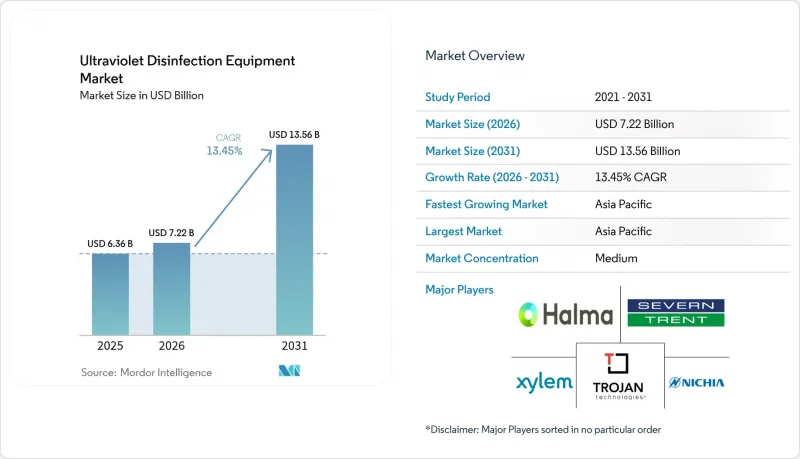
Mordor Intelligence에 의하면, 자외선(UV) 소독 장비 시장 규모는 2025년 63억 6,000만 달러에서 2026년에는 72억 2,000만 달러로 확대되어 2026년부터 2031년까지 CAGR 13.45%로 성장을 지속하여, 2031년에는 135억 6,000만 달러에 이를 것으로 예측됩니다.
본 보고서는 구성 부품(UV 램프, 석영관 등), 정격 출력(저출력, 중출력, 고출력),파장 유형(UV-A, UV-B, UV-C, 진공 자외선), 설치 형태(고정식 시스템 등), 용도(물 및 폐수 등), 최종 사용자(주택, 상업시설 등), 지역별로 분류되어 있습니다. 시장 예측은 금액(달러) 기준으로 제시되어 있습니다.
전 세계 자외선 소독 장비 시장 동향 및 인사이트
PFAS 및 DBP에 대한 규제 강화로 인해, 지자체에서 음용수에 UV 기술을 도입하는 속도가 빨라지고 있습니다.
미국 환경보호청(EPA)의 새로운 PFAS 규제 기준 확정 및 이와 병행되는 유럽의 동향으로 인해, 상수도 유틸리티자들은 화학물질 잔류량을 증가시키지 않는 고급 산화 처리(AOP) 공정의 도입을 요구받고 있습니다. 자외선(UV) 기반 AOP 시스템은 최대 99%의 PFAS 제거를 실현하는 동시에 염소 수요를 억제하며, 스위니 정수장에서는 트리할로메탄 생성을 37% 저감시키고 있습니다. 이러한 이중적인 규제 준수 이점 외에도 LED 가격 하락이 더해져 조달 프로젝트가 확대되고 있습니다.
상업용 HVAC 분야의 UV-C LED 개조 모듈의 급속한 보급
수요 반응형 환기 전략에서 즉시 점등형 UV-C LED가 스마트 빌딩 시스템과 결합되기 시작했습니다. 코일 효율 10-20% 향상, 24개월 미만으로 입증된 투자 회수 기간, 공기 중 병원체 90% 감소와 같은 효과가 미국과 일본에서의 도입을 뒷받침하고 있습니다. 건물 소유주들은 수은 램프에 비해 수명 주기 비용이 낮고 유지보수가 용이하다는 점을 높이 평가했습니다.
심자외선 LED와 저압 수은 램프의 1mW당 비용 비교
심자외선 LED의 평균 벽면 콘센트 효율은 수은 광원에 미치지 못해, 대풍량 설비에서의 초기 투자 비용을 높이고 있습니다. 일부 지자체 프로젝트에서는 그 차이가 300%를 초과하여, LED의 대규모 도입을 지연시키고 있습니다. 연간 약 20%의 효율 향상과 수은 규제 강화로 인해 그 격차는 점차 좁혀지고 있지만, 2027년 이전에 경제적 동등성이 달성될 가능성은 낮아, 비용에 민감한 부문에서 자외선 소독 장비 시장의 확장을 제약하고 있습니다.
부문 분석
2025년 자외선 소독 장비 시장의 부품 시장 규모는 41억 9,000만 달러에 달했으며, 그중 UV 램프가 매출의 57.35%를 차지했습니다. 그러나 고체 UV-C LED 시스템은 연평균 성장률(CAGR) 17.65%로 확대되고 있으며, 수은을 배제하고 예열 시간을 단축하며 IoT 지원 제어 시스템과 원활하게 통합함으로써 램프의 우위를 서서히 잠식하고 있습니다. 비용 곡선의 개선에 따라 자외선 소독 장비 시장에서 LED 유닛의 점유율은 2031년까지 25%를 넘어설 것으로 전망됩니다. 보조 센서의 중요성이 높아지면서, 점점 더 엄격해지는 감사 추적 요건을 충족하는 실시간 조도 검증을 제공합니다. 리액터 챔버에서는 최적화된 유체 설계와 첨단 석영 코팅을 채택하여 그림자의 영향을 줄이는 한편, 스마트 밸러스트를 통해 예측 유지보수가 가능해져 수명 주기 비용을 25% 절감하고 있습니다.
이러한 변화를 보완하듯, 수직 통합형 공급업체는 LED 엔진, 드라이버, 모니터링 소프트웨어를 단일 OEM 패키지로 통합하여 소규모 전력 사업자의 조달을 용이하게 하고 있습니다. 또한, 자본 배분도 초기 설비 투자에서 하드웨어 업데이트, 센서 교정, 분석을 하나의 요금으로 묶은 다년 계약 서비스 계약으로 전환되고 있습니다. 이로 인해 현장 서비스 네트워크와 클라우드 지원 플랫폼을 보유한 제조업체가 유리한 입장에 있습니다.
2024년 도입 건수의 대부분은 중출력 어셈블리(10-999 kW)가 차지했으나, 10 kW 미만의 저출력 시스템은 주택, 치과, 사용 지점(PoU)용 장비 분야에서 급속히 확대되고 있습니다. 순간 점등형 LED는 간헐적인 가동 주기에 적합하여 에너지 소비를 줄이는 동시에 방별 소독 도입을 가능하게 하고 있습니다. 한편, 1 MW를 초과하는 고출력 원자로는 메가 플랜트에 여전히 필수적이지만, 포화 상태에 이른 OECD 시장에서는 신규 도입 전망이 제한적입니다. 개발도상국에서는 도시의 성장이 여전히 중출력에 대한 안정적인 수요를 뒷받침하고 있지만, 분산형 처리 시범 사업을 통해 추가 자본이 저출력 클러스터형 노드로 이동하기 시작하고 있습니다.
기술 로드맵에 따르면, 차세대 LED 칩은 저렴한 비용으로 180mW의 광 출력을 실현할 수 있으며, 이를 통해 제조업체는 소형 어레이를 유연한 카트리지 형태로 재구성할 수 있게 됩니다. 이러한 카트리지는 현장에서의 교체를 간소화하고 가동 중단 시간을 대폭 단축하므로, 호텔 체인이나 소규모 병원에 매력적인 제안이 될 것입니다. 그 결과, 2026년부터 2031년까지, 단위당 요금이 아닌 가동 시간당 요금을 부과하는 서비스 모델을 통해 저출력 유닛의 보급이 가속화될 것으로 예측됩니다.
지역별 분석
아시아태평양은 2025년에 매출 점유율 33.60%를 차지하며, 모든 지역 중 가장 높은 수치를 기록했습니다. 또한 2031년까지 연평균 성장률(CAGR) 10.95%를 나타낼 것으로 예측됩니다. 중국의 ‘제14차 5개년 계획’에서는 2급 도시의 UV 관련 투자를 중시하고 있으며, 또한 심자외선(deep UV) 반도체 분야에서 일본의 리더십이 해당 지역의 LED 비용 절감에 기여하고 있습니다. 만성적인 물 부족에 직면한 인도와 호주에서는 UV를 주요 소독 수단으로 도입한 식수 재이용 프로젝트가 확대되고 있습니다. 인도네시아와 베트남을 중심으로 한 동남아시아 국가들에서는 수산물 수출이 확대되고 있으며, 이것이 양식 분야의 UV 수요를 견인하고 있습니다. 이러한 요인들이 결합되어 광범위한 도입 기반을 강화하고 현지 제조 클러스터를 활성화함으로써, 자외선 소독 장비 시장이 지역적인 성장세를 유지할 수 있도록 보장하고 있습니다.
북미는 안정적인 교체 수요가 있는 기술적으로 선진화된 시장으로 자리 잡고 있습니다. EPA의 PFAS 규제는 중요한 촉매 역할을 하며, 상수도 유틸리티자들을 UV-AOP 조합으로 이끌고 있습니다. 미국 병원에서는 UV 도입 후 병원 내 감염(HAI)이 30% 감소한 것으로 보고되어, 이는 단계적인 조달을 뒷받침하고 있습니다. 사무실 개발업체들은 WELL 및 LEED 기준을 충족하기 위해 UV 지원 공조 설비 사양을 포함시키고 있습니다. 캐나다가 미국의 PFAS 규제 기준 및 규제와 조화를 이루게 됨에 따라, 국경을 넘는 장비 판매가 더욱 촉진될 것입니다. 지속적인 인프라 보조금을 통해 중규모 지자체에 대한 공공 지출이 유도되고 있으며, 중출력 반응기의 수주가 유지되고 있습니다.
유럽에서는 보급이 성숙 단계에 접어들었음에도 혁신은 계속되고 있습니다. 개정된 EU 음용수 지침에서는 신종 오염 물질 모니터링이 도입되어, 수도 유틸리티자들이 UV를 통합한 다단계 차단 시스템을 채택하도록 장려하고 있습니다. 수자원이 부족한 지중해 국가들은 재이용 시설에 투자하고 있는 반면, 스칸디나비아 국가들에서는 대중교통에서 원자외선(Far-UVC) 시스템의 시범 운영이 진행되고 있습니다. 서유럽의 병원에서는 감염 방지 예산이 확대되고 있으며, 독일의 산업 부문에서는 엄격한 그린 케미스트리 규정을 준수하기 위해 UV를 활용하고 있습니다. 중동 및 아프리카는 시장 규모는 작지만, GCC(걸프협력회의)의 다각화 프로그램에 따라 해수 담수화 및 지역 냉방 시설에 UV가 통합됨에 따라 성장률 면에서는 다른 지역을 앞지르고 있습니다.
기타 혜택:
- 엑셀 형식 시장 예측(ME) 시트
- 3개월간의 애널리스트 지원
자주 묻는 질문
목차
제1장 서론
제2장 조사 방법
제3장 주요 요약
제4장 시장 구도
제5장 시장 규모와 성장 예측
제6장 경쟁 구도
제7장 시장 기회와 향후 전망
JHS 26.09.07According to Mordor Intelligence, the ultraviolet disinfection equipment market size is expected to grow from USD 6.36 billion in 2025 to USD 7.22 billion in 2026 and is forecast to reach USD 13.56 billion by 2031 at 13.45% CAGR over 2026-2031.
This report is Segmented by Component (UV Lamps, Quartz Sleeves, and More), Power Rating (Low-Power, Medium-Power, and High-Power), Wavelength Type (UV-A, UV-B, UV-C, and Vacuum-UV), Mobility (Fixed Systems, and More), Application (Water and Wastewater, and More), End-User (Residential, Commercial Facilities, and More), and Geography. The Market Forecasts are Provided in Terms of Value (USD).
Global Ultraviolet Disinfection Equipment Market Trends and Insights
Stricter PFAS & DBP Regulations Accelerating UV Adoption in Municipal Drinking-Water
New PFAS limits finalized by the United States Environmental Protection Agency and parallel European moves are forcing utilities to seek advanced oxidation processes that do not increase chemical residuals. UV-based AOP trains deliver up to 99% PFAS removal and concurrently suppress chlorine demand, lowering trihalomethane formation by 37% at the Sweeney Water Treatment Plant. These dual-compliance benefits, together with falling LED prices, are scaling procurement pipelines.
Rapid Uptake of UV-C LED Retrofit Modules in Commercial HVAC
Demand-controlled ventilation strategies now pair instant-on UV-C LEDs with smart building systems. Coil efficiency gains of 10-20%, documented payback periods under 24 months, and 90% airborne pathogen reductions are propelling adoption in the United States and Japan.Building owners value low lifecycle costs and easier maintenance versus mercury lamps.
High USD/mW Cost of Deep-UV LEDs vs. Low-Pressure Mercury Lamps
Average wall-plug efficiency for deep-UV LEDs trails mercury sources, inflating capital outlays for high-flow installations. The differential exceeds 300% in some municipal projects, delaying large-scale LED rollouts. Annual efficiency gains near 20% and escalating mercury restrictions are narrowing the gap, yet economic parity is unlikely before 2027, constraining the Ultraviolet disinfection equipment market in cost-sensitive segments.
Other drivers and restraints analyzed in the detailed report include:
- Rising Zero-Chemical Mandates by Food & Beverage Majors
- Hospital Infection-Control Spending Surge in Western Europe
- Shadowing and Turbidity Challenges in Industrial Wastewater
For complete list of drivers and restraints, kindly check the Table Of Contents.
Segment Analysis
The Ultraviolet disinfection equipment market size for components stood at USD 4.19 billion in 2025, with UV Lamps securing 57.35% of revenue. Solid-state UV-C LED systems, however, are compounding at 17.65% and eroding lamp dominance by removing mercury, shortening warm-up time, and integrating seamlessly with IoT-enabled controls. The Ultraviolet disinfection equipment market share of LED units is on course to exceed 25% by 2031 as cost curves improve. Auxiliary sensors are rising in importance, providing real-time irradiance verification that satisfies tightening audit trails. Reactor chambers now leverage optimized hydraulics and advanced quartz coatings to mitigate shadowing, while smart ballasts enable predictive maintenance that lowers lifecycle costs by 25%.
Complementing these shifts, vertically integrated suppliers bundle LED engines, drivers, and monitoring software into single-OEM packages, making procurement easier for smaller utilities. Capital allocations are also moving from upfront equipment to multiyear service agreements that combine hardware refresh, sensor calibration, and analytics under one fee. This favours manufacturers with field-service networks and cloud support platforms.
Medium-power assemblies (10-999 kW) generated the bulk of installations in 2024, but low-power systems beneath 10 kW are expanding rapidly in residences, dental clinics, and point-of-use devices. Instant-on LEDs suit intermittent duty cycles, lowering energy use and room-by-room disinfection deployments. Meanwhile, high-power reactors above 1 MW remain indispensable for mega-plants yet face limited green-field prospects in saturated OECD markets. In developing economies, urban growth still supports steady medium-power demand, though decentralised treatment pilots are starting to divert incremental capital toward clustered low-power nodes.
Technology roadmaps reveal that next-generation LED chips can achieve 180 mW optical power at reduced cost, letting manufacturers reconfigure smaller arrays into flexible cartridge formats. Such cartridges simplify field replacement and slash downtime, an attractive proposition for hospitality chains and small hospitals. As a result, service models charging per-operating-hour rather than per-unit are expected to accelerate low-power unit penetration during 2026-2031.
Complete Report Scope:
- By Component
- UV Lamps
- Quartz Sleeves
- Reactor Chambers
- Ballasts and Control Units
- Auxiliary Sensors
- By Power Rating
- Low-Power ( Less than 10 kW)
- Medium-Power (10-999 kW)
- High-Power (1 MW and Above)
- By Wavelength Type
- UV-A
- UV-B
- UV-C
- Vacuum-UV (V-UV)
- By Mobility
- Fixed Systems
- Portable/Mobile Towers
- In-duct Retrofits
- By Application
- Water and Wastewater
- Drinking-Water Plants
- Industrial Process Water
- Municipal Wastewater
- Air Disinfection
- Hospital Rooms and Operating Theatres
- Commercial HVAC and AHU
- Transportation (Aircraft, Rail)
- Surface Disinfection
- Food and Beverage Processing Lines
- Pharmaceutical Cleanrooms
- Consumer Electronics Assembly
- Water and Wastewater
- By End-user
- Municipal Utilities
- Residential
- Commercial Facilities
- Industrial Manufacturing
- Healthcare Institutions
- Aquaculture and Marine
- By Geography
- North America
- United States
- Canada
- Mexico
- Europe
- Germany
- United Kingdom
- France
- Italy
- Spain
- Rest of Europe
- Asia-Pacific
- China
- Japan
- South Korea
- India
- South East Asia
- Rest of Asia-Pacific
- South America
- Brazil
- Rest of South America
- Middle East and Africa
- Middle East
- United Arab Emirates
- Saudi Arabia
- Rest of Middle East
- Africa
- South Africa
- Rest of Africa
- Middle East
- North America
Geography Analysis
Asia Pacific commanded a 33.60% revenue share in 2025, the highest among all regions, and is projected to grow at an 10.95% CAGR through 2031. China's 14th Five-Year Plan emphasizes UV investments in tier-two municipalities, and Japan's leadership in deep-UV semiconductors compresses regional LED costs. India and Australia, facing chronic water scarcity, are scaling potable-reuse projects that embed UV as the primary disinfection barrier. Southeast Asian nations, led by Indonesia and Vietnam, are expanding seafood exports, driving aquaculture UV demand. Collectively, these factors reinforce a broad installation base and spur local manufacturing clusters, ensuring the Ultraviolet disinfection equipment market maintains regional momentum.
North America remains a technologically advanced arena with steady replacement demand. The EPA's PFAS rule is a critical catalyst, propelling utilities toward UV-AOP combinations. Hospitals in the United States document 30% HAI reductions post-UV deployment, underpinning incremental procurement. Office developers include UV-ready HVAC specifications to meet WELL and LEED standards. Canada's regulatory harmonization with U.S. PFAS limits will further stimulate cross-border equipment sales. Ongoing infrastructure grants channel public spending to mid-sized municipalities, sustaining medium-power reactor orders.
Europe shows mature penetration but continues to innovate. The revised EU Drinking Water Directive introduces emerging contaminant monitoring, pushing utilities to adopt multi-barrier trains featuring UV. Water-scarce Mediterranean states invest in reuse plants, while Scandinavia pilots Far-UVC systems in public transport. Western European hospitals allocate larger infection-control budgets, and Germany's industrial sector leverages UV to align with stringent green-chemistry rules. The Middle East and Africa, although smaller, outperform on growth rates due to GCC diversification programs that bundle UV into desalination and district-cooling assets.
- Xylem Inc.
- Trojan Technologies (Danaher)
- Halma plc (Aquionics, Hanovia)
- Evoqua Water Technologies LLC
- Signify N.V. (Philips UV-C)
- AquiSense Technologies
- Atlantic Ultraviolet Corp.
- American Ultraviolet
- Advanced UV Inc.
- Severn Trent Services
- Ultraaqua A/S
- Lumalier Corporation
- Nichia Corporation
- Heraeus Noblelight GmbH
- UV-technik Speziallampen GmbH
- Australian Ultra Violet Services Pty Ltd
- Hitech Ultraviolet Pvt Ltd
- UV Pure Technologies Inc.
- Aquafine (Watts Water)
- Excelitas Technologies (LumenDynamics)
- Light Progress Srl
Additional Benefits:
- The market estimate (ME) sheet in Excel format
- 3 months of analyst support
TABLE OF CONTENTS
1 INTRODUCTION
- 1.1 Study Assumptions and Market Definition
- 1.2 Scope of the Study
2 RESEARCH METHODOLOGY
3 EXECUTIVE SUMMARY
4 MARKET LANDSCAPE
- 4.1 Market Overview
- 4.2 Market Drivers
- 4.2.1 Stricter PFAS and DBP Regulations Accelerating UV Adoption in Municipal Drinking-Water (North America and EU)
- 4.2.2 Rapid Uptake of UV-C LED Retrofit Modules in Commercial HVAC (U.S., Japan)
- 4.2.3 Rising Zero-Chemical Mandates by Food and Beverage Majors (Global)
- 4.2.4 Expansion of Water-Reuse Projects in Water-Stressed Gulf Cooperation Council Countries Economies
- 4.2.5 Hospital Infection-Control Spending Surge in Western Europe
- 4.3 Market Restraints
- 4.3.1 High USD/mW Cost of Deep-UV LEDs vs. Low-Pressure Mercury Lamps
- 4.3.2 Shadowing and Turbidity Challenges in Industrial Wastewater
- 4.3.3 Minamata-Driven Phase-out Complexity for Legacy Hg-Lamp Stock
- 4.3.4 Fragmented Certification Standards in ASEAN
- 4.4 Industry Ecosystem Analysis
- 4.5 Technological Outlook
- 4.6 Porter's Five Forces Analysis
- 4.6.1 Bargaining Power of Suppliers
- 4.6.2 Bargaining Power of Buyers
- 4.6.3 Threat of New Entrants
- 4.6.4 Intensity of Competitive Rivalry
- 4.6.5 Threat of Substitutes
5 MARKET SIZE AND GROWTH FORECASTS (VALUES)
- 5.1 By Component
- 5.1.1 UV Lamps
- 5.1.2 Quartz Sleeves
- 5.1.3 Reactor Chambers
- 5.1.4 Ballasts and Control Units
- 5.1.5 Auxiliary Sensors
- 5.2 By Power Rating
- 5.2.1 Low-Power ( Less than 10 kW)
- 5.2.2 Medium-Power (10-999 kW)
- 5.2.3 High-Power (1 MW and Above)
- 5.3 By Wavelength Type
- 5.3.1 UV-A
- 5.3.2 UV-B
- 5.3.3 UV-C
- 5.3.4 Vacuum-UV (V-UV)
- 5.4 By Mobility
- 5.4.1 Fixed Systems
- 5.4.2 Portable/Mobile Towers
- 5.4.3 In-duct Retrofits
- 5.5 By Application
- 5.5.1 Water and Wastewater
- 5.5.1.1 Drinking-Water Plants
- 5.5.1.2 Industrial Process Water
- 5.5.1.3 Municipal Wastewater
- 5.5.2 Air Disinfection
- 5.5.2.1 Hospital Rooms and Operating Theatres
- 5.5.2.2 Commercial HVAC and AHU
- 5.5.2.3 Transportation (Aircraft, Rail)
- 5.5.3 Surface Disinfection
- 5.5.3.1 Food and Beverage Processing Lines
- 5.5.3.2 Pharmaceutical Cleanrooms
- 5.5.3.3 Consumer Electronics Assembly
- 5.5.1 Water and Wastewater
- 5.6 By End-user
- 5.6.1 Municipal Utilities
- 5.6.2 Residential
- 5.6.3 Commercial Facilities
- 5.6.4 Industrial Manufacturing
- 5.6.5 Healthcare Institutions
- 5.6.6 Aquaculture and Marine
- 5.7 By Geography
- 5.7.1 North America
- 5.7.1.1 United States
- 5.7.1.2 Canada
- 5.7.1.3 Mexico
- 5.7.2 Europe
- 5.7.2.1 Germany
- 5.7.2.2 United Kingdom
- 5.7.2.3 France
- 5.7.2.4 Italy
- 5.7.2.5 Spain
- 5.7.2.6 Rest of Europe
- 5.7.3 Asia-Pacific
- 5.7.3.1 China
- 5.7.3.2 Japan
- 5.7.3.3 South Korea
- 5.7.3.4 India
- 5.7.3.5 South East Asia
- 5.7.3.6 Rest of Asia-Pacific
- 5.7.4 South America
- 5.7.4.1 Brazil
- 5.7.4.2 Rest of South America
- 5.7.5 Middle East and Africa
- 5.7.5.1 Middle East
- 5.7.5.1.1 United Arab Emirates
- 5.7.5.1.2 Saudi Arabia
- 5.7.5.1.3 Rest of Middle East
- 5.7.5.2 Africa
- 5.7.5.2.1 South Africa
- 5.7.5.2.2 Rest of Africa
- 5.7.5.1 Middle East
- 5.7.1 North America
6 COMPETITIVE LANDSCAPE
- 6.1 Market Concentration
- 6.2 Strategic Moves
- 6.3 Market Share Analysis
- 6.4 Company Profiles (includes Global level Overview, Market level overview, Core Segments, Financials as available, Strategic Information, Market Rank/Share for key companies, Products and Services, and Recent Developments)
- 6.4.1 Xylem Inc.
- 6.4.2 Trojan Technologies (Danaher)
- 6.4.3 Halma plc (Aquionics, Hanovia)
- 6.4.4 Evoqua Water Technologies LLC
- 6.4.5 Signify N.V. (Philips UV-C)
- 6.4.6 AquiSense Technologies
- 6.4.7 Atlantic Ultraviolet Corp.
- 6.4.8 American Ultraviolet
- 6.4.9 Advanced UV Inc.
- 6.4.10 Severn Trent Services
- 6.4.11 Ultraaqua A/S
- 6.4.12 Lumalier Corporation
- 6.4.13 Nichia Corporation
- 6.4.14 Heraeus Noblelight GmbH
- 6.4.15 UV-technik Speziallampen GmbH
- 6.4.16 Australian Ultra Violet Services Pty Ltd
- 6.4.17 Hitech Ultraviolet Pvt Ltd
- 6.4.18 UV Pure Technologies Inc.
- 6.4.19 Aquafine (Watts Water)
- 6.4.20 Excelitas Technologies (LumenDynamics)
- 6.4.21 Light Progress Srl
7 MARKET OPPORTUNITIES AND FUTURE OUTLOOK
- 7.1 White-space and Unmet-Need Assessment