

|
시장보고서
상품코드
2124002
나트륨 이온 배터리 시장 : 시장 점유율 분석, 업계 동향 및 통계, 성장 예측(2026-2031년)Sodium-ion Battery - Market Share Analysis, Industry Trends & Statistics, Growth Forecasts (2026 - 2031) |
||||||
 Mordor Intelligence
Mordor Intelligence에 의하면, 나트륨 이온 배터리 시장 규모는 2026년에 5억 4,000만 달러로 추정되고, 예측 기간(2026-2031년) CAGR 16.89%로 성장을 지속할 전망이며, 2031년까지 11억 9,000만 달러에 이를 전망입니다.
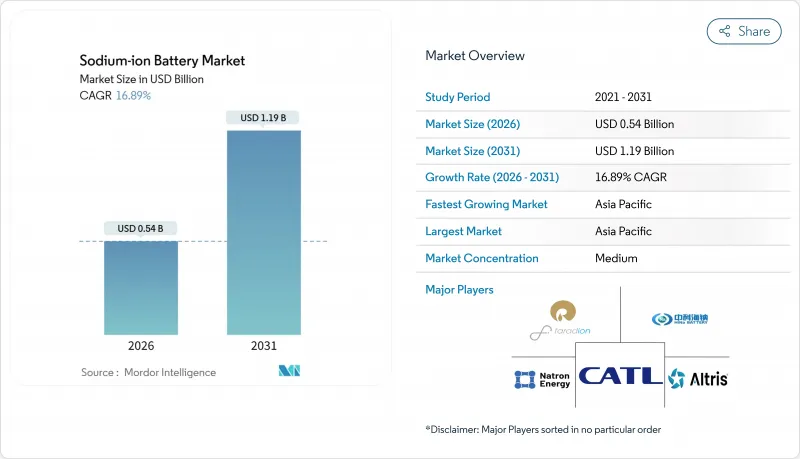
본 보고서는 형태별(원통형, 각형, 파우치형), 용도별(고정형 에너지 저장, 운송, 가정용 전자기기, 산업용 백업 전원, 선박용 및 기타), 최종 사용자 산업별(유틸리티, 주택, 상업 및 산업, 자동차) 및 지역별(북미, 유럽, 아시아태평양, 남미, 중동 및 아프리카)로 분류되어 있습니다.
세계의 나트륨 이온 배터리 시장 동향 및 인사이트
중국의 정책에 힘입어 100 MWh 이상의 계통 연계 입찰이 국내 수요를 가속화
베이징이 나트륨 이온 배터리를 에너지 저장 분야의 ‘전략적’ 기술로 지정한 데 따라, 광시 및 장쑤성의 지방 송전 사업자들은 2025년 중 100 MWh를 초과하는 나트륨 이온 배터리 계약을 체결했습니다. HiNa Battery가 난닝에 설치한 100 MWh 시스템은 5,000회 사이클 동안 92%의 왕복 효율을 달성했으며, kWh당 0.10달러 미만의 균등화 저장 비용(LCOE)을 실현했습니다. 2022년에 톤당 8만 달러까지 급등했던 탄산리튬 가격 변동으로부터 전력 사업자를 보호하기 위해 입찰 절차가 신속하게 진행되었습니다. 국내 소다회 매장량(톤당 300달러)이 가격 안정을 뒷받침하고 있을 뿐만 아니라, 중국개발은행이 우대 대출을 제공함으로써 프로젝트의 자금 조달 비용을 절감하고 있습니다. 정책 입안자들은 수 기가와트시 수요를 확보함으로써 상용화까지의 기간을 2년 가까이 단축했습니다.
유럽의 전기차 제조업체들은 EU의 배터리 규제에 대응하기 위해 주행 거리가 짧은 모델을 나트륨 이온 배터리로 전환하고 있습니다.
유럽연합(EU)의 배터리 규정에 따라 2027년 이후 탄소 발자국 공개와 재활용 소재 함유율 기준이 의무화됨에 따라, 각 OEM 업체들은 코발트나 니켈을 포함하지 않는 나트륨 이온 배터리로의 전환을 강요받고 있습니다. 스텔란티스와 폭스바겐은 A부문 및 B부문 차량을 대상으로 나트륨 이온 배터리 팩의 시범 운용을 진행 중이며, NMC811 셀에 비해 내재된 탄소량이 35%에서 40% 감소한다고 밝혔습니다. 노스볼트는 알트리스와 공동으로 160Wh/kg의 프로토타입을 개발했으며, 스켈레프테아 공장에서 볼보의 차세대 시티카 시리즈용 각형 배터리의 양산을 추진하고 있습니다. 공급망의 간소화를 통해 디지털 여권 관련 규정 준수 비용이 절감될 뿐만 아니라, 각 OEM 기업들은 칠레나 호주에서의 리튬 수출이 위축될 경우를 대비한 리스크 헤지 수단으로 나트륨 배터리를 활용하고 있습니다.
-장거리 전기차의 경우, LFP에 비해 에너지 밀도가 30% 낮은
나트륨 배터리의 에너지 밀도는 140-160 Wh/kg에 달하지만, LFP의 180-200 Wh/kg에는 약 30% 미치지 못하며, 그 결과 배터리 팩의 무게가 증가하여 이 화학 계열은 시티카, 밴 및 고정형 용도로만 제한되고 있습니다. 테슬라는 2027년까지 4680 셀의 에너지 밀도를 300 Wh/kg으로 높이는 것을 목표로 하고 있어, 나트륨 배터리가 메워야 할 격차가 부각되고 있습니다. 축전지 시스템에서 중량이 증가하면 배선 및 소화 설비 요구 사항이 약 15% 증가합니다. 유럽의 자동차 제조업체들은 나트륨 배터리 팩을 A부문 모델로 한정하고 있지만, 이 부문이 2025년 전기차 판매 대수에서 차지하는 비중은 고작 12%에 불과했습니다. 안티몬을 첨가한 음극은 실험실에서는 유망한 것으로 평가받고 있지만, 여전히 비용이 너무 높아 실용화가 어려우며, 2031년까지 에너지 밀도의 한계는 변하지 않을 전망입니다.
부문 분석
2025년, 원통형 배터리는 나트륨 이온 배터리 시장 규모의 48.5%를 차지했으며, 리튬 배터리 권선 라인을 전용할 수 있었던 점이 호재로 작용했습니다. 파우치형 셀은 차체 하부 공간의 부피 효율을 추구하는 자동차 제조업체들에 힘입어 연평균 성장률(CAGR) 22.0%를 나타낼 것으로 전망됩니다. 각형 모듈은 약 30%를 차지하며, 표준화된 280Ah 블록이 랙 구성을 단순화하는 메가와트급 프로젝트에서 주류를 이루고 있습니다. CATL의 ‘Naxtra’ 시리즈는 가정용 에너지 저장을 위한 1만 8,650원통형 배터리와 스쿠터용 파우치형 배터리를 모두 제공하며, 화학 조성의 유연성을 입증하고 있습니다.
적층형 파우치 셀을 통해 설계자는 A부문 차량의 불규칙한 섀시 공간을 효율적으로 활용할 수 있습니다. 이는 1㎤ 단위의 공간이 중요한 결정적인 강점이 됩니다. 중국 그리드 시장에서 프리즘형 배터리가 우위를 차지하는 이유는 현장 유지보수로 인한 가동 중단 시간을 대폭 단축하는 핫스왑 지원 모듈 덕분입니다. 자동 적층 라인의 성숙에 따라 원통형 셀의 비용 면에서의 우위는 점차 약화되고 있습니다. 2031년까지 자동차용 생산량이 고정형 설치량을 초과함에 따라, 시장의 선호도는 파우치형과 프리즘형으로 수렴될 가능성이 있습니다.
지역별 분석
아시아태평양은 2025년 나트륨 이온 배터리 시장 점유율의 45.6%를 차지했으며, 2031년까지 연평균 성장률(CAGR) 19.5%로 확대될 것으로 예측됩니다. 중국의 기가와트시(GWh) 규모 공장과 인도의 이륜차 붐이 수요를 뒷받침하고 있습니다. 난닝에 위치한 HiNa사의 100 MWh 프로젝트는 그리드 규모의 실용성을 입증했습니다. 또한, CATL사는 중국 신재생 에너지 총량의 18%를 차지하는 장쑤성과 산둥성의 전력망과 다년간의 전력 구매 계약을 체결했습니다. 인도의 24억 달러 규모 인센티브 정책에 힘입어, 국내 OEM 제조업체들과 2026년 가동을 예정하고 있는 Faradion사의 잠나가르 공장간의 제휴가 가속화되고 있습니다. 일본과 한국은 선박용 보조 전원에 나트륨 배터리를 활용하는 방안을 모색하고 있는 반면, 태국과 인도네시아는 지역 스쿠터 시장을 위한 조립 거점으로 부상하고 있습니다.
유럽은 2025년에 약 28%의 점유율을 차지했으며, 북유럽 국가들의 한랭지 도입 및 주택용 에너지 저장 시스템에 대한 보조금이 이를 견인했습니다. 스웨덴이 알트리스(Altiris)사에 8,000만 스웨덴 크로나를 지원한 것과 노르웨이가 1kWh당 5,000 노르웨이 크로나의 리베이트를 제공한 것은 정책에 의한 견인력을 여실히 보여주고 있습니다. 독일과 프랑스는 2027년 탄소 발자국 규제에 앞서 태양광 발전의 안정화를 위한 나트륨 배터리 시범 운영을 진행하고 있습니다. 노스볼트(Northvolt)는 볼보(Volvo)의 시티카용 프리즘형 셀 개발에 착수하며 국내 생산 능력을 확대되고 있습니다. 스페인이나 이탈리아 등 남유럽 국가들은 수입에 의존하고 있어 초기 단계에서의 보급은 제한적입니다.
북미는 2025년에 약 18%의 점유율을 차지할 것으로 예상되며, 그 수요는 전력 회사의 에너지 저장 및 데이터센터 백업에 집중되어 있습니다. 피크 에너지(Peak Energy)사의 콜로라도주에 위치한 2GWh 규모의 공장은 서던 컴퍼니(Southern Company) 및 듀크 에너지(Duke Energy)에 공급하는 것을 전제로 2027년 가동을 목표로 하고 있습니다. 나트론(Natron)사의 노스캐롤라이나주 기가팩토리 계획은 2025년 가동 중단 이후 정체되어 있어 공급 공백이 발생하고 있습니다. ‘인플레이션 억제법’에 따른 세액 공제 적용 요건에 대해서는 에너지부가 아직 지침을 제시하지 않았습니다. 캐나다는 앨버타주의 오일샌드 지역에서 미니 그리드 시범 운영을 진행 중이며, 멕시코는 농촌 지역 전기화 계획을 검토하고 있습니다. 남미 및 중동 및 아프리카의 합계 점유율은 9% 미만이며, 브라질과 남아프리카공화국에서는 리튬 물류 비용이 급등하고 있는 지역에서 미니 그리드 시범 운영이 진행되고 있습니다.
기타 혜택 :
- 엑셀 형식 시장 예측(ME) 시트
- 3개월간의 애널리스트 지원
자주 묻는 질문
목차
제1장 서론
제2장 조사 방법
제3장 주요 요약
제4장 시장 구도
제5장 시장 규모 및 성장 예측
제6장 경쟁 구도
제7장 시장 기회 및 향후 전망
AJY 26.09.11According to Mordor Intelligence, the sodium-ion battery market size is estimated at USD 0.54 billion in 2026, and is expected to reach USD 1.19 billion by 2031, at a CAGR of 16.89% during the forecast period (2026-2031).
This report is Segmented by Form Factor (Cylindrical, Prismatic, and Pouch), Application (Stationary Energy Storage, Transportation, Consumer Electronics, Industrial Backup Power, and Marine and Others), End-User Industry (Utility, Residential, Commercial and Industrial, and Automotive), and Geography (North America, Europe, Asia-Pacific, South America, and Middle East and Africa).
Global Sodium-ion Battery Market Trends and Insights
China's Policy-Backed 100 + MWh Grid Tenders Accelerate Domestic Demand
Provincial grid operators in Guangxi and Jiangsu awarded more than 100 MWh of sodium-ion contracts during 2025 after Beijing labeled the chemistry "strategic" for energy storage. A 100 MWh system installed by HiNa Battery in Nanning delivered 92% round-trip efficiency across 5,000 cycles and met a levelized cost of storage below USD 0.10 per kWh. Tenders were fast-tracked to cushion utilities from lithium carbonate volatility that spiked to USD 80,000 per tonne in 2022. Domestic soda-ash reserves at USD 300 per tonne underpin price stability, while China Development Bank offers preferential loans that shave project financing costs. By anchoring multi-gigawatt-hour demand, policymakers have shortened commercial ramp-up timelines by close to two years.
European EV OEMs Switching Low-Range Models to Sodium-Ion to Meet EU Battery Regulation
The European Union's Battery Regulation requires carbon-footprint declarations and recycled-content thresholds from 2027, nudging OEMs toward cobalt- and nickel-free sodium recipes. Stellantis and Volkswagen are piloting sodium packs for A- and B-segment cars, citing a 35% to 40% drop in embedded carbon compared with NMC811 cells. Northvolt built a 160 Wh/kg prototype with Altris and is adapting prismatic formats at Skelleftea for Volvo's next city car line. Simpler supply chains reduce digital-passport compliance costs, and OEMs view sodium chemistry as a hedge should lithium exports tighten in Chile or Australia.
-30% Energy-Density Penalty vs. LFP in Long-Range EVs
Sodium cells reach 140-160 Wh/kg, roughly 30% short of LFP's 180-200 Wh/kg, forcing heavier packs and limiting the chemistry to city cars, vans, and stationary roles. Tesla targets 300 Wh/kg by 2027 for its 4680 cell, highlighting the gulf that sodium must close. Heavier racks inflate cabling and fire-suppression needs by about 15% in grid storage. European automakers confine sodium packs to A-segment models that formed just 12% of 2025 EV sales. Antimony-doped anodes show promise in labs but remain cost-prohibitive, keeping density ceilings static through 2031.
Other drivers and restraints analyzed in the detailed report include:
- LFP Cathode Cost Inflation Narrows Pack-Level Cost Gap Below USD 70/kWh
- Prussian-Blue Breakthrough Enables 15-Minute Charge for India Two-Wheelers
- Absence of Standardized BMS Protocols Raises Integration Costs
For complete list of drivers and restraints, kindly check the Table Of Contents.
Segment Analysis
Cylindrical formats held 48.5% of the sodium-ion battery market size in 2025, benefiting from repurposed lithium winding lines. Pouch cells are set for a 22.0% CAGR, propelled by automakers chasing volumetric efficiency under vehicle floors. Prismatic modules, roughly 30%, dominate megawatt-scale projects where standardized 280 Ah blocks simplify racking. CATL's Naxtra range offers both 18650 cylinders for home storage and pouches for scooters, proving chemistry flexibility.
Stacked pouch cells let designers exploit irregular chassis spaces in A-segment cars, a decisive edge where every cubic centimeter counts. Prismatic dominance in China's grid market owes to hot-swappable modules that slash field servicing downtime. Cylindrical cost leadership is fading as automated stacking lines mature; by 2031, market preference may converge on pouch and prismatic as automotive volume overtakes stationary installations.
Complete Report Scope:
- By Form Factor
- Cylindrical
- Prismatic
- Pouch
- By Application
- Stationary Energy Storage
- Transportation
- Consumer Electronics
- Industrial Backup Power
- Marine and Others
- By End-User Industry
- Utility
- Residential
- Commercial and Industrial
- Automotive
- By Geography
- North America
- United States
- Canada
- Mexico
- Europe
- United Kingdom
- Germany
- France
- Spain
- Nordic Countries
- Russia
- Rest of Europe
- Asia-Pacific
- China
- India
- Japan
- South Korea
- ASEAN Countries
- Rest of Asia-Pacific
- South America
- Brazil
- Argentina
- Colombia
- Rest of South America
- Middle East and Africa
- United Arab Emirates
- Saudi Arabia
- South Africa
- Rest of Middle East and Africa
- North America
Geography Analysis
Asia-Pacific controlled 45.6% of the sodium-ion battery market share in 2025 and is forecast to rise at a 19.5% CAGR to 2031. China's gigawatt-hour factories and India's two-wheeler boom underpin demand. HiNa's 100 MWh project in Nanning showcased grid-scale viability, and CATL sealed multi-year offtake deals with Jiangsu and Shandong grids that together host 18% of China's renewables. India's USD 2.4 billion incentive scheme accelerates partnerships between domestic OEMs and Faradion's Jamnagar plant, scheduled for 2026 start-up. Japan and South Korea explore sodium for marine auxiliaries, while Thailand and Indonesia emerge as assembly hubs for regional scooter markets.
Europe captured around 28% share in 2025, led by Nordic cold-climate adoption and residential-storage subsidies. Sweden's SEK 80 million grant to Altris and Norway's NOK 5,000 per kWh rebate highlight policy pull. Germany and France are piloting sodium for solar firming ahead of 2027 carbon footprint rules. Northvolt works on prismatic cells for Volvo's city cars, adding domestic capacity. Southern markets like Spain and Italy depend on imports, limiting early penetration.
North America held a roughly 18% share in 2025, concentrated in utility storage and data-center backup. Peak Energy's 2 GWh Colorado plant aims for 2027 output with Southern Company and Duke Energy offtake. Natron's North Carolina gigafactory plan stalled after its 2025 shutdown, leaving supply gaps. Eligibility for Inflation Reduction Act credits remains pending Department of Energy guidance. Canada pilots mini-grids in Alberta's oil sands, and Mexico assesses rural electrification schemes. South America and the Middle East & Africa combined for under 9%, with Brazil and South Africa testing mini-grids where lithium logistics prove costly.
- Contemporary Amperex Technology Co. Limited (CATL)
- Faradion Ltd
- Natron Energy Inc.
- HiNa Battery Technology Co. Ltd
- Altris AB
- TIAMAT SAS
- AMTE Power PLC
- NGK Insulators Ltd
- BYD Co. Ltd
- Northvolt AB
- Clarios International
- Peak Energy
- Panasonic Energy Co.
- BLUETTI Power Inc.
- North American Battery Systems (NABS)
- Sodium Ion Technologies LLC
Additional Benefits:
- The market estimate (ME) sheet in Excel format
- 3 months of analyst support
TABLE OF CONTENTS
1 Introduction
- 1.1 Study Assumptions & Market Definition
- 1.2 Scope of the Study
2 Research Methodology
3 Executive Summary
4 Market Landscape
- 4.1 Market Overview
- 4.2 Market Drivers
- 4.2.1 China's Policy-Backed 100+ MWh Grid Tenders Accelerate Domestic Demand
- 4.2.2 European EV OEMs Switching Low-Range Models to Sodium-Ion to Meet EU Battery Regulation
- 4.2.3 LFP Cathode Cost Inflation Narrows Pack-Level Cost Gap Below $70/kWh
- 4.2.4 Prussian-Blue Breakthrough Enables 15-min Charge for India Two-Wheelers
- 4.2.5 Cold-Climate Resilience Spurs Nordic Residential Storage Subsidies
- 4.2.6 CATL-Utility Joint-Venture Plants Secure Vertical Supply Chains
- 4.3 Market Restraints
- 4.3.1 -30 % Energy-Density Penalty vs. LFP in Long-Range EVs
- 4.3.2 Absence of Standardised BMS Protocols Raises Integration Costs
- 4.3.3 Nascent Recycling Ecosystem Clashes with EU Battery-Passport Rules
- 4.3.4 Metallic-Sodium Deposition Risks in >3.7 V Designs
- 4.4 Supply-Chain Analysis
- 4.5 Regulatory Policy Outlook
- 4.6 Technological Outlook
- 4.7 Porter's Five Forces
- 4.7.1 Bargaining Power of Suppliers
- 4.7.2 Bargaining Power of Buyers
- 4.7.3 Threat of New Entrants
- 4.7.4 Threat of Substitutes
- 4.7.5 Intensity of Competitive Rivalry
5 Market Size & Growth Forecasts
- 5.1 By Form Factor
- 5.1.1 Cylindrical
- 5.1.2 Prismatic
- 5.1.3 Pouch
- 5.2 By Application
- 5.2.1 Stationary Energy Storage
- 5.2.2 Transportation
- 5.2.3 Consumer Electronics
- 5.2.4 Industrial Backup Power
- 5.2.5 Marine and Others
- 5.3 By End-User Industry
- 5.3.1 Utility
- 5.3.2 Residential
- 5.3.3 Commercial and Industrial
- 5.3.4 Automotive
- 5.4 By Geography
- 5.4.1 North America
- 5.4.1.1 United States
- 5.4.1.2 Canada
- 5.4.1.3 Mexico
- 5.4.2 Europe
- 5.4.2.1 United Kingdom
- 5.4.2.2 Germany
- 5.4.2.3 France
- 5.4.2.4 Spain
- 5.4.2.5 Nordic Countries
- 5.4.2.6 Russia
- 5.4.2.7 Rest of Europe
- 5.4.3 Asia-Pacific
- 5.4.3.1 China
- 5.4.3.2 India
- 5.4.3.3 Japan
- 5.4.3.4 South Korea
- 5.4.3.5 ASEAN Countries
- 5.4.3.6 Rest of Asia-Pacific
- 5.4.4 South America
- 5.4.4.1 Brazil
- 5.4.4.2 Argentina
- 5.4.4.3 Colombia
- 5.4.4.4 Rest of South America
- 5.4.5 Middle East and Africa
- 5.4.5.1 United Arab Emirates
- 5.4.5.2 Saudi Arabia
- 5.4.5.3 South Africa
- 5.4.5.4 Rest of Middle East and Africa
- 5.4.1 North America
6 Competitive Landscape
- 6.1 Strategic Moves (M&A, Partnerships, PPAs)
- 6.2 Market Share Analysis (Market Rank/Share for key companies)
- 6.3 Company Profiles (includes Global level Overview, Market level overview, Core Segments, Financials as available, Strategic Information, Products & Services, and Recent Developments)
- 6.3.1 Contemporary Amperex Technology Co. Limited (CATL)
- 6.3.2 Faradion Ltd
- 6.3.3 Natron Energy Inc.
- 6.3.4 HiNa Battery Technology Co. Ltd
- 6.3.5 Altris AB
- 6.3.6 TIAMAT SAS
- 6.3.7 AMTE Power PLC
- 6.3.8 NGK Insulators Ltd
- 6.3.9 BYD Co. Ltd
- 6.3.10 Northvolt AB
- 6.3.11 Clarios International
- 6.3.12 Peak Energy
- 6.3.13 Panasonic Energy Co.
- 6.3.14 BLUETTI Power Inc.
- 6.3.15 North American Battery Systems (NABS)
- 6.3.16 Sodium Ion Technologies LLC
7 Market Opportunities & Future Outlook
- 7.1 White-space & Unmet-Need Assessment


