|
시장보고서
상품코드
2124005
흡입제 및 비강 스프레이 제네릭 의약품 시장 : 시장 점유율 분석, 업계 동향 및 통계, 성장 예측(2026-2031년)Inhalation And Nasal Spray Generic Drugs - Market Share Analysis, Industry Trends & Statistics, Growth Forecasts (2026 - 2031) |
||||||
 Mordor Intelligence
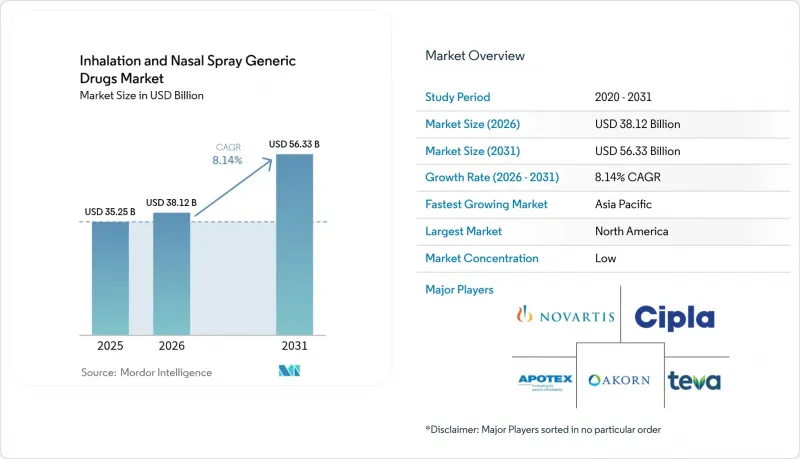
Mordor Intelligence에 의하면, 2026년 흡입제 및 비강 스프레이 제네릭 의약품 시장 규모는 381억 2,000만 달러로 추정되고, 2025년 352억 5,000만 달러에서 확대해, 2031년에는 563억 3,000만 달러에 이를 것으로 예측됩니다.
2026-2031년 연평균 성장률(CAGR)은 8.14%를 나타낼 전망입니다.
본 보고서는 약물 분류별(코르티코스테로이드, 기관지 확장제 등), 적응증별(천식, COPD 등), 기기 유형별(pMDI, DPI 등), 유통 채널별(소매, 병원, 온라인 약국), 지역별(북미, 유럽, 아시아태평양, 중동 및 아프리카, 남미)로 분류되어 있습니다. 시장 예측은 금액(달러) 기준으로 제시되어 있습니다.
세계의 흡입제 및 비강 스프레이 제네릭 의약품 시장 동향 및 인사이트
천식 및 COPD 유병률의 급증
세계적으로 천식은 2억 6,200만 명에게 영향을 미치고 있으며, COPD로 인한 사망률은 전체 사례의 85%가 발생하는 저·중소득 국가에서 급격히 증가하고 있습니다. 선진국의 고령화는 임상적 부담을 가중시키고 있는 반면, 신흥 시장의 치료비 부담 능력 격차로 인해 저가 제네릭 의약품이 필수적입니다. 세계보건기구(WHO)는 흡입용 코르티코스테로이드 및 기관지 확장제를 필수 의약품 목록에 지정함으로써, 제네릭 의약품의 광범위한 접근성을 위한 정책 추진에 박차를 가하고 있습니다. 지불 주체가 가치 기반 의료를 추구하는 가운데, 비용 대비 효과가 높은 호흡기용 제네릭 의약품은 경기 침체의 영향을 덜 받는 필수품이며, 흡입제 및 비강 스프레이 제네릭 의약품 시장을 지탱하는 기반이 되고 있습니다.
특허 만료 후의 합리적인 가격 책정
2025년 3월, 심비코트의 첫 번째 제네릭 의약품인 ‘브레이나’가 승인된 것은 특허 만료로 인해 브랜드 흡입제의 가격이 1년 이내에 40-60% 하락하는 현실을 여실히 보여줍니다. ‘플로벤트’의 판매 중단에 따른 처방약 목록 재검토로 인해 승인된 제네릭 의약품으로의 전환이 더욱 가속화되고 있으며, 텍사스주 메디케이드에서는 제네릭 플루티카손에 대한 사전 승인 제한이 해제되었습니다. 단계적 환급 체계에서는 제네릭 의약품이 일관되게 우선 순위에 배치되어 있으며, 이로 인해 흡입제 및 비강 스프레이 제네릭 의약품 시장 전체에서 지속적인 시장 점유율 확대가 촉진되고 있습니다.
엄격한 생물학적 동등성 및 기기 동등성 시험
FDA는 현재 후보 제품 1개당 1,500만-2,500만 달러의 비용이 드는 체외 및 생체 내 교차 시험을 의무화하고 있으며, 이로 인해 개발 기간이 최대 2년 연장되고 있습니다. EMA의 2025년판 흡입기 관련 지침에서는 첨가제나 기기의 차이가 존재하는 경우, 완전한 비교 데이터의 제출을 요구하고 있습니다. 이러한 자금적 장벽이 중소규모의 신규 진출기업을 가로막아, 흡입제 및 비강 스프레이 제네릭 의약품 시장에서경쟁 구도를 좁히고 있습니다.
부문 분석
코르티코스테로이드는 2025년 매출의 34.92%를 차지했으며, 흡입제 및 비강 스프레이 제네릭 의약품 시장의 중추를 이루고 있습니다. 시장에서의 수용은 천식 및 COPD 치료 프로토콜에서 입증된 항염증 효과에 힘입고 있으며, 처방 의사들 사이에서 널리 알려져 있는 점도 이를 뒷받침하고 있습니다. 주요 특허의 만료에 따라 제네릭 플루티카손 및 부데소니드가 급속히 보급되어 지불 주체에게 상당한 비용 절감을 가져다주었으며, 판매량 증가를 견인했습니다.
ICS/LABA 병용 요법은 임상의들이 폐 기능 지표, 복약 순응도 및 삶의 질을 향상시키는 이중 작용 조절 요법을 채택함에 따라 2031년까지 연평균 성장률(CAGR) 9.11%로 가장 높은 성장률을 보이고 있습니다. 심비코트(Symbicort) 제네릭 의약품의 출시가 길을 열었으며, 다른 복합제 역시 곧 특허 만료를 앞둔 제품들이 대기 중입니다. 제약 기업들에게 복합제의 높은 이익률은 생물학적 동등성 시험 및 흡입기 적합성 확보에 대한 투자를 상쇄하여, 흡입제 및 비강 스프레이 제네릭 의약품 업계 전체의 수익성을 높이고 있습니다.
기관지 확장제는 응급약으로서 안정적인 수요가 지속되고 있지만, 항히스타민제나 충혈 완화 스프레이는 보다 제한적인 계절적 틈새 시장을 차지하고 있습니다. 레우코트리엔 조절제나 항콜린제 등 신흥 의약품 유형은 파이프라인의 다양화에 기여하고 있지만, 주력 제품인 코르티코스테로이드와 비교하면 현재 시장 규모는 작습니다. 그럼에도 불구하고, 각 약종이 단계적으로 수익을 창출하고 있으며, 이들이 결합되어 예측 기간 동안 흡입제 및 비강 스프레이 제네릭 의약품 시장 규모를 확대되고 있습니다.
천식은 2025년 매출의 46.20%를 차지하며, 여전히 가장 큰 임상 적응증으로 남았습니다. 수십 년에 걸친 진료 지침에 기반한 치료로 인해 소아 및 성인 환자층 모두에서 흡입용 제네릭 의약품의 사용이 정착되어 있습니다. 패스트트랙 승인 제도를 통해 브랜드 의약품 공급에 차질이 발생할 경우에도 즉시 대체 의약품이 확보되어 환자의 접근성이 보장되고 있습니다.
COPD 치료제 시장은 인구 고령화와 그동안 치료 대상에서 제외되었던 환자층을 식별하는 진단 기술의 발전으로 인해 연평균 성장률(CAGR) 8.98%로 확대되고 있습니다. 이러한 성장을 주도하고 있는 것은 병용 유지 요법용 흡입제입니다. 고령층 증가에 따라 보험사 측에서 저비용 유지 요법을 요구하게 됨에 따라, COPD 치료제 중 흡입제 및 비강 스프레이 제네릭 의약품 시장 규모는 급격히 확대될 것으로 예측됩니다.
비염, 비폴립, 부비동염의 적응증 분야는 알레르기 유발 물질 노출 주기 및 비강 스프레이 기술의 점진적인 혁신에 힘입어 완만한 성장을 유지하고 있습니다. 금연 및 폐동맥 고혈압은 아직 발전 단계에 있지만 고부가가치 부문이며, 흡입 투여법이 약동학적 이점을 제공하기 때문에 흡입제 및 비강 스프레이 제네릭 의약품 시장의 향후 다각화가 기대됩니다.
지역별 분석
북미는 FDA의 패스트 트랙 ANDA(제네릭 의약품 승인 신청) 제도, 확립된 보험 적용 제도, 그리고 천식 및 COPD의 높은 유병률에 힘입어 2025년 전 세계 매출의 42.90%를 차지했습니다. 플로벤트(Flovent) 시장 철수 이후, 승인된 제네릭 의약품이 공급 공백을 신속하게 메운 것은 이 지역의 유연성을 여실히 보여주었습니다. 정책 입안자들은 상위 100개 제네릭 의약품 중 83개 품목에 대해 미국 국내에 유효 성분(API) 공급원이 없는 것으로 밝혀짐에 따라, 국내 제조의 회복력을 중시하고 있습니다. 이러한 동향으로 인해 북미의 흡입제 및 비강 스프레이 제네릭 의약품 시장은 지속적인 주도적 지위를 확보하고 있습니다.
아시아태평양은 의료 서비스의 확대, 규제 조화, 그리고 인도와 중국의 비용 효율적인 제조에 힘입어 2031년까지 연평균 성장률(CAGR) 10.18%를 기록하며 가장 빠르게 성장하는 지역입니다. 지방 자치 단체는 제네릭 의약품을 국민 건강 보험 제도에 포함시키고 있지만, 많은 환자에게 있어 약값은 여전히 일일 임금보다 높아, 충족되지 않은 수요가 여전히 크게 남아 있습니다. 따라서 합리적인 가격의 흡입기는 공중보건상 매우 중요한 역할을 수행하고 있으며, 아시아태평양 전역의 흡입제 및 비강 스프레이 제네릭 의약품 시장을 견인하고 있습니다.
유럽은 환경 규제 준수라는 과제와 공급 부족이라는 이중의 문제에 직면해 있습니다. 2024년 6월, EU 회원국 21개국에서 살부타몰 공급 부족이 발생하여, 소수 공급업체에 대한 의존도가 드러났습니다. 동시에, 이 지역에서는 엄격한 탄소 배출 감축 목표가 시행되고 있어 저 GWP(지구온난화지수) 기기에 대한 투자가 촉진되고 있으며, 이는 조기 도입 기업으로 시장 점유율 이동으로 이어질 가능성이 있습니다. 지난 10년간 제네릭 의약품 매출은 26% 감소했으나, 추진제 교체 의무화로 인해 흡입제 및 비강 스프레이 제네릭 의약품 시장에서 혁신이 다시 활성화되고 있습니다. 남미에서는 규제 현대화와 보험 적용 범위 확대가 호재로 작용하고 있습니다. 이러한 신흥 지역들은 매출 규모는 작지만, 전 세계 흡입제 및 비강 스프레이 제네릭 의약품 시장에 깊이와 다양성을 더하고 있습니다.
기타 혜택 :
- 엑셀 형식 시장 예측(ME) 시트
- 3개월간의 애널리스트 지원
자주 묻는 질문
목차
제1장 서론
제2장 조사 방법
제3장 주요 요약
제4장 시장 구도
제5장 시장 규모 및 성장 예측
제6장 경쟁 구도
제7장 시장 기회 및 향후 전망
AJY 26.09.11According to Mordor Intelligence, the inhalation and nasal spray generic drugs market size in 2026 is estimated at USD 38.12 billion, growing from 2025 value of USD 35.25 billion with 2031 projections showing USD 56.33 billion, growing at 8.14% CAGR over 2026-2031.
This report is Segmented by Drug Class (Corticosteroids, Bronchodilators, and More), Indication (Asthma, COPD, and More), Device Type (pMDI, DPI, and More), Distribution Channel (Retail, Hospital, Online Pharmacies), and Geography (North America, Europe, Asia-Pacific, Middle East & Africa, South America). The Market Forecasts are Provided in Terms of Value (USD).
Global Inhalation And Nasal Spray Generic Drugs Market Trends and Insights
Surging Prevalence of Asthma & COPD
Worldwide, asthma affects 262 million people, and COPD mortality is rising sharply in low- and middle-income countries where 85% of cases occur. Aging populations in developed economies compound the clinical burden, while treatment affordability gaps in emerging markets make low-priced generics indispensable. The World Health Organization places inhaled corticosteroids and bronchodilators on the essential medicines list, reinforcing policy momentum for broad generic availability . As payers pursue value-based care, cost-effective respiratory generics remain recession-resistant necessities that underpin the inhalation and nasal spray generic drugs market.
Affordable Pricing Post-Patent-Expiry
The approval of Breyna, the first generic Symbicort, in March 2025 illustrates how patent expiries cut branded inhaler prices by 40-60% within a year. Formulary resets following the Flovent withdrawal further accelerate substitution to authorized generics, with Texas Medicaid lifting prior-authorization blocks on generic fluticasone. Tiered reimbursement frameworks consistently place generics at preferred levels, driving durable share gains across the inhalation and nasal spray generic drugs market.
Stringent Bio-Equivalence & Device Sameness Tests
FDA now requires in-vitro plus in-vivo crossover trials that cost USD 15-25 million per candidate, extending timelines by up to two years. EMA's 2025 inhaler guidance demands full comparative data when excipient or device differences exist. The capital hurdle restrains smaller entrants, narrowing the competitive field within the inhalation and nasal spray generic drugs market.
Other drivers and restraints analyzed in the detailed report include:
- Favorable Fast-Track ANDA Pathways
- Transition to Low-GWP Propellants Accelerates Product Switch-Outs
- CDMO One-Stop Inhalation Platforms Lower Entry Barriers
- Smart-Inhaler Add-Ons Boost Payer Acceptance
- 'Device-Patent Thickets' Delaying Generic Launches
For complete list of drivers and restraints, kindly check the Table Of Contents.
Segment Analysis
Corticosteroids accounted for 34.92% of 2025 revenue, making them the anchor of the inhalation and nasal spray generic drugs market. Market acceptance rests on proven anti-inflammatory efficacy across asthma and COPD protocols, aided by widespread familiarity among prescribers. Following key patent expirations, generic fluticasone and budesonide realized rapid uptake, creating significant cost savings for payers and driving volume growth.
Combination ICS/LABA therapies show the fastest 9.11% CAGR through 2031 as clinicians embrace dual-mechanism control that improves lung-function metrics, adherence, and quality of life. The Symbicort generic launch paved the way, and additional combos await imminent patent cliffs. For manufacturers, the higher margin of complex blends offsets the investment in bioequivalence trials and device alignment, bolstering profitability across the inhalation and nasal spray generic drugs industry.
Bronchodilators continue steady demand as rescue medications, whereas antihistamines and decongestant sprays occupy narrower seasonal niches. Emerging classes such as leukotriene modifiers and anticholinergics diversify pipelines, but their current base is small compared with flagship corticosteroids. Nevertheless, each class contributes incremental revenue that collectively enlarges the inhalation and nasal spray generic drugs market size over the forecast horizon.
Asthma represented 46.20% of 2025 sales and remains the single largest clinical application. Decades of guideline-driven therapy have normalized inhaled generics in both pediatric and adult populations. Fast-track approvals guarantee ready substitutes whenever branded supply disruptions occur, safeguarding patient access.
COPD treatments are expanding at a 8.98% CAGR thanks to demographic aging and better diagnostics that uncover previously untreated segments. Combination maintenance inhalers dominate this growth. The inhalation and nasal spray generic drugs market size for COPD drugs is projected to widen sharply as payers demand lower-cost maintenance regimens for an enlarging elderly cohort.
Rhinitis, nasal polyposis, and sinusitis applications maintain moderate growth based on allergen exposure cycles and incremental innovation in nasal spray technology. Smoking cessation and pulmonary arterial hypertension represent nascent but high-value segments where inhalation delivery offers pharmacokinetic advantages, promising future diversification within the inhalation and nasal spray generic drugs market.
Complete Report Scope:
- By Drug Class
- Corticosteroids
- Bronchodilators (LABA, SABA)
- Combination ICS/LABA
- Antihistamines
- Decongestant Sprays
- Others (Leukotriene modifiers, Anticholinergics)
- By Indication
- Asthma
- COPD
- Allergic & Non-allergic Rhinitis
- Nasal Polyposis & Sinusitis
- Smoking Cessation & PAH
- By Device Type
- Pressurised Metered-Dose Inhalers (pMDI)
- Dry-Powder Inhalers (DPI)
- Soft-Mist Inhalers
- Unit/Bi-Dose Nasal Sprays
- Nebulisers
- By Distribution Channel
- Retail Pharmacies
- Hospital Pharmacies
- Online Pharmacies & DTC Platforms
- By Geography
- North America
- United States
- Canada
- Mexico
- Europe
- Germany
- United Kingdom
- France
- Italy
- Spain
- Rest of Europe
- Asia-Pacific
- China
- Japan
- India
- Australia
- South Korea
- Rest of Asia-Pacific
- Middle East & Africa
- GCC
- South Africa
- Rest of Middle East & Africa
- South America
- Brazil
- Argentina
- Rest of South America
- North America
Geography Analysis
North America generated 42.90% of global 2025 revenue, underpinned by FDA fast-track ANDA pathways, established coverage systems, and high asthma and COPD prevalence. The post-Flovent withdrawal episode underscored the region's agility, with authorized generics rapidly filling supply gaps. Policymakers emphasize domestic manufacturing resilience after finding that 83 of the top 100 generics have no U.S. API source . These dynamics secure continued leadership for the inhalation and nasal spray generic drugs market in North America.
Asia-Pacific is the fastest-growing region at 10.18% CAGR through 2031, driven by healthcare expansion, regulatory harmonization, and cost-efficient manufacturing in India and China. Local governments integrate generics into universal health schemes, yet medication still exceeds daily wages for many patients, leaving substantial unmet need. Affordable inhalers therefore play a critical public-health role, propelling the inhalation and nasal spray generic drugs market across Asia-Pacific.
Europe faces dual challenges of environmental compliance and supply shortages. A June 2024 salbutamol deficit across 21 EU member states exposed reliance on limited suppliers. Simultaneously, the region enforces strict carbon reduction targets, spurring investment in low-GWP devices that could tilt share toward early adopters. Though generic medicine revenues slipped 26% over the past decade, propellant transition mandates reinvigorate innovation within the inhalation and nasal spray generic drugs market. South America benefits from regulatory modernization and wider insurance coverage. Together, these emerging territories add depth and diversification to the global inhalation and nasal spray generic drugs market, albeit from smaller revenue bases.
- Teva Pharmaceutical Industries
- Viatris
- Cipla
- Hikma Pharmaceuticals
- Sandoz (Novartis)
- Sun Pharmaceuticals Industries
- Apotex
- Akorn
- Beximco Pharma
- Glenmark Pharma
- Lupin
- Aurobindo Pharma
- Dr Reddy's Laboratories
- Amneal Pharma
- Perrigo Company
- Chiesi Farmaceutici
- Boehringer Ingelheim
- AstraZeneca
- GlaxoSmithKline
- Accord Healthcare
- Orion
Additional Benefits:
- The market estimate (ME) sheet in Excel format
- 3 months of analyst support
TABLE OF CONTENTS
1 Introduction
- 1.1 Study Assumptions & Market Definition
- 1.2 Scope of the Study
2 Research Methodology
3 Executive Summary
4 Market Landscape
- 4.1 Market Overview
- 4.2 Market Drivers
- 4.2.1 Surging Prevalence Of Asthma & COPD
- 4.2.2 Affordable Pricing Post-Patent-Expiry
- 4.2.3 Favourable Fast-Track Anda Pathways
- 4.2.4 Transition To Low-Gwp Propellants Accelerates Product Switch-Outs
- 4.2.5 Cdmo One-Stop Inhalation Platforms Lower Entry Barriers
- 4.2.6 Smart-Inhaler Add-Ons Boost Payer Acceptance Of Generics
- 4.3 Market Restraints
- 4.3.1 Stringent Bio-Equivalence & Device Sameness Tests
- 4.3.2 'Device-Patent Thickets' Delaying Generic Launches
- 4.3.3 Impending HFA-134A Supply Squeeze Under F-Gas Rules
- 4.3.4 Post-Flovent Withdrawal Formulary Volatility & Stocking Gaps
- 4.4 Value / Supply-Chain Analysis
- 4.5 Regulatory Landscape
- 4.6 Technological Outlook
- 4.7 Porter's Five Forces Analysis
- 4.7.1 Threat of New Entrants
- 4.7.2 Bargaining Power of Buyers
- 4.7.3 Bargaining Power of Suppliers
- 4.7.4 Threat of Substitutes
- 4.7.5 Intensity of Rivalry
5 Market Size & Growth Forecasts (Value)
- 5.1 By Drug Class
- 5.1.1 Corticosteroids
- 5.1.2 Bronchodilators (LABA, SABA)
- 5.1.3 Combination ICS/LABA
- 5.1.4 Antihistamines
- 5.1.5 Decongestant Sprays
- 5.1.6 Others (Leukotriene modifiers, Anticholinergics)
- 5.2 By Indication
- 5.2.1 Asthma
- 5.2.2 COPD
- 5.2.3 Allergic & Non-allergic Rhinitis
- 5.2.4 Nasal Polyposis & Sinusitis
- 5.2.5 Smoking Cessation & PAH
- 5.3 By Device Type
- 5.3.1 Pressurised Metered-Dose Inhalers (pMDI)
- 5.3.2 Dry-Powder Inhalers (DPI)
- 5.3.3 Soft-Mist Inhalers
- 5.3.4 Unit/Bi-Dose Nasal Sprays
- 5.3.5 Nebulisers
- 5.4 By Distribution Channel
- 5.4.1 Retail Pharmacies
- 5.4.2 Hospital Pharmacies
- 5.4.3 Online Pharmacies & DTC Platforms
- 5.5 By Geography
- 5.5.1 North America
- 5.5.1.1 United States
- 5.5.1.2 Canada
- 5.5.1.3 Mexico
- 5.5.2 Europe
- 5.5.2.1 Germany
- 5.5.2.2 United Kingdom
- 5.5.2.3 France
- 5.5.2.4 Italy
- 5.5.2.5 Spain
- 5.5.2.6 Rest of Europe
- 5.5.3 Asia-Pacific
- 5.5.3.1 China
- 5.5.3.2 Japan
- 5.5.3.3 India
- 5.5.3.4 Australia
- 5.5.3.5 South Korea
- 5.5.3.6 Rest of Asia-Pacific
- 5.5.4 Middle East & Africa
- 5.5.4.1 GCC
- 5.5.4.2 South Africa
- 5.5.4.3 Rest of Middle East & Africa
- 5.5.5 South America
- 5.5.5.1 Brazil
- 5.5.5.2 Argentina
- 5.5.5.3 Rest of South America
- 5.5.1 North America
6 Competitive Landscape
- 6.1 Market Concentration
- 6.2 Market Share Analysis
- 6.3 Company Profiles (includes Global level Overview, Market level overview, Core Segments, Financials as available, Strategic Information, Market Rank/Share for key companies, Products & Services, and Recent Developments)
- 6.3.1 Teva Pharmaceutical Industries
- 6.3.2 Viatris
- 6.3.3 Cipla
- 6.3.4 Hikma Pharmaceuticals
- 6.3.5 Sandoz (Novartis)
- 6.3.6 Sun Pharma
- 6.3.7 Apotex
- 6.3.8 Akorn
- 6.3.9 Beximco Pharma
- 6.3.10 Glenmark Pharma
- 6.3.11 Lupin Ltd
- 6.3.12 Aurobindo Pharma
- 6.3.13 Dr Reddy's Laboratories
- 6.3.14 Amneal Pharma
- 6.3.15 Perrigo Company
- 6.3.16 Chiesi Farmaceutici
- 6.3.17 Boehringer Ingelheim
- 6.3.18 AstraZeneca
- 6.3.19 GlaxoSmithKline
- 6.3.20 Accord Healthcare
- 6.3.21 Orion Corporation
7 Market Opportunities & Future Outlook
- 7.1 White-space & Unmet-Need Assessment