

|
시장보고서
상품코드
2124009
키토산 시장 : 시장 점유율 분석, 업계 동향 및 통계, 성장 예측(2026-2031년)Chitosan - Market Share Analysis, Industry Trends & Statistics, Growth Forecasts (2026 - 2031) |
||||||
 Mordor Intelligence
Mordor Intelligence에 의하면, 키토산 시장 규모는 2026년에 63억 달러로 추정되고, 예측 기간(2026-2031년)에서 CAGR 12.38%로 성장을 지속할 전망이며, 2031년까지 113억 달러에 이를 전망입니다.
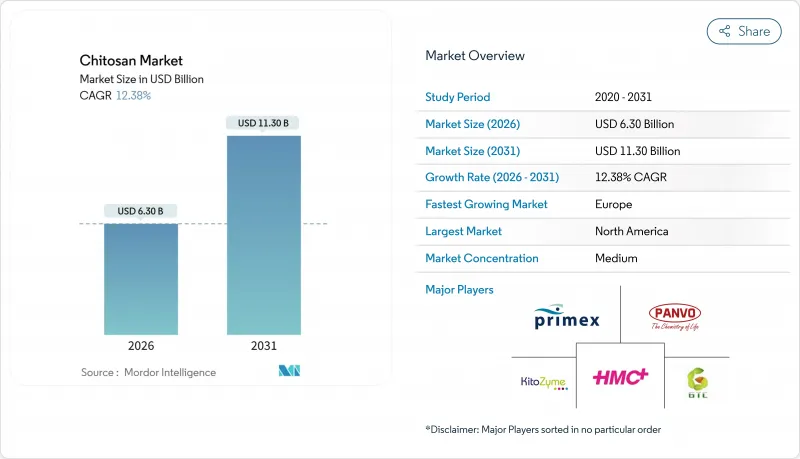
본 보고서는 원료별(새우, 게 등), 등급별(산업용 등급, 식품용 등급 등), 형태별(분말, 플레이크 등), 용도별(수처리, 화장품 및 퍼스널케어 등), 지역별(북미, 유럽, 아시아태평양, 중동 및 아프리카, 남미)로 분류되어 있습니다. 본 시장 조사 보고서에서는 상기 부문별 시장 규모(달러)를 제시하고 있습니다.
세계의 키토산 시장 동향 및 인사이트
수처리 규제 강화
유럽연합(EU)의 유틸리티 사업자는 현재 미량 오염 물질을 대상으로 한 4차 처리를 도입할 의무가 있으며, 키토산은 콜로이드의 응집과 미량 유기물의 흡착을 동시에 수행함으로써 명반의 사용량을 최대 30%까지 줄여줍니다. 미국의 산업 시설은 중금속에 관한 40 CFR Part 125의 더 엄격한 규제에 직면해 있지만, 키토산 유도체는 유해한 슬러지를 발생시키지 않으면서 철, 구리, 아연의 93-99%를 제거합니다. 중국에서는 전기도금 폐수의 총 크롬 배출 기준이 0.5 mg/L로 하향 조정됨에 따라, 저장성과 광둥성에서 키토산계 응집제의 조기 도입이 진행되고 있습니다. 이러한 규제 동향에 따라, 성능과 생분해성을 모두 갖춘 고탈아세틸화 키토산 등급의 잠재 시장이 확대되고 있습니다.
생분해성·친환경 소재에 대한 수요 급증
플라스틱이 없는 포장재나 퇴비화 가능한 농업 자재를 추구하는 브랜드 소유주들은 산업용 퇴비화 조건에서 60일 이내에 80-90%가 분해되는 키토산 필름을 지정하고 있으며, 그 분해 속도는 폴리에틸렌보다 훨씬 빠릅니다. 유럽의 ‘일회용 플라스틱 지침’은 옥소 분해성 폴리머의 사용을 규제하고 있으며, 이에 따라 배합 개발자들은 잔류물을 남기지 않는 키토산 종자 코팅 및 방출 조절 비료로 관심을 돌리고 있습니다. 헤어케어 브랜드에서는 미세 플라스틱을 사용하지 않으면서도 고정력을 발휘하는 4급 키토산을 이용한 젤의 재처방이 진행되고 있으며, 해양 유래라는 스토리성을 활용하여 매장에서 프리미엄 가격 책정을 실현하고 있습니다. 이러한 추세에 따라 전 세계 키토산 시장은 단순한 규제 준수의 범위를 넘어, 생분해성이 마케팅상의 강점으로 변모하고 있습니다.
알레르기 유발 물질에 대한 우려가 식품·화장품 분야에서의 보급을 제한
저품질 갑각류 유래 키토산에 포함된 잔류 단백질은 갑각류에 과민반응이 있는 사람들에게 IgE 반응을 유발할 가능성이 있습니다. 이 때문에 유럽식품안전청(EFSA)은 식품과의 직접 접촉에 관한 견해 발표를 연기하고 있으며, 화장품 브랜드는 갑각류 유래임을 표시할 수밖에 없는 상황입니다. 곰팡이 또는 곤충 유래 키토산이라면 알레르기 유발 물질 표기를 피할 수 있을 가능성이 있지만, 임상 안전성에 관한 자료가 여전히 불완전하여 본격적인 상용화가 저해되고 있습니다. 위험 평가가 완료될 때까지 대중 시장을 겨냥한 식품 및 화장품 제형 개발자들은 키토산의 배합을 제한하거나 더 높은 순도의 등급에 투자하게 될 것이며, 단기적인 판매량 증가세는 둔화될 것입니다.
부문 분석
2025년에는 새우 껍질이 전 세계 키토산 시장 생산량의 45.55%를 차지한 것으로 평가되었습니다. 이는 태국, 베트남, 인도의 확립된 물류 체계에 힘입은 것으로, 150만 톤의 껍질 폐기물이 전용 탈아세틸화 라인에 공급되고 있기 때문입니다. 게의 경우, 알래스카와 북유럽의 가공업체들이 껍질 회수 체계를 강화하고 탈아세틸화 수율 향상 및 단위 비용 절감을 도모하고 있어, 연평균 성장률(CAGR) 13.25%로 성장을 주도할 것으로 예측됩니다. 곤충의 외골격과 균류의 바이오매스는 비건, 할랄, 코셔를 표방하는 새로운 원료로 부상하고 있지만, 인프라가 미비하여 추출 비용은 여전히 20-30% 높은 수준입니다. 계절적 변동은 여전히 전 세계 키토산 시장에 영향을 미치고 있으며, 엘니뇨 현상이 발생하는 해에는 기후 이상으로 인해 새우 어획량이 감소하므로, 가공업체들은 갑각류와 균류를 혼합한 원료를 사용하여 공급 리스크를 헤지하고 있습니다. 오징어 유래 키토산은 여전히 틈새 시장이지만, 그 투명성과 낮은 점도 덕분에 고급 화장품 시장에서 프리미엄 가격을 형성하고 있어 해양 유래 원료의 다양화 가능성을 보여주고 있습니다.
노르웨이와 캐나다에서 게를 원료로 하는 생산 능력 확대는 냉수 어업 폐기물의 유효 활용을 지원하는 보조금에 힘입고 있으며, EU 그린딜에 따라 추적성을 요구하는 유럽 바이어들에게 공급 안정성을 높여주고 있습니다. 아시아 각국 정부의 식품 폐기물을 활용한 곤충 사육 장려 정책 또한 시범 규모의 검은파리 유래 키토산 제조 공장을 육성하고 있어, 순환형 경제의 새로운 전개를 열어가고 있습니다. 곤충 유래 키토산은 현재 전 세계 키토산 시장 규모의 2% 미만에 불과하지만, 생애주기 평가(LCA) 결과가 양호할 경우 정제 비용이 낮아지면 그 점유율이 확대될 가능성이 있습니다. 전반적으로 원료의 다양화는 원자재 리스크를 저감하고, 양식병 발생에 취약한 시장에서 가격 안정을 뒷받침하고 있습니다.
2025년에는 산업용 등급 키토산이 세계 시장 규모의 45.53%를 차지했으며, 75-85%의 탈아세틸화만으로 충분한 수처리 및 섬유 분야의 틈새 시장을 채우고 있습니다. 한편, 의약품 및 생의학용 등급은 임상적 근거가 확산되고 군의 지혈용 드레싱 조달이 증가함에 따라 2031년까지 연평균 성장률(CAGR) 12.85%를 기록하며 범용 등급을 상회하는 성장이 예상됩니다. 탈아세틸화 정도, 내독소 부하, 분자량 범위에 따라 가격대가 결정되며, 우수 제조 기준(GMP)을 준수하는 로트의 소매 가격은 산업용 등급의 3-10배에 달할 전망입니다.
키토산·콜라겐 복합체 및 나노 겔 매트릭스를 포괄하는 약물 전달체에 관한 특허가 가격의 견조함을 뒷받침하는 한편, 프라이멕스(Primex), 헤페 메디컬 키토산(Heppe Medical Chitosan), 그리고 소수의 중국 DMF 보유자에 의한 과점적 공급이 시장의 질서를 유지하고 있습니다. 산업용과 의료용 기준의 중간에 위치하는 식품 등급 키토산은 미국에서는 ‘일반적으로 안전하다고 인정되는(GRAS)’ 지위의 혜택을 받고 있지만, 유럽에서는 아직 완전한 승인을 기다리고 있는 상황입니다. 그 결과, 등급의 범위가 확대되면서 구매자들은 단순한 수량 요건이 아닌 규제상의 위험 및 이익률에 대한 성향에 따라 세분화되고 있습니다.
지역별 분석
유럽은 4급 폐수 규제 및 농업 분야에서의 키토산 도입을 간소화하는 생장 촉진제로서의 분류에 힘입어, 2031년까지 연평균 성장률(CAGR)이 14.51%로 가장 높은 성장세를 보일 전망입니다. 독일에서는 폴리아크릴아마이드를 키토산으로 대체하는 지자체 실증 실험에 자금을 지원하고 있으며, 스페인에서는 합성 살균제 사용량을 줄이기 위해 포도 재배에 키토산 스프레이가 도입되고 있습니다. 영국의 외상 센터에서는 키토산 드레싱이 표준화되어 있어, 이로 인해 병원 수요가 증가하면서 의료 용도 분야에서 해당 지역의 선도적 입지가 더욱 공고해지고 있습니다.
북미는 2025년에 전 세계 키토산 시장 점유율의 25.13%를 차지했으며, EPA(미국 환경보호청)의 전처리 기준과 전장에서의 키토산 제지혈제 조기 도입이 이를 뒷받침하고 있습니다. 수처리 시설의 확충이 진행됨에 따라 성장은 완만해지겠지만, 흡입용 의약품 등급의 키토산이 최초로 USP(미국약전) 규격에 채택됨에 따라 의약품 분야의 전망은 여전히 매력적입니다. 캐나다의 냉수 게 어업은 오염 물질이 적은 갑각류를 공급하여 고품질 의약품 공급망을 뒷받침하고, 지역의 경쟁력을 강화하고 있습니다.
아시아태평양은 원료의 대부분을 공급하고 있으며, 태국, 베트남, 중국에서는 연간 약 200만 톤의 껍질 폐기물이 처리되고 있습니다. 국내 키토산의 보급 상황은 지역마다 편차가 있습니다. 중국에서는 크롬 배출 기준이 엄격해지면서 지역적인 도입이 촉진되었지만, 규제 집행의 미비로 인해 전국적인 보급은 제한되고 있습니다. 일본은 독자적인 가수분해 기술을 활용한 화장품 등급의 올리고당을 전문으로 하고 있는 반면, 인도의 수산 양식 거점은 세계 수출을 목표로 산업용 등급의 생산을 확대되고 있습니다. 중동의 신흥 시장에서는 해수 담수화의 전처리로 키토산에 대한 시험이 진행되고 있으며, 남미에서는 관세 및 인프라 측면의 역풍에도 불구하고 브라질이 유기농 대두 재배에 키토산계 바이오 농약을 도입하는 등 착실히 진전을 보이고 있습니다.
기타 혜택 :
- 엑셀 형식 시장 예측(ME) 시트
- 3개월간의 애널리스트 지원
자주 묻는 질문
목차
제1장 서론
제2장 조사 방법
제3장 주요 요약
제4장 시장 구도
제5장 시장 규모 및 성장 예측
제6장 경쟁 구도
제7장 시장 기회 및 향후 전망
AJY 26.09.11According to Mordor Intelligence, the chitosan market size is estimated at USD 6.30 billion in 2026, and is expected to reach USD 11.30 billion by 2031, at a CAGR of 12.38% during the forecast period (2026-2031).
This report is Segmented by Source (Shrimps, Crabs, and More), Grade (Industrial Grade, Food Grade, and More), Form (Powder, Flake, and More), Application (Water Treatment, Cosmetics and Personal Care, and More), and Geography (North America, Europe, Asia-Pacific, Middle East and Africa, and South America). The Market Research Report Offers the Value (in USD) for the Above Segments.
Global Chitosan Market Trends and Insights
Rising Water-Treatment Regulations
Utilities in the European Union must now install quaternary treatment that targets micropollutants, and chitosan simultaneously coagulates colloids and adsorbs trace organics, reducing alum use by up to 30%. Industrial sites in the United States face stricter 40 CFR Part 125 limits for heavy metals, and chitosan derivatives remove 93-99% of iron, copper and zinc without hazardous sludge. China has cut total chromium limits for electroplating effluent to 0.5 mg L-1, prompting early adoption of chitosan flocculants in Zhejiang and Guangdong. These converging regulations enlarge the addressable market for high-deacetylation chitosan grades that assure both performance and biodegradability.
Surging Demand for Biodegradable and Eco-Friendly Materials
Brand owners pursuing plastic-free packaging and compostable agriculture inputs are specifying chitosan films that degrade 80-90% within 60 days under industrial composting, far faster than polyethylene. The Single-Use Plastics Directive in Europe curbs oxo-degradable polymers, directing formulators toward chitosan seed coatings and controlled-release fertilizers that leave no persistent residue. Hair-care brands are reformulating gels with quaternized chitosan that delivers hold without microplastics, leveraging marine-origin storytelling to command premium shelf pricing. These preferences move the global chitosan market beyond compliance, turning biodegradability into a marketing advantage.
Allergenic Concerns Limiting Food and Cosmetic Uptake
Residual proteins in lower-grade crustacean chitosan can trigger IgE reactions in shellfish-sensitized individuals, leading the European Food Safety Authority to delay opinions on direct food contact and forcing cosmetic brands to label shellfish origin. Fungal and insect chitosan could bypass allergen labeling, but clinical safety dossiers remain incomplete, holding back full-scale commercialization. Until risk assessments conclude, formulators in mass-market foods and cosmetics will limit chitosan inclusion or invest in higher-purity grades, tempering near-term volume growth.
Other drivers and restraints analyzed in the detailed report include:
- Expanding Biomedical, Cosmetics and Food Uses of Chitosan Oligosaccharides
- Shift Toward Bio-Based Flocculants in Industrial Effluents
- High Cost of Ultra-High-Purity Medical-Grade Chitosan
For complete list of drivers and restraints, kindly check the Table Of Contents.
Segment Analysis
Shrimp shells yielded 45.55% of global chitosan market output in 2025, supported by established logistics in Thailand, Vietnam and India that channel 1.5 million t of shell waste into dedicated deacetylation lines. Crabs are forecast to lead growth at a 13.25% CAGR as processors in Alaska and Northern Europe consolidate shell recovery, boosting deacetylation yields and lowering unit costs. Insect exoskeletons and fungal biomass are emerging feedstocks with vegan, Halal and Kosher positioning, yet extraction costs remain 20-30% higher owing to immature infrastructure. Seasonal variability still influences the global chitosan market, as climate anomalies shrink shrimp harvests in El Nino years, prompting processors to hedge supply with mixed crustacean and fungal inputs. Although squid-derived chitosan remains a niche, its clarity and low viscosity command premium pricing in high-end cosmetics, revealing the diversification potential within marine feedstocks.
Crab-based capacity expansions in Norway and Canada are backed by grants that subsidize cold-water fishery waste valorization, reinforcing supply security for European buyers seeking traceability under the EU Green Deal. Asian government incentives for insect farming on food waste are likewise nurturing pilot-scale black soldier fly chitosan plants, opening a circular-economy storyline. While insect chitosan currently represents less than 2% of global chitosan market volume, favorable life-cycle assessments could accelerate its share once purification costs fall. Overall, feedstock diversification limits raw-material risk and supports stable pricing in a market vulnerable to aquaculture disease outbreaks.
Industrial-grade material commanded 45.53% of the global chitosan market size in 2025, filling water-treatment and textile niches where 75-85% deacetylation suffices. Pharmaceutical and biomedical grades, however, will outpace commodity specifications at 12.85% CAGR through 2031 as clinical evidence spreads and military procurement of hemostatic dressings rises. The degree of deacetylation, endotoxin burden and molecular-weight range define price tiers, with Good Manufacturing Practice batches retailing at 3-10 times industrial equivalents.
Drug-carrier patents covering chitosan-collagen composites and nano-gel matrices strengthen price resilience, while oligopolistic supply from Primex, Heppe Medical Chitosan and a few Chinese DMF holders preserves market discipline. Food-grade chitosan, positioned between industrial and medical benchmarks, benefits from Generally Recognized as Safe status in the United States yet awaits full clearance in Europe. As a result, the grade hierarchy widens, segmenting buyers by regulatory exposure and margin appetite rather than sheer volume requirements.
Complete Report Scope:
- By Source
- Shrimps
- Crabs
- Squid
- Fungi / Mycelium
- Insect Exoskeletons
- Others
- By Grade
- Industrial Grade
- Food Grade
- Pharmaceutical & Biomedical Grade
- By Form
- Powder
- Flake
- Liquid
- Nano / Micro Particles
- By Application
- Water Treatment
- Cosmetics & Personal Care
- Pharmaceutical & Biomedical
- Food & Beverage
- Agriculture & Horticulture
- Textile & Printing
- Others
- By Geography
- North America
- United States
- Canada
- Mexico
- Europe
- Germany
- United Kingdom
- France
- Italy
- Spain
- Rest of Europe
- Asia-Pacific
- China
- Japan
- India
- Australia
- South Korea
- Rest of Asia-Pacific
- Middle East & Africa
- GCC
- South Africa
- Rest of Middle East & Africa
- South America
- Brazil
- Argentina
- Rest of South America
- North America
Geography Analysis
Europe will post the strongest 14.51% CAGR through 2031, propelled by quaternary wastewater mandates and the biostimulant classification that simplifies chitosan deployment in farming. Germany funds municipal trials that replace polyacrylamide with chitosan, and Spain deploys chitosan sprays in viticulture to reduce synthetic fungicide load. United Kingdom trauma centers have standardized chitosan dressings, boosting hospital demand and reinforcing the region's leadership in medical applications.
North America captured 25.13% of global chitosan market share in 2025, anchored by EPA pretreatment standards and early battlefield use of chitosan hemostats. Growth moderates as water-treatment installations mature, yet pharmaceutical prospects remain attractive as inhaled-drug-grade chitosan wins its first USP monograph. Canada's cold-water crab fisheries provide low-contaminant shells, supporting premium pharmaceutical supply chains and reinforcing regional competitiveness.
Asia-Pacific supplies most feedstock, processing about 2 million t of shell waste annually in Thailand, Vietnam and China. Domestic chitosan uptake is uneven; China tightened chromium discharge limits, catalyzing localized adoption, but enforcement gaps restrain nationwide penetration. Japan specializes in cosmetic-grade oligosaccharides with proprietary hydrolysis technology, while India's aquaculture hubs expand industrial-grade output for global export. Emerging markets in the Middle East test chitosan as a pretreatment in desalination, and South America inches forward with Brazil deploying chitosan bio-pesticides in organic soy farming amid tariff and infrastructure headwinds.
- Advanced Biopolymers AS
- Bio21 AS
- ChitoTech Co. Ltd
- D'Labs Chemicals Pvt Ltd
- Dainichiseika Color & Chemicals Mfg
- Golden-Shell Pharmaceutical Co. Ltd
- GTC Bio
- Heppe Medical Chitosan
- Japan BioKey Inc.
- KIMICA
- KitoZyme
- Koyo World
- Marsing & Co A/S
- Meron Biopolymers
- Panvo Organics
- Primex ehf
- Qingdao Yunzhou Biochemistry Co. Ltd
- Tidal Vision Products Inc.
- Zhejiang Aoxing Biotechnology Co. Ltd
- Zhejiang Golden-Shell Biotechnology Co. Ltd
Additional Benefits:
- The market estimate (ME) sheet in Excel format
- 3 months of analyst support
TABLE OF CONTENTS
1 Introduction
- 1.1 Study Assumptions & Market Definition
- 1.2 Scope of the Study
2 Research Methodology
3 Executive Summary
4 Market Landscape
- 4.1 Market Overview
- 4.2 Market Drivers
- 4.2.1 Rising water-treatment regulations
- 4.2.2 Surging demand for biodegradable & eco-friendly materials
- 4.2.3 Expanding biomedical, cosmetics & food uses of chitosan oligosaccharides
- 4.2.4 Shift toward bio-based flocculants in industrial effluents
- 4.2.5 Adoption of fungal/plant-based chitosan for vegan & Halal/Kosher markets
- 4.2.6 Circular-economy valorization of seafood & insect waste streams
- 4.3 Market Restraints
- 4.3.1 Allergenic concerns limiting food & cosmetic uptake
- 4.3.2 High cost of ultra-high-purity medical-grade chitosan
- 4.3.3 Limited scalability of fungal fermentation capacity
- 4.3.4 Climate-driven volatility of crustacean biomass supply
- 4.4 Value / Supply-Chain Analysis
- 4.5 Regulatory Landscape
- 4.6 Technological Outlook
- 4.7 Porter's Five Forces
- 4.7.1 Threat of New Entrants
- 4.7.2 Bargaining Power of Buyers/Consumers
- 4.7.3 Bargaining Power of Suppliers
- 4.7.4 Threat of Substitute Products
- 4.7.5 Intensity of Competitive Rivalry
5 Market Size & Growth Forecasts (Value, USD)
- 5.1 By Source
- 5.1.1 Shrimps
- 5.1.2 Crabs
- 5.1.3 Squid
- 5.1.4 Fungi / Mycelium
- 5.1.5 Insect Exoskeletons
- 5.1.6 Others
- 5.2 By Grade
- 5.2.1 Industrial Grade
- 5.2.2 Food Grade
- 5.2.3 Pharmaceutical & Biomedical Grade
- 5.3 By Form
- 5.3.1 Powder
- 5.3.2 Flake
- 5.3.3 Liquid
- 5.3.4 Nano / Micro Particles
- 5.4 By Application
- 5.4.1 Water Treatment
- 5.4.2 Cosmetics & Personal Care
- 5.4.3 Pharmaceutical & Biomedical
- 5.4.4 Food & Beverage
- 5.4.5 Agriculture & Horticulture
- 5.4.6 Textile & Printing
- 5.4.7 Others
- 5.5 By Geography
- 5.5.1 North America
- 5.5.1.1 United States
- 5.5.1.2 Canada
- 5.5.1.3 Mexico
- 5.5.2 Europe
- 5.5.2.1 Germany
- 5.5.2.2 United Kingdom
- 5.5.2.3 France
- 5.5.2.4 Italy
- 5.5.2.5 Spain
- 5.5.2.6 Rest of Europe
- 5.5.3 Asia-Pacific
- 5.5.3.1 China
- 5.5.3.2 Japan
- 5.5.3.3 India
- 5.5.3.4 Australia
- 5.5.3.5 South Korea
- 5.5.3.6 Rest of Asia-Pacific
- 5.5.4 Middle East & Africa
- 5.5.4.1 GCC
- 5.5.4.2 South Africa
- 5.5.4.3 Rest of Middle East & Africa
- 5.5.5 South America
- 5.5.5.1 Brazil
- 5.5.5.2 Argentina
- 5.5.5.3 Rest of South America
- 5.5.1 North America
6 Competitive Landscape
- 6.1 Market Concentration
- 6.2 Market Share Analysis
- 6.3 Company Profiles (includes Global level Overview, Market level overview, Core Segments, Financials as available, Strategic Information, Market Rank/Share for key companies, Products & Services, and Recent Developments)
- 6.3.1 Advanced Biopolymers AS
- 6.3.2 Bio21 AS
- 6.3.3 ChitoTech Co. Ltd
- 6.3.4 D'Labs Chemicals Pvt Ltd
- 6.3.5 Dainichiseika Color & Chemicals Mfg Co. Ltd
- 6.3.6 Golden-Shell Pharmaceutical Co. Ltd
- 6.3.7 GTC Bio Corporation
- 6.3.8 Heppe Medical Chitosan GmbH
- 6.3.9 Japan BioKey Inc.
- 6.3.10 KIMICA Corporation
- 6.3.11 KitoZyme SA
- 6.3.12 Koyo World
- 6.3.13 Marsing & Co A/S
- 6.3.14 Meron Biopolymers
- 6.3.15 Panvo Organics Pvt Ltd
- 6.3.16 Primex ehf
- 6.3.17 Qingdao Yunzhou Biochemistry Co. Ltd
- 6.3.18 Tidal Vision Products Inc.
- 6.3.19 Zhejiang Aoxing Biotechnology Co. Ltd
- 6.3.20 Zhejiang Golden-Shell Biotechnology Co. Ltd
7 Market Opportunities & Future Outlook
- 7.1 White-space & Unmet-Need Assessment


