|
시장보고서
상품코드
2124017
초자체 망막 수술용 기기 시장 : 시장 점유율 분석, 업계 동향 및 통계, 성장 예측(2026-2031년)Vitreoretinal Surgery Devices - Market Share Analysis, Industry Trends & Statistics, Growth Forecasts (2026 - 2031) |
||||||
 Mordor Intelligence
Mordor Intelligence에 의하면, 초자체 망막 수술용 기기 시장 규모는 2025년 7억 3,362만 달러로 평가되었고, 2026년에는 7억 6,212만 달러로 추정되고, 2031년까지 9억 1,986만 달러에 이를 것으로 예상되며, 2026-2031년 CAGR 3.74%로 성장할 전망입니다.
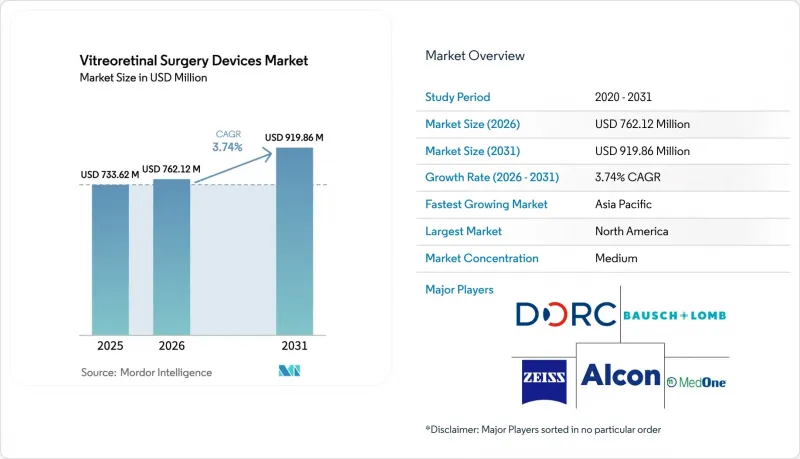
본 보고서는 제품 유형별(퍼플루오로카본 용액, 내시경 조명 기구 등), 수술 유형별(후부, 전부), 기술별(20/23 게이지, 25/27 게이지), 최종 사용자별(병원, ASC, 안과 클리닉), 지역별(북미, 유럽, 아시아태평양, 중동 및 아프리카, 남미)로 분류되어 있습니다. 시장 전망은 금액(달러) 기준으로 제시되어 있습니다.
세계의 초자체 망막 수술용 기기 시장 동향 및 인사이트
당뇨병성 망막병증 및 노인성 황반변성(AMD) 유병률 증가
2025년에는 당뇨병성 망막병증 성인 환자 수가 1억 312만 명, 노화성 황반변성 환자 수가 1억 9,592만 명에 달하여, 복잡한 망막 수술에 대한 지속적인 수요를 창출했습니다. 중국의 ‘건강 중국 2030’ 계획에 따라 2025년까지 농촌 지역의 망막 검진 커버리지가 54%로 확대된 결과, 새로 진단된 증식기 사례가 22% 증가했습니다. 인도의 ‘실명 방지 국가 프로그램’ 보고서에 따르면, 2025년에는 알려진 당뇨병 환자 중 당뇨병성 안질환 유병률이 21.3%로 상승하여, 2급 도시에서 전문의 진료 대기 시간이 길어지고 있습니다. 북미에서는 비만율 상승으로 인해 당뇨병 신규 발병이 지속되면서 수술 대기 건수가 높은 수준을 유지하고 있습니다. 이러한 역학적 동향이 초자체 망막 수술용 기기 시장의 확장을 견인하고 있으며, 병원 및 외래수술센터(ASC)는 증가하는 수요에 대응하기 위해 추가 콘솔 및 소모품에 투자하고 있습니다.
엄격한 감염 관리 요건에 따라 추진되는 일회용 안과 기구로의 전환
2024년 CDC 지침에 따르면, 재사용 가능한 내시경 조명 장치는 사례별로 멸균이 필요한 중요 의료기기로 재분류되었습니다. 이는 많은 멸균 처리 부서가 대응에 어려움을 겪고 있는 기준입니다. 이에 대해 미국의 망막 진료 부서는 미리 멸균 처리된 일회용 라이트파이프 및 커터로 전환을 추진하고 있으며, 그 결과 2025년 3분기 알콘사의 일회용 제품 매출이 41% 급증했습니다. EU 의료기기 규정의 추적성 관련 조항으로 인해 재사용 가능한 기기의 행정 처리 부담이 증가하면서, 독일과 프랑스의 수술 건수가 많은 의료기관에서 일회용 제품 도입이 가속화되었습니다. 보쉬 앤 롬(Bosch & Rom)사의 ‘스텔라리스 엘리트(Stellaris Elite)’ 플랫폼은 재처리 과정에서 발생하는 책임을 배제하는 25게이지 일회용 팩을 세트로 구성하여 이러한 추세를 활용했으며, 2025년에는 미국 ASC(외래수술센터(ASC)) 부문의 18%를 차지하게 되었습니다. 아시아태평양의 도시 소재 병원들이 서유럽의 감염 관리 기준을 따르기 시작함에 따라, 싱가포르, 서울 및 중국의 주요 도시에서 일회용 제품의 보급률이 상승하고 있습니다.
높은 설비 투자 및 소모품 비용
완벽하게 갖춰진 유리체 절제술 수술실 비용은 25만-45만 달러에 달하며, 이 금액 때문에 미국 독립 망막 클리닉의 68%는 장비를 소유할 수 없습니다. 일회용 팩은 1건당 800-1,200달러의 추가 비용이 드는 반면, 재처리 인건비를 포함한 재사용 가능한 기구의 경우 200-300달러에 불과하기 때문에 저소득 시장에서는 이익률을 압박하고 있습니다. 인도에서는 소모품이 수술 비용의 42%를 차지하고 있어, 본인 부담금이 주를 이루는 2급 및 3급 도시에서의 도입을 제한하고 있습니다. DORC사의 ‘EVA NEXUS’는 18만 달러에 출시되어 모듈식 업그레이드를 통해 이러한 격차를 해소하고자 하고 있지만, 외과의사들이 이미 정착한 알콘사나 바우슈사의 생태계를 우선시하고 있어 보급 속도는 더딘 상황입니다. 알콘(Alcon)사의 ‘OptiLease’와 같은 리스 모델은 비용을 36개월에 걸쳐 분산할 수 있지만, 기술 노후화 위험이 우려되어 이를 도입한 진료소는 10%에 불과합니다.
부문 분석
2025년에는 일회용 소모품인 초자체 망막 수술용 기기 시장 점유율이 확대되었으며, 2031년까지 연평균 6.76%의 성장이 예상됩니다. 한편, 유리체 절제 콘솔은 매출의 34.81%를 차지했습니다. 사전 충전된 실리콘 오일 주사기는 1건당 준비 시간을 8분 단축하고 오염 위험을 줄여, 신속한 환자 회전을 중시하는 외래수술센터(ASC)에서의 채택을 촉진했습니다. 내시경 조명은 일회용 LED 라이트 파이프로 전환되고 있으며, 2025년 바우슈(Bausch)사의 매출의 58%는 일회용 제품에서 발생할 것으로 예측됩니다. 퍼플루오로카본(PFC) 액체는 틈새 시장이지만 여전히 안정적인 수익원입니다. 2024년에 CE 마크를 획득한 Vitreq사의 장시간 지속형 제제는 탐포네이드의 체류 시간을 연장하여 재수술 시기를 늦추었습니다.
소모품 시장의 성장세는 감염 관리 의무화와 재처리 공간이 제한된 ASC(외래수술센터(ASC))의 경제성에 좌우됩니다. CDC 및 EU 규제 당국이 재사용 가능 기기의 검증 데이터를 면밀히 검토하고 있는 만큼, 소모성 초자체 망막 수술용 기기 시장은 더욱 확대될 것으로 예측됩니다. 한편, 콘솔 벤더들은 하위 호환성을 중시하고 있으며, 알콘(Alcon)사의 ‘Unity’ 시스템의 경우 기존 ‘Constellation’ 사용자도 게이지 전용 일회용 카세트를 추가함으로써 단계적인 전환이 가능합니다. 칼 자이스 메디텍(Carl Zeiss Meditec)은 장기적인 소모품 수익을 확보하기 위해 현미경에 OCT 모듈을 번들로 제공하고 있으며, 이는 현금 흐름을 안정화시키는 ‘프린터·잉크·면도기 모델’을 반영한 것입니다.
후부 수술은 여전히 주류를 이루며, 2025년에는 매출의 69.03%를 차지한 것으로 예상되었지만, 소아 외상 및 백내장 관련 합병증으로 인해 전부 유리체 절제술 건수는 연평균 7.20% 증가했습니다. 전부 증례용 초자체 망막 수술용 기기 시장 규모는 후부 수술에 사용되는 것과 동일한 27게이지 커터를 겸용할 수 있다는 점에서 혜택을 보고 있으며, ASC(외래수술센터(ASC))의 재고 SKU를 최소화하고 있습니다. 27게이지 전방 접근법은 20게이지 접근법에 비해 수술 시간을 12분 단축하고, 소아의 마취 노출 시간을 단축할 뿐만 아니라 ASC의 세션 단위 경제성에도 부합합니다. 후방 수술 사례는 성장 속도가 완만하지만, 집게, 가위, 망막 탐포네이드를 더 많이 필요로 하기 때문에 소모품 비용의 82%를 차지하고 있습니다.
메디케어의 2025년 ‘사이트 뉴트럴(site-neutral)’ 개혁에 따라 입원·외래 구분이 더욱 해소되어, 후부 복원술에서도 당일 퇴원이 권장되게 되었습니다. 안과 의사들은 복잡한 전방 합병증을 망막 전문의에게 의뢰하는 경향이 강해지고 있으며, 일회용 키트를 지정하는 처리 능력이 뛰어난 센터에 사례가 집중되고 있습니다. BVI와 Katalyst Surgical은 현재 보험사의 번들 지급 기준에 부합하는 400달러 미만의 전방 유리체 절제술 키트를 제공하고 있으며, 이로 인해 초자체 망막 수술용 기기 시장의 소모품 수요 증가세가 더욱 가속화되고 있습니다.
지역별 분석
북미는 2025년 매출의 39.16%를 차지한 것으로 평가되었으며, 메디케어의 디지털 시각화 기술에 대한 보상 의지와 ASC(외래수술센터(ASC))의 높은 보급률이 그 기반이 되고 있습니다. 미국에서만 2025년에 230대의 새로운 유리체 절제 콘솔이 도입되었으며, 그중 64%가 ASC에 도입되었습니다. 캐나다에서는 여전히 병원의 외래 진료 부서가 주류를 이루고 있지만, 2027년까지 ASC의 인가를 가속화할 가능성이 있는 종합적 지불 제도의 시범 사업이 시험적으로 시행되고 있습니다.
아시아태평양은 가장 성장세가 두드러지는 지역으로, 2031년까지 연평균 성장률(CAGR) 7.74%로 확대되고 있습니다. 2025년에는 의료 관광을 통해 태국에 4만 7,200명의 안과 외래 환자가 유입되었으며, 같은 해 인도의 국가보건미션(NHSA)은 지역 병원을 위한 유리체 절제 시스템 140대에 자금을 지원했습니다. 중국 국가위생건강위원회(NHSA)는 2025년에 12가지 망막 치료 관련 보험 적용 코드를 등록하고, 환자 부담액의 85%를 보험으로 보장함으로써 2급 도시권에서 콘솔에 대한 수요를 촉진했습니다. 이러한 노력들이 맞물려 초자체 망막 수술용 기기 시장을 확대하고, 설치 대수 증가세를 아시아태평양으로 이동시키고 있습니다.
유럽의 성장은 DRG(진단 관련 그룹) 보상이 정체된 상태와 EU의 MDR(의료기기 규정)에 따른 엄격한 규제로 인해 저해되고 있습니다. 이로 인해 승인까지의 기간이 길어지면서 신형 게이지 제품 및 일회용 제품의 출시가 지연되고 있습니다. 독일, 영국, 프랑스의 미처리 사례(백로그) 압박으로 인해 동유럽의 클리닉들은 저비용 23게이지 시스템 도입을 강요받고 있으며, 이는 해당 지역의 평균 판매 가격(ASP)을 하락시킬 가능성이 있습니다. 중동 및 아프리카는 걸프협력회의(GCC) 회원국의 병원 민영화와 남아프리카공화국의 민간 병원 네트워크 확장에 힘입어 연평균 6.2%의 성장세를 보이고 있습니다. 남미는 환율 변동에 직면해 있습니다. 브라질의 공적 의료 제도(SUS)에서는 기본적인 20게이지 키트만 보험 적용 대상이므로, 프리미엄 제품에 대한 수요는 본인 부담제가 적용되는 도시 지역 클리닉으로 이동하고 있습니다. 호주에서는 규모는 작지만, 2025년에 수술 중 OCT에 대한 보험 적용이 승인되어, 호주가 조기 도입국이라는 특징이 두드러집니다.
기타 혜택 :
- 엑셀 형식 시장 예측(ME) 시트
- 3개월간의 애널리스트 지원
자주 묻는 질문
목차
제1장 서론
제2장 조사 방법
제3장 주요 요약
제4장 시장 구도
제5장 시장 규모 및 성장 예측
제6장 경쟁 구도
제7장 시장 기회 및 향후 전망
AJYAccording to Mordor Intelligence, the vitreoretinal surgery devices market size is expected to increase from USD 733.62 million in 2025 to USD 762.12 million in 2026 and reach USD 919.86 million by 2031, growing at a CAGR of 3.74% over 2026-2031.
This report is Segmented by Product Type (Perfluorocarbon Liquids, Endo-Illumination Instruments, and More), Surgery Type (Posterior, Anterior), Technology (20/23-Gauge, 25/27-Gauge), End User (Hospitals, Ascs, Ophthalmology Clinics), and Geography (North America, Europe, Asia-Pacific, Middle East & Africa, South America). The Market Forecasts are Provided in Terms of Value (USD).
Global Vitreoretinal Surgery Devices Market Trends and Insights
Rising Prevalence of Diabetic Retinopathy & AMD
Diabetic retinopathy affected 103.12 million adults in 2025, while age-related macular degeneration reached 195.92 million cases, creating a durable pipeline for complex retinal procedures. China's Healthy China 2030 program increased rural retinal screening coverage to 54% by 2025, resulting in a 22% boost in newly diagnosed proliferative cases. India's National Programme for Control of Blindness reported that diabetic eye disease prevalence climbed to 21.3 % among known diabetics in 2025, lengthening specialist wait times in tier-2 cities. In North America, rising obesity rates sustain incident diabetes, keeping procedure backlogs elevated. These epidemiological trends are driving the expansion of the vitreoretinal surgery devices market, as hospitals and ASCs invest in additional consoles and consumables to meet the growing demand.
Shift Toward Single-Use Ophthalmic Instruments Driven by Strict Infection-Control Mandates
The 2024 CDC guideline reclassified reusable endo-illuminators as critical devices that require sterilization between cases, a standard many sterile-processing departments struggle to meet. U.S. retina services responded by shifting to pre-sterilized disposable light pipes and cutters, prompting a 41% surge in Alcon's disposable sales during Q3 2025. The EU Medical Device Regulation's traceability rules added paperwork for reusables, accelerating the adoption of single-use products in high-volume centers in Germany and France. Bausch + Lomb's Stellaris Elite platform capitalized on the trend by bundling 25-gauge disposable packs that eliminate reprocessing liability, capturing 18% of the U.S. ASC segment in 2025. As urban APAC hospitals emulate Western infection-control standards, the penetration of single-use products is rising in Singapore, Seoul, and tier-1 Chinese cities.
High Capital & Consumable Costs
A fully configured vitrectomy suite costs USD 250,000 to USD 450,000, a figure that excludes 68% of U.S. independent retina practices from ownership. Single-use packs add USD 800 to USD 1,200 per case, versus USD 200 to USD 300 for reusables after reprocessing labor, straining margins in low-income markets. In India, consumables account for 42% of procedure costs, which limits adoption in tier-2 and tier-3 cities, where out-of-pocket payments dominate. DORC's EVA NEXUS, launched at USD 180,000, aims to bridge the gap with modular upgrades but commands slow uptake, as surgeons prioritize entrenched Alcon and Bausch ecosystems. While leasing models, such as Alcon's OptiLease, spread costs over 36 months, only 10% of practices have adopted them due to the perceived risk of obsolescence.
Other drivers and restraints analyzed in the detailed report include:
- Expansion of Outpatient/ASC Vitreoretinal Procedures
- Intra-Operative OCT & Digital Visualization Uptake
- Patchy Reimbursement for Premium Kits
For complete list of drivers and restraints, kindly check the Table Of Contents.
Segment Analysis
Single-use consumables expanded their share of the vitreoretinal surgery devices market in 2025 and are forecast to grow at a 6.76% annual rate through 2031, while vitrectomy consoles accounted for 34.81% of the revenue. Prefilled silicone-oil syringes trimmed eight minutes of prep time per case and cut contamination risk, propelling adoption among ASCs focused on fast turnover. Endo-illumination is shifting toward disposable LED light pipes, with 58% of Bausch's 2025 sales projected to come from single-use units. Perfluorocarbon liquids remain a niche but steady earner; Vitreq's extended-duration formulation, CE Marked in 2024, lengthened tamponade dwell time and postponed follow-up surgeries.
The momentum of consumables hinges on infection-control mandates and the economics of ASCs, where reprocessing space is at a premium. The vitreoretinal surgery devices market for disposables is projected to expand further as CDC and EU regulators scrutinize validation data for reusable devices. Meanwhile, console vendors stress backward compatibility; Alcon's Unity system allows legacy Constellation owners to migrate gradually by adding disposable gauge-specific cassettes. Carl Zeiss Meditec bundles microscopes with OCT modules to secure long-term consumable revenue, mirroring the printer-ink razor model that stabilizes cash flow.
Posterior procedures continued to dominate, accounting for 69.03% of the revenue in 2025; however, anterior vitrectomy volumes increased by 7.20% annually due to pediatric trauma and cataract-related complications. The vitreoretinal surgery devices market size for anterior cases benefits from cross-utilizing the same 27-gauge cutters used posteriorly, minimizing inventory SKUs for ASCs. A 27-gauge anterior approach cut surgical time by 12 minutes compared to a 20-gauge approach, lowering anesthesia exposure in children and aligning with ASC session economics. Posterior cases, although slower-growing, account for 82% of consumable spend, as they require more forceps, scissors, and retinal tamponades.
Medicare's 2025 site-neutral reforms further erased inpatient-outpatient divides, encouraging same-day discharge even for posterior repairs. Ophthalmologists increasingly refer complex anterior complications to retina specialists, concentrating volume in high-throughput centers that specify disposable kits. BVI and Katalyst Surgical now offer sub-USD 400 anterior vitrectomy packs that align with payor bundles, reinforcing consumable tailwinds for the vitreoretinal surgery devices market.
Complete Report Scope:
- By Product Type
- Perfluorocarbon Liquids
- Endo-illumination Instruments
- Vitreoretinal Prefilled Silicone-Oil Syringes
- Vitrectomy Systems
- Single-use Consumables
- Other Product Types
- By Surgery Type
- Posterior Vitreoretinal Surgery
- Anterior Vitreoretinal Surgery
- By Technology
- 20/23-Gauge Conventional Systems
- 25/27-Gauge Micro-incision Systems
- By End User
- Hospitals
- Ambulatory Surgical Centers
- Ophthalmology Clinics
- By Geography
- North America
- United States
- Canada
- Mexico
- Europe
- Germany
- United Kingdom
- France
- Italy
- Spain
- Rest of Europe
- Asia-Pacific
- China
- Japan
- India
- Australia
- South Korea
- Rest of Asia-Pacific
- Middle East & Africa
- GCC
- South Africa
- Rest of Middle East & Africa
- South America
- Brazil
- Argentina
- Rest of South America
- North America
Geography Analysis
North America accounted for 39.16% of 2025 revenue, anchored by Medicare's willingness to reimburse digital visualization and high ASC penetration. The United States alone placed 230 new vitrectomy consoles in 2025, with 64% of these going to ASCs. Canada continues to favor hospital outpatient departments but is trialing bundled-payment pilots that could speed ASC licensing by 2027.
Asia-Pacific is the fastest-growing territory, advancing at a 7.74% CAGR through 2031. Medical tourism drew 47,200 inbound ophthalmic cases to Thailand in 2025, while India's National Health Mission funded 140 district-hospital vitrectomy systems that same year. China's NHSA cataloged 12 reimbursable retinal codes in 2025, reimbursing 85% of the patient's cost and igniting demand for consoles in tier-2 urban clusters. Collectively, these initiatives expand the vitreoretinal surgery devices market and shift unit placement growth toward APAC.
Europe's growth is hindered by flat DRG tariffs and stringent EU MDR rules, which extend approval timelines and delay the launch of new-gauge and single-use products. Backlog pressures in Germany, the United Kingdom, and France are pushing clinics in Eastern Europe to adopt lower-cost 23-gauge systems, which could moderate regional ASPs. The Middle East and Africa are growing at a rate of 6.2% per year, buoyed by the Gulf Cooperation Council's hospital privatization and South Africa's expansion of its private-hospital network. South America faces currency volatility; Brazil's public SUS system reimburses only basic 20-gauge kits, shifting premium demand to self-pay urban clinics. Australia, while minor, approved intra-operative OCT for reimbursement in 2025, underscoring its early-adopter profile.
- Alcon
- ASICO
- Bausch Health
- BVI (Beaver-Visitec)
- Carl Zeiss
- D.O.R.C. USA
- Dutch Ophthalmic Research Center International
- GEUDER
- HOYA / Pentax Medical
- IRIDEX
- Johnson & Johnson
- Katalyst Surgical
- Danaher
- MedOne Surgical
- Nidek
- OCULUS Optikgerate
- Optos
- Peregrine Surgical
- Synergetics
- Topcon
- Vitreq
- Ziemer Group
Additional Benefits:
- The market estimate (ME) sheet in Excel format
- 3 months of analyst support
TABLE OF CONTENTS
1 Introduction
- 1.1 Study Assumptions & Market Definition
- 1.2 Scope of the Study
2 Research Methodology
3 Executive Summary
4 Market Landscape
- 4.1 Market Overview
- 4.2 Market Drivers
- 4.2.1 Rising Prevalence of Diabetic Retinopathy & AMD
- 4.2.2 Growing Geriatric Population Worldwide
- 4.2.3 Shift Toward Single-Use Ophthalmic Instruments Driven by Strict Infection-Control Mandates
- 4.2.4 Expansion of Outpatient/ASC Vitreoretinal Procedures
- 4.2.5 Intra-Operative OCT & Digital Visualization Uptake
- 4.2.6 APAC Medical-Tourism-Led Procedure Growth
- 4.3 Market Restraints
- 4.3.1 High Capital & Consumable Costs
- 4.3.2 Post-Operative Complications
- 4.3.3 Patchy Reimbursement for Premium Kits
- 4.3.4 Lengthy and Stringent Regulatory Approval Cycles
- 4.4 Regulatory Landscape
- 4.5 Technological Outlook
- 4.6 Porter's Five Forces Analysis
- 4.6.1 Threat of New Entrants
- 4.6.2 Bargaining Power of Buyers
- 4.6.3 Bargaining Power of Suppliers
- 4.6.4 Threat of Substitutes
- 4.6.5 Competitive Rivalry
5 Market Size & Growth Forecasts
- 5.1 By Product Type
- 5.1.1 Perfluorocarbon Liquids
- 5.1.2 Endo-illumination Instruments
- 5.1.3 Vitreoretinal Prefilled Silicone-Oil Syringes
- 5.1.4 Vitrectomy Systems
- 5.1.5 Single-use Consumables
- 5.1.6 Other Product Types
- 5.2 By Surgery Type
- 5.2.1 Posterior Vitreoretinal Surgery
- 5.2.2 Anterior Vitreoretinal Surgery
- 5.3 By Technology
- 5.3.1 20/23-Gauge Conventional Systems
- 5.3.2 25/27-Gauge Micro-incision Systems
- 5.4 By End User
- 5.4.1 Hospitals
- 5.4.2 Ambulatory Surgical Centers
- 5.4.3 Ophthalmology Clinics
- 5.5 By Geography
- 5.5.1 North America
- 5.5.1.1 United States
- 5.5.1.2 Canada
- 5.5.1.3 Mexico
- 5.5.2 Europe
- 5.5.2.1 Germany
- 5.5.2.2 United Kingdom
- 5.5.2.3 France
- 5.5.2.4 Italy
- 5.5.2.5 Spain
- 5.5.2.6 Rest of Europe
- 5.5.3 Asia-Pacific
- 5.5.3.1 China
- 5.5.3.2 Japan
- 5.5.3.3 India
- 5.5.3.4 Australia
- 5.5.3.5 South Korea
- 5.5.3.6 Rest of Asia-Pacific
- 5.5.4 Middle East & Africa
- 5.5.4.1 GCC
- 5.5.4.2 South Africa
- 5.5.4.3 Rest of Middle East & Africa
- 5.5.5 South America
- 5.5.5.1 Brazil
- 5.5.5.2 Argentina
- 5.5.5.3 Rest of South America
- 5.5.1 North America
6 Competitive Landscape
- 6.1 Market Concentration
- 6.2 Market Share Analysis
- 6.3 Company Profiles (includes Global level Overview, Market-level Overview, Core Segments, Financials, Strategic Information, Market Rank/Share, Products & Services, Recent Developments)
- 6.3.1 Alcon, Inc.
- 6.3.2 ASICO
- 6.3.3 Bausch & Lomb, Inc
- 6.3.4 BVI (Beaver-Visitec)
- 6.3.5 Carl Zeiss Meditec
- 6.3.6 D.O.R.C. USA
- 6.3.7 Dutch Ophthalmic Research Center International BV
- 6.3.8 Geuder AG
- 6.3.9 HOYA / Pentax Medical
- 6.3.10 IRIDEX
- 6.3.11 Johnson & Johnson Vision
- 6.3.12 Katalyst Surgical
- 6.3.13 Leica Microsystems
- 6.3.14 MedOne Surgical, Inc
- 6.3.15 NIDEK
- 6.3.16 OCULUS Optikgerate
- 6.3.17 Optos
- 6.3.18 Peregrine Surgical
- 6.3.19 Synergetics
- 6.3.20 Topcon Corporation
- 6.3.21 Vitreq
- 6.3.22 Ziemer Ophthalmic Systems
7 Market Opportunities & Future Outlook
- 7.1 White-space & Unmet-need Assessment