

|
시장보고서
상품코드
2124027
야시장비 시장 : 시장 점유율 분석, 업계 동향 및 통계, 성장 예측(2026-2031년)Night Vision Devices - Market Share Analysis, Industry Trends & Statistics, Growth Forecasts (2026 - 2031) |
||||||
 Mordor Intelligence
Mordor Intelligence에 의하면, 야시장비 시장 규모는 2025년 93억 7,000만 달러로 평가되었고, 2026년 100억 7,000만 달러에서 2031년까지 144억 3,000만 달러로 확대될 것으로 예측되며, 2026-2031년 연평균 복합 성장률(CAGR)은 7.46%를 나타낼 전망입니다.
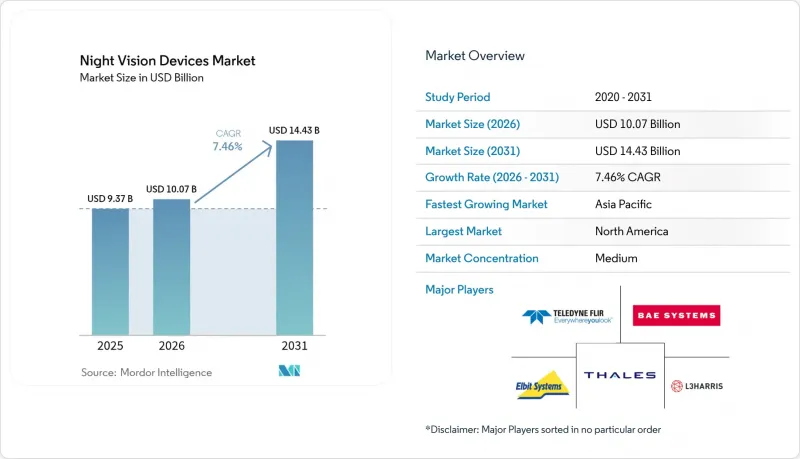
본 보고서는 기기 유형별(카메라, 고글, 라이플 스코프 등), 기술별(열화상, 이미지 증강관 등), 용도별(군 및 방위, 항법·해양 등), 최종 사용자별(정부, 기업, 일반 소비자), 판매 채널별(직접 계약, 유통업체·딜러, 전자상거래), 지역별로 분류되어 있습니다. 시장 예측은 금액(달러) 기준으로 제시되어 있습니다.
세계의 야시장비 시장 동향 및 인사이트
국방 현대화 예산 증가
NATO 회원국들은 2025년 집단 방위 지출을 2024년 대비 14% 증가한 3,920억 유로로 인상했으며, 24시간 대응이 가능한 전기 광학 시스템의 업그레이드에 상당한 비중을 할당했습니다. 미국 육군은 2025 회계연도에 3억 7,700만 달러, 2026 회계연도에 2억 1,100만 달러를 특히 퓨전(Fusion) 호환 고글에 할당함으로써, 단안형 고글의 교체에서 네트워크화된 병사용 시각 시스템으로의 전환을 시사했습니다. 인도 국방조달위원회는 2025년 8월 열화상 조준경 및 무기용 광학 장비에 67,000카롤 루피의 예산을 승인하여 뉴델리의 수입 대체 전략을 강화했습니다. 일본의 2026년도 예산에는 센카쿠 열도 순찰용 다중 스펙트럼 무인항공기(UAV) 탑재체에 765억 엔이 계상되어 있으며, 항공 플랫폼의 업그레이드 주기가 보병용 장비와 동기화되어 있음이 확인되었습니다. 한국이 2025년 1월 비무장지대(DMZ) 연안에 AI 탑재형 열화상 타워를 배치함으로써 오경보가 35% 감소했으며, 현대적인 예산 편성에서는 분석 기능을 사후 추가가 아닌 계획 단계부터 통합하고 있음이 입증되었습니다.
법 집행 기관의 융합형 센서 야간 시인 장치 도입
도시 지역 경찰 기관에서는 단일 채널 열화상관을 폐지하고, 열화상 및 영상 증폭 영상을 단일 디스플레이에 통합한 쌍안경으로의 전환이 진행되고 있습니다. 이러한 변경으로 인해 2024년에 실시된 ‘Breach PTQ136’ 단안형 쌍안경 시범 운영에서 로스앤젤레스 경찰관이 착색 유리 뒤에 숨은 도주자를 감지할 수 있게 되었습니다. 2025년 6월에 체결된 영국 1억 2,000만 파운드 규모의 기본 계약에서는 경찰관이 어두운 골목에서 밝은 거리로 이동할 때 발생하는 ‘블루밍’ 현상을 방지하기 위해 자동 휘도 제어 기능이 의무화되었습니다. 뉴욕시는 차량 탑재형 열화상 카메라에 420만 달러를 배정한 결과, 지하철 주요 역의 야간 대응 시간이 22% 단축되었습니다. 미국 세관·국경수비국은 1,200대의 열화상 타워를 추가로 도입하여, 기존의 적외선 비콘에 비해 무단 국경 횡단 감지율을 18% 향상시켰습니다. 열화상 및 가시광선 융합 기술 덕분에 두 유형의 광학 장비를 휴대할 필요가 없어져 훈련 부담이 경감될 뿐만 아니라, 연기나 먼지, 눈부심 속에서도 상황 인식을 유지할 수 있습니다.
높은 수명 주기 비용과 교정 비용
이미지 증강관은 1,000시간 사용 시마다 게인의 약 5%를 잃기 때문에 2년마다 800달러의 공장 재교정이 필요하며, 25만 대를 보유한 미 육군 장비 전체에 연간 4,700만 달러의 비용이 소요되고 있습니다. 비냉각형 마이크로볼로미터는 사막의 더위 속에서 더 빠르게 드리프트 현상이 발생합니다. 영국의 현장 감사 결과, 배치 후 10개월 이내에 차량용 열화상 조준경의 18%가 사양을 충족하지 못하는 것으로 밝혀졌습니다. 민간 경비 회사에는 정비 시설이 부족합니다. 텍사스주의 한 사업자는 40대의 카메라 유지 관리에 매년 1만 2,000달러를 지출하고 있으며, 이는 구매 가격의 15%에 해당합니다. 엑셀리타스(Excellitas)사는 퓨전 프리즘을 재조정할 수 있는 기술자가 극소수이기 때문에 2025년에는 6개월 분량의 서비스 대기 물량이 발생하여 법 집행 기관에 대한 반환이 지연될 것이라고 보고했습니다. 그 결과, 신흥 시장의 군는 교체 주기를 연장하거나 신품 가격의 60%에 재생산된 2세대 광학 장비를 구매하고 있으며, 이는 신규 판매를 억제하는 요인이 되고 있습니다.
부문 분석
2025년, 고글은 야간 투시경 시장 점유율의 36.71%를 차지하며 1위를 유지했습니다. 이는 쌍안경형 폼 팩터가 도보 순찰 중 깊이 감각을 유지하고 장시간 임무 시 피로를 줄여주기 때문입니다. 카메라는 2031년까지 연평균 성장률(CAGR) 8.41%를 나타낼 것으로 예측됩니다. 이는 상용 무인 항공기(UAV) 제조업체들이 영상을 클라우드 분석 대시보드로 직접 스트리밍하는 듀얼 센서 페이로드를 표준으로 장착하고 있기 때문입니다. 라이플 스코프는 텔레다인 FLIR사가 표적 식별 거리를 1,800m까지 연장하는 20배 줌 광학 시스템을 발표한 후에도 전술적 틈새 시장으로서의 입지를 유지했습니다. 이 거리는 대부분의 소형 무기 플랫폼의 사거리를 상회합니다. 모노큘러는 1그램 단위의 무게가 중요한 좁은 포탑이나 차량 내부에서 여전히 선호되는 선택지인 반면, 클립온 방식의 열화상 부착 장치는 조작자의 훈련을 변경할 필요 없이 기존 광학 장비에 후속 장착할 수 있습니다. 이러한 역할의 중복으로 인해 제품 간의 경쟁이 완화되어 전체 장치 구성의 총 판매량이 안정적으로 유지되고 있습니다.
카메라의 급속한 보급으로 인해 인공지능 엔진에 데이터를 공급하는 센서 기반이 확대되고, 노드당 비용이 감소함에 따라 주변 감시, 스마트 신호등, 중요 자산 점검 분야에서의 도입이 촉진되고 있습니다. 2031년까지는 쌍안경형 고글이 최대 수익원으로 남아 있을 것으로 보이지만, 비냉각형 열화상 코어의 비용이 지속적으로 하락함에 따라 엔트리급 카메라 키트의 가격이 1,000달러 아래로 떨어질 것으로 예상되어, 예산이 제한된 공공 안전 기관에 매력적인 선택지가 될 것입니다. 하지만 서방 국가 군의 융합형 쌍안경으로의 전환은 일부만 완료되었기 때문에 고글형 야간 투시경 시장은 절대적인 규모로 확대될 전망입니다. 또한, 각 벤더사는 탄소섬유와 마그네슘 합금을 활용한 케이스 재설계를 추진하여 무게를 15% 줄이는 동시에 평균 고장 간격(MTBF)을 향상시키고 있으며, 이는 조달 측면에서 설득력을 높이고 있습니다. 이러한 변화들을 종합해 보면, 임무 형태가 다양해짐에 따라 기기 유형의 주도권은 여전히 유동적임을 확인할 수 있습니다.
2025년 매출액 중 47.89%를 영상 증강관이 차지했으나, 현재는 다중 스펙트럼 융합 시스템에 그 기세를 양보하고 있으며, 해당 시스템은 2031년까지 연평균 성장률(CAGR) 8.44%를 나타낼 것으로 예측됩니다. 이미지 증강관은 텍스트 해독이나 제복 식별에 있어 여전히 저조도 환경에서 뛰어난 세부 재현성을 발휘하지만, 열화상 채널이 쉽게 투과하는 연기, 안개 또는 눈부심 속에서는 성능이 저하됩니다. 융합 광학 시스템은 두 영상을 실시간으로 중첩시키며, 최근 미 육군 훈련에서는 표적 인식 오류를 약 40% 감소시켰습니다. 적외선 조명 장치는 적 감지와 무관한 야생 동물 연구 분야에서 극히 제한된 틈새 시장을 차지하고 있지만, 신흥 저조도 CMOS 센서는 소셜 미디어 연동을 중시하는 500달러 미만의 소비자용 카메라에 널리 채택되고 있습니다.
가격 차이는 점차 줄어들고 있습니다. 듀얼 모드 고글의 가격 프리미엄은 2025년 80%에서 2026년에는 약 60%로 떨어질 것이며, 규모의 경제에 힘입어 이 차이는 10년 말까지 30% 미만으로 축소될 전망입니다. 그 결과, 많은 국방부에서는 현재 융합 기능을 옵션이 아닌 기본 사양으로 명시하고 있으며, 단일 채널 방식의 입찰을 배제하고 있습니다. 열화상 장비 공급업체들은 픽셀 피치를 지속적으로 축소하고 있어, 640×512 어레이를 7.5g의 코어에 탑재할 수 있게 되었으며, 드론이나 휴대용 안정화 장치에 쉽게 장착할 수 있게 되었습니다. 순수한 증강관에 의존하는 야시장비 시장 규모는 최전선 배치에서 운전자 지원, 유지보수 및 점검, 민간 보안 분야로의 재판매와 같은 2차 용도로 점차 전환될 것입니다. 이러한 진화는 기술의 융합이 조달을 통합 스펙트럼 아키텍처로 이끌고 있음을 여실히 보여줍니다.
지역별 분석
2025년, 북미는 야시장비 시장 점유율의 39.74%를 차지했습니다. 이는 미국 국방부의 2025 회계연도 3억 7,700만 달러 조달 및 2026 회계연도 2억 1,100만 달러 예산 배정에 힘입은 것으로, 이 자금은 주로 융합형 고글에 할당되었습니다. 캐나다는 C20 소총 프로그램을 위해 4,800만 캐나다 달러(3,500만 달러) 상당의 열화상 조준경을 발주했습니다. 한편, 멕시코는 북부 국경 지역의 마약 단속 순찰을 강화하기 위해 2025년도 야간 광학 장비 예산을 22% 증액했습니다. 이 지역은 보스턴과 올랜도에서 500km 반경 내에 집적된 수직 통합형 공장의 혜택을 받고 있으며, 이를 통해 리드 타임이 단축되고 정비 공장에서 신속한 수리가 가능해져 교체 주기를 4-6년이라는 안정적인 간격으로 유지하고 있습니다.
아시아태평양은 가장 빠르게 성장하는 지역으로, 2031년까지 연평균 성장률(CAGR) 8.53%로 확대될 것으로 예측됩니다. 이는 인도가 2025년 10월 659.47 카롤 루피(7,900만 달러)를 투자해 3만 개의 무기용 조준기를 구매한 것과, 일본이 2,773억 엔의 무인 시스템 관련 예산을 편성함에 따라 해당 지역의 지출이 증가하고 있기 때문입니다. 한국은 AI가 탑재된 열화상 타워를 도입하여 비무장지대(DMZ)에서의 오경보를 35% 줄였습니다. 또한, 호주는 ‘복서(Boxer)’ 전투 차량용 페이로드를 1억 2,000만 호주 달러(7,800만 달러)에 발주했으며, 이는 육상, 해상, 국경 경비 각 임무에서 광학 장비의 성능 향상이 요구되고 있음을 보여줍니다. 중국이 2025년에 안티몬화 인듐의 수출 할당량을 감축함에 따라 전 세계 공급량이 12% 감소했습니다. 이로 인해 검출기 제조업체들은 수은·카드뮴·텔루르화물(MCT) 대체재의 인증을 받을 수밖에 없게 되었으며, 아시아태평양의 납기 지연 가능성이 있지만, 전반적인 판매량 증가를 저해하지는 않을 것입니다.
유럽, 중동 및 아프리카, 남미는 합쳐서 점점 더 다양해지는 비즈니스 기회를 형성하고 있으며, 야간 투시 장비 시장 전체를 상승 궤도에 계속 올려놓고 있습니다. 유럽에서는 2025년 12월, 유럽 공동 무기 조달 기구(OJAC)가 독일과 벨기에를 대상으로 17만 8,000개의 고글을 발주하여 해당 기간 최대 규모의 단일 수주를 기록했습니다. 이 프로그램은 공통된 영상 증강관 사양을 확정하고, 규모에 따른 가격 책정을 촉진하기 위한 것입니다. 아랍에미리트(UAE)는 장갑차 개조를 위해 엘빗 시스템즈(Elbit Systems)와 8년간 23억 달러 규모의 기본 계약을 체결했습니다. 또한 사우디아라비아는 780만 달러 규모의 이동식 감시 시스템 계약을 추가로 체결하여, 걸프 국가들의 현대화 계획에서 융합형 센서가 중시되고 있음을 여실히 보여주었습니다. 브라질의 6,400만 달러 규모의 아마존 열대우림 감시 기금과 아르헨티나의 600만 달러 규모의 국경용 단안형 감시 장치 프로그램은 재정적 제약 속에서도 환경 법 집행 및 마약 단속으로 인해 라틴아메리카 수요가 감소할 가능성이 있음을 보여줍니다. 이를 종합해 보면, 지역을 초월한 수주는 공급업체의 수익을 다각화하고 특정 국방 예산에 대한 과도한 의존을 완화하는 결과를 가져옵니다.
기타 혜택 :
- 엑셀 형식 시장 예측(ME) 시트
- 3개월간의 애널리스트 지원
자주 묻는 질문
목차
제1장 서론
제2장 조사 방법
제3장 주요 요약
제4장 시장 구도
제5장 시장 규모 및 성장 예측
제6장 경쟁 구도
제7장 시장 기회 및 향후 전망
AJY 26.09.11According to Mordor Intelligence, the night vision devices market size is projected to expand from USD 9.37 billion in 2025 and USD 10.07 billion in 2026 to USD 14.43 billion by 2031, registering a CAGR of 7.46% between 2026 and 2031.
This report is Segmented by Device Type (Cameras, Goggles, Rifle Scopes, and More), Technology (Thermal Imaging, Image Intensifier, and More), Application (Military and Defence, Navigation and Marine, and More), End User (Government, Commercial, Consumer), Sales Channel (Direct Contracts, Distributors and Dealers, E-Commerce), and Geography. The Market Forecasts are Provided in Terms of Value (USD).
Global Night Vision Devices Market Trends and Insights
Rising Defense Modernization Budgets
NATO members increased collective defense outlays to EUR 392 billion in 2025, up 14% from 2024, and allocated a larger share to 24-hour electro-optical upgrades. The United States Army earmarked USD 377 million in FY 2025 and USD 211 million in FY 2026 specifically for fusion-ready goggles, signaling a pivot from monocular replacements to networked soldier-vision suites. India's Defence Acquisition Council cleared INR 67,000 crore in August 2025 for thermal driver sights and weapon optics, reinforcing New Delhi's import-substitution strategy. Japan's FY 2026 budget features JPY 76.5 billion for multispectral UAV payloads to patrol the Senkaku Islands, confirming that airborne platforms now share the same upgrade cadence as infantry kits. South Korea's January 2025 deployment of AI-enabled thermal towers along the DMZ cut false alarms by 35%, proving that modern budgets now integrate analytics from inception rather than bolt them on later.
Adoption of Fused-Sensor Night Vision for Law Enforcement
Urban police agencies are retiring single-channel tubes in favor of binoculars that blend thermal and image-intensified video into a single display, a change that lets Los Angeles officers spot fugitives hiding behind tinted glass during a 2024 pilot of Breach PTQ136 monoculars. The United Kingdom's GBP 120 million framework, signed in June 2025, requires automatic brightness control to prevent blooming when officers move from dark alleys to lit streets. New York City allocated USD 4.2 million for vehicle-mounted thermal cameras and then logged a 22% drop in after-dark response time at subway hubs. U.S. Customs and Border Protection added 1,200 thermal towers, which increased unauthorized-crossing detections by 18% compared with legacy infrared beacons. Thermal-visible fusion reduces the need to carry two optics, lowers training overhead, and preserves situational awareness in smoke, dust, or glare.
High Lifecycle and Calibration Cost
Image-intensifier tubes lose roughly 5% of their gain every 1,000 h of use, forcing USD 800 factory recalibrations every 2 years and costing the U.S. Army USD 47 million annually across a 250,000-unit fleet. Uncooled microbolometers drift faster in desert heat; a U.K. field audit found 18% of vehicle thermal sights out of spec within 10 months of deployment. Commercial security firms lack depot facilities. A Texas operator spends USD 12,000 each year maintaining 40 cameras, which is 15% of the purchase cost. Excelitas reported a six-month service backlog in 2025 because only a handful of technicians can realign fusion prisms, delaying law enforcement returns. Emerging-market militaries therefore stretch replacement cycles or buy refurbished Gen-2 optics at 60% of new-unit cost, tempering fresh sales.
Other drivers and restraints analyzed in the detailed report include:
- Digitized Soldier-Vision Programs
- Miniaturized SWaP-C Image-Intensifier Tubes
- Export-Control Restrictions
For complete list of drivers and restraints, kindly check the Table Of Contents.
Segment Analysis
Goggles captured 36.71% of the night vision devices market share in 2025, maintaining the lead, as binocular form factors preserve depth perception during foot patrols and reduce fatigue on long missions. Cameras are projected to record an 8.41% CAGR through 2031 as commercial unmanned-aerial-vehicle makers bundle dual-sensor payloads that stream video directly to cloud analytics dashboards. Rifle scopes retained their tactical niche after Teledyne FLIR unveiled a 20X zoom optic that extends target identification to 1,800 m, a distance that out-ranges most small-arms platforms. Monoculars remain the preferred choice in cramped turret and vehicle interiors where every gram matters, while clip-on thermal attachments retrofit legacy glass without changing operator training. These overlapping roles reduce product cannibalization and stabilize overall volumes within the device mix.
Cameras' fast climb widens the installed sensor base that feeds artificial-intelligence engines, lowering per-node costs and driving adoption in perimeter monitoring, smart traffic lights, and critical-asset inspections. Although binocular goggles will stay the largest revenue contributor through 2031, sustained cost declines in uncooled thermal cores are expected to pull entry-level camera kits below USD 1,000, enticing budget-constrained public-safety agencies. The night vision devices market for goggles will nonetheless expand in absolute terms, as Western armies have only partially completed their transition to fused binoculars. Vendors are also redesigning housings with carbon fiber and magnesium alloys, trimming 15% of weight and improving mean-time-between-failure scores, which strengthens procurement arguments. Combined, these shifts confirm that device-type leadership will remain fluid as mission profiles diversify.
Image intensifiers accounted for 47.89% of 2025 revenue, yet now cede momentum to multispectral fusion systems, which are forecast to grow at an 8.44% CAGR through 2031. Intensifiers still deliver superior low-light detail for reading text or distinguishing uniforms, but they struggle in smoke, fog, or glare that thermal channels easily pierce. Fusion optics overlays both streams in real time, cutting target-recognition errors by roughly 40% during recent U.S. Army drills. Infrared-illumination units hold a small niche in wildlife studies where adversary detection is irrelevant, while emerging low-light CMOS sensors populate sub-USD 500 consumer cameras that emphasize social-media connectivity.
Price gaps are narrowing: the premium for dual-mode goggles fell from 80% in 2025 to about 60% in 2026, and scale economies are on track to compress that spread below 30% by decade's end. As a result, many defense ministries now write fusion capability as a baseline specification rather than an option, locking out single-channel bids. Thermal vendors continue shrinking pixel pitch, allowing 640X512 arrays to fit within 7.5 g cores that mount easily on drones and handheld stabilizers. The night vision devices market size tied to pure intensifiers will gradually shift from frontline deployment toward secondary uses such as driver enhancement, maintenance inspection, and resale into commercial security. This evolution underscores how technological convergence is steering procurement toward integrated spectral architectures.
Complete Report Scope:
- By Device Type
- Cameras
- Goggles
- Monoculars and Binoculars
- Rifle Scopes
- Other Device Types
- By Technology
- Thermal Imaging
- Image Intensifier
- Infra-Red Illumination
- Multispectral Fusion
- Other Technologies
- By Application
- Military and Defence
- Surveillance and Security
- Wildlife Spotting and Conservation
- Navigation and Marine
- Other Applications
- By End User
- Government
- Commercial
- Consumer
- By Sales Channel
- Direct Contracts
- Distributors and Dealers
- E-Commerce
- By Geography
- North America
- United States
- Canada
- Mexico
- South America
- Brazil
- Argentina
- Rest of South America
- Europe
- United Kingdom
- Germany
- France
- Italy
- Rest of Europe
- Asia Pacific
- China
- Japan
- India
- South Korea
- Rest of Asia Pacific
- Middle East and Africa
- Middle East
- United Arab Emirates
- Saudi Arabia
- Rest of Middle East
- Africa
- South Africa
- Egypt
- Rest of Africa
- Middle East
- North America
Geography Analysis
North America accounted for 39.74% of the night vision devices market share in 2025, anchored by the United States Department of Defense's USD 377 million fiscal-year 2025 procurement and USD 211 million fiscal-year 2026 appropriation, funds channeled mainly into fusion-ready goggles. Canada added a CAD 48 million (USD 35 million) thermal-sight order for its C20 rifle program, while Mexico raised its 2025 budget for night optics by 22% to bolster counter-narcotics patrols along the northern border. The region benefits from vertically integrated factories clustered within 500 km of Boston and Orlando, which shorten lead times and enable quick depot repairs, keeping replacement cycles on a steady four-to-six-year cadence.
Asia-Pacific is the fastest-growing territory, projected to expand at an 8.53% CAGR through 2031 as India's INR 659.47 crore (USD 79 million) October 2025 buy for 30,000 weapon sights and Japan's JPY 277.3 billion unmanned-capability budget lifts regional spending. South Korea deployed AI-enabled thermal towers that cut DMZ false alarms by 35%, and Australia placed an AUD 120 million (USD 78 million) order for Boxer combat-vehicle payloads, signaling that land, maritime, and border missions all demand upgraded optics. China's 2025 export quota on indium antimonide trimmed global supply 12%, forcing detector makers to qualify mercury-cadmium-telluride alternatives, which may elongate Asia-Pacific delivery schedules but should not derail overall unit growth.
Europe, the Middle East, Africa, and South America together represent an increasingly diversified opportunity set that keeps the overall night vision devices market on an upward trajectory. Europe booked the single-largest order of the period when the Organisation for Joint Armament Cooperation commissioned 178,000 goggles for Germany and Belgium in December 2025, a program that locks in common image-intensifier specifications and drives scale pricing. The United Arab Emirates signed an eight-year USD 2.3 billion framework with Elbit Systems to retrofit armored fleets, and Saudi Arabia added a USD 7.8 million mobile-surveillance award, highlighting how Gulf modernization agendas favor fused sensors. Brazil's USD 64 million Amazon rainforest surveillance fund and Argentina's USD 6 million border-monocular program show that environmental enforcement and narcotics control can reduce Latin American demand, even under fiscal constraints. Taken together, cross-region orders diversify supplier revenue and reduce over-reliance on any single defense budget.
- Teledyne FLIR LLC
- L3Harris Technologies Inc.
- Elbit Systems Ltd.
- BAE Systems plc
- Thales Group
- Raytheon Technologies Corp.
- Bushnell Holdings Inc.
- Exosens SAS
- Panasonic Holdings Corp.
- Excelitas Technologies Corp.
- EOTECH LLC
- Opgal Optronic Industries Ltd.
- QinetiQ Group plc
- Photonis France SAS
- Theon Sensors SA
- Rheinmetall AG
- Hensoldt AG
- SATIR Europe (Ireland) Co. Ltd.
- American Technologies Network Corp.
- AGM Global Vision LLC
- Yukon Advanced Optics Worldwide
- Nivisys LLC
- Opticoelectron Group JSCo.
- Tactical Night Vision Company LLC
- Tak Technologies Pvt. Ltd.
- Safran Electronics and Defense SA
- Leonardo DRS Inc.
Additional Benefits:
- The market estimate (ME) sheet in Excel format
- 3 months of analyst support
TABLE OF CONTENTS
1 INTRODUCTION
- 1.1 Study Assumptions and Market Definition
- 1.2 Scope of the Study
2 RESEARCH METHODOLOGY
3 EXECUTIVE SUMMARY
4 MARKET LANDSCAPE
- 4.1 Market Overview
- 4.2 Market Drivers
- 4.2.1 Rising Defence Modernisation Budgets
- 4.2.2 Adoption of Fused-Sensor Night-Vision for Law-Enforcement
- 4.2.3 Digitised Soldier-Vision Programmes (ENVG-B, DNVT)
- 4.2.4 Miniaturised SWaP-C Image-Intensifier Tubes
- 4.2.5 Night-Vision Integration in Commercial UAVs
- 4.2.6 On-Orbit Low-Light Sensors for Space Situational Awareness
- 4.3 Market Restraints
- 4.3.1 High Lifecycle and Calibration Cost
- 4.3.2 Export-Control (ITAR, Wassenaar) Restrictions
- 4.3.3 Day-Bright Blooming and Sensor Saturation
- 4.3.4 Scarcity of Indium Antimonide Supply Chain
- 4.4 Industry Value Chain Analysis
- 4.5 Impact of Macroeconomic Factors on the Market
- 4.6 Regulatory Landscape
- 4.7 Technological Outlook
- 4.8 Porter's Five Forces Analysis
- 4.8.1 Bargaining Power of Suppliers
- 4.8.2 Bargaining Power of Buyers
- 4.8.3 Threat of New Entrants
- 4.8.4 Threat of Substitutes
- 4.8.5 Intensity of Competitive Rivalry
5 MARKET SIZE AND GROWTH FORECASTS (VALUE)
- 5.1 By Device Type
- 5.1.1 Cameras
- 5.1.2 Goggles
- 5.1.3 Monoculars and Binoculars
- 5.1.4 Rifle Scopes
- 5.1.5 Other Device Types
- 5.2 By Technology
- 5.2.1 Thermal Imaging
- 5.2.2 Image Intensifier
- 5.2.3 Infra-Red Illumination
- 5.2.4 Multispectral Fusion
- 5.2.5 Other Technologies
- 5.3 By Application
- 5.3.1 Military and Defence
- 5.3.2 Surveillance and Security
- 5.3.3 Wildlife Spotting and Conservation
- 5.3.4 Navigation and Marine
- 5.3.5 Other Applications
- 5.4 By End User
- 5.4.1 Government
- 5.4.2 Commercial
- 5.4.3 Consumer
- 5.5 By Sales Channel
- 5.5.1 Direct Contracts
- 5.5.2 Distributors and Dealers
- 5.5.3 E-Commerce
- 5.6 By Geography
- 5.6.1 North America
- 5.6.1.1 United States
- 5.6.1.2 Canada
- 5.6.1.3 Mexico
- 5.6.2 South America
- 5.6.2.1 Brazil
- 5.6.2.2 Argentina
- 5.6.2.3 Rest of South America
- 5.6.3 Europe
- 5.6.3.1 United Kingdom
- 5.6.3.2 Germany
- 5.6.3.3 France
- 5.6.3.4 Italy
- 5.6.3.5 Rest of Europe
- 5.6.4 Asia Pacific
- 5.6.4.1 China
- 5.6.4.2 Japan
- 5.6.4.3 India
- 5.6.4.4 South Korea
- 5.6.4.5 Rest of Asia Pacific
- 5.6.5 Middle East and Africa
- 5.6.5.1 Middle East
- 5.6.5.1.1 United Arab Emirates
- 5.6.5.1.2 Saudi Arabia
- 5.6.5.1.3 Rest of Middle East
- 5.6.5.2 Africa
- 5.6.5.2.1 South Africa
- 5.6.5.2.2 Egypt
- 5.6.5.2.3 Rest of Africa
- 5.6.5.1 Middle East
- 5.6.1 North America
6 COMPETITIVE LANDSCAPE
- 6.1 Market Concentration
- 6.2 Strategic Moves
- 6.3 Market Share Analysis
- 6.4 Company Profiles (includes Global Level Overview, Market Level Overview, Core Segments, Financials as available, Strategic Information, Market Rank/Share, Products and Services, Recent Developments)
- 6.4.1 Teledyne FLIR LLC
- 6.4.2 L3Harris Technologies Inc.
- 6.4.3 Elbit Systems Ltd.
- 6.4.4 BAE Systems plc
- 6.4.5 Thales Group
- 6.4.6 Raytheon Technologies Corp.
- 6.4.7 Bushnell Holdings Inc.
- 6.4.8 Exosens SAS
- 6.4.9 Panasonic Holdings Corp.
- 6.4.10 Excelitas Technologies Corp.
- 6.4.11 EOTECH LLC
- 6.4.12 Opgal Optronic Industries Ltd.
- 6.4.13 QinetiQ Group plc
- 6.4.14 Photonis France SAS
- 6.4.15 Theon Sensors SA
- 6.4.16 Rheinmetall AG
- 6.4.17 Hensoldt AG
- 6.4.18 SATIR Europe (Ireland) Co. Ltd.
- 6.4.19 American Technologies Network Corp.
- 6.4.20 AGM Global Vision LLC
- 6.4.21 Yukon Advanced Optics Worldwide
- 6.4.22 Nivisys LLC
- 6.4.23 Opticoelectron Group JSCo.
- 6.4.24 Tactical Night Vision Company LLC
- 6.4.25 Tak Technologies Pvt. Ltd.
- 6.4.26 Safran Electronics and Defense SA
- 6.4.27 Leonardo DRS Inc.
7 MARKET OPPORTUNITIES AND FUTURE OUTLOOK
- 7.1 White-Space and Unmet-Need Assessment


