|
시장보고서
상품코드
2124037
데이터 컨버터 시장 : 점유율 분석, 업계 동향과 통계, 성장 예측(2026-2031년)Data Converter - Market Share Analysis, Industry Trends & Statistics, Growth Forecasts (2026 - 2031) |
||||||
 Mordor Intelligence
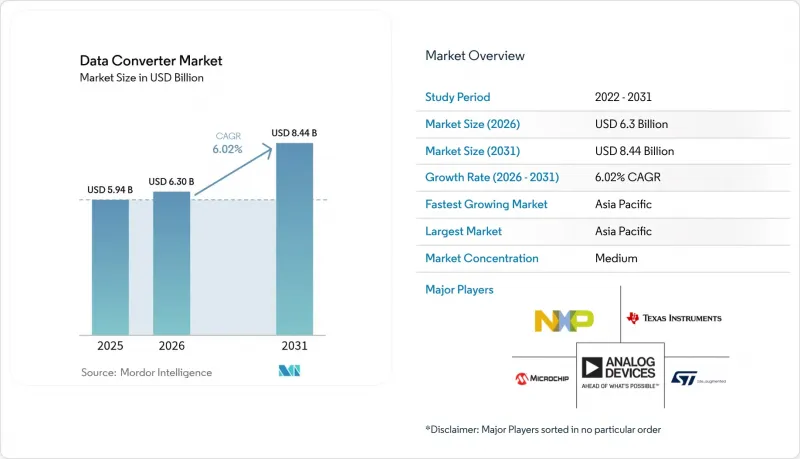
Mordor Intelligence에 의하면, 데이터 컨버터 시장 규모는 2025년 59억 4,000만 달러에서 2026년에는 63억 달러로 확대되어 2026년부터 2031년까지 CAGR 6.02%로 성장을 지속하여, 2031년에는 84억 4,000만 달러에 이를 것으로 예측됩니다.
본 보고서는 변환기 유형(아날로그-디지털 변환기, 디지털-아날로그 변환기 등), 해상도(8비트 이하 등), 샘플링 속도(고속, 중속, 저속),최종 사용자 산업(통신, 자동차, 산업용 자동화 및 테스트, 기타), 그리고 지역(북미, 남미, 유럽, 기타)별로 분류되어 있습니다. 시장 예측은 금액(달러) 기준으로 제시되어 있습니다.
세계 데이터 컨버터 시장 동향 및 인사이트
5G 인프라의 보급
5G 기지국의 Massive MIMO 아키텍처에서는 60dB를 초과하는 스퓨리어스 프리 다이내믹 레인지를 갖춘 멀티 기가헤르츠급 ADC 및 DAC 채널이 요구되며, 컨버터 제조업체는 전력 소비 증가를 억제하면서 선형성을 최적화해야 합니다. 각국 정부는 2024년 5G 구축을 위해 중국에서 244억 달러, 미국에서 131억 달러, 유럽 전체에서 108억 달러를 예산으로 편성했으며, 이로 인해 수요는 고속·고해상도 부품에 집중되고 있어 특수 아날로그 파운드리 생산 능력에 부담이 가중되고 있습니다. 소프트웨어 정의 무선(SDR) 플랫폼은 더욱 복잡해지고 있습니다. 장비 제조업체들은 현재 단일 시스템 온 칩(SoC) 내에서 멀티 GSPS 속도의 14-16비트 분해능을 요구하고 있으며, 이로 인해 속도와 프로그래밍 가능한 유연성을 겸비한 디바이스에 대한 프리미엄 가격 책정이 촉진되고 있습니다. RF 프런트엔드와 고속 컨버터를 통합한 모놀리식 솔루션을 공급할 수 있는 벤더는 조달을 간소화하고 장기적인 지원을 확보하고자 하는 통신 기기 OEM 제조업체와 수년에 걸친 공급 계약을 체결하고 있습니다.
의료용 영상 진단 분야의 해상도 요구 사항 증가
MRI, CT 및 차세대 초음파 진단 장비에서는 AI를 활용한 진단 기준을 충족하는 더 우수한 동적 범위와 노이즈 성능을 실현하기 위해 16-24비트 델타-시그마형 ADC에 대한 의존도가 높아지고 있습니다. 초음파 진단 장치는 일반적으로 40 MHz-200 MHz의 샘플링 속도로 작동하며, 신호 열화는 현재 이상 감지 워크플로우의 기반이 되고 있는 머신러닝 알고리즘에 직접적인 악영향을 미칩니다. 규제 당국은 FDA 510(k) 신청 시 컨버터의 사양을 엄격하게 심사하기 때문에 각 OEM 업체들은 임상 성능 실적이 문서화되어 있고 현장에서 풍부한 운영 데이터를 보유한 장치를 선정하도록 권장받고 있습니다. 델타-시그마 토폴로지가 선호되는 이유는 고유한 노이즈 셰이핑 특성으로 인해 아날로그 필터링 요구 사항이 최소화되어, 설계자가 환자 안전 기준을 유지하면서 검증 주기를 단축할 수 있기 때문입니다. 이 틈새 시장을 공략하는 공급업체는 의료기기의 제품 수명 주기가 7년에서 10년으로 길어 단기적인 경제 변동의 영향을 덜 받기 때문에 수익 회복력을 높일 수 있습니다.
높은 샘플링 속도에서의 열 잡음 제한
컨버터의 샘플링 속도가 1 GSPS를 초과하면, 기본 열 잡음은 대역폭에 비례하여 증가하며, -174 dBm/Hz 부근에 하한이 설정되어 달성 가능한 신호 대 잡음비가 제한됩니다. 설계자들은 시간 인터리브형 아키텍처를 통해 이러한 장벽을 극복하려고 시도하고 있지만, 미스매치 및 보정 오버헤드로 인해 실리콘 면적과 전력 소비가 증가하게 됩니다. 28nm 미만의 공정 노드로의 전환은 소자의 고유 잡음을 개선하지만, 웨이퍼 비용과 수율 리스크를 증가시키기 때문에 중규모 생산을 하는 산업용 고객에게는 도입이 제한됩니다. 따라서 물리적 제약에 의한 상한선이 최첨단 분야의 성장을 억제하고 있으며, 일부 OEM 제조업체는 컨버터의 성능 요구 사항을 완화하는 대체 시스템 아키텍처로 전환하고 있습니다.
부문 분석
2025년에도 아날로그-디지털 변환기는 데이터 변환기 시장 점유율의 58.72%를 차지하며 여전히 주도적인 위치를 유지하고 있습니다. 이는 통신, 의료, 산업용 시스템이 신호 체인의 각 단계에서 고정밀 디지털화에 의존하고 있기 때문입니다. 집적화가 진행되고 있음에도 불구하고, 시스템당 디바이스 수는 높은 수준을 유지하고 있어 대규모 도입 기반이 유지되고 있습니다. 그러나 혼합 신호 변환기는 개별 ADC 및 DAC 채널을 단일 패키지에 통합함으로써 기판 면적을 절약하고 부품 원가를 절감할 수 있기 때문에 2031년까지 연평균 성장률(CAGR) 7.48%라는 명확한 성장 동력이 되고 있습니다. 이러한 동향은 시스템 인 패키지(SiP) 모듈의 보급과 맞물려, 각 OEM 업체들이 컨버터 코어를 전원 관리 및 인터페이스 로직과 하나의 기판 위에 통합할 수 있게 하고 있습니다. 그 결과, 데이터 컨버터 시장에서는 현장 신뢰성을 높이기 위해 자가 보정 엔진, 온도 센서, 온칩 전압 레퍼런스를 통합한 혼합 신호 디바이스에 대한 연구 개발(R&D)에 대한 관심이 높아지고 있습니다.
자동차 및 산업 분야의 시스템 통합사업자들은 외부 회로 없이도 예측 유지보수 프로그램을 용이하게 할 수 있도록, 혼합 신호 설계에 내재된 진단 기능을 높이 평가했습니다. 텍사스 기기의 16채널 DAC ‘DAC60516’은 이러한 방향성을 구현한 제품으로, 12비트 DAC 어레이와 내장형 2.5V 레퍼런스를 결합하여 주변 부품을 최대 30%까지 줄였습니다. 예측 기간 동안, 혼합 신호 솔루션은 과거 개별 ADC/DAC 쌍에 할당되었던 시장 점유율을 점진적으로 확대하여, 데이터 컨버터 시장에서 가장 역동적인 분야로서의 입지를 공고히 할 전망입니다.
2025년에는 10-12비트 디바이스가 매출의 37.85%를 차지하며, 적당한 동적 범위로 대부분의 변조 및 오디오 요구 사항을 충족하는 주류 무선 인프라 및 소비자 가전 시장을 지원할 전망입니다. 하이엔드 분야에서는 16비트 이상의 컨버터가 2031년까지 연평균 성장률(CAGR) 7.86%로 시장을 주도하고 있습니다. 이는 서브 마이크로볼트 수준의 노이즈에 묻힌 신호를 측정해야 하는 MRI 스캐너, 지구물리 계측 기기 및 공장 자동화 장비에 대한 수요가 증가하고 있음을 반영합니다. 따라서 고정밀 부문의 데이터 컨버터 시장 규모는 판매 수량 기준으로는 작지만, 평균 판매 가격이 저해상도 대체 제품보다 몇 배나 높기 때문에 급속히 확대될 것으로 예측됩니다.
교정 알고리즘과 디지털 오차 보정 기술의 발전으로, 현재는 16비트 이상의 부품이 선형성을 손상시키지 않고 2.5V 전원으로 작동할 수 있게 되었으며, 최신 저전력 로직과의 호환성이 확대되어 고가의 아날로그 신호 조정 필요성이 줄어들고 있습니다. 닛신보 마이크로디바이스의 핀 호환성을 갖춘 16비트, 20비트, 24비트 NA220x 제품군을 통해 OEM 업체들은 단일 PCB 레이아웃상에서 성능 등급을 계층화할 수 있게 되어, 인증 주기를 대폭 단축할 수 있습니다. 분해능 단계당 비용이 지속적으로 하락함에 따라, 8비트 이하의 틈새 시장은 계속해서 축소되고 있으며, 레거시 용도으로만 한정되는 추세를 보이고 있습니다.
지역별 분석
아시아태평양은 2025년에 매출의 40.12%를 차지하며 계속해서 주도적인 위치를 유지하고 있으며, 중국의 국내 웨이퍼 제조 투자, 일본의 계측 기술 전문 지식, 그리고 한국의 선진적인 패키징 능력을 바탕으로 2031년까지 연평균 성장률(CAGR) 6.73%를 나타낼 것으로 예측됩니다. 소비자용 및 산업용 수요를 모두 충족하는 저전력 혼합 신호 컨버터는 재고 주기를 단축하기 위해 현지 공급망을 중시하는 지역의 OEM 기업들에서 적극적으로 채택되고 있습니다. 각 지역 정부는 반도체 자급자족 프로그램을 지원하고 있으며, 이로 인해 통신 인프라 및 AIoT 엣지 디바이스에서 고성능 컨버터의 채택이 더욱 가속화되고 있습니다.
북미는 매출액 기준 2위를 차지하고 있으며, 방위용 전자기기, 광대역 구축, 생명과학용 계측기기 분야에서 꾸준한 수요가 계속될 것으로 보입니다. 방사선 내성 요건을 충족하거나 FDA의 설계 자료 요건을 충족하는 컨버터는 가격 프리미엄이 붙기 때문에 소비자용 및 휴대전화용 수요의 주기적 영향을 완화하고 있습니다. 실리콘밸리와 오스틴을 중심으로 한 활기찬 팹리스 기업 커뮤니티는 특수한 컨버터 아키텍처를 목표로 하는 스타트업 기업의 건실한 파이프라인을 유지하고 있어, 데이터 컨버터 시장에서 지역 전체의 활력을 더욱 강화하고 있습니다.
유럽은 엄격한 기능 안전 및 전자기 호환성 기준이 요구되는 자동차, 산업용 자동화, 재생에너지 응용 분야에서 리더십을 발휘하고 있습니다. 이 지역은 반도체 제조 능력 자체에서는 다른 지역에 뒤처져 있지만, ‘유럽 칩 법’과 같은 정책 이니셔티브를 통해 현지 아날로그 공정 개발이 촉진되어 향후 공급망 단축으로 이어질 가능성이 있습니다. ISO 26262 자동차 규격 준수 및 IEC 61000 내성 규격을 충족하는 컨버터는 Tier 1 공급업체들 사이에서 우대받고 있으며, 유럽 규격에 정통한 벤더에게는 지속적인 시장 점유율 확보로 이어지고 있습니다. 남미, 중동 및 아프리카와 같은 신흥 지역에서는 소규모 기반에서 두 자릿수의 판매량 성장을 기록하고 있지만, 인프라 부족과 환율 변동으로 인해 절대적인 매출 확대는 여전히 제한되고 있습니다.
기타 혜택:
- 엑셀 형식 시장 예측(ME) 시트
- 3개월간의 애널리스트 지원
자주 묻는 질문
목차
제1장 서론
제2장 조사 방법
제3장 주요 요약
제4장 시장 구도
제5장 시장 규모와 성장 예측
제6장 경쟁 구도
제7장 시장 기회와 향후 전망
JHS 26.09.07According to Mordor Intelligence, the data converter market size is expected to grow from USD 5.94 billion in 2025 to USD 6.3 billion in 2026 and is forecast to reach USD 8.44 billion by 2031 at 6.02% CAGR over 2026-2031.

This report is Segmented by Converter Type (Analog-To-Digital Converters, Digital-To-Analog Converters, and More), Resolution (<= 8-Bit, and More), Sampling Rate (High-Speed, Mid-Speed, Low-Speed), End-User Industry (Telecommunications, Automotive, Industrial Automation and Test, and More), and Geography (North America, South America, Europe, and More). The Market Forecasts are Provided in Terms of Value (USD).
Global Data Converter Market Trends and Insights
Proliferation of 5G Infrastructure
Massive MIMO architectures in 5G base stations call for multi-gigahertz ADC and DAC channels with spurious-free dynamic range above 60 dB, forcing converter makers to optimize linearity without ballooning power budgets. Governments earmarked USD 24.4 billion in China, USD 13.1 billion in the United States, and USD 10.8 billion across Europe for 5G deployments in 2024, concentrating demand on high-speed, high-resolution parts that strain specialty analog foundry capacity. Software-defined radio platforms add further complexity because equipment makers now require 14-16-bit resolution at multi-GSPS rates within a single system-on-chip, spurring premium pricing for devices that combine speed with programmable flexibility. Vendors able to supply monolithic solutions that integrate RF front ends alongside high-speed converters are securing multi-year supply agreements with telecom OEMs seeking to simplify procurement and ensure long-term support.
Rising Resolution Requirements in Medical Imaging
MRI, CT, and next-generation ultrasound modalities increasingly depend on 16-24-bit delta-sigma ADCs to deliver enhanced dynamic range and noise performance that meet AI-enabled diagnostic standards. Ultrasound consoles typically operate between 40 MHz and 200 MHz sampling rates, and any signal degradation directly compromises machine learning algorithms that now underpin anomaly detection workflows. Regulators scrutinize converter specifications during FDA 510(k) submissions, motivating OEMs to select devices with documented clinical performance histories and extensive in-field operating data. Delta-sigma topologies are favored because their inherent noise-shaping characteristics minimize analog filtering requirements, allowing designers to shorten validation cycles while maintaining patient-safety thresholds. Suppliers addressing this niche bolster revenue resiliency because medical devices follow seven-to-ten-year product lifecycles that insulate demand from short-term economic swings.
Thermal-Noise Limitations at Higher Sampling Rates
As converter sampling speeds eclipse 1 GSPS, fundamental thermal noise rises proportionally with bandwidth, setting a floor near -174 dBm/Hz and limiting achievable signal-to-noise ratios. Designers attempt to circumvent the barrier through time-interleaved architectures, yet mismatch and calibration overheads inflate silicon area and power consumption. Migrating to sub-28 nm nodes improves intrinsic device noise but drives up wafer costs and yield risk, constraining accessibility for mid-volume industrial customers. The physics-driven ceiling, therefore, tempers growth in bleeding-edge segments, steering some OEMs toward alternative system architectures that relax converter performance demands.
Other drivers and restraints analyzed in the detailed report include:
- Shift Toward Electrification in Automotive Systems
- Growth of Edge AI Hardware Accelerators
- Supply-Chain Cyclicality of Specialty Foundries
For complete list of drivers and restraints, kindly check the Table Of Contents.
Segment Analysis
Analog-to-digital converters retain primacy with 58.72% of the data converter market share in 2025 as telecom, medical, and industrial systems depend on precise digitization for every signal chain step. Device counts per system stay elevated even as integration rises, maintaining a large installed base. Mixed-signal converters, however, represent the clear growth vector with a 7.48% CAGR to 2031 because they collapse discrete ADC and DAC channels into a single package, saving board area and trimming bill-of-materials cost. The trend dovetails with wider adoption of system-in-package modules, enabling OEMs to combine converter cores with power management and interface logic under one substrate. As a result, the data converter market is witnessing a heavier R&D focus on mixed-signal devices that embed self-calibration engines, temperature sensors, and on-chip voltage references to enhance field reliability.
System integrators in automotive and industrial segments value the diagnostic features implicit in mixed-signal designs because they facilitate predictive maintenance programs without external circuitry. Texas Instruments' 16-channel DAC60516 exemplifies the direction, coupling a 12-bit DAC array with an internal 2.5 V reference to cut peripheral components by up to 30%. Over the forecast horizon, mixed-signal solutions are projected to capture incremental sockets once reserved for separate ADC/DAC pairs, reinforcing their status as the most dynamic portion of the data converter market.
10-12-bit devices commanded 37.85% revenue in 2025, serving mainstream wireless infrastructure and consumer electronics where moderate dynamic range satisfies most modulation and audio requirements. At the premium end, >16-bit converters are pacing the field with an 7.86% CAGR to 2031, reflecting intensified demand from MRI scanners, geophysical instruments, and factory automation rigs that must measure signals buried in sub-microvolt noise. The data converter market size for high-precision segments is therefore projected to expand rapidly despite their smaller volume base because average selling prices sit several multiples above lower-resolution alternatives.
Advances in calibration algorithms and digital error correction now permit >16-bit parts to operate from 2.5 V supplies without sacrificing linearity, broadening their compatibility with modern low-power logic and reducing the need for expensive analog signal conditioning. Nisshinbo Micro Devices' pin-compatible 16-, 20-, and 24-bit NA220x family lets OEMs tier performance grades across a single PCB layout, materially shrinking qualification cycles. Ongoing shrinkage in cost per resolution step will continue to erode the <=8-bit niche, which is increasingly confined to legacy applications.
Complete Report Scope:
- By Converter Type
- Analog-to-Digital Converters (ADC)
- Digital-to-Analog Converters (DAC)
- Mixed-Signal Converters (ADC + DAC)
- By Resolution
- Less than equal to 8-bit
- 10 - 12-bit
- 14 - 16-bit
- Greater than 16-bit
- By Sampling Rate
- High-speed (Greater than 500 MSPS)
- Mid-speed (50 - 500 MSPS)
- Low-speed (Less than 50 MSPS)
- By End-User Industry
- Telecommunications
- Automotive
- Industrial Automation and Test
- Consumer Electronics
- Medical and Healthcare
- Aerospace and Defense
- Other End-user Industries (Energy, Research Labs)
- By Geography
- North America
- United States
- Canada
- Mexico
- South America
- Brazil
- Argentina
- Rest of South America
- Europe
- Germany
- United Kingdom
- France
- Italy
- Rest of Europe
- Asia-Pacific
- China
- Japan
- South Korea
- India
- Rest of Asia-Pacific
- Middle East
- Saudi Arabia
- United Arab Emirates
- Rest of Middle East
- Africa
- South Africa
- Rest of Africa
- North America
Geography Analysis
Asia-Pacific retained leadership with a 40.12% revenue contribution in 2025 and is projected to register a 6.73% CAGR through 2031, supported by China's investments in domestic wafer fabrication, Japan's metrology expertise, and South Korea's advanced packaging capacity. Power-efficient mixed-signal converters that address both consumer and industrial demand profiles find ready adoption across regional OEMs, which favor local supply ecosystems to tighten inventory cycles. Regional governments underwrite semiconductor self-reliance programs that further accelerate the adoption of high-performance converters in communications infrastructure and AIoT edge devices.
North America ranks second by revenue and continues to manifest strong pull from defense electronics, broadband roll-outs, and life-science instrumentation. Converters that meet radiation-tolerant profiles or satisfy FDA design dossiers attract pricing premiums, mitigating cyclicality in consumer and handset demand. A vibrant fabless community centered in Silicon Valley and Austin sustains a healthy pipeline of start-ups targeting specialized converter architectures, reinforcing overall regional dynamism in the data converter market.
Europe leverages leadership in automotive, industrial automation, and renewable-energy applications that specify stringent functional-safety and electromagnetic-compatibility criteria. Although the region trails in raw semiconductor fabrication capacity, policy initiatives such as the European Chips Act aim to stimulate local analog process development, potentially shortening future supply chains. Converters supporting ISO 26262 automotive compliance and IEC 61000 immunity standards enjoy favored status among Tier-1 suppliers, ensuring sustained share for vendors attuned to European norms. Emerging regions in South America and the Middle East, and Africa record double-digit unit growth from a small base, but infrastructure deficits and currency volatility continue to temper absolute revenue expansion.
- Analog Devices, Inc.
- Texas Instruments Incorporated
- Microchip Technology Inc.
- STMicroelectronics N.V.
- NXP Semiconductors N.V.
- Infineon Technologies AG
- ON Semiconductor Corporation
- Renesas Electronics Corporation
- Rohm Co., Ltd.
- Cirrus Logic, Inc.
- Silicon Laboratories Inc.
- Maxim Integrated Products, Inc.
- Teledyne e2v (UK) Ltd.
- National Instruments Corporation
- Integrated Device Technology, Inc.
- Mouser Electronics, Inc.
- DATEL, Inc.
- Synopsys, Inc.
- Excelitas Technologies Corp.
- Analogic Corporation
Additional Benefits:
- The market estimate (ME) sheet in Excel format
- 3 months of analyst support
TABLE OF CONTENTS
1 INTRODUCTION
- 1.1 Study Assumptions and Market Definition
- 1.2 Scope of the Study
2 RESEARCH METHODOLOGY
3 EXECUTIVE SUMMARY
4 MARKET LANDSCAPE
- 4.1 Market Overview
- 4.2 Market Drivers
- 4.2.1 Proliferation of 5G infrastructure
- 4.2.2 Rising resolution requirements in medical imaging
- 4.2.3 Shift toward electrification in automotive systems
- 4.2.4 Growth of edge AI hardware accelerators
- 4.2.5 Emergence of ultra-low-power IoT sensor nodes
- 4.2.6 Defense demand for radiation-hardened converters
- 4.3 Market Restraints
- 4.3.1 Thermal-noise limitations at higher sampling rates
- 4.3.2 Supply-chain cyclicality of specialty foundries
- 4.3.3 Design complexity of mixed-signal SoCs
- 4.3.4 Compliance costs of evolving RF emission norms
- 4.4 Industry Value Chain Analysis
- 4.5 Regulatory Landscape
- 4.6 Technological Outlook
- 4.7 Porter's Five Forces Analysis
- 4.7.1 Bargaining Power of Suppliers
- 4.7.2 Bargaining Power of Buyers
- 4.7.3 Threat of New Entrants
- 4.7.4 Threat of Substitutes
- 4.7.5 Intensity of Competitive Rivalry
- 4.8 Impact of Macroeconomic Factors on the Market
- 4.9 Investment Analysis
5 MARKET SIZE AND GROWTH FORECASTS (VALUE)
- 5.1 By Converter Type
- 5.1.1 Analog-to-Digital Converters (ADC)
- 5.1.2 Digital-to-Analog Converters (DAC)
- 5.1.3 Mixed-Signal Converters (ADC + DAC)
- 5.2 By Resolution
- 5.2.1 Less than equal to 8-bit
- 5.2.2 10 - 12-bit
- 5.2.3 14 - 16-bit
- 5.2.4 Greater than 16-bit
- 5.3 By Sampling Rate
- 5.3.1 High-speed (Greater than 500 MSPS)
- 5.3.2 Mid-speed (50 - 500 MSPS)
- 5.3.3 Low-speed (Less than 50 MSPS)
- 5.4 By End-User Industry
- 5.4.1 Telecommunications
- 5.4.2 Automotive
- 5.4.3 Industrial Automation and Test
- 5.4.4 Consumer Electronics
- 5.4.5 Medical and Healthcare
- 5.4.6 Aerospace and Defense
- 5.4.7 Other End-user Industries (Energy, Research Labs)
- 5.5 By Geography
- 5.5.1 North America
- 5.5.1.1 United States
- 5.5.1.2 Canada
- 5.5.1.3 Mexico
- 5.5.2 South America
- 5.5.2.1 Brazil
- 5.5.2.2 Argentina
- 5.5.2.3 Rest of South America
- 5.5.3 Europe
- 5.5.3.1 Germany
- 5.5.3.2 United Kingdom
- 5.5.3.3 France
- 5.5.3.4 Italy
- 5.5.3.5 Rest of Europe
- 5.5.4 Asia-Pacific
- 5.5.4.1 China
- 5.5.4.2 Japan
- 5.5.4.3 South Korea
- 5.5.4.4 India
- 5.5.4.5 Rest of Asia-Pacific
- 5.5.5 Middle East
- 5.5.5.1 Saudi Arabia
- 5.5.5.2 United Arab Emirates
- 5.5.5.3 Rest of Middle East
- 5.5.6 Africa
- 5.5.6.1 South Africa
- 5.5.6.2 Rest of Africa
- 5.5.1 North America
6 COMPETITIVE LANDSCAPE
- 6.1 Market Concentration
- 6.2 Strategic Moves
- 6.3 Market Share Analysis
- 6.4 Company Profiles (includes Global level Overview, Market level overview, Core Segments, Financials as available, Strategic Information, Market Rank/Share, Products and Services, Recent Developments)
- 6.4.1 Analog Devices, Inc.
- 6.4.2 Texas Instruments Incorporated
- 6.4.3 Microchip Technology Inc.
- 6.4.4 STMicroelectronics N.V.
- 6.4.5 NXP Semiconductors N.V.
- 6.4.6 Infineon Technologies AG
- 6.4.7 ON Semiconductor Corporation
- 6.4.8 Renesas Electronics Corporation
- 6.4.9 Rohm Co., Ltd.
- 6.4.10 Cirrus Logic, Inc.
- 6.4.11 Silicon Laboratories Inc.
- 6.4.12 Maxim Integrated Products, Inc.
- 6.4.13 Teledyne e2v (UK) Ltd.
- 6.4.14 National Instruments Corporation
- 6.4.15 Integrated Device Technology, Inc.
- 6.4.16 Mouser Electronics, Inc.
- 6.4.17 DATEL, Inc.
- 6.4.18 Synopsys, Inc.
- 6.4.19 Excelitas Technologies Corp.
- 6.4.20 Analogic Corporation
7 MARKET OPPORTUNITIES AND FUTURE OUTLOOK
- 7.1 White-space and Unmet-need Assessment