

|
시장보고서
상품코드
2124044
워크플로우 자동화 시장 : 점유율 분석, 업계 동향과 통계, 성장 예측(2026-2031년)Workflow Automation - Market Share Analysis, Industry Trends & Statistics, Growth Forecasts (2026 - 2031) |
||||||
 Mordor Intelligence
Mordor Intelligence에 의하면, 워크플로우 자동화 시장 규모는 2025년에 237억 7,000만 달러로 평가되었고 2026년 260억 1,000만 달러에서 2031년까지 407억 7,000만 달러에 이를 것으로 예측되며, 예측 기간(2026-2031년) CAGR은 9.41%를 나타낼 전망입니다.
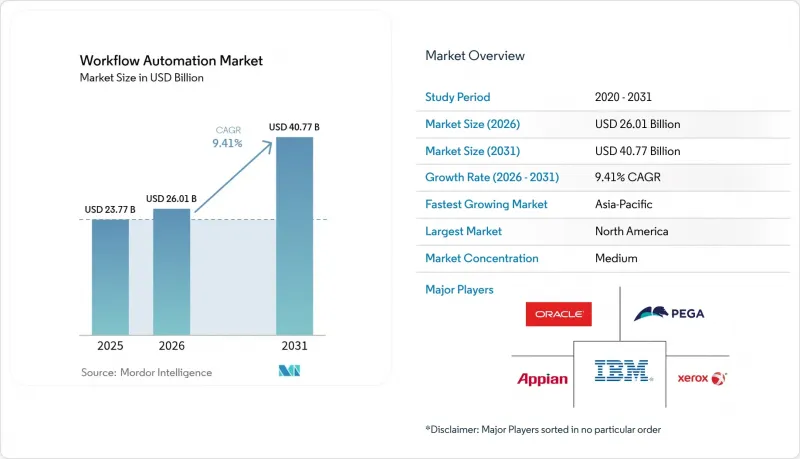
본 보고서는 도입 형태(On-Premise, 클라우드, 하이브리드), 솔루션(소프트웨어(워크플로우 오케스트레이션 플랫폼 등), 서비스(컨설팅 및 자문 등)), 최종 사용자 산업(은행 및 금융 서비스, 통신 등), 조직 규모(대기업, 중소기업) 및 지역별로 분류되어 있습니다. 시장 예측은 금액(달러) 기준으로 제시되어 있습니다.
세계 워크플로우 자동화 시장 동향 및 인사이트
IoT 지원 엣지 워크플로의 급속한 보급
데이터 소스에서의 실시간 처리를 통해, 그동안 기계의 중요한 자동화를 방해하던 지연이라는 장벽이 해소되고 있습니다. 제조업체들은 로컬 컴퓨팅을 활용하여 센서 스트림을 밀리초 단위로 분석하고, 중앙 집중형 클라우드를 기다릴 필요 없이 불량률을 줄이고 예측 유지보수 일정을 수립하고 있습니다. 광업 사업자들은 가스나 진동의 임계값이 급격히 상승할 때 자동 안전 차단 기능을 작동시키는 엣지 노드를 도입하여 엄격한 IEC 61508 요건을 충족하고 있습니다. 물류 허브에서는 5G 프라이빗 네트워크와 엣지 오케스트레이션을 결합함으로써, 자율 주행 로봇이 연결 지연 없이 동적인 창고 레이아웃 내에서 이동할 수 있게 되었습니다. 의료 기관에서는 병상 모니터에 엣지 분석 기능을 통합하여 임상 경보가 즉시 발령되도록 함으로써, 환자의 예후를 개선하는 동시에 간호사의 업무 부담을 경감하고 있습니다. 이러한 성과를 바탕으로 견고한 게이트웨이 및 컨테이너화된 오케스트레이션 스택에 대한 설비 투자가 촉진되면서, 워크플로우 자동화 시장은 운영 기술(OT) 영역으로 더욱 깊이 침투하고 있습니다.
워크플로우 자동화와 생성형 AI 코파일럿의 융합
생성형 AI는 자동화를 규칙 기반 스크립트에서 맥락을 인식하는 의사결정 지원으로 진화시키고 있습니다. 금융 기관에서는 규제 공문을 분석하고, 조항을 업무 관리 절차와 대조하며, 승인 흐름을 자동으로 설정하는 코파일럿을 도입하고 있습니다. 이를 통해 감사 가능성을 유지하면서 컴플라이언스 사이클 기간을 수 주간 단축하고 있습니다. 병원에서는 비정형화된 임상 기록을 대규모 언어 모델에 입력하여 패혈증 위험을 감지하고, 케어 패스 워크플로를 가동하며, HIPAA 보호 조치를 준수하기 위해 보호 대상 건강 정보를 가리고 있습니다. 보험사는 문서 이해 엔진을 활용하여 다국어 보험 증서에서 중요한 용어를 추출하고, 인간의 판단이 부가가치를 가져다주는 경우에만 예외 사항을 담당자에게 전달하고 있습니다. 초기 파일럿 프로젝트에서는 지식 집약적 업무 전반에 걸쳐 40-60%의 생산성 향상이 보고되었으나, 기업은 샌드박스 환경을 넘어 확장하기 전에 모델 거버넌스, 편향 완화 및 설명 가능성 프레임워크를 철저히 마련해야 합니다.
멀티테넌트형 클라우드에서의 데이터 보안 및 개인정보 보호 문제
재무 기록이나 의료 기록을 다루는 기업은 워크플로가 공유 스택에서 실행될 경우 정보 유출 위험이 높아집니다. 유럽의 데이터 관리자는 GDPR(EU 개인정보보호규정) 준수를 요구하며, 벤더에게 동의 추적, 데이터 최소화 및 요청에 따른 삭제 기능의 통합을 의무화하고 있습니다. 디지털 운영 복원력 법(DORA) 준수를 준비하는 금융 기관은 세밀한 감사 추적, 전송 중 및 저장 중인 데이터의 암호화, 그리고 지속적인 취약점 스캔을 강력히 요구하고 있습니다. 따라서 많은 기업은 클라우드 분석 계층을 활용하면서도 기밀 데이터를 On-Premise에 배치하는 하이브리드 아키텍처를 채택하고 있습니다. 벤더의 로드맵에서는 FedRAMP, ISO 27001, SOC 2 인증 외에도, 레플리카를 주권 클라우드 내에 배치하는 지역별 데이터 상주 옵션이 중시되고 있습니다.
부문 분석
2025년에는 클라우드 호스팅 서비스가 매출의 62.15%를 차지하며, 탄력적인 확장성과 구독형 가격 책정이 선호되고 있음이 두드러지게 나타났습니다. 벤더들은 AI 서비스와 기성 커넥터를 번들로 제공하며, 고객은 몇 시간 만에 워크플로우를 시범 운영할 수 있습니다. 금융 서비스, 소매, 의료 업계에서는 하드웨어 교체 주기를 피하고 급속한 혁신을 활용하기 위해 클라우드로의 전환이 진행되고 있습니다. 그러나 규제 당국과 이사회로부터의 감시가 강화됨에 따라 하이브리드 모델로의 전환이 진행되고 있으며, 현재 연평균 성장률(CAGR) 10.08%로 성장하고 있습니다. 이 모델에서는 기밀 데이터를 On-Premise에 남겨둔 채 오케스트레이션 계층을 벤더의 클라우드에서 실행함으로써 주권과 민첩성 간의 균형을 맞추고 있습니다. 5G 엣지 노드가 지연 시간이 중요한 작업을 로컬에서 처리한 후 업스트림 분석 시스템과 동기화함으로써, 하이브리드 아키텍처용 워크플로우 자동화 시장 규모가 확대되고 있습니다. 각 벤더는 데이터 분류 및 성능 목표에 따라 각 프로세스 인스턴스를 클라우드 또는 엣지에 할당하는 정책 기반 라우팅 기능으로 플랫폼을 강화하고 있습니다.
공공 기관 및 방위 관련 주요 기업들이 암호화 키와 감사 로그에 대한 입증 가능한 관리를 요구함에 따라 하이브리드 도입이 확산되고 있습니다. 통합 관리 대시보드를 통해 구역 간 가시성이 통일되어 규정 준수 보고가 용이해집니다. 에어 갭이나 제로 트러스트 체제가 필수로 요구되는 원자력, 국방 및 에어 갭이 적용된 시설에서는 On-Premise 배포가 지속되고 있습니다. ISO 27001 인증을 획득한 엣지 어플라이언스는 컨테이너화된 오케스트레이션 엔진을 실행하여, 네트워크 장애 시에도 공장이 자율적인 운영을 유지할 수 있도록 합니다. 예측 기간 동안 워크로드 이식성, 기밀 컴퓨팅 및 주권 클라우드 제휴를 통해 유연성이 점차 강화될 것, 비용-편익 분석 관점에서 볼 때 규제 대상이 아닌 워크로드에 대해서는 클라우드가 계속해서 우위를 점할 것입니다.
소프트웨어 플랫폼은 2025년 지출의 66.55%를 차지하며, 워크플로우 오케스트레이션, RPA, 이벤트 스트리밍, AI 추론을 통합된 제품군으로 제공합니다. 이 부문의 활력은 대규모 언어 모델의 도입에 있으며, 이를 통해 봇이 자유 형식의 지시를 이해하고 API 호출을 자동 생성할 수 있게 됩니다. 이러한 진화를 통해 RPA는 가장 빠르게 성장하는 하위 부문으로서의 입지를 확고히 했으며, 기업들이 지금까지 자동화할 수 없었던 예외 처리를 재검토함에 따라 연평균 성장률(CAGR) 9.95%로 성장하고 있습니다. 각 벤더는 모델 드리프트를 모니터링하고, 모델을 재학습하며, 책임 있는 AI 원칙을 준수하도록 하는 ‘모델 운영(Model Ops)’ 콘솔을 제공하고 있으며, 이러한 기능은 규제 대상 구매자에게 있어 구매의 필수 조건이 되고 있습니다.
서비스 부문은 시장 가치의 33.45%를 차지하고 있으며, 시스템 간 데이터 일관성을 확보하는 시스템 통합 및 변경 관리 프로젝트가 핵심을 이루고 있습니다. 프로세스 마이닝을 통한 평가는 백로그 로드맵 수립에 활용되는 한편, 매니지드 서비스 계약은 전문 인력을 보유하지 않은 고객사에 대해 성과 기반의 SLA를 보장합니다. 컨설팅 부문은 서비스의 수직적 전문화를 추진하여, 은행을 위한 DORA 규정 준수 가속화 도구 및 제약 공장을 위한 GMP 인증 템플릿 등을 제공합니다. 워크플로우 자동화 시장의 성장에 따라 하이퍼스케일러와 부티크형 통합업체 간의 공동 혁신 파트너십이 확대되어, 세계 확장력과 전문 분야의 심도 있는 인사이트력이 융합될 것입니다.
지역별 분석
2025년, 안정적인 규제 감독 하에서 기업들이 클라우드 전환과 AI 도입을 가속화한 결과, 북미는 전 세계 매출의 34.22%를 차지했습니다. 금융 기관은 SOX 및 도드-프랭크법에 부합하는 종단간 온보딩 워크플로우를 도입한 반면, 제조업체는 생산의 복원력을 강화하기 위해 엣지 노드를 통합했습니다. 미국의 벤더들은 지역 생태계의 핵심을 담당하며, 실험을 촉진하는 얼리 액세스 베타 버전을 제공합니다. 캐나다 공공 부문의 디지털화 프로그램은 특히 시민 서비스 포털을 통해 지역 수요를 더욱 뒷받침하고 있습니다.
아시아태평양은 제조업의 디지털화, 전자상거래의 성장, 그리고 정부의 유리한 인센티브에 힘입어 연평균 성장률(CAGR) 9.92%로 확대되고 있습니다. 중국의 ‘이중 순환’ 전략에 따라 공장에서는 공급망 가시화를 위해 워크플로우 엔진 도입이 진행되고 있는 반면, 인도의 ‘메이크 인 인디아(Make in India)’ 캠페인은 중소기업의 로우코드 도구 도입을 촉진하고 있습니다. 일본과 한국은 5G 지원 스마트 팩토리를 우선시하고 있으며, 노동력 부족을 완화하기 위해 엣지 오케스트레이션과 산업용 로봇을 통합하고 있습니다. 동남아시아 국가들에서는 지역 규정을 준수하는 데이터센터에서 호스팅되는 클라우드 네이티브 플랫폼이 도입되고 있으며, 중견 기업에서의 채택이 확대되고 있습니다.
유럽은 매출액 기준 3위이지만, 규정 준수를 주도한 도입이 활발합니다. DORA의 2025년 마감 시한이 은행의 비즈니스 연속성 오케스트레이션 투자를 촉진하는 한편, GDPR(EU 개인정보보호규정)은 내장형 동의 관리에 대한 수요를 뒷받침하고 있습니다. 독일의 ‘인더스트리 4.0’이 제조 워크플로우를 뒷받침하고 있으며, 영국의 NHS(국민건강서비스)는 케어 경로를 최적화하기 위해 프로세스 마이닝에 투자하고 있습니다. 데이터 거주 요건으로 인해 하이브리드 도입이 촉진되고 있으며, 하이퍼스케일러가 제공하는 소버린 클라우드 지역이 주목받고 있습니다. 중동 및 아프리카 및 라틴아메리카는 여전히 발전 단계에 있지만, 통신 사업자들이 5G를 구축하고 정부가 공공 서비스의 디지털화를 추진함에 따라 관심이 높아지고 있습니다.
기타 혜택:
- 엑셀 형식 시장 전망(ME) 시트
- 3개월간의 애널리스트 지원
자주 묻는 질문
목차
제1장 서론
제2장 조사 방법
제3장 주요 요약
제4장 시장 구도
제5장 시장 규모와 성장 예측
제6장 경쟁 구도
제7장 시장 기회와 향후 전망
JHS 26.09.07According to Mordor Intelligence, the workflow automation market size was valued at USD 23.77 billion in 2025 and estimated to grow from USD 26.01 billion in 2026 to reach USD 40.77 billion by 2031, at a CAGR of 9.41% during the forecast period (2026-2031).
This report is Segmented by Deployment (On-Premise, Cloud, and Hybrid), Solution (Software [Workflow Orchestration Platforms, and More]; Services [Consulting and Advisory, and More]), End-User Industry (Banking and Financial Services, Telecom, and More), Organization Size (Large Enterprises, and Small and Medium-Sized Enterprises), and Geography. The Market Forecasts are Provided in Terms of Value (USD).
Global Workflow Automation Market Trends and Insights
Rapid Adoption of IoT-Enabled Edge Workflows
Real-time processing at the data source is removing latency barriers that previously hampered machine-critical automation. Manufacturers leverage local compute to analyze sensor streams in milliseconds, cutting scrap rates and scheduling predictive maintenance without waiting on centralized clouds. Mining operators deploy edge nodes that trigger automated safety shutdowns when gas or vibration thresholds spike, satisfying stringent IEC 61508 mandates. Logistics hubs combine 5G private networks with edge orchestration, letting autonomous mobile robots navigate dynamic warehouse layouts without connectivity delays. Healthcare providers embed edge analytics into bedside monitors so clinical alerts fire instantly, improving patient outcomes and easing nurse workloads. These gains reinforce capital investment in ruggedized gateways and containerized orchestration stacks that extend the workflow automation market deeper into operational technology footprints.
Convergence of Workflow Automation with Generative AI Copilots
Generative AI is elevating automation from rule-based scripting to context-aware decision support. Financial institutions deploy copilots that parse regulatory bulletins, map clauses to business controls, and auto-configure approval chains, trimming weeks from compliance cycles while preserving auditability.Hospitals feed unstructured clinical notes into large language models that flag sepsis risk, launch care-path workflows, and redact protected health information to uphold HIPAA safeguards. Insurers use document understanding engines to extract key terms from multilingual policies, then route exceptions to underwriters only when human judgment adds value. Early pilots report 40-60% productivity boosts across knowledge tasks, but firms must enforce model-governance, bias-mitigation, and explainability frameworks before scaling beyond sandbox environments.
Data Security and Privacy Concerns Within Multi-Tenant Cloud
Enterprises handling financial and health records face heightened breach risks when workflows run on shared stacks. European controllers demand GDPR alignment, compelling vendors to embed consent tracking, data-minimization, and erase-on-request functions. Financial institutions preparing for Digital Operational Resilience Act compliance insist on granular audit trails, encryption in transit and at rest, and continuous vulnerability scans. Many firms therefore adopt hybrid architectures that stage sensitive data on-premises while leveraging cloud analytics layers. Vendor roadmaps emphasize FedRAMP, ISO 27001, and SOC 2 certifications, plus region-specific data-residency options that place replicas inside sovereign clouds.
Other drivers and restraints analyzed in the detailed report include:
- Growing Demand for Low-Code / No-Code Development Platforms
- Rise in Implementation of Robotic Process Automation in Business Process Management
- Shortage of Process-Mining Skill Sets to Scope Automation Projects
For complete list of drivers and restraints, kindly check the Table Of Contents.
Segment Analysis
Cloud-hosted offerings generated 62.15% of revenue in 2025, underscoring the preference for elastic scaling and subscription pricing. Vendors bundle AI services and pre-built connectors, letting clients pilot flows in hours. Financial services, retail, and healthcare gravitate toward cloud to avoid hardware refresh cycles and to tap rapid innovation. Yet rising scrutiny from regulators and boards sparks a shift to hybrid, now pacing at a 10.08% CAGR. Here, sensitive data remains on-premises while orchestration tiers run in vendor clouds, balancing sovereignty with agility. The workflow automation market size for hybrid architectures is expanding as 5G edge nodes route latency-critical tasks locally, then sync analytics upstream. Vendors augment platforms with policy-based routing that assigns each process instance to cloud or edge based on data classification and performance targets.
Hybrid adoption broadens as public sector agencies and defense primes demand demonstrable control over encryption keys and audit logs. Integrated management dashboards unify visibility across zones, easing compliance reporting. On-premises deployments persist in nuclear, defense, and air-gapped plants where air-gap and zero-trust postures are mandatory. Edge appliances certified to ISO 27001 run containerized orchestration engines, letting factories maintain autonomous operations during network outages. Over the forecast span, workload portability, confidential computing, and sovereign-cloud alliances will embed flexibility, but cost-benefit analysis will continue to favor cloud for non-regulated workloads.
Software platforms accounted for 66.55% of 2025 spending, bundling workflow orchestration, RPA, event streaming, and AI inference in cohesive suites. The segment's dynamism lies in the infusion of large language models, enabling bots to comprehend free-text instructions and auto-generate API calls. This evolution positions RPA as the fastest-growing sub-segment, rising at 9.95% CAGR as enterprises revisit previously unautomatable exception handling. Vendors expose model ops consoles that monitor drift, retrain models, and enforce responsible-AI principles, features becoming purchase prerequisites for regulated buyers.
Services held 33.45% of value, anchored by system integration and change-management engagements that ensure cross-system data coherence. Process-mining assessments feed backlog roadmaps, while managed-service contracts guarantee outcome-based SLAs for clients lacking domain talent. Consulting arms increasingly verticalize offerings, delivering DORA compliance accelerators for banks or GMP-validated templates for pharmaceutical plants. As the workflow automation market grows, co-innovation partnerships between hyperscalers and boutique integrators will amplify, combining global reach with domain depth.
Complete Report Scope:
- By Deployment
- On-premise
- Cloud
- Hybrid
- By Solution
- Software
- Workflow Orchestration Platforms
- Business Process Management Suites
- RPA Platforms
- Services
- Consulting and Advisory
- Implementation and Integration
- Managed Services
- Software
- By End-user Industry
- Banking and Financial Services
- Telecom
- Retail and E-commerce
- Manufacturing
- Logistics and Transportation
- Healthcare and Pharmaceuticals
- Energy and Utilities
- Government and Public Sector
- Other End-user Industries
- By Organization Size
- Large Enterprises
- Small and Medium-sized Enterprises
- By Geography
- North America
- United States
- Canada
- Mexico
- South America
- Brazil
- Argentina
- Rest of South America
- Europe
- Germany
- United Kingdom
- France
- Italy
- Rest of Europe
- Asia Pacific
- China
- Japan
- India
- South Korea
- Australia and New Zealand
- Rest of Asia Pacific
- Middle East
- Saudi Arabia
- United Arab Emirates
- Turkey
- Rest of Middle East
- Africa
- South Africa
- Nigeria
- Kenya
- Rest of Africa
- North America
Geography Analysis
North America contributed 34.22% of global revenue in 2025 as enterprises accelerated cloud migration and AI adoption under stable regulatory oversight. Financial institutions implemented end-to-end onboarding workflows compliant with SOX and Dodd-Frank, while manufacturers embedded edge nodes to enhance production resilience. U.S. vendors anchor local ecosystems, offering early-access betas that encourage experimentation. Canada's public sector digitization programs further underwrite regional demand, especially for citizen-service portals.
Asia Pacific is expanding at a 9.92% CAGR, propelled by manufacturing digitization, e-commerce growth, and favorable government incentives. China's dual-circulation strategy drives factories to embed workflow engines for supply-chain visibility, whereas India's Make-in-India campaign spurs SMEs to adopt low-code tools. Japan and South Korea prioritize 5G-enabled smart factories, integrating edge orchestration with industrial robots to curb labor shortages. Southeast Asian nations deploy cloud-native platforms hosted in regionally-compliant data centers, raising adoption among mid-market firms.
Europe ranks third by revenue but exhibits strong compliance-driven uptake. DORA's 2025 deadlines catalyze bank spending on continuity orchestration, while GDPR fosters demand for built-in consent management. Germany's Industrie 4.0 tailwinds support manufacturing workflows, and the United Kingdom's NHS invests in process mining to optimize care pathways. Data-residency requirements encourage hybrid implementations, with sovereign-cloud regions from hyperscalers gaining traction. The Middle East and Africa and Latin America remain nascent but display rising interest as telecom operators roll out 5G and governments digitize public services.
- Appian Corporation
- Atos SE
- Bizagi Group Limited
- Camunda Services GmbH
- Hyland Software Incorporated
- IBM Corporation
- Kofax Incorporated
- Laserfiche
- Microsoft Corporation
- Nintex Global Limited
- OpenText Corporation
- Oracle Corporation
- Pegasystems Inc.
- PiperLabs Technologies Private Limited
- SAP SE
- ServiceNow Inc.
- Software AG
- SS and C Technologies Holdings Inc.
- UiPath Inc.
- Xerox Holdings Corporation
Additional Benefits:
- The market estimate (ME) sheet in Excel format
- 3 months of analyst support
TABLE OF CONTENTS
1 INTRODUCTION
- 1.1 Study Assumptions and Market Definition
- 1.2 Scope of the Study
2 RESEARCH METHODOLOGY
3 EXECUTIVE SUMMARY
4 MARKET LANDSCAPE
- 4.1 Market Overview
- 4.2 Market Drivers
- 4.2.1 Rapid adoption of IoT-enabled edge workflows
- 4.2.2 Rise in implementation of robotic process automation (RPA) in business process management
- 4.2.3 Growing demand for low-code/no-code development platforms
- 4.2.4 Convergence of workflow automation with generative AI copilots
- 4.2.5 Operational resilience mandates in highly regulated sectors
- 4.2.6 Expansion of 5G private networks enabling real-time industrial automation
- 4.3 Market Restraints
- 4.3.1 Data security and privacy concerns within multi-tenant cloud
- 4.3.2 Shortage of process-mining skill sets to scope automation projects
- 4.3.3 Legacy system integration complexity in brown-field enterprises
- 4.3.4 Budget compression amid macro-economic uncertainty
- 4.4 Industry Value Chain Analysis
- 4.5 Regulatory Landscape
- 4.6 Technological Outlook
- 4.7 Impact of Macroeconomic Factors
- 4.8 Porter's Five Forces Analysis
- 4.8.1 Bargaining Power of Suppliers
- 4.8.2 Bargaining Power of Buyers
- 4.8.3 Threat of New Entrants
- 4.8.4 Intensity of Competitive Rivalry
- 4.8.5 Threat of Substitutes
5 MARKET SIZE AND GROWTH FORECASTS (VALUE)
- 5.1 By Deployment
- 5.1.1 On-premise
- 5.1.2 Cloud
- 5.1.3 Hybrid
- 5.2 By Solution
- 5.2.1 Software
- 5.2.1.1 Workflow Orchestration Platforms
- 5.2.1.2 Business Process Management Suites
- 5.2.1.3 RPA Platforms
- 5.2.2 Services
- 5.2.2.1 Consulting and Advisory
- 5.2.2.2 Implementation and Integration
- 5.2.2.3 Managed Services
- 5.2.1 Software
- 5.3 By End-user Industry
- 5.3.1 Banking and Financial Services
- 5.3.2 Telecom
- 5.3.3 Retail and E-commerce
- 5.3.4 Manufacturing
- 5.3.5 Logistics and Transportation
- 5.3.6 Healthcare and Pharmaceuticals
- 5.3.7 Energy and Utilities
- 5.3.8 Government and Public Sector
- 5.3.9 Other End-user Industries
- 5.4 By Organization Size
- 5.4.1 Large Enterprises
- 5.4.2 Small and Medium-sized Enterprises
- 5.5 By Geography
- 5.5.1 North America
- 5.5.1.1 United States
- 5.5.1.2 Canada
- 5.5.1.3 Mexico
- 5.5.2 South America
- 5.5.2.1 Brazil
- 5.5.2.2 Argentina
- 5.5.2.3 Rest of South America
- 5.5.3 Europe
- 5.5.3.1 Germany
- 5.5.3.2 United Kingdom
- 5.5.3.3 France
- 5.5.3.4 Italy
- 5.5.3.5 Rest of Europe
- 5.5.4 Asia Pacific
- 5.5.4.1 China
- 5.5.4.2 Japan
- 5.5.4.3 India
- 5.5.4.4 South Korea
- 5.5.4.5 Australia and New Zealand
- 5.5.4.6 Rest of Asia Pacific
- 5.5.5 Middle East
- 5.5.5.1 Saudi Arabia
- 5.5.5.2 United Arab Emirates
- 5.5.5.3 Turkey
- 5.5.5.4 Rest of Middle East
- 5.5.6 Africa
- 5.5.6.1 South Africa
- 5.5.6.2 Nigeria
- 5.5.6.3 Kenya
- 5.5.6.4 Rest of Africa
- 5.5.1 North America
6 COMPETITIVE LANDSCAPE
- 6.1 Market Concentration
- 6.2 Strategic Moves
- 6.3 Market Share Analysis
- 6.4 Company Profiles (includes global level overview, market level overview, core segments, financials as available, strategic information, market rank/share for key companies, products and services, and recent developments)
- 6.4.1 Appian Corporation
- 6.4.2 Atos SE
- 6.4.3 Bizagi Group Limited
- 6.4.4 Camunda Services GmbH
- 6.4.5 Hyland Software Incorporated
- 6.4.6 IBM Corporation
- 6.4.7 Kofax Incorporated
- 6.4.8 Laserfiche
- 6.4.9 Microsoft Corporation
- 6.4.10 Nintex Global Limited
- 6.4.11 OpenText Corporation
- 6.4.12 Oracle Corporation
- 6.4.13 Pegasystems Inc.
- 6.4.14 PiperLabs Technologies Private Limited
- 6.4.15 SAP SE
- 6.4.16 ServiceNow Inc.
- 6.4.17 Software AG
- 6.4.18 SS and C Technologies Holdings Inc.
- 6.4.19 UiPath Inc.
- 6.4.20 Xerox Holdings Corporation
7 MARKET OPPORTUNITIES AND FUTURE OUTLOOK
- 7.1 White-space and Unmet-need Assessment


