
|
시장보고서
상품코드
2124048
도시 감시 시장 : 점유율 분석, 업계 동향과 통계, 성장 예측(2026-2031년)City Surveillance - Market Share Analysis, Industry Trends & Statistics, Growth Forecasts (2026 - 2031) |
||||||
 Mordor Intelligence
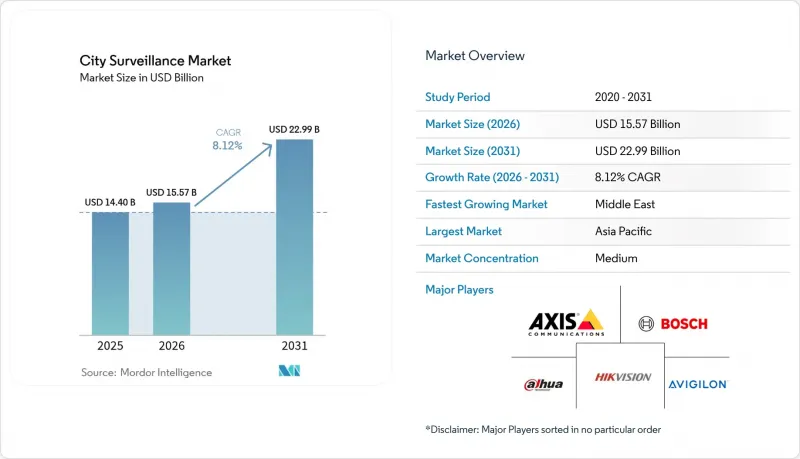
Mordor Intelligence에 의하면, 2026년 도시 감시 시장 규모는 155억 7,000만 달러로 추정되고 있어 2025년 144억 달러에서 확대되어, 2031년에는 229억 9,000만 달러에 이를 것으로 예측됩니다.
2026년부터 2031년까지 연평균 성장률(CAGR) 8.12%로 성장할 것으로 전망됩니다.
본 보고서는 구성 요소(카메라, 스토리지 등), 도입 형태(On-Premise, 클라우드, 하이브리드), 카메라 연결 방식(유선, 무선), 용도(법 집행 기관, 중요 인프라 보호, 대중교통 허브 등), 최종 사용자(지자체, 경찰서 등) 및 지역별로 분류되어 있습니다. 시장 전망은 금액(달러) 기준으로 제시되어 있습니다.
전 세계 도시 감시 시장 동향 및 인사이트
도시 보안 인프라에 대한 지출 증가
범죄 증가와 테러 위협 평가의 고조에 따라, 각 도시는 2024년에 카메라 네트워크 업그레이드에 32억 달러를 배정하기로 했습니다. 디트로이트의 ‘프로젝트 그린라이트’만 해도 공공 및 민간 소유 시설을 연결하는 통합 영상 전송 시스템에 700만 달러를 투자하고 있습니다. 바르셀로나에서도 유사한 예산 확대가 나타나, 5,000만 유로(5,450만 달러)가 보안, 교통 흐름, 환경 모니터링 기능을 통합한 카메라 네트워크 구축에 할당되었습니다. 미국의 ‘지역사회 지향 경찰 서비스(COPS)’를 포함한 연방 및 지역 보조금 프로그램은 재량 자금이 충분하지 않은 지자체에게 대규모 조달에 수반되는 위험을 지속적으로 완화해 주고 있습니다. 그 결과 발생하는 수요 파이프라인은 종단간 솔루션을 제공하고 안전 측면의 투자 수익률(ROA) 지표를 입증할 수 있는 공급업체에 유리하게 작용하여, 도시 감시 시장의 성장 궤도를 더욱 공고히 하고 있습니다.
IP 카메라 가격 하락과 첨단 영상 분석
부품 비용이 연간 15-20% 하락함에 따라 조달 기준이 화질에서 내장형 인텔리전스로 전환되어, 예산이 제한된 도시에서도 장치에서 직접 분석을 수행하는 4K 카메라를 도입할 수 있게 되었습니다. 샌프란시스코시는 이벤트를 자동으로 분류하고 스토리지 요구 사항을 줄여주는 엣지 지원 기기로 전환함으로써 총 소유 비용(TCO)을 40% 절감하는 데 성공했습니다. 현재 AI 추론이 카메라 칩셋에서 실행됨에 따라, 지자체는 실시간 인사이트력을 확보하는 동시에 대역폭 부하를 최대 90%까지 줄일 수 있게 되었습니다. 이러한 ‘합리적인 가격’과 ‘지능’의 시너지 효과로 인해, 도시 감시 시장은 2030년까지 견조한 성장 궤도를 유지할 것으로 예측됩니다.
개인정보 보호 규제 강화와 시민들의 반대
유럽연합(EU)의 ‘AI 법’은 실시간 생체 인증을 제한하고 있으며, 이로 인해 규정 준수 비용이 증가하여 프로젝트 예산에 최대 20%의 추가 비용이 발생할 가능성이 있습니다. 2024년에는 지방 자치 단체에 대한 GDPR(EU 개인정보보호규정)(일반 데이터 보호 규정) 집행 조치가 3배로 증가했으며, 감시 데이터의 부적절한 처리에 대한 평균 벌금은 280만 유로(305만 달러)에 달했습니다. 시민들의 시위로 인해 유럽 주요 15개 도시에서 카메라 도입이 지연되거나 중단되었으며, 지방 자치 단체는 ‘프라이버시 바이 디자인(Privacy by Design)’ 원칙을 적용할 수밖에 없게 되었습니다. 이로 인해 도입 일정이 장기화되고 기능 세트가 제한되면서 도시 감시 시장의 성장이 둔화되고 있습니다.
부문 분석
2025년, 도시 감시 시장 매출의 45.12%를 카메라 하드웨어가 차지하며, 필수적인 영상 획득 계층으로서의 입지를 공고히 했습니다. 그러나 지자체가 수동적인 녹화에서 실시간 인텔리전스로 전환함에 따라, 영상 분석 플랫폼은 구성 요소 중 가장 높은 9.02%의 연평균 성장률(CAGR)을 나타낼 전망입니다. 장치 상의 추론 처리를 통해 대역폭 및 스토리지 비용을 절감하면서도 상황 인식 능력을 향상시킬 수 있기 때문에 도시 감시 시장에서 영상 분석 시장 규모는 급속히 확대될 전망입니다.
엣지 분석에서는 중요한 메타데이터만 보관하기 때문에 장기 보관 데이터의 양이 억제되어 스토리지 어레이의 점유율은 축소될 전망입니다. 소프트웨어 벤더들은 GDPR(EU 개인정보보호규정)을 준수하는 익명화, 자동 마스킹, 그리고 교통·환경 센서와 연동되는 오픈 API를 통해 차별화를 꾀하고 있습니다. 이러한 특징 덕분에 분석 기업들은 프리미엄 가격을 책정하고 조달 기준을 주도하는 입지에 있어, 도시 감시 시장에서 새로운 우위를 더욱 공고히 하고 있습니다.
2025년에는 On-Premise형 솔루션이 도시 감시 시장 점유율의 61.74%를 차지하며, 이는 기존 투자 및 데이터 관리의 확실성에 대한 인식을 반영한 것입니다. 한편, 클라우드 도입은 유연한 스토리지, 자동 소프트웨어 업데이트 및 라이프사이클 비용 절감을 바탕으로 연평균 성장률(CAGR) 9.29%를 나타낼 것으로 예측됩니다. 하이브리드 모델은 실시간 로컬 처리와 클라우드 분석을 융합하여 피닉스와 같은 대도시가 온사이트 하드웨어를 증설하지 않고도 고해상도 영상을 장기간 저장할 수 있게 해줍니다.
규제 강화는 역설적이긴 하지만, 전환을 가속화하고 있습니다. 이는 인증된 클라우드 제공업체가 대부분의 지자체 IT 예산을 상회하는 수준의 암호화, 감사 추적, 규정 준수 문서를 제공하고 있기 때문입니다. 이러한 우려가 완화됨에 따라 도시 감시 시장에는 SaaS(Software-as-a-Service)를 통한 새로운 지속적인 수익원이 생겨나며, 벤더의 수입원은 더욱 다양해질 것입니다.
지역별 분석
아시아태평양은 2025년 매출의 35.05%를 차지하며 주도적인 위치를 차지하고 있으며, 2031년까지 연평균 성장률(CAGR) 8.46%를 나타낼 것으로 예측됩니다. 중국의 고밀도 도시 감시 프로그램과 인도의 150억 달러 규모의 ‘스마트 시티 미션’이 이 지역 수요 기반을 뒷받침하고 있습니다. 싱가포르의 ‘스마트 네이션’ 구상에서는 이미 20만 대의 카메라가 도시 전역의 분석 시스템과 연동되어 교통, 인파 밀도, 환경 모니터링 관리에 활용되고 있습니다. 호주는 2024년, 개인정보 보호를 고려한 교통 허브 보안 대책에 5억 호주 달러(3억 3,500만 달러)를 투자했습니다. 한편, 일본에서는 고령화 진행에 따라 긴급 대응을 지원하기 위한 AI 기반 이상 감지 기술이 추진되고 있습니다.
북미에서는 지속적인 업그레이드가 진행되고 있으며, 미국의 지자체는 2024년에 현대화를 위해 32억 달러를 배정했습니다. 연방 정부의 인프라 법안에 따라 소규모 도시에 대한 보조금이 지급되는 한편, 캐나다의 대도시권에서는 지역 데이터 주권 요건을 충족하는 하이브리드 클라우드 도입이 시범적으로 진행되고 있습니다. 유럽의 예측 연평균 성장률(CAGR) 7.84%는 GDPR(EU 개인정보보호규정)(일반 데이터 보호 규정)에 따른 장비 교체 주기와 ‘AI법’이 가져오는 기술적 규정 준수에 대한 추진력을 반영하고 있습니다. 이러한 성숙한 지역의 도시 감시 시장 규모 확대는 더욱 꾸준하지만, 그 배경에는 사이버 보안 및 개인정보 보호에 대한 의무적인 재검토가 있습니다. 중동 및 아프리카은 사우디아라비아의 ‘NEOM’이나 UAE의 국가 디지털 도시 프로그램과 같은 메가 프로젝트를 원동력으로 연평균 성장률(CAGR) 8.92%를 나타낼 것으로 예측됩니다. 카타르는 2022년 월드컵 인프라를 다기관 협력 감시 네트워크로 재활용하고 있는 반면, 나이지리아의 2억 달러에 달하는 도시 보안 지출은 사하라 이남 아프리카 수요 증가를 뒷받침하고 있습니다. 남미에서는 브라질의 8억 달러 규모 스마트시티 구상이나 아르헨티나의 감시 시스템과 911 신고 센터 통합 등에서 볼 수 있듯이 새로운 성장세가 나타나고 있습니다. 환율 변동이나 조달 절차의 번거로움이 도입 규모를 억제하고는 있지만, 전략적 의도에는 영향을 미치지 않고 있으며, 도시 감시 시장은 점차 확대될 것으로 시사되고 있습니다.
기타 혜택:
- 엑셀 형식 시장 예측(ME) 시트
- 3개월간의 애널리스트 지원
자주 묻는 질문
목차
제1장 서론
제2장 조사 방법
제3장 주요 요약
제4장 시장 구도
제5장 시장 규모와 성장 예측
제6장 경쟁 구도
제7장 시장 기회와 향후 전망
JHS 26.09.07According to Mordor Intelligence, city surveillance market size in 2026 is estimated at USD 15.57 billion, growing from 2025 value of USD 14.40 billion with 2031 projections showing USD 22.99 billion, growing at 8.12% CAGR over 2026-2031.
This report is Segmented by Component (Camera, Storage, and More), Deployment Mode (On-Premise, Cloud, and Hybrid), Camera Connectivity (Wired, and Wireless), Application (Law Enforcement, Critical Infrastructure Protection, Public Transportation Hubs, and More), End User (Municipal Authorities, Police Departments, and More), and Geography. The Market Forecasts are Provided in Terms of Value (USD).
Global City Surveillance Market Trends and Insights
Increased Spending on Urban Security Infrastructure
Escalating crime and higher terrorism threat assessments prompted cities to earmark USD 3.2 billion for camera-network upgrades during 2024, with Detroit's Project Green Light alone channeling USD 7 million toward integrated video feeds that link public and privately owned sites. Similar budget expansions are visible in Barcelona, where EUR 50 million (USD 54.5 million) funded a camera grid that merges security, traffic flow, and environmental monitoring functions. Federal and regional grant programs, including the U.S. Community Oriented Policing Services, continue to de-risk large-scale procurements for municipalities that lack discretionary capital. The resulting demand pipeline favors platform vendors that supply end-to-end solutions and provide documented return-on-safety metrics, thereby reinforcing the growth trajectory of the city surveillance market.
Declining IP-Camera Prices and Enhanced Video Analytics
A component cost erosion of 15-20% per year has shifted procurement criteria from image resolution to embedded intelligence, enabling budget-constrained cities to deploy 4K cameras with on-device analytics. San Francisco achieved a 40% total cost of ownership reduction after migrating to edge-enabled units that automatically classify events and reduce storage requirements. As AI inference now executes on camera chipsets, municipalities capture real-time insights while trimming bandwidth loads by up to 90%. The affordability-intelligence nexus is expected to keep the city surveillance market on a robust expansion path through 2030.
Heightened Privacy Regulations and Public Opposition
The European Union's AI Act restricts real-time biometric identification, driving compliance costs that can add 20% to project budgets. GDPR enforcement actions against municipalities increased threefold in 2024, with an average fine of EUR 2.8 million (USD 3.05 million) for mishandling surveillance data. Citizen activism has delayed or canceled camera deployments in 15 major European cities, forcing local governments to apply privacy-by-design principles that lengthen roll-out timelines and limit feature sets, thereby tempering the growth of the city surveillance market.
Other drivers and restraints analyzed in the detailed report include:
- Growing Terrorism and Crime Concerns in Mega-Cities
- Expansion of Smart-City Budgets for Integrated Surveillance
- Rising Cybersecurity Vulnerabilities in IoT Cameras
For complete list of drivers and restraints, kindly check the Table Of Contents.
Segment Analysis
Camera hardware accounted for 45.12% of city surveillance market revenue in 2025, affirming its status as the indispensable capture layer. Video analytics platforms, however, are projected to deliver a 9.02% CAGR, the fastest among components, as municipalities shift from passive recording to real-time intelligence. The city surveillance market size for video analytics is set to expand rapidly because on-device inference reduces bandwidth and storage costs while enhancing situational awareness.
Storage arrays face share erosion as edge analytics retains only critical metadata, curbing long-term archiving volumes. Software vendors differentiate through GDPR-compliant anonymization, automated redaction, and open APIs that integrate with traffic and environmental sensors. These attributes position analytics firms to command premium pricing and shape procurement criteria, reinforcing their emerging dominance within the city surveillance market.
On-premise solutions controlled 61.74% of the city surveillance market share in 2025, reflecting legacy investments and a perception of greater data custody. Cloud deployments, however, are forecast to post a 9.29% CAGR, buoyed by elastic storage, automatic software updates, and lower lifecycle costs. Hybrid models bridge real-time local processing with cloud analytics, enabling large cities like Phoenix to store high-resolution footage for extended periods without expanding on-site hardware.
Regulatory stringency is paradoxically accelerating migration, as certified cloud providers offer encryption, audit trails, and compliance documentation that surpass most municipal IT budgets. As these concerns ease, the city surveillance market gains a fresh layer of recurring, software-as-a-service revenue, further diversifying vendor income streams.
Complete Report Scope:
- By Component
- Camera
- Storage
- Video Management System
- Video Analytics
- By Deployment Mode
- On-Premise
- Cloud
- Hybrid
- By Camera Connectivity
- Wired
- Wireless
- By Application
- Traffic Management
- Law Enforcement
- Critical Infrastructure Protection
- Public Transportation Hubs
- Other Application
- By End User
- Municipal Authorities
- Police Departments
- Transportation Agencies
- Utilities
- Other End User
- By Geography
- North America
- United States
- Canada
- Mexico
- Europe
- Germany
- United Kingdom
- France
- Russia
- Rest of Europe
- Asia-Pacific
- China
- Japan
- India
- South Korea
- Australia
- Rest of Asia-Pacific
- Middle East and Africa
- Middle East
- Saudi Arabia
- United Arab Emirates
- Rest of Middle East
- Africa
- South Africa
- Egypt
- Rest of Africa
- Middle East
- South America
- Brazil
- Argentina
- Rest of South America
- North America
Geography Analysis
The Asia-Pacific region dominated with 35.05% of 2025 revenue and is forecasted to grow at an 8.46% CAGR through 2031. China's high-density urban surveillance programs and India's USD 15 billion Smart Cities Mission anchor the region's demand pipeline. Singapore's Smart Nation initiative already interconnects 200,000 cameras with citywide analytics to manage traffic, crowd density, and environmental monitoring. Australia committed AUD 500 million (USD 335 million) in 2024 toward privacy-compliant transport hub security, while Japan's aging population dynamics drive AI-based anomaly detection to assist emergency response.
North America recorded sustained upgrades, with U.S. municipalities allocating USD 3.2 billion for modernization in 2024. Federal infrastructure bills subsidize smaller cities, while Canadian metropolitan areas pilot hybrid-cloud deployments that meet local data-sovereignty requirements. Europe's 7.84% projected CAGR reflects GDPR-driven equipment refresh cycles and the AI Act's technical-compliance impetus. The city surveillance market size expansion across these mature regions is steadier but underpinned by mandatory cybersecurity and privacy overhauls. The Middle East and Africa are projected to record a 8.92% CAGR, powered by megaprojects such as Saudi Arabia's NEOM and the UAE's national digital-city programs. Qatar repurposes 2022 World Cup infrastructure into multi-agency surveillance grids, while Nigeria's USD 200 million urban security outlay underscores the rising demand in sub-Saharan Africa. South America is experiencing emergent growth, as evidenced by Brazil's USD 800 million smart-city commitments and Argentina's integration of surveillance with 911-call centers. Currency volatility and procurement red tape temper volume but not strategic intent, signaling a gradual uptick in the city surveillance market.
- Hangzhou Hikvision Digital Technology Co., Ltd.
- Zhejiang Dahua Technology Co., Ltd.
- Axis Communications AB (Canon Inc.)
- Robert Bosch GmbH - Bosch Security and Safety Systems
- Motorola Solutions, Inc. - Avigilon Corporation
- Hanwha Vision Co., Ltd.
- Honeywell International Inc. - Honeywell Security Group
- Panasonic Holdings Corporation
- NEC Corporation
- Genetec Inc.
- CP Plus International
- Infinova Corporation
- Cisco Systems, Inc.
- Agent Video Intelligence Ltd.
- Verint Systems Inc.
- NICE Ltd.
- Qognify Inc. (Battery Ventures)
- Zhejiang Uniview Technologies Co., Ltd.
Additional Benefits:
- The market estimate (ME) sheet in Excel format
- 3 months of analyst support
TABLE OF CONTENTS
1 INTRODUCTION
- 1.1 Study Assumptions and Market Definition
- 1.2 Scope of the Study
2 RESEARCH METHODOLOGY
3 EXECUTIVE SUMMARY
4 MARKET LANDSCAPE
- 4.1 Market Overview
- 4.2 Market Drivers
- 4.2.1 Increased Spending on Urban Security Infrastructure
- 4.2.2 Declining IP Camera Prices and Enhanced Video Analytics
- 4.2.3 Growing Terrorism and Crime Concerns in Mega-Cities
- 4.2.4 Expansion of Smart City Budgets for Integrated Surveillance
- 4.2.5 Edge AI Chips Cutting Bandwidth Costs
- 4.2.6 Smart Lighting Poles Embedding Camera Modules
- 4.3 Market Restraints
- 4.3.1 Heightened Privacy Regulations and Public Opposition
- 4.3.2 Rising Cybersecurity Vulnerabilities in IoT Cameras
- 4.3.3 Shortage of Skilled Video Analytics Personnel
- 4.3.4 Interoperability Gaps with Legacy Public Safety Systems
- 4.4 Industry Value Chain Analysis
- 4.5 Regulatory Landscape
- 4.6 Technological Outlook
- 4.7 Porter's Five Forces Analysis
- 4.7.1 Bargaining Power of Suppliers
- 4.7.2 Bargaining Power of Buyers
- 4.7.3 Threat of New Entrants
- 4.7.4 Threat of Substitutes
- 4.7.5 Intensity of Competitive Rivalry
- 4.8 Impact of Macroeconomic Factors
5 MARKET SIZE AND GROWTH FORECASTS (VALUE)
- 5.1 By Component
- 5.1.1 Camera
- 5.1.2 Storage
- 5.1.3 Video Management System
- 5.1.4 Video Analytics
- 5.2 By Deployment Mode
- 5.2.1 On-Premise
- 5.2.2 Cloud
- 5.2.3 Hybrid
- 5.3 By Camera Connectivity
- 5.3.1 Wired
- 5.3.2 Wireless
- 5.4 By Application
- 5.4.1 Traffic Management
- 5.4.2 Law Enforcement
- 5.4.3 Critical Infrastructure Protection
- 5.4.4 Public Transportation Hubs
- 5.4.5 Other Application
- 5.5 By End User
- 5.5.1 Municipal Authorities
- 5.5.2 Police Departments
- 5.5.3 Transportation Agencies
- 5.5.4 Utilities
- 5.5.5 Other End User
- 5.6 By Geography
- 5.6.1 North America
- 5.6.1.1 United States
- 5.6.1.2 Canada
- 5.6.1.3 Mexico
- 5.6.2 Europe
- 5.6.2.1 Germany
- 5.6.2.2 United Kingdom
- 5.6.2.3 France
- 5.6.2.4 Russia
- 5.6.2.5 Rest of Europe
- 5.6.3 Asia-Pacific
- 5.6.3.1 China
- 5.6.3.2 Japan
- 5.6.3.3 India
- 5.6.3.4 South Korea
- 5.6.3.5 Australia
- 5.6.3.6 Rest of Asia-Pacific
- 5.6.4 Middle East and Africa
- 5.6.4.1 Middle East
- 5.6.4.1.1 Saudi Arabia
- 5.6.4.1.2 United Arab Emirates
- 5.6.4.1.3 Rest of Middle East
- 5.6.4.2 Africa
- 5.6.4.2.1 South Africa
- 5.6.4.2.2 Egypt
- 5.6.4.2.3 Rest of Africa
- 5.6.4.1 Middle East
- 5.6.5 South America
- 5.6.5.1 Brazil
- 5.6.5.2 Argentina
- 5.6.5.3 Rest of South America
- 5.6.1 North America
6 COMPETITIVE LANDSCAPE
- 6.1 Market Concentration
- 6.2 Strategic Moves
- 6.3 Market Share Analysis
- 6.4 Company Profiles (includes Global Level Overview, Market Level Overview, Core Segments, Financials as Available, Strategic Information, Market Rank/Share for Key Companies, Products and Services, and Recent Developments)
- 6.4.1 Hangzhou Hikvision Digital Technology Co., Ltd.
- 6.4.2 Zhejiang Dahua Technology Co., Ltd.
- 6.4.3 Axis Communications AB (Canon Inc.)
- 6.4.4 Robert Bosch GmbH - Bosch Security and Safety Systems
- 6.4.5 Motorola Solutions, Inc. - Avigilon Corporation
- 6.4.6 Hanwha Vision Co., Ltd.
- 6.4.7 Honeywell International Inc. - Honeywell Security Group
- 6.4.8 Panasonic Holdings Corporation
- 6.4.9 NEC Corporation
- 6.4.10 Genetec Inc.
- 6.4.11 CP Plus International
- 6.4.12 Infinova Corporation
- 6.4.13 Cisco Systems, Inc.
- 6.4.14 Agent Video Intelligence Ltd.
- 6.4.15 Verint Systems Inc.
- 6.4.16 NICE Ltd.
- 6.4.17 Qognify Inc. (Battery Ventures)
- 6.4.18 Zhejiang Uniview Technologies Co., Ltd.
7 MARKET OPPORTUNITIES AND FUTURE OUTLOOK
- 7.1 White-space and Unmet Need Analysis