

|
시장보고서
상품코드
2124058
매장 내 분석 시장 : 점유율 분석, 업계 동향과 통계, 성장 예측(2026-2031년)In-store Analytics - Market Share Analysis, Industry Trends & Statistics, Growth Forecasts (2026 - 2031) |
||||||
 Mordor Intelligence
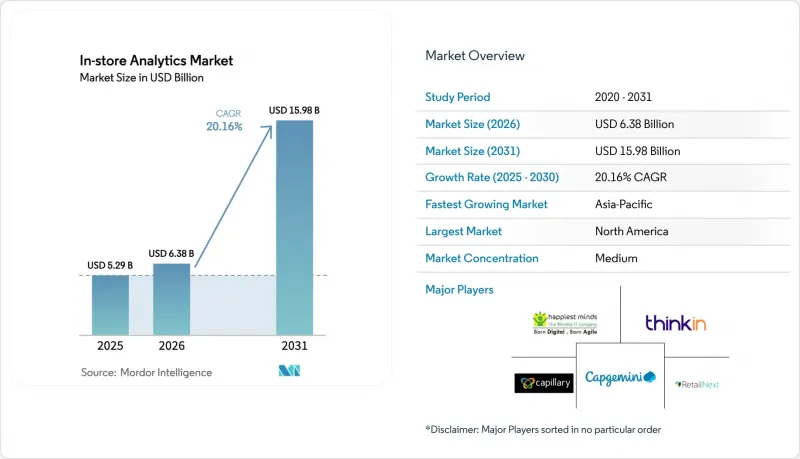
Mordor Intelligence에 의하면, 매장 내 분석 시장 규모는 2025년 52억 9,000만 달러에서 2026년에는 63억 8,000만 달러로 확대되어 2031년까지 159억 8,000만 달러에 이를 것으로 예상되고 있어 2026년부터 2031년까지 CAGR 20.16%로 성장할 전망입니다.
본 보고서는 구성 요소(소프트웨어 및 서비스), 도입 형태(클라우드 및 On-Premise), 조직 규모(대기업 및 중소기업), 용도(고객 관리, 리스크 및 컴플라이언스 관리, 매장 운영 관리, 상품 관리 등) 및 지역별로 분류되어 있습니다. 시장 전망은 금액(달러)으로 표시되어 있습니다.
세계 매장 내 분석 시장 동향 및 인사이트
클라우드 네이티브 및 엣지 지원 도입
각 하이퍼스케일러 기업은 현재 간단한 REST 호출을 통해 진열대 규정 준수 및 플래노그램 검증용 API를 제공합니다. 이를 통해 사내 모델 훈련이 불필요해지며, 도입 주기가 수개월에서 수일로 단축됩니다. AWS Edge Manager for Retail은 카메라 펌웨어의 무선 업데이트(OTA)를 지원하며, 추론 결과를 중앙 집중형 데이터 레이크와 거의 실시간으로 동기화합니다. 인텔에 최적화된 OpenVINO 어플라이언스는 75와트 미만의 전력 소비로 최대 30개의 비디오 스트림을 처리하며, 유럽의 슈퍼마켓에서 성능과 에너지 소비의 균형을 실현하고 있습니다. 서버리스 컴퓨팅, 경량 컨테이너, 5G 백홀이 결합되어, 과거에는 포춘 500대 소매업체에만 국한되었던 고급 분석이 널리 보급되고 있습니다. 소매업체들이 하이브리드 스택을 표준화함에 따라, 엣지에서 클라우드에 이르는 원활한 워크플로를 조정할 수 있는 벤더들이 압도적인 시장 점유율을 확보하고 있습니다.
더 나은 고객 서비스와 쇼핑 경험 개선의 필요성
진열대의 빈 공간을 자동으로 감지함으로써 품절 발생을 30% 줄였고, 직원들은 부가가치가 높은 고객 응대에 집중할 수 있게 되어 기존 매장의 매출이 4% 증가했습니다. 대기 시간이 3분을 초과하면 대기열 관리 알고리즘과 통합된 고객 수 히트맵이 직원 재배치를 촉발하여, 일본 내 2,000개 이상의 편의점에서 계산대 처리 능력이 향상되고 있습니다. 또한 영상 분석은 고도로 개인화된 고객 응대를 가능하게 합니다. 파일럿 프로그램에서는 특정 상품 카테고리 앞에서의 체류 시간이 미리 설정된 임계값을 초과할 경우, 로열티 데이터를 파악한 점원을 해당 장소로 파견하고 있습니다. 이러한 이용 사례는 ‘지식이 풍부한 직원이 있다’는 점을 온라인 쇼핑이 아닌 오프라인 매장을 방문하는 주된 이유로 꼽는 소비자의 68%를 만족시키고 있습니다. 디지털 신호와 매장 내 상황을 융합함으로써 소매업체는 인건비를 늘리지 않고도 서비스 품질을 향상시킬 수 있습니다.
인사이트를 운영에 활용하기 위한 인재 역량 부족
기업들은 AI 기술 인력 부족에 직면해 있으며, 소매 분석직 채용 기간은 일반 IT 직종에 비해 50% 더 길게 소요되어 프로젝트의 가치 실현 시기를 늦추고 있습니다. 사내에 데이터 사이언스자를 보유하지 않은 중견 체인점은 테라바이트 규모의 영상 데이터를 상품 진열 조치로 전환하는 데 어려움을 겪는 경우가 많습니다. 이에 대응하여 각 벤더사는 수동 쿼리 작업 없이 우선순위가 지정된 권장 사항을 제시하는 자동화된 인사이트 생성 기능을 도입하고 있습니다. 그러나 이러한 도구는 여전히 일정 수준의 통계 지식을 전제로 하고 있어, 디지털 분야의 선도 기업과 뒤처진 기업 간의 성과 격차가 확대되고 있습니다.
부문 분석
서비스 시장은 2031년까지 연평균 성장률(CAGR) 28.40%로 확대되고 있으며, 소매업체들이 사내 인력 부족을 해소하기 위해 통합 업무 및 관리형 애널리틱스를 외부에 위탁함에 따라 매장 내 분석 시장 전체의 성장률을 상회하고 있습니다. SaaS 플랫폼이 구독 형식으로 비전 API 및 대시보드를 제공한 결과, 2025년 매출의 70.01%를 소프트웨어가 차지했으나, 이러한 도구를 ERP, POS, 공급망 시스템과 통합할 때의 복잡성으로 인해 전문 서비스에 대한 수요가 증가하고 있습니다. 캡제미니는 2025년에 소매 분석 부문 인력을 35% 증원하여 턴키 프로젝트 증가를 반영하고 있습니다. 왓슨엑스(watsonx) 거버넌스를 통합한 IBM의 컨설팅 계약은 고객사당 평균 250만 달러에 달하며, 규정 준수가 완료된 아키텍처에 대한 프리미엄이 강조되고 있습니다.
소프트웨어 자체는 수평형 플랫폼과 특정 매장 형태에 최적화된 수직형 솔루션의 두 가지로 분화되고 있습니다. Oracle의 ‘Retail AI Foundation’은 수요 예측 및 재고 감소 감지 모델을 자사의 클라우드 ERP에 직접 통합하여, 기존 고객의 도입 기간을 6개월에서 6주로 단축하고 있습니다. 벤더에 구애받지 않는 통합 레이어를 제공하는 벤더 덕분에 소매업체는 락인(lock-in)을 피하면서 최고의 구성 요소를 조합할 수 있게 되었으며, 서비스 수익은 두 자릿수 성장을 유지하고 있습니다.
각 하이퍼스케일러 기업이 소매 업계에 특화된 AI 모델을 인프라 서비스에 통합하여 업데이트 작업과 통합 분석을 효율화하고 있는 덕분에, 클라우드 도입은 2025년 매출의 64.83%를 차지하며 연평균 성장률(CAGR) 29.70%로 성장하고 있습니다. 그러나 자율형 계산대나 실시간 도난 감지 등 지연 시간에 민감한 이용 사례에서는 여전히 On-Premise 추론 엔진이 필요합니다. 현실적인 해결책으로, 엣지 어플라이언스가 동영상을 로컬에서 처리하여 50밀리초 미만의 목표치를 유지하면서, 집계된 인사이트를 클라우드 데이터 레이크로 전송해 머신러닝 재훈련을 수행하는 하이브리드 토폴로지가 채택되고 있습니다. ‘AWS Outposts for Retail’은 랙 마운트형 AWS 서버를 매장 백룸에 설치하여 기밀성이 높은 생체 인증 데이터의 보관 장소를 확보하는 동시에, 보다 광범위한 AWS 서비스 카탈로그에 대한 접근을 가능하게 합니다.
Microsoft Azure와 Trax의 연동을 통해 점원의 스마트폰에서 진열대 이미지를 전처리한 후 클라우드에서 검증함으로써, 데이터 전송 비용을 60% 절감하고 플래노그램 피드백을 90초 이내에 반영하고 있습니다. 2027년까지 EU AI 법안이 제정될 것으로 예상에 따라, 감사 로그 및 지역 내에 설치된 인프라에 대한 수요가 증가할 것이며, 규제 시장에서는 하이브리드 아키텍처가 기본 아키텍처로 자리 잡게 될 것입니다.
지역별 분석
북미는 2025년 매출의 38.32%를 차지하고 있으며, 성숙한 옴니채널 인프라와 높은 인건비가 자동화에 대한 투자를 정당화하고 있습니다. Amazon Fresh와 같은 체인점의 자율 계산대 모델 시범 도입은 1초 미만의 추론에 대한 단기적인 수요를 보여주고 있으며, 매장 내 분석 시장에서 리더십을 유지하고 있습니다. 아시아태평양은 연평균 성장률(CAGR) 27.40%로 가장 빠르게 성장하고 있으며, 그 배경에는 중국의 소셜 커머스와의 융합, 디지털 퍼스트형 매장 형식을 가능하게 하는 인도의 통합 결제 인터페이스(UPI), 그리고 로봇 기술 투자를 촉진하는 일본의 노동력 고령화가 있습니다. 이러한 요인들이 복합적으로 작용하여, 인프라 기반의 편차가 있음에도 불구하고 아시아태평양 도시의 매장 내 분석 시장 규모 확대가 가속화되고 있습니다.
유럽에서는 GDPR(EU 개인정보보호규정)과 관련된 규정 준수 부담으로 인해 당초 도입이 더뎠으나, 현재는 독일과 영국의 고급 식료품점들이 식품 폐기 억제와 ESG 보고 의무 준수를 위해 컴퓨터 비전을 도입하고 있습니다. 또한 프랑스에서는 총국이 정한 2025년 지침에 따라, 동적 가격 책정과 연동된 전자 가격표가 슈퍼마켓에서 이미 주류를 이루고 있으며, 명확한 규칙이 잠재 수요를 불러일으킬 수 있음을 보여주고 있습니다. 남미에서는 모던 트레이드 형태로 도입이 확대되고 있는 반면, 환율 변동과 자본 제약으로 인해 국내 체인점에서의 도입 속도는 제한적입니다.
두바이와 리야드 등 중동의 스마트 시티 구상에서는 센서 지원 소매 인프라가 의무화되어 있어, 이를 통해 쇼핑몰은 리모델링 단계가 아닌 건설 단계부터 분석 기능을 통합할 수 있게 되었습니다. 아프리카에서는 전력 공급의 불안정성과 대역폭 비용으로 인해 남아프리카공화국이나 나이지리아 이외의 지역에서의 도입은 여전히 초기 단계에 머물러 있지만, 전 세계 퀵서비스 브랜드의 가맹점에서는 인력 배치를 최적화하기 위해 저전력 재실 감지기를 시범 도입하고 있습니다. 신흥 시장이 성숙해짐에 따라, 지역별 규제 및 인프라 현황에 맞추어 도입 방안을 조정하는 벤더가 압도적인 시장 점유율을 차지하게 될 것입니다.
기타 혜택:
- 엑셀 형식 시장 예측(ME) 시트
- 3개월간의 애널리스트 지원
자주 묻는 질문
목차
제1장 서론
제2장 조사 방법
제3장 주요 요약
제4장 시장 구도
제5장 시장 규모와 성장 예측
제6장 경쟁 구도
제7장 시장 기회와 향후 전망
JHS 26.09.07According to Mordor Intelligence, the in-store analytics market size is expected to increase from USD 5.29 billion in 2025 to USD 6.38 billion in 2026 and reach USD 15.98 billion by 2031, growing at a CAGR of 20.16% over 2026-2031.
This report is Segmented by Component (Software, and Services), Deployment (Cloud, and On-Premises), Organization Size (Large Enterprises, and Small and Medium Enterprises), Application (Customer Management, Risk and Compliance Management, Store Operations Management, Merchandise Management, and More), and Geography. The Market Forecasts are Provided in Terms of Value (USD).
Global In-store Analytics Market Trends and Insights
Cloud-Native and Edge-Enabled Deployments
Hyperscalers now expose shelf-compliance and planogram-verification APIs via simple REST calls, eliminating the need for in-house model training and shrinking deployment cycles from months to days. AWS Edge Manager for Retail supports over-the-air camera firmware updates, synchronizing inference results with centralized data lakes in near real time. Intel-optimized OpenVINO appliances process up to 30 video streams at <75 watts, balancing performance and energy consumption for European supermarkets. Serverless compute, lightweight containers, and 5G backhaul collectively democratize advanced analytics once reserved for Fortune 500 retailers. As retailers standardize on hybrid stacks, vendors able to orchestrate seamless edge-to-cloud workflows win a disproportionate share.
Need for Better Customer Service and Enhanced Shopping Experience
Automated shelf-gap detection reduces out-of-stock incidents by 30%, freeing associates to focus on high-value engagement that lifts comparable-store sales by 4%. Occupancy heatmaps integrated with queue-management algorithms trigger staff redeployment when wait times exceed three minutes, improving checkout throughput in more than 2,000 Japanese convenience stores. Video analytics also power hyper-personalized interactions; pilots dispatch associates armed with loyalty data whenever dwell time in front of a category exceeds pre-set thresholds. These use cases satisfy 68% of consumers who say knowledgeable staff is the primary reason to visit physical stores over e-commerce. By merging digital signals with in-store context, retailers elevate service without swelling payroll costs.
Lack of Personnel Skills to Operationalize Insights
Firms face AI-skills gaps, with retail analytics positions staying open 50% longer than general IT roles, hampering time-to-value for projects. Mid-market chains lacking in-house data scientists often struggle to translate terabytes of video data into merchandising actions. Vendors counter by embedding automated insight generation that surfaces prioritized recommendations without manual querying. Yet these tools still assume a baseline level of statistical competence, widening the performance gap between digital leaders and laggards.
Other drivers and restraints analyzed in the detailed report include:
- Real-Time Computer Vision and Video Analytics Breakthroughs
- Dynamic Pricing Models Driven by In-Store Data
- High Up-Front Sensor and Camera Retrofit Costs
For complete list of drivers and restraints, kindly check the Table Of Contents.
Segment Analysis
Services are expanding at 28.40% CAGR through 2031, outpacing the overall in-store analytics market growth because retailers outsource integration and managed analytics to close internal talent shortages. Software retained 70.01% of 2025 revenue as SaaS platforms delivered vision APIs and dashboards via subscription, yet complexity in marrying these tools with ERP, point-of-sale, and supply-chain systems drives demand for professional services. Capgemini expanded retail-analytics headcount by 35% in 2025, reflecting rising turnkey project volumes. IBM consulting engagements incorporating watsonx governance averaged USD 2.5 million per client, underscoring the premium for compliance-ready architectures.
Software itself is bifurcating between horizontal platforms and vertical solutions optimized for specific store formats. Oracle's Retail AI Foundation embeds demand-forecasting and shrink-detection models directly into its cloud ERP, cutting deployment timelines from six months to six weeks for existing customers. Vendors offering vendor-agnostic integration layers enable retailers to combine best-of-breed components while averting lock-in, sustaining double-digit services revenue growth.
Cloud deployments commanded 64.83% of 2025 revenue and are growing at 29.70% CAGR as hyperscalers insert retail-specific AI models into infrastructure offerings, streamlining updates and central analytics. Yet latency-sensitive use cases like autonomous checkout or real-time theft detection still require on-premises inference engines. The pragmatic outcome is a hybrid topology where edge appliances process video locally to stay within sub-50 millisecond targets, while aggregated insights feed cloud data lakes for machine-learning retraining. AWS Outposts for Retail co-locate rack-mounted AWS servers in store backrooms, maintaining residency for sensitive biometric data while exposing the broader AWS service catalog.
Microsoft Azure's collaboration with Trax preprocesses shelf images on associate smartphones before cloud validation, cutting egress fees by 60% and cycling planogram feedback in under 90 seconds. Anticipated passage of the EU AI Act by 2027 amplifies demand for audit logs and region-resident infrastructure, cementing hybrid as the default architecture in regulated markets.
Complete Report Scope:
- By Component
- Software
- Services
- By Deployment
- Cloud
- On-Premises
- By Organization Size
- Large Enterprises
- Small and Medium Enterprises
- By Application
- Customer Management
- Risk and Compliance Management
- Store Operations Management
- Merchandise Management
- Other Applications
- By Geography
- North America
- United States
- Canada
- Mexico
- South America
- Brazil
- Argentina
- Rest of South America
- Europe
- Germany
- United Kingdom
- France
- Italy
- Spain
- Rest of Europe
- Asia Pacific
- China
- Japan
- South Korea
- India
- Australia
- New Zealand
- Rest of Asia-Pacific
- Middle East and Africa
- Middle East
- United Arab Emirates
- Saudi Arabia
- Turkey
- Rest of Middle East
- Africa
- South Africa
- Nigeria
- Kenya
- Rest of Africa
- Middle East
- North America
Geography Analysis
North America contributed 38.32% of 2025 revenue as mature omnichannel infrastructures and high labor costs justify automation investments. Pilot deployments of autonomous-checkout models by chains like Amazon Fresh showcase near-term demand for sub-second inference, sustaining leadership in the in-store analytics market. Asia-Pacific is the fastest expanding region at 27.40% CAGR, underpinned by China's social-commerce fusion, India's Unified Payments Interface enabling digital-first store formats, and Japan's aging workforce driving robotics investment. These factors compound to accelerate the in-store analytics market size across APAC urban centers despite heterogeneous infrastructure baselines.
Europe faces GDPR-linked compliance overhead that initially slows adoption, yet premium grocers in Germany and the United Kingdom now deploy computer vision to curb food waste and meet ESG reporting mandates. Electronic shelf labels tied to dynamic pricing have already become mainstream among French supermarkets following the Directorate General's 2025 guidelines, illustrating how clear rules can unlock pent-up demand. South America shows growing uptake in modern-trade formats, while currency volatility and capital constraints limit pace among domestic chains.
Middle Eastern smart-city initiatives in Dubai and Riyadh mandate sensor-ready retail infrastructure, enabling malls to embed analytics at construction rather than retrofit stages. African adoption remains embryonic beyond South Africa and Nigeria due to power instability and bandwidth costs, though franchisees of global quick-service brands pilot low-power occupancy sensors to optimize staffing. Vendors tailoring deployment to regional regulatory and infrastructure realities will capture outsize share as emerging markets mature.
- Capgemini SE
- RetailNext Inc.
- Happiest Minds Technologies Ltd.
- Capillary Technologies Global Pte. Ltd.
- Thinkinside SRL
- Trax Technology Solutions Pte. Ltd.
- Cloud4Wi Inc.
- Amoobi SA
- Hoxton Analytics Ltd.
- Motionloft Inc.
- SAP SE
- Oracle Corporation
- IBM Corporation
- Cisco Systems Inc.
- Zebra Technologies Corporation
- Johnson Controls International plc (Sensormatic Solutions)
- Scanalytics Inc.
- Dor Technologies Inc.
- ShopperTrak (Part of Sensormatic)
- Pathr.ai Inc.
Additional Benefits:
- The market estimate (ME) sheet in Excel format
- 3 months of analyst support
TABLE OF CONTENTS
1 INTRODUCTION
- 1.1 Study Assumptions and Market Definition
- 1.2 Scope of the Study
2 RESEARCH METHODOLOGY
3 EXECUTIVE SUMMARY
4 MARKET LANDSCAPE
- 4.1 Market Overview
- 4.2 Market Drivers
- 4.2.1 Cloud-Native and Edge-Enabled Deployments
- 4.2.2 Need for Better Customer Service & Enhanced Shopping Experience
- 4.2.3 Real-Time Computer Vision and Video Analytics Breakthroughs
- 4.2.4 Dynamic Pricing Models Driven by In-Store Data
- 4.2.5 Integration of In-Store Analytics with Retail Media Networks
- 4.2.6 On-Device AI Chips Powering Battery-Free Shelf Cameras
- 4.3 Market Restraints
- 4.3.1 Lack of Personnel Skills to Operationalize Insights
- 4.3.2 High Up-Front Sensor and Camera Retrofit Costs
- 4.3.3 Retailer Data-Sovereignty Concerns Over Cloud Storage
- 4.3.4 Rising Energy Costs of GPU-Edge Appliances
- 4.4 Industry Value-Chain Analysis
- 4.5 Regulatory Landscape
- 4.6 Technological Outlook
- 4.7 Porter's Five Forces Analysis
- 4.7.1 Bargaining Power of Buyers
- 4.7.2 Bargaining Power of Suppliers
- 4.7.3 Threat of New Entrants
- 4.7.4 Threat of Substitutes
- 4.7.5 Competitive Rivalry
5 MARKET SIZE AND GROWTH FORECASTS (VALUE)
- 5.1 By Component
- 5.1.1 Software
- 5.1.2 Services
- 5.2 By Deployment
- 5.2.1 Cloud
- 5.2.2 On-Premises
- 5.3 By Organization Size
- 5.3.1 Large Enterprises
- 5.3.2 Small and Medium Enterprises
- 5.4 By Application
- 5.4.1 Customer Management
- 5.4.2 Risk and Compliance Management
- 5.4.3 Store Operations Management
- 5.4.4 Merchandise Management
- 5.4.5 Other Applications
- 5.5 By Geography
- 5.5.1 North America
- 5.5.1.1 United States
- 5.5.1.2 Canada
- 5.5.1.3 Mexico
- 5.5.2 South America
- 5.5.2.1 Brazil
- 5.5.2.2 Argentina
- 5.5.2.3 Rest of South America
- 5.5.3 Europe
- 5.5.3.1 Germany
- 5.5.3.2 United Kingdom
- 5.5.3.3 France
- 5.5.3.4 Italy
- 5.5.3.5 Spain
- 5.5.3.6 Rest of Europe
- 5.5.4 Asia Pacific
- 5.5.4.1 China
- 5.5.4.2 Japan
- 5.5.4.3 South Korea
- 5.5.4.4 India
- 5.5.4.5 Australia
- 5.5.4.6 New Zealand
- 5.5.4.7 Rest of Asia-Pacific
- 5.5.5 Middle East and Africa
- 5.5.5.1 Middle East
- 5.5.5.1.1 United Arab Emirates
- 5.5.5.1.2 Saudi Arabia
- 5.5.5.1.3 Turkey
- 5.5.5.1.4 Rest of Middle East
- 5.5.5.2 Africa
- 5.5.5.2.1 South Africa
- 5.5.5.2.2 Nigeria
- 5.5.5.2.3 Kenya
- 5.5.5.2.4 Rest of Africa
- 5.5.5.1 Middle East
- 5.5.1 North America
6 COMPETITIVE LANDSCAPE
- 6.1 Market Concentration
- 6.2 Strategic Moves
- 6.3 Market Share Analysis
- 6.4 Company Profiles (includes Global Level Overview, Market Level Overview, Core Segments, Financials as available, Strategic Information, Market Rank/Share, Products and Services, Recent Developments)
- 6.4.1 Capgemini SE
- 6.4.2 RetailNext Inc.
- 6.4.3 Happiest Minds Technologies Ltd.
- 6.4.4 Capillary Technologies Global Pte. Ltd.
- 6.4.5 Thinkinside SRL
- 6.4.6 Trax Technology Solutions Pte. Ltd.
- 6.4.7 Cloud4Wi Inc.
- 6.4.8 Amoobi SA
- 6.4.9 Hoxton Analytics Ltd.
- 6.4.10 Motionloft Inc.
- 6.4.11 SAP SE
- 6.4.12 Oracle Corporation
- 6.4.13 IBM Corporation
- 6.4.14 Cisco Systems Inc.
- 6.4.15 Zebra Technologies Corporation
- 6.4.16 Johnson Controls International plc (Sensormatic Solutions)
- 6.4.17 Scanalytics Inc.
- 6.4.18 Dor Technologies Inc.
- 6.4.19 ShopperTrak (Part of Sensormatic)
- 6.4.20 Pathr.ai Inc.
7 MARKET OPPORTUNITIES AND FUTURE OUTLOOK
- 7.1 White-Space and Unmet-Need Assessment


