

|
시장보고서
상품코드
2124059
셀룰러 IoT 시장 : 점유율 분석, 업계 동향과 통계, 성장 예측(2026-2031년)Cellular IoT - Market Share Analysis, Industry Trends & Statistics, Growth Forecasts (2026 - 2031) |
||||||
 Mordor Intelligence
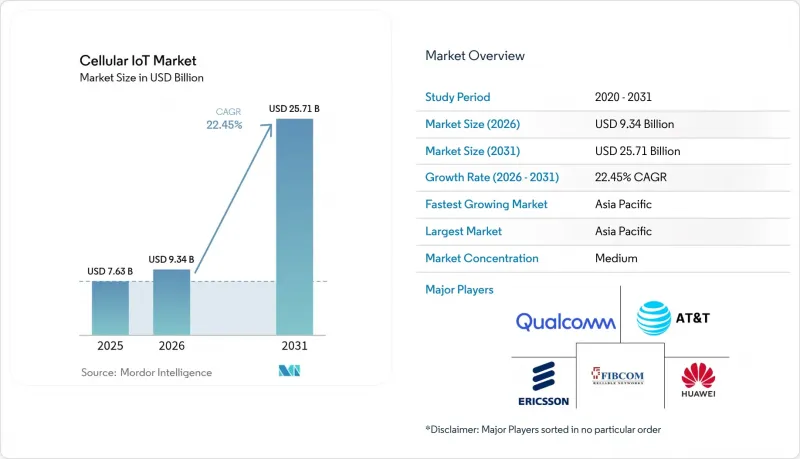
Mordor Intelligence에 의하면, 셀룰러 IoT 시장 규모는 2025년에 76억 3,000만 달러로 평가되었고 2026년 93억 4,000만 달러에서 2031년까지 257억 1,000만 달러에 이를 것으로 예측되며, 예측 기간(2026-2031년) CAGR은 22.45%를 나타낼 전망입니다.
본 보고서는 구성 요소(소프트웨어(보안 플랫폼 등), 하드웨어(안테나 등), 기타), 기술(2G, 3G, 기타), 최종 사용자 산업(자동차 및 운송, 에너지·유틸리티, 의료, 농업, 기타), 용도(자산 추적, 스마트 계량, 산업 자동화, 기타), 지역별로 분류되어 있습니다. 시장 예측은 금액(달러) 기준으로 제시되어 있습니다.
세계 셀룰러 IoT 시장 동향 및 인사이트
URLLC IoT를 실현하는 5G SA의 전개
상용 스탠드얼론(SA) 5G 네트워크는 산업 기업이 폐쇄 루프 자동화에 필요로 하는 5밀리초 미만의 지연을 실현합니다. 2024년 6월 AT&T가 댈러스에서 시작한 ‘RedCap’ 서비스를 통해 칩셋 공급업체는 실제 가동 중인 5G SA 네트워크에서 기기를 인증할 수 있게 되었으며, LTE Cat-4 모듈에 비해 전력 소비가 65% 감소한 것으로 확인되었습니다. 텔레포니카의 독일 내 시범 운영과 삼성 및 현대자동차의 생산 라인은 상용화 준비가 완료되었음을 보여주고 있지만, 진정한 규모 확대는 각국의 5G SA 커버리지와 합리적인 가격의 모듈 공급에 달려 있습니다.
Cat-1bis 모듈의 평균 판매 가격(ASP)은 4달러 미만
2024년 중국에서 실시된 대규모 입찰을 통해 Cat-1bis 모듈의 가격은 4달러 미만으로 떨어졌습니다. 이로 인해 구형 네트워크가 폐지되기 전에 4G의 잠재 고객 기반이 확대되었습니다. Quectel과 Fibocom 두 회사가 모듈 매출의 3분의 2를 차지했지만, 단일 제조 지역에 대한 과도한 의존으로 인해 유럽과 미국에서는 공급 안정성에 대한 재검토가 진행되고 있습니다. 중국 이외공급업체들은 이익률 압박에 직면해 있으며, u-blox는 지속적인 적자를 겪은 끝에 2025년 1월 이 분야에서 철수했습니다.
배터리 구동 기기에서 5G 모듈의 높은 전력 소비
RedCap을 통한 효율 개선 이후에도, 10년간의 현장 가동을 목표로 하는 센서의 경우 절대적인 전력 소비는 여전히 과제로 남아 있습니다. Nordic Semiconductor사의 nRF9151 모듈은 배터리 수명을 연장하고 원격 농업에 필수적인 위성 폴백 링크를 지원하기 위해 Power Class 5 출력을 도입했습니다. 디바이스 제조업체들은 에너지 수확 기능을 탑재하고 있지만, 성능을 확보하기 위해 비용과 크기를 희생할 수밖에 없습니다.
부문 분석
네트워크 서비스 종료에 앞서 각 제조업체들이 레거시 장비 교체를 서두른 결과, 2025년 매출의 63.35%를 하드웨어가 차지했습니다. 퀄컴은 칩셋에 대한 견조한 수요를 바탕으로 2025년 2분기 IoT 매출이 전년 동기 대비 27% 증가한 15억 8,000만 달러를 기록했습니다. 서비스에 기인한 셀룰러 IoT 시장 규모는 2031년까지 연평균 성장률(CAGR) 24.10%로 하드웨어를 상회할 것으로 예상되며, 이는 전 세계적으로 연결 관리, 무선 펌웨어 업데이트, 제로 터치 보안 패치에 대한 계약 건수 증가를 반영한 것입니다.
현재 전 세계 기업들은 여러 통신 사업자와 다양한 기술을 아우르는 기기군을 통합적으로 관리할 수 있는 대시보드를 요구하고 있습니다. KORE Wireless는 AI를 활용한 장애 감지를 통해 이미 200개국에서 1,900만 회선의 활성 회선을 관리하고 있습니다. 전문 서비스 팀은 무선 계획, 인증, 규제 준수 분야의 지식 격차를 해소하고 있습니다. 매니지드 서비스 계약은 하드웨어 가격 하락을 상쇄할 수 있는 지속적인 수익을 확보하는 동시에, 벤더의 인센티브를 고객의 가동 시간 및 보안 목표와 일치시킵니다.
중국의 각 OEM 업체들이 모듈 가격을 4달러 미만으로 인하한 결과, 2025년에는 4G LTE Cat-1이 매출 점유율의 56.20%를 차지하게 되었습니다. LTE-M 및 NB-IoT와 같은 보완적인 LPWA 모드는 계량 및 누수 감지 등 초저 처리량이 필요한 이용 사례에 대응하고 있습니다. 통신 사업자들이 주파수 대역을 5G SA로 재할당함에 따라, 기존의 2G/3G 연결은 기존 예측보다 빠르게 감소하고 있습니다. 고객들이 RedCap으로 전환함에 따라 4G 셀룰러 IoT 시장 규모는 축소될 전망이지만, 커버리지와 비용이 대역폭보다 우선시되는 분야에서는 여전히 대규모 도입이 기대되는 선택지로 남을 것입니다.
5G RedCap은 연평균 성장률(CAGR) 27.10%로 성장을 지속하고, 있으며, LPWA와 풀 스펙 5G를 연결하는 가교로 간주됩니다. Samsung Electronics와 현대자동차는 2025년 2월 공장 시험을 통해 RedCap의 유효성을 입증했으며, LTE-M에 비해 결정적인 지연 시간과 40%의 에너지 절감 효과를 보여주었습니다. 지상파 5G를 보완하는 비지상파 네트워크(NTN)가 탄력을 받고 있습니다. Viasat와 Myriota는 2025년 3월, 환경 감지용 최초의 5G NTN 서비스를 시작하여 단일 모듈 SKU를 통한 세계 커버리지의 길을 열었습니다.
지역별 분석
아시아태평양은 2025년 매출의 69.60%를 차지하며, 각국의 디지털 전환 계획을 배경으로 2031년까지 연평균 성장률(CAGR) 28.60%로 성장할 전망입니다. 중국에서는 2030년까지 41억 건의 라이선스가 부여된 셀룰러 연결이 예상되며, 이는 전 세계 총 건수의 70%를 차지합니다. 5G-Advanced의 커버리지가 더 많은 성으로 확대됨에 따라, 중국 내 전개에 기인한 셀룰러 IoT 시장 규모는 다른 모든 지역을 합친 규모를 훨씬 능가할 전망입니다.
지역별 제조 거점의 집중은 모듈 비용을 절감하지만, 한편으로는 의존 리스크를 초래하고 있으며, 현재 유럽과 미국의 규제 당국이 이를 면밀히 검토하고 있습니다. 인도의 57억 6,000만 달러 규모의 ‘스마트 시티 미션’과 인도네시아에서 예정된 RedCap 주파수 대역 경매는 중국 이외 지역 수요를 더욱 끌어올리는 요인이 될 것입니다. 동남아시아 전역의 신흥 시장에서는 현지 통신 분야의 전문 지식 부족을 보완하기 위해 클라우드 관리형 턴키 방식의 사설 네트워크 패키지가 채택되고 있으며, 이를 통해 연결성 격차가 급속히 줄어들고 있습니다. 북미는 프리미엄 용도 허브로서의 입지를 확고히 하고 있으며, AT&T와 T-Mobile은 저지연 산업 용도입에 주력하고 있습니다. 유럽에서는 규정 준수 및 지속가능성이 IoT 투자의 핵심으로 자리 잡고 있으며, 텔레포니카는 독일에서 RedCap 시범 운영을 진행하고 있고, 에릭슨은 프랑스 지방 자치 단체에서 프라이빗 5G를 구축하고 있습니다. 아시아태평양의 셀룰러 IoT 시장 점유율이 2030년 이전에 하락할 가능성은 낮지만, 기기 수 증가에 따라 세 지역 모두에서 수익 구조는 관리형 서비스로 전환될 것입니다.
기타 혜택:
- 엑셀 형식 시장 예측(ME) 시트
- 3개월간의 애널리스트 지원
자주 묻는 질문
목차
제1장 서론
제2장 조사 방법
제3장 주요 요약
제4장 시장 구도
제5장 시장 규모와 성장 예측
제6장 경쟁 구도
제7장 시장 기회와 향후 전망
JHS 26.09.07According to Mordor Intelligence, the cellular IoT market size was valued at USD 7.63 billion in 2025 and estimated to grow from USD 9.34 billion in 2026 to reach USD 25.71 billion by 2031, at a CAGR of 22.45% during the forecast period (2026-2031).
This report is Segmented by Component (Software [Security Platform, and More], Hardware [Antennas, and More], and More), Technology (2G, 3G, and More), End-User Industry (Automotive and Transportation, Energy and Utilities, Healthcare, Agriculture, and More), Application (Asset Tracking, Smart Metering, Industrial Automation, and More), and Geography. The Market Forecasts are Provided in Terms of Value (USD).
Global Cellular IoT Market Trends and Insights
5G SA roll-out enabling URLLC IoT
Commercial standalone 5G networks deliver sub-5 ms latency that industrial firms require for closed-loop automation. AT&T's June 2024 RedCap launch in Dallas allowed chipset vendors to certify devices on a live 5G SA network and confirmed power-consumption cuts of 65% against LTE Cat-4 modules.Telefonica's German trials and Samsung-Hyundai manufacturing lines underline readiness, yet true scale hinges on national 5G SA coverage and affordable module supply.
Module ASPs below USD 4 for Cat-1bis
Large 2024 tenders in China pushed Cat-1bis modules under USD 4, widening 4G's addressable base before older networks shut down. Quectel and Fibocom together captured two-thirds of module revenue, but heavy reliance on a single manufacturing region has triggered supply-security reviews in Europe and the United States. Non-Chinese suppliers face margin compression; u-blox exited the segment in January 2025 after sustained losses.
High power draw of 5G modules in battery devices
Even after RedCap efficiency gains, absolute power remains a challenge for sensors targeting 10-year field life. Nordic Semiconductor's nRF9151 module introduced Power Class 5 output to extend battery cycles and accommodate satellite fallback links essential for remote agriculture. Device makers are integrating energy-harvest options but must trade cost and size against performance.
Other drivers and restraints analyzed in the detailed report include:
- Government-funded NB-IoT smart-city mandates
- 5G RedCap modules unlock mid-tier devices
- 2G/3G sunsets causing retrofit costs
For complete list of drivers and restraints, kindly check the Table Of Contents.
Segment Analysis
Hardware contributed 63.35% of 2025 revenue as manufacturers rushed to replace legacy units ahead of network sunsets. Qualcomm posted 27% year-over-year IoT revenue growth to USD 1.58 billion in Q2 2025 on the back of robust chipset demand. The cellular IoT market size attributed to services is expected to outpace hardware with a 24.10% CAGR through 2031, reflecting climbing subscriptions for global connectivity management, firmware-over-air updates, and zero-touch security patches.
Global enterprises now insist on unified dashboards that orchestrate multi-carrier, multi-technology fleets. KORE Wireless already manages 19 million active lines across 200 countries through AI-driven fault detection. Professional services teams fill knowledge gaps in radio-planning, certification, and regulatory compliance. Managed-service contracts ensure recurring revenue that cushions hardware price erosion, aligning vendor incentives with customer uptime and security objectives.
4G LTE Cat-1 secured 56.20% revenue share in 2025 after Chinese OEMs slashed module prices below USD 4. Complementary LPWA modes such as LTE-M and NB-IoT serve ultra-low-throughput use cases including metering and leak detection. Legacy 2G/3G connections decline faster than previously forecast because operators are reallocating spectrum to 5G SA. The cellular IoT market size for 4G will taper as customers migrate to RedCap, but it remains a high-volume option where coverage and cost trump bandwidth.
5G RedCap is registering a 27.10% CAGR and is viewed as the bridge between LPWA and full-spec 5G. Samsung and Hyundai validated RedCap in a February 2025 factory trial, showing deterministic latency and 40% energy savings compared with LTE-M. Non-terrestrial networks that complement terrestrial 5G are gaining momentum; Viasat and Myriota launched the first 5G NTN service for environmental sensing in March 2025, opening pathways for global coverage on a single module SKU.
Complete Report Scope:
- By Component
- Hardware
- Modules / Chipsets
- Antennas
- Gateways and Routers
- Software
- Connectivity Management Platform
- Device Management
- Security Platform
- Data Analytics Platform
- Services
- Professional Services
- Managed Services
- Hardware
- By Technology
- 2G
- 3G
- 4G LTE (Cat-1/Cat-4)
- LTE-M
- NB-IoT
- 5G NR (eMBB and RedCap)
- Non-Terrestrial (Satellite NTN)
- By End-User Industry
- Automotive and Transportation
- Energy and Utilities
- Manufacturing and Industrial
- Healthcare
- Retail
- Consumer Electronics
- Agriculture
- Logistics and Supply Chain
- Smart Cities / Public Infrastructure
- By Application
- Asset Tracking
- Smart Metering
- Industrial Automation
- Remote Monitoring and Control
- Wearables and Personal Devices
- Smart Home Devices
- By Geography
- North America
- United States
- Canada
- Mexico
- South America
- Brazil
- Argentina
- Chile
- Rest of South America
- Europe
- Germany
- United Kingdom
- France
- Italy
- Spain
- Netherlands
- Russia
- Rest of Europe
- Asia Pacific
- China
- India
- Japan
- South Korea
- ASEAN
- Rest of Asia Pacific
- Middle East and Africa
- Middle East
- GCC (Saudi Arabia, UAE, Qatar, etc.)
- Turkey
- Rest of Middle East
- Africa
- South Africa
- Nigeria
- Kenya
- Rest of Africa
- Middle East
- North America
Geography Analysis
Asia Pacific secured 69.60% of 2025 revenue and is set to advance at 28.60% CAGR through 2031 on the back of national digital-transformation plans. China expects 4.1 billion licensed cellular connections by 2030, representing 70% of global totals. The cellular IoT market size attached to Chinese deployments alone is poised to dwarf every other region combined as 5G-Advanced coverage blankets additional provinces.
Regional manufacturing concentration cuts module costs but introduces dependency risk that Western regulators now scrutinize. India's USD 5.76 billion Smart Cities Mission and Indonesia's upcoming RedCap spectrum auctions add incremental volume outside China. Emerging markets across Southeast Asia adopt turnkey cloud-managed private-network packages that offset limited local telecom expertise, ensuring that connectivity gaps shrink quickly. North America positions itself as the premium application hub, with AT&T and T-Mobile focusing on low-latency industrial deployments. Europe places compliance and sustainability at the center of IoT spending, with Telefonica testing RedCap in Germany and Ericsson rolling out private 5G in French municipalities. The cellular IoT market share of Asia Pacific is unlikely to erode before 2030, but revenue mix will swing toward managed services in all three regions as device counts grow.
- Quectel Wireless Solutions Co., Ltd.
- Fibocom Wireless Inc.
- Telit IoT Solutions Holding Ltd.
- Semtech Corporation (incl. Sierra Wireless, Inc.)
- u-blox Holding AG
- Qualcomm Incorporated
- MediaTek Inc.
- CommSolid GmbH
- Sequans Communications SA
- ZTE Corporation
- Thales Group
- Texas Instruments Incorporated
- Nordic Semiconductor ASA
- Huawei Technologies Co. Ltd.
- Telefonaktiebolaget LM Ericsson
- Vodafone Group plc
- China Mobile Limited
- Verizon Communications Inc.
- AT&T Inc.
- Deutsche Telekom AG
Additional Benefits:
- The market estimate (ME) sheet in Excel format
- 3 months of analyst support
TABLE OF CONTENTS
1 INTRODUCTION
- 1.1 Study Assumptions and Market Definition
- 1.2 Scope of the Study
2 RESEARCH METHODOLOGY
3 EXECUTIVE SUMMARY
4 MARKET LANDSCAPE
- 4.1 Market Overview
- 4.2 Market Drivers
- 4.2.1 5G SA roll-out enabling URLLC IoT
- 4.2.2 Module ASPs below USD 4 for Cat-1bis
- 4.2.3 Government-funded NB-IoT smart-city mandates
- 4.2.4 5G RedCap modules unlock mid-tier devices
- 4.2.5 Sustainability-linked asset-tracking demand
- 4.2.6 Mass certification of eSIM/iSIM
- 4.3 Market Restraints
- 4.3.1 High power draw of 5G modules in battery devices
- 4.3.2 2G/3G sunsets causing retrofit costs
- 4.3.3 Cat-1bis chipset supply volatility (China fabs)
- 4.3.4 Fragmented IoT security standards and liabilities
- 4.4 Value Chain Analysis
- 4.5 Regulatory Landscape
- 4.6 Technological Outlook
- 4.7 Porter's Five Forces Analysis
- 4.7.1 Bargaining Power of Suppliers
- 4.7.2 Bargaining Power of Buyers
- 4.7.3 Threat of New Entrants
- 4.7.4 Threat of Substitutes
- 4.7.5 Competitive Rivalry
5 MARKET SIZE AND GROWTH FORECASTS (VALUE)
- 5.1 By Component
- 5.1.1 Hardware
- 5.1.1.1 Modules / Chipsets
- 5.1.1.2 Antennas
- 5.1.1.3 Gateways and Routers
- 5.1.2 Software
- 5.1.2.1 Connectivity Management Platform
- 5.1.2.2 Device Management
- 5.1.2.3 Security Platform
- 5.1.2.4 Data Analytics Platform
- 5.1.3 Services
- 5.1.3.1 Professional Services
- 5.1.3.2 Managed Services
- 5.1.1 Hardware
- 5.2 By Technology
- 5.2.1 2G
- 5.2.2 3G
- 5.2.3 4G LTE (Cat-1/Cat-4)
- 5.2.4 LTE-M
- 5.2.5 NB-IoT
- 5.2.6 5G NR (eMBB and RedCap)
- 5.2.7 Non-Terrestrial (Satellite NTN)
- 5.3 By End-User Industry
- 5.3.1 Automotive and Transportation
- 5.3.2 Energy and Utilities
- 5.3.3 Manufacturing and Industrial
- 5.3.4 Healthcare
- 5.3.5 Retail
- 5.3.6 Consumer Electronics
- 5.3.7 Agriculture
- 5.3.8 Logistics and Supply Chain
- 5.3.9 Smart Cities / Public Infrastructure
- 5.4 By Application
- 5.4.1 Asset Tracking
- 5.4.2 Smart Metering
- 5.4.3 Industrial Automation
- 5.4.4 Remote Monitoring and Control
- 5.4.5 Wearables and Personal Devices
- 5.4.6 Smart Home Devices
- 5.5 By Geography
- 5.5.1 North America
- 5.5.1.1 United States
- 5.5.1.2 Canada
- 5.5.1.3 Mexico
- 5.5.2 South America
- 5.5.2.1 Brazil
- 5.5.2.2 Argentina
- 5.5.2.3 Chile
- 5.5.2.4 Rest of South America
- 5.5.3 Europe
- 5.5.3.1 Germany
- 5.5.3.2 United Kingdom
- 5.5.3.3 France
- 5.5.3.4 Italy
- 5.5.3.5 Spain
- 5.5.3.6 Netherlands
- 5.5.3.7 Russia
- 5.5.3.8 Rest of Europe
- 5.5.4 Asia Pacific
- 5.5.4.1 China
- 5.5.4.2 India
- 5.5.4.3 Japan
- 5.5.4.4 South Korea
- 5.5.4.5 ASEAN
- 5.5.4.6 Rest of Asia Pacific
- 5.5.5 Middle East and Africa
- 5.5.5.1 Middle East
- 5.5.5.1.1 GCC (Saudi Arabia, UAE, Qatar, etc.)
- 5.5.5.1.2 Turkey
- 5.5.5.1.3 Rest of Middle East
- 5.5.5.2 Africa
- 5.5.5.2.1 South Africa
- 5.5.5.2.2 Nigeria
- 5.5.5.2.3 Kenya
- 5.5.5.2.4 Rest of Africa
- 5.5.5.1 Middle East
- 5.5.1 North America
6 COMPETITIVE LANDSCAPE
- 6.1 Market Concentration
- 6.2 Strategic Moves
- 6.3 Market Share Analysis
- 6.4 Company Profiles (includes Global level Overview, Market level overview, Core Segments, Financials as available, Strategic Information, Market Rank/Share for key companies, Products and Services, and Recent Developments)
- 6.4.1 Quectel Wireless Solutions Co., Ltd.
- 6.4.2 Fibocom Wireless Inc.
- 6.4.3 Telit IoT Solutions Holding Ltd.
- 6.4.4 Semtech Corporation (incl. Sierra Wireless, Inc.)
- 6.4.5 u-blox Holding AG
- 6.4.6 Qualcomm Incorporated
- 6.4.7 MediaTek Inc.
- 6.4.8 CommSolid GmbH
- 6.4.9 Sequans Communications SA
- 6.4.10 ZTE Corporation
- 6.4.11 Thales Group
- 6.4.12 Texas Instruments Incorporated
- 6.4.13 Nordic Semiconductor ASA
- 6.4.14 Huawei Technologies Co. Ltd.
- 6.4.15 Telefonaktiebolaget LM Ericsson
- 6.4.16 Vodafone Group plc
- 6.4.17 China Mobile Limited
- 6.4.18 Verizon Communications Inc.
- 6.4.19 AT&T Inc.
- 6.4.20 Deutsche Telekom AG
7 MARKET OPPORTUNITIES AND FUTURE OUTLOOK
- 7.1 White-space and Unmet-need Assessment


