

|
시장보고서
상품코드
2124060
소비자 IoT 시장 : 점유율 분석, 업계 동향과 통계, 성장 예측(2026-2031년)Consumer IoT - Market Share Analysis, Industry Trends & Statistics, Growth Forecasts (2026 - 2031) |
||||||
 Mordor Intelligence
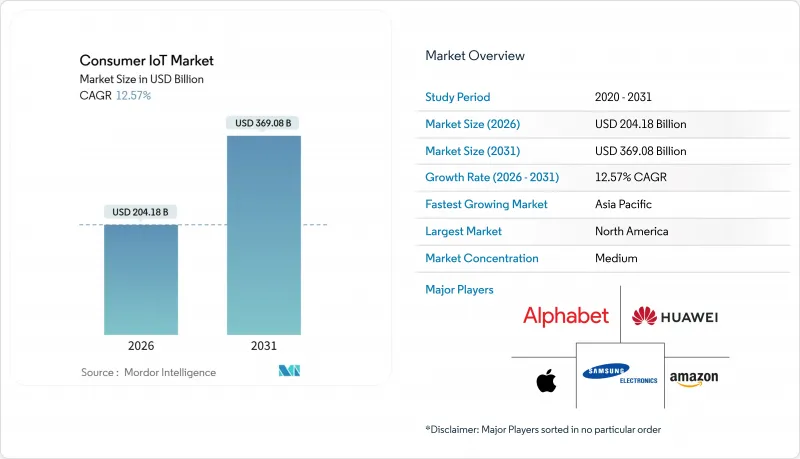
Mordor Intelligence에 의하면, 소비자 IoT 시장은 2026년에 2,041억 8,000만 달러에 이르고, 2031년까지 3,690억 8,000만 달러에 이를 것으로 예측됩니다. 해당 기간 CAGR이 12.57%으로 전망되며 현재 시장 규모와 향후 시장가치 양쪽 모두에서 강력한 상승 경향이 확인되고 있습니다.
본 보고서는 제품 유형(하드웨어, 소프트웨어, 서비스), 연결 기술(Wi-Fi, 블루투스/BLE, Zigbee/Z-Wave/Thread, 셀룰러, 초광대역),용도(홈 오토메이션, 소비자 웨어러블, 가전제품, 헬스케어 기기 등), 판매 채널(온라인, 오프라인), 지역별로 분류되어 있습니다. 시장 예측은 금액(달러) 기준으로 제시되어 있습니다.
세계 소비자 IoT 시장 동향 및 인사이트
연결 기기의 보급과 센서 가격 하락
2025년 말까지 Thread 인증 제품 수는 1,100건을 넘어섰으며, 이에 따라 모션 센서, 온도 센서, 습도 센서의 단가가 0.50달러 미만으로 떨어졌습니다. 이로 인해 기본적인 스마트 플러그나 도어 센서의 소매 가격이 20달러 미만으로 유지되고 있습니다. TSMC, 인텔, 삼성의 애리조나주 및 텍사스주 파운드리 생산 확대로 인해 연간 총 100만 장 이상의 웨이퍼 스타트가 추가되어, 마이크로컨트롤러의 리드타임이 안정화되고 공급 접근성이 확대되었습니다. Bosch Sensortec사의 BHI360 및 BHI380 센서 허브는 온칩 머신 러닝 기능을 통합하여 웨어러블 기기 및 노드에서 외부 프로세서의 부하를 줄이고 배터리 수명을 연장합니다. 이러한 비용 효율성 향상과 더불어, ISO/IEC 30141 참조 아키텍처의 채택으로 엔지니어링 오버헤드가 감소했으며, 차별화의 초점은 소프트웨어 기반 서비스로 이동하고 있습니다.
5G 및 LPWAN 연결의 확산
GSMA의 집계에 따르면, 2024년 초 기준으로 전 세계 5G 연결 건수는 16억 건에 달했습니다. 한편, 에릭슨은 2025년 말까지 인구의 60%를 커버할 것으로 전망하며, 실시간 건강 모니터링 및 몰입형 용도에 필요한 10밀리초 미만의 지연 시간을 실현할 것입니다. Skylo는 퀄컴, 삼성, 구글, 가민과 제휴하여 프리미엄 스마트폰 및 웨어러블 기기에 위성 메시징 기능을 통합함으로써 지상 통신의 사각지대를 메우고, 긴급 상황 시 통신을 지원하고 있습니다. Orange Europe은 2025년 11월, 해상 및 고산 지역을 대상으로 위성 SMS 서비스를 도입했습니다. Semtech의 HL78 LoRa Edge 모듈은 LPWAN과 GNSS 위치 파악 기술을 결합하여 자산 추적 장치의 배터리 수명을 5년 이상으로 연장합니다. Thread 1.4에서는 ‘슬리피(Sleepy)’ 엔드 디바이스가 도입되어, 상시 연결된 Wi-Fi에 비해 전력 소비를 최대 40% 절감함으로써, 지방이나 저전력 환경에서의 도입에 기여합니다.
데이터 개인정보 보호 및 사이버 보안에 대한 우려
유럽 데이터 보호 위원회는 2018년 이후 GDPR(EU 개인정보보호규정)에 근거하여 45억 유로(51억 달러)의 벌금을 부과해 왔으며, 여기에는 2023년 5월 메타(Meta)에 부과된 12억 유로(13억 6,000만 달러)의 벌금도 포함됩니다. 이로 인해 IoT 공급업체들은 데이터 저장의 현지화 및 권한 관리 프레임워크 개선을 서둘러야 하는 상황에 놓여 있습니다. 유로스타트(Eurostat)의 조사에 따르면, 2024년에는 EU 시민의 7%가 보안에 대한 우려를 도입의 장벽으로 꼽았으며, 저소득 가구에서는 그 비율이 12%로 상승했습니다. 2025년 12월에 시작된 FDA의 TEMPO 시범 프로그램에서는 의료기기 신청자에게 사이버 보안 위협 모델 및 소프트웨어 부품 목록의 제출을 의무화하고 있습니다. 소규모 공급업체들은 불균형적인 규정 준수 비용에 직면해 있으며, 법적 부담을 감당할 수 있는 플랫폼 사업자를 중심으로 한 업계 재편이 가속화되고 있습니다.
부문 분석
각 벤더가 일회성 하드웨어 판매에서 펌웨어 업데이트, 예측 유지보수, 이용 현황 분석을 포함한 구독 번들로 비즈니스 모델을 전환함에 따라, 서비스 시장은 2026년부터 2031년까지 연평균 성장률(CAGR) 13.21%로 확대되고 있습니다. 2025년에는 하드웨어가 소비자 IoT 시장 점유율의 47.62%를 유지했으나, 서비스 시장 규모는 하드웨어 시장보다 빠르게 확대되고 있으며, 이는 지속적인 수익이 초기 투자로 인한 이익률 압박을 상회하고 있음을 보여줍니다. 아마존의 프리미엄 플랜 ‘Alexa+’나 구글의 Gemini 기반 Nest 카메라용 클라우드 스토리지는 플랫폼이 하드웨어 소유자를 장기 구독자로 전환시키는 메커니즘을 여실히 보여줍니다. EU의 에너지 효율 규제에 따라 소비 데이터를 집계하고 자동적인 부하 감축을 촉발하는 대시보드 소프트웨어가 추진되고 있으며, 슈나이더 일렉트릭의 ‘Wiser Energy’ 플랫폼이 그 대표적인 예입니다.
하드웨어 출하량은 여전히 매우 중요합니다. 기기의 보급이야말로 서비스 도입률을 뒷받침하는 기반이 되기 때문입니다. 보쉬 센서테크(Bosch Sensortech)의 통합 센서 허브를 통한 비용 절감과 미국 파운드리 업체들의 웨이퍼 생산 능력 확충으로 인해 보급형 제품 가격은 낮게 유지되고 있지만, 상품화가 진행됨에 따라 이익률은 압박을 받고 있습니다. ISO/IEC 30141 규격은 참조 아키텍처의 표준화를 가속화하여 통합 비용을 절감하는 동시에, 소프트웨어 및 서비스 제공업체가 제공하는 분석, 클라우드 호스팅, AI 기능과 같은 분야로 이익을 유도하고 있습니다.
2025년에는 레거시 라우터의 보급 기반과 Wi-Fi 7로의 멀티 기가비트 업그레이드에 힘입어 Wi-Fi가 도입의 43.44%를 차지했습니다. 그러나 울트라 와이드밴드(UWB)는 2031년까지 연평균 성장률(CAGR) 13.62%를 나타낼 것으로 예측되며, 자동차 키 포브에서 센티미터 단위의 위치 측정이 가능한 스마트폰에 이르기까지 그 활용 범위를 확대되고 있습니다. UWB 지원 기기의 소비자 IoT 시장 규모는 특히 디지털 키, 자산 추적, 공간 오디오 분야에서 급속히 확대되고 있으며, 이러한 성장으로 인해 실내 내비게이션 분야에서 한때 확고한 입지를 다졌던 Wi-Fi의 존재감이 점차 희미해지고 있습니다. FCC Part 15 및 ETSI의 준수 요건에는 벤더가 제품 설계 초기 단계에서 충족해야 하는 방사 제한이 규정되어 있지만, FiRa 컨소시엄의 세계 회원사들은 인증 장벽을 낮추는 레퍼런스 설계를 공유하고 있습니다.
블루투스 및 BLE는 웨어러블 기기나 헤드폰에서 막대한 출하량을 유지하고 있지만, 상시 작동으로 인한 전력 소비가 배터리 소모에 민감한 엔드포인트의 제약 요인이 되고 있습니다. Thread와 같은 저전력 메시 규격은 센서나 도어 콘택트에 유용합니다. 특히 Thread 1.4에서는 배터리 수명을 현저히 연장하는 ‘슬리피’ 엔드 디바이스가 도입되었습니다. 셀룰러 통신인 NB-IoT 및 LTE-M은 모빌리티 이용 사례에 대응하는 반면, Skylo의 위성 오버레이 기술은 메시징 범위를 지상파 통신 영역 밖으로 확장하여, 원격지의 보안 장치나 어드벤처용 웨어러블 기기에서 채택이 확대되고 있습니다.
지역별 분석
2025년, 북미는 전 세계 매출의 37.89%를 차지했습니다. 이는 스마트 홈 도입 시 최대 15%의 보험 할인 혜택과 미국 ‘인플레이션 억제법(Inflation Reduction Act)’에 따른 스마트 온도 조절기에 대한 연방 세액 공제가 뒷받침된 결과입니다. 캘리포니아주의 ‘타이틀 24(Title 24)’와 같은 주 규정은 신축 주택에 부하 관리 제어 장치 설치를 의무화하고 있으며, 이로 인해 지능형 기기의 보급이 더욱 확대되고 있습니다. 캐나다의 유틸리티자들은 리베이트나 시간대별 요금제를 통해 유사한 인센티브를 제공하고 있는 반면, 멕시코에서는 니어쇼어링 붐과 국경을 넘는 전자상거래로 인해 중산층 가구가 소비자 IoT 시장에 진입하고 있습니다.
아시아태평양은 2031년까지 연평균 성장률(CAGR) 14.11%로 확대될 것으로 예측되며, 지역별로는 가장 빠른 성장세를 보일 전망입니다. 샤오미는 2024년에 1억 대 이상의 스마트 홈 기기를 출하했으며, 공격적인 가격 정책을 통해 중국 내 진입 장벽을 낮췄습니다. 인도의 ‘디지털 인디아(Digital India)’ 프로그램은 광대역 인터넷에 대한 보조금을 지급하고 국내 조립 라인을 육성함으로써 커넥티드 기기에 대한 접근성을 확대되고 있습니다. 한국의 5G 커버리지율은 95%를 넘어, 국내 대기업인 삼성과 LG의 AI 탑재 가전제품의 급속한 보급을 뒷받침하고 있습니다. 일본에서는 인지도는 높지만 소유율은 낮으며, Matter 인증의 보급에도 불구하고 상호 운용성 및 가치에 대한 인식이 보급을 저해하고 있습니다.
유럽의 동향은 ‘에너지 효율 지침 2023/1791’과 직접적으로 연계되어 있으며, 이 지침은 2030년까지 에너지 소비량을 11.7% 감축할 것을 의무화하고, 사실상 모든 신축 건물에 스마트 계량기 설치를 의무화하고 있습니다. 2024년에 채택된 ‘수리권’ 관련 법안은 기기의 수명을 연장하고, 하드웨어 교체를 통한 매출보다 소프트웨어 업데이트를 통한 수익을 촉진하고 있습니다. 북유럽 국가들은 거의 전국을 커버하는 광대역 인프라와 환경 의식이 높은 소비자의 혜택을 누리고 있는 반면, 이탈리아와 스페인에서는 국가 에너지 계획을 통해 스마트 계량기 도입을 가속화하고 있습니다. GDPR(EU 개인정보보호규정) 및 향후 도입될 AI 규제로 인해 규정 준수 요구가 높아지고 있으며, 이는 기존 기업들에게 유리하게 작용하고 있습니다.
남미 시장은 여전히 발전 단계에 있지만, 브라질과 아르헨티나에서 도시 중산층이 확대되고 있는 혜택을 받고 있습니다. 중동 및 아프리카는 국가 주도의 스마트 시티 메가 프로젝트에 의존하고 있습니다. UAE는 2031년까지 1,000건의 기술 도입에 110억 AED(30억 달러)를 배정하고 있으며, 여기에는 아부다비와 두바이에서 이미 가동 중인 60만 대의 스마트 미터가 포함됩니다. 사우디아라비아의 ‘비전 2030’과 남아프리카공화국의 송전망 현대화 이니셔티브 역시 지역별 수요를 뒷받침하고 있습니다. 세계은행 데이터에 따르면, 걸프협력회의(GCC) 회원국에서는 5G 커버리지율이 90%를 넘고, 모바일 광대역 속도도 100 Mbps를 상회하여 향후 보급을 뒷받침하고 있습니다.
기타 혜택:
- 엑셀 형식 시장 예측(ME) 시트
- 3개월간의 애널리스트 지원
자주 묻는 질문
목차
제1장 서론
제2장 조사 방법
제3장 주요 요약
제4장 시장 구도
제5장 시장 규모와 성장 예측
제6장 경쟁 구도
제7장 시장 기회와 향후 전망
JHS 26.09.07According to Mordor Intelligence, the consumer IoT market stood at USD 204.18 billion in 2026 and is projected to reach USD 369.08 billion by 2031, reflecting a 12.57% CAGR across the period and confirming a strong upward trajectory in both current market size and future value.
This report is Segmented by Product Type (Hardware, Software, and Services), Connectivity Technology (Wi-Fi, Bluetooth/BLE, Zigbee/Z-Wave/Thread, Cellular, and Ultra-Wideband), Application (Home Automation, Consumer Wearables, Consumer Electronics, Healthcare Devices, and More), Distribution Channel (Online, and Offline), and Geography. The Market Forecasts are Provided in Terms of Value (USD).
Global Consumer IoT Market Trends and Insights
Connected Device Proliferation and Falling Sensor Prices
The number of Thread-certified products exceeded 1,100 by late 2025, pushing unit costs for motion, temperature, and humidity sensors below USD 0.50, which supports sub-USD 20 retail prices for basic smart plugs and door sensors. Foundry ramps by TSMC, Intel and Samsung in Arizona and Texas collectively added more than 1 million wafer starts per year, stabilizing microcontroller lead times and widening supply access. Bosch Sensortec's BHI360 and BHI380 sensor hubs integrate on-chip machine learning that reduces external processor load and lengthens battery life in wearables and nodes. These cost efficiencies, coupled with ISO/IEC 30141 reference architectures, reduce engineering overhead and reposition differentiation toward software-based services.
Roll-out of 5G and LPWAN Connectivity
GSMA counted 1.6 billion 5G connections globally by early 2024, while Ericsson projected 60% population coverage by the end of 2025, delivering sub-10 millisecond latency necessary for real-time health monitoring and immersive applications.Skylo partnerships with Qualcomm, Samsung, Google, and Garmin embed satellite messaging into premium smartphones and wearables, closing terrestrial gaps and supporting emergency communication. Orange Europe added satellite SMS services in November 2025 for maritime and alpine regions. Semtech's HL78 LoRa Edge module combines LPWAN with GNSS positioning to extend battery life beyond five years in asset trackers. Thread 1.4 introduced sleepy end devices that cut energy draw by up to 40% compared with always-on Wi-Fi, benefiting rural and low-power deployments.
Data-Privacy and Cyber-Security Concerns
The European Data Protection Board has imposed EUR 4.5 billion (USD 5.1 billion) in GDPR fines since 2018, including Meta's EUR 1.2 billion (USD 1.36 billion) penalty in May 2023, prompting IoT vendors to localize data storage and refine permission frameworks. Eurostat recorded 7% of EU citizens citing security fears as a barrier to adoption in 2024, rising to 12% in lower-income households. The FDA's TEMPO pilot, launched December 2025, obligates medical-device applicants to submit cybersecurity threat models and software bills of materials. Smaller vendors face disproportionate compliance costs, accelerating consolidation around platform operators that can absorb legal overhead.
Other drivers and restraints analyzed in the detailed report include:
- Rapid Smart-Home Ecosystem Adoption
- AI-Driven Voice-Assistant Integration
- Interoperability Fragmentation Despite Matter Roll-out
For complete list of drivers and restraints, kindly check the Table Of Contents.
Segment Analysis
Services are expanding at a 13.21% CAGR from 2026 to 2031 as vendors pivot from one-time hardware sales to subscription bundles that include firmware updates, predictive maintenance, and usage analytics. The Consumer IoT market size for Services is rising faster than hardware even though Hardware maintained 47.62% Consumer IoT market share in 2025, indicating that recurring revenue is eclipsing upfront margin compression. Amazon's premium Alexa+ tier and Google's Gemini-based cloud storage for Nest cameras illustrate how platforms convert hardware owners into long-lived subscribers. EU energy-efficiency mandates drive dashboard software that aggregates consumption data and triggers automated load shedding, as seen in Schneider Electric's Wiser Energy platform.
Hardware shipment volumes remain critical because device proliferation anchors any attach rate for services. Cost reductions from Bosch Sensortec's integrated sensor hubs and wafer-capacity additions by U.S. foundries have kept entry-level prices low, yet commoditization squeezes margins. ISO/IEC 30141 accelerates reference-architecture alignment, lowering integration costs and channeling profit pools toward analytics, cloud hosting, and AI features that software and service providers supply.
Wi-Fi accounted for 43.44% of deployments in 2025 due to legacy router bases and multi-gigabit upgrades to Wi-Fi 7. However, Ultra-Wideband is projected to post a 13.62% CAGR to 2031, scaling upward from automotive key fobs to smartphones that offer centimeter-level positioning. The Consumer IoT market size for UWB-enabled devices is accelerating particularly in digital-key, asset-tracking, and spatial-audio scenarios, and gains are eroding the once unassailable presence of Wi-Fi in indoor navigation. FCC Part 15 and ETSI compliance requirements set emission limits that vendors must address early in product design, but global members of the FiRa Consortium are pooling reference designs that lower certification hurdles.
Bluetooth and BLE sustain huge unit volumes in wearables and headphones, though always-on power draw constrains battery-sensitive endpoints. Low-power mesh standards such as Thread benefit sensors and door contacts, especially since Thread 1.4 introduced sleepy end devices that extend battery life markedly. Cellular NB-IoT and LTE-M serve mobility use cases, while Skylo's satellite overlay pushes messaging beyond terrestrial coverage, expanding adoption in remote security devices and adventure wearables.
Complete Report Scope:
- By Product Type
- Hardware
- Software
- Services
- By Connectivity Technology
- Wi-Fi
- Bluetooth / BLE
- Zigbee / Z-Wave / Thread
- Cellular
- Ultra-Wideband (UWB)
- By Application
- Home Automation
- Consumer Wearables
- Consumer Electronics
- Healthcare Devices
- Automotive
- Other Applications
- By Distribution Channel
- Online
- Offline
- By Geography
- North America
- United States
- Canada
- Mexico
- South America
- Brazil
- Argentina
- Rest of South America
- Europe
- Germany
- United Kingdom
- France
- Italy
- Spain
- Rest of Europe
- Asia-Pacific
- China
- Japan
- India
- South Korea
- Australia and New Zealand
- Rest of Asia-Pacific
- Middle East and Africa
- Middle East
- Saudi Arabia
- United Arab Emirates
- Turkey
- Rest of Middle East
- Africa
- South Africa
- Egypt
- Nigeria
- Rest of Africa
- Middle East
- North America
Geography Analysis
North America contributed 37.89% of global revenue in 2025, supported by insurance discounts that reach 15% for smart-home installations and by federal tax credits for smart thermostats under the U.S. Inflation Reduction Act. State mandates such as California's Title 24 require load-management controls in new homes, further embedding intelligent devices. Canadian utilities mirror these incentives through rebates and time-of-use tariffs, while Mexico's nearshoring boom and cross-border e-commerce invite mid-income households into the Consumer IoT market.
Asia-Pacific is projected to expand at a 14.11% CAGR to 2031, the fastest regional pace. Xiaomi shipped more than 100 million smart-home devices in 2024, using aggressive pricing to lower entry barriers in China. India's Digital India program subsidizes broadband and nurtures local assembly lines, delivering wider access to connected devices. South Korea's 5G coverage surpasses 95%, fostering rapid uptake of AI-enhanced appliances from domestic champions Samsung and LG. Japan exhibits high awareness but low ownership, with interoperability and perceived value hindering rollouts despite the spread of Matter certification.
Europe's trajectory ties directly to the Energy Efficiency Directive 2023/1791, which mandates an 11.7% consumption reduction by 2030 and effectively requires smart meters in all new buildings. Right-to-Repair legislation adopted in 2024 extends device lifespans, encouraging software-update revenue more than replacement hardware sales. Nordic countries benefit from near-universal broadband and eco-conscious consumers, whereas Italy and Spain accelerate meter deployment through national energy plans. GDPR and forthcoming AI regulation sustain compliance demands that favor incumbents.
South America remains nascent but benefits from expanding urban middle classes in Brazil and Argentina. Middle East and Africa rely on sovereign smart-city megaprojects; the UAE allocated AED 11 billion (USD 3 billion) for 1,000 technology installations by 2031, including 600,000 smart meters already active in Abu Dhabi and Dubai. Saudi Arabia's Vision 2030 and South Africa's grid-modernization initiatives also spur localized demand. World Bank data shows Gulf Cooperation Council members enjoy more than 90% 5G coverage and mobile broadband speeds above 100 Mbps, underpinning future adoption.
- Apple Inc.
- Amazon.com Inc.
- Alphabet Inc. (Google)
- Samsung Electronics Co. Ltd.
- Microsoft Corp.
- Sony Group Corp.
- LG Electronics Inc.
- Huawei Technologies Co. Ltd.
- Xiaomi Corp.
- Bosch Sensortec GmbH
- Cisco Systems Inc.
- Intel Corp.
- IBM Corp.
- Honeywell International Inc.
- Schneider Electric SE
- Hewlett Packard Enterprise
- AT&T Inc.
- Comcast Corp.
- ADT Inc.
- Ring LLC
- Arlo Technologies Inc.
- Garmin Ltd.
- Fitbit LLC
- Qorvo Inc.
- Signify N.V.
- Ecobee Inc.
Additional Benefits:
- The market estimate (ME) sheet in Excel format
- 3 months of analyst support
TABLE OF CONTENTS
1 INTRODUCTION
- 1.1 Study Assumptions and Market Definition
- 1.2 Scope of the Study
2 RESEARCH METHODOLOGY
3 EXECUTIVE SUMMARY
4 MARKET LANDSCAPE
- 4.1 Market Overview
- 4.2 Market Drivers
- 4.2.1 Proliferation of Connected Consumer Devices and Falling Sensor Prices
- 4.2.2 Roll-out of 5G and LPWAN Connectivity
- 4.2.3 Rapid Smart-Home Ecosystem Adoption
- 4.2.4 AI-Driven Voice-Assistant Integration
- 4.2.5 Insurance-Linked Incentives for Risk-Mitigating IoT Devices
- 4.2.6 Energy-Price-Driven Demand for Smart Home Energy Management
- 4.3 Market Restraints
- 4.3.1 Data-Privacy and Cyber-Security Concerns
- 4.3.2 Inter-operability Fragmentation Despite Matter Roll-out
- 4.3.3 Chip-Supply Volatility and Pricing Pressure
- 4.3.4 E-Waste, Right-to-Repair and Eco-Design Regulation Impact
- 4.4 Industry Value Chain Analysis
- 4.5 Regulatory Landscape
- 4.6 Technological Outlook
- 4.7 Porter's Five Forces Analysis
- 4.7.1 Bargaining Power of Suppliers
- 4.7.2 Bargaining Power of Consumers
- 4.7.3 Threat of New Entrants
- 4.7.4 Threat of Substitutes
- 4.7.5 Intensity of Competitive Rivalry
- 4.8 Impact of Macroeconomic Factors on the Market
5 MARKET SIZE AND GROWTH FORECASTS (VALUE)
- 5.1 By Product Type
- 5.1.1 Hardware
- 5.1.2 Software
- 5.1.3 Services
- 5.2 By Connectivity Technology
- 5.2.1 Wi-Fi
- 5.2.2 Bluetooth / BLE
- 5.2.3 Zigbee / Z-Wave / Thread
- 5.2.4 Cellular
- 5.2.5 Ultra-Wideband (UWB)
- 5.3 By Application
- 5.3.1 Home Automation
- 5.3.2 Consumer Wearables
- 5.3.3 Consumer Electronics
- 5.3.4 Healthcare Devices
- 5.3.5 Automotive
- 5.3.6 Other Applications
- 5.4 By Distribution Channel
- 5.4.1 Online
- 5.4.2 Offline
- 5.5 By Geography
- 5.5.1 North America
- 5.5.1.1 United States
- 5.5.1.2 Canada
- 5.5.1.3 Mexico
- 5.5.2 South America
- 5.5.2.1 Brazil
- 5.5.2.2 Argentina
- 5.5.2.3 Rest of South America
- 5.5.3 Europe
- 5.5.3.1 Germany
- 5.5.3.2 United Kingdom
- 5.5.3.3 France
- 5.5.3.4 Italy
- 5.5.3.5 Spain
- 5.5.3.6 Rest of Europe
- 5.5.4 Asia-Pacific
- 5.5.4.1 China
- 5.5.4.2 Japan
- 5.5.4.3 India
- 5.5.4.4 South Korea
- 5.5.4.5 Australia and New Zealand
- 5.5.4.6 Rest of Asia-Pacific
- 5.5.5 Middle East and Africa
- 5.5.5.1 Middle East
- 5.5.5.1.1 Saudi Arabia
- 5.5.5.1.2 United Arab Emirates
- 5.5.5.1.3 Turkey
- 5.5.5.1.4 Rest of Middle East
- 5.5.5.2 Africa
- 5.5.5.2.1 South Africa
- 5.5.5.2.2 Egypt
- 5.5.5.2.3 Nigeria
- 5.5.5.2.4 Rest of Africa
- 5.5.5.1 Middle East
- 5.5.1 North America
6 COMPETITIVE LANDSCAPE
- 6.1 Market Concentration
- 6.2 Strategic Moves
- 6.3 Market Share Analysis
- 6.4 Company Profiles (includes Global Level Overview, Market Level Overview, Core Segments, Financials as Available, Strategic Information, Market Rank/Share for Key Companies, Products and Services, and Recent Developments)
- 6.4.1 Apple Inc.
- 6.4.2 Amazon.com Inc.
- 6.4.3 Alphabet Inc. (Google)
- 6.4.4 Samsung Electronics Co. Ltd.
- 6.4.5 Microsoft Corp.
- 6.4.6 Sony Group Corp.
- 6.4.7 LG Electronics Inc.
- 6.4.8 Huawei Technologies Co. Ltd.
- 6.4.9 Xiaomi Corp.
- 6.4.10 Bosch Sensortec GmbH
- 6.4.11 Cisco Systems Inc.
- 6.4.12 Intel Corp.
- 6.4.13 IBM Corp.
- 6.4.14 Honeywell International Inc.
- 6.4.15 Schneider Electric SE
- 6.4.16 Hewlett Packard Enterprise
- 6.4.17 AT&T Inc.
- 6.4.18 Comcast Corp.
- 6.4.19 ADT Inc.
- 6.4.20 Ring LLC
- 6.4.21 Arlo Technologies Inc.
- 6.4.22 Garmin Ltd.
- 6.4.23 Fitbit LLC
- 6.4.24 Qorvo Inc.
- 6.4.25 Signify N.V.
- 6.4.26 Ecobee Inc.
7 MARKET OPPORTUNITIES AND FUTURE OUTLOOK
- 7.1 White-Space and Unmet-Need Assessment


