

|
시장보고서
상품코드
2124063
붕소 시장 : 시장 점유율 분석, 업계 동향 및 통계, 성장 예측(2026-2031년)Boron - Market Share Analysis, Industry Trends & Statistics, Growth Forecasts (2026 - 2031) |
||||||
 Mordor Intelligence
Mordor Intelligence에 의하면, 붕소 시장 규모는 2025년 532만 톤으로 평가되었고, 2026년에는 554만 톤으로 추정되고, 2031년까지 678만 톤에 이를 것으로 예상되며, 2026-2031년 CAGR 4.12%로 성장할 전망입니다.
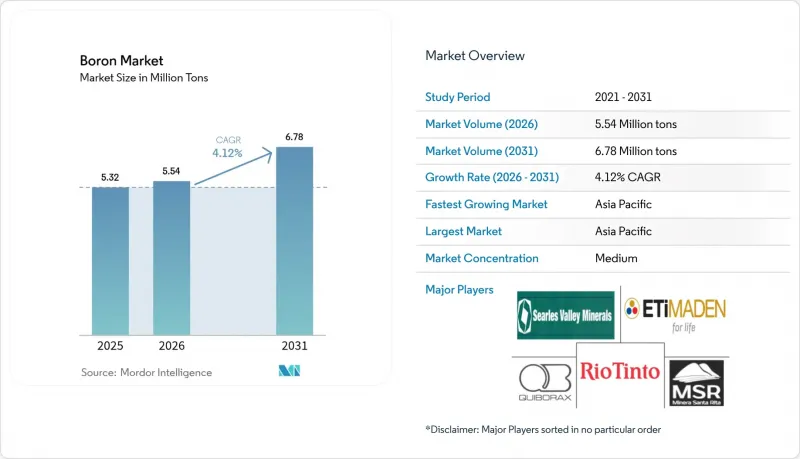
본 보고서는 등급별(기술 등급 및 산업용), 용도별(유리, 세라믹, 농업, 세제·세척제, 기타 용도), 지역별(아시아태평양, 북미, 유럽, 남미, 중동 및 아프리카)로 분류되어 있습니다. 시장 예측은 수량(톤) 기준으로 제시되어 있습니다.
세계의 붕소 시장 동향 및 인사이트
건설용 유리 수요 급증
붕규산 유리는 전문 실험실 용도에서 주류 인프라의 필수 소재로 전환되었습니다. 의약품 바이알 제조업체들은 바이오의약품에서 용출물을 방지하기 위해 제1형 붕규산 유리를 채택하고 있습니다. 태양전지 업계 제조업체들은 저철 보로실리케이트 유리 커버 시트를 선택하고 있습니다. 이는 이러한 시트가 더 많은 빛을 투과할 뿐만 아니라 우박의 충격도 견딜 수 있기 때문입니다. 특히 아시아태평양의 설치가 태양광 발전용 유리 소비량의 대부분을 차지했습니다. 고체 산화물 연료전지 개발 기업들은 800°C에서 작동이 가능하면서도 이온 전도성을 유지할 수 있는 칼슘 붕규산염 기판을 채택하고 있습니다. 한국과 대만의 평면 디스플레이 생산 라인에서는 여전히 알루미노붕산염이 사용되고 있지만, OLED로의 전환으로 인해 생산량 증가세는 둔화되고 있습니다. 이러한 동향들이 맞물려 붕산유리에 대한 안정적인 수요가 확보되고 있으며, 다른 분야에서 나타나는 변동에 대해 붕소 시장을 완충하는 역할을 하고 있습니다.
전동화에 따른 반도체용 붕소 도판트
이온 주입에는 초고순도 삼플루오로보린이 필수적입니다. 3nm 미만의 노드에서 게이트 올 어라운드(Gate-All-Around)형 트랜지스터는 금속 오염을 일절 허용하지 않기 때문에 순도 99.999%의 가스에 대한 수요가 더욱 높아지고 있습니다. 2024년 조사에서는 붕소를 도핑한 다이아몬드 MOSFET의 이동도가 100 cm²/V·s를 초과하는 것이 입증되어, 향후 전기차용 인버터에서 실리콘 카바이트를 대체할 가능성이 시사되고 있습니다. 중성자 흡수형 제어봉은 국방상 매우 중요하기 때문에 미국 국방부는 국내 붕소 카바이드 생산을 확대하기 위해 자금을 배정했습니다. 대만과 한국의 주요 파운드리 기업들은 붕소 원료를 전적으로 수입에 의존하고 있기 때문에 튀르키예의 수출 정책에 따른 지정학적 변화는 잠재적인 공급 위험을 초래하며, 이는 붕소 시장의 다각화를 더욱 촉진하는 요인이 되고 있습니다.
에너지 집약적 정제 비용의 변동
붕소 제련에서는 특히 900°C를 초과하는 다단계 소성 공정에서 에너지 비용이 큰 비중을 차지합니다. 유럽의 가스 가격은 2024년 초에 급등했으나, 2025년 말에는 급락했습니다. 그러나 이러한 가격 변동으로 인해 투자자들은 새로운 소성로 투자에 신중한 태도를 보이고 있습니다. 2024년, 리오 틴토는 캘리포니아주의 이동식 설비 연료를 재생 가능 디젤로 전환했습니다. 이 조치로 인해 Scope 1 탄소 배출량은 감소했으나, 동시에 연료 비용도 증가했습니다. 한편, 에티 마덴은 튀르키예의 전기 요금 보조금 제도를 활용하고 있으며, 이로 인해 현저한 비용 격차가 발생하고 있어 궁극적으로 붕소 시장의 거래 가격에 영향을 미치고 있습니다.
부문별 분석
2025년 총 공급량 중 테크니컬 등급이 52.23%를 차지했으며, 그 점유율은 연평균 성장률(CAGR) 4.16%로 성장할 전망입니다. 이는 마이크로전자공학 및 방위 산업 등 분야에서 ppm 수준의 순도에 대한 수요가 증가함에 따라 주도되고 있습니다. 예를 들어, 3nm 미만의 노드에서는 고순도의 이온 주입용 삼플루오르화 붕소가 필요합니다. 마찬가지로, 원자로의 안전 여유를 확보하기 위해서는 중성자 흡수재인 붕소 카바이드에서 특정 임계치를 초과하는 붕소-10의 농축이 필수적입니다. 특히, 이 등급에 특화된 자금 투자는 향후 수년에 걸쳐 수요가 급증할 것으로 예상을 시사합니다. 한편, 산업용 등급은 유리, 세제, 비료 등의 분야에 공급되고 있습니다. 그러나 그 성장세는 둔화되고 있습니다. 용도가 성숙 단계에 접어들면서 한계가 나타나고 있으며, 가정용 세제 분야에서는 대체재 사용이 진행 중입니다.
2025년에는 붕소의 프리미엄 스프레드가 대폭 확대되었습니다. 이러한 변화는 튀르키예와 칠레의 정제업체들이 수익성이 높은 리튬 브라인을 선택하고 붕소 정제를 뒤로 미룬 결과, 테크니컬 등급공급 증가가 억제된 데 기인합니다. 주요 항공우주 기업들은 고순도 분말의 조달처를 단일화하는 움직임을 점점 더 강화하고 있습니다. 이 전략은 인증 절차의 지연을 피할 뿐만 아니라 장기 계약 체결로 이어져 붕소 시장의 가격 안정성을 높이고 있습니다. 반면, 산업용 등급의 가격은 운임 및 에너지 할증료 변동의 영향을 받습니다. 이러한 가격 변동은 파급 효과를 일으켜, 계절적 재고 관리 과제에 직면한 농업용 소매업체에도 영향을 미치고 있습니다.
지역별 분석
아시아태평양은 2025년에 전 세계 공급량의 52.34%를 차지했으며, 연평균 성장률(CAGR) 4.20%로 성장할 전망입니다. 이는 해당 지역이 플랫 패널 디스플레이용 유리, 비료 소비, 정밀 세라믹 분야에서 지배적인 위치를 차지하고 있음을 반영합니다. 중국은 국내 광물 자원이 제한적이어서 튀르키예와 칠레로부터의 수입에 크게 의존해 왔습니다. 보조금 덕분에 인도의 농업 수요는 매년 증가할 전망입니다. 한편, 일본은 반도체 패키징에 필수적인 고정밀 질화붕소 부품 수출에서 비약적인 성장을 이루고 있습니다. 또한, 베트남과 태국에서 부상하고 있는 유리 산업 클러스터는 공급망을 확대할 뿐만 아니라, 붕소 시장을 해당 지역의 제조업 구조에 통합해 나가고 있습니다.
2025년에는 북미가 전 세계 생산량의 상당 부분을 차지했습니다. 리오 틴토(Rio Tinto)사의 캘리포니아 복합 시설은 전 세계 정제 생산량에 크게 기여하고 있지만, 2024년 이후의 확장 계획은 발표되지 않았습니다. 2025년 11월부터 미국에서 붕소가 연방 정부에 의해 ‘중요 광물’로 지정됨에 따라 세제 혜택의 길이 열렸고, 국내 사업이 탄력을 받고 있습니다. 2024년 10월에 인가를 받은 아이오니아(Ionia)사의 ‘라이오라이트 리지(Lyalite Ridge)’는 2028년에 가동을 시작해 연중 보산을 생산할 예정입니다. 한편, 캐나다와 멕시코는 주로 미국 판매업체로부터 수입하는 데 그치고 있어 그 역할은 제한적입니다.
2025년, 유럽은 전 세계 붕소 소비량에서 상당한 비중을 차지했습니다. 독일, 프랑스, 이탈리아와 같은 주요 국가들은 유리섬유 단열재 및 세라믹 분야의 중심적 위치를 차지하고 있는 반면, 붕소 수입의 상당 부분을 튀르키예에 의존하고 있습니다. 이러한 의존 관계는 붕소를 전략적 원자재로 분류하는 EU의 법안 초안에 의해 더욱 부각되고 있으며, 이 지역공급 측면에서의 취약성이 뚜렷이 드러나고 있습니다. 상당한 점유율을 차지하는 남미에서는 칠레의 살라르 데 수릴레 공장과 SQM사의 살라르 데 아타카마 사업장이 주도적인 역할을 하고 있습니다. 점유율은 작지만, 중동 및 아프리카에서는 사우디아라비아와 남아프리카공화국이 주요 수입국으로 부상하고 있습니다.
기타 혜택 :
- 엑셀 형식 시장 예측(ME) 시트
- 3개월간 애널리스트 지원
자주 묻는 질문
목차
제1장 서론
제2장 조사 방법
제3장 주요 요약
제4장 시장 구도
제5장 시장 규모 및 성장 예측
제6장 경쟁 구도
제7장 시장 기회 및 향후 전망
AJY 26.09.11According to Mordor Intelligence, the boron market size is expected to increase from 5.32 million tons in 2025 to 5.54 million tons in 2026 and reach 6.78 million tons by 2031, growing at a CAGR of 4.12% over 2026-2031.
This report is Segmented by Grade (Technical and Industrial), Application (Glass, Ceramics, Agriculture, Detergent and Cleaning, and Other Applications), and Geography (Asia-Pacific, North America, Europe, South America, and Middle-East and Africa). The Market Forecasts are Provided in Terms of Volume (Tons).
Global Boron Market Trends and Insights
Construction-Grade Glass Demand Surge
Borosilicate glass has transitioned from specialized laboratory use to becoming a staple in mainstream infrastructure. Producers of pharmaceutical vials turn to Type I borosilicate to sidestep leachables in biologics. Manufacturers in the solar industry opt for low-iron borosilicate cover sheets, as these sheets not only transmit more light but also endure hail impacts. Notably, installations in the Asia-Pacific region represented a significant portion of photovoltaic glass consumption. Developers of solid-oxide fuel cells are choosing calcium-borosilicate substrates, which can operate at 800 °C while retaining ionic conductivity. While flat-panel display lines in South Korea and Taiwan continue to utilize aluminoborosilicate, the shift towards OLEDs has tempered volume growth. Collectively, these dynamics ensure a consistent demand for borosilicate glass, providing a buffer for the boron market against fluctuations seen in other sectors.
Electrification-Induced Semiconductor Boron Dopants
Ion implantation depends on ultra-high-purity boron trifluoride. Gate-all-around transistors at sub-3 nm nodes tolerate no metallic contamination, reinforcing demand for 99.999% gas. Research during 2024 demonstrated boron-doped diamond MOSFET mobility above 100 cm2/V*s, suggesting future displacement of silicon carbide in electric-vehicle inverters. Due to the defense-critical nature of neutron-absorbing control rods, the U.S. Department of Defense has allocated funds to boost domestic boron carbide production. Foundry majors in Taiwan and South Korea import all boron feedstock, so geopolitical shifts in Turkish export policy present a latent supply risk that further incentivizes diversification of the boron market.
Energy-Intensive Refining Cost Swings
In boron refining, energy costs dominate, especially with multi-stage calcination processes exceeding 900 °C. European gas prices surged in early 2024, only to plummet by late 2025. However, this volatility has made investors wary of committing to new kilns. In 2024, Rio Tinto transitioned its California mobile equipment to renewable diesel. This move reduced its Scope 1 carbon emissions but simultaneously increased its fuel costs. Meanwhile, Eti Maden capitalizes on subsidized electricity rates in Turkey, creating a pronounced cost disparity that ultimately influences transaction prices in the boron market.
Other drivers and restraints analyzed in the detailed report include:
- Micronutrient-Driven Agritech Adoption
- Hydrogen Storage via Solid Borohydrides
- Open-Pit Mining Environmental Curbs
For complete list of drivers and restraints, kindly check the Table Of Contents.
Segment Analysis
Technical Grade held 52.23% of the 2025 volume, and its dominance is set to expand at a 4.16% CAGR. This is driven by heightened demands for ppm-level purity from sectors like microelectronics and defense. For instance, sub-3 nm nodes necessitate ion-implant boron trifluoride with a high level of purity. Similarly, to ensure reactor safety margins, neutron-absorbing boron carbide mandates boron-10 enrichment exceeding specific thresholds. Notably, funding directed specifically at this grade hints at a predictable multi-year demand surge. On the other hand, Industrial Grade caters to sectors like glass, detergents, and fertilizers. However, its growth is tempered. Mature applications impose limits, and there's an ongoing substitution trend in household cleaners.
Premium spreads for boron widened significantly in 2025. This shift occurred as refiners in Turkey and Chile opted for higher-margin lithium brines, sidelining boron purification and thereby capping the incremental supply of Technical Grade. Major aerospace players are increasingly turning to single-sourcing high-purity powders. This strategy not only sidesteps qualification delays but also results in long-term contracts, bolstering price stability in the boron market. In contrast, prices for Industrial Grade are influenced by fluctuations in freight rates and energy surcharges. Such volatility has a ripple effect, impacting agricultural retailers who navigate seasonal inventory challenges.
Complete Report Scope:
- By Grade
- Technical
- Industrial
- By Application
- Glass
- Ceramics
- Agriculture
- Detergent and Cleaning
- Other Applications
- By Geography
- Asia-Pacific
- China
- India
- Japan
- South Korea
- ASEAN Countries
- Rest of Asia-Pacific
- North America
- United States
- Canada
- Mexico
- Europe
- Germany
- United Kingdom
- France
- Italy
- Russia
- Nordic Countries
- Rest of Europe
- South America
- Brazil
- Argentina
- Rest of South America
- Middle-East and Africa
- Saudi Arabia
- South Africa
- Rest of Middle-East and Africa
- Asia-Pacific
Geography Analysis
Asia-Pacific accounted for 52.34% of global volume in 2025 and will expand at a 4.20% CAGR, reflecting the region's dominance in flat-panel glass, fertilizer consumption, and precision ceramics. China heavily relied on imports from Turkey and Chile due to the limited scale of local ores. Thanks to a subsidy, India's farm demand is set to rise annually. Meanwhile, Japan is making strides by exporting precision boron nitride parts, crucial for semiconductor packaging. Additionally, emerging glass clusters in Vietnam and Thailand are not only expanding supply chains but also integrating the boron market into the region's manufacturing landscape.
North America accounted for a significant share of the global volume in 2025. Rio Tinto's California complex contributes substantially to the global refined output, yet has not announced any expansions post-2024. A federal designation as a critical mineral in the U.S. from November 2025 paves the way for tax incentives, bolstering domestic ventures. Ioneer's Rhyolite Ridge, which received clearance in October 2024, is set to commence operations in 2028, producing boric acid annually. Meanwhile, Canada and Mexico play a minor role, primarily importing from U.S. distributors.
Europe accounted for a notable portion of the global boron consumption in 2025. Key players like Germany, France, and Italy, while central to fiberglass insulation and ceramics, depend on Turkey for a significant share of their boron imports. This reliance is further emphasized by the draft EU legislation classifying boron as a strategic raw material, highlighting the region's supply vulnerabilities. South America, with a considerable share, is spearheaded by Chile's Salar de Surire plant and SQM's unit at Salar de Atacama. In the Middle East and Africa, accounting for a smaller share, Saudi Arabia and South Africa emerge as the main importers.
- 3M
- Air Liquide
- American Elements
- Boron Molecular
- Boron One Holdings
- Eti Maden
- Gujarat Boron Derivatives Pvt., Ltd.
- Ioneer
- Minera Santa Rita (MSR)
- Momentive Technologies
- Quiborax
- Resonac Holdings Corporation
- Rio Tinto
- Saint-Gobain
- SB Boron Corporation
- Searles Valley Minerals
- Stella Chemifa Corporation
Additional Benefits:
- The market estimate (ME) sheet in Excel format
- 3 months of analyst support
TABLE OF CONTENTS
1 Introduction
- 1.1 Study Assumptions and Market Definition
- 1.2 Scope of the Study
2 Research Methodology
3 Executive Summary
4 Market Landscape
- 4.1 Market Overview
- 4.2 Market Drivers
- 4.2.1 Construction-grade glass demand surge (borosilicate, glass-ceramics)
- 4.2.2 Electrification-induced semiconductor boron dopants
- 4.2.3 Micronutrient-driven agritech adoption
- 4.2.4 Hydrogen storage via solid borohydrides
- 4.2.5 Ultra-high-temperature ceramics for hypersonics
- 4.3 Market Restraints
- 4.3.1 Energy-intensive refining cost swings
- 4.3.2 Open-pit mining environmental curbs
- 4.3.3 Silicon-based glass modifiers substitution risk
- 4.4 Value Chain Analysis
- 4.5 Porter's Five Forces
- 4.5.1 Bargaining Power of Suppliers
- 4.5.2 Bargaining Power of Consumers
- 4.5.3 Threat of New Entrants
- 4.5.4 Threat of Substitutes
- 4.5.5 Degree of Competition
5 Market Size and Growth Forecasts (Volume)
- 5.1 By Grade
- 5.1.1 Technical
- 5.1.2 Industrial
- 5.2 By Application
- 5.2.1 Glass
- 5.2.2 Ceramics
- 5.2.3 Agriculture
- 5.2.4 Detergent and Cleaning
- 5.2.5 Other Applications
- 5.3 By Geography
- 5.3.1 Asia-Pacific
- 5.3.1.1 China
- 5.3.1.2 India
- 5.3.1.3 Japan
- 5.3.1.4 South Korea
- 5.3.1.5 ASEAN Countries
- 5.3.1.6 Rest of Asia-Pacific
- 5.3.2 North America
- 5.3.2.1 United States
- 5.3.2.2 Canada
- 5.3.2.3 Mexico
- 5.3.3 Europe
- 5.3.3.1 Germany
- 5.3.3.2 United Kingdom
- 5.3.3.3 France
- 5.3.3.4 Italy
- 5.3.3.5 Russia
- 5.3.3.6 Nordic Countries
- 5.3.3.7 Rest of Europe
- 5.3.4 South America
- 5.3.4.1 Brazil
- 5.3.4.2 Argentina
- 5.3.4.3 Rest of South America
- 5.3.5 Middle-East and Africa
- 5.3.5.1 Saudi Arabia
- 5.3.5.2 South Africa
- 5.3.5.3 Rest of Middle-East and Africa
- 5.3.1 Asia-Pacific
6 Competitive Landscape
- 6.1 Market Concentration
- 6.2 Strategic Moves
- 6.3 Market Share (%)/Ranking Analysis
- 6.4 Company Profiles (includes Global level Overview, Market level overview, Core Segments, Financials as available, Strategic Information, Products and Services, Recent Developments)
- 6.4.1 3M
- 6.4.2 Air Liquide
- 6.4.3 American Elements
- 6.4.4 Boron Molecular
- 6.4.5 Boron One Holdings
- 6.4.6 Eti Maden
- 6.4.7 Gujarat Boron Derivatives Pvt., Ltd.
- 6.4.8 Ioneer
- 6.4.9 Minera Santa Rita (MSR)
- 6.4.10 Momentive Technologies
- 6.4.11 Quiborax
- 6.4.12 Resonac Holdings Corporation
- 6.4.13 Rio Tinto
- 6.4.14 Saint-Gobain
- 6.4.15 SB Boron Corporation
- 6.4.16 Searles Valley Minerals
- 6.4.17 Stella Chemifa Corporation
7 Market Opportunities and Future Outlook
- 7.1 White-space and Unmet-need Assessment


