
|
시장보고서
상품코드
2124067
액체 지붕재 시장 : 시장 점유율 분석, 업계 동향 및 통계, 성장 예측(2026-2031년)Liquid Roofing - Market Share Analysis, Industry Trends & Statistics, Growth Forecasts (2026 - 2031) |
||||||
 Mordor Intelligence
Mordor Intelligence에 의하면, 액체 지붕재 시장 규모는 2025년 2억 8,025만 평방미터로 평가되었고, 2026년에는 2억 9,324만 평방미터로 추정되고, 2026-2031년 CAGR 4.44%로 성장을 지속할 전망이며, 2031년에는 3억 6,438만 평방미터에 이를 것으로 예측됩니다.
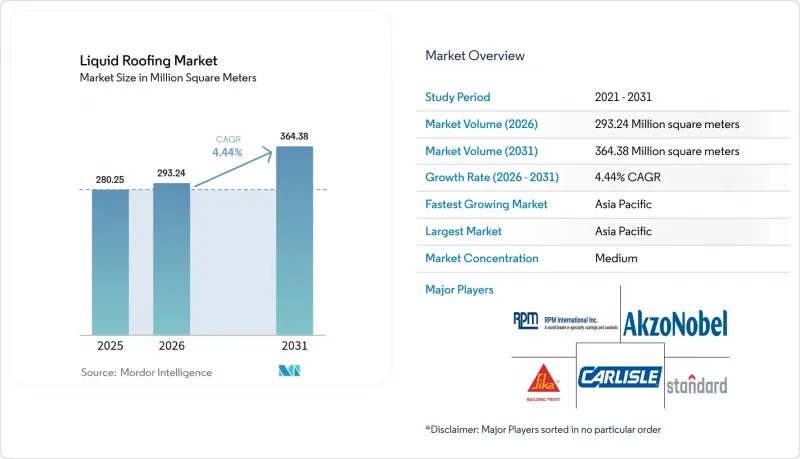
본 보고서는 유형별(폴리우레탄계 도료, 아크릴계 도료, 아스팔트계 도료, 실리콘계 도료 등), 용도별(돔형 지붕, 경사 지붕, 평지붕 등), 최종 사용자 산업별(주택, 상업시설, 인프라 등), 지역별(아시아태평양, 북미, 유럽, 남미, 중동 및 아프리카)별로 분류되어 있습니다. 시장 예측은 수량(제곱미터) 단위로 제시되어 있습니다.
세계의 액체 지붕재 시장 동향 및 인사이트
기후 변화에 따른 이상 기상 현상을 배경으로 한 지붕 재시공 수요의 급증
세계적으로 지붕 손상에 대한 보험금 지급이 급증하고 있어, 소유주들은 균열 없이 우박의 충격 에너지를 분산시키는 엘라스토머계 코팅으로 입자형 싱글에서 전환해야 하는 상황에 직면해 있습니다. 2024년, 미국에서 우박과 바람으로 인한 보험 청구액은 단독으로 310억 달러에 달했으며, 1년 동안 22% 증가했습니다. 또한 같은 시즌 유럽에서 발생한 우박 폭풍으로 인한 보험금 지급액은 42억 유로에 달했습니다. 이에 대응하여 보험사는 계약 갱신 조건으로 내충격성 등급 4의 막재 사용을 점점 더 요구하고 있으며, 과거에는 선택적 유지보수였던 것이 위험 감소를 위한 필수 사항으로 변화하고 있습니다. 또한, 액체 지붕재는 지붕을 전면적으로 철거하는 것이 아니라 손상되지 않은 데크 위에 새로운 층을 도포하기 때문에 매립 폐기물 감축으로도 이어집니다. 폐기 비용 절감과 보험료 할인이라는 경제적 이점이 더해지면서, 액체 지붕재 시장은 기후 변화 적응 예산에 확고히 자리 잡고 있습니다.
속경화형 폴리우레아 및 하이브리드 시스템이 현장 가동 중단 시간을 단축
순수 폴리우레아계 방수 시트는 몇 초 만에 경화되므로, 시공 업체는 작업 시작 당일에 데이터센터나 병원의 옥상 사용을 재개할 수 있습니다. 폴리우레아와 폴리우레탄의 하이브리드 블렌드는 금속 및 콘크리트에 대한 우수한 접착력을 갖추고 있어, 100% 폴리우레아에서 때때로 발생하는 박리 문제를 해결합니다. Sikalastic-625 BMS는 시공 후 2시간 만에 비를 견딜 수 있는 상태가 되며, 기존 제품에 비해 탄소 배출량을 35% 줄여 속도와 지속가능성을 동시에 달성할 수 있음을 입증하고 있습니다. 2025년에 출시된 존스 맨빌의 ‘SeamFree PMMA’는 30분 만에 보행이 가능해지며, 전문 장비가 부족한 작업 팀에게 스프레이 건이 필요 없는 대안이 됩니다. 미국 지붕 시공업체의 92%가 숙련된 인력 확보에 어려움을 겪고 있다고 보고하고 있는 만큼, 경화 시간이나 세팅 시간을 1분이라도 단축할 수 있다면 인건비 절감과 프로젝트 처리 능력 향상으로 직결됩니다.
이소시아네이트 및 비투멘의 가격 변동이 이익률을 압박
2024-2025년 유럽의 여러 공장에서 예기치 못한 가동 중단이 발생함에 따라 MDI의 가격 변동 폭은 30%를 초과했습니다. 한편, 브렌트 원유 가격의 변동으로 인해 아스팔트의 벤치마크 가격은 분기마다 18-25%의 급등락을 보였습니다. 도급업체는 대개 6-12개월 후를 내다보며 프로젝트 입찰에 참여하기 때문에 시공 도중에 원자재 가격이 급등하면 생산자는 큰 위험에 노출될 수밖에 없습니다. 다국적 기업들은 헤지 전략을 펼치지만, 소규모 지역 제조업체들은 저비용 자금 조달 수단이나 선물 시장에 대한 접근성이 부족하여 가격 충격을 흡수하거나 폴리우레탄을 많이 사용하는 제품 라인에서 철수해야 하는 선택의 기로에 서 있습니다. 수성 아크릴계나 고고형분 실리콘으로 배합을 변경하면 이소시아네이트에 대한 의존도는 낮아지지만, 경화 시간이 오래 걸리거나 온도에 민감하다는 제약으로 인해 긴급 공사나 겨울철 공사에서는 이러한 선택지가 제한됩니다. 그 결과 발생하는 이익률 압박이, 본래라면 견조한 성장이 예상되던 액체 지붕재 시장의 전반적인 성장을 둔화시키고 있습니다.
부문 분석
아크릴계는 2025년 판매량의 51.49%를 차지했으며, 비용에 민감한 액체 지붕재 시장의 중심을 지탱하고 있습니다. 이 수성 화학 조성은 실리콘보다 20-30% 저렴한 시공 가격으로, 충분한 반사율과 기재에 대한 범용성을 제공합니다. 그러나 실리콘계 코팅은 연평균 성장률(CAGR) 5.04%로 시장 점유율을 확대되고 있습니다. 이는 오염 저항성과 색상 안정성 덕분에 일사량이 많은 지역에서 재도장 빈도가 절반으로 줄어들며, 구매 가격은 비싸지만 수명 주기 비용을 절감할 수 있기 때문입니다. 폴리우레탄계는 양자 사이에 위치하며, 산업용 데크에서의 내화학성 및 내마모성으로 높이 평가받고 있지만, 탑코트를 도포하지 않는 한 자외선에 의한 백화 현상이 발생하기 쉬우며, 이러한 단점은 입찰 사양서에서 점점 더 많이 지적되고 있습니다. 폴리우레아 및 하이브리드 시스템은 여전히 틈새 시장 제품이지만, 독자적인 가치, 2단계 경화, 그리고 연중 시공이 가능하다는 장점이 있어, 시공업체들은 가격이 비싸다는 점에도 불구하고 주요 시설에 이를 선정하고 있습니다. 현재 EU 규정에서는 환경 제품 선언(EPD)이 의무화되어 있으며, 이 요건으로 인해 저탄소 아크릴 및 실리콘 배합의 매력이 높아져, 예측 기간 동안 액체 지붕재 시장 점유율 구성이 더욱 변화할 가능성이 있습니다.
모든 화학 분야에서 공공 조달 평가 기준에 힘입어 바이오 유래 폴리올 및 재생 충전재로 전환하는 속도가 가속화되고 있습니다. 시카(Seeka)가 2024년에 도입한, 내재된 탄소량을 35% 줄인 바이오 함유 하이브리드 제품은 지속가능성 실적을 통한 경쟁력 있는 포지셔닝의 좋은 예입니다. 한편, 순수 폴리우레아의 채택은 오일 샌드 작업 캠프나 냉동 창고에서 한때 비용 면에서 지나치게 민감한 것으로 여겨졌던 지방 자치 단체의 교통 플랫폼으로 확대되고 있습니다. 여기에서는 가동 중단 시간을 최소화하는 것이 높은 자재비를 상쇄하는 이점이 되고 있습니다. 코팅 제품에 클라우드 연결형 품질 보증 센서를 세트로 판매하는 공급업체는 설치 후에도 장기간에 걸쳐 규정 준수 여부를 입증하는 데이터 스트림을 제공함으로써 고객의 충성도를 높이고 있습니다. 향후 5년 동안 제품 유형의 차별화는 단일 화학 조성보다는 하도, 필름, 마감 도료, 분석 기능 등을 결합한 토탈 시스템 패키지로 초점이 이동할 것입니다. 이는 액체 지붕재 시장에서 점점 더 정교해지는 구매 담당자들을 위해 시공 속도, 내구성 및 검증된 탄소 지표를 융합한 것입니다.
지역별 분석
아시아태평양은 2025년 출하량의 41.20%를 차지했으며, 메가시티의 인프라 정비 및 제조 거점 확장을 배경으로 2031년까지 연평균 성장률(CAGR) 4.80%를 유지할 것으로 예측됩니다. 중국의 ‘제14차 5개년 계획’에서는 철도 및 산업 허브에 3조 8,000억 위안(RMB)이 배정되었으며, 액체 막은 시공 속도가 빠르고 경사가 낮은 지형에 적응성이 뛰어나 방수 사양에서 중요한 위치를 차지하고 있습니다. 슬래브 및 지붕 수요를 나타내는 선행 지표인 인도의 시멘트 생산량은 2026년 중반까지 전년 대비 8-11% 증가하고 있으며, 이는 아크릴계 및 실리콘계 코팅재 소비 확대와 궤를 같이 하고 있습니다. 베트남의 푸미 3에서 인도네시아의 바탄 산업단지에 이르는 동남아시아의 수출가공구에서는 투자자의 탄소 프로토콜을 충족하기 위해 반사형 지붕에 대한 수요가 점점 높아지고 있어, 액체 지붕재 시장 전체에서 견조한 수요가 예상됩니다.
북미는 전 세계 출하량의 대부분을 차지하고 있으며, 2026년에는 미국의 데이터센터 건설만으로도 26% 증가했습니다. 캐나다 산불로 인한 재건과 멕시코 허리케인 피해 복구도 이 지역의 지붕 교체 수요를 더욱 끌어올리고 있습니다. 보험사들은 균열이 생긴 펠트 재료를 불리하게 평가하는 알고리즘을 기반으로 한 지붕 평가를 시작했으며, 이를 통해 소유주들을 엘라스토머계 액체 지붕재로 유도하고 있습니다. 이는 성숙 단계에 접어들었으나 기회가 풍부한 북미 액체 지붕재 시장 특유의 정책 동향입니다.
유럽에서는 2025년 초 독일과 프랑스에서 주택 착공이 정체되면서 건설 업계 전체가 전월 대비 0.5% 위축되었습니다. 그럼에도 불구하고 EU의 기후 변화 대책 계획과 초저 VOC 규제로 인해 ‘양보다 질’을 중시하는 경향이 두드러지고 있습니다. 고고형분 실리콘계 및 수성 아크릴계가 현재 사양서의 주류를 차지하고 있으며, 그 프리미엄 가격 덕분에 지역 전체의 판매 수량 정체 추세를 상쇄하고 있습니다. 한편, 남유럽에서는 관광 프로젝트와 관련된 스페인의 2024년 12월 건설업이 11.2% 급증한 것을 필두로, 경기 둔화 추세와 반대로 지역 내 편차가 두드러졌습니다. 엄격한 CPR(건설 제품 규정) 및 디이소시아네이트 관련 규제로 인해 진입 장벽이 높아지면서, 규정 준수를 위한 자금을 확보할 수 있는 기존 기업들이 시장 점유율을 공고히 하는 반면, 저가 수입품을 노릴 수 있는 시장 규모는 축소되고 있습니다.
기타 혜택 :
- 엑셀 형식 시장 예측(ME) 시트
- 3개월간의 애널리스트 지원
자주 묻는 질문
목차
제1장 서론
제2장 조사 방법
제3장 주요 요약
제4장 시장 구도
제5장 시장 규모 및 성장 예측
제6장 경쟁 구도
제7장 시장 기회 및 향후 전망
AJY 26.09.11According to Mordor Intelligence, the liquid roofing market size is expected to grow from 280.25 million square meters in 2025 to 293.24 million square meters in 2026 and is forecast to reach 364.38 million square meters by 2031 at a 4.44% CAGR over 2026-2031.
This report is Segmented by Type (Polyurethane Coatings, Acrylic Coatings, Bituminous Coatings, Silicone Coatings, and More), Application (Domed Roofs, Pitched Roof, and Flat Roofed), End-User Industry (Residential, Commercial, Infrastructure, and, More), and Geography (Asia-Pacific, North America, Europe, South America, and Middle East and Africa). The Market Forecasts are Provided in Terms of Volume (Square Meters).
Global Liquid Roofing Market Trends and Insights
Surging Re-Roofing Demand Amid Climate-Related Extreme Weather
Insurance payouts for roof damage have surged worldwide, pushing owners to upgrade from granular shingles to elastomeric coatings that dissipate hail energy without cracking. US hail and wind claims alone reached USD 31 billion in 2024, a 22% jump in one year, and European hailstorms inflicted EUR 4.2 billion in insured losses the same season. In response, carriers increasingly require impact-resistant Class 4 membranes as a condition of policy renewal, converting what used to be discretionary maintenance into a risk-mitigation imperative. Liquid roofs also reduce landfill waste because crews apply new layers over intact decks instead of executing full tear-offs. The combined economics of lower disposal costs and premium discounts firmly embed the liquid roofing market in climate-adaptation budgets.
Fast-Curing Polyurea & Hybrid Systems Cut Site Downtime
Pure polyurea membranes cure within seconds, allowing contractors to reopen data-center or hospital rooftops the same day the job starts. Hybrid polyurea-polyurethane blends add superior adhesion to metal and concrete, addressing delamination that occasionally plagues 100% polyurea. Sikalastic-625 BMS delivers a 2-hour rain-ready window and 35% lower embodied carbon than earlier products, demonstrating that speed need not compromise sustainability. Johns Manville's SeamFree PMMA, launched in 2025, walks on in 30 minutes, providing a spray-gun-free alternative for crews short on specialized equipment. Because 92% of U.S. roofers report difficulty recruiting skilled labor, every minute shaved from cure or setup time translates directly into lower payroll outlays and higher project throughput.
Volatile Isocyanate & Bitumen Prices Squeeze Margins
MDI price swings exceeded 30% during 2024-2025 after unplanned outages at several European plants, while Brent crude fluctuations sent bitumen benchmarks gyrating 18-25% quarter-to-quarter. Contracting firms often bid on projects six to twelve months ahead, leaving producers exposed when feedstock spikes arrive mid-execution. Multinationals hedge, but smaller regional formulators lack low-cost finance or futures market access, forcing them either to absorb shocks or exit polyurethane-heavy lines. Reformulation toward water-based acrylics and high-solids silicones reduces isocyanate dependence, yet slower cure or temperature-sensitivity limits those options on fast-track or winter jobs. The resulting margin compression tempers otherwise healthy headline growth for the liquid roofing market.
Other drivers and restraints analyzed in the detailed report include:
- Infrastructure Stimulus Across Asia-Pacific Megacities
- Insurance Premium Discounts for Resilient Liquid Membranes
- Tightening Regional Bans on High-VOC Products
For complete list of drivers and restraints, kindly check the Table Of Contents.
Segment Analysis
Acrylics accounted for 51.49% of 2025 volume, anchoring the cost-sensitive core of the liquid roofing market. Their water-borne chemistry offers respectable reflectivity and substrate versatility at installation prices 20-30% below silicone. However, silicone coatings are advancing at a 5.04% CAGR because their dirt resistance and color stability halve recoating frequency in high-irradiance regions, lowering lifecycle cost despite higher purchase price. Polyurethane sits between the two, prized for chemical and abrasion resistance on industrial decks, yet prone to UV chalking unless top-coated, a drawback increasingly cited in bid specifications. Polyurea and hybrid systems, though still niche, unlock unique value, second-level cure, and year-round application, which contractors select for critical facilities despite premium pricing. EU rules now require Environmental Product Declarations, a mandate that amplifies the appeal of low-carbon acrylic and silicone recipes and could further tilt the liquid roofing market share mix during the forecast window.
Across all chemistries, the push toward bio-based polyols and recycled fillers accelerates, driven by public procurement scoring. Sika's 2024 introduction of a bio-content hybrid with 35% lower embodied carbon exemplifies competitive positioning through sustainability credentials. Meanwhile, pure polyurea adoption spreads from oil-sand work camps and freezer warehouses into municipal transit platforms once deemed too cost-sensitive; here, minimal shutdowns outweigh material premiums. Suppliers that bundle coatings with cloud-connected quality-assurance sensors deepen loyalty because the data stream proves compliance long after installation. Over the next five years, type-level differentiation will pivot less on standalone chemistry and more on total-system packages, primer, membrane, finish, and analytics, that blend speed, durability, and verified carbon metrics for increasingly sophisticated buyers in the liquid roofing market.
Complete Report Scope:
- By Type
- Polyurethane Coatings
- Acrylic Coatings
- Silicone Coatings
- Bituminous Coatings
- Epoxy Coatings
- Other Types (Polyurea & Hybrid Systems, etc.)
- By Application
- Flat Roofs
- Pitched Roofs
- Domed Roofs
- By End-user Industry
- Residential
- Commercial
- Industrial/Institutional
- Infrastructure
- By Geography
- Asia-Pacific
- China
- India
- Japan
- Australia
- ASEAN Countries
- Rest of Asia-Pacific
- North America
- United States
- Canada
- Mexico
- Europe
- Germany
- United Kingdom
- France
- Italy
- Spain
- Russia
- NORDIC Countries
- Rest of Europe
- South America
- Brazil
- Argentina
- Rest of South America
- Middle-East and Africa
- Saudi Arabia
- South Africa
- Rest of Middle-East and Africa
- Asia-Pacific
Geography Analysis
Asia-Pacific controlled 41.20% of 2025 volume and is projected to maintain a 4.80% CAGR to 2031 on the back of megacity infrastructure and manufacturing build-outs. China's 2025 plan allocates CNY 3.8 trillion to rail and industrial hubs, and liquid membranes feature prominently in waterproofing specifications due to speed and low-slope compatibility. India's cement output, an early indicator of slab and roof demand, rose 8-11% year-on-year through mid-2026, aligning with accelerating consumption of acrylic and silicone coatings. Southeast Asia's export-processing zones, from Vietnam's Phu My 3 to Indonesia's Batang Industrial Park, increasingly require reflective roofs to meet investor carbon protocols, ensuring strong uptake across the liquid roofing market.
North America represents a majority of the worldwide shipments, with US data-center construction alone climbing 26% in 2026. Canadian wildfire rebuilds and Mexican hurricane repairs further lift regional re-roofing. Insurers have started algorithmic roof scoring that penalizes cracked felts, thereby steering owners toward elastomeric liquids, a policy dynamic unique to the mature but opportunity-rich North American slice of the liquid roofing market.
In Europe, macro construction shrank 0.5% month-to-month in early 2025 as housing starts stalled in Germany and France. Nonetheless, EU climate plans and ultra-low-VOC mandates deliver a quality over quantity story; high-solids silicone and water-based acrylic now dominate specifications, commanding premiums that offset flat regional volume. Southern Europe, led by Spain's 11.2% surge in December 2024 construction tied to tourism projects, bucked the slowdown, illustrating intra-regional divergence. Strict CPR and diisocyanate-training rules raise entry barriers, consolidating share with incumbents able to finance compliance while shrinking the addressable pool for budget imports.
- 3M
- Akzo Nobel N.V.
- Alumasc Building Products
- Carlisle Companies Incorporated
- Garland Company, Inc.
- Johns Manville (A Berkshire Hathaway Company)
- Kemper System Ltd
- Langley UK Ltd
- Mapei S.p.A.
- PPG Industries, Inc.
- RPM INTERNATIONAL INC.
- Saint-Gobain
- SIG plc
- Sika AG
- SOPREMA Group
- Standard Industries Inc.
Additional Benefits:
- The market estimate (ME) sheet in Excel format
- 3 months of analyst support
TABLE OF CONTENTS
1 Introduction
- 1.1 Study Assumptions & Market Definition
- 1.2 Scope of the Study
2 Research Methodology
3 Executive Summary
4 Market Landscape
- 4.1 Market Overview
- 4.2 Market Drivers
- 4.2.1 Surging re-roofing demand amid climate-related extreme weather
- 4.2.2 Fast-curing polyurea & hybrid systems cut site downtime
- 4.2.3 Infrastructure stimulus across Asia-Pacific megacities
- 4.2.4 Insurance premium discounts for resilient liquid membranes
- 4.2.5 AI-based moisture mapping accelerates preventive maintenance
- 4.3 Market Restraints
- 4.3.1 Volatile isocyanate & bitumen prices squeeze margins
- 4.3.2 Tightening regional bans on high-VOC products
- 4.3.3 Skilled-applicator shortage in emerging economies
- 4.4 Value Chain Analysis
- 4.5 Porter's Five Forces
- 4.5.1 Bargaining Power of Suppliers
- 4.5.2 Bargaining Power of Buyers
- 4.5.3 Threat of New Entrants
- 4.5.4 Threat of Substitutes
- 4.5.5 Degree of Competition
5 Market Size & Growth Forecasts (Volume)
- 5.1 By Type
- 5.1.1 Polyurethane Coatings
- 5.1.2 Acrylic Coatings
- 5.1.3 Silicone Coatings
- 5.1.4 Bituminous Coatings
- 5.1.5 Epoxy Coatings
- 5.1.6 Other Types (Polyurea & Hybrid Systems, etc.)
- 5.2 By Application
- 5.2.1 Flat Roofs
- 5.2.2 Pitched Roofs
- 5.2.3 Domed Roofs
- 5.3 By End-user Industry
- 5.3.1 Residential
- 5.3.2 Commercial
- 5.3.3 Industrial/Institutional
- 5.3.4 Infrastructure
- 5.4 By Geography
- 5.4.1 Asia-Pacific
- 5.4.1.1 China
- 5.4.1.2 India
- 5.4.1.3 Japan
- 5.4.1.4 Australia
- 5.4.1.5 ASEAN Countries
- 5.4.1.6 Rest of Asia-Pacific
- 5.4.2 North America
- 5.4.2.1 United States
- 5.4.2.2 Canada
- 5.4.2.3 Mexico
- 5.4.3 Europe
- 5.4.3.1 Germany
- 5.4.3.2 United Kingdom
- 5.4.3.3 France
- 5.4.3.4 Italy
- 5.4.3.5 Spain
- 5.4.3.6 Russia
- 5.4.3.7 NORDIC Countries
- 5.4.3.8 Rest of Europe
- 5.4.4 South America
- 5.4.4.1 Brazil
- 5.4.4.2 Argentina
- 5.4.4.3 Rest of South America
- 5.4.5 Middle-East and Africa
- 5.4.5.1 Saudi Arabia
- 5.4.5.2 South Africa
- 5.4.5.3 Rest of Middle-East and Africa
- 5.4.1 Asia-Pacific
6 Competitive Landscape
- 6.1 Market Concentration
- 6.2 Strategic Moves
- 6.3 Market Share(%)/Ranking Analysis
- 6.4 Company Profiles (includes Global level Overview, Market level overview, Core Segments, Financials as available, Strategic Information, Products & Services, and Recent Developments)
- 6.4.1 3M
- 6.4.2 Akzo Nobel N.V.
- 6.4.3 Alumasc Building Products
- 6.4.4 Carlisle Companies Incorporated
- 6.4.5 Garland Company, Inc.
- 6.4.6 Johns Manville (A Berkshire Hathaway Company)
- 6.4.7 Kemper System Ltd
- 6.4.8 Langley UK Ltd
- 6.4.9 Mapei S.p.A.
- 6.4.10 PPG Industries, Inc.
- 6.4.11 RPM INTERNATIONAL INC.
- 6.4.12 Saint-Gobain
- 6.4.13 SIG plc
- 6.4.14 Sika AG
- 6.4.15 SOPREMA Group
- 6.4.16 Standard Industries Inc.
7 Market Opportunities & Future Outlook
- 7.1 White-space & Unmet-Need Assessment