

|
시장보고서
상품코드
2124068
저마찰 코팅 시장 : 점유율 분석, 업계 동향과 통계, 성장 예측(2026-2031년)Low Friction Coating - Market Share Analysis, Industry Trends & Statistics, Growth Forecasts (2026 - 2031) |
||||||
 Mordor Intelligence
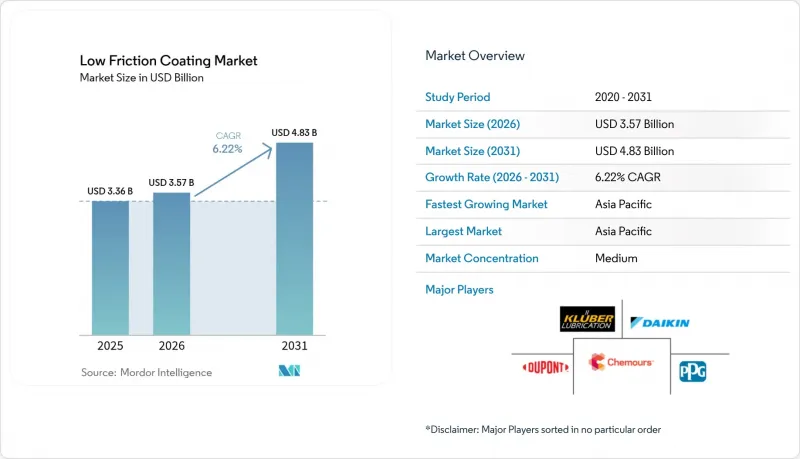
Mordor Intelligence에 의하면, 저마찰 코팅 시장 2026년 시장 규모는 35억 7,000만 달러로 추정되고 있어 2025년 33억 6,000만 달러에서 확대되어, 2031년에는 48억 3,000만 달러에 이를 것으로 예측됩니다. 2026년부터 2031년까지 CAGR 6.22%로 성장할 전망입니다.
본 보고서는 유형별(이황화 몰리브덴, 이황화 텅스텐, 폴리테트라플루오로에틸렌, 기타),용도별(베어링, 자동차 부품, 동력 전달 부품 등), 최종 사용자 산업별(자동차 및 운송, 항공우주 및 방위, 의료 등), 지역별(아시아태평양, 북미, 유럽 등)로 분류되어 있습니다. 시장 예측은 금액(달러) 기준으로 제시되어 있습니다.
전 세계 저마찰 코팅 시장 동향 및 인사이트
자동차 연비 기준 및 전기차(EV) 주행 거리 목표의 강화
현재 전 세계 규제 당국은 미국 연방 규정집 제40편 제1037.560조에 따라 차축 효율 시험을 실시하고 있으며, 초저마찰 표면을 평가 대상으로 하는 명확한 성능 기준이 설정되어 있습니다. 따라서 자동차 제조업체들은 과거에는 실험실 환경에서만 달성 가능했던 0.01 미만의 마찰 계수를 실현할 수 있는 코팅을 지정하고 있습니다. 저점도 오일로 전환함에 따라 표면 공학에 대한 수요가 증가하고 있습니다. 이는 기존 윤활유에서는 필름 두께가 얇아졌을 때 경계 윤활에 의한 보호를 확보할 수 없게 되었기 때문입니다. EV 구동계 설계자들은 특히 고속 e-액슬에서 기생 손실을 줄이고 배터리 주행 거리를 연장하기 위해 유사한 코팅을 채택하고 있습니다. 내연기관 및 전기 구동 시스템 양쪽 아키텍처에서 결과를 검증할 수 있는 공급업체는 주요 시장에서 차량군 평균 CO₂ 배출량 상한선이 단계적으로 낮아지는 가운데, 멀티 플랫폼 조달 계약을 확보하고 있습니다.
항공우주용 복합재 구조의 급속한 성장
복합재로 제작된 기체는 경량화를 실현하는 한편, 베어링 계면로의 하중 집중을 악화시키기 때문에 극히 얇은 환경에서 기능하는 고체 막 윤활제의 가치가 높아지고 있습니다. 이황화 몰리브덴 및 이황화 텅스텐은 진공 상태에서 마찰 계수가 0.003에 가까운 초윤활성을 발휘하여, 태양전지 어레이 구동 장치 등의 기구가 유지보수 없이 수년에 걸친 임무를 수행할 수 있도록 합니다. 메가 콘스텔레이션이 증가함에 따라 각 위성에는 수십 개의 코팅 처리된 부품이 필요할 가능성이 있어 총 수요가 확대되고 있습니다. 우주용 하드웨어에는 원자 상태의 산소 및 고에너지 방사선에 대한 내성도 요구되지만, 전이 금속 디칼코게나이드 코팅은 질량 증가를 최소화하면서 이러한 특성을 제공합니다. 항공기 제조업체들은 이러한 코팅을 비가압 동체 부분에 채택하고 있어 지상에서의 활용도 더욱 확대되고 있습니다.
PFAS의 단계적 폐지가 PTFE 배합에 제약을 가져옵니다.
미국에서는 여러 주에서 2025년부터 소비재에 대한 의도적인 PFAS 첨가를 금지하고 있으며, 캐나다도 단계적인 금지 조치를 시작하여 더욱 광범위한 규제가 예상됩니다. 그 결과, 기존의 PTFE 기반 저마찰 코팅은 조리 기구, 자동차, 전자기기 분야에서 가까운 시일 내에 사용할 수 없게 될 가능성이 있습니다. 공급업체들은 불소를 포함하지 않는 화학 조성으로의 재조성을 추진하고 있으나, 대체재는 화학적 비활성 및 온도 안정성 면에서 동등해야 합니다. 전환 비용에는 자산 재검증, 생산 라인 세척, 고객 재인증 주기 등이 포함됩니다. 이와 동시에, 유럽 규제 당국은 PFAS 사용을 더욱 제한할 가능성이 있는 더 엄격한 등록 규정을 마련하고 있어, 수출업체의 규정 준수 부담이 증가하고 있습니다.
부문 분석
2025년, 이황화 몰리브덴은 저마찰 코팅 시장의 45.10%를 차지하며, 항공우주, 자동차, 산업기계 분야에서 확고한 입지를 입증하고 있습니다. 이 부문의 성장은 진공 환경 및 오일 부족을 해소하는 경계 윤활 조건 하에서 입증된 성능에 여전히 뒷받침되고 있습니다. 현재, 하이브리드 스프레이 및 스퍼터링 시스템을 통해 서브미크론 수준의 거칠기를 가진 결정질 막이 형성되어, 탄소섬유 복합재의 계면이 주기적인 하중을 견딜 수 있게 되었습니다. 동시에, 설계자들이 400°C를 초과하는 고온 내성을 우선시함에 따라, 이황화 텅스텐은 연평균 성장률(CAGR) 6.78%로 시장을 확대되고 있습니다. 그 층상 구조는 이황화 몰리브덴이 산화되기 시작하는 온도에서도 윤활성을 유지하기 때문에 초음속 항공기의 베어링이나 첨단 터빈 액추에이터에 필수적입니다.
연구팀은 이 두 유형의 디칼코게나이드를 그래핀 박막과 혼합하여, 극도의 내열성과 초저마찰성을 겸비한 복합 막을 제작했습니다. 이러한 다상 구조는 금속 기판과 폴리머 하우징 간의 열팽창 차이를 보다 적절하게 흡수합니다. PTFE의 변형 제품은 PFAS 규제로 인해 시장 점유율이 하락하고 있습니다. 그러나 소비자용 제품의 규제 대상에서 제외되는 밀폐 시스템에서는 여전히 유용합니다. PFAS가 포함되지 않은 불소 수지 대체재를 양산하는 공급업체는 규제가 확대됨에 따라 대체 수요를 확보하게 될 것입니다. 예측 기간 동안 소재 대체 추세로 인해 몰리브덴의 우위는 축소될 것으로 예상되지만, 2031년 시점에서도 해당 부문은 여전히 40.20% 이상의 점유율을 차지할 전망입니다.
지역별 분석
아시아태평양은 2025년에 36.40%의 점유율로 1위를 차지할 것이며, 2031년까지 연평균 성장률(CAGR) 6.98%를 나타낼 것으로 예측됩니다. 중국에서의 BPA 대규모 생산 확대는 지역 컴파운드 제조업체에 수지 원료 비용 측면에서 우위를 제공합니다. 이 지역에는 정부의 전기차 판매 장려 정책에 힘입어 차세대 e-액슬용 코팅을 신속하게 도입하는 통합된 자동차 공급망이 존재합니다. 일본은 정밀 가공 기술을 활용하여 하이브리드용 파워 일렉트로닉스에 대한 필름 코팅을 전개하고 있는 반면, 한국은 국내 텅스텐 광업을 활용하여 고온용 배합의 현지화를 추진하고 있습니다. 학술 컨소시엄 간의 지역적 협력을 통해 파일럿 라인에서의 검증이 가속화되어, 새로운 화학 조성 시장 출시까지 걸리는 기간이 단축되고 있습니다.
북미에서는 항공우주 및 첨단 자동차 프로그램을 기반으로 한 견조한 수요가 유지되고 있습니다. 미국의 배기가스 규제 및 국방부 조달 규정에 따라 PFAS와 중국산 텅스텐에 대한 감시가 강화되고 있어, 기업들은 중복된 공급망 구축을 강요받고 있습니다. 우주 발사 인프라에 대한 투자로 인해 진공 안정성이 뛰어난 코팅에 대한 수요가 두 배로 증가하고 있으며, 실리콘 밸리의 의료기기 클러스터에서는 소형화된 마찰학 솔루션에 대한 틈새 수주가 발생하고 있습니다. 캐나다의 단계적 PFAS 금지 조치는 불소 무함유 폴리머 필름의 조기 도입을 촉진하고 있으며, 국내 공급업체들은 향후 시행될 EU 규제에 선제적으로 대응하는 입지를 확립하고 있습니다.
유럽에서는 엄격한 지속가능성 요건과 오랜 기간 축적된 항공우주 분야의 기술력이 융합되고 있습니다. 독일과 프랑스에 본사를 둔 자동차 제조업체들은 REACH 규정과 탄소 발자국 요건을 모두 충족하는 PFAS 프리 e-액슬용 베어링 코팅의 세계 확대를 주도하고 있습니다. 유럽우주국(ESA)의 달 및 화성 탐사 로드맵은 수명이 긴 메커니즘에 대한 수요를 뒷받침하고 있습니다. 지역 내 코팅 생산 라인에서는 재생에너지에 대한 의존도가 높아지고 있어, 최종 사용자가 중시하는 수명 주기 평가(LCA)를 촉진하고 있습니다.
기타 혜택:
- 엑셀 형식 시장 예측(ME) 시트
- 3개월간 애널리스트 지원
자주 묻는 질문
목차
제1장 서론
제2장 조사 방법
제3장 주요 요약
제4장 시장 구도
제5장 시장 규모와 성장 예측
제6장 경쟁 구도
제7장 시장 기회와 향후 전망
JHS 26.09.07According to Mordor Intelligence, low friction coating market size market size in 2026 is estimated at USD 3.57 billion, growing from 2025 value of USD 3.36 billion with 2031 projections showing USD 4.83 billion, growing at 6.22% CAGR over 2026-2031.
This report is Segmented by Type (Molybdenum Disulphide, Tungsten Disulphide, Polytetrafluoroethylene, and Others), Application (Bearings, Automotive Parts, Power Transmission Items, and More), End-User Industry (Automotive and Transportation, Aerospace and Defense, Healthcare, and More), and Geography (Asia-Pacific, North America, Europe, and More). The Market Forecasts are Provided in Terms of Value (USD).
Global Low Friction Coating Market Trends and Insights
Tightening Automotive Fuel-Economy and EV Range Targets
Global regulators now test axle efficiency under U.S. 40 CFR 1037.560, creating explicit performance thresholds that reward ultra-low friction surfaces. Automakers therefore specify coatings able to reach friction coefficients below 0.01, a figure once achievable only in laboratory settings. The switch to lower-viscosity oils intensifies surface-engineering needs because legacy lubricants no longer ensure boundary protection at reduced film thickness. EV drivetrain designers adopt similar coatings to trim parasitic losses and stretch battery range, especially in high-speed e-axles. Suppliers that can validate results across internal-combustion and electric architectures secure multi-platform platform sourcing agreements as fleet-average CO2 caps ratchet downward in core markets.
Rapid Growth of Aerospace Composite Structures
Composite airframes shed weight but impose harsher load concentrations at bearing interfaces, elevating the value of solid-film lubricants that function in thin atmospheres. Molybdenum disulfide and tungsten disulfide deliver superlubricity in vacuum with friction coefficients nearing 0.003, enabling mechanisms such as solar-array drives to survive multiyear missions without service. As megaconstellations multiply, each satellite may require dozens of coated components, magnifying aggregate demand. Space hardware also needs resistance to atomic oxygen and high-energy radiation, attributes that transition-metal dichalcogenide coatings supply with minimal mass penalty. Aircraft manufacturers transfer these coatings into non-pressurized fuselage sections, further expanding terrestrial uptake.
PFAS Phase-Out Constraining PTFE Formulations
Multiple U.S. states ban intentionally added PFAS in consumer goods from 2025, while Canada has launched a phased prohibition that foreshadows broader restrictions. Traditional PTFE-based low friction coatings therefore face near-term disqualification in cookware, automotive, and electronics. Suppliers are reformulating around fluorine-free chemistries, yet replacements must match chemical inertness and temperature stability. Transition costs include asset re-validation, line cleaning, and customer re-qualification cycles. In parallel, European regulators prepare stricter registration rules that may further limit PFAS use, increasing compliance overhead for exporters.
Other drivers and restraints analyzed in the detailed report include:
- Push for Medical-Device Miniaturization
- Expansion of High-Speed E-Axle Bearings in EVs
- High Energy Intensity of PVD/CVD Deposition
For complete list of drivers and restraints, kindly check the Table Of Contents.
Segment Analysis
Molybdenum disulfide held 45.10% of the low friction coatings market in 2025, underscoring its entrenched position in aerospace, automotive, and industrial machinery. Segment growth remains tied to proven performance under vacuum and boundary-lubrication regimes that defeat oil starvation. Hybrid spray and sputter systems now deposit crystalline films with sub-micron roughness, enabling carbon-fiber composite interfaces to withstand cyclical loads. Concurrently, tungsten disulfide advances at a 6.78% CAGR as designers prioritize high-temperature resilience above 400 °C. Its lamellar structure retains lubricity where molybdenum disulfide begins to oxidize, making it essential for hypersonic vehicle bearings and advanced turbine actuators.
Research teams mix both dichalcogenides with graphene platelets to create composite films that marry extreme heat tolerance with ultra-low friction. These multiphase structures better accommodate differential thermal expansion between metal substrates and polymer housings. PTFE variants lose share due to PFAS curbs, yet remain viable in sealed systems exempt from consumer-product rules. Suppliers that scale PFAS-free fluoropolymer analogs will capture replacement business as bans spread. Over the forecast window, material substitution dynamics are expected to narrow the molybdenum lead, though the tier will still command more than 40.20% by 2031.
Complete Report Scope:
- By Type
- Molybdenum Disulphide
- Tungsten Disulphide
- Polytetrafluoroethylene (PTFE)
- Others
- By End-user Industry
- Automotive and Transportation
- Aerospace and Defense
- Healthcare
- Construction
- Oil and Gas
- Others
- By Application
- Bearings
- Automotive Parts
- Power Transmission Items
- Valve components and Actuators
- Others
- By Geography
- Asia-Pacific
- China
- India
- Japan
- South Korea
- Thailand
- Indonesia
- Malaysia
- Vietnam
- Rest of Asia-Pacific
- North America
- United States
- Canada
- Mexico
- Europe
- Germany
- United Kingdom
- Italy
- France
- Russia
- Spain
- Turkey
- NORDIC Countries
- Rest of Europe
- South America
- Brazil
- Argentina
- Colombia
- Rest of South America
- Middle-East and Africa
- Saudi Arabia
- South Africa
- Qatar
- United Arab Emirates
- Egypt
- Nigeria
- Rest of Middle-East and Africa
- Asia-Pacific
Geography Analysis
Asia-Pacific led with a 36.40% share in 2025 and is projected to grow at a 6.98% CAGR through 2031. China's large-scale BPA expansions provide resin feedstock cost advantages to regional formulators. The region hosts integrated automotive supply chains that rapidly adopt next-generation e-axle coatings, supported by government EV sales incentives. Japan leverages precision machining to deploy films onto hybrid power electronics, while South Korea capitalizes on domestic tungsten mining to localize high-temperature formulations. Regional collaboration among academic consortia accelerates pilot-line validation, reducing time-to-market for novel chemistries.
North America maintains a robust demand anchored in aerospace and advanced automotive programs. U.S. emission regulations and Department of Defense sourcing rules elevate scrutiny over PFAS and Chinese tungsten, prompting firms to build redundant supplier networks. Investment in space-launch infrastructure multiplies the need for vacuum-stable coatings, and Silicon Valley medical-device clusters create niche orders for miniaturized tribological solutions. Canada's phased PFAS ban spurs early adoption of fluorine-free polymer films, positioning domestic suppliers ahead of upcoming EU rules.
Europe combines stringent sustainability mandates with enduring aerospace capability. Automakers headquartered in Germany and France lead global rollouts of PFAS-free e-axle bearing coatings that satisfy both REACH and carbon-footprint requirements. The European Space Agency's Moon and Mars exploration roadmaps sustain long-life mechanism demand. Regional coating lines increasingly rely on renewable electricity, bolstering life-cycle assessments favored by end-users.
- AFT Fluorotec Ltd
- ASV Multichemie Private Limited
- Carl Bechem GmBH
- Daikin Industries, Ltd.
- DuPont
- Endura Coatings
- Everlube (Curtiss-Wright Corporation)
- FUCHS
- GGB (The Timken Company)
- IHI HAUZER TECHNO COATING B.V. (IHI CORPORATION)
- IKV Tribology Ltd
- Impreglon UK Limited
- Indestructible Paint Limited
- Kluber Lubrication
- Micro Surface Corp.
- Poeton
- PPG Industries, Inc.
- The Chemours Company
- VITRACOAT
Additional Benefits:
- The market estimate (ME) sheet in Excel format
- 3 months of analyst support
TABLE OF CONTENTS
1 Introduction
- 1.1 Study Assumptions and Market Definition
- 1.2 Scope of the Study
2 Research Methodology
3 Executive Summary
4 Market Landscape
- 4.1 Market Overview
- 4.2 Market Drivers
- 4.2.1 Tightening Automotive Fuel-Economy and EV Range Targets
- 4.2.2 Rapid Growth of Aerospace Composite Structures
- 4.2.3 Push for Medical-Device Miniaturisation
- 4.2.4 Expansion of High-Speed E-Axle Bearings in EVs
- 4.2.5 Satellite-Constellation Boom for Space-Qualified Coatings
- 4.3 Market Restraints
- 4.3.1 PFAS Phase-Out Constraining PTFE Formulations
- 4.3.2 Volatile Mo and W Supply Chain Costs
- 4.3.3 High Energy Intensity of PVD/CVD Deposition
- 4.4 Value Chain Analysis
- 4.5 Porter's Five Forces
- 4.5.1 Bargaining Power of Suppliers
- 4.5.2 Bargaining Power of Buyers
- 4.5.3 Threat of New Entrants
- 4.5.4 Threat of Substitutes
- 4.5.5 Degree of Competition
5 Market Size and Growth Forecasts (Value)
- 5.1 By Type
- 5.1.1 Molybdenum Disulphide
- 5.1.2 Tungsten Disulphide
- 5.1.3 Polytetrafluoroethylene (PTFE)
- 5.1.4 Others
- 5.2 By End-user Industry
- 5.2.1 Automotive and Transportation
- 5.2.2 Aerospace and Defense
- 5.2.3 Healthcare
- 5.2.4 Construction
- 5.2.5 Oil and Gas
- 5.2.6 Others
- 5.3 By Application
- 5.3.1 Bearings
- 5.3.2 Automotive Parts
- 5.3.3 Power Transmission Items
- 5.3.4 Valve components and Actuators
- 5.3.5 Others
- 5.4 By Geography
- 5.4.1 Asia-Pacific
- 5.4.1.1 China
- 5.4.1.2 India
- 5.4.1.3 Japan
- 5.4.1.4 South Korea
- 5.4.1.5 Thailand
- 5.4.1.6 Indonesia
- 5.4.1.7 Malaysia
- 5.4.1.8 Vietnam
- 5.4.1.9 Rest of Asia-Pacific
- 5.4.2 North America
- 5.4.2.1 United States
- 5.4.2.2 Canada
- 5.4.2.3 Mexico
- 5.4.3 Europe
- 5.4.3.1 Germany
- 5.4.3.2 United Kingdom
- 5.4.3.3 Italy
- 5.4.3.4 France
- 5.4.3.5 Russia
- 5.4.3.6 Spain
- 5.4.3.7 Turkey
- 5.4.3.8 NORDIC Countries
- 5.4.3.9 Rest of Europe
- 5.4.4 South America
- 5.4.4.1 Brazil
- 5.4.4.2 Argentina
- 5.4.4.3 Colombia
- 5.4.4.4 Rest of South America
- 5.4.5 Middle-East and Africa
- 5.4.5.1 Saudi Arabia
- 5.4.5.2 South Africa
- 5.4.5.3 Qatar
- 5.4.5.4 United Arab Emirates
- 5.4.5.5 Egypt
- 5.4.5.6 Nigeria
- 5.4.5.7 Rest of Middle-East and Africa
- 5.4.1 Asia-Pacific
6 Competitive Landscape
- 6.1 Market Concentration
- 6.2 Strategic Moves
- 6.3 Market Share (%)/Ranking Analysis
- 6.4 Company Profiles (includes Global Overview, Market Overview, Core Segments, Financials, Strategic Information, Market Rank, Products and Services, Recent Developments)
- 6.4.1 AFT Fluorotec Ltd
- 6.4.2 ASV Multichemie Private Limited
- 6.4.3 Carl Bechem GmBH
- 6.4.4 Daikin Industries, Ltd.
- 6.4.5 DuPont
- 6.4.6 Endura Coatings
- 6.4.7 Everlube (Curtiss-Wright Corporation)
- 6.4.8 FUCHS
- 6.4.9 GGB (The Timken Company)
- 6.4.10 IHI HAUZER TECHNO COATING B.V. (IHI CORPORATION)
- 6.4.11 IKV Tribology Ltd
- 6.4.12 Impreglon UK Limited
- 6.4.13 Indestructible Paint Limited
- 6.4.14 Kluber Lubrication
- 6.4.15 Micro Surface Corp.
- 6.4.16 Poeton
- 6.4.17 PPG Industries, Inc.
- 6.4.18 The Chemours Company
- 6.4.19 VITRACOAT
7 Market Opportunities and Future Outlook
- 7.1 White-space and Unmet-need Assessment


