|
시장보고서
상품코드
2124070
미네랄 울 시장 : 점유율 분석, 업계 동향과 통계, 성장 예측(2026-2031년)Mineral Wool - Market Share Analysis, Industry Trends & Statistics, Growth Forecasts (2026 - 2031) |
||||||
 Mordor Intelligence
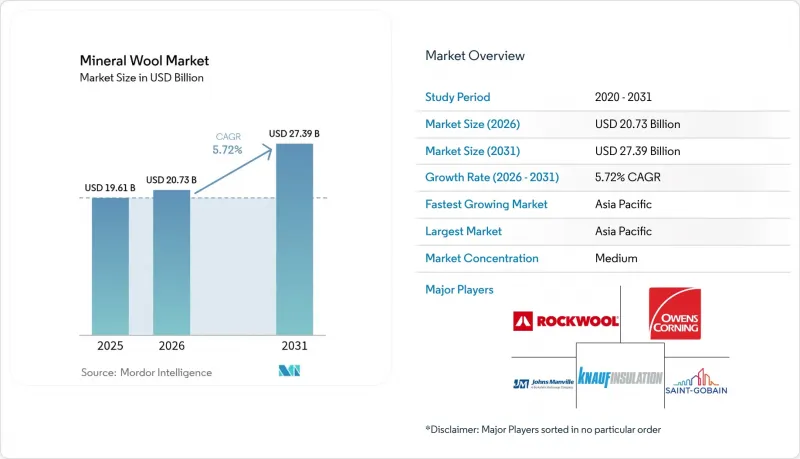
Mordor Intelligence에 의하면, 2026년 미네랄 울 시장 규모는 207억 3,000만 달러로 추정되고 있어 2025년 196억 1,000만 달러에서 확대되어, 2031년에는 273억 9,000만 달러에 이를 것으로 예측됩니다. 2026년부터 2031년까지 CAGR은 5.72%를 나타낼 전망입니다.
본 보고서는 유형별(유리솜, 석면솜,슬래그 울), 제품 유형별(보드, 블랭킷, 루즈 울 등), 최종 사용자 산업별(자동차 및 운송, 건축 및 건설, 산업용·소비자용 기기 등), 지역별(아시아태평양, 북미, 유럽, 남미, 중동 및 아프리카)로 분류되어 있습니다. 시장 전망은 금액(달러) 기준으로 제시되어 있습니다.
세계 미네랄 울 시장 동향 및 인사이트
에너지 절약형 외피를 둘러싼 건축 및 건설 붐
세계적인 탈탄소화 정책에 따라, 개보수 예산은 기밀막과 스마트 유리를 결합한 미네랄 울 기반의 외피로 집중되고 있습니다. EU 규정 2024/1681에 따르면, 회원국은 매년 공공 건축물의 3%를 리모델링해야 할 의무가 있으며, 이에 따라 향후 10년간 2,750억 유로 규모의 단열재 시장이 창출될 전망입니다. 인도의 ‘2024년 에너지 절약 건축 기준’에서는 27개 기후 구역에 걸쳐 규정된 U값이 정해져 있는 반면, 중국의 ‘DG/TJ08-205-2024’에서는 상하이의 신규 프로젝트에 대해 75%의 에너지 절약을 의무화하고 있습니다. 2024년까지 연평균 성장률(CAGR) 6.2%로 확대되고 있는 모듈식 건축에서는 현재 공장에서 제조된 벽용 카세트에 미네랄 울 코어를 결합하여 현장 노동력을 40% 절감하고 시공 기간을 단축하고 있습니다.
에너지 성능 및 화재 안전에 관한 의무적 규제
가연성 외벽을 둘러싼 소송이 규제 당국이 고층 빌딩에서의 폴리머 폼 사용을 금지하는 가운데, 미네랄 울 시장의 확장을 뒷받침하고 있습니다. 영국의 ‘승인 문서 B(Approved Document B)’ 2024년 개정판에서는 높이 18미터를 초과하는 부분에 A등급 이외의 단열재 사용을 금지하고 있으며,이 기준은 호주의 ‘2025년 국가 건축 기준(National Construction Code 2025)’의 성능 요건 FP1.4에도 반영되어 있습니다. EU 규정 2024/3110은 내화 시험 대상을 샌드위치 패널까지 확대하여, 과거 폴리우레탄 코어에 유리했던 허점을 메우고 있습니다. 또한, 산업 배출 지침 2024/1785에 규정된 페놀계 바인더 내 VOC(휘발성 유기 화합물)에 관한 병행 규제로 인해 발포재의 제조 비용이 절감되어, 미네랄 울과의 가격 차이가 줄어들고 있습니다.
흡입성 섬유에 대한 건강 및 발암성 우려
생체 용해성에 대한 모호함이 시장 진입을 가로막고 있습니다. EU의 주석 Q에서는 폐액 내 가중 반감기가 40일 미만인 경우, 최신 섬유는 발암성 물질 표시가 면제되지만, OSHA는 여전히 3µm 미만의 섬유에 대해 위험 경고 표시를 의무화하고 있습니다. 미국에서는 배상 책임에 대한 우려로 인해 2024년에 건설업자의 보험료가 15-25% 상승했습니다. 3M사가 2024년에 취득한 3µm 이상의 세라믹 및 유리 섬유 관련 특허는 1,000°C에서의 성능을 실현하면서도 흡입성 분진 발생을 방지하고 있어, 차세대 비흡입성 제품으로의 길을 제시하고 있습니다.
부문별 분석
글라스울은 2025년 수요의 61.98%를 차지하며 연평균 성장률(CAGR) 6.78%로 성장을 이어가고 있어, 미네랄 울 시장에서 압도적인 선두 자리를 유지하고 있습니다. 이 부문은 재활용 소재 함유율 의무화의 혜택을 받고 있습니다. Recticel사는 2024년에 사용 후 유리 파편을 19.2% 배합했으며, 2030년까지 25%를 목표로 하고 있어, 이를 통해 제품 1kg당 1.2 kg CO2-eq의 내재 탄소를 감축하고 있습니다. 산업용 분야에서 600°C를 초과하는 사용 온도에서 높은 평가를 받고 있는 스톤울은 밀도가 120-160 kg/m³이기 때문에 글라스울 배트에 비해 물류 비용이 40% 더 높아 성장률은 5.55%로 다소 완만합니다. 슬래그 울은 고로 슬래그가 풍부하여 동유럽이나 중국 일부 지역에서는 여전히 저렴하지만, 제철소가 전기 아크로 기술로 전환함에 따라 이 판로는 축소될 것으로 예상되어 연평균 성장률(CAGR) 4.12%의 성장세가 억제될 전망입니다.
이차적인 영향으로 글라스울의 우위가 더욱 강화되고 있습니다. 오웬스 코닝(Owens Corning)은 2024년 3분기 단열재 매출이 10억 2,000만 달러(전년 동기 대비 6% 증가)를 기록했다고 보고했습니다. 이는 건축 기준에 따라 R-30 벽이 의무화되어 표준이 된 미국 남부 전역에서 유리솜 출하가 주도한 결과입니다. 한편, 아시아태평양의 락울 매출은 5% 감소했습니다. 이는 중국 건설업체들이 개조 용이성을 이유로 유리솜 블랭킷으로 전환했기 때문입니다. 3M이 특허를 취득한 유리 세라믹 복합재를 기반으로 한 초박형 배터리 팩용 매트는 밀도 제약으로 인해 스톤울로는 대응할 수 없는 새로운 고수익성 틈새 시장을 창출하고 있습니다.
지역별 분석
아시아태평양은 2025년에 세계 수요의 41.78%를 차지하며 주도적인 위치를 차지하고 있으며, 2031년까지 연평균 성장률(CAGR) 6.25%로 확대될 것으로 예측되어 미네랄 울 시장의 중심으로서의 입지를 더욱 공고히 하고 있습니다. 상하이의 DG/TJ08-205-2024 규격에서는 75%의 에너지 절감이 의무화되어 있으며, 사실상 연속적인 외단열이 규정되어 있습니다. 한편, 베이징과 선전에서도 유사한 초안이 발표되었습니다. 인도의 개정판 ECBC에서는 벽 및 지붕의 U값이 규정되어 있으며, 용적률(FAR) 우대 조치와 결합함으로써 상업용 고층 빌딩에서의 미네랄 울 채택을 촉진하고 있습니다. 일본은 2024년, 1980년 이전에 건설된 주택의 개보수에 1,200억 엔을 예산으로 편성했으며, 한국의 ‘그린 리폼 기금’은 단열 공사비의 최대 50%를 보조하고 있어, 아파트 타워를 대상으로 한 대량 발주가 잇따르고 있습니다.
북미에서는 록울(Rockwool)사가 미시시피주의 신규 생산 라인 및 온타리오주의 설비 갱신에 13억 덴마크 크로네를 투입하여, 수요 증가에 발맞추어 현지 공급을 확보하고 있습니다. 오웬스 코닝(Owens Corning)사는 소다회 가격 변동 속에서도 수직 통합된 유리 생산 능력을 활용하여 단열재 사업의 EBITDA 마진 31.4%를 유지하고 있습니다. 캐나다의 2024년도 예산에는 주택 에너지 효율화에 대한 환급금으로 44억 캐나다 달러가 편성된 반면, 멕시코에서는 난방 또는 냉방 일수가 1,500일을 초과하는 사회주택 지역에서 단열재 사용이 의무화되어 있습니다.
유럽에서는 독일, 프랑스, 이탈리아의 건설 시장 침체가 수요를 위축시키고 있지만, 규정 2024/1681에 따라 공공 건축물의 연간 3% 개보수가 의무화되어 있어, 2030년까지 2,750억 유로의 단열재 지출이 예상됩니다. 동유럽 및 북유럽 국가들은 이러한 부진을 일부 상쇄하고 있습니다. 폴란드의 치가치체 공장에서는 증설로 인해 록울 생산 능력이 5만 톤 증가했으며, 스웨덴에서는 순환형 조달 규정을 충족하기 위해 재생 소재가 포함된 보드를 구매하고 있습니다.
사우디아라비아의 메가 프로젝트인 ‘NEOM’ 및 ‘Qiddiya’에서는 고층 타워에 불연성 단열재 사용이 규정되어 있어, 이에 따라 킹스팬(Kingspan)과 생고뱅(Saint-Gobain)이 담맘에 투자하고 있습니다. 브라질에서는 현재 ‘Programa Casa Verde e Amarela’에 따라 5개의 생물기후 구역에서 지붕의 R값이 의무화되어 있으며, 상파울루주 및 리우그란데두술주 전역에서 광범위한 수요가 발생하고 있습니다. UAE는 2024년에 ‘그린 빌딩 규정’을 개정하여, 500 m²를 초과하는 모든 공조 설비를 갖춘 건물에 대해 외피 단열을 의무화했습니다.
기타 혜택:
- 엑셀 형식 시장 예측(ME) 시트
- 3개월간의 애널리스트 지원
자주 묻는 질문
목차
제1장 서론
제2장 조사 방법
제3장 주요 요약
제4장 시장 구도
제5장 시장 규모와 성장 예측
제6장 경쟁 구도
제7장 시장 기회와 향후 전망
JHSAccording to Mordor Intelligence, mineral wool market size in 2026 is estimated at USD 20.73 billion, growing from 2025 value of USD 19.61 billion with 2031 projections showing USD 27.39 billion, growing at 5.72% CAGR over 2026-2031.
This report is Segmented by Type (Glass Wool, Stone Wool, and Slag Wool), Product Type (Board, Blanket, Loose Wool, and More), End-User Industry (Automotive and Transportation, Building and Construction, Industrial and Consumer Appliances, and More), and Geography (Asia-Pacific, North America, Europe, South America, and Middle East and Africa). The Market Forecasts are Provided in Terms of Value (USD).
Global Mineral Wool Market Trends and Insights
Building And Construction Boom In Energy-Efficient Envelopes
Global decarbonization policies are steering retrofit budgets toward mineral-wool-based envelopes that pair air-sealing membranes with smart glazing. Regulation 2024/1681 in the EU obliges member states to renovate 3% of public buildings yearly, translating to a EUR 275 billion insulation opportunity this decade. India's 2024 Energy Conservation Building Code overlays prescriptive U-values across 27 climate zones, while China's DG/TJ08-205-2024 locks in 75% energy savings for new projects in Shanghai. Modular construction-scaling at 6.2% CAGR through 2024-now embeds mineral-wool cores into factory-built wall cassettes, trimming on-site labor by 40% and compressing installation schedules.
Mandatory Energy-Performance And Fire-Safety Regulations
Litigation over combustible facades propels the mineral wool market as regulators outlaw polymer foams in tall buildings. The UK's 2024 update to Approved Document B bans non-A-rated insulation above 18 m, a benchmark mirrored by Australia's National Construction Code 2025 Performance Requirement FP1.4. EU Regulation 2024/3110 extends reaction-to-fire tests to sandwich panels, closing loopholes that once favored polyurethane cores. Parallel limits on VOCs in phenolic binders, as outlined in the Industrial Emissions Directive 2024/1785, reduce foam-production costs, narrowing the price gap with mineral wool.
Health And Carcinogenicity Concerns Over Respirable Fibres
Ambiguity around bio-solubility fragments market access. EU Note Q exempts modern fibers from carcinogen labeling if the weighted half-life in lung fluid is under 40 days, yet OSHA still mandates hazard warnings on fibers below 3 µm. Insurance premiums for U.S. contractors rose 15-25% in 2024 due to liability concerns. 3M's 2024 patent for >=3 µm ceramic-glass fibres achieves 1,000°C performance while sidestepping respirable-dust generation, hinting at next-generation non-respirable products.
Other drivers and restraints analyzed in the detailed report include:
- Tightening Green-Building Codes In Emerging Asia-Pacific
- Circular-Economy Push For Mineral-Wool Recycling Streams
- Price-Driven Substitution By Low-Cost Polymer Foams
For complete list of drivers and restraints, kindly check the Table Of Contents.
Segment Analysis
Glass wool represented 61.98% of 2025 demand and continues to expand at a 6.78% CAGR, giving it the clear lead in the mineral wool market. The segment benefits from recycled-content mandates; Recticel integrated 19.2% post-consumer cullet in 2024 and targets 25% by 2030, reducing embodied carbon by 1.2 kg CO2-eq per kg of product. Stone wool, prized for its service temperatures exceeding 600 °C in industrial settings, grows more slowly at 5.55% because its density of 120-160 kg/m3 inflates logistics costs by 40% compared with glass wool batts. Slag wool remains inexpensive in Eastern Europe and parts of China due to the abundance of blast-furnace slag; however, as steel mills shift to electric-arc technology, this outlet is expected to shrink, restraining its 4.12% CAGR growth.
Second-order effects reinforce glass wool's ascendancy. Owens Corning reported USD 1.02 billion in insulation revenue for Q3 2024, a 6% increase, driven by glass-wool shipments across the southern United States, where code-mandated R-30 walls have become the default. Conversely, Rockwool's Asia-Pacific sales declined 5% as Chinese builders shifted to glass-wool blankets for easier retrofitting. Ultra-thin battery-pack mats, built on glass-ceramic composites patented by 3M, create fresh high-margin niches that stone wool cannot meet owing to density constraints.
Complete Report Scope:
- By Type
- Glass Wool
- Stone Wool
- Slag Wool
- By Product Type
- Board
- Blanket
- Loose Wool
- Other Product Type
- By End-user Industry
- Automotive and Transportation
- Building and Construction
- Industrial and Consumer Appliances
- Other End-user Industries
- By Geography
- Asia-Pacific
- China
- India
- Japan
- South Korea
- ASEAN Countries
- Rest of Asia-Pacific
- North America
- United States
- Canada
- Mexico
- Europe
- Germany
- France
- United Kingdom
- Italy
- Spain
- Russia
- Rest of Europe
- South America
- Brazil
- Argentina
- Rest of South America
- Middle East and Africa
- Saudi Arabia
- South Africa
- Rest of Middle-East and Africa
- Asia-Pacific
Geography Analysis
The Asia-Pacific region dominated with 41.78% of global demand in 2025 and is projected to advance at a 6.25% CAGR to 2031, reinforcing its position at the center of the mineral wool market. Shanghai's DG/TJ08-205-2024 code mandates 75% energy savings, effectively prescribing continuous exterior insulation, while Beijing and Shenzhen issue similar drafts. India's revised ECBC lists prescriptive wall and roof U-values, pairing them with FAR incentives, which catalyze the uptake of mineral wool in commercial high-rises. Japan budgeted JPY 120 billion in 2024 to retrofit pre-1980 homes, and South Korea's Green Remodeling Fund covers up to 50% of insulation costs, spurring blanket orders for multi-family towers.
In North America, Rockwool earmarked DKK 1.3 billion for new lines in Mississippi and upgrades in Ontario, ensuring local supply as demand accelerates. Owens Corning leverages its backward-integrated glass capacity to protect its 31.4% insulation EBITDA margin, even as soda-ash prices fluctuate. Canada's 2024 budget sets aside CAD 4.4 billion for home-energy rebates, while Mexico now insists on thermal insulation in social-housing zones with >1,500 heating- or cooling-degree-days.
In Europe, construction softness in Germany, France, and Italy chills demand, though Regulation 2024/1681 obliges 3% annual retrofit of public buildings, equating to EUR 275 billion insulation spend to 2030. Eastern Europe and the Nordics offset some weakness: Poland's Cigacice plant expansion adds 50,000 t of stone-wool capacity, and Sweden buys recycled-content boards to fulfill circular-procurement rules.
Saudi mega-projects NEOM and Qiddiya specify non-combustible insulation in high-rise towers, drawing Kingspan and Saint-Gobain investments in Dammam. Brazil now enforces roof R-values in five bioclimatic zones under Programa Casa Verde e Amarela, opening blanket demand across Sao Paulo and Rio Grande do Sul. The UAE updated its Green Building Regulations in 2024, obliging envelope insulation on all conditioned buildings beyond 500 m2.
- ARMACELL
- BRUCHA Panel
- CertainTeed, LLC
- Etex Group
- Fletcher Insulation
- Guardian Fiberglass
- Isolatek International
- Johns Manville
- Kingspan Group
- Knauf Insulation
- Lattonedil
- Owens Corning
- Recticel
- Rockwool International AS
- Saint-Gobain
- TECHNONICOL
- USD Corporation
Additional Benefits:
- The market estimate (ME) sheet in Excel format
- 3 months of analyst support
TABLE OF CONTENTS
1 Introduction
- 1.1 Study Assumptions & Market Definition
- 1.2 Scope of the Study
2 Research Methodology
3 Executive Summary
4 Market Landscape
- 4.1 Market Overview
- 4.2 Market Drivers
- 4.2.1 Building and construction boom in energy-efficient envelopes
- 4.2.2 Mandatory energy-performance and fire-safety regulations
- 4.2.3 Tightening green-building codes in emerging Asia-Pacific
- 4.2.4 Circular-economy push for mineral-wool recycling streams
- 4.2.5 Rise of modular prefab panels accelerating demand
- 4.3 Market Restraints
- 4.3.1 Health and carcinogenicity concerns over respirable fibres
- 4.3.2 Price-driven substitution by low-cost polymer foams
- 4.3.3 Volatile basalt/coke/binder input prices
- 4.4 Value Chain Analysis
- 4.5 Porter's Five Forces
- 4.5.1 Bargaining Power of Suppliers
- 4.5.2 Bargaining Power of Consumers
- 4.5.3 Threat of New Entrants
- 4.5.4 Threat of Substitutes
- 4.5.5 Degree of Competition
5 Market Size & Growth Forecasts (Value)
- 5.1 By Type
- 5.1.1 Glass Wool
- 5.1.2 Stone Wool
- 5.1.3 Slag Wool
- 5.2 By Product Type
- 5.2.1 Board
- 5.2.2 Blanket
- 5.2.3 Loose Wool
- 5.2.4 Other Product Type
- 5.3 By End-user Industry
- 5.3.1 Automotive and Transportation
- 5.3.2 Building and Construction
- 5.3.3 Industrial and Consumer Appliances
- 5.3.4 Other End-user Industries
- 5.4 By Geography
- 5.4.1 Asia-Pacific
- 5.4.1.1 China
- 5.4.1.2 India
- 5.4.1.3 Japan
- 5.4.1.4 South Korea
- 5.4.1.5 ASEAN Countries
- 5.4.1.6 Rest of Asia-Pacific
- 5.4.2 North America
- 5.4.2.1 United States
- 5.4.2.2 Canada
- 5.4.2.3 Mexico
- 5.4.3 Europe
- 5.4.3.1 Germany
- 5.4.3.2 France
- 5.4.3.3 United Kingdom
- 5.4.3.4 Italy
- 5.4.3.5 Spain
- 5.4.3.6 Russia
- 5.4.3.7 Rest of Europe
- 5.4.4 South America
- 5.4.4.1 Brazil
- 5.4.4.2 Argentina
- 5.4.4.3 Rest of South America
- 5.4.5 Middle East and Africa
- 5.4.5.1 Saudi Arabia
- 5.4.5.2 South Africa
- 5.4.5.3 Rest of Middle-East and Africa
- 5.4.1 Asia-Pacific
6 Competitive Landscape
- 6.1 Market Concentration
- 6.2 Strategic Moves
- 6.3 Market Share (%)/ Ranking Analysis
- 6.4 Company Profiles (includes Global level Overview, Market level overview, Core Segments, Financials as available, Strategic Information, Market Rank/Share, Products & Services, and Recent Developments)
- 6.4.1 ARMACELL
- 6.4.2 BRUCHA Panel
- 6.4.3 CertainTeed, LLC
- 6.4.4 Etex Group
- 6.4.5 Fletcher Insulation
- 6.4.6 Guardian Fiberglass
- 6.4.7 Isolatek International
- 6.4.8 Johns Manville
- 6.4.9 Kingspan Group
- 6.4.10 Knauf Insulation
- 6.4.11 Lattonedil
- 6.4.12 Owens Corning
- 6.4.13 Recticel
- 6.4.14 Rockwool International AS
- 6.4.15 Saint-Gobain
- 6.4.16 TECHNONICOL
- 6.4.17 USD Corporation
7 Market Opportunities and Future Outlook
- 7.1 White-space and Unmet-need Assessment