|
시장보고서
상품코드
2124073
스마트 미러 시장 : 시장 점유율 분석, 업계 동향 및 통계, 성장 예측(2026-2031년)Smart Mirror - Market Share Analysis, Industry Trends & Statistics, Growth Forecasts (2026 - 2031) |
||||||
 Mordor Intelligence
Mordor Intelligence에 의하면, 스마트 미러 시장 규모는 2025년 44억 9,000만 달러로 평가되었고, 2026년 49억 2,000만 달러에서 2031년까지 73억 7,000만 달러로 확대될 것으로 예측되며, 2026-2031년 연평균 복합 성장률(CAGR)은 8.42%를 나타낼 전망입니다.

본 보고서는 구성 요소별(하드웨어, 소프트웨어, 서비스), 최종 사용자 용도별(자동차, 소매·마케팅, 헬스케어, 주택, 호스피탈리티), 디스플레이 기술별(LCD, OLED 등), 판매 채널별(B2B, B2C), 지역별(북미, 유럽, 아시아태평양, 남미 등)로 분류되어 있습니다. 시장 예측은 금액(달러) 기준으로 제시되어 있습니다.
세계의 스마트 미러 시장 동향 및 인사이트
자동차 분야에서의 스마트 미러 채택 확대
유럽 및 아시아태평양의 트럭 제조업체들은 유엔 유럽 경제 위원회(UN ECE)의 R158 규정에 따라 물리적 미러 설치가 법적으로 불필요해짐에 따라 카메라·모니터 시스템을 채택했습니다. 이에 따라 메르세데스-벤츠, 볼보, 스카니아, MAN은 2025년까지 20만 대 이상의 대형 차량에 해당 시스템을 탑재할 예정입니다. 현대와 기아는 유로 NCAP 5성급 평가를 확보하기 위해 신형 EV 플랫폼의 실내 미러에 운전자 상태 모니터링 카메라를 통합했습니다. 젠텍스(Gentex)사의 2025년형 ‘풀 디스플레이 미러’는 OLED 패널, 후방 카메라 영상, 운전자 모니터링 기능을 하나의 12인치 유닛에 통합하고 있으며, 이는 개별 센서에서 다기능 모듈로의 전환을 보여줍니다. 외부 미러가 사라짐에 따라 공기 저항이 5% 감소하여 배터리 비용 증가 없이 전기차의 주행 거리를 연장할 수 있게 됨에 따라, 관련 규제가 도입을 가속화하고 있습니다. 그 결과, 각 공급업체들은 멕시코와 폴란드에 전용 생산 라인을 증설하고 있으며, 콕핏 사용자 경험(UX)의 차별화를 열망하는 OEM 업체들과 3년 계약을 체결하고 있습니다.
AI를 활용한 개인화 기능의 급속한 통합
현재, 가정 및 소매용 제품에는 피부 수분량을 평가하고, 잔주름을 감지하며, 화장품을 추천하는 컨볼루션 신경망이 탑재되어 있어, 거울은 일상의 건강 조언자로 변모하고 있습니다. CareOS의 ‘BMind’ 거울은 호텔 욕실에서 기분 추적 기능과 안내식 호흡법을 결합한 공로로 2024년 CES 혁신상을 수상했습니다. 프랑스 백화점에서 진행된 로레알과 ModiFace의 시범 프로젝트에서는 체류 시간을 연장하는 것으로 입증된 색조를 거울이 제안한 결과, 전환율이 30% 향상되었습니다. HiMirror의 새로운 펌웨어는 피부과 데이터베이스를 참조하여 의심스러운 점(모반)을 감지할 경우 원격 피부과 진료로 연결해 줍니다. AI를 통한 개인화는 적용 가능한 이용 사례를 확대하고 있으며, 각 벤더사는 안전한 무선 통신 채널을 통해 매월 모델 업데이트를 제공합니다. 데이터가 기기 외부로 유출되지 않을 경우, 사용자의 옵트인 비율은 70%를 초과하며, 엄격한 유럽의 개인정보 보호 규정을 충족하는 엣지 퍼스트형 아키텍처의 유효성이 입증되었습니다.
높은 초기 비용과 낮은 소비자 인지도
가정용 스마트 미러의 소매 가격은 800-3,000달러로, 150달러인 기존 조명 미러보다 훨씬 비싸기 때문에 고소득층 이외의 가구로의 보급을 제한하고 있습니다. 2024년 딜로이트 조사에 따르면, 미국 주택 소유자 중 ‘스마트 미러’를 알고 있는 사람은 고작 22%에 불과했으며, 건강상의 이점을 언급한 사람은 5% 미만이었습니다. 이에 따라 메리어트나 힐튼 등의 호텔에서는 프리미엄 스위트룸에 스마트 거울을 도입해 그 장점을 어필하고, 더 광범위한 확장을 위한 비용 대비 효과 분석에 활용할 피드백을 수집하고 있습니다. 이커머스 플랫폼의 할부 결제 플랜이나 ‘지금 구매, 나중에 결제’ 옵션 덕분에 높은 가격으로 인한 구매 망설임은 완화되고 있지만, 중산층 소비자들은 획기적인 앱이 등장하기 전까지는 여전히 구매에 소극적입니다. 가격 하락은 2027년에 예정된 OLED 수율 향상과 범용화된 엣지 AI 칩의 보급에 달려 있습니다.
부문 분석
2025년 매출액 중 하드웨어가 여전히 66.73%를 차지했지만, 플랫폼이 SaaS 라이선스, 클라우드 스토리지 계층형 요금제, 프리미엄 분석 번들로 전환됨에 따라 서비스 부문은 2031년까지 연평균 성장률(CAGR) 9.61%로 성장할 전망입니다. 젠텍스(Gentex)는 2024년 솔라스 시스템즈(Solace Systems)와 제휴하여 무선 전력 전송 및 펌웨어 업데이트 기능을 도입했습니다. 이를 통해 판매 후에도 고해상도 녹화 기능과 피로 예측 대시보드를 이용할 수 있게 되었습니다. 소매업체들은 ModiFace와 Perfect Corp로부터 AR 피팅 엔진을 세션 단위로 임대함으로써 자본 예산을 운영비로 전환하고 있습니다. 원격 의료용 거울은 병원 프로젝트 총액의 35%를 차지하는 연간 유지보수 계약을 통해 전자건강기록(EHR) 공급업체와 협력하고 있습니다. 또한, 서비스 수익은 식별자를 제거하면서도 피팅룸 이용 피크와 같은 거시적 동향을 파악할 수 있는 개인정보 보호 중심의 데이터 레이크를 통해 확대되고 있으며, 소매업체에 실행 가능한 인사이트력을 제공합니다.
하드웨어 로드맵에서는 베젤의 슬림화와 전력 소비를 40% 절감하는 엣지 라이트 방식 LED를 통한 눈부심 억제가 우선순위로 설정되어 있습니다. 이는 거울이 하루 18시간 가동되는 호텔 복도에서 특히 중요하게 여겨지는 장점입니다. 소프트웨어 팀은 음성 UI와 대화형 AI에 주력하여, 습기가 많은 욕실이나 진동이 있는 차량 내부에서도 뉴스 피드, 조명, 웰니스 컨텐츠를 핸즈프리로 선택할 수 있도록 하고 있습니다. 서비스의 차별화는 기기에서 학습하고, 일원적으로 업데이트된 후 재배포되는 연방 학습 모델에서 비롯됩니다. 이를 통해 기밀성이 높은 프레임 데이터를 로컬에 보관하면서 알고리즘의 정확도를 향상시키고 있습니다. 이러한 전환은 스마트 미러 시장에서 투자자 평가에 필수적인 지속적인 수익의 기반이 되고 있습니다.
2025년 스마트 미러 시장 규모에서는 EU 및 아시아태평양의 규제로 인해 트럭에 대한 대량 도입이 촉진됨에 따라, 자동차 분야가 매출의 41.89%를 차지하며 시장을 주도했습니다. 한편, 의료용 미러는 CMS(의료보험서비스센터)의 환급 및 일본의 ‘익숙한 곳에서의 고령화’ 정책에 힘입어 연평균 성장률(CAGR) 10.02%를 기록할 전망입니다. 소매 분야는 전환율 향상에 기여한다는 증거가 늘어나고 있어 그 뒤를 잇고 있으나, 주택 분야에서의 도입은 욕실 1실당 5만 달러를 초과하는 고급 리모델링으로 한정되어 있습니다. 힐튼이 2025년에 12개 시설에서 실시한 시범 프로그램에서 스마트 미러를 설치한 객실의 투숙객 만족도 점수가 25% 더 높은 것으로 밝혀져, 체인 전체에 걸친 도입 검토가 진행되고 있습니다.
병원의 경우, ISO 13485 준수, 피부 전기 센서, FHIR 상호 운용성이 요구되어 판매 주기가 18개월로 연장되지만, 그 대신 수년에 걸친 지원 계약이 체결됩니다. 자동차 분야의 최종 사용자는 FMVSS 201을 준수하는 머리 충격 내구성과 -40°C에서의 내열성을 중요하게 생각합니다. 소매업체는 99.5%의 가동률과 원격 진단을 요구하지만, 가정용 고객은 인테리어와 조화를 이루고 Apple HomeKit과 연동되어 일원적으로 제어할 수 있는 프레임을 구매합니다. 호텔 업계의 구매자는 5년 보증을 협상하고, 스마트 미러를 IPTV 업그레이드와 세트로 묶어 규모의 경제를 누림으로써 계약 총액을 확대되고 있습니다.
지역별 분석
유럽은 2025년 매출의 31.47%를 차지했으며, 그 원동력은 운전자 졸음 감지 시스템을 의무화하여 차량 내 카메라 수요를 끌어올린 규정 2019/2144입니다. 독일 공급망에는 피코사, 무라카미, 발레오가 거점을 두고 있으며, 각각 폭스바겐과 BMW의 프로그램에 부품을 공급하고 있습니다. 한편, 프랑스의 발레오는 카메라 모듈 생산 능력 확대에 2억 유로(2억 1,300만 달러)를 투자했습니다. 영국은 유엔 유럽경제위원회(UN ECE) 규정을 준수하고 있지만, 12개월의 시차가 있어 범유럽적인 형식 승인이 복잡해지고 있습니다.
북미에서는 NHTSA가 여전히 물리적 사이드 미러를 의무화하고 있어 자동차 분야에서의 도입은 늦어지고 있지만, 스마트 홈에 대한 지출이 증가함에 따라 주거용 및 호텔·리조트 분야의 매출은 증가하고 있습니다. 젠텍스(Gentex)는 USMCA에 따라 관세 면제 혜택을 받으며 제품을 출하할 수 있는 50만 제곱피트 규모의 티후아나 공장을 운영하여 관세 리스크를 최소화하고 있습니다. 멕시코시티의 호텔과 부티크 헬스클럽에서는 투숙객을 위한 웰니스 서비스의 차별화를 꾀하기 위해 미러의 시범 도입이 진행되고 있으며, 미국 국경을 넘어선 지역적 수요가 높다는 사실이 입증되고 있습니다. 남미와 아프리카는 가격 민감도로 인해 여전히 초기 단계에 있지만, 상파울루의 고급 아파트와 케이프타운의 스파 리조트에서의 시범 도입은 향후 성장 가능성을 시사하고 있습니다.
아시아태평양의 연평균 성장률(CAGR) 10.86%는 중국의 전기차 붐, 한국의 디스플레이 연구개발 보조금, 그리고 일본의 고령자 대상 원격의료 추진에 기인합니다. MOTIE는 2024년에 투명 디스플레이를 전략 산업으로 지정하고, LG디스플레이와 현대모비스의 공동 프로젝트에 자금을 지원하고 있습니다. 인도의 도시 중산층은 음성 비서를 구매하고, 이와 연동되는 미러를 원하고 있지만, 1,000달러를 넘는 가격대가 보급을 저해하고 있습니다. 호주 및 뉴질랜드는 아시아와 유럽에서 미러를 수입하고 있으며, 230볼트 안전 규격과 태양광 발전에 적합한 대기 전력을 중요시하고 있습니다.
걸프협력회의(GCC) 회원국인 중동의 구매자들은 스마트 시티 구상의 일환으로 아랍어 음성 팩과 내모래 코팅이 결합된 스마트 미러를 고급 아파트에 도입하고 있습니다. UAE의 정부 주도 주택 이니셔티브에서는 넷 제로 목표 준수를 보장하기 위해, 미러가 프로토콜 계층에서 건물의 에너지 관리 시스템과 통합되어야 합니다.
기타 혜택 :
- 엑셀 형식 시장 예측(ME) 시트
- 3개월간의 애널리스트 지원
자주 묻는 질문
목차
제1장 서론
제2장 조사 방법
제3장 주요 요약
제4장 시장 구도
제5장 시장 규모 및 성장 예측
제6장 경쟁 구도
제7장 시장 기회 및 향후 전망
AJY 26.09.11According to Mordor Intelligence, the smart mirror market size is projected to expand from USD 4.49 billion in 2025 and USD 4.92 billion in 2026 to USD 7.37 billion by 2031, registering a CAGR of 8.42% between 2026 to 2031.
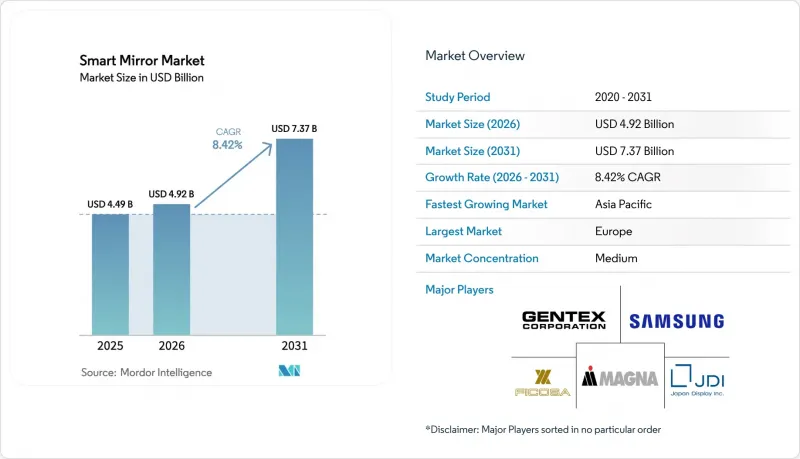
This report is Segmented by Component (Hardware, Software, and Services), End-User Application (Automotive, Retail and Marketing, Healthcare, Residential, and Hospitality), Display Technology (LCD, OLED, and More), Sales Channel (Business-To-Business, and Business-To-Consumer), and Geography (North America, Europe, Asia Pacific, South America, and More). The Market Forecasts are Provided in Terms of Value (USD).
Global Smart Mirror Market Trends and Insights
Growing Adoption of Smart Mirrors in Automotive Sector
Europe and Asia Pacific truck makers embraced camera-monitor systems after UN ECE R158 removed the legal need for physical mirrors, enabling Mercedes-Benz, Volvo, Scania, and MAN to equip more than 200,000 heavy-duty vehicles by 2025. Hyundai and Kia embedded driver-state cameras in interior mirrors of new EV platforms to secure Euro NCAP five-star ratings. Gentex's 2025 Full Display Mirror fuses an OLED panel, rear-camera feed, and driver-monitoring into a single 12-inch unit, signaling a shift from discrete sensors to multifunction modules. Regulations accelerate adoption because aerodynamic drag falls 5% when external mirrors disappear, extending EV range without battery cost penalties. Suppliers consequently ramp dedicated production lines in Mexico and Poland, locking in three-year contracts with OEMs eager to differentiate cockpit UX.
Rapid Integration of AI-Based Personalization Features
Residential and retail units now package convolutional neural networks that grade skin hydration, detect fine lines, and recommend cosmetics, turning the mirror into a daily health advisor. CareOS's BMind mirror won a 2024 CES Innovation Award for pairing mood tracking with guided breathing in hotel bathrooms. L'Oreal and ModiFace pilots in French department stores raised conversion by 30% as mirrors suggested shades proven to lift dwell time. HiMirror's new firmware references dermatology databases and offers teledermatology hand-offs when it detects suspicious moles. AI personalization widens addressable use cases, motivating vendors to ship monthly model updates via secure over-the-air channels. User opt-in rates exceed 70% when data never leaves the device, validating an edge-first architecture that satisfies stringent European privacy rules.
High Initial Cost and Limited Consumer Awareness
Residential smart mirrors retail between USD 800 and USD 3,000, far above a USD 150 conventional lit mirror, limiting penetration outside affluent households. A 2024 Deloitte poll found that only 22% of U.S. homeowners recognized "smart mirror," and fewer than 5% cited a health benefit. Hotels such as Marriott and Hilton therefore deploy mirrors in premium suites to showcase benefits, collecting feedback that feeds cost-benefit analyses for broader rollouts. Bundled financing and buy-now-pay-later options on e-commerce platforms mitigate sticker shock, yet middle-income consumers remain hesitant until killer apps appear. Price compression hinges on OLED yield gains and commoditized edge AI chips due in 2027.
Other drivers and restraints analyzed in the detailed report include:
- Expansion of Connected Retail Fitting-Room Solutions
- Rising Demand for Tele-health and Remote Patient Monitoring
- Cyber-Security and Data-Privacy Concerns
For complete list of drivers and restraints, kindly check the Table Of Contents.
Segment Analysis
Hardware still delivered 66.73% of 2025 revenue, but services are on pace for a 9.61% CAGR to 2031 as platforms shift to SaaS licenses, cloud storage tiers, and premium analytics bundles. Gentex's 2024 tie-up with Solace Systems introduced wireless power transfer and firmware updates that unlock high-definition recording and fatigue-prediction dashboards post-sale. Retailers rent AR try-on engines from ModiFace and Perfect Corp on a per-session basis, turning capital budgets into operating outlays. Tele-health mirrors integrate with EHR vendors through annual maintenance contracts that represent 35% of hospital project value. Services revenue also scales through privacy-centric data lakes that scrub identifiers yet reveal macro trends such as peak dressing-room occupancy, giving retailers actionable insights.
Hardware roadmaps prioritize slimmer bezels and glare suppression via edge-lit LEDs that cut energy draw 40%, advantages prized in hotel corridors where mirrors run 18 hours daily. Software teams focus on voice UI and conversational AI to enable hands-free selection of news feeds, lighting, and wellness content in humid bathrooms and vibrating cabs. Services differentiation flows from federated learning models that train on-device, update centrally, then redeploy, keeping sensitive frames local while enhancing algorithm accuracy. This pivot underpins recurring income crucial for investor valuations in the smart mirror market.
Automotive dominated the 2025 smart mirror market size with 41.89% revenue as EU and Asia Pacific mandates triggered mass truck deployments. Yet healthcare mirrors will clock a 10.02% CAGR, propelled by CMS reimbursements and Japan's aging-in-place policies. Retail follows as conversion-boost evidence grows, while residential adoption remains confined to luxury renovations exceeding USD 50,000 per bathroom. Hilton's 2025 pilots in 12 properties showed 25% higher guest-satisfaction scores for smart-mirror rooms, prompting chain-wide assessments.
Hospitals demand ISO 13485 compliance, galvanic-skin sensors, and FHIR interoperability, extending sales cycles to 18 months but yielding multiyear support contracts. Automotive end users stress FMVSS 201 head-impact endurance and -40 °C thermal resilience. Retailers push for 99.5% uptime and remote diagnostics, whereas residential customers buy frames that match decor and pair with Apple HomeKit for unified control. Hospitality buyers negotiate five-year warranties and bundle smart mirrors with IPTV upgrades to capture economies of scale, thereby broadening the total contract value.
Complete Report Scope:
- By Component
- Hardware
- Software
- Services
- By End-User Application
- Automotive
- Retail and Marketing
- Healthcare
- Residential
- Hospitality
- By Display Technology
- LCD
- OLED
- Other Display Technologies
- By Sales Channel
- Business-to-Business (B2B)
- Business-to-Consumer (B2C)
- By Geography
- North America
- United States
- Canada
- Mexico
- South America
- Brazil
- Argentina
- Rest of South America
- Europe
- Germany
- United Kingdom
- France
- Italy
- Spain
- Russia
- Benelux
- Nordics
- Rest of Europe
- Asia-Pacific
- China
- India
- Japan
- South Korea
- ASEAN
- Australia and New Zealand
- Rest of Asia-Pacific
- Middle East
- GCC
- Turkey
- Israel
- Rest of Middle East
- Africa
- Egypt
- South Africa
- Rest of Africa
- North America
Geography Analysis
Europe controlled 31.47% of 2025 revenue, anchored by Regulation 2019/2144 which mandated driver-drowsiness detection systems and propelled demand for interior cameras. Germany's supply cluster houses Ficosa, Murakami, and Valeo, each feeding Volkswagen and BMW programs, while France's Valeo spent EUR 200 million (USD 213 million) expanding camera module capacity. The UK mirrors UN ECE rules but with a 12-month lag, complicating pan-European homologation.
North America trails in automotive adoption because NHTSA still mandates physical exterior mirrors, yet residential and hospitality sales rise as smart-home spending climbs. Gentex runs a 500,000-square-foot Tijuana plant that ships duty-free under USMCA, curbing tariff risk. Mexico City hotels and boutique gyms pilot mirrors to differentiate guest wellness offerings, proving regional appetite beyond U.S. borders. South America and Africa remain early-stage due to price sensitivity, but pilot installs in Sao Paulo's luxury condos and Cape Town's spa resorts hint at future upside.
Asia Pacific's 10.86% CAGR stems from China's EV boom, South Korea's display R&D grants, and Japan's geriatrics-driven tele-health push. MOTIE labeled transparent displays a strategic industry in 2024 and funds joint projects between LG Display and Hyundai Mobis. India's urban middle class buys voice assistants and seeks mirrors that sync with them, though tickets above USD 1,000 curb penetration. Australia and New Zealand import mirrors from Asia and Europe, prioritizing 230-volt safety ratings and solar-friendly standby power.
Middle East buyers in the Gulf Cooperation Council outfit premium apartments with smart mirrors as part of smart-city visions, combining Arabic voice packs and sand-resistant coatings. Government housing initiatives in the UAE require mirrors to integrate at the protocol layer with building energy-management systems, ensuring compliance with net-zero goals.
- Gentex Corporation
- Ficosa International SA
- Magna International Inc.
- Samsung Electronics Co., Ltd.
- Japan Display Inc.
- Murakami Corporation
- Dension Ltd.
- Electric Mirror Inc.
- Perseus Mirror
- Seura Inc.
- CareOS (Baracoda)
- Capstone Connected Holdings, Inc.
- Evervue USA Inc.
- HiMirror (New Kinpo Group)
- Acer Inc.
- Mues-Tec GmbH & Co. KG
- Shenzhen Haier Smart Home Co., Ltd.
- ad notam AG
- Panasonic Holdings Corporation
- Shenzhen Pro Display Co., Ltd.
Additional Benefits:
- The market estimate (ME) sheet in Excel format
- 3 months of analyst support
TABLE OF CONTENTS
1 INTRODUCTION
- 1.1 Study Assumptions and Market Definition
- 1.2 Scope of the Study
2 RESEARCH METHODOLOGY
3 EXECUTIVE SUMMARY
4 MARKET LANDSCAPE
- 4.1 Market Overview
- 4.2 Market Drivers
- 4.2.1 Growing Adoption of Smart Mirrors in Automotive Sector
- 4.2.2 Rapid Integration of AI-Based Personalization Features
- 4.2.3 Expansion of Connected Retail Fitting-Room Solutions
- 4.2.4 Rising Demand for Tele-health and Remote Patient Monitoring
- 4.2.5 Government Mandates for Automotive Digital Rear-View Systems
- 4.2.6 Aging-in-Place Tech Driving Smart Bathroom Mirrors
- 4.3 Market Restraints
- 4.3.1 High Initial Cost and Limited Consumer Awareness
- 4.3.2 Cyber-Security and Data-Privacy Concerns
- 4.3.3 Fragile Supply Chain for Specialized Display Glass
- 4.3.4 Regulatory Uncertainty on Camera-Enabled Mirrors
- 4.4 Industry Value Chain Analysis
- 4.5 Regulatory Landscape
- 4.6 Technological Outlook
- 4.7 Porter's Five Forces Analysis
- 4.7.1 Bargaining Power of Suppliers
- 4.7.2 Bargaining Power of Buyers
- 4.7.3 Threat of New Entrants
- 4.7.4 Threat of Substitutes
- 4.7.5 Intensity of Competitive Rivalry
5 MARKET SIZE AND GROWTH FORECASTS (VALUE)
- 5.1 By Component
- 5.1.1 Hardware
- 5.1.2 Software
- 5.1.3 Services
- 5.2 By End-User Application
- 5.2.1 Automotive
- 5.2.2 Retail and Marketing
- 5.2.3 Healthcare
- 5.2.4 Residential
- 5.2.5 Hospitality
- 5.3 By Display Technology
- 5.3.1 LCD
- 5.3.2 OLED
- 5.3.3 Other Display Technologies
- 5.4 By Sales Channel
- 5.4.1 Business-to-Business (B2B)
- 5.4.2 Business-to-Consumer (B2C)
- 5.5 By Geography
- 5.5.1 North America
- 5.5.1.1 United States
- 5.5.1.2 Canada
- 5.5.1.3 Mexico
- 5.5.2 South America
- 5.5.2.1 Brazil
- 5.5.2.2 Argentina
- 5.5.2.3 Rest of South America
- 5.5.3 Europe
- 5.5.3.1 Germany
- 5.5.3.2 United Kingdom
- 5.5.3.3 France
- 5.5.3.4 Italy
- 5.5.3.5 Spain
- 5.5.3.6 Russia
- 5.5.3.7 Benelux
- 5.5.3.8 Nordics
- 5.5.3.9 Rest of Europe
- 5.5.4 Asia-Pacific
- 5.5.4.1 China
- 5.5.4.2 India
- 5.5.4.3 Japan
- 5.5.4.4 South Korea
- 5.5.4.5 ASEAN
- 5.5.4.6 Australia and New Zealand
- 5.5.4.7 Rest of Asia-Pacific
- 5.5.5 Middle East
- 5.5.5.1 GCC
- 5.5.5.2 Turkey
- 5.5.5.3 Israel
- 5.5.5.4 Rest of Middle East
- 5.5.6 Africa
- 5.5.6.1 Egypt
- 5.5.6.2 South Africa
- 5.5.6.3 Rest of Africa
- 5.5.1 North America
6 COMPETITIVE LANDSCAPE
- 6.1 Market Concentration
- 6.2 Strategic Moves
- 6.3 Market Share Analysis
- 6.4 Company Profiles (includes Global Level Overview, Market Level Overview, Core Segments, Financials as Available, Strategic Information, Market Rank/Share for Key Companies, Products and Services, and Recent Developments)
- 6.4.1 Gentex Corporation
- 6.4.2 Ficosa International SA
- 6.4.3 Magna International Inc.
- 6.4.4 Samsung Electronics Co., Ltd.
- 6.4.5 Japan Display Inc.
- 6.4.6 Murakami Corporation
- 6.4.7 Dension Ltd.
- 6.4.8 Electric Mirror Inc.
- 6.4.9 Perseus Mirror
- 6.4.10 Seura Inc.
- 6.4.11 CareOS (Baracoda)
- 6.4.12 Capstone Connected Holdings, Inc.
- 6.4.13 Evervue USA Inc.
- 6.4.14 HiMirror (New Kinpo Group)
- 6.4.15 Acer Inc.
- 6.4.16 Mues-Tec GmbH & Co. KG
- 6.4.17 Shenzhen Haier Smart Home Co., Ltd.
- 6.4.18 ad notam AG
- 6.4.19 Panasonic Holdings Corporation
- 6.4.20 Shenzhen Pro Display Co., Ltd.
7 MARKET OPPORTUNITIES AND FUTURE OUTLOOK
- 7.1 White-Space and Unmet-Need Assessment