

|
시장보고서
상품코드
2124075
세라믹 막 시장 : 시장 점유율 분석, 업계 동향 및 통계, 성장 예측(2026-2031년)Ceramic Membranes - Market Share Analysis, Industry Trends & Statistics, Growth Forecasts (2026 - 2031) |
||||||
 Mordor Intelligence
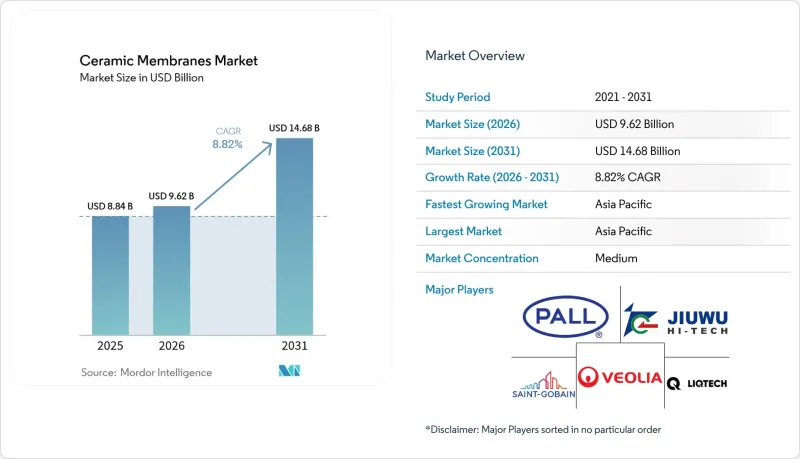
Mordor Intelligence에 의하면, 세라믹 막 시장 규모는 2025년 88억 4,000만 달러로 평가되었고, 2026년에는 96억 2,000만 달러로 추정되고, 2031년까지 146억 8,000만 달러에 이를 것으로 예상되며, 2026-2031년 CAGR 8.82%로 성장할 전망입니다.
본 보고서는 소재 유형별(알루미나, 실리카, 티타니아, 지르코늄 산화물, 실리콘 카바이드, 기타), 최종 사용자 산업별(상하수도 처리, 식품 및 음료, 화학 산업, 제약, 기타) 및 지역별(아시아태평양, 북미, 유럽, 남미, 중동 및 아프리카)로 세분화되어 있습니다. 시장 전망은 금액(달러) 기준으로 제시되어 있습니다.
세계의 세라믹 막 시장 동향 및 인사이트
상하수도 처리 인프라에 대한 수요 증가
신흥 경제국 정부는 운영자의 개입을 최소화하면서 가동되는 분산형 시스템에 자금을 지원하고 있습니다. 인도의 ‘Jal Jeevan Mission’은 농촌 지역 상수도 유틸리티에 500억 달러를 배정하고, 신규 설치의 60%에서 세라믹 미세 여과막 사용을 의무화했습니다. 이는 역세척 주기가 폴리머 카트리지의 24시간에 비해 72시간에 달하기 때문입니다. 중국에서 석탄 화학 산업 단지에 ‘폐수 무방류’를 의무화함에 따라, 2024-2025년 340개 플랜트에 총 180만 m²의 세라믹 막이 도입되었습니다. ACWA Power사의 타위라 시설 등 중동의 플랜트에서는 현재 12만 m²의 알루미나 튜브를 이용한 역삼투(RO)를 전단에 배치함으로써 약품 투여량을 35% 절감하고 있습니다. 미국 메릴랜드주 및 버지니아주에서 영양염 제거를 위한 개보수 공사에서는 설치 면적을 확대하지 않고도 총질소 농도 3 mg/L의 규제 기준을 충족하기 위해 세라믹 막이 채택되었습니다. 이러한 노력들이 합쳐져 공공 부문의 지출을 촉진하고, 세라믹 막 시장의 장기적인 수요를 뒷받침하고 있습니다.
전 세계 산업 폐수 규제의 강화
각 지역에서 규제 당국은 고분자계 시스템으로는 달성하기 어려운 배출 기준을 더욱 엄격하게 적용하고 있습니다. 미국 환경보호청(EPA)의 2024년 유기 화학 물질 ELG에서는 BOD를 10 mg/L, 탁도를 0.5 NTU로 제한하고 있습니다. 세라믹 막은 응집 처리 없이도 이 기준을 충족하므로, 건조 톤당 80달러를 초과하는 슬러지 운반 비용을 절감할 수 있습니다. 유럽의 개정된 ‘산업 배출 지침’에서는 30분 이내의 CIP(정지 세척) 주기를 권장하고 있으나, 세라믹 막은 80°C에서 2%의 가성 알칼리를 사용함으로써 이 기준을 충족하고 있습니다. 중국의 의약품 규격 GB 31962-2015에서는 COD 상한선을 50 mg/L로 정하고 있으며, 이에 따라 저장성의 22개 API 공장은 건당 50만 위안 벌금을 피하기 위해 2025년까지 세라믹 막 설비로 전환할 예정입니다. 이러한 일련의 정책 동향에 따라 세라믹 막 시장의 예상 연평균 성장률(CAGR)은 2.1포인트의 지속적인 상승 효과가 예상됩니다.
저 TDS 용도에서의 저압 고분자계 대체재 보급
저탁도의 지표수의 경우, 고분자 중공사막의 초기 투자 비용이 여전히 세라믹 막보다 낮습니다. 2025년 미국 수도 협회(AWWA)의 조사에 따르면, 고분자 미세 여과의 비용은 1m3/일당 420달러인 반면, 세라믹 막은 680달러였습니다. 새로운 PES 모듈은 500 ppm의 차아염소산 나트륨을 견딜 수 있어 내화학성 격차가 점차 좁혀지고 있습니다. 2025년 수환경연맹(WEF)의 조사에 따르면, 북미 상수도 유틸리티자의 62%가 최장 수명보다 10년간의 순현재가치(NPV)가 낮은 것을 우선시한다고 응답했습니다. 구형 저압 플랜트를 개조할 경우, 트레인당 15만-30만 달러의 부수적인 업그레이드 비용이 발생하기 때문에 이러한 환경에서는 세라믹 막 시장의 단기적인 성장 여지가 제한적입니다.
부문 분석
2025년 매출액 중 알루미나(Alumina)가 44.12%를 차지했으며, 세라믹 막 시장 점유율의 주축을 이루고 있습니다. 연마 용도에서는 실리콘 카바이드가 그 뒤를 잇고 있지만, 50nm 컷오프에 대한 반도체 및 제약 업계 수요를 배경으로 티타니아계 제품이 연평균 성장률(CAGR) 9.80%로 가장 빠르게 성장할 것으로 전망됩니다. 알루미나계 세라믹 막 시장 규모는 중국 내 생산 능력 확대로 단가가 200달러/m2 아래로 떨어짐에 따라 2031년까지 65억 달러에 달할 것으로 예측됩니다. 비용 격차는 여전히 존재하며, 티타니아는 상 제어 소성 공정으로 인해 320-400달러/m²의 가격대를 형성하고 있지만, 광촉매에 의한 자가 세정 기능 덕분에 고순도 공정에서 프리미엄 가격이 책정되고 있습니다. 신흥 유리 세라믹 복합재료는 중간 수준의 비용과 폭넓은 pH 내성을 보장하고 있어, 향후 시장 점유율의 재분배가 시사되고 있습니다.
가격과 내구성의 우위 덕분에 2031년까지는 알루미나의 확고한 우위가 유지되겠지만, 용도의 다양화가 진행되고 있습니다. 실리콘 카바이드는 모스 경도 9.5를 자랑하며, 광산 폐석 및 셰일 가스 생산수 처리에서 필수적인 존재가 되고 있습니다. 지르코니아는 용매를 많이 포함하는 유기물의 나노 여과에 사용되지만, 이트리아 안정화에 따른 비용 제약으로 인해 그 점유율은 6% 미만에 그치고 있습니다. 광촉매 활성을 대상으로 한 ISO 19749 시험의 개정에 따라, 티타니아 공급업체는 오염 저항성 측면에서 차별화를 꾀할 수 있게 되어, 세라믹 막 시장에서 한 자릿수 후반대의 높은 성장 궤도를 유지할 것으로 보입니다.
지역별 분석
아시아태평양은 2025년 매출의 52.98%를 차지했으며, 인프라 확충 가속화, 배출 기준 강화, 현지 생산 확대에 힘입어 2031년까지 연평균 성장률(CAGR) 10.02%로 성장할 전망입니다. 중국의 ‘제14차 5개년 계획’에서는 산업 폐수 처리 시설 개보수에 1,800억 위안이 배정되어 있으며, JIUWU 등 국내 공급업체들은 현재 수입품보다 30% 저렴한 가격을 제시하고 있습니다. 인도의 ‘Jal Jeevan Mission’에서는 마을 정수 시설의 60%에 세라믹 막 사용을 규정하고 있어, 남아시아 전역의 세라믹 막 시장 잠재 수요가 확대되고 있습니다. 일본, 한국, 대만에서는 고도의 물 재사용을 실현하는 산업단지에 자금이 지원되고 있어, 해당 지역의 우위가 더욱 공고해지고 있습니다.
북미의 2025년 시장 점유율은 ‘수질 정화법’ 준수, 원주민을 위한 상수도 시스템에 대한 자금 지원, 그리고 셰일가스 생산수의 재활용을 통해 상승했습니다. 밀워키, 뉴어크, 플린트에서는 입자상 납을 제거하기 위한 세라믹 처리 시설의 시범 운영이 진행되고 있으며, 2028년까지 9억 달러 규모의 지자체 시설 개보수 시장이 열릴 가능성이 있습니다. 캐나다의 19억 캐나다 달러 규모의 오지 지역사회 지원 프로그램 역시 동결-융해에 대한 내구성 때문에 마찬가지로 세라믹 제품을 우선적으로 채택하고 있습니다. 멕시코의 바히오 산업 회랑에서는 2025년에 14곳의 세라믹 폐수 처리 시설이 신설되어, 이 지역이 북미 대륙의 제조 거점으로 자리 잡는 추세가 확고해졌습니다.
유럽의 2025년 시장 가치는 예산 측면의 역풍을 상회하는 규제 동향의 영향으로 변화했습니다. 독일은 발트해 유역의 유출수에서 영양염을 제거하는 데 보조금을 지급하고, 영국은 AMP8에 따른 인(P) 저감에 자금을 지원하며, 네덜란드는 PVDF 교체를 신속히 추진하고 있습니다. 남유럽에서는 설비 투자가 부진하지만, 고염분 환경이라는 틈새 시장에서는 여전히 세라믹 막에 대한 입찰이 잇따르고 있습니다. 라틴아메리카와 중동 및 아프리카를 합쳐도 시장 점유율은 7%에 불과하지만, 사우디아라비아와 UAE에서 진행 중인 수십억 달러 규모의 해수 담수화 플랜트 개보수 공사는 세계 세라믹 막 시장에서 고성장 분야의 존재를 시사하고 있습니다.
기타 혜택 :
- 엑셀 형식 시장 예측(ME) 시트
- 3개월간의 애널리스트 지원
자주 묻는 질문
목차
제1장 서론
제2장 조사 방법
제3장 주요 요약
제4장 시장 구도
제5장 시장 규모 및 성장 예측
제6장 경쟁 구도
제7장 시장 기회 및 향후 전망
AJY 26.09.11According to Mordor Intelligence, the ceramic membranes market size is expected to increase from USD 8.84 billion in 2025 to USD 9.62 billion in 2026 and reach USD 14.68 billion by 2031, growing at a CAGR of 8.82% over 2026-2031.
This report is Segmented by Material Type (Alumina, Silica, Titania, Zirconium Oxide, Silicon Carbide, and Others), End-User Industry (Water and Wastewater Treatment, Food and Beverage, Chemical Industry, Pharmaceutical, and Others), and Geography (Asia-Pacific, North America, Europe, South America, and the Middle East and Africa). The Market Forecasts are Provided in Terms of Value (USD).
Global Ceramic Membranes Market Trends and Insights
Rising Demand for Water & Wastewater Treatment Infrastructure
Emerging-economy governments are funding decentralized systems that operate with minimal operator input. India's Jal Jeevan Mission allocated USD 50 billion to rural water supply and specified ceramic microfiltration for 60% of new installations because backwash intervals stretch to 72 hours versus 24 hours for polymeric cartridges. China's zero-liquid-discharge mandate for coal-chemical parks drove 1.8 million m2 of ceramic area installations across 340 plants in 2024-2025. Middle-Eastern plants, such as ACWA Power's Taweelah facility, now front-load RO with 120,000 m2 of alumina tubes, cutting chemical dosing by 35%. U.S. nutrient-removal retrofits in Maryland and Virginia adopted ceramic membranes to meet 3 mg/L total nitrogen limits without footprint expansion. Collectively, these programs lift public-sector spending, anchoring longer-term demand for the ceramic membrane market.
Stringent Industrial Effluent Regulations Worldwide
Across regions, regulators are tightening discharge limits that polymeric systems struggle to meet. The US EPA's 2024 Organic-Chemicals ELGs limit BOD to 10 mg/L and turbidity to 0.5 NTU; ceramic membranes comply without flocculation, avoiding sludge-haul costs that exceed USD 80 per dry ton. Europe's revised Industrial Emissions Directive now favors cleaning-in-place cycles under 30 minutes, a benchmark ceramics reach with 2% caustic at 80°C. China's pharmaceutical standard GB 31962-2015 caps COD at 50 mg/L, prompting 22 API plants in Zhejiang to switch to ceramic units in 2025 to avoid CNY 500,000 penalties per incident. These simultaneous policy moves add a durable 2.1-point lift to the forecast CAGR for the ceramic membrane market.
Prevalence of Low-Pressure Polymeric Alternatives in Low-TDS Uses
In low-turbidity surface water, polymeric hollow-fiber capital still undercuts ceramics. A 2025 American Water Works Association survey put polymeric microfiltration at USD 420 per m3/day versus USD 680 for ceramics. New PES modules tolerate 500 ppm sodium hypochlorite, narrowing the chemical-resistance gap. Sixty-two percent of North American utilities in a 2025 Water Environment Federation poll ranked the lowest 10-year NPV above the longest life. Retrofitting older low-pressure plants can add USD 150,000-300,000 in ancillary upgrades per train, muting the ceramic membrane market's near-term upside in these settings.
Other drivers and restraints analyzed in the detailed report include:
- Longer Service-Life & Lower Lifecycle Cost vs. Polymeric Membranes
- Expansion of Dairy & Beverage Protein-Concentration Processes
- Limited Operator Expertise at Municipal Utilities
For complete list of drivers and restraints, kindly check the Table Of Contents.
Segment Analysis
Alumina captured 44.12% of 2025 revenue, making it the anchor of the ceramic membrane market share. Silicon-carbide follows in abrasive service, but titania variants are set to grow fastest at 9.80% CAGR on semiconductor and pharma demand for 50 nm cut-offs. The ceramic membrane market size for alumina-based elements is projected to reach USD 6.5 billion by 2031 as domestic Chinese capacity pushes unit prices below USD 200/m2. Cost differentials persist, titania commands USD 320-400/m2 due to phase-control firing, yet its photocatalytic self-cleaning provides a premium in high-purity operations. Emerging glass-ceramic composites promise mid-range cost and broad pH tolerance, hinting at future share redistribution.
Price and durability advantages keep alumina firmly ahead through 2031, but the application mix is diversifying. Silicon-carbide's Mohs 9.5 hardness makes it indispensable for mining tailings and shale-gas produced water. Zirconia serves solvent-rich organic nanofiltration, though its yttria stabilization cost caps volume under 6%. ISO 19749 test updates covering photocatalytic activity will help titania suppliers differentiate on fouling resistance, maintaining a high single-digit growth trajectory inside the ceramic membrane market.
Complete Report Scope:
- By Material Type
- Alumina
- Silica
- Titania
- Zirconium Oxide
- Silicon Carbide
- Others (Glassy Materials, Magnesia, carbon, Glass-Ceramic composites, etc.)
- By End-user Industry
- Water and Wastewater Treatment
- Food and Beverage
- Chemical Industry
- Pharmaceutical
- Others (Biotechnology, Textile, Petrochemical, etc.)
- By Geography
- Asia-Pacific
- China
- India
- Japan
- South Korea
- Malaysia
- Thailand
- Indonesia
- Vietnam
- Rest of Asia-Pacific
- North America
- United States
- Canada
- Mexico
- Europe
- Germany
- United Kingdom
- France
- Italy
- Spain
- NORDIC Countries
- Turkey
- Russia
- Rest of Europe
- South America
- Brazil
- Argentina
- Colombia
- Rest of South America
- Middle-East and Africa
- Saudi Arabia
- Qatar
- United Arab Emirates
- Nigeria
- Egypt
- South Africa
- Rest of Middle-East and Africa
- Asia-Pacific
Geography Analysis
Asia-Pacific held 52.98% of 2025 revenue and will grow at 10.02% CAGR through 2031 on synchronized infrastructure build-outs, stricter discharge limits, and localized manufacturing. China's 14th Five-Year Plan earmarked CNY 180 billion for industrial wastewater upgrades, and domestic suppliers such as JIUWU now quote 30% below imports. India's Jal Jeevan Mission specs ceramics for 60% of village plants, raising the ceramic membrane market's addressable volume across South Asia. Japan, South Korea, and Taiwan fund high-reuse industrial parks, further cementing regional dominance.
North America's 2025 market share was lifted by Clean Water Act compliance, Indigenous water-system funding, and shale-gas produced-water recycling. Milwaukee, Newark, and Flint pilot ceramic plants to remove particulate lead, potentially opening a USD 900 million municipal retrofit pool by 2028. Canada's CAD 1.9 billion remote-community program likewise favors ceramics thanks to freeze-thaw durability. Mexico's Bajio industrial corridor added 14 ceramic wastewater plants in 2025, cementing a continental manufacturing-hub trend.
Europe's 2025 market value was impacted by regulatory momentum trumping budget headwinds. Germany subsidizes Baltic runoff nutrient removal, the UK funds AMP8 phosphorus cuts, and the Netherlands fast-tracks PVDF swap-outs. Southern Europe lags on capex, but high-salinity niches still pull in ceramic bids. Latin America and Middle East-Africa together form a 7% sliver, yet billion-dollar desalination retrofits in Saudi Arabia and UAE telegraph high-growth pockets inside the global ceramic membrane market.
- ALSYS
- atech innovations GmbH
- Ceraflo Pte Ltd
- GEA Group Aktiengesellschaft
- JIUWU HI-TECH
- Kovalus Separation Solutions
- LiqTech Holding A/S
- Membracon
- METAWATER. CO. LTD
- Nanostone
- Pall Corporation
- Qua Group LLC
- Saint-Gobain
- Sterlitech Corporation
- TAMI Industries
- Veolia
Additional Benefits:
- The market estimate (ME) sheet in Excel format
- 3 months of analyst support
TABLE OF CONTENTS
1 Introduction
- 1.1 Study Assumptions and Market Definition
- 1.2 Scope of the Study
2 Research Methodology
3 Executive Summary
4 Market Landscape
- 4.1 Market Overview
- 4.2 Market Drivers
- 4.2.1 Rising Demand for Water & Wastewater Treatment Infrastructure
- 4.2.2 Stringent Industrial Effluent Regulations Worldwide
- 4.2.3 Longer Service-Life & Lower Lifecycle Cost vs. Polymeric Membranes
- 4.2.4 Expansion of Dairy & Beverage Protein-Concentration Processes
- 4.2.5 Pending PVDF-based Membrane Restrictions Driving Ceramic Adoption
- 4.3 Market Restraints
- 4.3.1 Prevalence of Low-Pressure Polymeric Alternatives in Low-TDS Uses
- 4.3.2 Limited Operator Expertise at Municipal Utilities
- 4.3.3 Scarcity of Large-Scale Ceramic Tube Suppliers Outside Asia
- 4.4 Value Chain Analysis
- 4.5 Porter's Five Forces
- 4.5.1 Bargaining Power of Suppliers
- 4.5.2 Bargaining Power of Buyers
- 4.5.3 Threat of New Entrants
- 4.5.4 Threat of Substitutes
- 4.5.5 Degree of Competition
5 Market Size and Growth Forecasts (Value)
- 5.1 By Material Type
- 5.1.1 Alumina
- 5.1.2 Silica
- 5.1.3 Titania
- 5.1.4 Zirconium Oxide
- 5.1.5 Silicon Carbide
- 5.1.6 Others (Glassy Materials, Magnesia, carbon, Glass-Ceramic composites, etc.)
- 5.2 By End-user Industry
- 5.2.1 Water and Wastewater Treatment
- 5.2.2 Food and Beverage
- 5.2.3 Chemical Industry
- 5.2.4 Pharmaceutical
- 5.2.5 Others (Biotechnology, Textile, Petrochemical, etc.)
- 5.3 By Geography
- 5.3.1 Asia-Pacific
- 5.3.1.1 China
- 5.3.1.2 India
- 5.3.1.3 Japan
- 5.3.1.4 South Korea
- 5.3.1.5 Malaysia
- 5.3.1.6 Thailand
- 5.3.1.7 Indonesia
- 5.3.1.8 Vietnam
- 5.3.1.9 Rest of Asia-Pacific
- 5.3.2 North America
- 5.3.2.1 United States
- 5.3.2.2 Canada
- 5.3.2.3 Mexico
- 5.3.3 Europe
- 5.3.3.1 Germany
- 5.3.3.2 United Kingdom
- 5.3.3.3 France
- 5.3.3.4 Italy
- 5.3.3.5 Spain
- 5.3.3.6 NORDIC Countries
- 5.3.3.7 Turkey
- 5.3.3.8 Russia
- 5.3.3.9 Rest of Europe
- 5.3.4 South America
- 5.3.4.1 Brazil
- 5.3.4.2 Argentina
- 5.3.4.3 Colombia
- 5.3.4.4 Rest of South America
- 5.3.5 Middle-East and Africa
- 5.3.5.1 Saudi Arabia
- 5.3.5.2 Qatar
- 5.3.5.3 United Arab Emirates
- 5.3.5.4 Nigeria
- 5.3.5.5 Egypt
- 5.3.5.6 South Africa
- 5.3.5.7 Rest of Middle-East and Africa
- 5.3.1 Asia-Pacific
6 Competitive Landscape
- 6.1 Market Concentration
- 6.2 Strategic Moves
- 6.3 Market Share(%)/Ranking Analysis
- 6.4 Company Profiles (includes Global Overview, Market Overview, Core Segments, Financials, Strategic Information, Products and Services, Recent Developments)
- 6.4.1 ALSYS
- 6.4.2 atech innovations GmbH
- 6.4.3 Ceraflo Pte Ltd
- 6.4.4 GEA Group Aktiengesellschaft
- 6.4.5 JIUWU HI-TECH
- 6.4.6 Kovalus Separation Solutions
- 6.4.7 LiqTech Holding A/S
- 6.4.8 Membracon
- 6.4.9 METAWATER. CO. LTD
- 6.4.10 Nanostone
- 6.4.11 Pall Corporation
- 6.4.12 Qua Group LLC
- 6.4.13 Saint-Gobain
- 6.4.14 Sterlitech Corporation
- 6.4.15 TAMI Industries
- 6.4.16 Veolia
7 Market Opportunities and Future Outlook
- 7.1 White-space and Unmet-need Assessment


