
|
시장보고서
상품코드
2124083
디스플레이 드라이버 시장 : 시장 점유율 분석, 업계 동향 및 통계, 성장 예측(2026-2031년)Display Driver - Market Share Analysis, Industry Trends & Statistics, Growth Forecasts (2026 - 2031) |
||||||
 Mordor Intelligence
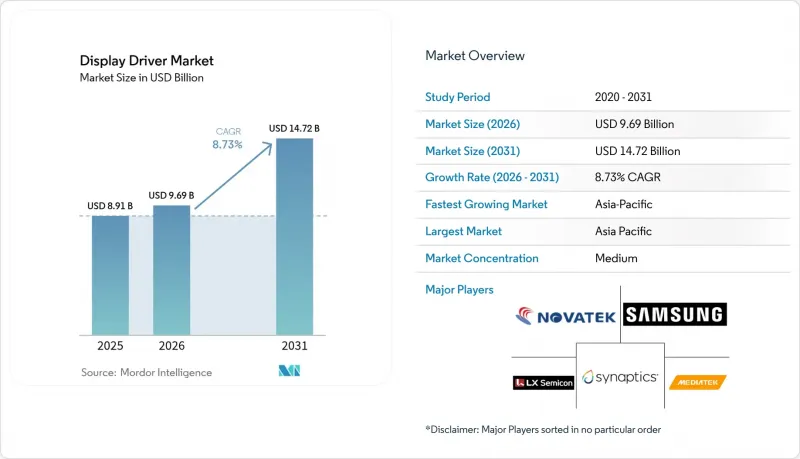
Mordor Intelligence에 의하면, 2026년 디스플레이 드라이버 시장 규모는 96억 9,000만 달러로 추정되고, 2025년 89억 1,000만 달러에서 확대해, 2031년에는 147억 2,000만 달러에 이를 것으로 예측됩니다.
2026-2031년 연평균 성장률(CAGR) 8.73%로 성장할 것으로 전망됩니다.
본 보고서는 폼 팩터별(대면적 DDIC, 중소면적 DDIC, 플렉서블/접이식 DDIC), 디스플레이 기술별(LCD, OLED, MicroLED, E-Paper), 용도별(TV, 스마트폰, 태블릿, 노트북, 차량용 디스플레이 등), 최종 이용 산업별(소비자 가전, 자동차, 산업용 등) 및 지역별로 분류되어 있습니다. 시장 전망은 금액(달러) 기준으로 제시되어 있습니다.
세계의 디스플레이 드라이버 시장 동향 및 인사이트
북미 및 아시아태평양의 플래그십 스마트폰에서 OLED 채택이 급속히 확대되고 있음
OLED는 2024년 스마트폰 출하 대수 점유율에서 LCD를 추월했으며, 각 브랜드가 120Hz 적응형 주사율 및 언더패널 카메라를 표준화해 감에 따라 여전히 점유율을 확대되고 있습니다. 2026년 출시 예정인 삼성디스플레이의 두께 0.6mm 패널은 전력 소비를 30% 줄이는 한편, 깜빡임 없이 1Hz에서 120Hz까지 주파수를 조절할 수 있는 드라이버가 필요합니다. 2026년 출시 예정인 애플 최초의 폴더블 아이폰은 프리미엄 플렉서블 디스플레이의 가치를 한층 더 입증할 뿐만 아니라, 트레이스 배선을 강화해 굽힘에 강한 드라이버 IC에 대한 수요를 뒷받침할 것입니다. 애플 워치 모델을 시작으로 양산 출하가 시작된 LTPO 백플레인은 5-15%의 전력 절약 효과로 인해 스마트폰의 표준 사양으로 자리 잡고 있으며, 2029년까지 누적 출하 대수에서 LTPS를 넘어설 것으로 전망됩니다. OEM 업체들이 더욱 복잡한 게이트 보정 및 터치 기능 통합을 필요로 하는 가운데, 이러한 변화들이 맞물려 디스플레이 드라이버 시장에 안정적인 호재를 가져오고 있습니다.
디지털 콕핏용 자동차 디스플레이의 채택 급증으로 유럽 내 멀티채널 드라이버 IC 수요 견인
유럽의 자동차 제조업체들은 아날로그 계기판에서 계기판, 인포테인먼트, 승객용 스크린을 단일 SoC 파이프라인 위에 통합한 소프트웨어 정의 콕핏 영역으로의 전환을 가속화하고 있습니다. 2024년에는 프리미엄 모델의 차량당 평균 패널 수가 4.3장으로 증가했으며, 멀티채널 드라이버 IC의 탑재율도 비슷한 추세를 보였습니다. Himax는 누적 7,000만 대를 출하한 후, 자동차용 TDDI 매출이 기존 DDIC 매출을 넘어선 첫 분기를 기록했습니다. 마이크로칩이 2025년에 커넥티비티 전문 기업인 VSI를 인수함에 따라, 차량용 네트워크 대역폭이 DisplayPort 2.1의 80Gbps로 확대되었으며, 이는 비압축 8K 대시보드의 필수 조건이 됩니다. 이러한 움직임에 따라 디스플레이 드라이버 시장은 ADAS 및 콕핏의 성장과 밀접하게 연계된 상태를 유지하고 있습니다.
40nm 이하 파운드리 생산 능력의 만성적인 부족이 DDIC 공급을 제한하고 있습니다.
드라이버 IC를 제조하는 팹에서는 AI 가속기 제조도 이루어지고 있습니다. TSMC는 2025년 2분기 매출을 314억 2,000만 달러로 예측하고 있으며, 이는 주로 5nm 및 7nm 웨이퍼의 대부분을 확보하고 있는 고성능 컴퓨팅 분야의 고객들에 의해 주도되고 있습니다. 28nm 및 40nm와 같은 성숙한 공정 노드에서는 소비자용 SoC와 수요 경쟁에 직면해 있어, 디스플레이 드라이버 수주는 할당제로 운영되고 있습니다. 2030년까지 6만 7,000명에 달할 것으로 예상되는 미국의 엔지니어 부족은 신규 공장(그린필드)의 생산 능력 확장을 더욱 지연시킬 가능성이 있습니다.
부문 분석
2025년에는 중소 면적 IC가 매출의 대부분을 차지했으며, 디스플레이 드라이버 시장 점유율의 56.65%를 차지했습니다. 이러한 부품은 스마트폰, 태블릿, 그리고 낮은 누설 전류와 컴팩트한 다이 크기가 중요한 다양한 IoT 디스플레이에 채택되고 있습니다. 평균 단가는 0.90달러 미만으로 머물러 있지만, 판매량이 낮은 마진을 상쇄하고 있어 이 부문은 디스플레이 드라이버 시장의 기반을 형성하고 있습니다. 각 휴대폰 제조업체들이 120Hz 가변 주사율로 전환함에 따라 수요는 견조한 추세를 보이고 있으며, 평균 판매 가격(ASP)도 소폭 상승하고 있습니다.
플렉서블/접이식 드라이버 IC는 현재 출하량이 훨씬 적음에도 불구하고 연평균 성장률(CAGR) 11.45%라는 가장 빠른 성장률을 보이고 있습니다. 삼성의 ‘Z 시리즈’는 2024년 2분기에 925만 장의 출하를 달성하며, 폴더블 단말기의 주류화를 뒷받침하는 동시에 경쟁 브랜드들에게도 추격을 촉구하고 있습니다. 화웨이도 같은 기간 동안 폴더블 단말기 출하 대수를 거의 두 배로 늘리며, 구매층이 확대되고 있음을 시사하고 있습니다. 이 카테고리의 드라이버 IC는 반경 2mm 미만의 반복적인 굽힘을 견디고, 접힘 현상을 완화하기 위한 보정 알고리즘을 내장하며, 기판 면적을 절약하기 위해 터치 기능을 통합해야 합니다. LG이노텍의 2메탈 COF 기판은 양면 배선을 가능하게 하여 베젤을 더욱 축소합니다. 2026년에 예상되는 애플 시장 진입은 수요를 뒷받침하는 요인이며, 거의 모든 팹리스 기업의 로드맵이 이미 이를 목표로 삼고 있습니다.
LCD는 확립된 제조 규모 덕분에 2025년 디스플레이 드라이버 시장에서 매출 점유율 62.70%를 유지했지만, 가치 동향은 변화하고 있습니다. 미니 LED 백라이트의 채택으로 타이밍 컨트롤러에 훨씬 더 많은 채널 수가 요구되며, 프리미엄 TV에서 패널 1대당 부가가치는 2배로 증가했습니다. 한편, 태블릿과 노트북에서는 OLED 채택이 진행되고 있으며, 태블릿의 보급률은 2028년까지 5.7%에서 18%로 확대될 전망으로, 이는 저전력 드라이버에 큰 호재가 될 것입니다.
그러나 마이크로 LED는 2031년까지 연평균 성장률(CAGR)이 12.25%로 두드러집니다. 직접 발광형 패널은 프로토타입 마이크로 디스플레이에서 20,000니트의 최대 휘도를 달성하여 OLED를 능가할 뿐만 아니라 수명에 대한 우려도 해소하고 있습니다. 애플라이드 머티리얼즈의 양자점 기반 색상 변환 기술은 비용 측면의 장벽을 낮추고 수율의 균일성을 높이고 있습니다. 드라이버 IC는 현재 5µm 미만의 픽셀 피치를 지원하며, 다이오드 수준의 전류 매칭을 실현해야 합니다. 이러한 사양은 아날로그 회로 노하우를 보유한 기업에게 유리한 조건이 됩니다. 전자 종이는 여전히 틈새 시장이지만, 진열대 가격표나 리더기용 저주파 게이트 드라이버에 대한 안정적인 수요를 유지하고 있습니다.
지역별 분석
2025년, 중국은 디스플레이 드라이버 시장 매출의 44.25%를 차지하며 1위를 차지했습니다. 정부의 대규모 지원책과 지속적인 패널 투자로 인해 중국은 드라이버 IC의 최대 구매국일 뿐만 아니라, 향후 가장 유력한 공급국이 될 것입니다. 국내 팹은 55nm 공정에서 실용적인 28nm 노드로 진화하고 있으며, 현지 고객에게 대만 파운드리 대신 선택할 수 있는 대안을 제공함으로써 조달 지도를 재구성하고 있습니다. TCL의 잉크젯 인쇄 방식을 활용한 OLED 파일럿 라인은 이러한 자립화 움직임을 뒷받침하고 있습니다. 패널의 자급자족은 현지 정책과 드라이버 수요 사이에 밀접한 상관관계를 가져오고 있습니다.
한국은 가장 빠른 성장세를 기록하고 있으며, 2031년까지 연평균 성장률(CAGR)은 9.85%로 예측됩니다. 삼성과 LG디스플레이는 OLED 증착 기술과 층의 균일성 측면에서 그 선두 위치를 더욱 공고히 하고 있습니다. 정부가 지원하는 4,710억 달러 규모의 반도체 회랑 계획에는 16개의 신규 팹 가동 개시와 시스템 수준의 생산 능력을 2배 이상 확대하는 내용이 포함되어 있습니다. 이 웨이퍼 재고의 대부분은 22nm 및 그보다 미세한 공정으로 제조되는 디스플레이 드라이버용 웨이퍼에 할당될 예정입니다.
대만은 전 세계 팹리스 기업들에게 여전히 없어서는 안 될 파운드리 파트너로 남아 있습니다. TSMC만 해도 분기 매출 314억 2,000만 달러를 목표로 하고 있으며, 최첨단 생산 능력의 대부분을 AI 칩이 차지하는 상황에서도 디스플레이 드라이버의 테이프아웃을 유지하고 있습니다. 미국에서는 ‘CHIPS법’에 따른 우대 조치로 인해 제한된 양의 드라이버가 국내 생산으로 전환되고 있으며, TSMC가 로직 및 첨단 패키징 라인을 결합한 1650억 달러 규모의 애리조나주 확장 계획이 그 대표적인 사례입니다. 유럽은 자동차용 디스플레이 수요를 통해 독자적인 틈새 시장을 개척하고 있습니다. 유럽의 각 OEM 업체들은 미션 크리티컬한 ADAS 클러스터에 대해서는 현지 조달을 선호하기 때문에 규모는 작지만 전략적으로 중요한 드라이버 IC 설계 회사들이 활기를 띠고 있습니다.
기타 혜택 :
- 엑셀 형식 시장 예측(ME) 시트
- 3개월간의 애널리스트 지원
자주 묻는 질문
목차
제1장 서론
제2장 조사 방법
제3장 주요 요약
제4장 시장 구도
제5장 시장 규모 및 성장 예측
제6장 경쟁 구도
제7장 시장 기회 및 향후 전망
AJYAccording to Mordor Intelligence, the display driver market size in 2026 is estimated at USD 9.69 billion, growing from 2025 value of USD 8.91 billion with 2031 projections showing USD 14.72 billion, growing at 8.73% CAGR over 2026-2031.
This report is Segmented by Form Factor (Large-Area DDIC, Small and Medium-Area DDIC, and Flexible/Foldable DDIC), Display Technology (LCD, OLED, Microled, and E-Paper), Application (Television, Smartphone, Tablet, Notebook PC, Automotive Displays, and More), End-Use Industry (Consumer Electronics, Automotive, Industrial, and More), and Geography. The Market Forecasts are Provided in Terms of Value (USD).
Global Display Driver Market Trends and Insights
Exponential OLED adoption in flagship smartphones across North America and Asia-Pacific
OLED overtook LCD in smartphone unit share during 2024 and is still gaining ground as brands standardize on 120 Hz adaptive refresh and under-panel cameras. Samsung Display's 0.6 mm-thin panels scheduled for 2026 will cut power draw by 30% and require drivers able to throttle from 1 Hz to 120 Hz without flicker. Apple's first foldable iPhone, slated for 2026, further validates the premium flexible format and boosts demand for bend-tolerant driver ICs with reinforced trace routing. LTPO backplanes, which ship in volume starting with Apple Watch models, are becoming a smartphone default thanks to their 5-15% power savings and will surpass LTPS in cumulative units before 2029. Together these shifts add steady tailwinds to the display driver market as OEMs need more complex gate compensation and touch integration.
Surge in automotive display adoption for digital cockpits fueling multi-channel driver IC demand in Europe
European vehicle makers are accelerating the transition from analog gauges to software-defined cockpit domains that blend instrument, infotainment, and passenger screens on a single SoC pipeline. Average panel count per vehicle climbed to 4.3 in premium models during 2024, and multi-channel driver IC attach rates followed the same arc. Himax recorded its first quarter in which automotive TDDI revenue surpassed classic DDIC income after shipping 70 million units cumulatively. Microchip's 2025 acquisition of connectivity specialist VSI expands in-vehicle networking bandwidth to DisplayPort 2.1's 80 Gbps, a prerequisite for uncompressed 8K dashboards. These moves keep the display driver market firmly tethered to ADAS and cockpit growth.
Chronic foundry capacity tightness below 40 nm limiting DDIC supply
The same fabs that print driver ICs also run AI accelerators. TSMC projects USD 31.42 billion in Q2 2025 revenue, fueled mainly by high-performance compute customers that lock in the bulk of 5 nm and 7 nm wafers. Mature nodes at 28 nm and 40 nm face competing demand from consumer SOCs, leaving display driver orders on allocation. The engineer shortage in the United States, pegged at 67,000 by 2030, may further delay greenfield capacity ramps.
Other drivers and restraints analyzed in the detailed report include:
- Rapid proliferation of large-area 8K LCD TV panels in China elevating driver IC ASPs
- Migration toward LTPO backplane and integrated touch drivers in wearables boosting high-margin SDDI sales
- Intensifying panel-maker vertical integration curtailing third-party driver IC TAM
For complete list of drivers and restraints, kindly check the Table Of Contents.
Segment Analysis
Small- and medium-area ICs dominated sales, holding 56.65% of display driver market share in 2025. These parts serve smartphones, tablets, and a broad range of IoT screens that prize low leakage and compact die sizes. Average unit price remains under USD 0.90, yet volume offsets the thin margins, making the segment a foundation of the display driver market. Demand stays resilient as handset OEMs migrate to 120 Hz variable refresh, prompting a subtle uplift in ASP.
Flexible / foldable driver ICs generate far lower unit volume today but post the fastest expansion at an 11.45% CAGR. Samsung's Z series hit 9.25 million panels shipped in Q2 2024, validating mainstream foldables and pushing competing brands to follow. Huawei nearly doubled its foldable shipments within the same window, signaling a widened field of buyers. Drivers in this category must tolerate repetitive bending at radii below 2 mm, pack in compensation algorithms for crease mitigation, and integrate touch to save board area. LG Innotek's two-metal COF substrate offers dual-side routing, shrinking bezels even further. Apple's anticipated 2026 entrance is a demand kicker that nearly every fabless roadmap is already targeting.
LCD retained 62.70% revenue share of the display driver market in 2025 thanks to entrenched manufacturing scale, but the value story is shifting. Mini LED backlights force far higher channel counts into timing controllers, doubling the attachment value per panel in premium TVs. Meanwhile OLED adoption grows in tablets and laptops, scaling from 5.7% to 18% penetration in tablets by 2028, a windfall for power-efficient drivers.
MicroLED, however, stands out with a 12.25% CAGR to 2031. Direct-emission panels achieve peak brightness of 20,000 nits in prototype microdisplays, surpassing OLED while cutting lifetime concerns. Applied Materials' quantum-dot color-conversion technique lowers cost hurdles and raises yield uniformity. Driver ICs must now handle sub-5 µm pixel pitches and deliver diode-level current matching, a spec set that favors firms with analog circuit heritage. E-paper remains niche, but it preserves a steady stream of low-frequency gate drivers for shelf labels and readers.
Complete Report Scope:
- By Form Factor
- Large-Area DDIC
- Small and Medium-Area DDIC
- Flexible/Foldable DDIC
- By Display Technology
- LCD
- OLED
- MicroLED
- E-Paper
- By Application
- Television
- Smartphone
- Tablet
- Notebook PC
- Desktop Monitor
- Automotive Displays
- Wearables
- Industrial and HMI
- AR/VR Headsets
- By End-use Industry
- Consumer Electronics
- Automotive
- Industrial
- Healthcare
- Aerospace and Defense
- By Geography
- China
- Taiwan
- South Korea
- Americas
- Rest of the World
Geography Analysis
China sat atop the leaderboard with 44.25% of display driver market revenue in 2025. Massive government incentives and on-going panel investments make the nation both the largest buyer and the most formidable future supplier of driver ICs. Domestic fabs advance from 55 nm riverbeds to viable 28 nm nodes, giving local customers an alternative to Taiwan foundries and thus reshaping the procurement map. TCL's inkjet-printed OLED pilot lines strengthen this self-reliance push. Panel self-sufficiency translates into a tight correlation between local policy and driver demand.
South Korea records the fastest growth, posting a projected 9.85% CAGR through 2031. Samsung and LG Display extend their lead in OLED evaporation know-how and layer uniformity. The government-backed USD 471 billion semiconductor corridor plans to bring sixteen new fabs online and more than double system-level capacity. A high share of that wafer inventory will roll into display driver wafers printed at 22 nm and finer.
Taiwan remains the indispensable foundry partner for global fabless players. TSMC alone aims for USD 31.42 billion in quarterly revenue, keeping display driver tape-outs alive even as AI chips claim the lion's share of leading-edge capacity. In the Americas, CHIPS Act incentives pull limited driver volumes onshore, illustrated by TSMC's USD 165 billion Arizona build-out that pairs logic with advanced packaging lines. Europe carves its niche through automotive display demand: continental OEMs prefer local supply for mission-critical ADAS clusters, spurring small but strategic driver IC design houses.
List of Companies Covered in this Report:
- Novatek Microelectronics Corp.
- Synaptics Incorporated
- Samsung Electronics Co., Ltd. (System LSI)
- Silicon Works Co., Ltd.
- MediaTek Inc.
- LX Semicon Co., Ltd.
- Magnachip Semiconductor Corp.
- Fitipower Integrated Technology Inc.
- Raydium Semiconductor Corp.
- Sitronix Technology Corp.
- Himax Technologies, Inc.
- FocalTech Systems Co., Ltd.
- Parade Technologies, Ltd.
- Solomon Systech Ltd.
- Pixelworks, Inc.
- Alpha and Omega Semiconductor Ltd.
- Chipone Technology (Beijing) Co., Ltd.
- Rockchip Electronics Co., Ltd.
- Ilitek (I-LITEK) Corp.
- Silan Microelectronics Co., Ltd.
- Apple Inc. (Internal Display Driver Group)
- BOE Varitronix Ltd.
- Shenzhen Goodix Technology Co., Ltd.
- Arm Technology (Display HW IP)
- Texas Instruments Incorporated
Additional Benefits:
- The market estimate (ME) sheet in Excel format
- 3 months of analyst support
TABLE OF CONTENTS
1 INTRODUCTION
- 1.1 Study Assumptions and Market Definition
- 1.2 Scope of the Study
2 RESEARCH METHODOLOGY
3 EXECUTIVE SUMMARY
4 MARKET LANDSCAPE
- 4.1 Market Overview
- 4.2 Market Drivers
- 4.2.1 Exponential Adoption of OLED and AMOLED Panels in Flagship Smartphones across North America and Asia-Pacific
- 4.2.2 Surge in Automotive Display Adoption for Digital Cockpits Fueling Multi-Channel DDIC Demand in Europe
- 4.2.3 Rapid Proliferation of Large-Area 8K LCD TV Panels in China Elevating Driver IC ASPs
- 4.2.4 Migration Toward LTPO Backplane and Integrated Touch Drivers in Wearables Boosting High-Margin SDDI Sales
- 4.2.5 Government-Backed Semiconductor Self-Sufficiency Programs in Taiwan and South Korea Bolstering Local Foundry capacity
- 4.2.6 Accelerated Shift toLess than 28 nm Process Nodes for Power-Efficient OLED Drivers in EV Infotainment Displays
- 4.3 Market Restraints
- 4.3.1 Chronic Foundry capacity TightnessLess than 40 nm Limiting DDIC Supply Fulfilment
- 4.3.2 High Royalty Costs of ESD and T-Con IP Stifling Entry of Fab-Lite Competitors
- 4.3.3 Yield Challenges in COF Packaging for Ultra-Thin Bezel Displays Inflating BOM for Notebook ODMs
- 4.3.4 Intensifying Panel-Maker Vertical Integration Curtailing Third-Party Driver IC TAM
- 4.4 Industry Value Chain Analysis
- 4.5 Regulatory or Technological Outlook
- 4.6 Porter's Five Forces Analysis
- 4.6.1 Threat of New Entrants
- 4.6.2 Bargaining Power of Suppliers
- 4.6.3 Bargaining Power of Buyers
- 4.6.4 Threat of Substitute Products
- 4.6.5 Intensity of Competitive Rivalry
- 4.7 Technological Roadmap and Advances
- 4.8 Investment Analysis
5 MARKET SIZE AND GROWTH FORECASTS (VALUES)
- 5.1 By Form Factor
- 5.1.1 Large-Area DDIC
- 5.1.2 Small and Medium-Area DDIC
- 5.1.3 Flexible/Foldable DDIC
- 5.2 By Display Technology
- 5.2.1 LCD
- 5.2.2 OLED
- 5.2.3 MicroLED
- 5.2.4 E-Paper
- 5.3 By Application
- 5.3.1 Television
- 5.3.2 Smartphone
- 5.3.3 Tablet
- 5.3.4 Notebook PC
- 5.3.5 Desktop Monitor
- 5.3.6 Automotive Displays
- 5.3.7 Wearables
- 5.3.8 Industrial and HMI
- 5.3.9 AR/VR Headsets
- 5.4 By End-use Industry
- 5.4.1 Consumer Electronics
- 5.4.2 Automotive
- 5.4.3 Industrial
- 5.4.4 Healthcare
- 5.4.5 Aerospace and Defense
- 5.5 By Geography
- 5.5.1 China
- 5.5.2 Taiwan
- 5.5.3 South Korea
- 5.5.4 Americas
- 5.5.5 Rest of the World
6 COMPETITIVE LANDSCAPE
- 6.1 Market Concentration
- 6.2 Strategic Moves
- 6.3 Market Share Analysis
- 6.4 Company Profiles (includes Global level Overview, Market level overview, Core Segments, Financials as available, Strategic Information, Market Rank/Share for key companies, Products and Services, and Recent Developments)
- 6.4.1 Novatek Microelectronics Corp.
- 6.4.2 Synaptics Incorporated
- 6.4.3 Samsung Electronics Co., Ltd. (System LSI)
- 6.4.4 Silicon Works Co., Ltd.
- 6.4.5 MediaTek Inc.
- 6.4.6 LX Semicon Co., Ltd.
- 6.4.7 Magnachip Semiconductor Corp.
- 6.4.8 Fitipower Integrated Technology Inc.
- 6.4.9 Raydium Semiconductor Corp.
- 6.4.10 Sitronix Technology Corp.
- 6.4.11 Himax Technologies, Inc.
- 6.4.12 FocalTech Systems Co., Ltd.
- 6.4.13 Parade Technologies, Ltd.
- 6.4.14 Solomon Systech Ltd.
- 6.4.15 Pixelworks, Inc.
- 6.4.16 Alpha and Omega Semiconductor Ltd.
- 6.4.17 Chipone Technology (Beijing) Co., Ltd.
- 6.4.18 Rockchip Electronics Co., Ltd.
- 6.4.19 Ilitek (I-LITEK) Corp.
- 6.4.20 Silan Microelectronics Co., Ltd.
- 6.4.21 Apple Inc. (Internal Display Driver Group)
- 6.4.22 BOE Varitronix Ltd.
- 6.4.23 Shenzhen Goodix Technology Co., Ltd.
- 6.4.24 Arm Technology (Display HW IP)
- 6.4.25 Texas Instruments Incorporated
7 MARKET OPPORTUNITIES AND FUTURE OUTLOOK
- 7.1 White-Space and Unmet-Need Assessment