

|
시장보고서
상품코드
2124101
전도성 코팅 시장 : 시장 점유율 분석, 업계 동향 및 통계, 성장 예측(2026-2031년)Electrically Conductive Coating - Market Share Analysis, Industry Trends & Statistics, Growth Forecasts (2026 - 2031) |
||||||
 Mordor Intelligence
에 의하면, 전도성 코팅 시장 규모는 2025년 246억 7,000만 달러로 평가되었고, 2026년에는 260억 1,000만 달러로 추정되고, 2031년까지 344억 9,000만 달러에 이를 것으로 예측되며, 2026-2031년 CAGR 5.81%로 성장할 전망입니다.
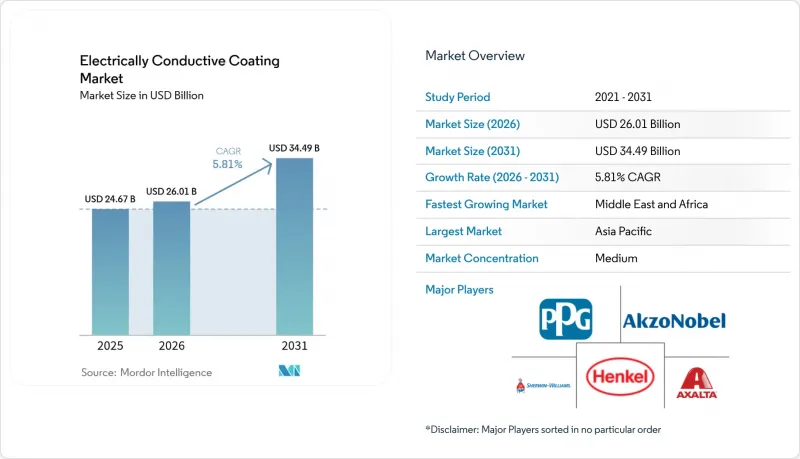
본 보고서는 유형별(아크릴계, 에폭시계, 폴리에스터계 등), 전도성 충전재별(구리, 알루미늄 등), 용도별(전자 및 전기, 자동차, 항공우주 및 방위, 기타 용도), 지역별(아시아태평양, 북미, 유럽, 남미, 중동 및 아프리카)로 분류되어 있습니다. 시장 예측은 금액(달러) 기준으로 제시되어 있습니다.
세계의 전도성 코팅 시장 동향 및 인사이트
정전기 방지 용도 증가
게이트 산화막이 3nm로 좁아짐에 따라, 반도체 팹에서는 정전기 방전(ESD) 허용 임계값이 10V 미만으로 강화되고 있으며, 이에 따라 모든 신규 클린룸 건설에서 전도성 바닥 및 작업대용 코팅의 도입이 추진되고 있습니다. 2025년에는 대만과 한국의 클린룸 증설이 22% 증가할 것으로 예상되며, 1제곱미터당 0.1초 이내에 전하를 소산시키는 속경화형 아크릴 코팅으로 마감될 것입니다. 극자외선(EUV) 리소그래피의 경우, 단 한 번의 정전기 방전(ESD)만으로도 15만 달러 상당의 레티클이 파손될 가능성이 있어 위험이 더욱 커지고 있습니다. 그 결과, 팹에서는 현재 표면 저항률이 105-109Ω/제곱인 것으로 지정되어 있습니다. 말레이시아와 베트남의 중소규모 수탁 제조업체들은 휘발성 유기 화합물(VOC) 관련 규정 위반을 초래하지 않으면서 ISO 14644의 입자 농도 기준을 충족하기 위해 수성 화학 약품을 채택하고 있으며, 이러한 추세로 인해 2028년까지 연평균 한 자릿수 중반의 생산량 성장이 예상됩니다. 이러한 요인들이 복합적으로 작용하여, 정전기 방지 코팅은 단순한 선택적 업그레이드가 아닌 필수 요건으로 자리 잡고 있습니다.
전기 및 전자 산업 수요 증가
인쇄 회로 기판(PCB)의 세계 생산량은 2025년에 8억 2,000만 m²를 넘어선 것으로 평가되었으며, 그 면적의 약 35%에 전도성 코팅이 적용되어 고속 배선을 접지하고 있습니다. 현재 주력 스마트폰은 18층 이상을 통합하고 있으며, 각 층에는 비아 충진 및 전자기 간섭(EMI) 억제를 위한 선택적 코팅이 필요합니다. 5G 지원 단말기에서는 안테나 수가 두 배로 증가함에 따라, 곡면 솔더 접합부 전체에서 전도성을 유지하는 콘포멀 코팅이 필수화되어 중국, 한국, 일본 수요를 끌어올렸습니다. 디스플레이 제조업체들은 OLED 스택에 터치 센서를 통합하고 있으며, 굽힘에 강한 은 나노와이어 분산액으로 취성이 있는 인듐 주석 산화물(ITO)을 대체하고 있습니다. 이러한 구조적 변화로 인해 2029년까지 코팅 수요가 연간 1억 2,000만 m² 증가할 것으로 예측됩니다.
중금속 충전제의 독성 및 환경적 우려
RoHS 지침은 전자 기기의 카드뮴 함량을 100 ppm, 납 함량을 1,000 ppm으로 제한하고 있어, 과거 내식성 확보를 위해 산화 카드뮴에 의존하던 기존 코팅의 배합 변경이 불가피하게 되었습니다. 규정 준수 시험에는 SKU당 약 5만 달러의 비용이 소요되며, 항공우주 및 자동차용 프로그램의 경우 인증에 소요되는 기간이 2배로 늘어날 가능성이 있습니다. 나노실버에 관한 REACH 신청 서류에는 현재 수생 독성 데이터의 제출이 의무화되어 있습니다. 이는 큰물벼룩(Daphnia magna)에 대한 LC50 값이 10µg/L 미만으로 나타나 위험성 분류 및 더 엄격한 운송 규제가 적용되었기 때문입니다. 중국의 중금속 제한에 관한 초안은 2027년까지 아시아태평양(APAC)에서도 유사한 규제가 도입될 것임을 시사합니다. 그래핀이나 탄소나노튜브를 대체 재료로 사용할 수 있지만, 그 제조 비용이 은 플레이크보다 30-40% 비싸기 때문에 광범위한 채택에 걸림돌이 되고 있습니다.
부문 분석
아크릴 계열은 UV 경화 속도가 빠르고 롤-투-롤 방식의 PCB 라인과 호환성이 있어, 2025년 전도성 코팅 시장에서 34.28%의 점유율을 유지했습니다. 한편, 폴리우레탄은 연평균 성장률(CAGR) 6.22%를 나타낼 것으로 예측되며, 전기차(EV)용 배터리 팩, 자동차 내장재, 헬스케어용 웨어러블 기기에서 균열 없이 10만 회의 굽힘 주기를 견딜 수 있는 코팅이 요구되고 있어, 전도성 코팅 시장 전체의 성장률을 상회할 전망입니다. 에폭시 수지는 150℃ 이상의 고온에 노출되는 항공 전자 기기용으로 여전히 선택되고 있는 반면, 폴리에스터 수지는 궁극적인 전도성보다는 내후성이 중시되는 실외 통신 기기 분야에서 수요가 있습니다.
폴리우레탄의 채택은 -40°C에서 85°C 사이에서 온도가 변동하는 배터리 관리 시스템 분야에서 가속화되고 있습니다. 이러한 조건 하에서는 아크릴계 코팅이 500사이클 이내에 박리되어 버립니다. 자동차 제조업체들은 현재 실온 경화형 2액형 우레탄을 지정하고 있으며, 이를 통해 오븐의 에너지 비용을 절감하고 타크트 타임을 단축하고 있습니다. 이에 반해, 아크릴 수지 공급업체들은 아크릴 골격에 폴리우레탄 올리고머를 그래프트시킨 하이브리드 화학 구조의 수지로 대응하고 있지만, 이러한 블렌드 수지에서는 과거 아크릴 수지에 처리 능력의 우위를 가져다주었던 ‘30초 만에 택 프리(tack-free)가 된다’는 특성을 희생하고 있습니다.
지역별 분석
2025년, 아시아태평양은 전 세계 매출의 48.37%를 차지했습니다. 이는 선전, 쑤저우, 페낭의 수직 통합형 클러스터에 힘입은 결과로, 이 지역에서는 코팅 배합 업체, PCB 제조업체, 최종 조립 업체가 당일 배송이 가능한 트럭 운송 경로 내에서 사업을 전개하고 있습니다. 중국 단독으로 2025년에 900만 대의 전기차가 생산되었으며, 5G의 적극적인 확산을 배경으로 18만 톤의 전도성 코팅이 소비되었습니다. 인도의 ‘생산 연계형 인센티브(PLI)’ 제도에 따라 국내 전자기기 생산량이 28% 증가했고, 현지 생산 능력이 1만 2,000톤에서 1만 8,000톤으로 확대됨에 따라 코팅 수입도 증가했습니다. 일본과 한국은 생체 적합성 및 내열성 에폭시 수지와 같은 고부가가치 틈새 시장을 독점하고 있으며, 20-30%의 가격 프리미엄을 확보하고 있습니다. 동남아시아 국가들은 중국에서 이전해 오는 조립 업무를 확보하고 있지만, 수지 및 충전재 생태계가 미비하여 여전히 수입에 의존하는 상태가 지속되고 있습니다.
북미의 전도성 코팅 수요는 자동차, 항공우주, 데이터센터의 하드웨어에 집중되어 있습니다. 미국의 ‘인플레이션 감축법(Inflation Reduction Act)’은 배터리 공장 인근에서 제조되는 코팅을 장려하고 있으며, 미시간주와 조지아주에서는 2027년까지 연간 총 2만 5,000톤의 생산 능력을 갖춘 3개 시설이 가동을 시작할 예정입니다. 캐나다는 퀘벡주에서 제조되는 항공 전자 기기용 특수 에폭시 수요의 거점이 되고 있는 반면, 멕시코에서는 니어쇼어링 붐에 힘입어 와이어 하네스 및 의료기기 조립 제조업체가 확대되면서 전자 기기 생산이 16% 증가했으나, 여전히 수입 도료에 의존하고 있습니다.
유럽은 2025년에 큰 시장 점유율을 확보했으며, 독일, 프랑스, 영국이 자동차 및 산업 분야 수요를 주도하고 있습니다. 엄격한 RoHS 및 REACH 규제로 인해 구리 및 그래핀으로의 전환이 가속화되고 있는 반면, 규정 준수 비용의 상승으로 인해 중소 공급업체들이 시장에서 철수할 수밖에 없는 상황입니다. EU의 배터리 규정에 따르면 2kWh를 초과하는 구동용 배터리에 EMI 차폐가 의무화되어 있어, 이로 인해 전기차 생산 라인에서 지속적인 수요가 확보되고 있습니다. 남미, 중동 및 아프리카 3개 지역은 매출의 9%를 차지하고 있습니다. 그중에서도 중동 및 아프리카은 고밀도 랙용으로 60dB 차폐가 필요한 사우디아라비아와 UAE의 데이터센터 건설에 힘입어 연평균 성장률(CAGR) 5.98%로 가장 빠르게 성장하고 있는 지역입니다. 브라질의 플렉스 연료 차량 시장에서는 2025년에 약 4,500톤의 코팅재가 소비되었으나, 아르헨티나 시장은 관세 및 환율 변동의 영향으로 성장이 주춤했습니다.
기타 혜택 :
- 엑셀 형식 시장 예측(ME) 시트
- 3개월간의 애널리스트 지원
자주 묻는 질문
목차
제1장 서론
제2장 조사 방법
제3장 주요 요약
제4장 시장 구도
제5장 시장 규모 및 성장 예측
제6장 경쟁 구도
제7장 시장 기회 및 향후 전망
AJY 26.09.11According to Mordor Intelligence, the electrically conductive coating market size is projected to grow from USD 24.67 billion in 2025 to USD 26.01 billion in 2026, and reach USD 34.49 billion by 2031, growing at a CAGR of 5.81% from 2026 to 2031.
This report is Segmented by Type (Acrylics, Epoxy, Polyesters, and More), Conductive Filler Material (Copper, Aluminum, and More), Application (Electronics and Electrical, Automotive, Aerospace and Defense, Other Applications), and Geography (Asia-Pacific, North America, Europe, South America, and Middle East and Africa). Market Forecasts are Provided in Terms of Value (USD).
Global Electrically Conductive Coating Market Trends and Insights
Rising Applications for Anti-Static Protection
Semiconductor fabs are tightening electrostatic-discharge thresholds below 10 V as gate oxides narrow toward 3 nm, pushing conductive floor and workbench coatings into all new cleanroom builds. Cleanroom additions in Taiwan and South Korea climbed 22% in 2025, with each square meter finished in fast-curing acrylic layers that dissipate charge within 0.1 seconds. Extreme-ultraviolet lithography magnifies risk because a single ESD event can destroy a USD 150,000 reticle; consequently, fabs now specify surface resistivity between 105 and 109 Ω/square. Smaller contract manufacturers in Malaysia and Vietnam are adopting water-based chemistries to meet ISO 14644 particulate limits without volatile-organic-compound penalties, a trajectory that supports mid-single-digit volume growth through 2028. Collectively, these forces are anchoring anti-static coatings as a baseline requirement rather than an optional upgrade.
Growing Demand from Electrical and Electronics Industry
Printed-circuit boards (PCBs) surpassed 820 million m2 of global output in 2025, with conductive coatings applied to roughly 35% of that area to ground high-speed traces. Flagship smartphones now integrate more than 18 layers, and each layer needs selective coatings for via fill and EMI suppression. As 5G handsets doubled antenna counts, conformal coatings that maintain conductivity across curved solder joints became mandatory, lifting demand in China, South Korea, and Japan. Display makers are embedding touch sensors into OLED stacks, displacing brittle indium tin oxide with silver-nanowire dispersions that better tolerate flexing. This architecture shift should add an incremental 120 million m2 of coating demand annually by 2029.
Toxicity and Environmental Concerns of Heavy-Metal Fillers
RoHS caps cadmium at 100 ppm and lead at 1,000 ppm in electronics, forcing reformulation of legacy coatings that once relied on cadmium oxide for corrosion resistance. Compliance testing adds about USD 50,000 per SKU and can double the qualification timetable for aerospace or automotive programs. REACH dossiers for nano-silver now require aquatic-toxicity data, as LC50 values below 10 µg/L for Daphnia magna triggered hazard classification and stricter transport rules. China's draft heavy-metal limits signal that similar rules will land in APAC by 2027. Although graphene and carbon nanotubes can substitute, their production costs run 30-40% above silver flakes, slowing broad adoption.
Other drivers and restraints analyzed in the detailed report include:
- Surge in Adoption of EMI/RFI Shielding in 5G Infrastructure
- Rapid Miniaturization in Wearable Electronics
- Volatility in Silver and Copper Prices
For complete list of drivers and restraints, kindly check the Table Of Contents.
Segment Analysis
Acrylics retained 34.28% share of the electrically conductive coating market in 2025, owing to fast UV curing and compatibility with roll-to-roll PCB lines. Polyurethanes, however, are projected to grow at a 6.22% CAGR, outpacing the overall electronically conductive coating market size growth because EV battery packs, automotive interiors, and health-wearables need coatings that endure 100,000 flex cycles without cracking. Epoxies remain the choice for high-heat avionics that see >=150 °C, while polyesters fill outdoor telecom niches where weatherability matters more than ultimate conductivity.
Polyurethane adoption is accelerating in battery-management systems that swing from -40 °C to 85 °C, conditions that delaminate acrylics within 500 cycles. Automakers now specify room-temperature-curing two-component urethanes, trimming oven energy costs and cutting takt time. Acrylic vendors are responding with hybrid chemistries that graft polyurethane oligomers onto acrylic backbones, but these blends sacrifice the 30-second tack-free cure that once gave acrylics a throughput edge.
Complete Report Scope:
- By Type
- Acrylics
- Epoxy
- Polyesters
- Polyurethanes
- Other Types
- By Conductive Filler Material
- Copper
- Aluminum
- Silver
- Other Material Types
- By Application
- Electronics and Electrical
- Automotive
- Aerospace and Defense
- Other Applications
- By Geography
- Asia-Pacific
- China
- India
- Japan
- South Korea
- Malaysia
- Thailand
- Indonesia
- Vietnam
- Rest of Asia-Pacific
- North America
- United States
- Canada
- Mexico
- Europe
- Germany
- United Kingdom
- France
- Italy
- Spain
- Russia
- NORDIC Countries
- Rest of Europe
- South America
- Brazil
- Argentina
- Rest of South America
- Middle-East and Africa
- Saudi Arabia
- United Arab Emirates
- Egypt
- South Africa
- Rest of Middle-East and Africa
- Asia-Pacific
Geography Analysis
Asia-Pacific controlled 48.37% of global revenue in 2025, underpinned by vertically integrated clusters in Shenzhen, Suzhou, and Penang, where coating formulators, PCB shops, and final assemblers operate within the same-day trucking lanes. China alone consumed 180,000 tons of conductive coatings in 2025 on the back of 9 million EVs produced and aggressive 5G roll-outs. India's Production-Linked Incentive scheme lifted domestic electronics output 28%, expanding coating imports as local capacity rose from 12,000 tons to 18,000 tons. Japan and South Korea dominate high-value niches such as biocompatible and high-temperature epoxies, commanding 20-30% price premiums. Southeast Asian nations are winning assembly work relocating from China, but resin and filler ecosystems lag, keeping them import-dependent.
North American electrically conductive coatings demand is concentrated in automotive, aerospace, and data-center hardware. The U.S. Inflation Reduction Act incentivizes coatings made near battery plants; three facilities totaling 25,000 tons/year will open by 2027 in Michigan and Georgia. Canada anchors specialty epoxy demand for avionics built in Quebec, while Mexico's nearshoring boom lifted electronics production 16% as wire-harness and medical-device assemblers expanded, albeit still reliant on imported coatings.
Europe captured significant market share in 2025, with Germany, France, and the U.K. driving automotive and industrial demand. Stringent RoHS and REACH rules are accelerating the pivot to copper and graphene while hiking compliance costs that push smaller suppliers to exit. The EU Battery Regulation mandates EMI shielding on traction batteries exceeding 2 kWh, locking in a recurring volume stream from electric-vehicle lines. South America and the Middle East and Africa share 9% of revenue; the latter is the fastest-growing region at 5.98% CAGR, powered by Saudi and UAE data-center builds that demand 60 dB shielding for high-density racks. Brazil's flex-fuel vehicles absorbed around 4,500 tons of coatings in 2025, but Argentina's market dragged due to tariffs and currency volatility.
- A & A Coatings
- Akzo Nobel NV
- Ameetuff Technical Paints Industries
- Axalta Coating Systems
- BeDimensional
- CAIG
- Creative Materials Inc.
- Cromas Paints
- Gelest Inc.
- Henkel AG & Co. KGaA
- Holland Shielding Systems BV
- MG Chemicals
- Parker-Hannifin Corporation
- PPG Industries Inc.
- RS Coatings
- Specialty Coating Systems Inc.
- The Sherwin-Williams Company
Additional Benefits:
- The market estimate (ME) sheet in Excel format
- 3 months of analyst support
TABLE OF CONTENTS
1 Introduction
- 1.1 Study Assumptions and Market Definition
- 1.2 Scope of the Study
2 Research Methodology
3 Executive Summary
4 Market Landscape
- 4.1 Market Overview
- 4.2 Market Drivers
- 4.2.1 Rising applications for anti-static protection
- 4.2.2 Growing demand from electrical and electronics industry
- 4.2.3 Surge in adoption of EMI/RFI shielding in 5G infrastructure
- 4.2.4 Rapid miniaturization in wearable electronics
- 4.2.5 Conductive bio-compatible coatings for implants
- 4.3 Market Restraints
- 4.3.1 Toxicity and environmental concerns of heavy-metal fillers
- 4.3.2 Volatility in silver and copper prices
- 4.3.3 Dispersion issues of nano-fillers causing defects
- 4.4 Value Chain Analysis
- 4.5 Porter's Five Forces
- 4.5.1 Threat of New Entrants
- 4.5.2 Bargaining Power of Buyers
- 4.5.3 Bargaining Power of Suppliers
- 4.5.4 Threat of Substitute Products
- 4.5.5 Degree of Competition
5 Market Size and Growth Forecasts (Value)
- 5.1 By Type
- 5.1.1 Acrylics
- 5.1.2 Epoxy
- 5.1.3 Polyesters
- 5.1.4 Polyurethanes
- 5.1.5 Other Types
- 5.2 By Conductive Filler Material
- 5.2.1 Copper
- 5.2.2 Aluminum
- 5.2.3 Silver
- 5.2.4 Other Material Types
- 5.3 By Application
- 5.3.1 Electronics and Electrical
- 5.3.2 Automotive
- 5.3.3 Aerospace and Defense
- 5.3.4 Other Applications
- 5.4 By Geography
- 5.4.1 Asia-Pacific
- 5.4.1.1 China
- 5.4.1.2 India
- 5.4.1.3 Japan
- 5.4.1.4 South Korea
- 5.4.1.5 Malaysia
- 5.4.1.6 Thailand
- 5.4.1.7 Indonesia
- 5.4.1.8 Vietnam
- 5.4.1.9 Rest of Asia-Pacific
- 5.4.2 North America
- 5.4.2.1 United States
- 5.4.2.2 Canada
- 5.4.2.3 Mexico
- 5.4.3 Europe
- 5.4.3.1 Germany
- 5.4.3.2 United Kingdom
- 5.4.3.3 France
- 5.4.3.4 Italy
- 5.4.3.5 Spain
- 5.4.3.6 Russia
- 5.4.3.7 NORDIC Countries
- 5.4.3.8 Rest of Europe
- 5.4.4 South America
- 5.4.4.1 Brazil
- 5.4.4.2 Argentina
- 5.4.4.3 Rest of South America
- 5.4.5 Middle-East and Africa
- 5.4.5.1 Saudi Arabia
- 5.4.5.2 United Arab Emirates
- 5.4.5.3 Egypt
- 5.4.5.4 South Africa
- 5.4.5.5 Rest of Middle-East and Africa
- 5.4.1 Asia-Pacific
6 Competitive Landscape
- 6.1 Market Concentration
- 6.2 Strategic Moves
- 6.3 Market Share(%)/Ranking Analysis
- 6.4 Company Profiles (includes Global level Overview, Market level overview, Core Segments, Financials as available, Strategic Information, Products and Services, and Recent Developments)
- 6.4.1 A & A Coatings
- 6.4.2 Akzo Nobel NV
- 6.4.3 Ameetuff Technical Paints Industries
- 6.4.4 Axalta Coating Systems
- 6.4.5 BeDimensional
- 6.4.6 CAIG
- 6.4.7 Creative Materials Inc.
- 6.4.8 Cromas Paints
- 6.4.9 Gelest Inc.
- 6.4.10 Henkel AG & Co. KGaA
- 6.4.11 Holland Shielding Systems BV
- 6.4.12 MG Chemicals
- 6.4.13 Parker-Hannifin Corporation
- 6.4.14 PPG Industries Inc.
- 6.4.15 RS Coatings
- 6.4.16 Specialty Coating Systems Inc.
- 6.4.17 The Sherwin-Williams Company
7 Market Opportunities and Future Outlook
- 7.1 White-space and Unmet-Need Assessment


