

|
시장보고서
상품코드
2124104
산업 계측 시장 : 점유율 분석, 업계 동향과 통계, 성장 예측(2026-2031년)Industrial Metrology - Market Share Analysis, Industry Trends & Statistics, Growth Forecasts (2026 - 2031) |
||||||
 Mordor Intelligence
Mordor Intelligence에 의하면, 산업 계측 시장 규모는 2025년 126억 6,000만 달러, 2026년 136억 4,000만 달러에서 2031년까지 190억 7,000만 달러로 확대될 것으로 예측되고 있어 2026년부터 2031년까지 연평균 복합 성장률(CAGR)은 6.93%를 나타낼 전망입니다.
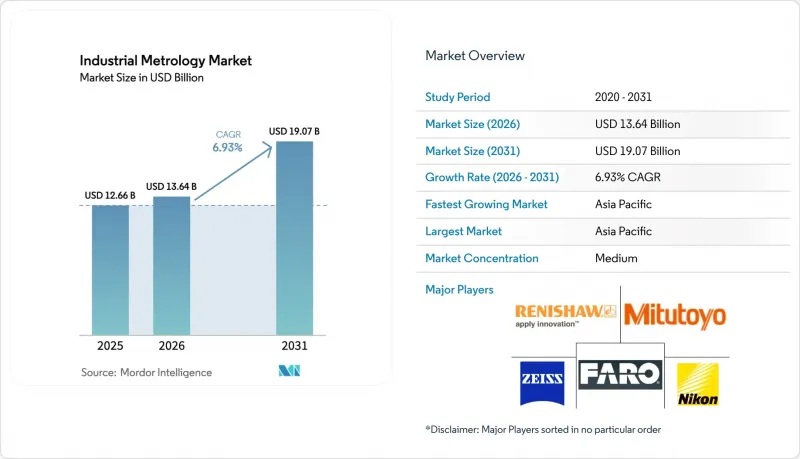
본 보고서는 제품별(하드웨어 등), 장비별(2D 계측 장비 등), 폼 팩터별(고정형 벤치탑 시스템 등),용도별(리버스 엔지니어링 등), 최종 사용자 산업별(항공우주 및 방위, 중장비·공작기계, 의료기기·헬스케어 등), 지역별로 분류되어 있습니다. 시장 예측은 금액(달러) 기준으로 제시되어 있습니다.
전 세계 산업 계측 시장 동향 및 인사이트
아시아의 인라인 계측 지출을 주도하는 전기차용 배터리 기가팩토리
배터리 셀의 공차는 1자리 마이크로미터 단위까지 좁혀졌으며, 기가팩토리에서는 샘플링 검사에서 100% 인라인 검사로의 전환이 진행되고 있습니다. CATL과 BYD는 2025년 총 설비 투자액 중 약 100억 달러를 신규 공장에 할당했으며, 그 중 약 8%를 레이저, X선, 로봇 계측 기기 구매에 배정했습니다. 오므론의 측정기는 라인 속도 100m/min에서 0.5μm의 반복 정밀도를 실현하여, 작업자가 성형 사이클 전에 코팅 결함을 감지할 수 있게 되었습니다. 써모피셔는 리튬 및 니켈 함량을 실시간으로 검증하기 위해 2025년 상반기에 아시아 배터리 제조 거점으로 XRF 분광기 출하 대수를 전년 동기 대비 22% 늘렸습니다. 한국의 각 제조업체는 생산 라인에 로봇식 CMM 셀을 도입하여 1년 이내에 불량률을 4.2%에서 2.8%로 낮췄습니다. 이러한 시너지 효과로 인해 2028년까지 배터리 제조 분야에서 12억 달러 규모의 계측 시장이 창출될 전망입니다.
디지털 트윈 도입
디지털 트윈은 실측 기하학적 형상 데이터의 지속적인 스트림에 의존하기 때문에 공장에서는 CMM 및 스캐너를 클라우드 플랫폼에 직접 연결하고 있습니다. ISO 23247은 장치에 구애받지 않는 데이터 교환을 위한 참조 아키텍처를 제공하며, 공급업체들이 2025년 규정 준수 기한을 대비함에 따라 그 채택이 확대되고 있습니다. 지멘스 보고서에 따르면, 2025년에 판매된 Xcelerator 라이선스의 38%에 계측 데이터를 통합하는 트윈 모듈이 포함되어 있으며, 이는 2년 전의 22%에서 증가한 수치입니다. NIST의 테스트베드는 다중 벤더 장비 간의 상호 운용성을 검증하고, 통합 과정에서 발생하는 주요 병목 현상을 해소하고 있습니다. 항공우주 분야의 사용자들은 트윈이 편차를 자동으로 표시할 수 있도록 함으로써, 최초 제품 검사 주기를 6주에서 10일로 단축했습니다. 500MB 규모의 포인트 클라우드를 현장에서 압축하는 엣지 게이트웨이를 통해 네트워크 지연이 허용 가능한 수준까지 더욱 감소되었습니다.
북미의 나노계측 엔지니어 부족
고급 노드에는 스캐터메트리, 원자력 현미경, 전자빔 기술에 정통한 전문가가 필요하지만, 2024년 미국 대학을 졸업한 나노 계측 엔지니어는 200명도 채 되지 않았습니다. 인텔은 애리조나주에서 3nm 공정의 양산 확대를 위해 120명의 전문가가 필요했으나, 2025년 중반 시점에서 68명밖에 채용하지 못해 그 부족분을 메우기 위해 외국인 인재 채용에 의존할 수밖에 없었습니다. 고급 계측직 채용에 소요되는 기간의 중앙값은 22주에 달하며, 이는 장비 설치 및 공정 인증 일정을 지연시키는 요인이 되고 있습니다. NIST는 500명의 기술자를 양성하는 프로그램을 시작했으나, 그 커리큘럼은 고도의 계측 과학이라기보다는 교정에 중점을 두고 있습니다. 초임 평균이 14만 달러로 상승하여 2023년 수준보다 35% 높은데, 이는 인력 부족을 완전히 해결하지 못한 채 비용 측면의 압박을 가중시키고 있습니다.
부문 분석
2025년 매출에서 하드웨어가 차지하는 비중은 73.44%였으나, 서비스 부문은 2031년까지 연평균 성장률(CAGR) 7.61%로 꾸준히 성장할 것으로 예측됩니다. 하드웨어가 여전히 지출의 주축을 차지하고 있지만, 구독 모델로의 전환은 분명합니다. 헥사곤은 2025년 계측 분야 매출의 28%를 서비스 계약에서 얻었으며, 이는 2년 동안 9포인트 증가한 수치입니다. KLA와 어플라이드 머티리얼즈의 ‘서비스형 툴(Tool-as-a-Service)’ 모델은 가동 시간을 보장하고, 고정 자본 지출을 영업 비용으로 전환하고 있습니다. 소규모 공장의 경우, 레니쇼의 종량제 측정 장치 ‘Equator’를 통해 3년간의 소유 비용을 22% 절감할 수 있었습니다.
서비스에 대한 시장 수요가 높아짐에 따라, 산업 계측 시장은 지속적인 수익원에 힘입어 확대되고 있습니다. 이는 더 많은 사용자가 교정, 업데이트, 분석 기능을 다년 계약에 포함시키고 있기 때문입니다. 가동률을 입증하고 AI 기반의 공정 개선 제안을 제공하는 벤더는 고객의 충성도를 확보하고 있는 반면, 순수한 하드웨어 공급업체는 상품화 위험에 직면해 있습니다.
오랫동안 자동차 및 항공우주 산업의 품질 관리 부서를 지탱해 온 좌표 측정기(CMM)는 2025년 산업 계측 시장 매출의 39.83%를 차지했으나, GOM사 등이 제공하는 블루라이트 스캐너는 연평균 성장률(CAGR) 8.22%로 성장하고 있습니다. FAA(미국 연방항공청)의 자문 회람 20-62B에 따라, 비중요 부품의 초도품 검사에서 광학 스캔 사용이 승인되면서 연간 6억 8,000만 달러 규모의 항공우주 분야 틈새 시장이 개척되었습니다.
X선 CT 및 AOI 시스템도 특히 배터리 생산 라인과 첨단 패키징 분야에서 성장세를 보이고 있습니다. 니콘의 협동 로봇형 CMM은 기존 셀보다 35% 저렴한 가격으로 책정되어 중소 제조업체에 널리 보급되고 있습니다. 3D 프린팅이 보급되는 가운데, 풀필드 광학 계측은 리버스 엔지니어링 주기를 단축시켜 접촉식 CMM을 틈새 시장인 초정밀 용도로 밀어내고 있습니다.
지역별 분석
2025년에는 아시아태평양이 매출의 38.19%를 차지하며, 연평균 성장률(CAGR) 7.91%는 다른 지역을 상회할 전망입니다. 중국의 기가팩토리 건설에서는 설비 예산의 약 8%가 계측 기술에 배정되어 있으며, 이는 연간 4억 달러의 지출에 해당합니다. 한편, 한국에서는 OLED 생산 확대에 따라 픽셀 결함 허용치가 5마이크로미터 미만이라는 요건 하에 AOI(자동 광학 검사) 수요가 주도되고 있습니다. 일본이 국내 공작기계 제조업체에 3억 1,000만 달러의 보조금을 제공함으로써 공급 회복력이 강화되고 있습니다. 인도와 호주는 수출 지향적인 자동차 부품 및 광업용 디지털 트윈을 통해 2차적인 성장 동력을 제공합니다.
북미는 2025년 매출의 28%를 차지했습니다. 'CHIPS 계측 프로그램'에 2억 5,200만 달러가 지출됨에 따라 기준 표준이 마련되었으며, 애리조나주, 뉴욕주, 유타주의 팹에는 2027년까지 300대 이상의 장비가 도입되어 지역 수요에 18억 달러가 추가될 전망입니다. 캐나다의 항공우주 클러스터와 멕시코의 전기차(EV) 공급망이 그 영향력을 더욱 확대되고 있습니다.
유럽은 약 26%의 점유율을 차지하고 있으며, 독일의 ‘인더스트리 4.0’이 요구하는 실시간 치수 데이터에 대한 수요에 힘입고 있습니다. 기계 상 측정 기술의 도입으로 Tier 1 공급업체에서는 초기 부품 사이클 시간이 68% 단축되어, 공장 전체에서 연간 260만 달러의 비용 절감을 실현했습니다. EU의 ‘칩 법’은 430억 유로의 지원을 약속하고 있지만, 그 도입은 미국에 비해 뒤처지고 있습니다. 영국의 항공우주 산업, 프랑스의 차체 패널 프레스 가공, 이탈리아의 공작기계용 터치 프로브가 수요를 보완하고 있지만, 수출 규제로 인해 러시아의 10nm 미만 공작기계 접근은 제한되고 있습니다.
기타 혜택:
- 엑셀 형식 시장 예측(ME) 시트
- 3개월간의 애널리스트 지원
자주 묻는 질문
목차
제1장 서론
제2장 조사 방법
제3장 주요 요약
제4장 시장 구도
제5장 시장 규모와 성장 예측
제6장 경쟁 구도
제7장 시장 기회와 향후 전망
JHS 26.09.07According to Mordor Intelligence, the industrial metrology market size is projected to expand from USD 12.66 billion in 2025 and USD 13.64 billion in 2026 to USD 19.07 billion by 2031, registering a CAGR of 6.93% between 2026 to 2031.
This report is Segmented by Offering (Hardware, and More), Equipment (2D Metrology Equipment, and More), Form Factor (Stationary Benchtop Systems, and More), Application (Reverse Engineering, and More), End-User Industry (Aerospace and Defense, Heavy Machinery and Machine Tools, Medical Devices and Healthcare, and More), and Geography. The Market Forecasts are Provided in Terms of Value (USD).
Global Industrial Metrology Market Trends and Insights
EV-Battery Gigafactories Driving Inline Metrology Spend In Asia
Battery-cell tolerances have narrowed to single-digit micrometers, pushing gigafactories to replace sampling with 100% inline inspection. CATL and BYD together directed nearly USD 10 billion of 2025 capital outlays to new plants and earmarked about 8% for laser, X-ray, and robotic metrology hardware. Omron's gauges now repeat to 0.5 µm at 100 m/min line speeds, letting operators catch coating defects before formation cycles. Thermo Fisher shipped 22% more XRF spectrometers to Asian battery sites during the first half of 2025 to verify lithium and nickel content in real time. Korean producers retrofitted lines with robotic CMM cells and cut scrap from 4.2% to 2.8% within a year. The cumulative effect is creating a USD 1.2 billion metrology opportunity in battery manufacturing by 2028.
Digital-Twin Adoption
Digital twins depend on continuous streams of as-built geometry, so factories are wiring CMMs and scanners directly to cloud platforms. ISO 23247 provides a reference architecture for device-agnostic data exchange and has gained traction as suppliers prepare for 2025 compliance deadlines. Siemens reported that 38% of Xcelerator licenses sold in 2025 included twin modules that ingest metrology data, up from 22% two years earlier. NIST's testbed validates interoperability among multi-vendor devices, removing a key integration bottleneck. Aerospace users trimmed first-article inspection cycles from six weeks to ten days by letting the twin flag deviations automatically. Edge gateways that compress 500 MB point clouds in situ are further reducing network latency to acceptable levels.
Shortage Of Nanometrology Engineers In North America
Advanced nodes require specialists versed in scatterometry, atomic-force microscopy, and e-beam techniques, yet United States universities graduated fewer than 200 nanometrology engineers in 2024. Intel needed 120 such professionals for its 3 nm ramp in Arizona, but had filled only 68 roles by mid-2025, relying on foreign hires to bridge the gap. Median time to fill senior metrology positions stretched to 22 weeks, hampering tool installations and process qualification schedules. NIST launched a program to train 500 technicians, though the curriculum focuses on calibration rather than advanced measurement science. Rising salaries, with starting offers averaging USD 140,000, are 35% above 2023 levels, adding cost pressure without fully solving the capacity shortfall.
Other drivers and restraints analyzed in the detailed report include:
- Sub-5 nm Node Migration Raising Overlay Metrology Demand In United States Fabs
- CHIPS-Act Mandates For Domestic Advanced-Packaging Metrology
- Interoperability Gaps Between Legacy CMM And Cloud Platforms
For complete list of drivers and restraints, kindly check the Table Of Contents.
Segment Analysis
Hardware accounted for a 73.44% share of revenue in 2025, while services are anticipated to grow at a steady 7.61% CAGR through 2031. Hardware still anchors spending, but the shift to subscriptions is unmistakable. Hexagon drew 28% of 2025 metrology revenue from service contracts, up nine points in two years. Tool-as-a-service models from KLA and Applied Materials guarantee uptime, converting fixed capital outlays to operating expenses. For smaller plants, Renishaw's pay-per-use Equator gauging trimmed three-year ownership costs by 22%.
Market appetite for services lifts the industrial metrology market, driven by recurring revenue streams, as more users bundle calibration, updates, and analytics under multi-year contracts. Vendors that demonstrate uptime and deliver AI-based process recommendations capture loyalty, while pure hardware suppliers risk commoditization.
CMMs, long the backbone of automotive and aerospace quality rooms, accounted for 39.83% of industrial metrology market revenue in 2025, yet blue-light scanners from GOM and others are expanding at an 8.22% CAGR. FAA Advisory Circular 20-62B cleared optical scanning for first-article inspection of non-critical parts, unlocking a USD 680 million yearly aerospace niche.
X-ray CT and AOI systems add momentum, especially in battery lines and advanced packaging. Nikon's collaborative robotic CMM, priced 35% below conventional cells, is widening access for small manufacturers. As 3D printing proliferates, full-field optical capture shortens reverse-engineering cycles, edging contact CMMs toward niche ultraprecision roles.
Complete Report Scope:
- By Offering
- Hardware
- Software
- Services
- By Equipment
- Coordinate Measuring Machines
- Optical Digitizers and Scanners
- X-ray and Computed Tomography Systems
- Automated Optical Inspection
- 2D Metrology Equipment
- Inline Metrology Cells, Robotic
- By Form Factor
- Stationary Benchtop Systems
- Portable Handheld Systems
- Inline, On-Machine Solutions
- Robotic and Automated Cells
- By Application
- Quality Control and Inspection
- Reverse Engineering
- Alignment and Assembly
- 3D Mapping and Modelling
- Virtual Simulation and Digital Twins
- By End-User Industry
- Automotive
- Aerospace and Defense
- Semiconductor and Electronics
- Energy and Power Generation, Renewables
- Heavy Machinery and Machine Tools
- Medical Devices and Healthcare
- Other End-User Industries
- By Geography
- North America
- United States
- Canada
- Mexico
- Europe
- Germany
- United Kingdom
- France
- Russia
- Rest of Europe
- Asia-Pacific
- China
- Japan
- India
- South Korea
- Australia
- Rest of Asia-Pacific
- Middle East and Africa
- Middle East
- Saudi Arabia
- United Arab Emirates
- Rest of Middle East
- Africa
- South Africa
- Egypt
- Rest of Africa
- Middle East
- South America
- Brazil
- Argentina
- Rest of South America
- North America
Geography Analysis
Asia-Pacific generated 38.19% of revenue in 2025, and its 7.91% CAGR will outpace other regions. China's gigafactory build-out allocates about 8% of equipment budgets to metrology, translating to a USD 400 million annual spend, while South Korea's OLED expansions drive AOI demand with pixel-defect thresholds below 5 micrometers. Japan's USD 310 million subsidy for domestic toolmakers nurtures supply resilience. India and Australia provide secondary momentum via export-oriented auto components and mining digital twins.
North America accounted for 28% of 2025 revenue. The CHIPS Metrology Program's USD 252 million outlay funds reference standards, and fabs in Arizona, New York, and Utah will install more than 300 tools by 2027, adding USD 1.8 billion to regional demand. Canada's aerospace cluster and Mexico's EV supply base further broaden the footprint.
Europe held about a 26% share, propelled by Germany's Industrie 4.0 requirements for real-time dimensional data. On-machine metrology shaved first-part cycle time by 68% at Tier-1 suppliers, yielding USD 2.6 million in annual plant savings. The EU Chips Act promises EUR 43 billion, yet its rollout lags behind the United States. UK aerospace, French body-panel stamping, and Italian machine-tool touch probes round out demand, while export controls limit Russia's access to sub-10 nm tools.
- Carl Zeiss AG
- Nikon Corporation
- FARO Technologies
- Renishaw plc
- Mitutoyo Corporation
- Jenoptik AG
- KLA Corporation
- Applied Materials Inc.
- Keyence Corporation
- Creaform Inc.
- Automated Precision Inc.
- 3D Systems Inc.
- WENZEL Group
- Bruker Alicona
- CyberOptics Corporation
- InnovMetric Software
- Polytec GmbH
- GOM GmbH
- Atlas Copco Aktiebolag
- Hexagon AB
Additional Benefits:
- The market estimate (ME) sheet in Excel format
- 3 months of analyst support
TABLE OF CONTENTS
1 INTRODUCTION
- 1.1 Study Assumptions and Market Definition
- 1.2 Scope of the Study
2 RESEARCH METHODOLOGY
3 EXECUTIVE SUMMARY
4 MARKET LANDSCAPE
- 4.1 Market Overview
- 4.2 Market Drivers
- 4.2.1 EV-battery Gigafactories Driving Inline Metrology Spend in Asia
- 4.2.2 Digital-Twin Adoption
- 4.2.3 Sub-5 nm Node Migration Raising Overlay Metrology Demand in United States Fabs
- 4.2.4 CHIPS-Act Mandates for Domestic Advanced-Packaging Metrology
- 4.2.5 AI-enabled Predictive QA Reducing Recall Costs for Chinese OEMs
- 4.2.6 Portable CMM Penetration of On-Machine Inspection on German Shopfloors
- 4.3 Market Restraints
- 4.3.1 Shortage of Nanometrology Engineers in North America
- 4.3.2 Interoperability Gaps Between Legacy CMM and Cloud Platforms
- 4.3.3 CapEx Pull-Backs Amid Semiconductor Down-Cycle 2025-26
- 4.3.4 Cyber-Risk Concerns Hindering Cloud-Hosted Measurement Data
- 4.4 Impact of Macroeconomic Factors on the Market
- 4.5 Industry Value Chain Analysis
- 4.6 Regulatory and Technological Outlook
- 4.7 Porter's Five Forces Analysis
- 4.7.1 Bargaining Power of Suppliers
- 4.7.2 Bargaining Power of Buyers
- 4.7.3 Threat of New Entrants
- 4.7.4 Threat of Substitutes
- 4.7.5 Intensity of Competitive Rivalry
5 MARKET SIZE AND GROWTH FORECASTS (VALUE)
- 5.1 By Offering
- 5.1.1 Hardware
- 5.1.2 Software
- 5.1.3 Services
- 5.2 By Equipment
- 5.2.1 Coordinate Measuring Machines
- 5.2.2 Optical Digitizers and Scanners
- 5.2.3 X-ray and Computed Tomography Systems
- 5.2.4 Automated Optical Inspection
- 5.2.5 2D Metrology Equipment
- 5.2.6 Inline Metrology Cells, Robotic
- 5.3 By Form Factor
- 5.3.1 Stationary Benchtop Systems
- 5.3.2 Portable Handheld Systems
- 5.3.3 Inline, On-Machine Solutions
- 5.3.4 Robotic and Automated Cells
- 5.4 By Application
- 5.4.1 Quality Control and Inspection
- 5.4.2 Reverse Engineering
- 5.4.3 Alignment and Assembly
- 5.4.4 3D Mapping and Modelling
- 5.4.5 Virtual Simulation and Digital Twins
- 5.5 By End-User Industry
- 5.5.1 Automotive
- 5.5.2 Aerospace and Defense
- 5.5.3 Semiconductor and Electronics
- 5.5.4 Energy and Power Generation, Renewables
- 5.5.5 Heavy Machinery and Machine Tools
- 5.5.6 Medical Devices and Healthcare
- 5.5.7 Other End-User Industries
- 5.6 By Geography
- 5.6.1 North America
- 5.6.1.1 United States
- 5.6.1.2 Canada
- 5.6.1.3 Mexico
- 5.6.2 Europe
- 5.6.2.1 Germany
- 5.6.2.2 United Kingdom
- 5.6.2.3 France
- 5.6.2.4 Russia
- 5.6.2.5 Rest of Europe
- 5.6.3 Asia-Pacific
- 5.6.3.1 China
- 5.6.3.2 Japan
- 5.6.3.3 India
- 5.6.3.4 South Korea
- 5.6.3.5 Australia
- 5.6.3.6 Rest of Asia-Pacific
- 5.6.4 Middle East and Africa
- 5.6.4.1 Middle East
- 5.6.4.1.1 Saudi Arabia
- 5.6.4.1.2 United Arab Emirates
- 5.6.4.1.3 Rest of Middle East
- 5.6.4.2 Africa
- 5.6.4.2.1 South Africa
- 5.6.4.2.2 Egypt
- 5.6.4.2.3 Rest of Africa
- 5.6.4.1 Middle East
- 5.6.5 South America
- 5.6.5.1 Brazil
- 5.6.5.2 Argentina
- 5.6.5.3 Rest of South America
- 5.6.1 North America
6 COMPETITIVE LANDSCAPE
- 6.1 Market Concentration
- 6.2 Strategic Moves, M&A, JV, Funding, Product Launch
- 6.3 Market Share Analysis
- 6.4 Company Profiles (includes Global Level Overview, Market Level Overview, Core Segments, Financials as Available, Strategic Information, Market Rank, Products and Services, Recent Developments)
- 6.4.1 Carl Zeiss AG
- 6.4.2 Nikon Corporation
- 6.4.3 FARO Technologies
- 6.4.4 Renishaw plc
- 6.4.5 Mitutoyo Corporation
- 6.4.6 Jenoptik AG
- 6.4.7 KLA Corporation
- 6.4.8 Applied Materials Inc.
- 6.4.9 Keyence Corporation
- 6.4.10 Creaform Inc.
- 6.4.11 Automated Precision Inc.
- 6.4.12 3D Systems Inc.
- 6.4.13 WENZEL Group
- 6.4.14 Bruker Alicona
- 6.4.15 CyberOptics Corporation
- 6.4.16 InnovMetric Software
- 6.4.17 Polytec GmbH
- 6.4.18 GOM GmbH
- 6.4.19 Atlas Copco Aktiebolag
- 6.4.20 Hexagon AB
7 MARKET OPPORTUNITIES AND FUTURE OUTLOOK
- 7.1 White-Space and Unmet-Need Assessment


