|
시장보고서
상품코드
2124110
카올린 시장 : 시장 점유율 분석, 업계 동향 및 통계, 성장 예측(2026-2031년)Kaolin - Market Share Analysis, Industry Trends & Statistics, Growth Forecasts (2026 - 2031) |
||||||
 Mordor Intelligence
Mordor Intelligence에 의하면, 카올린 시장 규모는 2025년 4,759만 톤으로 평가되었고, 2026년에는 4,946만 톤으로 추정되고, 2026-2031년 CAGR 4.24%로 성장을 지속할 전망이며, 2031년에는 6,087만 톤에 이를 것으로 예측됩니다.
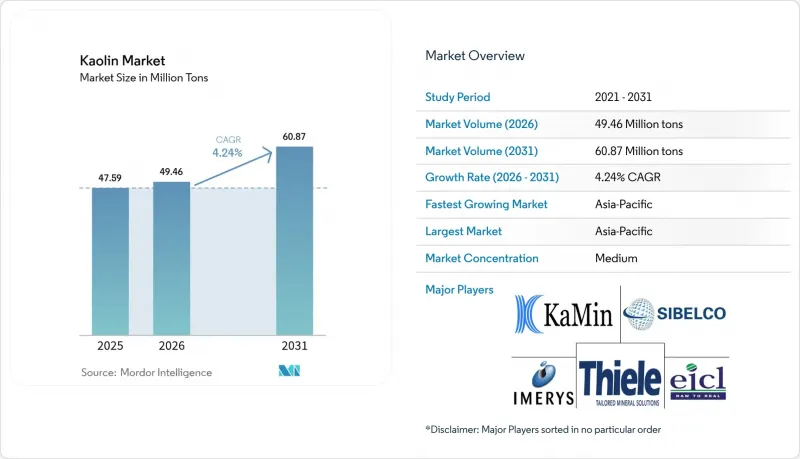
본 보고서는 형태별(가공 카올린 및 미가공 카올린), 등급별(수화 카올린, 소성 카올린, 박리 카올린, 기타), 용도별(세라믹, 시멘트, 종이, 내화물, 페인트 및 코팅, 플라스틱 등) 및 지역별(아시아태평양, 북미, 유럽, 남미, 중동 및 아프리카)로 분류되어 있습니다. 시장 예측은 수량(톤) 기준으로 제시되어 있습니다.
세계의 카올린 시장 동향 및 인사이트
급성장하는 위생 도기 및 타일 제조
중국의 타일 생산량은 연간 50억 m²를 초과하며, 1,200만-1,500만 톤의 카올린을 소비하고 있습니다. 한편, 인도는 2026년까지 30억 m²를 목표로 하는 움직임을 보이고 있으며, 이로 인해 국내 수요가 추가로 150만-200만 톤 증가할 가능성이 있습니다. 인도의 원광 채굴량 830만 톤에 비해 가공 능력이 고작 7만 3,000톤에 그치는 불균형으로 인해, 타일 제조업체들은 말레이시아나 인도네시아에서 고광택 등급의 카올린을 수입할 수밖에 없으며, 이로 인해 입고 비용이 12-18% 상승하고 있습니다. 인도네시아와 베트남은 사우디아라비아의 ‘비전 2030’이 요구하는 800만-1,000만 개의 위생 도기를 포함한 중동의 메가 프로젝트에 대응하기 위해 위생 도기 생산 규모를 확대되고 있습니다. 고급 유리질 도자기 제품 라인에는 Fe2O3 함량이 1.5% 미만인 카올린이 필요하기 때문에 이로 인해 지역 내 공급이逼迫되어 2024년 초 이후 광택도 90% 이상 등급에 대한 현물 가격이 22-25% 상승했습니다. 러시아가 수입 대체로 전환함에 따라 2019-2022년 카올린 수요가 100만 톤 더 증가했습니다.
고광택 포장용지로의 전환
식품 접촉용지의 PFAS 단계적 폐지에 따라 제지 제조업체들은 차단 성능을 향상시키기 위해 광물 코팅의 두께를 늘리고 있습니다. 카올린의 판상 구조는 인쇄 적합성을 높이지만, 현재 포장용 인쇄량의 35-40%를 차지하는 디지털 잉크젯 인쇄에서는 불투명도가 높은 탄산칼슘이 선호되기 때문에 2025년에는 카올린의 점유율이 50-55%로 축소될 것으로 예측됩니다. 총량의 불과 8-10%를 차지하는 층상 카올린은 특히 화장품이나 주류 포장용 고급지에서 15-20%의 프리미엄 가격이 책정되어 있습니다. 카올린과 탄산칼슘의 하이브리드 블렌드를 통해 미국 및 EU의 제지 공장에서는 순수 카올린의 코팅 중량이 약 3분의 1로 감소했습니다. 그러나 아시아의 신규 설비에서는 탄산칼슘공급망이 미비하기 때문에 여전히 카올린을 많이 함유한 배합이 지정되고 있습니다.
소성 과정의 높은 에너지 집약도와 비용 상승
플래시 소성에는 1톤당 1.2-1.5 MMBtu가 필요하며, 생산자는 천연가스 가격 변동 위험에 노출되어 있습니다. 유럽의 TTF 가격은 2025년에 1 MWh당 35-45유로로 형성되고 있으며, 2022년 이전의 15-20유로에서 상승함에 따라 Sibelco사와 Imerys사는 생산 능력의 15-20%를 중단하거나,가격을 15-20% 인상할 수밖에 없게 되었습니다. EU 배출권 거래 제도(EU-ETS)에 따른 탄소 비용으로 인해, 소성 카올린 1톤당 10-15유로의 추가 비용이 발생합니다. 미국 생산자물가지수(PPI) 데이터에 따르면, 전력 회사가 추가 요금을 전가한 결과, 2022년 12월부터 2025년 9월에 걸쳐 카올린 가격은 18.6% 상승했습니다. 고객들은 추가적인 가격 인상에 저항하고 있으며, 탄산칼슘을 이용한 부분적인 대체가 가속화되고 있습니다.
부문별 분석
2025년에는 가공 카올린이 시장 규모의 70.12%를 차지하며 카올린 시장을 주도한 반면, 원료 카올린/미가공 카올린은 2031년까지 연평균 성장률(CAGR) 4.89%라는 더 빠른 속도로 확대될 전망입니다. 인도의 830만 톤에 달하는 막대한 원료 카올린 생산량에 비해 국내 가공 능력이 부족하기 때문에 타일 제조업체들은 수입 프리미엄을 지불할 수밖에 없어, 카올린 시장의 구조적인 차익 거래가 두드러지고 있습니다. EICL 및 20 Microns의 선광 투자로 인해 2027년까지 20만-30만 톤의 가공 능력이 추가될 전망입니다.
정제 카올린은 다단계 자력 분리, 표백, 분무 건조를 통해 85% 이상의 백도와 1% 미만의 Fe₂O₃ 함유율을 실현하므로, 배터리용 분리막, 고백도 포장재, 화장품과 같은 고급 용도로 채택되고 있습니다. 미정제 카올린은 저가형 벽돌, 시멘트, 농업 용도로 사용되고 있지만, 원료의 안정적인 공급을 필요로 하는 신흥 시장에서 후방 통합의 관점에서 주목을 받고 있습니다. 2022년 제재 조치 이후, 중국의 우크라이나 및 러시아산 미정제 카올린 수입량은 40-50% 급감했으며, 호주와 인도네시아공급이 중국으로 전환됨에 따라 지역 카올린 시장은 공급 부족 사태를 겪고 있습니다.
지역별 분석
아시아태평양은 2025년에 카올린 시장의 43.26%를 차지한 것으로 평가되었으며, 2031년까지 연평균 성장률(CAGR) 4.94%로 확대될 것으로 전망됩니다. 중국은 고순도 위생 도자기 및 첨단 세라믹으로의 전환을 추진하고 있으며, 2024년 초 이후 백도 프리미엄이 22-25% 상승했습니다. 인도는 2027년까지 30만 톤의 신규 생산 능력을 도입하여 선광 능력 부족을 해소하고, 12-18%의 수입 프리미엄을 줄이는 것을 목표로 하고 있습니다. 일본과 한국은 전자 기판용 고순도 등급을 수입하고 있으며, 이로 인해 미국 및 호주로부터공급이 유입되고 있습니다.
북미에서는 조지아주 카올린 벨트가 국내 공급의 기반을 이루고 있으며, 중국, 멕시코, 일본으로 160만-180만 톤을 수출하고 있습니다. 14억 3,000만 유로의 사업 분할을 거쳐 설립된 KaMin LLC는 성숙하지만 자금력이 있는 자산에 대한 사모펀드의 투자 의지를 여실히 보여주고 있습니다. 미시간주와 테네시주에서 전기차 배터리 투자가 이루어짐에 따라, 해당 지역의 소성 카올린 수요는 증가할 전망입니다. EPA(미국 환경보호청)의 폐수 및 분진 관련 규제로 인해 광산 1곳당 500만-1,000만 달러의 설비 투자가 증가하지만, 한편으로는 신규 시장 진출기업에 대한 진입 장벽도 형성되고 있습니다.
유럽에서는 천연가스 가격과 탄소 가격의 급등으로 소성 사업의 수익성이 압박을 받고 있어, 경쟁의 과제가 되고 있습니다. 시벨코(Sibelco)사가 2023년에 콰르츠베르케(Quartzwerke)사의 카올린 사업을 인수하고 폐열 이용 설비를 개조한 것은 규모 확대와 에너지 효율로의 전환을 보여주는 좋은 사례입니다. 남미의 광대한 아마존 지역의 매장량은 엄격한 허가·인가 제도로 인해 거의 미개발 상태이지만, 중동 및 아프리카에서는 ‘사우디 비전 2030’에 따라 위생 도기 수요가 확대되고 있어 수입에 의존하고 있습니다.
기타 혜택 :
- 엑셀 형식 시장 예측(ME) 시트
- 3개월간 애널리스트 지원
자주 묻는 질문
목차
제1장 서론
제2장 조사 방법
제3장 주요 요약
제4장 시장 구도
제5장 시장 규모 및 성장 예측
제6장 경쟁 구도
제7장 시장 기회 및 향후 전망
AJY 26.09.11According to Mordor Intelligence, the kaolin market size is expected to grow from 47.59 Million tons in 2025 to 49.46 Million tons in 2026 and is forecast to reach 60.87 Million tons by 2031 at 4.24% CAGR over 2026-2031.
This report is Segmented by Form (Processed Kaolin and Crude/Unprocessed Kaolin), Grade (Hydrous Kaolin, Calcined Kaolin, Delaminated Kaolin, and Other Grades), Application (Ceramics, Cement, Paper, Refractories, Paints and Coatings, Plastics, and More) and Geography (Asia-Pacific, North America, Europe, South America, and Middle-East and Africa). The Market Forecasts are Provided in Terms of Volume (Tons).
Global Kaolin Market Trends and Insights
Booming Sanitary-Ware and Tile Manufacturing
China's tile output exceeds 5 billion m2 annually, consuming 12-15 million tons of kaolin, while India's march toward 3 billion m2 by 2026 could lift domestic demand by another 1.5-2 million tons. The mismatch between India's 8.3 million tons of crude extraction and just 73,000 tons of processing capacity forces tile makers to import high-brightness grades from Malaysia and Indonesia, inflating landed costs by 12-18%. Indonesia and Vietnam are scaling sanitary-ware output to serve mega-projects in the Middle-East, including Saudi Vision 2030 requirements for 8-10 million fixtures. Premium vitreous-china lines require kaolin with less than 1.5% Fe2O3, tightening regional supply and driving spot prices for 90%+ brightness grades 22-25% higher since early 2024. Russia's own shift toward import substitution added another 1 million tons of kaolin demand between 2019 and 2022.
Shift to High-Brightness Packaging Paper
Phasing out PFAS in food-contact paper propels mills to thicken mineral coatings for barrier performance. Kaolin's plate-like structure enhances printability, but digital inkjet now represents 35-40% of packaging print volume and prefers calcium carbonate's greater opacity, trimming kaolin's share to 50-55% in 2025. Delaminated kaolin, just 8-10% of total volume, earns 15-20% premiums for luxury paper stocks, specifically in cosmetics and spirits packaging. Hybrid kaolin-carbonate blends reduced pure-kaolin coat weights by roughly one-third in U.S. and EU mills; however, new Asian machines still specify kaolin-heavy formulations due to sparse carbonate supply chains.
High Energy Intensity and Cost Inflation in Calcination
Flash calcination needs 1.2-1.5 MMBtu per ton, leaving producers exposed to natural-gas volatility. Europe's TTF prices hovered at EUR 35-45 / MWh in 2025, up from EUR 15-20 pre-2022, forcing Sibelco and Imerys to idle 15-20% capacity or raise prices 15-20%. Carbon costs under the EU-ETS add EUR 10-15 per ton of calcined kaolin. U.S. PPI data show kaolin prices rising 18.6% between December 2022 and September 2025 as utilities passed through surcharges. Customers resist further hikes, accelerating partial substitution by calcium carbonate.
Other drivers and restraints analyzed in the detailed report include:
- Growing Demand from Paper and Rubber Industries
- Rapid Adoption of Calcined Kaolin in Li-ion Battery Separator Coatings
- Stringent Mine-Site Environmental Permitting
For complete list of drivers and restraints, kindly check the Table Of Contents.
Segment Analysis
Processed kaolin led the kaolin market size with 70.12% share in 2025, whereas crude/unprocessed kaolin is expanding at a faster 4.89% CAGR to 2031. India's huge 8.3 million tons of crude output contrasts with scarce domestic processing, compelling tile makers to pay import premiums and highlighting a structural arbitrage within the kaolin market. Beneficiation investments by EICL and 20 Microns will add 200,000-300,000 tons of processed capacity by 2027.
Processed kaolin captures premium end uses-battery separators, high-brightness packaging, cosmetics-because multi-stage magnetic separation, bleaching, and spray drying deliver more than 85% brightness and less than 1% Fe2O3. Crude kaolin serves low-end bricks, cement, and agriculture, but is becoming attractive for backward integration in emerging markets craving feedstock security. China's imports of Ukrainian and Russian crude plunged 40-50% after 2022 sanctions, redirecting flows from Australia and Indonesia and tightening the regional kaolin market.
Complete Report Scope:
- By Form
- Processed Kaolin
- Crude/Unprocessed Kaolin
- By Grade
- Hydrous Kaolin
- Calcined Kaolin
- Delaminated Kaolin
- Other Grades
- By Application
- Ceramics
- Cement
- Paper
- Refractories
- Paints and Coatings
- Plastics
- Other Applications
- By Geography
- Asia-Pacific
- China
- India
- Japan
- South Korea
- Rest of Asia-Pacific
- North America
- United States
- Canada
- Mexico
- Europe
- Germany
- United Kingdom
- France
- Italy
- Rest of Europe
- South America
- Brazil
- Argentina
- Rest of South America
- Middle-East and Africa
- Saudi Arabia
- South Africa
- Rest of Middle-East and Africa
- Asia-Pacific
Geography Analysis
Asia-Pacific commanded 43.26% of the kaolin market in 2025 and is projected to expand at 4.94% CAGR through 2031. China transitions toward higher-purity sanitary-ware and advanced ceramics, pushing brightness premiums up 22-25% since early 2024. India is closing its beneficiation gap via 300,000 tons of new capacity by 2027, aiming to cut import premiums of 12-18%. Japan and South Korea import high-purity grades for electronic substrates, pulling supply from the U.S. and Australia.
In North America, the Georgia kaolin belt anchors domestic supply, exporting 1.6-1.8 million tons to China, Mexico, and Japan. KaMin LLC's formation after a EUR 1.43 billion carve-out underscores private-equity bets on mature but cash-rich assets. EV battery investments in Michigan and Tennessee are set to lift calcined-kaolin demand regionally. EPA effluent and dust rules add USD 5-10 million capex per mine but create a moat against new entrants.
Europe faces competitiveness challenges as natural-gas costs and carbon prices inflate calcination economics. Sibelco's 2023 acquisition of Quarzwerke's kaolin business and waste-heat retrofits illustrate a shift toward scale and energy efficiency. South America's vast Amazon reserves stay mostly untapped due to stringent permitting, while Middle-East and Africa rely on imports as Saudi Vision 2030 boosts sanitary-ware requirements.
- 20 Microns
- Active Minerals International LLC
- Ashapura Group
- Burgess Pigment Company
- EICL
- Gebruder Dorfner GmbH & Co.
- Green 360 Technologies
- Imerys
- I-Minerals Inc.
- KaMin LLC / CADAM
- Kaolin AD
- Keramost a.s.
- LASSELSBERGER Group GmbH
- LB MINERALS, Ltd.
- Quarzwerke GmbH
- Sibelco
- Thiele Kaolin Company
- Tokai Clay Industry Co., Ltd.
- Zeotech
Additional Benefits:
- The market estimate (ME) sheet in Excel format
- 3 months of analyst support
TABLE OF CONTENTS
1 Introduction
- 1.1 Study Assumptions and Market Definition
- 1.2 Scope of the Study
2 Research Methodology
3 Executive Summary
4 Market Landscape
- 4.1 Market Overview
- 4.2 Market Drivers
- 4.2.1 Booming sanitary-ware and tile manufacturing
- 4.2.2 Shift to high-brightness packaging paper
- 4.2.3 Growing demand from paper and rubber industries
- 4.2.4 Cosmetics and personal-care industry growth
- 4.2.5 Rapid adoption of calcined kaolin in Li-ion battery separator coatings
- 4.3 Market Restraints
- 4.3.1 High energy intensity and cost inflation in calcination
- 4.3.2 Stringent mine-site environmental permitting
- 4.3.3 Substitution risk from high-opacity calcium carbonates in digital-print papers
- 4.4 Value Chain Analysis
- 4.5 Porter's Five Forces
- 4.5.1 Bargaining Power of Buyers
- 4.5.2 Bargaining Power of Suppliers
- 4.5.3 Threat of New Entrants
- 4.5.4 Threat of Substitutes
- 4.5.5 Degree of Competition
5 Market Size and Growth Forecasts (Volume)
- 5.1 By Form
- 5.1.1 Processed Kaolin
- 5.1.2 Crude/Unprocessed Kaolin
- 5.2 By Grade
- 5.2.1 Hydrous Kaolin
- 5.2.2 Calcined Kaolin
- 5.2.3 Delaminated Kaolin
- 5.2.4 Other Grades
- 5.3 By Application
- 5.3.1 Ceramics
- 5.3.2 Cement
- 5.3.3 Paper
- 5.3.4 Refractories
- 5.3.5 Paints and Coatings
- 5.3.6 Plastics
- 5.3.7 Other Applications
- 5.4 By Geography
- 5.4.1 Asia-Pacific
- 5.4.1.1 China
- 5.4.1.2 India
- 5.4.1.3 Japan
- 5.4.1.4 South Korea
- 5.4.1.5 Rest of Asia-Pacific
- 5.4.2 North America
- 5.4.2.1 United States
- 5.4.2.2 Canada
- 5.4.2.3 Mexico
- 5.4.3 Europe
- 5.4.3.1 Germany
- 5.4.3.2 United Kingdom
- 5.4.3.3 France
- 5.4.3.4 Italy
- 5.4.3.5 Rest of Europe
- 5.4.4 South America
- 5.4.4.1 Brazil
- 5.4.4.2 Argentina
- 5.4.4.3 Rest of South America
- 5.4.5 Middle-East and Africa
- 5.4.5.1 Saudi Arabia
- 5.4.5.2 South Africa
- 5.4.5.3 Rest of Middle-East and Africa
- 5.4.1 Asia-Pacific
6 Competitive Landscape
- 6.1 Market Concentration
- 6.2 Strategic Moves
- 6.3 Market Share(%)/Ranking Analysis
- 6.4 Company Profiles (includes Global level Overview, Market level overview, Core Segments, Financials as available, Strategic Information, Products and Services, and Recent Developments)
- 6.4.1 20 Microns
- 6.4.2 Active Minerals International LLC
- 6.4.3 Ashapura Group
- 6.4.4 Burgess Pigment Company
- 6.4.5 EICL
- 6.4.6 Gebruder Dorfner GmbH & Co.
- 6.4.7 Green 360 Technologies
- 6.4.8 Imerys
- 6.4.9 I-Minerals Inc.
- 6.4.10 KaMin LLC / CADAM
- 6.4.11 Kaolin AD
- 6.4.12 Keramost a.s.
- 6.4.13 LASSELSBERGER Group GmbH
- 6.4.14 LB MINERALS, Ltd.
- 6.4.15 Quarzwerke GmbH
- 6.4.16 Sibelco
- 6.4.17 Thiele Kaolin Company
- 6.4.18 Tokai Clay Industry Co., Ltd.
- 6.4.19 Zeotech
7 Market Opportunities and Future Outlook
- 7.1 White-Space and Unmet-Need Assessment
- 7.2 Growing Demand for Sanitary Ceramics