|
시장보고서
상품코드
2124112
골프 카트 시장 : 점유율 분석, 업계 동향과 통계, 성장 예측(2026-2031년)Golf Cart - Market Share Analysis, Industry Trends & Statistics, Growth Forecasts (2026 - 2031) |
||||||
 Mordor Intelligence
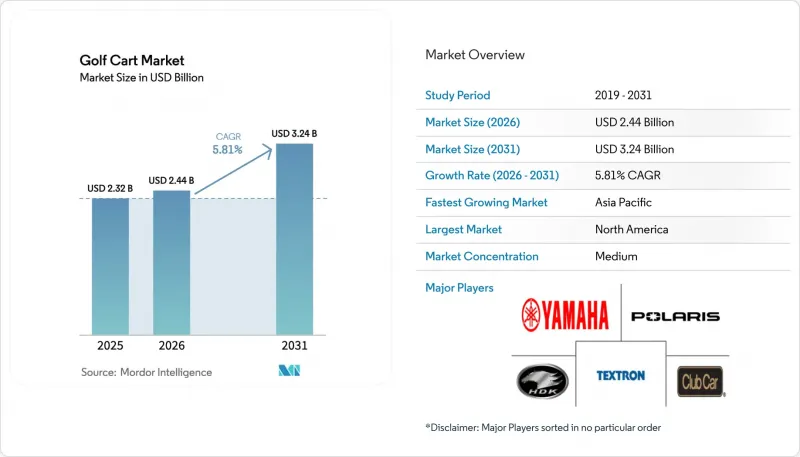
Mordor Intelligence에 의하면, 골프 카트 시장 규모는 2025년에 23억 2,000만 달러로 평가되었고 2026년 24억 4,000만 달러에서 2031년까지 32억 4,000만 달러에 이를 것으로 예측되며, 예측 기간(2026-2031년) CAGR은 5.81%를 나타낼 전망입니다.
본 보고서는 구동 방식(전기, 가솔린, 태양광 하이브리드), 승차 정원(2인승, 4인승, 6인승, 8인승 이상), 차체 유형(오픈탑, 클로즈드), 용도(골프장 등), 판매 채널(오프라인, 온라인) 및 지역별로 분류되어 있습니다. 시장 전망은 금액(달러) 및 수량(대수)으로 제시되어 있습니다.
세계 골프 카트 시장 동향 및 인사이트
미국 은퇴자 커뮤니티에서 새로운 동향의 급속한 확산
플로리다주, 애리조나주, 사우스캐롤라이나주에서는 시니어 주거 커뮤니티에서 골프 카트가 주요 이동 수단으로 자리 잡고 있습니다. 주요 사업자인 ‘더 빌리지스(The Villages)’는 다수의 골프 카트를 운영하고 있으며, 매년 현저한 성장을 이루고 있습니다. 최근 플로리다주의 딜러들 사이에서는 골프 카트 판매 대수가 대폭 증가하고 있습니다. 이러한 성장은 주로 서스펜션 리프트업, LED 조명, 블루투스 오디오 등의 기능을 장착해 골프 카트를 맞춤화하고, 일반 도로 주행이 가능하도록 한 젊은 세대의 은퇴자들에 의해 주도되고 있습니다. 더니든과 파나마시티에서는 시 조례에 따라 저속 차량 구역이 확대되어, 주택에서 소매 지역이나 의료시설로 직접 접근할 수 있게 되었습니다. 그 결과, 다세대 가구의 요구를 반영하여 4인승 카트에 대한 수요가 높아지고 있습니다. 최근 미국 도로교통안전국(NHTSA)은 안전 기준 개정을 발표하여, 향후 몇년내에 특히 일반 도로에서 주행하는 카트에 대해 안전벨트, 전면 유리, 방향 지시등 장착을 의무화하기로 했습니다.
GCC의 메가 프로젝트로 계획 중인 골프 타운십
사우디아라비아의 NEOM이 추진하는 기도리(Gidori)와 키디야(Qiddiya), 그리고 아랍에미리트(UAE)의 레드시 코스(Red Sea Course)에서는 뜨거운 사막의 더위를 이겨내기 위해 좌석 수가 다른 밀폐형에 에어컨이 완비된 카트가 도입되고 있습니다. 향후 몇 년 동안 연간 다수의 방문객을 유치하는 것을 목표로 하는 키디야에서는 대용량 VIP용 카트 군이 절실히 요구되고 있습니다. 이러한 야심 찬 프로젝트에서는 공급업체와의 제휴를 추진하고 있으며, 온도 관리 기능이 탑재된 배터리와 태양광 하이브리드 지붕에 중점을 둠으로써 기존 발전기에 대한 의존도를 대폭 줄이고 있습니다.
리튬 이온 배터리 팩의 비용 변동
최근 몇 년간 배터리 팩 가격은 대폭 하락하여 지난 5여년동안 최저 수준에 도달했습니다. 이러한 가격 하락에도 불구하고, 셀 생산의 대부분은 여전히 중국에 집중되어 있으며, 전 세계 생산량의 상당 부분을 차지하고 있습니다. 라틴아메리카나 아프리카 등지에서 수입에 의존하는 조립 제조업체들은 공급망 혼란으로 인한 문제에 직면하고 있으며, 그 결과 수입 부품 비용 상승을 초래하고 있습니다. 국제에너지기구(IEA)에 따르면, 인산철리튬(LFP) 및 나트륨 이온 배터리 화학 기술의 발전이 가속화되고 추가적인 확장성이 실현됨에 따라 향후 몇 년 동안 추가적인 비용 절감이 예상됩니다. 야마하가 2020년대 중반에 출시할 예정인 신형 전동 카트에는 LFP 화학 기술을 채택한 혁신적인 자체 개발 배터리 팩이 탑재될 예정입니다. 이 새로운 설계를 통해 납축전지에 의존하던 기존 모델에 비해 에너지 효율이 대폭 향상될 것으로 기대되며, 시장 변동 속에서도 보다 안정적이고 신뢰할 수 있는 솔루션을 제공할 것입니다.
부문 분석
대부분의 골프 코스에 충전 인프라가 구축되어 있는 것을 배경으로, 전동 카트가 78.81%의 점유율을 차지하며 시장을 주도하고 있습니다. 그러나 자립성을 추구하는 Off-grid 리조트 지역을 발판 삼아, 태양광 하이브리드 모델 골프 카트 시장 규모는 연평균 성장률(CAGR) 5.83%로 확대될 것으로 예측됩니다. 로스 나란호스 골프 클럽에서는 옥상에 태양광 패널을 설치하여 전기 요금을 40% 절감하고, 5년 만에 투자 회수가 가능함을 입증했습니다. LFP 배터리가 납축전지를 대체하며 에너지 밀도와 사이클 수명이 향상되고 있는 반면, 야마하의 수소 연료전지 컨셉은 미래의 다양화를 시사하고 있습니다. EU 규정 2023/1804 등의 규제 때문에 가솔린 차량에서 전환이 가속화되고 있으며, 내연기관 탑재 카트의 장기적인 전망은 좁아지고 있습니다.
중국 공급업체들은 CE 마크가 부착된 태양광 지붕과 150W 트리클 충전기를 세트로 400달러 미만에 제공하고 있어, 동남아시아 및 카리브해 지역의 사업자들에게 하이브리드형이 매력적인 선택지가 되고 있습니다. 골프 카트 시장은 폐차된 전기차에서 회수된 배터리 팩을 지속적으로 흡수하고 있으며, 이로 인해 공급이 안정화되고 배출량 감축으로 이어지고 있습니다.
2인승 모델은 2025년에도 47.63%의 시장 점유율을 차지하며 여전히 가장 큰 점유율을 유지하고 있지만, 선벨트 지역에서의 주거용 도입을 배경으로 4인승 모델의 성장세가 가장 빠릅니다. 4인승 골프 카트 시장 규모는 2031년까지 연평균 5.88%의 성장률을 보일 것으로 예측됩니다. E-Z-GO사의 ‘Liberty’나 야마하사의 5인승 ‘G30E’와 같은 모델은 공간 효율성과 승객 수용 능력 향상을 동시에 실현하고 있습니다.
은퇴자 커뮤니티에서는 후방 시트나 카고 박스를 사후 장착하는 개조가 이루어지고 있어 애프터마켓 수익을 뒷받침하고 있습니다. GCC(걸프협력회의) 지역의 메가 프로젝트에서는 VIP나 단체 이용객을 위해 에어컨이 장착된 6인승 및 8인승 카트가 선호되며, 프리미엄 수요층을 형성하고 있습니다.
지역별 분석
북미는 2025년에 매출의 38.71%를 차지하며, 확고히 자리 잡은 시니어 커뮤니티 문화와 광범위한 코스 네트워크 덕분에 계속해서 핵심 시장으로서의 지위를 유지하고 있습니다. FMVSS 305a에 따른 안전 기준의 통일화로 평균 판매 가격은 상승할 전망이지만, 동시에 구형 차량의 교체도 촉진될 것입니다. 캐나다의 더욱 엄격한 방화 규제로 인해 개조 비용은 증가하는 한편, 클럽카, 야마하, 텍스트론의 현지 생산을 통해 빠른 납기와 수요에 맞춘 서비스 패키지가 확보되고 있습니다.
아시아태평양은 연평균 성장률(CAGR) 5.87%로 가장 빠르게 성장하고 있는 지역입니다. 태국은 현지 제조업체의 지원과 관광 주도형 카트 수요에 힘입어 아세안(ASEAN) 국가 중 도입을 선도하고 있습니다. 중국 시장 규모는 2022년에 이미 1억 3,447만 달러에 달했으며, 공원 및 산업단지로의 용도 확대에 따라 2029년까지 두 배로 증가할 가능성이 있습니다. 일본에서는 5인승 캐디 카트가 선호되는 경향이 있으며, 각 OEM 업체들은 페어웨이에서 자율 주행하기 위한 전자기 유도 시스템 통합을 추진하고 있습니다. 인도의 타운십용 차량 함대는 시범 운영 단계에 접어들었으며, 패키지형 금융이 정착되면 대규모 확대 가능성이 시사되고 있습니다.
유럽에서는 기회와 리스크가 공존하고 있습니다. 전기화 의무화로 인해 교체 수요는 보장되고 있지만, 영국, 독일, 프랑스의 회원 수 감소로 인해 판매 대수 증가세는 둔화되고 있습니다. 스페인과 이탈리아의 골프 클럽에서는 태양광 지붕과 축전지를 결합해 전력 비용을 상쇄함으로써 5년 이내에 손익분기점을 달성하고 있습니다. 남미와 중동은 절대 수치로는 뒤처져 있지만, 성장률은 가장 높으며, GCC(걸프협력회의) 국가들의 메가 프로젝트가 밀폐형·에어컨 장착 카트 분야에서 프리미엄 벤치마크를 확립하고 있습니다. 카리브해 섬들에서는 태양광 하이브리드 도입이 앞서고 있으며, 바베이도스에서 진행 중인 배터리 재사용 실증 실험이 순환형 경제의 이점을 입증하고 있습니다.
기타 혜택:
- 엑셀 형식 시장 예측(ME) 시트
- 3개월간의 애널리스트 지원
자주 묻는 질문
목차
제1장 서론
제2장 조사 방법
제3장 주요 요약
제4장 시장 구도
제5장 시장 규모와 성장 예측
제6장 경쟁 구도
제7장 시장 기회와 향후 전망
JHS 26.09.07According to Mordor Intelligence, the golf cart market size was valued at USD 2.32 billion in 2025 and estimated to grow from USD 2.44 billion in 2026 to reach USD 3.24 billion by 2031, at a CAGR of 5.81% during the forecast period (2026-2031).
This report is Segmented by Propulsion Type (Electric, Gasoline, and Solar-Hybrid), Seating Capacity (2, 4, 6, and 8+ Seater), Vehicle Format (Open-Top and Enclosed), Application (Golf Courses and More), Sales Channel (Offline and Online), and Geography. Market Forecasts in Value (USD) and Volume (Units).
Global Golf Cart Market Trends and Insights
United States Retirement Communities Rapidly Adopting New Trends
In Florida, Arizona, and South Carolina, retirement communities have made carts a staple mode of transport. The Villages, a prominent player, operates a substantial number of units and boasts significant annual growth. In recent years, Florida dealers have experienced a considerable increase in cart sales. This growth is largely driven by younger retirees who are customizing their carts with features like lifted suspensions, LED lighting, and Bluetooth audio, ensuring they're street-legal. In Dunedin and Panama City, city ordinances have expanded low-speed vehicle zones, linking homes directly to retail areas and healthcare facilities. As a result, there's an increasing demand for four-seater carts, reflecting the needs of multigenerational households. Recently, the National Highway Traffic Safety Administration introduced updated safety standards, requiring the integration of seat belts, windshields, and turn signals in carts over the coming years, especially for those on public roads .
Planned Golf Townships Emerging in GCC Mega-Projects
Saudi Arabia's NEOM's Gidori and Qiddiya, along with the United Arab Emirates' Red Sea courses, are introducing enclosed, air-conditioned carts with varying seating capacities, designed to combat the sweltering desert heat. Qiddiya, aiming to attract a significant number of annual visitors in the coming years, is in dire need of high-capacity VIP fleets. These ambitious projects are fostering partnerships with suppliers, focusing on thermally managed batteries and solar-hybrid roofs, significantly reducing dependence on traditional generators .
Lithium-Ion Pack Cost Volatility
In recent years, battery pack prices have experienced a significant decline, reaching their lowest levels in over half a decade. Despite this reduction, the majority of cell production continues to be heavily concentrated in China, accounting for a substantial share of the global output. Import-dependent assemblers in regions such as Latin America and Africa face challenges due to disruptions in the supply chain, which have led to increased costs for imported components. According to the International Energy Agency, further cost reductions are anticipated in the coming years as advancements in lithium iron phosphate (LFP) and sodium-ion battery chemistries gain momentum and achieve greater scalability . Yamaha's upcoming electric cart model, scheduled for release in the middle of the decade, features an innovative in-house battery pack utilizing LFP chemistry. This new design is expected to deliver significantly improved energy efficiency compared to earlier models that relied on lead-acid batteries, providing a more stable and reliable solution amidst market volatility.
Other drivers and restraints analyzed in the detailed report include:
- OEM Bundled Financing for Community Fleets in India
- Caribbean Resorts Piloting Solar-Hybrid Carts
- Declining Golf Membership in Western Europe
For complete list of drivers and restraints, kindly check the Table Of Contents.
Segment Analysis
Electric carts dominate with 78.81% share, anchored by mature charging infrastructure at most courses. The golf cart market size for solar-hybrid models, however, is projected to grow at a 5.83% CAGR, catalyzed by off-grid resorts seeking autonomy. Los Naranjos Golf Club cut electricity costs by 40% by adding rooftop panels, validating a five-year payback. LFP batteries displace lead-acid, improving energy density and cycle life, while Yamaha's hydrogen fuel-cell concept hints at future diversification. Regulations such as EU 2023/1804 accelerate the pivot away from gasoline, narrowing long-term prospects for combustion carts.
Chinese suppliers offer CE-marked solar roofs bundled with 150 W trickle chargers priced under USD 400, making hybrids attractive for Southeast Asian and Caribbean operators. The golf cart market continues to absorb battery-reuse packs from end-of-life EVs, smoothing supply and lowering emissions footprints.
Two-seater units still hold the largest slice with 47.63% market share in 2025, yet four-seaters advance fastest on the back of Sun-belt residential adoption. The golf cart market size for four-seater models is forecast to expand 5.88% per year through 2031. Players like E-Z-GO's Liberty and Yamaha's five-seat G30Es bridge space efficiency with greater passenger accommodation.
Retirement communities retrofit rear-facing seats and cargo boxes, spurring aftermarket revenue. GCC mega-projects lean toward six- and eight-seater, air-conditioned carts for VIP and group play, shaping premium demand tiers.
Complete Report Scope:
- By Propulsion Type
- Electric Golf Carts
- Gasoline Golf Carts
- Solar-Hybrid Golf Carts
- By Seating Capacity
- 2 Seater
- 4 Seater
- 6 Seater
- 8+ Seater
- By Vehicle Format
- Open-Top
- Enclosed / Weather-proof
- By Application
- Golf Courses
- Personal / Residential Mobility
- Commercial Services (Resorts, Theme-Parks, Campuses)
- Industrial & Airport Utility
- By Sales Channel
- Offline (Dealers & Distributors)
- Online / Direct-to-Consumer
- By Geography
- North America
- United States
- Canada
- Rest of North America
- South America
- Brazil
- Argentina
- Rest of South America
- Europe
- Germany
- United Kingdom
- France
- Italy
- Spain
- Rest of Europe
- Asia Pacific
- China
- India
- Japan
- South Korea
- Rest of Asia Pacific
- Middle East and Africa
- United Arab Emirates
- Saudi Arabia
- South Africa
- Turkey
- Rest of Middle East and Africa
- North America
Geography Analysis
North America, with 38.71% revenue in 2025, remains the anchor due to entrenched retirement-community culture and extensive course networks. FMVSS 305a harmonizes safety compliance, likely raising average selling prices but also spurring replacement of older fleets. Canada's stricter fire codes add retrofit costs, while localized production by Club Car, Yamaha, and Textron ensures quick lead times and tailored service packages.
Asia Pacific is the fastest-rising region at a 5.87% CAGR. Thailand leads ASEAN adoption, supported by local manufacturers and tourism-driven cart demand. China's market, already USD 134.47 million in 2022, could double by 2029 as applications widen to parks and industrial campuses. Japan's preference for five-seat caddie carts pushes OEMs to integrate electromagnetic guidance for autonomous fairway loops. India's township fleets enter pilot stage, signaling potential scale once bundled financing solidifies.
Europe blends opportunity and risk. Electrification mandates guarantee replacement demand, yet United Kingdom, German, and French membership attrition reduces volume upside. Clubs in Spain and Italy offset power costs through solar roofs and battery-storage pairs, breaking even within five years. South America and the Middle East trail in absolute numbers but post the steepest percentage gains, with GCC mega-projects setting premium benchmarks for enclosed, cooled carts. Caribbean islands pioneer solar-hybrid adoption as battery-reuse labs in Barbados illustrate circular-economy gains.
- Club Car LLC
- Yamaha Golf-Car Company
- Textron Specialized Vehicles (E-Z-GO, Cushman)
- Columbia Vehicle Group (ParCar)
- HDK Electric Vehicles
- Suzhou Eagle EV Mfg. Co.
- JH Global Services (Star EV)
- Dongguan Excellence Golf & Sightseeing Car
- ICON EV
- Marshell Electric Vehicle
- Bintelli Electric Vehicles
- Xiamen Dalle Electric Car
- Polaris GEM (Polaris Inc.)
- Speedways Electric
- AgT Electric Cars
- CitEcar Electric Vehicles
- Kandi Technologies Group
- Tomberlin (Columbia)
- ELLWEE AB
Additional Benefits:
- The market estimate (ME) sheet in Excel format
- 3 months of analyst support
TABLE OF CONTENTS
1 Introduction
- 1.1 Study Assumptions and Market Definition
- 1.2 Scope of the Study
2 Research Methodology
3 Executive Summary
4 Market Landscape
- 4.1 Market Overview
- 4.2 Market Drivers
- 4.2.1 United States Retirement Communities, Especially in the Sun-belt States, are Rapidly Adopting New Trends
- 4.2.2 European Golf Courses and Country Clubs are Mandated to Electrify their Operations
- 4.2.3 Southeast Asian Islands are Integrating Micro-Mobility Programs Into their Resorts
- 4.2.4 Planned Golf Townships are Quickly Emerging as Part of Mega-projects in the GCC
- 4.2.5 OEM Bundled-Financing for Community Transport Fleets in India
- 4.2.6 Caribbean Resorts with Low Grid Access are Piloting Solar-hybrid Carts
- 4.3 Market Restraints
- 4.3.1 Lithium-Ion Pack Cost Volatility (Post-2023 Supply Shock)
- 4.3.2 Declining Golf Membership in Western Europe
- 4.3.3 Municipal Fire-Code Tightening for Cart Storage (United States and Canada)
- 4.3.4 Sparse Charging Infrastructure in Outlying Caribbean Islands
- 4.4 Value / Supply-Chain Analysis
- 4.5 Regulatory Landscape
- 4.6 Technological Outlook
- 4.7 Porter's Five Forces
- 4.7.1 Bargaining Power of Suppliers
- 4.7.2 Bargaining Power of Buyers
- 4.7.3 Threat of New Entrants
- 4.7.4 Threat of Substitutes
- 4.7.5 Competitive Rivalry
5 Market Size and Growth Forecasts (Value (USD) and Volume (Units))
- 5.1 By Propulsion Type
- 5.1.1 Electric Golf Carts
- 5.1.2 Gasoline Golf Carts
- 5.1.3 Solar-Hybrid Golf Carts
- 5.2 By Seating Capacity
- 5.2.1 2 Seater
- 5.2.2 4 Seater
- 5.2.3 6 Seater
- 5.2.4 8+ Seater
- 5.3 By Vehicle Format
- 5.3.1 Open-Top
- 5.3.2 Enclosed / Weather-proof
- 5.4 By Application
- 5.4.1 Golf Courses
- 5.4.2 Personal / Residential Mobility
- 5.4.3 Commercial Services (Resorts, Theme-Parks, Campuses)
- 5.4.4 Industrial & Airport Utility
- 5.5 By Sales Channel
- 5.5.1 Offline (Dealers & Distributors)
- 5.5.2 Online / Direct-to-Consumer
- 5.6 By Geography
- 5.6.1 North America
- 5.6.1.1 United States
- 5.6.1.2 Canada
- 5.6.1.3 Rest of North America
- 5.6.2 South America
- 5.6.2.1 Brazil
- 5.6.2.2 Argentina
- 5.6.2.3 Rest of South America
- 5.6.3 Europe
- 5.6.3.1 Germany
- 5.6.3.2 United Kingdom
- 5.6.3.3 France
- 5.6.3.4 Italy
- 5.6.3.5 Spain
- 5.6.3.6 Rest of Europe
- 5.6.4 Asia Pacific
- 5.6.4.1 China
- 5.6.4.2 India
- 5.6.4.3 Japan
- 5.6.4.4 South Korea
- 5.6.4.5 Rest of Asia Pacific
- 5.6.5 Middle East and Africa
- 5.6.5.1 United Arab Emirates
- 5.6.5.2 Saudi Arabia
- 5.6.5.3 South Africa
- 5.6.5.4 Turkey
- 5.6.5.5 Rest of Middle East and Africa
- 5.6.1 North America
6 Competitive Landscape
- 6.1 Market Concentration
- 6.2 Strategic Moves
- 6.3 Market Share Analysis
- 6.4 Company Profiles (Includes Global Level Overview, Market Level Overview, Core Segments, Financials as Available, Strategic Information, Market Rank/Share for Key Companies, Products and Services, SWOT Analysis, and Recent Developments)
- 6.4.1 Club Car LLC
- 6.4.2 Yamaha Golf-Car Company
- 6.4.3 Textron Specialized Vehicles (E-Z-GO, Cushman)
- 6.4.4 Columbia Vehicle Group (ParCar)
- 6.4.5 HDK Electric Vehicles
- 6.4.6 Suzhou Eagle EV Mfg. Co.
- 6.4.7 JH Global Services (Star EV)
- 6.4.8 Dongguan Excellence Golf & Sightseeing Car
- 6.4.9 ICON EV
- 6.4.10 Marshell Electric Vehicle
- 6.4.11 Bintelli Electric Vehicles
- 6.4.12 Xiamen Dalle Electric Car
- 6.4.13 Polaris GEM (Polaris Inc.)
- 6.4.14 Speedways Electric
- 6.4.15 AgT Electric Cars
- 6.4.16 CitEcar Electric Vehicles
- 6.4.17 Kandi Technologies Group
- 6.4.18 Tomberlin (Columbia)
- 6.4.19 ELLWEE AB
7 Market Opportunities and Future Outlook
- 7.1 White-space and Unmet-need Assessment