

|
시장보고서
상품코드
2124114
알킬 폴리글리코시드 시장 : 점유율 분석, 업계 동향과 통계, 성장 예측(2026-2031년)Alkyl Polyglycoside - Market Share Analysis, Industry Trends & Statistics, Growth Forecasts (2026 - 2031) |
||||||
 Mordor Intelligence
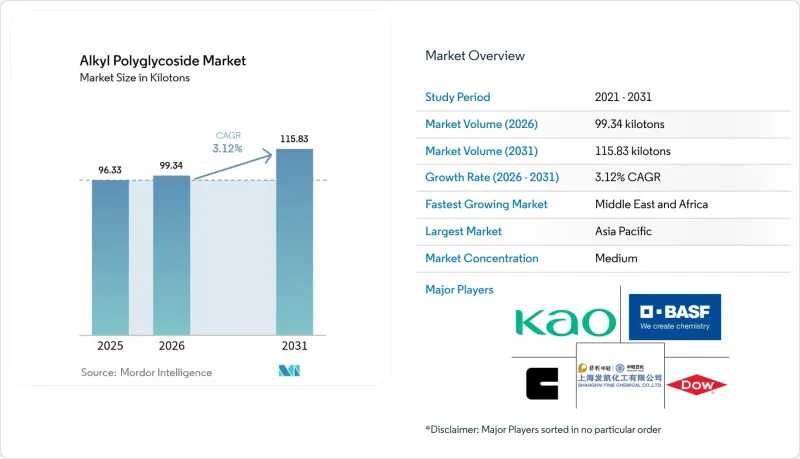
Mordor Intelligence에 의하면, 알킬 폴리글리코시드 시장 규모는 2025년에 96.33 킬로톤, 2026년에 99.34 킬로톤이 되어, 2031년까지 115.83 킬로톤에 이를 것으로 예측되며, 2026년부터 2031년까지 CAGR 3.12%로 성장할 전망입니다.
본 보고서는 제품 유형(지방 알코올, 당류, 옥수수 전분, 식물성 기름, 기타 제품 유형), 용도(퍼스널케어 및 화장품, 홈 케어 제품, 산업용 세정제, 농약, 기타 용도), 지역(아시아태평양, 북미, 유럽, 남미, 중동 및 아프리카)별로 분류되어 있습니다. 시장 전망은 수량(톤) 기준으로 제시되어 있습니다.
세계 알킬 폴리글리코시드 시장 동향 및 인사이트
가정용 및 퍼스널케어 제품에서의 바이오 유래 계면활성제 붐
서유럽 및 북미의 브랜드 소유자에 따르면, 2025년에는 가구의 68%가 가격보다 성분의 투명성을 우선시할 것으로 보이며, 이로 인해 제품 재처방의 경제성이 APG 채택으로 결정적으로 기울고 있습니다. 프록터 앤 갬블(Procter & Gamble)은 의류 관리용 계면활성제 배합량에서 APG의 비율을 12%로 높여, 향후 에톡실레이트 금지 조치의 영향을 완화했습니다. 퍼스널케어 제품 라인에서는 자극을 줄이기 위해 황산염 대신 C8-C10 APG가 채택되고 있는 반면, 유니레버는 APG 조달량을 22% 늘려 알킬 폴리글리코시드 시장을 재량 지출의 변동으로부터 보호하는 수요의 하한선을 강화하고 있습니다.
NPE 및 기타 유해 계면활성제에 대한 규제에 따른 단계적 폐지
2024년 EU REACH 개정안에 따라 소비자용 세제 내 NPE 함유 상한선이 0.01%로 설정됨에 따라, 업계 전반에서 APG로의 전환이 불가피해졌습니다. 헨켈은 2025년 유럽 내 계면활성제 매출 성장의 18%가 NPE에서 APG로의 대체에 기인할 것으로 전망하고, 파일럿 시험에 2,500만 유로를 투자했습니다. 캘리포니아주의 ‘더 안전한 소비자 제품(Safer Consumer Products)’ 프로그램도 유사한 규제를 도입하여 북미 브랜드들의 처방 표준화를 촉진하는 동시에, 지역 외 수요를 확대시켰습니다.
다른 저자극성 계면활성제와의 경쟁
베타인 및 아민옥사이드(amino oxide)는 제형 개발자들이 생분해성뿐만 아니라 거품 안정성과 사용감도 중시하는 프리미엄 퍼스널케어 제품의 제형에서 점유율을 확대되고 있습니다. 특히 코카미도프로파일베타인은 황산염이 함유되지 않은 샴푸에서 뛰어난 거품 밀도와 사용감을 제공하며, 유효 성분 기준으로 C8-C10 APG보다 10-15% 저렴하기 때문에 APG 공급업체에게는 지속적인 가격 측면의 역풍이 되고 있습니다. 에보닉(Evonik)사의 베타인 판매량은 2025년에 전년 대비 8% 증가하여, 비용 관리를 중시하는 중저가 브랜드의 APG 성장률을 상회했습니다. 따라서 알킬 폴리글리코시드 시장은 생분해성 및 탄소 지표를 이유로 높은 가격 책정이 가능한 프리미엄 브랜드로 점점 더 이동하고 있습니다.
부문 분석
2025년에는 지방 알코올계 APG가 판매량의 42.16%를 차지하며, 제품 유형별 알킬 폴리글리코시드 시장에서 가장 큰 점유율을 기록했습니다. 팜 커널 오일과 코코넛 오일의 통합에 힘입은 식물성 오일 유래 제품군은 연평균 성장률(CAGR) 3.58%로 성장하여, 2031년까지 알킬 폴리글리코시드 시장 전체 규모를 상회하는 성장이 예상됩니다. 이러한 전환을 통해 팜유 지속가능성과 관련된 위험이 완화되고 스코프 3 배출량이 감소함에 따라, 공급업체는 유럽의 세제 제조업체 그룹과 다년 계약을 체결하기가 더 쉬워질 것입니다. 옥수수 전분이나 설탕을 원료로 하는 제조 공정은 국산 또는 비유전자변형(비GMO) 원료를 선호하는 북미의 제형 개발자들에게 지지를 받고 있지만, 2025년 옥수수 가격의 급등으로 인해 이익률이 압박을 받아 수입 지방 알코올에 대한 경쟁력이 떨어졌습니다. 효소 처리는 식물성 오일 기반 기질과 호환성이 뛰어나며, 착색체 형성을 방지하고 정제 주기를 단축할 수 있습니다.
하류 시장에서는 일본과 한국의 프리미엄 퍼스널케어 브랜드가 8-12%의 추가 비용이 발생하더라도 저탄소 식물성 오일 유래 APG를 선호하여 채택하고 있는 반면, 인도네시아의 범용 홈 케어 제품 라인은 가격 경쟁력을 유지하기 위해 여전히 지방 알코올 등급에 의존하고 있습니다. 설탕 유래 APG는 여전히 틈새 시장으로 남아 있으며, 비용 전가가 가능한 유럽의 유기농 인증 제품 라인으로 한정되어 있습니다. 합성 알코올계 APG의 용도는 여전히 농약용 보조제로 한정되어 있습니다. 이 분야에서는 규제 당국의 승인 절차가 장기간 소요되어 원료 전환이 저해되고 있으며, 그 결과 단일 원료의 가격 변동에 따른 공급업체에 미치는 영향을 완화하는 하이브리드형 제품 구성이 정착되어 있습니다.
지역별 분석
2025년, 아시아태평양은 전 세계 총 생산량의 45.96%를 차지하며 알킬 폴리글리코시드 시장에서 가장 규모가 큰 지역 점유율을 유지했습니다. 중국 장쑤성과 광둥성에 위치한 통합형 유지화학 단지는 지방알코올을 APG 제조 솥에 직접 공급하여 물류 비용을 최소화하고 있습니다. 인도의 구자라트주 및 타밀나두주에 위치한 세제 산업 중심지에서는 1인당 비누 소비량 증가에 따라 현지 수요가 뒷받침되고 있습니다. 2026년에 NPE 사용을 제한하는 중국의 지침안은 국내 원료 전환을 촉진하여 국내 APG 수요를 강화하는 동시에, 해당 지역의 수급 균형을 안정시킬 가능성이 있습니다. 동남아시아에서는 윌마(Wilmar)와 KLK 올레오(KLK Oleo)가 2만 7,000톤의 통합 생산 능력을 추가함으로써 저비용 수출 거점으로서의 입지를 공고히 하고 있습니다. 한편, 일본과 한국은 효소법으로 제조된 저알레르기성 등급을 중시하는 혁신의 거점 역할을 하고 있습니다.
북미와 유럽은 알킬 폴리글리코시드(APG) 시장 규모에서 공급량은 적지만, 단위당 이익률 면에서는 높은 기여를 하고 있습니다. EU의 REACH 규제와 미국의 ‘세이퍼 초이스(Safer Choice)’ 제도가 APG 채택을 뒷받침하고 있으며, 탄소 가격 제도를 통해 유럽 생산자들은 저탄소 등급 제품에 프리미엄 가격을 책정할 수 있게 되었습니다. 하지만 에너지 집약적인 분말 생산은 수익성 측면에서 역풍에 직면해 있습니다. 헨켈은 에너지 리스크를 완화하기 위해 2025년 APG 수요의 68%를 액상 형태로 조달했습니다. 북미의 유전들은 안정적인 수요원으로 자리 잡고 있어, 소매용 세제 판매량이 정체되더라도 기본 성장세를 뒷받침하고 있습니다.
중동 및 아프리카에서는 걸프 지역 유전 서비스 사업자들이 해양용 유체에 생분해성 계면활성제 사용을 의무화함에 따라 APG 수요가 직접적으로 증가했습니다. 사하라 이남 아프리카에서는 세제 스타트업 기업들이 도시 지역 소비자들에게 ‘강 환경 보전’을 강조하며, 분말 세탁 세제 제품의 대체를 가속화하고 있습니다. 브라질과 아르헨티나는 EU 수출 기준과 관련된 농약 첨가제 시장으로서 여전히 중요하지만, 라틴아메리카 전역에서는 비용에 대한 민감성으로 인해 소비자들의 광범위한 채택이 제한되고 있습니다.
기타 혜택:
- 엑셀 형식 시장 예측(ME) 시트
- 3개월간의 애널리스트 지원
자주 묻는 질문
목차
제1장 서론
제2장 조사 방법
제3장 주요 요약
제4장 시장 구도
제5장 시장 규모와 성장 예측
제6장 경쟁 구도
제7장 시장 기회와 향후 전망
JHS 26.09.11According to Mordor Intelligence, the alkyl polyglycoside market size is projected to be 96.33 kilotons in 2025, 99.34 kilotons in 2026, and reach 115.83 kilotons by 2031, growing at a CAGR of 3.12% from 2026 to 2031.
This report is Segmented by Product Type (Fatty Alcohol, Sugar, Corn-Starch, Vegetable Oil, and Other Product Type), Application (Personal Care and Cosmetics, Home-Care Products, Industrial Cleaners, Agricultural Chemicals, and Other Application), and Geography (Asia-Pacific, North America, Europe, South America, and Middle East and Africa). The Market Forecasts are Provided in Terms of Volume (Tons).
Global Alkyl Polyglycoside Market Trends and Insights
Bio-Based Surfactants Boom in Home and Personal-Care
Brand owners in Western Europe and North America report that 68% of households prioritized ingredient transparency over price in 2025, tipping reformulation economics decisively toward APG inclusion. Procter & Gamble increased APG to 12% of its fabric-care surfactant load, reducing exposure to future ethoxylate bans. Personal-care lines substitute C8-C10 APG for sulfates to curb irritation, while Unilever registered a 22% rise in APG procurement, reinforcing a demand floor that shelters the Alkyl polyglycoside market from swings in discretionary spending.
Regulatory Phase-Out Of NPEs And Other Hazardous Surfactants
An EU REACH amendment in 2024 capped NPEs at 0.01 % in consumer detergents, compelling an industry-wide switch to APG. Henkel attributed 18% of its European surfactant growth in 2025 to NPE-to-APG substitution and invested EUR 25 million in pilot trials. California's Safer Consumer Products program echoed the restriction, nudging North American brands to harmonize formulations and magnifying extraterritorial demand.
Competition From Other Mild Surfactants
Betaines and amine oxides are capturing share in premium personal-care formulations where formulators prioritize foam stability and sensory attributes over biodegradability alone. Cocamidopropyl betaine, in particular, offers superior foam density and skin-feel in sulfate-free shampoos, and it costs 10-15% less than C8-C10 APG on an active-matter basis, creating a persistent pricing headwind for APG suppliers. Evonik's betaine volumes rose 8% year-over-year in 2025, outpacing APG growth in mid-tier brands that prize cost control. The Alkyl polyglycoside market thus leans increasingly on premium labels where biodegradability and carbon metrics can command higher prices.
Other drivers and restraints analyzed in the detailed report include:
- Capacity Additions And Backward Integration Among Fatty-Alcohol Suppliers
- APG Penetration In Industrial Cleaning And Oil-Field Fluids
- High-Energy Demand For Powder-Grade APG Spray-Drying
For complete list of drivers and restraints, kindly check the Table Of Contents.
Segment Analysis
Fatty-alcohol APG dominated at 42.16% volume in 2025, giving this grade the largest Alkyl polyglycoside market share among product types. Vegetable-oil-derived variants, buoyed by palm-kernel and coconut integration, are projected to grow at a 3.58% CAGR and outpace the broader Alkyl polyglycoside market size through 2031. The shift mitigates palm-oil sustainability risk and lowers Scope 3 emissions, helping suppliers secure multi-year contracts with European detergent groups. Corn-starch and sugar routes appeal to North American formulators seeking domestic or non-GMO inputs, yet elevated corn prices in 2025 squeezed margins and reduced competitiveness against imported fatty alcohols. Enzymatic processes show strong compatibility with vegetable-oil substrates, avoiding color-body formation and shortening purification cycles.
Downstream, premium personal-care brands in Japan and South Korea favor low-carbon, vegetable-oil APG even at an 8-12% cost premium, while commodity home-care lines in Indonesia still rely on fatty-alcohol grades for price discipline. Sugar-based APG remains niche, reserved for certified-organic lines in Europe, where cost pass-through is viable. Synthetic-alcohol APG objects remain confined to agrochemical adjuvants where long regulatory approval cycles discourage feedstock changes, reinforcing a hybrid product landscape that cushions suppliers from single-feedstock shocks.
Complete Report Scope:
- By Product Type
- Fatty Alcohol
- Sugar
- Corn-starch
- Vegetable Oil
- Other Product Type
- By Application
- Personal Care and Cosmetics
- Home-care Products
- Industrial Cleaners
- Agricultural Chemicals
- Other Application
- By Geography
- Asia-Pacific
- China
- India
- Japan
- South Korea
- Indonesia
- Thailand
- Malaysia
- Vietnam
- Rest of Asia-Pacific
- North America
- United States
- Canada
- Mexico
- Europe
- Germany
- United Kingdom
- France
- Italy
- Spain
- Nordic Countries
- Turkey
- Russia
- Rest of Europe
- South America
- Brazil
- Argentina
- Colombia
- Rest of South America
- Middle East and Africa
- Saudi Arabia
- United Arab Emirates
- Qatar
- Egypt
- Nigeria
- South Africa
- Rest of Middle East and Africa
- Asia-Pacific
Geography Analysis
Asia-Pacific retained 45.96% of global tonnage in 2025, the largest regional slice of the Alkyl polyglycoside market. Integrated oleochemical complexes in China's Jiangsu and Guangdong provinces stream fatty alcohol directly into APG kettles, minimizing logistics costs. India's detergent heartland in Gujarat and Tamil Nadu underpins local demand as per-capita soap consumption climbs. Draft Chinese guidelines to curtail NPEs in 2026 could spark an internal switch, intensifying domestic APG pull and reinforcing the region's supply-demand balance. Southeast Asia is cementing its role as the low-cost export hub after Wilmar and KLK Oleo added 27,000 t of integrated capacity, while Japan and South Korea act as innovation nodes that reward enzymatically produced, hypoallergenic grades.
North America and Europe contribute smaller volumes but higher unit margins to the Alkyl polyglycoside market size. EU REACH limits and the US Safer Choice scheme encourage APG adoption, and carbon pricing lets European producers levy premiums on low-CO2 grades. Still, energy-intensive powder production faces profitability headwinds; Henkel sourced 68% of its 2025 APG in liquid form to reduce energy exposure. North American oilfields offer a stable demand stream that anchors baseline growth even when retail detergent volumes plateau.
In the Middle East and Africa, Gulf oilfield-service providers mandated biodegradable surfactants in offshore fluids, directly lifting APG offtake. Sub-Saharan detergent start-ups promote clean rivers messaging to urban consumers, accelerating substitution in powder laundry products. Brazil and Argentina remain important for agrochemical adjuvants linked to EU export standards, while cost sensitivity tempers wider consumer adoption across Latin America.
- BASF
- Brillachem
- Clariant
- Croda International plc
- Dow
- Evonik Industries
- FENCHEM
- Galaxy Surfactants
- Kao Corporation
- Pilot Chemical Corp.
- Seppic (Arkema Group)
- Shanghai Chenhua International Trade Co., Ltd.
- Shanghai Fine Chemical Co., Ltd.
- Shanghai Sunwise Chemical Co., Ltd
- Silver Fern Chemical LLC.
Additional Benefits:
- The market estimate (ME) sheet in Excel format
- 3 months of analyst support
TABLE OF CONTENTS
1 Introduction
- 1.1 Study Assumptions and Market Definition
- 1.2 Scope of the Study
2 Research Methodology
3 Executive Summary
4 Market Landscape
- 4.1 Market Overview
- 4.2 Market Drivers
- 4.2.1 Growing demand for bio-based surfactants in home and personal-care formulations
- 4.2.2 Regulatory phase-out of nonyl-phenol ethoxylates (NPEs) and other hazardous surfactants
- 4.2.3 Capacity additions and backward integration of fatty-alcohol suppliers
- 4.2.4 Rising adoption of APG hydrotropes in alkaline industrial cleaning and oil-field fluids
- 4.2.5 Cost-cutting high-gravity impinging-stream reactors enabling <3:1 alcohol-to-glucose ratios
- 4.3 Market Restraints
- 4.3.1 Volatility in natural fatty-alcohol and starch feedstock prices
- 4.3.2 Availability of alternative mild surfactants (e.g., betaines, amino-oxides)
- 4.3.3 Stringent RSPO/deforestation-free palm supply audits tightening raw-material access
- 4.4 Value Chain Analysis
- 4.5 Porter's Five Forces
- 4.5.1 Bargaining Power of Suppliers
- 4.5.2 Bargaining Power of Buyers
- 4.5.3 Threat of New Entrants
- 4.5.4 Threat of Substitutes
- 4.5.5 Degree of Competition
5 Market Size and Growth Forecasts (Volume)
- 5.1 By Product Type
- 5.1.1 Fatty Alcohol
- 5.1.2 Sugar
- 5.1.3 Corn-starch
- 5.1.4 Vegetable Oil
- 5.1.5 Other Product Type
- 5.2 By Application
- 5.2.1 Personal Care and Cosmetics
- 5.2.2 Home-care Products
- 5.2.3 Industrial Cleaners
- 5.2.4 Agricultural Chemicals
- 5.2.5 Other Application
- 5.3 By Geography
- 5.3.1 Asia-Pacific
- 5.3.1.1 China
- 5.3.1.2 India
- 5.3.1.3 Japan
- 5.3.1.4 South Korea
- 5.3.1.5 Indonesia
- 5.3.1.6 Thailand
- 5.3.1.7 Malaysia
- 5.3.1.8 Vietnam
- 5.3.1.9 Rest of Asia-Pacific
- 5.3.2 North America
- 5.3.2.1 United States
- 5.3.2.2 Canada
- 5.3.2.3 Mexico
- 5.3.3 Europe
- 5.3.3.1 Germany
- 5.3.3.2 United Kingdom
- 5.3.3.3 France
- 5.3.3.4 Italy
- 5.3.3.5 Spain
- 5.3.3.6 Nordic Countries
- 5.3.3.7 Turkey
- 5.3.3.8 Russia
- 5.3.3.9 Rest of Europe
- 5.3.4 South America
- 5.3.4.1 Brazil
- 5.3.4.2 Argentina
- 5.3.4.3 Colombia
- 5.3.4.4 Rest of South America
- 5.3.5 Middle East and Africa
- 5.3.5.1 Saudi Arabia
- 5.3.5.2 United Arab Emirates
- 5.3.5.3 Qatar
- 5.3.5.4 Egypt
- 5.3.5.5 Nigeria
- 5.3.5.6 South Africa
- 5.3.5.7 Rest of Middle East and Africa
- 5.3.1 Asia-Pacific
6 Competitive Landscape
- 6.1 Market Concentration
- 6.2 Strategic Moves
- 6.3 Market Share (%)/Ranking Analysis
- 6.4 Company Profiles (includes Global level Overview, Market level overview, Core Segments, Financials as available, Strategic Information, Market Rank/Share for key companies, Products and Services, and Recent Developments)
- 6.4.1 BASF
- 6.4.2 Brillachem
- 6.4.3 Clariant
- 6.4.4 Croda International plc
- 6.4.5 Dow
- 6.4.6 Evonik Industries
- 6.4.7 FENCHEM
- 6.4.8 Galaxy Surfactants
- 6.4.9 Kao Corporation
- 6.4.10 Pilot Chemical Corp.
- 6.4.11 Seppic (Arkema Group)
- 6.4.12 Shanghai Chenhua International Trade Co., Ltd.
- 6.4.13 Shanghai Fine Chemical Co., Ltd.
- 6.4.14 Shanghai Sunwise Chemical Co., Ltd
- 6.4.15 Silver Fern Chemical LLC.
7 Market Opportunities and Future Outlook
- 7.1 White-space and Unmet-need Assessment


