|
시장보고서
상품코드
2124125
알파 메틸스티렌 시장 : 시장 점유율 분석, 업계 동향 및 통계, 성장 예측(2026-2031년)Alpha Methylstyrene - Market Share Analysis, Industry Trends & Statistics, Growth Forecasts (2026 - 2031) |
||||||
 Mordor Intelligence
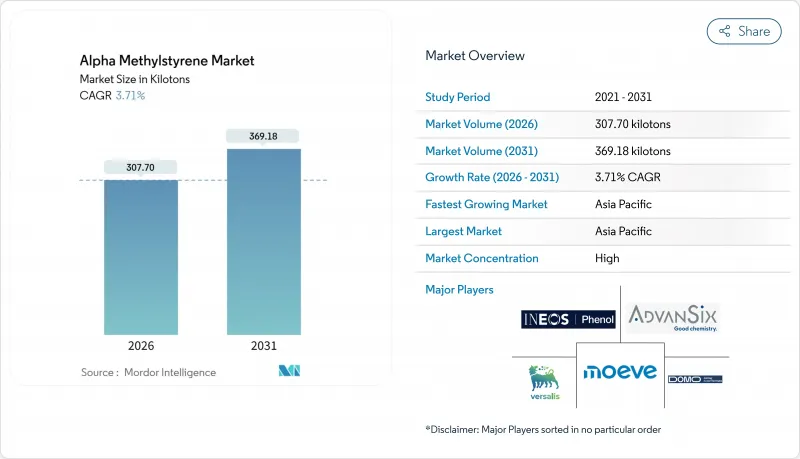
Mordor Intelligence에 의하면, 알파 메틸스티렌 시장 규모는 2026년에 307.70 킬로톤으로 추정되고, 예측 기간(2026-2031년) CAGR 3.71%로 성장을 지속할 전망이며, 2031년에는 369.18 킬로톤에 이를 전망입니다.
본 보고서는 순도별(99% 이상의 고순도 AMS 및 99% 미만의 표준 등급 AMS), 형태별(액체 및 고체), 용도별(ABS 제조, 플라스틱 첨가제 및 중간체 등), 최종 사용자 산업별(자동차, 타이어, 플라스틱 등), 지역별(아시아태평양, 북미, 유럽 등)로 분류되어 있습니다. 시장 예측은 수량(톤) 기준으로 제시되어 있습니다.
세계의 알파메틸스티렌 시장 동향 및 인사이트
자동차용 경량 부품에 대한 수요 급증
자동차 제조업체들은 열변형 온도를 100℃ 이상으로 높이는 동시에 부품 무게를 약 5분의 1로 줄이기 위해 알파 메틸스티렌 개질 ABS를 지정하고 있습니다. 이는 배터리 팩이 차량 내 공간을 압박하는 상황에서 필수적인 이점이 됩니다. INEOS Styrolution사의 2020년 특허에는 내장 트림에 대한 엄격한 VOC 및 열적 요건을 충족하는 최대 10 wt%의 알파 메틸스티렌을 포함하는 ABS 등급이 기재되어 있습니다. 중국의 전기차 생산이 견조하게 이어지면서 이러한 수지의 처리량은 높은 수준을 유지하고 있으며, 북미 공급업체들도 유사한 배합 전환을 추진하고 있습니다. 전기차 비중이 가속화되고 기존의 내연기관 프로그램이 단계적으로 폐지됨에 따라, 채택은 중기적으로 정점에 달할 것으로 예측됩니다.
내열성 전자 봉지재 소비 확대
현재 반도체 패키징 분야에서는 260°C의 리플로우 공정에서도 뒤틀림이 발생하지 않는 폴리머가 요구되고 있습니다. 고순도 알파 메틸스티렌은 이 기준을 충족할 뿐만 아니라 RoHS 및 REACH 규정도 준수하므로, 동아시아 전역에서 생산되는 노트북, 스마트폰, IoT 기기의 외장재에 사용할 수 있습니다. FDA는 몇 가지 CFR 조항에 근거하여 간접적인 식품 접촉을 허용하고 있으며, 이로 인해 가전제품 및 포장재에 대한 수요가 더욱 확대되고 있습니다. 아시아태평양이 전 세계 전자기기 조립의 70% 이상을 차지하고 있는 만큼, 이러한 수요 요인은 중기적으로 견인력을 유지할 전망입니다.
유해 폐기물 발생 및 쿠멘에 대한 REACH/EPA 규제 강화
쿠멘이 유해 대기 오염 물질로 분류됨에 따라, VOC(휘발성 유기 화합물) 감축을 위한 설비 투자가 촉진되고 있습니다. 한편, RCRA(자원 보존 및 회수법) 규제에 따라 인화점 53.9°C인 알파 메틸스티렌 폐기물의 보관 기간이 제한되고 있습니다. 소규모 독립 제조업체들은 이에 따른 규정 준수 비용으로 어려움을 겪고 있어, 업계 재편이 가속화되고 있습니다.
부문 분석
고순도(99% 이상) 알파 메틸스티렌은 2025년 생산량의 71.35%를 차지했으며, 2031년까지의 연평균 성장률(CAGR)은 4.69%로 예측되는데, 이는 표준 등급의 2배에 달하는 속도입니다. 전자 및 제약 업계의 구매자들은 페놀 함량이 20ppm 미만인 벤젠 프리 소재를 강력히 요구하고 있으며, DOMO Chemicals와 같은 제조업체들은 10-20%의 가격 프리미엄을 확보하고 있습니다. 따라서 인쇄 회로 기판 및 의료기기 공급망 전반에 걸쳐 검증 프로토콜이 엄격해짐에 따라, 고순도 알파 메틸스티렌 시장 규모는 그 우위를 더욱 확대해 나갈 전망입니다. 한편, 상품화된 표준 등급은 아시아 지역공급 과잉으로 여전히 어려움을 겪고 있어 차별화의 여지가 제한적입니다.
ASTM의 전용 시험 방법 D7977에 따라 하류 구매자는 폴리머 내 불순물을 더욱 엄격하게 관리할 수 있게 되어, 알파 메틸스티렌 시장의 양극화가 더욱 심화되고 있습니다. 현장에서 정제를 수행하는 통합형 복합 시설은 공급의 연속성을 보장할 수 있기 때문에 반도체, 진단용 프로브, 열성형 의료용 트레이 등 고사양 용도 분야에서 최적의 파트너로서의 입지를 확고히 하고 있습니다.
2025년 출하량의 90.88%를 차지한 액상 알파 메틸스티렌이 주류를 이루고 있습니다. 이는 연속식 ABS 및 SAN 중합 플랜트가 계량된 액상 원료공급에 의존하고 있기 때문입니다. 이러한 형태의 알파 메틸스티렌은 여전히 높은 시장 점유율을 유지하고 있지만, VOC(휘발성 유기 화합물) 노출에 대한 규제 강화로 인해 고체 플레이크 시장은 연평균 성장률(CAGR) 4.35%로 확대되고 있습니다.
플레이크 형태의 원료는 밀폐 용기 내에서 용융되기 때문에 증발에 의한 손실을 줄일 수 있어, 엄격한 작업장 노출 기준을 준수하기가 용이합니다. 대용량 유기 화학 물질에 관한 EU 지침은 이러한 방식을 권장하고 있으며, 환경 허가 기준이 가장 엄격한 유럽과 일본에서 고체 플레이크 시장의 성장세를 뒷받침하고 있습니다.
지역별 분석
아시아태평양은 2025년에 세계 생산량의 56.06%를 차지한 것으로 평가되었으며, 2031년까지 연평균 성장률(CAGR) 5.62%로 성장할 것으로 전망됩니다. 이는 중국에 위치한 연산 2,000만 톤 규모의 정유시설와, 벤젠,페놀, 그리고 궁극적으로는 알파 메틸스티렌을 생산하는 방향족 유닛을 결합한 거대 복합 시설이 배경에 있습니다. 절강석유화학과 헝리석유화학의 거점은 이러한 통합 모델을 상징하며, 이로 인해 일본이나 유럽의 구형 플랜트는 가동 중단을 피할 수 없게 되었습니다.
북미는 생산량 점유율이 소폭 감소하고 있지만, 전자 및 헬스케어용 고순도 제품 생산에 특화되어 있습니다. 2023년 이네오스 페놀(INEOS Phenol)이 미쓰이 페놀 싱가포르(Mitsui Phenol Singapore)를 인수한 것은 아시아 고객과의 근접성을 확보하고 원료 리스크를 분산시키려는 해당 지역의 노력을 여실히 보여줍니다. 유럽은 REACH 규제의 강화로 어려움을 겪고 있지만, 각 생산 기업들은 제올라이트 알킬화 및 VOC 회수 기술에 투자하여 제품 품질 향상과 배출량 감축을 도모함으로써 프리미엄 시장에서의 입지를 유지하고 있습니다.
중동 및 아프리카 및 남미는 수요의 대부분을 수입에 의존하는 신흥 시장입니다. 걸프 지역의 저비용 나프타는 향후 알파메틸스티렌 생산 공장의 기반이 될 수 있지만, 하류 ABS 및 SAN 클러스터가 존재하지 않아 단기적인 전망은 어두워지고 있습니다. 전반적으로 2031년까지 이 세 개의 확고한 지역이 알파메틸스티렌 시장 거래의 90% 이상을 계속 차지할 것으로 전망됩니다.
기타 혜택 :
- 엑셀 형식 시장 예측(ME) 시트
- 3개월간의 애널리스트 지원
자주 묻는 질문
목차
제1장 서론
제2장 조사 방법
제3장 주요 요약
제4장 시장 구도
제5장 시장 규모 및 성장 예측
제6장 경쟁 구도
제7장 시장 기회 및 향후 전망
AJY 26.09.09According to Mordor Intelligence, the alpha methylstyrene market size is estimated at 307.70 kilotons in 2026, and is expected to reach 369.18 kilotons by 2031, at a CAGR of 3.71% during the forecast period (2026-2031).
This report is Segmented by Purity (Greater Than or Equal To 99% High-Purity AMS and Less Than 99% Standard Grade AMS), Form (Liquid and Solid), Application (ABS Manufacture, Plastic Additives and Intermediates, and More), End-User Industry (Automotive, Tire, Plastics, and More), and Geography (Asia-Pacific, North America, Europe, and More). The Market Forecasts are Provided in Terms of Volume (Tons).
Global Alpha Methylstyrene Market Trends and Insights
Surging Demand in Lightweight Automotive Parts
Automakers specify Alpha-Methylstyrene-modified ABS to push heat-deflection temperatures beyond 100 °C while trimming component weight by nearly one-fifth, an essential gain as battery packs crowd interior space. A 2020 patent from INEOS Styrolution documents ABS grades with up to 10 wt% Alpha-Methylstyrene that meet strict VOC and thermal targets for interior trims. Strong electric-vehicle output in China keeps the throughput of such resins high, and North American suppliers are mirroring the formulation shift. Adoption should crest in the medium term as the EV mix accelerates and legacy internal-combustion programs sunset.
Rising Consumption in Heat-Resistant Electronic Encapsulants
Semiconductor packaging now requires polymers that survive 260 °C reflow without warping. High-purity Alpha-Methylstyrene meets this bar and complies with RoHS plus REACH, enabling its use in laptop, smartphone, and IoT housings produced across East Asia. The FDA permits indirect food contact under several CFR clauses, which further broadens appliance and packaging demand. With Asia-Pacific responsible for more than 70% of global electronics assembly, the driver maintains a mid-term push.
Hazardous Waste Streams and Stricter REACH/EPA Limits on Cumene
Cumene's classification as a hazardous air pollutant drives capital spending on VOC abatement, while RCRA rules curb the storage time of Alpha-Methylstyrene wastes with a flash point of 53.9 °C. Smaller standalone producers struggle with the resulting compliance cost, accelerating consolidation.
Other drivers and restraints analyzed in the detailed report include:
- Growing Use in Medical Devices Boosting Demand
- Emergence of Para-Cumylphenol as Battery-Electrolyte Additive
- Volatility in Crude-Derived Feedstock Pricing
For complete list of drivers and restraints, kindly check the Table Of Contents.
Segment Analysis
High-purity (>=99%) Alpha-Methylstyrene controlled 71.35% of 2025 volume and is forecast for a 4.69% CAGR to 2031, twice the pace of standard grades. Electronics and pharmaceutical buyers insist on benzene-free material with phenol below 20 ppm, allowing producers such as DOMO Chemicals to fetch 10-20% price premiums. The Alpha-Methylstyrene market size for high-purity volumes is therefore set to widen its lead as validation protocols tighten across printed-circuit and medical-device supply chains. Conversely, the commoditized standard grade remains burdened by Asian oversupply and has limited scope for differentiation.
ASTM's dedicated D7977 test method now gives downstream buyers tighter control over polymer contaminants, reinforcing the bifurcation of the Alpha-Methylstyrene market. Integrated complexes that purify on-site can guarantee supply continuity, positioning themselves as partners of choice for high-spec applications in semiconductors, diagnostic probes, and thermoformed medical trays.
Liquid Alpha-Methylstyrene dominates with 90.88% of 2025 shipments because continuous ABS and SAN polymerization plants depend on metered liquid feed. The Alpha-Methylstyrene market share for this form remains elevated, yet regulatory focus on VOC exposure is spurring a 4.35% CAGR in solid flakes.
Flaked material melts in sealed vessels, curbing vapor loss and easing compliance with tight workplace-exposure limits. EU guidelines for large-volume organic chemicals favor such approaches, giving solids momentum in Europe and Japan, where environmental permitting standards are strictest.
Complete Report Scope:
- By Purity
- Greater Than or Equal To 99% High-Purity AMS
- Less Than 99 % Standard Grade AMS
- By Form
- Liquid (Bulk)
- Solid (Flaked)
- By Application
- ABS Manufacture
- Plastic Additives and Intermediates
- Adhesives
- Coatings
- Other Applications
- By End-user Industry
- Automotive
- Tire
- Plastics
- Electronics
- Other Applications
- By Geography
- Asia-Pacific
- China
- India
- Japan
- South Korea
- ASEAN Countries
- Rest of Asia
- North America
- United States
- Canada
- Mexico
- Europe
- Germany
- United Kingdom
- France
- Italy
- Spain
- NORDIC Countries
- Rest of Europe
- South America
- Brazil
- Argentina
- Rest of South America
- Middle East and Africa
- Saudi Arabia
- South Africa
- Rest of Middle East and Africa
- Asia-Pacific
Geography Analysis
Asia-Pacific held 56.06% of global volume in 2025 and is projected to grow at a 5.62% CAGR to 2031 on the back of mega complexes in China that pair 20 million tons/year refineries with aromatics units churning out benzene, phenol, and ultimately Alpha-Methylstyrene. The hubs of Zhejiang Petroleum & Chemical and Hengli Petrochemical epitomize this integrated model, forcing older Japanese and European plants offline.
North America, while losing some volume share, specializes in high-purity output for electronics and healthcare. INEOS Phenol's 2023 takeover of Mitsui Phenols Singapore underscores the region's drive to secure Asian customer proximity and diversify feedstock risk. Europe grapples with tighter REACH rules, yet its producers invest in zeolite alkylation and VOC capture that elevate product quality and cut emissions, maintaining a premium foothold.
The Middle East and Africa and South America represent nascent pockets that import most of their needs. Low-cost naphtha in the Gulf could anchor future Alpha-Methylstyrene units, but the absence of downstream ABS and SAN clusters dilutes short-term prospects. Overall, the three established regions will continue to account for more than 90% of Alpha-Methylstyrene market transactions to 2031.
- Advansix
- ALTIVIA
- Chang Chun Group
- Deepak
- Domo Chemicals
- Eni S.p.A.
- INEOS
- Kraton Corporation
- KUMHO PandB CHEMICALS.,INC.
- LG Chem
- Mitsubishi Chemical Group Corporation
- Moeve (Cepsa)
- ROSNEFT
- Seqens
- SI Group, Inc.
- SIBUR Holding PJSC
- Solvay
- Sumitomo Chemical Co., Ltd.
- Yangzhou Lida Resin Co.,Ltd.
Additional Benefits:
- The market estimate (ME) sheet in Excel format
- 3 months of analyst support
TABLE OF CONTENTS
1 Introduction
- 1.1 Study Assumptions and Market Definition
- 1.2 Scope of the Study
2 Research Methodology
3 Executive Summary
4 Market Landscape
- 4.1 Market Overview
- 4.2 Market Drivers
- 4.2.1 Surging demand in lightweight automotive parts
- 4.2.2 Rising consumption in heat-resistant electronic encapsulants
- 4.2.3 Growing use in medical devices bossting demand
- 4.2.4 Emergence of para-cumylphenol as battery-electrolyte additive
- 4.2.5 Closed-loop AMS recovery in caprolactam complexes boosts on-site reuse
- 4.3 Market Restraints
- 4.3.1 Hazardous waste streams and stricter REACH/EPA limits on cumene
- 4.3.2 Volatility in crude-derived feedstock pricing
- 4.3.3 Rapid shift toward bio-based alpha-methyl-beta-styrene analogues in 3-D-printing resins
- 4.4 Value Chain Analysis
- 4.5 Porters Five Forces
- 4.5.1 Threat of New Entrants
- 4.5.2 Bargaining Power of Buyers
- 4.5.3 Bargaining Power of Suppliers
- 4.5.4 Threat of Substitutes
- 4.5.5 Degree of Competition
5 Market Size and Growth Forecasts (Volume)
- 5.1 By Purity
- 5.1.1 Greater Than or Equal To 99% High-Purity AMS
- 5.1.2 Less Than 99 % Standard Grade AMS
- 5.2 By Form
- 5.2.1 Liquid (Bulk)
- 5.2.2 Solid (Flaked)
- 5.3 By Application
- 5.3.1 ABS Manufacture
- 5.3.2 Plastic Additives and Intermediates
- 5.3.3 Adhesives
- 5.3.4 Coatings
- 5.3.5 Other Applications
- 5.4 By End-user Industry
- 5.4.1 Automotive
- 5.4.2 Tire
- 5.4.3 Plastics
- 5.4.4 Electronics
- 5.4.5 Other Applications
- 5.5 By Geography
- 5.5.1 Asia-Pacific
- 5.5.1.1 China
- 5.5.1.2 India
- 5.5.1.3 Japan
- 5.5.1.4 South Korea
- 5.5.1.5 ASEAN Countries
- 5.5.1.6 Rest of Asia
- 5.5.2 North America
- 5.5.2.1 United States
- 5.5.2.2 Canada
- 5.5.2.3 Mexico
- 5.5.3 Europe
- 5.5.3.1 Germany
- 5.5.3.2 United Kingdom
- 5.5.3.3 France
- 5.5.3.4 Italy
- 5.5.3.5 Spain
- 5.5.3.6 NORDIC Countries
- 5.5.3.7 Rest of Europe
- 5.5.4 South America
- 5.5.4.1 Brazil
- 5.5.4.2 Argentina
- 5.5.4.3 Rest of South America
- 5.5.5 Middle East and Africa
- 5.5.5.1 Saudi Arabia
- 5.5.5.2 South Africa
- 5.5.5.3 Rest of Middle East and Africa
- 5.5.1 Asia-Pacific
6 Competitive Landscape
- 6.1 Market Concentration
- 6.2 Strategic Moves (Mergers and Acquisitions, JVs, Capacity Expansions)
- 6.3 Market Share(%)/Ranking Analysis
- 6.4 Company Profiles {(includes Global level Overview, Market level overview, Core Segments, Financials as available, Strategic Information, Products and Services, and Recent Developments)}
- 6.4.1 Advansix
- 6.4.2 ALTIVIA
- 6.4.3 Chang Chun Group
- 6.4.4 Deepak
- 6.4.5 Domo Chemicals
- 6.4.6 Eni S.p.A.
- 6.4.7 INEOS
- 6.4.8 Kraton Corporation
- 6.4.9 KUMHO PandB CHEMICALS.,INC.
- 6.4.10 LG Chem
- 6.4.11 Mitsubishi Chemical Group Corporation
- 6.4.12 Moeve (Cepsa)
- 6.4.13 ROSNEFT
- 6.4.14 Seqens
- 6.4.15 SI Group, Inc.
- 6.4.16 SIBUR Holding PJSC
- 6.4.17 Solvay
- 6.4.18 Sumitomo Chemical Co., Ltd.
- 6.4.19 Yangzhou Lida Resin Co.,Ltd.
7 Market Opportunities and Future Outlook
- 7.1 White-space and Unmet-Need Assessment