|
시장보고서
상품코드
2124140
엘리베이터 제어 시장 : 점유율 분석, 업계 동향과 통계, 성장 예측(2026-2031년)Elevator Control - Market Share Analysis, Industry Trends & Statistics, Growth Forecasts (2026 - 2031) |
||||||
 Mordor Intelligence
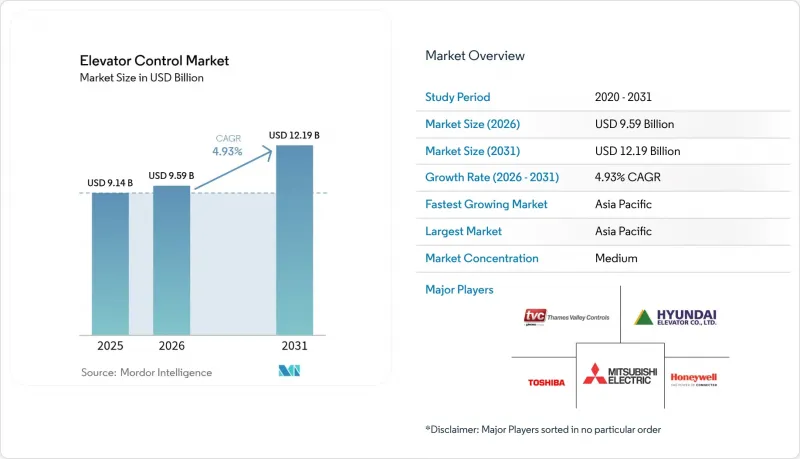
Mordor Intelligence에 의하면, 엘리베이터 제어 시장 규모는 2025년 91억 4,000만 달러에서 2026년에는 95억 9,000만 달러로 확대되어 2026년부터 2031년까지 CAGR 4.93%로 성장을 지속하여, 2031년에는 121억 9,000만 달러에 이를 것으로 예측됩니다.
본 보고서는 용도(주거용, 상업용 등), 구성 요소(컨트롤러, 드라이브 및 인버터 등), 제어 시스템 유형(기존 릴레이식, 마이크로프로세서식, 목적지 제어 시스템 등), 엘리베이터 기술(트랙션식, 기계실 없는 트랙션식 등) 및 지역별로 분류되어 있습니다. 시장 예측은 금액(달러) 기준으로 제시되어 있습니다.
전 세계 엘리베이터 제어 시장 동향 및 인사이트력
첨단 기술의 급속한 도입
각 엘리베이터 업체들은 인공지능(AI)을 탑재하여 승객 흐름, 과거 이용 현황, 실시간 탑승률 데이터를 분석함으로써 대기 시간을 단축하고, 기존 제어 시스템에 비해 에너지 사용량을 최대 30%까지 절감하고 있습니다. 클라우드에 연결된 센서가 실시간 성과 지표를 분석 대시보드로 전송함으로써, 고장이 발생하기 몇 주 전에 예측 경보를 발령할 수 있게 되었습니다. 제어반 내에 탑재된 엣지 프로세서는 네트워크 연결이 끊긴 경우에도 응답성을 유지하여, 서비스 중단 시에도 적절한 배차 품질을 보장합니다. 이러한 기능 세트는 입주자 경험과 에너지 효율 평가를 중시하는 고급 오피스 빌딩에서 호평을 받고 있습니다. 동시에, 사후 장착 키트를 통해 중급급 건물에도 유사한 기능이 도입되면서, 엘리베이터 제어 시장은 신축 건물에 대한 수요에 그치지 않고 확대되고 있습니다.
고층 빌딩 및 지하철에 대한 인프라 투자
중국, 인도, 인도네시아, 사우디아라비아의 메가 프로젝트에서는 지하철 허브나 복합 용도의 고층 빌딩과 통합된 목적지 지정형 엘리베이터 등 수직 운송 인프라에 사상 최대 규모의 예산이 배정되고 있습니다. 스마트 시티 구상의 추진에 따라 엘리베이터 제어 시스템은 보다 광범위한 빌딩 관리 및 스마트 그리드 생태계에 통합되어, 개방형 프로토콜 및 배터리 백업 기능이 탑재된 비상 구동 장치를 지원하는 컨트롤러에 대한 수요를 견인하고 있습니다. 2030년까지 전망이 확실한 자금 조달을 바탕으로, 각 OEM 기업들은 아시아태평양 및 걸프 지역에서 현지 생산 거점과 서비스 센터를 확대할 자신감을 가지고 있으며, 고성장 지역에서의 선구자로서의 우위를 강화하고 있습니다.
고액의 초기 설비 투자
컨트롤러를 전면 교체하는 데는 대당 15,000-5만 달러의 비용이 소요되며, 이에 수반되는 전기 공사 및 IT 관련 작업으로 인해 20-30%의 추가 비용이 발생할 수 있습니다. 가격에 민감한 신흥 시장에서는 에너지 절약 효과를 기대할 수 있음에도 불구하고, 대출 기간이 짧고 금리가 높기 때문에 소유주들은 업그레이드를 미루고 있습니다. 또한 일시적인 서비스 중단도 임차인의 발목을 잡고 있으며, 그 결과 건물주는 영업 시간 외에 높은 인건비를 지불하며 공사를 진행하게 되어 투자 회수 기간이 장기화되고 있습니다.
부문 분석
2025년, 상업용 빌딩은 엘리베이터 제어 시장 규모에 41억 9,000만 달러를 기여하며 45.80%의 점유율을 유지했습니다. 이는 부동산 관리 회사가 입주자 경험을 향상시키기 위해 정교한 목적지 지정 제어 및 원격 모니터링 시스템을 요구했기 때문입니다. LEED 및 BREEAM과 같은 에너지 벤치마킹 프로그램으로 인해 회생 구동 시스템과 AI 기반 교통량 최적화 모듈의 도입이 가속화되었습니다. 한편, 산업 및 물류 시설의 연평균 성장률(CAGR) 6.05%라는 전망은 창고 관리 소프트웨어와 원활하게 통합되는 수직 이송 모듈에 대한 전자상거래 사업자들의 강력한 수요를 뒷받침하고 있습니다.
주거 부문에서는 엘리베이터 호출을 모바일 인증 정보 및 건물 보안 시스템과 연동하는 스마트 홈 생태계를 배경으로 성장이 가속화되고 있습니다. 공항 및 지하철역을 포함한 인프라 및 공공시설에서는 다수의 승객을 수용하기 위해 파손 행위에 대한 내성이 있는 홀용 설비 및 이중화된 안전 릴레이가 요구되고 있습니다. 모든 용도에서 소유주가 에너지 비용 절감을 도모하고 EN 81-70 등 장애인 접근성 관련 규정을 준수하기를 요구함에 따라 개보수 수요가 증가하고 있습니다. 특히 상업용 부동산 소유주들은 상세한 승차 데이터를 수집하여 입주율 분석에 활용하고, 이를 공간 이용 전략 수립에 활용하는 컨트롤러를 높이 평가하고 있으며, 이러한 효과가 엘리베이터 제어 시장의 서비스 수익 주기를 강화하고 있습니다.
컨트롤러는 안전 로직, 그룹 디스패치, 네트워크 연결을 제어하는 중추적인 역할을 하며, 2025년 매출의 38.20%를 차지하고 있습니다. 컨트롤러 업그레이드는 여전히 현대화 패키지의 핵심이며, 이 구성 요소와 관련된 엘리베이터 제어 시장 점유율이 지역을 불문하고 폭넓은 기반을 유지할 것임을 보장합니다. 그러나 각 OEM 업체들이 구독형 대시보드, 사이버 보안 업데이트 및 예측 유지보수 엔진을 추진하고 있어, 소프트웨어 및 연결 플랫폼은 2031년까지 연평균 성장률(CAGR) 6.25%로 성장할 전망입니다.
드라이브 및 인버터의 출하량은 안정적인 추세를 보이고 있습니다. 이는 전력 소비를 억제하고 회생 제동을 가능하게 하기 위해 모든 현대화 공사에서 고효율 가변 전압 드라이브가 채택되고 있기 때문입니다. 홀 고정 장치 및 COP/LOP 패널은 비접촉식 및 모바일 지원 인터페이스로 변화하고 있으며, 이러한 변화는 팬데믹 이후의 위생에 대한 기대감에 의해 가속화되고 있습니다. 상태 모니터링이 표준화됨에 따라 센서 및 I/O 모듈도 보급되고 있습니다. 전반적으로 가치는 하드웨어의 이익률에서 정기적인 소프트웨어 사용료로 이동하고 있으며, 이러한 변화는 엘리베이터 제어 시장 전체의 수익 모델을 재구축하고 있습니다.
지역별 분석
아시아태평양은 2025년 매출의 43.30%를 차지하며, 이는 풍부한 신축 프로젝트 파이프라인과 스마트 시티 확산에 대한 정책적 지원을 반영한 것입니다. 중국의 도시 재생 계획과 인도의 ‘100개 스마트 시티’ 프로그램에 힘입어 컨트롤러에 대한 수요는 지속적으로 증가할 것으로 전망됩니다. 한편, 동남아시아 국가들에서는 제한된 설치 공간을 해결하기 위해 기계실 없는 설계가 채택되고 있습니다. 현지 OEM 조립 공장을 통해 리드 타임이 단축되고, 지역 규제에 맞춘 기능 맞춤화가 가능해짐에 따라 엘리베이터 제어 시장은 심각한 환율 충격의 영향을 덜 받게 되었습니다.
북미는 현대화의 호기를 맞이한 성숙한 설치 기반을 갖추고 있습니다. 캘리포니아주의 내진 안전 기준 개정이나 뉴욕시의 도어 잠금 장치 모니터링 요건 등 법규 제정의 업데이트로 인해, 소유주들은 1990년대 중반에 설치된 컨트롤러의 교체를 촉진하고 있습니다. 예지 보전 구독 서비스는 가동 시간 지표를 중시하는 부동산 투자 신탁(REIT)에서 호평을 받고 있으며, 프리미엄 가격 책정을 뒷받침하고 있습니다. 또한, 캐나다의 친환경 건축 정책에 따라 회생 구동 장치 및 에너지 보고 대시보드의 도입이 가속화되고 있습니다.
유럽에서는 EN 81-20/50 규격 준수에 따라 안전성과 접근성이 조달 기준의 최우선 과제가 되어 시장이 안정적입니다. 보급률이 높기 때문에 성장은 개보수 공사에 의존하고 있지만, 지속가능성에 대한 강력한 노력으로 인해 목적지 지정 제어 및 에너지 회수 하드웨어 도입이 진행되고 있습니다. 한편, 중동 및 아프리카에서는 걸프 지역의 메가 프로젝트에서 그린필드 건설이 급속히 진행되고 있어, 방진 기능을 갖춘 기후 변화에 강한 컨트롤러가 요구되고 있습니다. 라틴아메리카에서는 경제의 완만한 회복에 따라 신규 설치가 증가하고 있지만, 환율 변동이 설비 투자를 억제하고 있어 엘리베이터 제어 시장의 전환이 일부 정체되어 있습니다.
기타 혜택:
- 엑셀 형식 시장 예측(ME) 시트
- 3개월간의 애널리스트 지원
자주 묻는 질문
목차
제1장 서론
제2장 조사 방법
제3장 주요 요약
제4장 시장 구도
제5장 시장 규모와 성장 예측
제6장 경쟁 구도
제7장 시장 기회와 향후 전망
JHSAccording to Mordor Intelligence, the elevator control market size is expected to grow from USD 9.14 billion in 2025 to USD 9.59 billion in 2026 and is forecast to reach USD 12.19 billion by 2031 at 4.93% CAGR over 2026-2031.
This report is Segmented by Application (Residential, Commercial, and More), Component (Controllers, Drives and Inverters, and More), Control-System Type (Conventional Relay-Based, Microprocessor-Based, Destination-Control Systems, and More), Elevator Technology (Traction, Machine-Room-Less Traction, and More), and Geography. The Market Forecasts are Provided in Terms of Value (USD).
Global Elevator Control Market Trends and Insights
Rapid Implementation of Advanced Technologies
Elevator groups are embedding artificial intelligence to analyze passenger flow, historical traffic, and real-time occupancy data, trimming wait times and cutting energy use by as much as 30% compared with conventional controls. Cloud-connected sensors feed live performance metrics to analytics dashboards, enabling predictive alerts weeks before a failure point. Edge processors resident in the controller cabinet maintain responsiveness even when network connectivity drops, ensuring dispatch quality during service interruptions. The feature set appeals to premium office towers that value tenant experience and energy-benchmark ratings. Simultaneously, retrofit kits are bringing similar capability to mid-tier properties, expanding the elevator control market beyond new build opportunities.
Infrastructure Spending on High-Rise Buildings and Metros
Mega-projects in China, India, Indonesia, and Saudi Arabia are allocating record budgets to vertical-transport infrastructure, including destination-dispatch elevators integrated with metro hubs and mixed-use skyscrapers. Smart-city mandates now place elevator controls within the broader building-management and smart-grid ecosystems, creating pull-through demand for controllers that support open protocols and battery-backed rescue drives. Funding visibility stretching to 2030 gives OEMs confidence to expand local manufacturing footprints and service centers across Asia-Pacific and the Gulf, reinforcing first-mover advantages in high-growth corridors.
High Upfront Capital Expenditure
Full controller retrofits run between USD 15,000 and USD 50,000 per car, and ancillary electrical and IT work can add another 20-30%. In price-sensitive emerging markets, owners postpone upgrades despite energy savings because financing windows remain short and interest rates high. Temporary service outages also deter tenants, leading landlords to stage work during off-hours at premium labor rates, prolonging return-on-investment periods.
Other drivers and restraints analyzed in the detailed report include:
- Accelerated Modernization of Aging Elevator Stock
- Rise of AI-Based Predictive Maintenance Platforms
- Shortage of Certified Installation Technicians
For complete list of drivers and restraints, kindly check the Table Of Contents.
Segment Analysis
Commercial buildings contributed USD 4.19 billion to the elevator control market size in 2025 and retained a 45.80% share as property managers demanded sophisticated destination dispatch and remote-monitoring suites to enhance tenant experience. Energy benchmarking programs such as LEED and BREEAM intensified the adoption of regenerative drives and AI-based traffic-optimization modules. Meanwhile, the 6.05% CAGR forecast for industrial and logistics facilities underlines e-commerce operators' appetite for vertical lift modules that integrate seamlessly with warehouse-execution software.
The residential segment is adding growth on the back of smart-home ecosystems that link elevator calls to mobile credentials and building security. Infrastructure and public facilities, including airports and metro stations, seek vandal-resistant hall fixtures and redundant safety relays to handle heavy passenger loads. Across applications, retrofit demand is rising as owners chase lower energy bills and seek to comply with disability-access mandates such as EN 81-70. Commercial landlords especially prize controllers that harvest granular ride data, feeding occupancy analytics and informing space-utilization strategies-effects that reinforce the elevator control market's service-revenue loop.
Controllers delivered 38.20% of 2025 revenue by serving as the command brain that enforces safety logic, group dispatch, and network connectivity. Controller upgrades remain the cornerstone of modernization packages, ensuring the elevator control market share associated with this component stays broad-based across geographies. Yet, software and connectivity platforms are poised for a 6.25% CAGR through 2031 as OEMs push subscription-based dashboards, cybersecurity updates, and predictive-maintenance engines.
Drives and inverters hold stable volume because every modernization swings in a high-efficiency variable-voltage drive to curb electricity draw and enable regenerative braking. Hall fixtures and COP/LOP panels are morphing into touchless and mobile-enabled interfaces, a shift accelerated by post-pandemic hygiene expectations. Sensor and I/O modules proliferate as condition-monitoring becomes the norm. Overall, the value migrates from hardware margins to recurring software fees, a shift reshaping revenue models across the elevator control market.
Complete Report Scope:
- By Application
- Residential
- Commercial
- Industrial and Logistics
- Infrastructure and Public Facilities
- By Component
- Controllers
- Drives and Inverters
- Control Panels and COP/LOP
- Sensors and I/O Modules
- Software and Connectivity Platforms
- By Control-System Type
- Conventional Relay-Based
- Microprocessor-Based
- Destination-Control Systems
- IoT-Enabled Smart Controls
- Group / AI Traffic-Optimised Controls
- By Elevator Technology
- Traction
- Machine-Room-Less Traction
- Hydraulic
- Others (Pneumatic, Linear-Motor)
- By Geography
- North America
- United States
- Canada
- Mexico
- South America
- Brazil
- Argentina
- Rest of South America
- Europe
- Germany
- United Kingdom
- France
- Italy
- Spain
- Russia
- Rest of Europe
- Asia-Pacific
- China
- Japan
- India
- South Korea
- South-East Asia
- Rest of Asia-Pacific
- Middle East and Africa
- Middle East
- Saudi Arabia
- United Arab Emirates
- Turkey
- Rest of Middle East
- Africa
- South Africa
- Nigeria
- Rest of Africa
- Middle East
- North America
Geography Analysis
Asia-Pacific captured 43.30% of 2025 revenue, reflecting dense new-building pipelines and policy support for smart-city rollouts. China's urban-renewal schemes and India's 100-smart-cities program ensure sustained controller demand, while Southeast Asian nations embrace machine-room-less designs to fit constrained footprints. Local OEM assembly plants shorten lead times and tailor features to regional codes, insulating the elevator control market from severe currency shocks.
North America constitutes a mature installed base ripe for modernization. Legislative updates, including California's seismic safety amendments and New York City's door-lock monitoring requirement, incentivize owners to replace mid-1990s controllers. Predictive-maintenance subscriptions resonate with real-estate investment trusts that prioritize uptime metrics, supporting premium pricing. Additionally, Canada's green-building policies accelerate the adoption of regenerative drives and energy-reporting dashboards.
Europe remains steady as EN 81-20/50 compliance vaults safety and accessibility to the top of procurement criteria. High penetration means growth hinges on retrofits, yet strong sustainability agendas trigger adoption of destination dispatch and energy-recovery hardware. Meanwhile, the Middle East and Africa witness rapid greenfield activity across Gulf megaprojects, demanding climate-resilient controllers with dust-ingress protection. Latin America's gradual economic rebound lifts new installations, though currency volatility tempers capex, stalling some elevator control market conversions.
- Otis Worldwide Corporation
- Schindler Holding AG
- KONE Corporation
- TK Elevator GmbH
- Mitsubishi Electric Corporation
- Hitachi Ltd.
- Fujitec Co., Ltd.
- Hyundai Elevator Co., Ltd.
- Toshiba Elevator and Building Systems Corporation
- Nidec Motion Control Engineering Inc.
- Thames Valley Controls Ltd.
- Honeywell International Inc.
- SICK AG
- STEP Electric Corporation
- Arkel Elektronik San. ve Tic. A.?.
- Lester Controls Ltd.
- Monarch Control Technology Co., Ltd.
- Blue Light Inc.
- Inovance Technology Co., Ltd.
- Kleemann Hellas S.A.
- Canny Elevator Co., Ltd.
- Wittur Holding GmbH
- Suzhou Torin Drive Equipment Co., Ltd.
Additional Benefits:
- The market estimate (ME) sheet in Excel format
- 3 months of analyst support
TABLE OF CONTENTS
1 INTRODUCTION
- 1.1 Study Assumptions and Market Definition
- 1.2 Scope of the Study
2 RESEARCH METHODOLOGY
3 EXECUTIVE SUMMARY
4 MARKET LANDSCAPE
- 4.1 Market Overview
- 4.2 Market Drivers
- 4.2.1 Rapid implementation of advanced technologies in elevator controls
- 4.2.2 Infrastructure spending on high-rise buildings and metros
- 4.2.3 Accelerated modernization of aging elevator stock
- 4.2.4 Rise of AI?based predictive-maintenance platforms
- 4.2.5 Adoption of touch-free human-machine interfaces
- 4.2.6 Mandates for energy-efficient destination-dispatch systems
- 4.3 Market Restraints
- 4.3.1 High upfront capital expenditure
- 4.3.2 Shortage of certified installation technicians
- 4.3.3 Cyber-security and data-privacy concerns in connected controls
- 4.3.4 Volatility in semiconductor and power-electronics supply chains
- 4.4 Porter's Five Forces
- 4.4.1 Threat of New Entrants
- 4.4.2 Bargaining Power of Buyers/Consumers
- 4.4.3 Bargaining Power of Suppliers
- 4.4.4 Threat of Substitute Products
- 4.4.5 Intensity of Competitive Rivalry
- 4.5 Industry Supply Chain Analysis
- 4.6 Regulatory Landscape
- 4.7 Technological Outlook
- 4.8 Impact of Macroeconomic Factors
5 MARKET SIZE AND GROWTH FORECASTS (VALUE, USD)
- 5.1 By Application
- 5.1.1 Residential
- 5.1.2 Commercial
- 5.1.3 Industrial and Logistics
- 5.1.4 Infrastructure and Public Facilities
- 5.2 By Component
- 5.2.1 Controllers
- 5.2.2 Drives and Inverters
- 5.2.3 Control Panels and COP/LOP
- 5.2.4 Sensors and I/O Modules
- 5.2.5 Software and Connectivity Platforms
- 5.3 By Control-System Type
- 5.3.1 Conventional Relay-Based
- 5.3.2 Microprocessor-Based
- 5.3.3 Destination-Control Systems
- 5.3.4 IoT-Enabled Smart Controls
- 5.3.5 Group / AI Traffic-Optimised Controls
- 5.4 By Elevator Technology
- 5.4.1 Traction
- 5.4.2 Machine-Room-Less Traction
- 5.4.3 Hydraulic
- 5.4.4 Others (Pneumatic, Linear-Motor)
- 5.5 By Geography
- 5.5.1 North America
- 5.5.1.1 United States
- 5.5.1.2 Canada
- 5.5.1.3 Mexico
- 5.5.2 South America
- 5.5.2.1 Brazil
- 5.5.2.2 Argentina
- 5.5.2.3 Rest of South America
- 5.5.3 Europe
- 5.5.3.1 Germany
- 5.5.3.2 United Kingdom
- 5.5.3.3 France
- 5.5.3.4 Italy
- 5.5.3.5 Spain
- 5.5.3.6 Russia
- 5.5.3.7 Rest of Europe
- 5.5.4 Asia-Pacific
- 5.5.4.1 China
- 5.5.4.2 Japan
- 5.5.4.3 India
- 5.5.4.4 South Korea
- 5.5.4.5 South-East Asia
- 5.5.4.6 Rest of Asia-Pacific
- 5.5.5 Middle East and Africa
- 5.5.5.1 Middle East
- 5.5.5.1.1 Saudi Arabia
- 5.5.5.1.2 United Arab Emirates
- 5.5.5.1.3 Turkey
- 5.5.5.1.4 Rest of Middle East
- 5.5.5.2 Africa
- 5.5.5.2.1 South Africa
- 5.5.5.2.2 Nigeria
- 5.5.5.2.3 Rest of Africa
- 5.5.5.1 Middle East
- 5.5.1 North America
6 COMPETITIVE LANDSCAPE
- 6.1 Market Concentration
- 6.2 Strategic Moves
- 6.3 Market Share Analysis
- 6.4 Company Profiles (includes Global Level Overview, Market Level Overview, Core Segments, Financials as available, Strategic Information, Market Rank/Share for key companies, Products and Services, and Recent Developments)
- 6.4.1 Otis Worldwide Corporation
- 6.4.2 Schindler Holding AG
- 6.4.3 KONE Corporation
- 6.4.4 TK Elevator GmbH
- 6.4.5 Mitsubishi Electric Corporation
- 6.4.6 Hitachi Ltd.
- 6.4.7 Fujitec Co., Ltd.
- 6.4.8 Hyundai Elevator Co., Ltd.
- 6.4.9 Toshiba Elevator and Building Systems Corporation
- 6.4.10 Nidec Motion Control Engineering Inc.
- 6.4.11 Thames Valley Controls Ltd.
- 6.4.12 Honeywell International Inc.
- 6.4.13 SICK AG
- 6.4.14 STEP Electric Corporation
- 6.4.15 Arkel Elektronik San. ve Tic. A.?.
- 6.4.16 Lester Controls Ltd.
- 6.4.17 Monarch Control Technology Co., Ltd.
- 6.4.18 Blue Light Inc.
- 6.4.19 Inovance Technology Co., Ltd.
- 6.4.20 Kleemann Hellas S.A.
- 6.4.21 Canny Elevator Co., Ltd.
- 6.4.22 Wittur Holding GmbH
- 6.4.23 Suzhou Torin Drive Equipment Co., Ltd.
7 MARKET OPPORTUNITIES AND FUTURE OUTLOOK
- 7.1 White-Space and Unmet-Need Assessment