

|
시장보고서
상품코드
2124159
이더넷 컨트롤러 시장 : 점유율 분석, 업계 동향과 통계, 성장 예측(2026-2031년)Ethernet Controller - Market Share Analysis, Industry Trends & Statistics, Growth Forecasts (2026 - 2031) |
||||||
 Mordor Intelligence
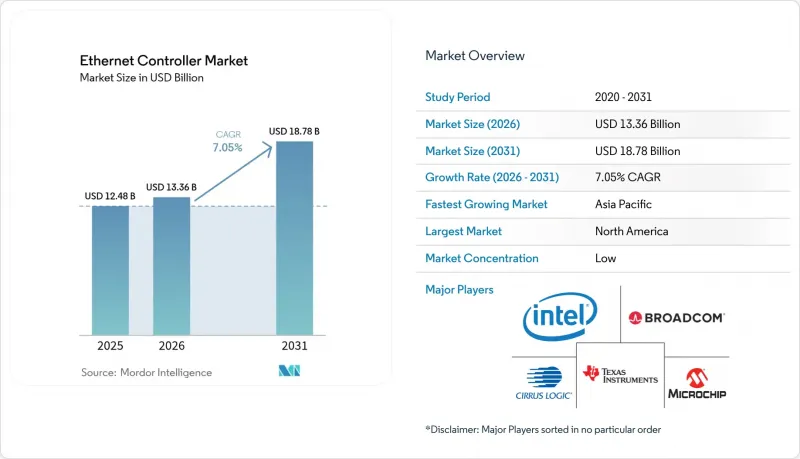
Mordor Intelligence에 의하면, 이더넷 컨트롤러 시장 규모는 2025년에 124억 8,000만 달러로 평가되었고 2026년 133억 6,000만 달러에서 2031년까지 187억 8,000만 달러에 이를 것으로 예측되며, 예측 기간(2026-2031년) CAGR은 7.05%를 나타낼 전망입니다.
본 보고서는 대역폭 유형(10 Mb 이더넷, 패스트 이더넷(100 Mb) 등), 기능(디스크리트 PHY, 통합형 MAC-PHY 컨트롤러 등), 최종 사용자(서버, 라우터 및 스위치, 산업 자동화 및 IIoT 등),용도(데이터센터 및 클라우드, 통신 및 5G RAN 등), 그리고 지역별로 분류되어 있습니다. 시장 예측은 금액(달러) 기준으로 제시되어 있습니다.
세계 이더넷 컨트롤러 시장 동향 및 인사이트
하이퍼스케일 데이터센터에서 AI 주도형 800G 및 1.6T 이더넷에 대한 수요
대규모 언어 모델(LLM) 훈련으로 인해 이스트-웨스트 트래픽이 기존 100G 스위칭의 한계를 넘어섬에 따라, 클라우드 사업자들은 비용과 성능의 균형을 맞춘 800G 및 1.6T 이더넷 패브릭으로의 전환을 추진하고 있습니다. Ultra Ethernet Consortium은 AI 워크로드에 필요한 혼잡 대응 전송 기능 및 결정론적 지연 기능에 대해 반도체 벤더와 하이퍼스케일러 간의 협력을 도모하고 있습니다. Broadcom은 2024 회계연도 AI 네트워킹 매출이 44억 달러에 달했다고 보고했으며, 통신 사업자들이 InfiniBand에서 전환하는 가운데 스위칭 ASIC이 이더넷 컨트롤러 시장을 주도하고 있습니다. 인텔(Intel)은 분산 훈련의 동기화를 최적화하기 위해 E810 컨트롤러에 용도 디바이스 큐 및 PTP 타임스탬프 기능을 추가했습니다. 이더넷 컨트롤러 시장은 표준화된 도구와 멀티 벤더 조달의 혜택을 받고 있지만, 지연에 민감한 AI 파이프라인에서 각 벤더는 독점적인 패브릭과 동등한 성능을 유지하기 위해 텔레메트리 및 흐름 제어 메커니즘의 혁신을 지속해야 합니다. IEEE 802.3df의 표준화 작업은 2세대 AI 클러스터 구축의 기반이 될 1.6T 신호 전송 및 레인 변조 방식을 표준화하는 것을 목표로 하고 있습니다.
멀티 기가비트 자동차용 이더넷을 채택한 자동차용 구역형 E/E 아키텍처
각 OEM 업체들은 도메인 기반 네트워크에서 존형 토폴로지로 전환하고 있으며, 기존의 CAN 및 LIN 버스를 레이더, 라이더, 카메라의 데이터 스트림을 중앙 집중식 컴퓨팅 노드로 집계할 수 있는 2.5G, 5G 및 10G 자동차용 이더넷 백본으로 대체하고 있습니다. 텍사스 기기(TI)의 DP83TG720S-Q1 PHY는 단일 트위스트 페어 케이블로 1G 전송을 실현하여 ISO 26262 ASIL B 요건을 충족하는 동시에 하네스의 경량화를 가능하게 합니다(TI.COM). 마블(Marvel)사가 인피니온(Infineon)사의 자동차용 이더넷 사업을 25억 달러에 인수한 것은 이더넷 컨트롤러 시장에서 ASIL 준수 PHY 지적 재산의 가치를 부각시키고 있습니다. NXP는 타임 센시티브 네트워킹을 컨트롤러에 통합하여 드라이브 바이 와이어 및 페일 오퍼레이셔널 스티어링 시스템에서 마이크로초 수준의 결정성을 보장합니다. OTA(Over-the-Air) 업데이트 기능과 ‘사이버 보안 바이 디자인(Cybersecurity by Design)’ 요구 사항에 따라, 이더넷은 자동차용 소프트웨어 플랫폼의 통합 전송 수단으로서 그 위상을 더욱 공고히 하고 있습니다. UNECE R155 사이버 보안 규정 및 R156 소프트웨어 업데이트 규정에 따른 규제 압력으로 인해 그 채택이 가속화되고 있으며, 멀티 기가비트 이더넷이 미래 EV 플랫폼의 표준 사양으로 자리 잡아가고 있습니다.
지속되는 레거시 노드용 반도체 공급 부족이 PHY 공급에 압박을 가하고 있습니다.
아날로그 회로를 많이 사용하는 이더넷 PHY는 파운드리 업체들이 첨단 공정에 자본을 집중하고 있기 때문에 웨이퍼 부족이 지속되고 있는 28nm 및 그 이전 노드에 여전히 의존하고 있습니다. 로이터 통신은 2024년 하반기 노스캐롤라이나주의 석영 광산에서 발생한 공급 차질과 특정 65nm PHY 제품군의 52주를 초과하는 리드타임 연장을 연관 지어 보도했습니다. TSMC는 제조 장비 부족과 평균 판매 가격(ASP) 하락을 고려할 때, 성숙한 노드의 생산 능력 확대는 여전히 경제적으로 어렵다고 밝혔습니다. 15년의 수명과 극한 온도 대응 등급을 필요로 하는 자동차 제조업체와 산업용 OEM은 가장 심각한 공급 제한에 직면하고 있으며, 이로 인해 컨트롤러 공급업체들은 패키징의 이중 소스화 및 2차 파운드리 활용을 고려할 수밖에 없는 상황입니다. 이더넷 컨트롤러 시장 전체 수요는 견조함에도 불구하고, 이러한 공급 부족은 단기적인 수익 확보를 위협하고 있습니다.
부문 분석
기가비트 이더넷은 기업, 소규모 데이터센터 및 산업용 컨트롤러가 예측 가능한 워크로드를 위해 성숙한 1Gb/s 설계의 인증을 계속함에 따라 2025년에도 매출의 28.05%를 차지했습니다. 그럼에도 불구하고, 하이퍼스케일러 기업들이 현재 200G, 400G, 800G 및 신흥 1.6T 옵션을 합친 시장을 주도하며 연평균 성장률(CAGR) 12.1%로 성장을 지속하고, 있습니다. 이에 따라 초고속 포트를 위한 이더넷 컨트롤러 시장 규모는 2031년까지 2배 이상으로 성장할 것으로 예측됩니다. 엔지니어들은 전면 패널의 설치 면적을 줄이면서 채널 손실 예산을 억제하기 위해 DSP 등화 기능을 통합한 PAM4 신호 방식을 선호하고 있습니다.
과도기 단계의 속도 대역에서는 2.5G 및 5G 솔루션이 기존 Cat-5e 케이블을 통해 Wi-Fi 7 트래픽을 백홀하는 상업시설을 지원하는 한편, 10G 및 25G는 스토리지 및 통신 사업자용 액세스 집약 분야에서 여전히 인기를 끌고 있습니다. 이더넷 컨트롤러 시장에서는 장거리 공장용 센서를 위한 10 Mb/s 싱글 페어 구현에 대한 관심이 다시 높아지고 있습니다. 이는 틈새 시장이지만, 수익은 제한적일지라도 안정적인 판매량이 예상됩니다. 각 공급업체는 범용형 PHY 대신 세분화된 실리콘 제품군을 생산함으로써 다이 면적의 상충 관계를 균형 있게 조정하고 있습니다. 이는 성숙한 노드에서 가격 경쟁이 격화되는 상황에서도 매출 총이익률을 유지하기 위한 전략입니다.
2025년에는 OEM 업체들이 소비자용 및 저가형 엔터프라이즈 장비에서 부품 비용 절감과 PCB 배선 간소화를 우선시한 결과, 통합형 MAC-PHY 디바이스가 이더넷 컨트롤러 시장 점유율의 30.75%를 차지했습니다. 한편, 스마트 NIC 및 인프라 처리 장치(IPU)는 연평균 성장률(CAGR) 12.95%로 확대되고 있습니다. 이는 클라우드 아키텍트가 TLS 종단 처리, VXLAN 캡슐화, 스토리지 RDMA를 전용 가속기로 이전하고, 호스트 코어를 수익 창출형 연산 처리에 할당하고 있기 때문입니다.
구성 유연성과 광범위한 온도 등급이 요구되는 광 모듈 제조업체나 견고한 산업용 보드의 경우, 디스크리트 PHY가 계속해서 채택되고 있습니다. 대역폭에 제약이 있는 사무실 환경에서 직원들이 유선 기가비트 연결을 통한 도킹을 강력히 요구하는 경향을 반영하여, 초슬림 노트북 및 태블릿 내 USB-to-Ethernet 브리지 컨트롤러의 채택이 확대되고 있습니다. 802.3bt를 준수하는 PoE(Power-over-Ethernet)용 실리콘도, 특히 빌딩 관리 대시보드에 데이터를 공급하는 텔레메트리 엔진과 결합된 경우 또 다른 성장 분야가 되고 있습니다. 예측 기간 동안, 오프로드 중심 디바이스용 이더넷 컨트롤러 시장 규모는 기존 통합형 솔루션과의 매출 격차를 좁힐 것으로 예상되지만, 출하 대수 측면에서는 대량 생산되는 소비자용 SKU에서 싱글 칩 MAC-PHY가 여전히 우위를 차지할 것입니다.
지역별 분석
2025년, 아시아태평양은 중국의 반도체 제조 생태계, 일본의 자동차용 전자기기 분야에서의 우위, 그리고 한국의 이더넷 기반 5G RAN 프론트홀의 조기 도입에 힘입어 38.20%의 점유율로 이더넷 컨트롤러 시장을 주도했습니다. 현지 공급망 자급자족을 위한 노력으로 국내 팹리스 기업들의 설계 채택이 더욱 촉진되고 있지만, 첨단 공정 노드에 의존하는 고속 광모듈 및 스마트 NIC 시장 점유율은 여전히 세계 벤더들이 차지하고 있습니다. AI 슈퍼컴퓨터 구축에 대한 정부의 보조금으로 인해 800G 스위치용 실리콘에 대한 지역적 수요가 강화되고 있으며, 수출 규제에 대한 불확실성이 때때로 발생하고 있음에도 불구하고 두 자릿수 성장을 유지하고 있습니다.
북미는 AI에 최적화된 데이터센터 패브릭 혁신의 중심지로 계속해서 자리 잡고 있으며, 그 결과 평균 판매 가격(ASP)이 매우 높은 수준을 유지하면서 출하 대수에 비해 해당 지역의 매출 점유율을 높이고 있습니다. 이더넷 컨트롤러 시장은 프로그래밍 가능한 스마트 NIC 아키텍처를 표준화하고 있는 주요 클라우드 기업들과 미시간주 및 온타리오주의 Tier 1 자동차 부품 공급업체들이 진행하는 존형 ECU 프로토타입 개발의 혜택을 받고 있습니다. ‘CHIPS and Science Act’에 따른 연방 정부의 장려책은 자동차용 PHY의 국내 패키징 라인 설치를 촉진하고 있으며, 중기적으로는 공급 리스크를 완화할 가능성이 있습니다.
중동 및 아프리카은 국부펀드가 지원하는 하이퍼스케일 캠퍼스, 사우디아라비아와 UAE의 스마트시티 구축, 그리고 이더넷 기반 상태 모니터링을 도입하는 신규 산업 단지를 배경으로 2031년까지 연평균 성장률(CAGR) 12.7%를 기록할 전망입니다. 아프리카 연안에서 유럽(ACE)을 연결하는 케이블 시스템을 따라 광섬유를 부설하는 사업과 교육 분야의 클라우드 이니셔티브 역시 컨트롤러 수입을 더욱 촉진하고 있습니다. 유럽에서는 독일의 ‘인더스트리 4.0’ 프로그램과 프랑스의 AI·클라우드 클러스터를 중심으로 안정적인 수요가 나타나고 있습니다. 한편, 남미의 성장은 브라질의 데이터센터 확장 및 아르헨티나의 자동차 분야 재설계를 중심으로 전개되고 있습니다. 모든 지역에서 무역 정책의 변동과 환율 변동은 이더넷 컨트롤러 시장 진출기업들이 주시해야 할 2차적 요인으로 남아 있습니다.
기타 혜택:
- 엑셀 형식 시장 예측(ME) 시트
- 3개월간의 애널리스트 지원
자주 묻는 질문
목차
제1장 서론
제2장 조사 방법
제3장 주요 요약
제4장 시장 구도
제5장 시장 규모와 성장 예측
제6장 경쟁 구도
제7장 시장 기회와 향후 전망
JHS 26.09.11According to Mordor Intelligence, the ethernet controller market size was valued at USD 12.48 billion in 2025 and estimated to grow from USD 13.36 billion in 2026 to reach USD 18.78 billion by 2031, at a CAGR of 7.05% during the forecast period (2026-2031).
This report is Segmented by Bandwidth Type (10 Mb Ethernet, Fast Ethernet (100 Mb), and More), Function (Discrete PHY, Integrated MAC-PHY Controller, and More), End User (Servers, Routers and Switches, Industrial Automation and IIoT, and More), Application (Data-Centre and Cloud, Telecommunications and 5G RAN, and More), and Geography. The Market Forecasts are Provided in Terms of Value (USD).
Global Ethernet Controller Market Trends and Insights
AI-driven demand for 800 G and 1.6 T Ethernet in hyperscale data-centers
Large language model training pushes east-west traffic beyond the limits of traditional 100 G switching, prompting cloud operators to migrate toward 800 G and 1.6 T Ethernet fabrics that balance cost and performance. The Ultra Ethernet Consortium aligns silicon vendors and hyperscalers on congestion-aware transport and deterministic latency features required for AI workloads. Broadcom reported USD 4.4 billion in AI networking revenue for fiscal 2024, with switching ASICs driving the Ethernet controller market as operators pivot away from InfiniBand. Intel added application-device queues and PTP timestamping to its E810 controllers to optimize distributed training synchronization. While the Ethernet controller market benefits from standardized tooling and multi-vendor sourcing, vendors must continue innovating on telemetry and flow-control mechanisms to maintain parity with proprietary fabrics in latency-sensitive AI pipelines. Standards work inside IEEE 802.3df aims to codify 1.6 T signaling and lane modulation schemes that will underpin second-generation AI cluster roll-outs.
Automotive zonal E/E architectures adopting multi-gig Automotive Ethernet
Original equipment manufacturers transition from domain-based networks to zonal topologies, replacing legacy CAN and LIN buses with 2.5-G, 5-G, and 10-G Automotive Ethernet backbones capable of aggregating radar, lidar, and camera data streams into centralized compute nodes. Texas Instruments' DP83TG720S-Q1 PHY delivers 1 G transmission over single twisted-pair cable, meeting ISO 26262 ASIL B budgets and enabling reduced harness weight TI.COM. Marvell's USD 2.5 billion purchase of Infineon's automotive Ethernet business underscores the value of ASIL-compliant PHY intellectual-property within the Ethernet controller market. NXP integrates time-sensitive networking into controllers to guarantee microsecond-level determinism for drive-by-wire and fail-operational steering systems. Over-the-air update capability and cybersecurity-by-design requirements further elevate Ethernet to a unifying transport for vehicle software platforms. Regulatory pressure from UNECE R155 cybersecurity and R156 software update rules accelerates adoption, locking multi-gig Ethernet into the baseline of future EV platforms.
Persistent legacy-node semiconductor shortages pressuring PHY supply
Analog-heavy Ethernet PHYs remain tied to 28 nm and older nodes where wafer shortages persist as foundries divert capital to advanced processes. Reuters linked late-2024 substrate disruptions in North Carolina quartz mines to extended lead times exceeding 52 weeks for certain 65 nm PHY lineups. TSMC commented that expanding mature-node capacity remains economically challenging given tool scarcity and lower ASPs. Automakers and industrial OEMs, which require 15-year longevity and extreme-temperature grades, face the heaviest allocations, compelling controller suppliers to dual-source packaging and explore second-tier foundries. The squeeze threatens near-term revenue capture even as overall Ethernet controller market demand remains healthy.
Other drivers and restraints analyzed in the detailed report include:
- Industrial 10BASE-T1L enabling single-pair IIoT sensor connectivity
- Growing adoption of EtherCAT for real-time machine control
- Stiff margin compression from low-cost Asian fabs and design wins
For complete list of drivers and restraints, kindly check the Table Of Contents.
Segment Analysis
Gigabit Ethernet retained a 28.05% revenue foothold in 2025 as enterprises, small data-centers, and industrial controllers continued qualifying mature 1 Gb/s designs for predictable workloads. Nevertheless, hyperscalers now drive a 12.1% CAGR for combined 200 G, 400 G, 800 G, and nascent 1.6 T options, ensuring that the Ethernet controller market size for very-high-speed ports will more than double by 2031. Engineers favor PAM4 signaling with integrated DSP equalization to compress front-panel footprint while curbing channel loss budgets.
Among transition speeds, 2.5 G and 5 G solutions help commercial campuses backhaul Wi-Fi 7 traffic over installed cat-5e cabling, whereas 10 G and 25 G remain popular in storage and telco access aggregation. The Ethernet controller market sees revived interest in 10 Mb/s single-pair implementations for span-length factory sensors, a niche forecast to deliver steady volume albeit limited revenue. Suppliers balance die-area trade-offs by producing segmented silicon families rather than one-size-fits-all PHYs, a strategy preserving gross margins despite intensifying price competition on mature nodes.
Integrated MAC-PHY devices captured 30.75% of Ethernet controller market share during 2025 as OEMs prioritized bill-of-materials savings and simplified PCB routing in consumer and low-end enterprise gear. Conversely, Smart NICs and Infrastructure Processing Units (IPUs) are scaling at a 12.95% CAGR because cloud architects shift TLS termination, VXLAN encapsulation, and storage RDMA to dedicated accelerators that free up host cores for revenue-generating compute.
Discrete PHYs persist for optical-module makers and rugged industrial boards that demand configuration flexibility and extended temperature ratings. USB-to-Ethernet bridge controllers expand inside ultra-thin laptops and tablets, reflecting employee appetite for wired gigabit docking in bandwidth-constrained offices. Power-over-Ethernet sourcing silicon that meets 802.3bt is another growth pocket, especially when coupled with telemetry engines that feed building-management dashboards. Over the forecast horizon, the Ethernet controller market size for off-load-centric devices is projected to close the revenue gap with traditional integrated solutions, though unit volumes will still favor single-chip MAC-PHYs in high-run-rate consumer SKUs.
Complete Report Scope:
- By Bandwidth Type
- 10 Mb Ethernet
- Fast Ethernet (100 Mb)
- Gigabit Ethernet (1 Gb)
- 2.5 / 5 Gb Multi-Gig Ethernet
- 10 Gb Ethernet
- 25 / 40 / 50 Gb Ethernet
- 100 Gb Ethernet
- 200 / 400 / 800 Gb and 1.6 Tb Ethernet
- By Function
- Discrete PHY
- Integrated MAC-PHY Controller
- Smart NIC / IPU
- USB-to-Ethernet Controller
- Single-Pair MAC-PHY (SPE / APL)
- PoE / PoE++ Controller
- By End User
- Servers
- Routers and Switches
- Industrial Automation and IIoT
- Automotive
- Consumer and Smart-Home Devices
- Others
- By Application
- Data-Centre and Cloud
- Telecommunications and 5G RAN
- Edge and Enterprise Campus
- Smart Factory / Industry 4.0
- Connected Vehicles (ADAS and IVI)
- By Geography
- North America
- United States
- Canada
- South America
- Brazil
- Argentina
- Europe
- Germany
- United Kingdom
- France
- Italy
- Russia
- Asia-Pacific
- China
- Japan
- India
- South Korea
- Australia and New Zealand
- Middle East and Africa
- GCC
- South Africa
- North America
Geography Analysis
Asia-Pacific led the Ethernet controller market with a 38.20% share in 2025, buoyed by China's semiconductor manufacturing ecosystems, Japan's automotive electronics dominance, and South Korea's early adoption of 5G RAN fronthaul over Ethernet. Local supply-chain self-sufficiency initiatives spur additional design wins for domestic fabless firms, yet global vendors still capture high-speed optics and Smart NIC sockets that hinge on advanced process nodes. Government subsidies for AI supercomputer build-outs strengthen regional demand for 800 G switch silicon, sustaining double-digit growth despite episodic export-control uncertainties.
North America remains the innovation epicenter for AI-optimized data-center fabrics, translating into outsized ASPs that elevate regional revenue share relative to unit shipments. The Ethernet controller market benefits from established cloud titans standardizing on programmable Smart NIC architectures and from Tier-1 automotive suppliers in Michigan and Ontario prototyping zonal ECUs. Federal incentives under the CHIPS and Science Act encourage on-shore packaging lines for automotive PHYs, potentially easing supply risk over the medium term.
The Middle East & Africa posts a 12.7% CAGR through 2031 on the back of sovereign wealth-fund-backed hyperscale campuses, smart-city deployments in Saudi Arabia and the UAE, and greenfield industrial zones embracing Ethernet-based condition-monitoring. Fiber build-outs along the Africa Coast to Europe (ACE) cable system, plus educational cloud initiatives, further stimulate controller imports. Europe exhibits steady demand centered on Germany's Industry 4.0 programs and France's AI-cloud clusters, while South America's growth clusters around Brazilian data-center expansions and Argentine automotive redesigns. Across all regions, trade-policy fluidity and currency fluctuations remain secondary variables that Ethernet controller market participants monitor closely.
- Intel Corporation
- Broadcom Inc.
- Marvell Technology Group
- Texas Instruments Inc.
- Microchip Technology Inc.
- Realtek Semiconductor Corp.
- Silicon Laboratories Inc.
- Cadence Design Systems Inc.
- Analog Devices Inc.
- NXP Semiconductors
- Renesas Electronics Corp.
- Infineon Technologies AG
- MaxLinear Inc.
- onsemi
- ASIX Electronics Corp.
- MediaTek Inc.
- Qualcomm Technologies Inc.
- STMicroelectronics
Additional Benefits:
- The market estimate (ME) sheet in Excel format
- 3 months of analyst support
TABLE OF CONTENTS
1 INTRODUCTION
- 1.1 Study Assumptions and Market Definition
- 1.2 Scope of the Study
2 RESEARCH METHODOLOGY
3 EXECUTIVE SUMMARY
4 MARKET LANDSCAPE
- 4.1 Market Overview
- 4.2 Market Drivers
- 4.2.1 AI-driven demand for 800 G and 1.6 T Ethernet in hyperscale data-centres
- 4.2.2 Automotive 'zonal' E/E architectures adopting multi-gig Automotive Ethernet
- 4.2.3 Industrial 10BASE-T1L enabling single-pair IIoT sensor connectivity
- 4.2.4 Growing adoption of EtherCAT for real-time machine control
- 4.2.5 Rapid proliferation of USB-to-Ethernet adapters for ultra-thin clients
- 4.2.6 Mandatory PoE++ deployment in smart-building lighting and security
- 4.3 Market Restraints
- 4.3.1 Persistent legacy-node semiconductor shortages pressuring PHY supply
- 4.3.2 Stiff margin compression from low-cost Asian fabs and design-wins
- 4.3.3 InfiniBand and proprietary AI fabrics challenging Ethernet latency
- 4.3.4 Rising power-consumption limits within AI clusters
- 4.4 Value / Supply-Chain Analysis
- 4.5 Regulatory Landscape
- 4.6 Technological Outlook
- 4.7 Porter's Five Forces Analysis
- 4.7.1 Threat of New Entrants
- 4.7.2 Bargaining Power of Suppliers
- 4.7.3 Bargaining Power of Buyers
- 4.7.4 Threat of Substitute Products
- 4.7.5 Intensity of Competitive Rivalry
5 MARKET SIZE AND GROWTH FORECASTS (VALUE)
- 5.1 By Bandwidth Type
- 5.1.1 10 Mb Ethernet
- 5.1.2 Fast Ethernet (100 Mb)
- 5.1.3 Gigabit Ethernet (1 Gb)
- 5.1.4 2.5 / 5 Gb Multi-Gig Ethernet
- 5.1.5 10 Gb Ethernet
- 5.1.6 25 / 40 / 50 Gb Ethernet
- 5.1.7 100 Gb Ethernet
- 5.1.8 200 / 400 / 800 Gb and 1.6 Tb Ethernet
- 5.2 By Function
- 5.2.1 Discrete PHY
- 5.2.2 Integrated MAC-PHY Controller
- 5.2.3 Smart NIC / IPU
- 5.2.4 USB-to-Ethernet Controller
- 5.2.5 Single-Pair MAC-PHY (SPE / APL)
- 5.2.6 PoE / PoE++ Controller
- 5.3 By End User
- 5.3.1 Servers
- 5.3.2 Routers and Switches
- 5.3.3 Industrial Automation and IIoT
- 5.3.4 Automotive
- 5.3.5 Consumer and Smart-Home Devices
- 5.3.6 Others
- 5.4 By Application
- 5.4.1 Data-Centre and Cloud
- 5.4.2 Telecommunications and 5G RAN
- 5.4.3 Edge and Enterprise Campus
- 5.4.4 Smart Factory / Industry 4.0
- 5.4.5 Connected Vehicles (ADAS and IVI)
- 5.5 By Geography
- 5.5.1 North America
- 5.5.1.1 United States
- 5.5.1.2 Canada
- 5.5.2 South America
- 5.5.2.1 Brazil
- 5.5.2.2 Argentina
- 5.5.3 Europe
- 5.5.3.1 Germany
- 5.5.3.2 United Kingdom
- 5.5.3.3 France
- 5.5.3.4 Italy
- 5.5.3.5 Russia
- 5.5.4 Asia-Pacific
- 5.5.4.1 China
- 5.5.4.2 Japan
- 5.5.4.3 India
- 5.5.4.4 South Korea
- 5.5.4.5 Australia and New Zealand
- 5.5.5 Middle East and Africa
- 5.5.5.1 GCC
- 5.5.5.2 South Africa
- 5.5.1 North America
6 COMPETITIVE LANDSCAPE
- 6.1 Market Concentration
- 6.2 Strategic Moves
- 6.3 Market Share Analysis
- 6.4 Company Profiles (includes Global level Overview, Market level overview, Core Segments, Financials as available, Strategic Information, Market Rank/Share, Products and Services, and Recent Developments)
- 6.4.1 Intel Corporation
- 6.4.2 Broadcom Inc.
- 6.4.3 Marvell Technology Group
- 6.4.4 Texas Instruments Inc.
- 6.4.5 Microchip Technology Inc.
- 6.4.6 Realtek Semiconductor Corp.
- 6.4.7 Silicon Laboratories Inc.
- 6.4.8 Cadence Design Systems Inc.
- 6.4.9 Analog Devices Inc.
- 6.4.10 NXP Semiconductors
- 6.4.11 Renesas Electronics Corp.
- 6.4.12 Infineon Technologies AG
- 6.4.13 MaxLinear Inc.
- 6.4.14 onsemi
- 6.4.15 ASIX Electronics Corp.
- 6.4.16 MediaTek Inc.
- 6.4.17 Qualcomm Technologies Inc.
- 6.4.18 STMicroelectronics
7 MARKET OPPORTUNITIES AND FUTURE OUTLOOK
- 7.1 White-space and Unmet-Need Assessment


