

|
시장보고서
상품코드
2124161
방송 장비 시장 : 시장 점유율 분석, 업계 동향 및 통계, 성장 예측(2026-2031년)Broadcast Equipment - Market Share Analysis, Industry Trends & Statistics, Growth Forecasts (2026 - 2031) |
||||||
 Mordor Intelligence
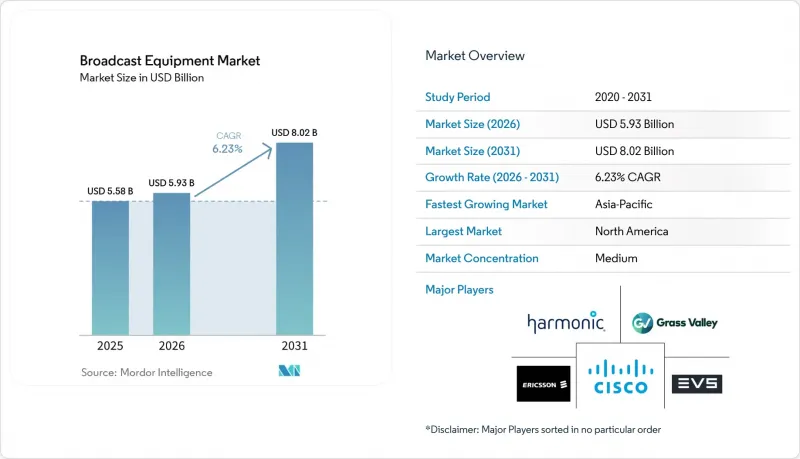
Mordor Intelligence에 의하면, 방송 장비 시장 규모는 2025년 55억 8,000만 달러로 평가되었고, 2026년에는 59억 3,000만 달러로 추정되고, 2026-2031년 CAGR 6.23%로 성장을 지속할 전망이며, 2031년에는 80억 2,000만 달러에 달할 것으로 예측됩니다.
본 보고서는 기술별(아날로그 방송, 디지털 방송), 제품별(파라볼라 안테나, 스위치 등), 용도별(라디오 방송, 텔레비전 방송, 인터넷 라이브 스트리밍, 위성 방송), 최종 사용자별(방송국, 케이블 네트워크 사업자, 스트리밍 서비스 제공업체, 제작 스튜디오), 지역별로 분류되어 있습니다. 시장 전망은 금액(달러) 기준으로 제시되어 있습니다.
세계의 방송 장비 시장 동향 및 인사이트
소비자용 OTT의 확대가 장비 업그레이드를 가속화
주요 스트리밍 서비스의 가입자 수가 폭발적으로 증가함에 따라, 방송 사업자들은 고품질의 리니어 전송과 적응형 비트레이트 스트림을 동시에 출력할 수 있도록 기존 설비를 갱신할 수밖에 없게 되었습니다. 2024년, 넷플릭스의 전 세계 구독자 수는 2억 6,000만 명을 기록했고, 디즈니+도 1억 5,000만 명을 돌파했습니다. 이에 따라 권리 보유자들은 케이블 헤드엔드용 HEVC, 대역폭 효율이 높은 스트리밍용 AV1, 그리고 8K 대응을 위한 신흥 표준 VVC를 통한 전송을 요구하고 있습니다. 그 결과, 단일 기능 어플라이언스 대신 멀티 코덱 인코더가 도입되면서 뉴스룸,스포츠 네트워크, 지역 방송국 전반에 걸쳐 새로운 구매 사이클이 형성되고 있습니다. 이와 병행하여 오리지널 컨텐츠 예산의 급증으로 인해 분산형 원격 제작 및 클라우드 포스트 프로덕션을 지원하는 IP 백홀 키트의 도입이 촉진되고 있으며, 스튜디오는 대규모 현장 인력에 의존하지 않고도 전 세계적인 출시를 신속하게 진행할 수 있게 되었습니다.
IP 기반 방송 인프라로의 급속한 전환
SMPTE ST 2110이 보급의 전환점에 도달함에 따라, 방송 사업자의 78%가 2024년에 IP 인프라 프로젝트 예산을 편성하고 있으며, SDI 라우터와 패치 패널의 역할이 점차 사라지는 추세가 가속화되고 있습니다. 범용 이더넷 패브릭으로의 전환에 따라 워크플로가 전용 베이스밴드 체인에서 COTS 서버에서 실행되는 소프트웨어 인스턴스로 이동함에 따라 배선 복잡성이 대폭 줄어들고 총 소유 비용(TCO)도 절감됩니다. 또한, IP 네트워크는 원활한 경로 보호를 통해 중복성을 단순화하는 한편, 네이티브 멀티캐스트를 통해 임시 채널이나 원격 해설석으로의 운영 확장이 가능해집니다. 특히 중요한 점은 IP 백본이 퍼블릭 클라우드 서비스로 이어지는 직접적인 가교 역할을 함으로써, 지속적인 하드웨어 비용을 발생시키지 않으면서도 주목도가 높은 이벤트 시에 일시적인 컴퓨팅 성능 증강을 가능하게 하여, 이를 통해 방송 장비 시장을 더욱 견인하고 있다는 점입니다.
UHD 및 8K 전송 장비에 드는 고액의 설비 투자
HD에서 UHD, 나아가 8K로의 전환에 따라 네트워크 데이터 전송 속도와 처리 오버헤드가 두 배로 증가했으며, 장비 가격은 HD 지원 기종의 3-7배까지 치솟았습니다. 소규모 방송국이나 신흥 시장의 사업자들은 이러한 막대한 지출에 대한 투자 회수 기간을 조정하는 데 어려움을 겪고 있으며, 주요 채널이 먼저 업그레이드하고 지역 방송국이 뒤처지는 ‘양극화’된 도입 양상이 나타나고 있습니다. 자금 조달 옵션이 제한적이고 감가상각 주기가 짧다는 점이 예산상의 압박을 더욱 가중시켜 광범위한 도입을 지연시키고, 방송 장비 시장의 수익 잠재력을 충분히 발휘하지 못하게 하는 요인이 되고 있습니다.
부문 분석
디지털 플랫폼은 2025년 수익의 66.02%를 차지했으며, 그 연평균 성장률(CAGR) 7.92%는 각국 정부가 아날로그 방송 종료 기한을 엄격하게 시행하는 가운데 그 기세가 꺾이지 않고 계속되고 있음을 보여줍니다. 이와 동시에, 많은 네트워크 사업자들은 기존 디지털 전송망에 IP 패브릭을 중첩하여 자체 구축형 전송 링크와 광고 수익을 견인하는 양방향 서비스를 실현하고 있습니다. 하이브리드형(아날로그·디지털 병용) 솔루션의 방송 장비 시장 규모는 일부 지방 지역에서 여전히 중요한 위치를 차지하고 있지만, 아날로그 방송 종료 일정에 따라 업데이트 유예 기간이 단축됨에 따라 소프트웨어 업데이트를 통해 재구성이 가능한 콤보 송신기에 대한 수요가 활발해지고 있습니다.
이러한 도입 추세는 디지털 부호화의 높은 주파수 효율에도 기인합니다. 이를 통해 단일 RF 대역 내에서 2차 채널이나 데이터 서비스를 다중화할 수 있게 됩니다. 이러한 유연성 덕분에 아시아태평양의 현지 언어 프로그램이나 유럽의 임시 스포츠 채널 전개가 촉진되며, 광고주를 위한 광고 슬롯이 확대되고 있습니다. 주파수 효율이 뛰어난 변조기와 IP 네이티브 모니터링 대시보드를 세트로 제공하는 벤더는 재주문을 확보하고 있으며, 방송 장비 시장에서 디지털 기술의 우위를 더욱 공고히 하고 있습니다.
인코더는 2025년 매출의 24.42%를 차지했으며, 지상파, 위성, 케이블, OTT 등 모든 전송 경로가 압축 효율에 의존하고 있기 때문에 6.61%의 성장 궤도를 유지하고 있습니다. AI를 활용한 알고리즘은 장면의 복잡성을 학습하고 비트를 적응적으로 할당함으로써 화질 저하를 초래하지 않으면서 30-40%의 절감을 실현하고 있습니다. 이러한 혁신을 통해 스트리밍 제공업체의 CDN 비용이 절감되고, 위성 사업자의 트랜스폰더 대역폭이 확보됨에 따라 방송 장비 시장의 주도적인 점유율을 뒷받침하는 선순환적인 업그레이드 사이클이 촉진되고 있습니다.
비디오 서버, 스위치, 송신기는 여전히 필수적이지만, 그 설계에는 컨테이너화된 소프트웨어로 감싸인 모듈식 x86 기반 하드웨어가 점점 더 많이 채택되고 있습니다. 그 결과, 고객들은 원시 하드웨어 사양보다 오케스트레이션 API나 라이선스의 유연성에 주목하게 되었습니다. 파라볼라 안테나는 원격지 전송이나 재해 복구용 링크로 계속 활용되고 있지만, 5G와 광섬유의 보급 범위가 확대됨에 따라 그 성장세는 IP 지상파 경로에 뒤처지고 있습니다. 인코더에 클라우드 트랜스코딩 및 저스트-인-타임 패키징을 결합한 벤더들은 융합이 진행 중인 방송 장비 업계 전반에서 경쟁 우위를 유지하고 있습니다.
지역별 분석
북미는 IP의 조기 도입, NextGen TV 장려책, 그리고 스트리밍에 대한 막대한 투자로 인해 2025년에는 33.21%의 점유율로 방송 장비 시장을 주도했습니다. 연방통신위원회(FCC)의 주파수 재조합과 ATSC 3.0 도입이 시설 재구축을 촉진한 반면, 권리 보유자들은 전미 규모의 스포츠 중계를 지원하는 REMI 스튜디오에 막대한 자본을 투입했습니다. 캐나다에서는 공공 서비스 의무 규정에 따라 다국어 자막 및 지방용 송신기 조달이 촉진되었습니다. 한편, 멕시코에서는 아날로그 방송의 완전 종료에 따라 송신기 발주가 마지막 물결로 발생했습니다.
유럽은 2위를 차지했으며, 표준화 및 인프라 공유를 촉진하는 유럽방송연합(EBU)의 국경 간 이니셔티브에 힘입고 있습니다. 독일과 영국은 UHD 워크플로우 및 IP 허브 앤 스포크 방식의 제작을 주도하고 있으며, 프랑스는 문화 보존 기금과 연계된 공영 방송의 업그레이드를 통해 수요를 뒷받침하고 있습니다. 남부 및 동부 시장에서는 DVB-T에서 DVB-T2로의 교체와 HD 계층 확대를 위한 HEVC 인코더 추가가 지속되면서 안정적인 장비 교체 주기가 유지되고 있습니다.
아시아태평양은 인도의 전국적인 디지털화로 2억 가구 이상이 연결되었고, 중국의 5G 기반 방송 시범 사업에서 8K 및 VR 시험 방송이 진행되고 있어 7.05%라는 가장 높은 연평균 성장률(CAGR)을 기록하고 있습니다. 일본과 한국은 몰입형 오디오 및 4K/8K 위성 서비스를 통해 기술적 리더십을 유지하고 있는 반면, 동남아시아 국가들은 인프라 구축을 위해 다자간 융자를 활용하고 있습니다. 호주에서는 인구가 광범위하게 분산되어 있어 광대한 지역을 커버하기 위한 위성 업링크 및 IP 전송에 대한 수요가 증가하고 있으며, 이는 방송 장비 시장의 지역적 성장 요인을 보완하고 있습니다.
기타 혜택 :
- 엑셀 형식 시장 예측(ME) 시트
- 3개월간 애널리스트 지원
자주 묻는 질문
목차
제1장 서론
제2장 조사 방법
제3장 주요 요약
제4장 시장 구도
제5장 시장 규모 및 성장 예측
제6장 경쟁 구도
제7장 시장 기회 및 향후 전망
AJY 26.09.09According to Mordor Intelligence, the broadcast equipment market size is expected to grow from USD 5.58 billion in 2025 to USD 5.93 billion in 2026 and is forecast to reach USD 8.02 billion by 2031 at 6.23% CAGR over 2026-2031.
This report is Segmented by Technology (Analog Broadcasting, Digital Broadcasting), Product (Dish Antennas, Switches, and More), Application (Radio Broadcasting, Television Broadcasting, Internet Live Streaming, Satellite Broadcasting), End User (Broadcasters, Cable Network Operators, Streaming Service Providers, Production Studios), and Geography. The Market Forecasts are Provided in Terms of Value (USD).
Global Broadcast Equipment Market Trends and Insights
Direct-To-Consumer OTT Expansion Accelerating Equipment Upgrades
Explosive subscriber growth at leading streaming services compels broadcasters to overhaul legacy plants so they can output pristine linear feeds and adaptive bitrate streams simultaneously. Netflix recorded 260 million global subscriptions in 2024, while Disney+ passed 150 million, prompting rights holders to demand delivery in HEVC for cable head-ends, AV1 for bandwidth-efficient streaming, and emerging VVC for 8K readiness. Multi-codec encoders, therefore, replace single-purpose appliances, triggering a new purchase cycle across newsrooms, sports networks, and regional stations. In parallel, the surge in original content budgets fuels the uptake of IP-backhaul kits that support distributed remote production and cloud post-production, ensuring that studios can fast-track global releases without relying on heavy on-site crews.
Rapid Transition to IP-Based Broadcasting Infrastructure
With SMPTE ST 2110 reaching critical mass, 78% of broadcasters budgeted IP infrastructure projects for 2024, accelerating the sunset of SDI routers and patch panels. Switching to commodity Ethernet fabrics slashes cabling complexity and reduces total cost of ownership as workflows migrate from dedicated baseband chains to software instances running on COTS servers. IP networks also simplify redundancy through seamless path protection, while native multicast enables operational scaling for pop-up channels or remote commentary positions. Crucially, IP backbones provide a direct bridge to public cloud services, enabling temporary compute bursts during marquee events without incurring permanent hardware costs, thereby further propelling the broadcast equipment market.
High Capital Expenditure for UHD and 8K Transmission Gear
Transitioning from HD to UHD and then to 8K multiplies network data rates and processing overhead, pushing equipment prices up to 3-7 times those of HD counterparts. Smaller stations and emerging-market operators struggle to align their payback horizons with such steep outlays, creating a two-speed adoption pattern where marquee channels upgrade first and regional players lag. Limited financing options and fast depreciation cycles exacerbate budget pressures, delaying wider rollouts and restraining the broadcast equipment market's full revenue potential.
Other drivers and restraints analyzed in the detailed report include:
- Growing Demand for Encoders Supporting Multiple Codecs
- Surge in Remote Production Workflows Post-Pandemic
- Persistent Lack of Global Standardization of Media Formats
For complete list of drivers and restraints, kindly check the Table Of Contents.
Segment Analysis
Digital platforms claimed 66.02% of 2025 revenue, and their 7.92% CAGR indicates relentless momentum as governments enforce analog switch-off deadlines. In parallel, many networks overlay IP fabrics on existing digital transmission, enabling self-provisioned contribution links and interactive services that drive advertising yield. The broadcast equipment market size for hybrid analog-digital solutions remains meaningful in rural pockets, yet sunset timetables narrow replacement windows, prompting brisk demand for combo transmitters that can be reconfigured through software updates.
Adoption also reflects the spectral efficiency of digital encoding, which allows multiplexing of secondary channels and data services within a single RF allocation. This agility fuels local language programming in the Asia-Pacific region and pop-up sports channels in Europe, expanding the addressable inventory for advertisers. Vendors that bundle spectrum-efficient modulators with IP-native monitoring dashboards secure repeat orders, reinforcing the primacy of digital technology within the broadcast equipment market.
Encoders generated 24.42% of 2025 turnover and maintain a 6.61% growth trajectory as every distribution path-terrestrial, satellite, cable, or OTT-depends on compression efficiency. AI-assisted algorithms now learn scene complexity and allocate bits adaptively, achieving 30-40% savings without picture degradation. These innovations lower CDN bills for streaming providers and free up transponder bandwidth for satellite operators, fueling a virtuous upgrade cycle that supports the broadcast equipment market's leadership share.
Video servers, switches, and transmitters remain indispensable, yet their design increasingly adopts modular, x86-based hardware wrapped in containerized software. As a result, customers focus on orchestration APIs and license flexibility rather than raw hardware specs. Dish antennas continue to serve remote contribution and disaster-recovery links, but growth lags IP terrestrial paths as 5G and fiber footprints widen. Vendors that package encoders with cloud transcoding and just-in-time packaging retain a competitive advantage across a converged broadcast equipment industry.
Complete Report Scope:
- By Technology
- Analog Broadcasting
- Digital Broadcasting
- By Product
- Dish Antennas
- Switches
- Video Servers
- Encoders
- Transmitters and Repeaters
- Other Products
- By Application
- Radio Broadcasting
- Television Broadcasting
- Internet Live Streaming
- Satellite Broadcasting
- By End User
- Broadcasters
- Cable Network Operators
- Streaming Service Providers
- Production Studios
- By Geography
- North America
- United States
- Canada
- Mexico
- Europe
- Germany
- United Kingdom
- France
- Russia
- Rest of Europe
- Asia-Pacific
- China
- Japan
- India
- South Korea
- Australia
- Rest of Asia-Pacific
- Middle East and Africa
- Middle East
- Saudi Arabia
- United Arab Emirates
- Rest of Middle East
- Africa
- South Africa
- Egypt
- Rest of Africa
- Middle East
- South America
- Brazil
- Argentina
- Rest of South America
- North America
Geography Analysis
North America led the broadcast equipment market with a 33.21% share in 2025 thanks to early IP adoption, NextGen TV incentives and heavy streaming investment. The Federal Communications Commission's spectrum repack and ATSC 3.0 rollouts triggered facility rebuilds, while rights-holders poured capital into REMI studios supporting coast-to-coast sports coverage. Canada's public-service mandates spurred procurements of multilingual captioning and rural transmitters, whereas Mexico's completed analog switch-off supplied a final wave of transmitter orders.
Europe ranks second, buoyed by cross-border initiatives from the European Broadcasting Union that promote standardization and shared infrastructure. Germany and the United Kingdom spearhead UHD workflows and IP hub-and-spoke production, and France underpins demand with public broadcasting upgrades tied to cultural preservation funds. Southern and Eastern markets continue replacing DVB-T with DVB-T2 and adding HEVC encoders for HD tier expansion, sustaining steady equipment refresh cycles.
Asia-Pacific posts the fastest 7.05% CAGR as India's nationwide digitization connects more than 200 million households and China's 5G-based broadcast pilots showcase 8K and VR trials. Japan and South Korea retain technology leadership through immersive audio and 4K/8K satellite services, while Southeast Asian nations tap multilateral loans for infrastructure. Australia's dispersed population drives demand for satellite uplinks and IP contribution to span vast geographies, rounding out regional growth drivers for the broadcast equipment market.
- Cisco Systems Inc.
- Telefonaktiebolaget LM Ericsson
- EVS Broadcast Equipment SA
- Grass Valley USA LLC
- Harmonic Inc.
- Clyde Broadcast Technology Ltd
- Sencore Inc.
- Eletec Broadcast Telecom Sarl
- AVL Technologies Inc.
- ETL Systems Ltd
- Rohde and Schwarz GmbH and Co KG
- NEC Corporation
- Sony Group Corporation
- Panasonic Corporation
- Imagine Communications Corp.
- Avid Technology Inc.
- Belden Inc.
- Blackmagic Design Pty Ltd
- Ross Video Ltd.
- TVU Networks Corporation
- NewTek Inc.
Additional Benefits:
- The market estimate (ME) sheet in Excel format
- 3 months of analyst support
TABLE OF CONTENTS
1 INTRODUCTION
- 1.1 Study Assumptions and Market Definition
- 1.2 Scope of the Study
2 RESEARCH METHODOLOGY
3 EXECUTIVE SUMMARY
4 MARKET LANDSCAPE
- 4.1 Market Overview
- 4.2 Market Drivers
- 4.2.1 Growing Demand for Encoders Supporting Multiple Codecs
- 4.2.2 Direct-To-Consumer OTT Expansion Accelerating Equipment Upgrades
- 4.2.3 Rapid Transition to IP-Based Broadcasting Infrastructure
- 4.2.4 Surge in Remote Production (REMI) Workflows Post-Pandemic
- 4.2.5 Adoption of Cloud-Native SaaS Playout and Graphics
- 4.2.6 Government Mandates for Digital Switch-Over in Emerging Economies
- 4.3 Market Restraints
- 4.3.1 Persistent Lack of Global Standardization of Media Formats
- 4.3.2 High Capital Expenditure for UHD and 8K Transmission Gear
- 4.3.3 Spectrum Allocation Constraints in Urban Regions
- 4.3.4 Skills Gap in Operating IP and Cloud Broadcast Systems
- 4.4 Industry Value Chain Analysis
- 4.5 Regulatory Landscape
- 4.6 Technological Outlook
- 4.7 Porter's Five Forces Analysis
- 4.7.1 Bargaining Power of Suppliers
- 4.7.2 Bargaining Power of Buyers
- 4.7.3 Threat of New Entrants
- 4.7.4 Threat of Substitutes
- 4.7.5 Intensity of Competitive Rivalry
- 4.8 Impact of Macroeconomic Factors
5 MARKET SIZE AND GROWTH FORECASTS (VALUE)
- 5.1 By Technology
- 5.1.1 Analog Broadcasting
- 5.1.2 Digital Broadcasting
- 5.2 By Product
- 5.2.1 Dish Antennas
- 5.2.2 Switches
- 5.2.3 Video Servers
- 5.2.4 Encoders
- 5.2.5 Transmitters and Repeaters
- 5.2.6 Other Products
- 5.3 By Application
- 5.3.1 Radio Broadcasting
- 5.3.2 Television Broadcasting
- 5.3.3 Internet Live Streaming
- 5.3.4 Satellite Broadcasting
- 5.4 By End User
- 5.4.1 Broadcasters
- 5.4.2 Cable Network Operators
- 5.4.3 Streaming Service Providers
- 5.4.4 Production Studios
- 5.5 By Geography
- 5.5.1 North America
- 5.5.1.1 United States
- 5.5.1.2 Canada
- 5.5.1.3 Mexico
- 5.5.2 Europe
- 5.5.2.1 Germany
- 5.5.2.2 United Kingdom
- 5.5.2.3 France
- 5.5.2.4 Russia
- 5.5.2.5 Rest of Europe
- 5.5.3 Asia-Pacific
- 5.5.3.1 China
- 5.5.3.2 Japan
- 5.5.3.3 India
- 5.5.3.4 South Korea
- 5.5.3.5 Australia
- 5.5.3.6 Rest of Asia-Pacific
- 5.5.4 Middle East and Africa
- 5.5.4.1 Middle East
- 5.5.4.1.1 Saudi Arabia
- 5.5.4.1.2 United Arab Emirates
- 5.5.4.1.3 Rest of Middle East
- 5.5.4.2 Africa
- 5.5.4.2.1 South Africa
- 5.5.4.2.2 Egypt
- 5.5.4.2.3 Rest of Africa
- 5.5.4.1 Middle East
- 5.5.5 South America
- 5.5.5.1 Brazil
- 5.5.5.2 Argentina
- 5.5.5.3 Rest of South America
- 5.5.1 North America
6 COMPETITIVE LANDSCAPE
- 6.1 Market Concentration
- 6.2 Strategic Moves
- 6.3 Market Share Analysis
- 6.4 Company Profiles (includes Global Level Overview, Market Level Overview, Core Segments, Financials as Available, Strategic Information, Market Rank/Share for Key Companies, Products and Services, and Recent Developments)
- 6.4.1 Cisco Systems Inc.
- 6.4.2 Telefonaktiebolaget LM Ericsson
- 6.4.3 EVS Broadcast Equipment SA
- 6.4.4 Grass Valley USA LLC
- 6.4.5 Harmonic Inc.
- 6.4.6 Clyde Broadcast Technology Ltd
- 6.4.7 Sencore Inc.
- 6.4.8 Eletec Broadcast Telecom Sarl
- 6.4.9 AVL Technologies Inc.
- 6.4.10 ETL Systems Ltd
- 6.4.11 Rohde and Schwarz GmbH and Co KG
- 6.4.12 NEC Corporation
- 6.4.13 Sony Group Corporation
- 6.4.14 Panasonic Corporation
- 6.4.15 Imagine Communications Corp.
- 6.4.16 Avid Technology Inc.
- 6.4.17 Belden Inc.
- 6.4.18 Blackmagic Design Pty Ltd
- 6.4.19 Ross Video Ltd.
- 6.4.20 TVU Networks Corporation
- 6.4.21 NewTek Inc.
7 MARKET OPPORTUNITIES AND FUTURE OUTLOOK
- 7.1 White-space and Unmet-Need Assessment


