|
시장보고서
상품코드
2124162
자동차 화이트바디 시장 : 점유율 분석, 업계 동향과 통계, 성장 예측(2026-2031년)Automotive Body-in-White - Market Share Analysis, Industry Trends & Statistics, Growth Forecasts (2026 - 2031) |
||||||
 Mordor Intelligence
Mordor Intelligence에 의하면, 2026년 자동차 화이트바디 시장 규모는 1,469억 2,000만 달러로 추정되고 있어 2025년 1,419억 2,000만 달러에서 확대해, 2031년에는 1,746억 7,000만 달러에 이를 것으로 예측됩니다.
2026년부터 2031년까지의 연평균 성장률(CAGR)은 3.52%를 나타낼 전망입니다.
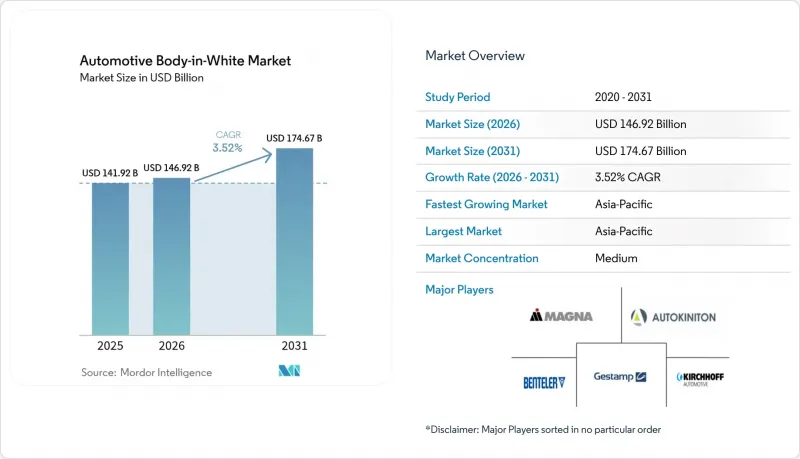
본 보고서는 차종별(승용차 및 상용차), 추진 방식별(내연기관차 및 전기자동차), 재질별(알루미늄, 강철, 복합재료, 마그네슘), 재료 접합 기술별(용접, 리벳 접합, 클린치 접합, 접착 접합),및 지역별로 분류되어 있습니다. 시장 예측은 금액(달러)으로 표시되어 있습니다.
전 세계 자동차 화이트바디 시장 동향 및 인사이트
경량 차량에 대한 수요 증가
세계 각국에서 규제 기준이 엄격해지는 가운데, 자동차 업계에서는 경량화 노력이 점점 더 활발해지고 있습니다. 각 자동차 제조업체는 안전성 및 성능 기준을 유지하면서 차량 중량을 줄이기 위해 첨단 소재와 혁신적인 설계 전략을 채택하고 있습니다. 차세대 고장력 강판이 최전선에 나서, 구조적 무결성이나 충돌 안전성을 훼손하지 않으면서도 현저한 경량화를 실현하고 있습니다. 동시에, 전기차의 보급이 급속히 확대되는 가운데, 더욱 경량화된 차체 구조에 대한 관심이 높아지고 있습니다. 미미한 경량화라도 주행 거리의 대폭적인 향상으로 이어지기 때문입니다.
알루미늄 스페이스 프레임은 고급차 부문에서 보급이 확대되고 있지만, 높은 제조 비용으로 인해 대중 시장에서의 추가적인 보급이 저해되고 있습니다. 따라서 각 자동차 제조업체들은 소재 선정 시 성능, 비용, 제조성을 면밀히 검토하고 있습니다.
EV 생산 플랫폼의 급속한 확대
EV 전용 플랫폼은 부품 수를 대폭 줄이고, 하중 경로를 겸하는 구조형 배터리 팩의 채택을 가능하게 합니다. 테슬라의 오스틴 공장에서는 전면 및 후면 기가캐스팅을 일체화함으로써 부품 수가 30-40% 감소했다고 보고되고 있습니다. BYD와 NIO는 셀-투-팩(Cell-to-Pack) 아키텍처를 채택하고 있으며, 이를 위해서는 새로운 접합 기술과 열 차단 솔루션이 필요합니다. 고급 전기차가 고전압 아키텍처를 채택함에 따라 전기적 절연성 향상에 대한 수요가 급증하고 있으며, 구조 부품에서 복합재 인서트에 대한 의존도가 높아지고 있습니다. 대형 배터리 팩의 무게 증가로 인해 초고강도 소재와 정교한 구조 설계의 필요성이 더욱 커지고 있습니다. 이에 대응하기 위해 자동차 제조업체들은 첨단 강재를 채택하고 토폴로지 최적화를 활용하여 차세대 차량 플랫폼에서 안전성, 성능, 효율의 조화를 도모하고 있습니다.
첨단 BIW 소재의 높은 비용
경량 소재는 자동차 혁신에 있어 매우 중요하지만, 그 채택은 비용, 인프라, 공급망의 역학이 복잡하게 얽힌 상황에 좌우됩니다. 경량화라는 장점으로 높이 평가받는 알루미늄은 기존 강재에 비해 현저히 비쌉니다. 이러한 가격 차이로 인해 알루미늄은 고급차 부문에는 적합하지만, 대중 시장용 용도에서는 제외되고 있습니다. 한편, 탄소섬유 강화 플라스틱(CFRP)은 뛰어난 강도 대 중량 비율을 자랑하지만, 재료비와 가공 비용이 높아 그 사용은 주로 초고급차에 한정되어 있습니다.
게다가 금속은 확립된 재활용 인프라의 혜택을 받고 있는 반면, 복합재료는 이에 비해 크게 뒤처져 있어 소유 비용을 높이고 순환형 경제의 가능성을 제한하고 있습니다. 알루미늄이 그 대표적인 예입니다. 원자재 가격의 예측 불가능성은 조달 전략을 더욱 복잡하게 만들어 제조업체의 장기적인 계획에 어려움을 초래하고 있습니다.
부문 분석
2025년 시점에서 승용차는 자동차 화이트바디 시장 규모의 67.60%를 차지했으나, 상용차는 2031년까지 연평균 4.43%의 성장률로 확대될 것으로 예측됩니다. 플릿 운영 사업자들은 수명 주기 전반에 걸친 운영 비용 절감을 우선시하고 있으며, 경량화와 전기차 주행 거리 연장으로 이어지는 알루미늄 스페이스 프레임의 높은 재료 비용을 감수하고 있습니다. 100kWh 배터리 팩을 탑재한 전기 밴에는 20-30%의 추가 보강이 필요하며, 이로 인해 초고장력강으로 제작된 크로스 멤버에 대한 수요가 발생하고 있습니다. 예측 기간 동안 모듈식 래더 프레임 개념을 통해 트럭 OEM 각사는 하나의 섀시 위에 적재함, 운전실, 연료전지 마운트를 조합할 수 있게 되어, 표준화된 접합 플랜지를 설계하는 BIW 공급업체에 혜택을 가져다줄 것입니다.
상용 플랫폼의 제품 수명 주기 연장(최장 10년)은 자본 집약적인 핫 스탬핑 생산 라인에 안정적인 생산량을 보장합니다. 운전 보조 센서 탑재를 의무화하는 EU의 ‘일반 안전 규정’ 등의 규제로 인해, BIW 설계에는 보호된 전자기기용 캐비티의 통합이 요구되고 있습니다. 2027년에 시행될 미국 대형 트럭용 온실가스 규제(2단계)는 경량 빔 및 크로스 멤버에 대한 수요를 더욱 확대시켜, 자동차 화이트바디 시장의 꾸준한 성장을 뒷받침할 것입니다.
2025년 자동차 화이트바디 시장에서 내연 기관은 62.70%의 점유율을 차지하고 있습니다. 전기차 및 전기 트럭은 급속히 부상하고 있으며, 2031년까지 연평균 성장률(CAGR)은 10.84%를 나타낼 것으로 전망됩니다. 구조용 배터리 팩의 채택으로 인해 독립적인 플로어 팬이 불필요해지고 비틀림 강성이 15-20% 향상되므로, 자동차 제조업체는 크로스 레일을 생략하고 충돌 하중 경로를 단순화할 수 있게 됩니다. 800V 전기차로의 전환에 따라 절연 요구 사항이 강화됨에 따라, 엔지니어들은 복합재료나 코팅 처리된 알루미늄 케이스를 채택해야 하는 상황에 직면해 있습니다. 내연기관 모델은 여전히 생산 대수에서 압도적인 점유율을 차지하고 있으며, 충돌 에너지 흡수에 최적화된 하이드로폼 가공 강철 사이드 실에 대한 기본 수요는 유지되고 있습니다. 2026년부터 2031년까지 듀얼 바디 아키텍처가 공존하게 될 것이며, 공급업체는 자동차 화이트바디 시장에서 용접과 접착 기술을 모두 병행하여 유지해야할 것입니다.
주행 거리에 대한 우려도 경량화 예산을 뒷받침하는 요인이 되고 있습니다. 이는 차체에서 1Kg이 경량화될 때마다 주행 거리가 2-3킬로미터 늘어날 수 있기 때문입니다. 마지막으로, EU의 배터리 규제는 ‘분해를 고려한 설계’를 요구하고 있기 때문에 각 OEM 업체들은 구조적 손상을 주지 않고 배터리 팩을 탈거할 수 있는 볼트 고정식 또는 리벳식 시스템으로 용접식 브래킷을 대체하고 있습니다.
지역별 분석
아시아태평양은 2025년에 자동차 화이트바디 시장의 45.60% 점유율을 차지하며, 2031년까지 연평균 성장률(CAGR) 4.69%를 기록할 전망입니다. 중국은 신에너지차(NEV) 할당제를 통해 판매 대수를 견인하고 있으며, BYD와 NIO는 하중 경로 설계를 새롭게 바꾼 구조형 배터리 팩을 주도하고 있습니다. 일본의 철강 제조업체들은 1,500 MPa의 AHSS(고장력 강판) 개발을 추진하며, 국내 및 아세안(ASEAN) 지역의 공장에 공급하고 있습니다. 한국에서는 바디 인 화이트(BIW), 배터리, 모듈 공급업체들이 집중되어 있어 수직 통합이 가속화되고 있습니다.
유럽은 다중 재료 접합 및 탈탄소화 생산 분야에서 기술적 리더십을 유지하고 있습니다. 독일의 금형 제조업체는 현지화된 담금질 구역을 갖춘 핫 스탬핑 라인을 출하하고 있습니다. 북유럽의 알루미늄 생산 업체들은 현재 탄소 발자국을 대폭 줄인 원료를 공급하고 있으며, 자동차 제조 분야에서 기존의 석탄을 연료로 사용하는 제련소를 능가하고 있습니다. 탄소 배출량이 많은 수입품에 과세하는 탄소 국경 조정 메커니즘(CBAM)의 도입에 따라, 이러한 북유럽 생산자들의 우위는 점점 더 뚜렷해지고 있습니다. 각 자동차 제조업체는 저탄소 소재로의 전환과 화이트바디 최적화에 주력하고 있으며, 이에 더해 규정 준수 비용의 급등으로 인해 차량 프로그램 예산의 상당 부분을 차지하는 사례가 빈번히 나타나고 있습니다. 이러한 전략은 규제 요건을 준수하는 것이며, 잠재적인 벌금을 피하기 위한 신중한 조치입니다.
북미에서는 USMCA(미국·멕시코·캐나다 협정)의 지역 내 조달 규정과 전기차(EV)에 대한 투자로 인해 꾸준한 성장이 나타나고 있습니다. 미국 공장에서는 알루미늄 대응 프레스 기계에 대한 재투자가 진행되는 한편, 멕시코 공장은 지역 내 조달 기준 범위 내에서 비용 경쟁력 있는 프레스 부품을 공급하고 있습니다. 캐나다의 제련소는 수력 발전을 활용하여 저탄소 알루미늄을 찾는 OEM 제조업체를 유치하고 있습니다. 아시아와의 인건비 격차는 여전히 역풍으로 작용하고 있지만, 온쇼어링에 대한 우대 조치와 물류 측면의 탄력성 덕분에 자동차 화이트바디 시장을 위한 생산 능력 확대는 순조롭게 진행되고 있습니다.
기타 혜택:
- 엑셀 형식 시장 예측(ME) 시트
- 3개월간의 애널리스트 지원
자주 묻는 질문
목차
제1장 서론
제2장 조사 방법
제3장 주요 요약
제4장 시장 구도
제5장 시장 규모와 성장 예측
제6장 경쟁 구도
제7장 시장 기회와 향후 전망
JHS 26.09.11According to Mordor Intelligence, the automotive body-in-white market size in 2026 is estimated at USD 146.92 billion, growing from 2025 value of USD 141.92 billion with 2031 projections showing USD 174.67 billion, growing at 3.52% CAGR over 2026-2031.
This report is Segmented by Vehicle Type (Passenger Vehicles and Commercial Vehicles), Propulsion Type (IC-Engine Vehicles and Electric Vehicles), Material Type (Aluminum, Steel, Composites, and Magnesium), Material Joining Technique (Welding, Riveting, Clinching, and Adhesive Bonding), and Geography. The Market Forecasts are Provided in Terms of Value (USD).
Global Automotive Body-in-White Market Trends and Insights
Growing Demand for Lightweight Vehicles
As global markets tighten regulatory standards, the automotive industry is increasingly turning to lightweighting. Automakers are now embracing advanced materials and innovative design strategies to shed vehicle weight, all while upholding safety and performance standards. Next-generation high-strength steels are at the forefront, delivering notable weight reductions without sacrificing structural integrity or crash safety. Concurrently, as electric vehicle adoption surges, there's a heightened emphasis on lighter body structures; even slight weight cuts can lead to substantial improvements in driving range.
Though aluminum space frames have gained traction in premium segments, their elevated production costs hinder broader acceptance in the mass market. Consequently, manufacturers are meticulously weighing performance, cost, and manufacturability in their material selections.
Rapid Scaling of EV Production Platforms
Dedicated EV platforms slash part counts and enable structural battery packs that double as load paths. Tesla's Austin plant reports a 30-40% component reduction after shifting to integrated front and rear giga-castings. BYD and NIO employ cell-to-pack architecture requiring new bonding and thermal-barrier solutions. The demand for enhanced electrical isolation surges as premium electric vehicles embrace high-voltage architectures, leading to a growing reliance on composite inserts in structural components. The heft of sizable battery packs amplifies the necessity for ultra-strong materials and refined structural designs. In response, automakers are turning to advanced steels and employing topology optimization to harmonize safety, performance, and efficiency in their next-gen vehicle platforms.
High Cost of Advanced BIW Materials
Lightweight materials are pivotal to automotive innovation, yet their adoption hinges on a web of cost, infrastructure, and supply chain dynamics. Aluminum, celebrated for its weight-saving advantages, commands a notable premium over conventional steel. This price disparity renders aluminum more suited for premium vehicle segments, sidelining it from mass-market applications. Meanwhile, carbon fiber-reinforced plastics (CFRP) boast an outstanding strength-to-weight ratio, yet their high material and processing costs restrict their use predominantly to ultra-luxury vehicles.
Moreover, while metals benefit from established recycling infrastructures, composites lag significantly, inflating ownership costs and curtailing the potential for a circular economy. Aluminum is a prime example. The unpredictability of raw material prices further muddies sourcing strategies, posing challenges for manufacturers' long-term planning.
Other drivers and restraints analyzed in the detailed report include:
- Stringent Global CO2 and Fuel-Economy Regulations
- Greenfield ASEAN EV Plants Boosting Local BIW Capacity
- Complex Joining and Repair of Multi-Material Structures
For complete list of drivers and restraints, kindly check the Table Of Contents.
Segment Analysis
Passenger cars represented 67.60% of the automotive body-in-white market size in 2025, whereas commercial vehicles are forecast to compound at 4.43% through 2031. Fleet operators prioritize lifetime operating savings, accepting the material premiums of aluminum space frames that cut mass and extend electric range. Electric vans carrying 100 kWh packs need 20-30% extra reinforcement, spawning demand for ultra-high-strength steel cross-members. Over the forecast, modular ladder-frame concepts will let truck OEMs mix cargo boxes, cabins, and fuel-cell mounts on one chassis, rewarding BIW suppliers that design standardized joining flanges.
Longer product cycles in commercial platforms-up to 10 years-provide volume stability for capital-intensive hot-stamping lines. Regulatory layers, such as the EU's General Safety Regulation mandating driver-assistance sensors, push BIW designs to embed protected electronics cavities. The 2027 U.S. Phase 2 greenhouse-gas rules for heavy trucks will further widen demand for lightweight beams and cross-members, supporting steady growth in the automotive body-in-white market.
Internal combustion engines hold a 62.70% share of the automotive body-in-white market 2025. Electric cars and trucks are rising quickly with an 10.84% CAGR through 2031. Structural battery packs eliminate separate floor pans and raise torsional stiffness by 15-20%, letting automakers delete cross rails and simplify crash-load paths. The shift to 800 V electrics ups insulation mandates, steering engineers toward composite or coated aluminum enclosures. Internal-combustion models still dominate unit volumes, preserving baseline demand for hydro-formed steel side sills optimized for crash energy absorption. Over 2026-2031, dual body architectures will coexist, compelling suppliers to maintain parallel welding and bonding competencies in the automotive body-in-white market.
Range anxiety also sustains lightweighting budgets because each kilogram trimmed from the body returns 2-3 km of driving distance. Finally, EU battery regulations require design-for-disassembly, so OEMs are replacing welded brackets with bolt-on or rivet systems that enable pack removal without structural damage.
Complete Report Scope:
- By Vehicle Type
- Passenger Cars
- Commercial Vehicles
- By Propulsion Type
- Internal Combustion Engine
- Electric Vehicles
- By Material Type
- Aluminum
- Steel (Mild, HSS, AHSS, UHSS)
- Composites (CFRP, GFRP, SMC)
- Magnesium and Other Metals
- By Material Joining Technique
- Welding (RSW, Laser, FSW)
- Self-Piercing and Plasma-Assisted Riveting
- Clinching and Mechanical Fastening
- Adhesive and Hybrid Bonding
- Geography
- North America
- United States
- Canada
- Rest of North America
- South America
- Brazil
- Argentina
- Rest of South America
- Europe
- Germany
- United Kingdom
- France
- Spain
- Italy
- Rest of Europe
- Asia-Pacific
- China
- Japan
- India
- South Korea
- Rest of Asia-Pacific
- Middle East and Africa
- Saudi Arabia
- United Arab Emirates
- Turkey
- South Africa
- Rest of Middle East and Africa
- North America
Geography Analysis
Asia-Pacific commanded 45.60% of the automotive body-in-white market share in 2025 and is tracking a 4.69% CAGR to 2031. China drives volume via New Energy Vehicle quotas, while BYD and NIO champion structural battery packs that reshape load-path design. Japanese steelmakers advance 1,500 MPa AHSS, supplying domestic and ASEAN factories. South Korea clusters BIW, battery, and module suppliers, accelerating vertical integration.
Europe retains technological leadership in multi-material joining and decarbonized production. German toolmakers ship hot-stamping lines with localized quench zones. Nordic aluminum producers are now supplying feedstock with a markedly reduced carbon footprint, outpacing traditional coal-based smelters in the automotive manufacturing sector. With the introduction of carbon border adjustment mechanisms (CBAM) imposing taxes on high-emission imports, the advantages of these Nordic producers are becoming more sharply focused. Automakers are pivoting towards low-carbon materials and body-in-white optimization, coupled with escalating compliance costs, frequently taking up a significant portion of vehicle program budgets. These strategies align with regulatory demands and serve as prudent measures to sidestep potential penalties.
North America grows steadily due to USMCA content rules and EV investments. United States factories reinvest in aluminum-ready presses, while Mexican plants supply cost-competitive stampings under regional-content thresholds. Canadian smelters leverage hydroelectric power to attract OEMs seeking low-carbon aluminum. Labor cost differentials versus Asia remain a headwind, but onshoring incentives and logistical resilience keep capacity expansion on track for the automotive body-in-white market.
- Magna International Inc.
- Norsk Hydro ASA
- Gestamp Automocion SA
- Aisin Seiki Co. Ltd.
- thyssenkrupp AG
- Tata Steel Ltd.
- Autokiniton US Holdings, Inc (Tower International)
- CIE Automotive
- Benteler International AG
- AUTOCOMP CORPORATION PANSE PVT. LTD.
- SM Auto Engineering Pvt. Ltd.
- ArcelorMittal SA
- KIRCHHOFF Automotive GmbH
- WEISS GmbH
- KUKA AG
Additional Benefits:
- The market estimate (ME) sheet in Excel format
- 3 months of analyst support
TABLE OF CONTENTS
1 Introduction
- 1.1 Study Assumptions and Market Definition
- 1.2 Scope of the Study
2 Research Methodology
3 Executive Summary
4 Market Landscape
- 4.1 Market Overview
- 4.2 Market Drivers
- 4.2.1 Growing Demand for Lightweight Vehicles
- 4.2.2 Stringent Global CO2 and Fuel-Economy Regulations
- 4.2.3 Rapid Scaling of EV Production Platforms
- 4.2.4 Advances in High-Strength Steel and Aluminum Alloys
- 4.2.5 Adoption of Giga-Cast Structures by Chinese EV OEMs
- 4.2.6 Greenfield ASEAN EV Plants Boosting Local BIW Capacity
- 4.3 Market Restraints
- 4.3.1 High Cost of Advanced BIW Materials
- 4.3.2 Complex Joining and Repair of Multi-Material Structures
- 4.3.3 Scarcity of Low-Carbon Steel/Aluminum Supply
- 4.3.4 Insurance and Repair-Cost Risks for Giga-Cast Bodies
- 4.4 Value / Supply-Chain Analysis
- 4.5 Regulatory Landscape
- 4.6 Technological Outlook
- 4.7 Porter's Five Forces Analysis
- 4.7.1 Bargaining Power of Suppliers
- 4.7.2 Bargaining Power of Consumers
- 4.7.3 Threat of New Entrants
- 4.7.4 Threat of Substitute Products
- 4.7.5 Intensity of Competitive Rivalry
5 Market Size and Growth Forecasts (Value (USD))
- 5.1 By Vehicle Type
- 5.1.1 Passenger Cars
- 5.1.2 Commercial Vehicles
- 5.2 By Propulsion Type
- 5.2.1 Internal Combustion Engine
- 5.2.2 Electric Vehicles
- 5.3 By Material Type
- 5.3.1 Aluminum
- 5.3.2 Steel (Mild, HSS, AHSS, UHSS)
- 5.3.3 Composites (CFRP, GFRP, SMC)
- 5.3.4 Magnesium and Other Metals
- 5.4 By Material Joining Technique
- 5.4.1 Welding (RSW, Laser, FSW)
- 5.4.2 Self-Piercing and Plasma-Assisted Riveting
- 5.4.3 Clinching and Mechanical Fastening
- 5.4.4 Adhesive and Hybrid Bonding
- 5.5 Geography
- 5.5.1 North America
- 5.5.1.1 United States
- 5.5.1.2 Canada
- 5.5.1.3 Rest of North America
- 5.5.2 South America
- 5.5.2.1 Brazil
- 5.5.2.2 Argentina
- 5.5.2.3 Rest of South America
- 5.5.3 Europe
- 5.5.3.1 Germany
- 5.5.3.2 United Kingdom
- 5.5.3.3 France
- 5.5.3.4 Spain
- 5.5.3.5 Italy
- 5.5.3.6 Rest of Europe
- 5.5.4 Asia-Pacific
- 5.5.4.1 China
- 5.5.4.2 Japan
- 5.5.4.3 India
- 5.5.4.4 South Korea
- 5.5.4.5 Rest of Asia-Pacific
- 5.5.5 Middle East and Africa
- 5.5.5.1 Saudi Arabia
- 5.5.5.2 United Arab Emirates
- 5.5.5.3 Turkey
- 5.5.5.4 South Africa
- 5.5.5.5 Rest of Middle East and Africa
- 5.5.1 North America
6 Competitive Landscape
- 6.1 Market Concentration
- 6.2 Strategic Moves
- 6.3 Market Share Analysis
- 6.4 Company Profiles (Includes Global level Overview, Market level overview, Core Segments, Financials as available, Strategic Information, Market Rank/Share for key companies, Products and Services, and Recent Developments)
- 6.4.1 Magna International Inc.
- 6.4.2 Norsk Hydro ASA
- 6.4.3 Gestamp Automocion SA
- 6.4.4 Aisin Seiki Co. Ltd.
- 6.4.5 thyssenkrupp AG
- 6.4.6 Tata Steel Ltd.
- 6.4.7 Autokiniton US Holdings, Inc (Tower International)
- 6.4.8 CIE Automotive
- 6.4.9 Benteler International AG
- 6.4.10 AUTOCOMP CORPORATION PANSE PVT. LTD.
- 6.4.11 SM Auto Engineering Pvt. Ltd.
- 6.4.12 ArcelorMittal SA
- 6.4.13 KIRCHHOFF Automotive GmbH
- 6.4.14 WEISS GmbH
- 6.4.15 KUKA AG