
|
시장보고서
상품코드
2124165
의료 이미징 분야 AI 시장 : 점유율 분석, 업계 동향과 통계, 성장 예측(2026-2031년)AI In Medical Imaging - Market Share Analysis, Industry Trends & Statistics, Growth Forecasts (2026 - 2031) |
||||||
 Mordor Intelligence
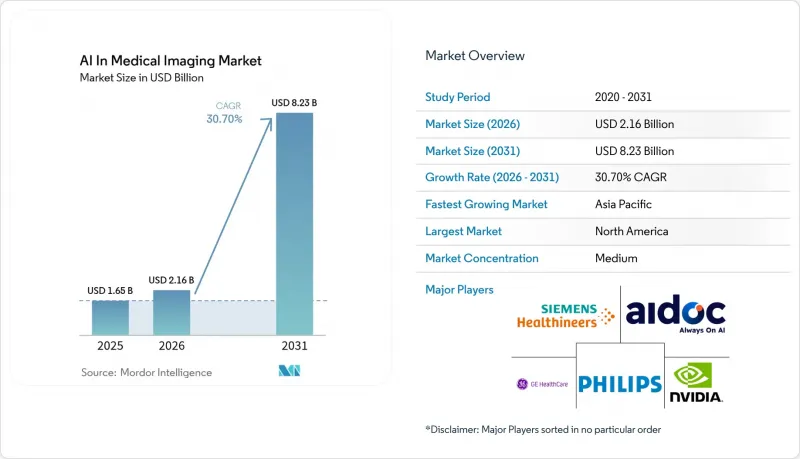
Mordor Intelligence에 의하면, 의료 이미징 분야 AI 시장 규모는 2025년 16억 5,000만 달러에서 2026년에는 21억 6,000만 달러로 확대되어 2026년부터 2031년까지 CAGR 30.7%로 성장하여 2031년에는 82억 3,000만 달러에 이를 것으로 예측됩니다.
본 보고서는 제공 형태(소프트웨어 도구/플랫폼, 서비스 등), 영상 진단 모달리티(X선, 컴퓨터 단층촬영(CT) 등), 용도(종양학, 신경학 등), 도입 모델(On-Premise, 클라우드/웹 기반 등), 최종 사용자(병원 및 진료소, 영상진단센터 등), 지역별로 분류되어 있습니다. 시장 예측은 금액(달러) 기준으로 제시되어 있습니다.
전 세계 의료 이미징 분야 AI 시장 동향 및 인사이트
미국 및 EU에서의 멀티 벤더 PACS 상호 운용성 표준의 급속한 확대
EU의 e-헬스 네트워크에 따른 국경을 초월한 영상 교환 규칙과 향후 도입될 미국의 상호 운용성 규정에 따라, 알고리즘은 인증된 PACS에 저장된 스캔 데이터를 읽을 수 있게 됩니다. FHIR 기반의 연합 프레임워크를 활용한 초기 시범 프로젝트에서는 데이터 검색 정확도 95%를 달성하고 지연 시간을 38% 단축했습니다. 이를 통해 데이터 주권을 유지하면서 응급 의료 현장에서의 환자 분류를 신속하게 진행할 수 있게 되었습니다.
아시아(중국, 일본, 한국)에서의 암 검진 의무화 가속화
정부 자금 지원 프로그램을 통해 매년 수백만 건의 CT 검사 및 내시경 검사가 추가되고 있습니다. 한국의 전국 위암 검진 사업은 우수한 비용 대비 효과를 보여주고 있으며, 일본에서는 AI가 우발성 결절을 감지함으로써 폐암의 70%를 1기 또는 2기 단계에서 발견할 수 있게 되었습니다.
단편적인 데이터 거버넌스 법안이 국경을 초월한 AI 모델 학습을 방해하고 있습니다.
EU의 AI법에서는 진단 알고리즘이 고위험군으로 분류되어 엄격한 적합성 평가가 요구되고 있습니다. 아시아 각지의 상이한 동의 규정이 다국간 데이터셋의 활용을 더욱 제한하고 있으며, 그 결과 모델의 일반화 능력이 저하되고, 특히 희귀질환 코호트에서 승인 절차가 지연되고 있습니다.
부문 분석
소프트웨어 도구 및 플랫폼 부문은 2025년 매출의 57.30%를 차지하며, 병원 네트워크 전체에서 알고리즘 오케스트레이션 및 라이프사이클 관리의 운영 계층으로서의 역할을 강조하고 있습니다. 서비스 부문은 워크플로우 재설계 및 도입 후 모니터링을 통해 부가가치를 제공하며, 2026년부터 2031년까지 31.4%라는 가장 높은 연평균 성장률(CAGR)을 나타낼 전망입니다. 각 벤더는 현재 도입, 임상 검증, 사이버 보안 지원을 번들로 제공하고 있으며, 이는 의료 기관이 업무 차질을 최소화하는 턴키 방식의 계약을 선호하는 경향을 반영합니다. 엣지 지원 어플라이언스는 여전히 틈새 시장이지만, 1초가 중요한 뇌졸중이나 외상 치료 현장에서는 주목을 받고 있습니다. 병원 측은 싱글 사인온(SSO)으로 수십 개의 승인된 알고리즘을 이용할 수 있는 벤더 중립적인 마켓플레이스를 높이 평가했습니다. GE 헬스케어의 ‘Genesis’ 스택을 통해 방사선과 의사는 용도를 필요에 따라 선택하고, 수동 재검증 없이 업데이트를 배포할 수 있어 총 소유 비용(TCO)을 절감하고 투자 회수 기간을 단축할 수 있습니다. 이러한 아키텍처는 의료 이미징 분야 AI 시장 기반이 되고 있으며, 향후 10년 동안의 조달 동향을 형성해 나갈 것입니다.
CT는 외상, 흉부, 신경 프로토콜에서 널리 보급되어 있어, 2025년 의료 이미징 분야 AI 시장에서 27.60%의 점유율을 유지했습니다. 뇌졸중 치료에서 알고리즘을 활용한 분류는 현재 많은 도시 지역의 뇌졸중 센터에서 표준으로 자리 잡고 있으며, 이송부터 치료 시작까지의 시간을 단축시키고 있습니다. 새롭게 상용화된 광자 계수 CT는 더욱 선명한 심장 영상을 제공할 것으로 기대되며, 차세대 모델을 위한 비옥한 토대를 마련하고 있습니다. 초음파는 2031년까지 연평균 성장률(CAGR)이 31.0%에 달하고, 다른 모든 모달리티를 능가할 것으로 예측됩니다. 실시간 AI 안내 기능과 결합된 휴대용 프로브는 응급 의료진이 내출혈 위치를 파악하는 데 도움을 주고, 조산사가 태아의 성장 상태를 확인하는 데 지원합니다. 최신 기기의 휴대성 덕분에 스캔 빈도가 증가하여, 훈련 파이프라인에는 그 어느 때보다 방대한 데이터 세트가 유입되고 있습니다. MRI 및 PET의 경우, 노이즈 감소 및 정량적 매핑 분야의 알고리즘 발전이 지속되고 있지만, 그 성장은 여전히 스캐너의 처리 능력 제약과 보험 환급의 복잡성에 좌우되고 있습니다.
지역별 분석
2025년, 북미는 의료 이미징 분야 AI 시장에서 40.60%의 점유율을 차지하며 1위를 차지했습니다. 견고한 의료 IT 인프라, 적극적인 FDA 승인, 그리고 보험 환급 체계가 AI 도입을 뒷받침하고 있습니다. 통합 의료 네트워크(IDN)는 아카이브를 신속하게 클라우드로 이전하고, 방사선과 의사의 자원을 공유하는 동시에 예측 분석의 잠재력을 발휘하고 있습니다. 캐나다가 흉부 및 신경 분야 AI 용도를 새롭게 승인한 것은 이 지역 전체에 걸쳐 보급이 확대될 것임을 시사합니다. 아시아는 가장 빠르게 성장하는 지역으로, 2031년까지 연평균 성장률(CAGR)이 32.5%를 나타낼 것으로 예측됩니다. 중국에는 수십 종의 국산 승인 의료기기가 있으며, 일본에서는 AI를 활용한 분류(triage)를 광범위하게 적용한 전국적인 폐암 검진에 공공 자금이 투입되고 있습니다. 한국의 국가 프로그램은 높은 비용 대비 효과를 보여주고 있으며, 이와 유사한 확대를 뒷받침하고 있습니다. 인도는 자원이 부족한 진료소를 위해 결핵(TB)에 특화된 도구를 개발하고 있어, 소득 수준에 관계없이 AI의 범용성을 부각시키고 있습니다. 유럽은 기회와 신중함의 균형을 맞추고 있습니다. 의료기기 규정에 따라 규정 준수 요건이 엄격해졌지만, EU 전역에 걸친 영상 교환 지침을 통해 더 광범위한 데이터 풀을 활용할 수 있게 되어 알고리즘의 견고성 향상에 기여하고 있습니다. 북유럽 국가들은 외딴 지역에 서비스를 제공하기 위해 원격 방사선 진단을 선도적으로 도입하고 있는 반면, 프랑스는 지속가능성 조항과 연구 자금을 포함시킨, 영상 진단의 가치를 극대화하는 장기적인 파트너십을 추진하고 있습니다.
기타 혜택:
- 엑셀 형식 시장 예측(ME) 시트
- 3개월간의 애널리스트 지원
자주 묻는 질문
목차
제1장 서론
제2장 조사 방법
제3장 주요 요약
제4장 시장 구도
제5장 시장 규모와 성장 예측
제6장 경쟁 구도
제7장 시장 기회와 향후 전망
JHS 26.09.11According to Mordor Intelligence, the AI in medical imaging market size market is expected to grow from USD 1.65 billion in 2025 to USD 2.16 billion in 2026 and is forecast to reach USD 8.23 billion by 2031 at 30.7% CAGR over 2026-2031.
This report is Segmented by Offering (Software Tools/Platform, Services and More), Imaging Modality (X-Ray, Computed Tomography, and More), Application (Oncology, Neurology and More), Deployment Model (On-Premise, Cloud / Web-Based and More), End User (Hospitals and Clinics, Diagnostic Imaging Centers and More), and Geography. The Market Forecasts are Provided in Terms of Value (USD).
Global AI In Medical Imaging Market Trends and Insights
Rapid expansion of multi-vendor PACS interoperability standards in U.S. and EU
Cross-border imaging exchange rules from the EU eHealth Network and upcoming U.S. interoperability provisions allow algorithms to read scans stored on any certified PACS. Early pilots using FHIR-based federated frameworks achieved 95% data-retrieval accuracy and cut latency by 38%, enabling faster triage in acute settings while maintaining data sovereignty
Accelerating oncology screening mandates in Asia (China, Japan, South Korea)
Government-funded programs are adding millions of extra CT and endoscopy exams each year. South Korea's national gastric-cancer initiative demonstrates favorable cost-utility ratios, and Japan now detects 70% of lung cancers at Stage I or II when AI flags incidental nodules.
Fragmented data-governance laws are hindering cross-border AI model training
The EU AI Act classifies diagnostic algorithms as high-risk, demanding rigorous conformity assessments. Divergent consent rules across Asia further limit the use of multi-country datasets, which in turn degrade model generalizability and slow down approvals, especially for rare-disease cohorts.
Other drivers and restraints analyzed in the detailed report include:
- Large-scale national AI diagnostics grants
- Growing shortage of radiologists boosting teleradiology adoption in Nordics & GCC
- High per-scan inference costs on edge GPUs in low-volume clinics
For complete list of drivers and restraints, kindly check the Table Of Contents.
Segment Analysis
The software tools and platforms segment captured 57.30% of 2025 revenue, underlining its role as the operating layer for algorithm orchestration and lifecycle management across hospital networks. Services are adding value through workflow redesign and post-deployment monitoring and are forecast to post the fastest 31.4% CAGR during 2026-2031. Vendors now bundle implementation, clinical-validation and cybersecurity support, reflecting provider preference for turnkey engagements that minimize disruption. Edge-enabled appliances remain a niche but are gaining traction for stroke and trauma hubs where every second matters. Hospitals appreciate vendor-neutral marketplaces that host dozens of cleared algorithms behind a single sign-on. GE HealthCare's Genesis stack lets radiologists select applications a la carte and deploy updates without manual re-validation, lowering total cost of ownership and accelerating time-to-benefit GE HealthCare. Such architectures anchor the AI in medical imaging market and will shape procurement for the remainder of the decade.
CT retained 27.60% share of the AI in medical imaging market in 2025 thanks to its ubiquity in trauma, chest and neuro protocols. Algorithmic triage in stroke care is now standard in many urban stroke centers, shrinking door-to-needle times. Photon-counting CT, newly commercialized, promises sharper cardiac images, opening fertile ground for next-generation models. Ultrasound is projected to outpace all other modalities with a 31.0% CAGR through 2031. Hand-held probes paired with real-time AI guidance help emergency staff locate internal bleeding and assist midwives in fetal-growth checks. The portability of modern devices increases scan frequency, feeding ever larger datasets into training pipelines. MRI and PET continue to see algorithmic gains in noise reduction and quantitative mapping, yet their growth remains tied to scanner throughput constraints and reimbursement complexities.
Complete Report Scope:
- By Offering
- Software Tools / Platforms
- Services
- Hardware / Integrated Solutions
- By Imaging Modality
- X-ray
- Computed Tomography (CT)
- Magnetic Resonance Imaging (MRI)
- Ultrasound
- Positron Emission Tomography (PET) / SPECT
- By Application
- Oncology
- Neurology
- Cardiology
- Musculoskeletal and Orthopedics
- Breast Imaging
- Pulmonology
- By Deployment Model
- On-premise
- Cloud / Web-based
- Hybrid
- By End User
- Hospitals and Clinics
- Diagnostic Imaging Centers
- Ambulatory Surgery Centers (ASC)
- Research and Academic Institutes
- Teleradiology Providers
- By Geography
- North America
- United States
- Canada
- South America
- Brazil
- Argentina
- Chile
- Europe
- Germany
- France
- United Kingdom
- Italy
- Spain
- Nordics (Sweden, Norway, Finland, Denmark)
- Rest of Europe
- Middle East
- Saudi Arabia
- United Arab Emirates
- Turkey
- Rest of Middle East
- Africa
- South Africa
- Nigeria
- Rest of Africa
- Asia Pacific
- China
- India
- Japan
- South Korea
- Southeast Asia
- Rest of Asia Pacific
- North America
Geography Analysis
North America led the AI in medical imaging market with 40.60% share in 2025. Robust health IT infrastructure, proactive FDA clearances and reimbursement pathways bolster adoption. Integrated Delivery Networks rapidly migrate archives to the cloud to pool radiologists and unlock predictive analytics. Canada's fresh approval of chest and neuro AI applications signals wider regional uptake. Asia is the fastest-growing geography, projected at 32.5% CAGR to 2031. China counts dozens of homegrown cleared devices, and Japan funds nationwide lung-cancer screening that leans heavily on AI triage. South Korea's national programs display cost-effectiveness that encourages similar rollouts. India advances TB-focused tools for low-resource clinics, highlighting the versatility of AI across income brackets. Europe balances opportunity and caution. The Medical Devices Regulation heightens compliance requirements, yet pan-EU image-exchange guidelines unlock a broader data pool that benefits algorithm robustness. The Nordics pioneer teleradiology to serve remote regions, while France embarks on long-term imaging-value partnerships that incorporate sustainability clauses and research funding.
- Siemens Healthineers AG
- GE HealthCare Technologies Inc.
- Koninklijke Philips N.V.
- IBM Watson Health / Merative
- NVIDIA Corporation
- Canon Medical Systems Corp.
- Fujifilm Holdings Corp.
- Agfa-Gevaert Group
- Zebra Medical Vision (Nanox AI)
- Lunit Inc.
- Aidoc Medical Ltd.
- Arterys Inc.
- Enlitic Inc.
- Qure.ai Technologies Pvt. Ltd.
- iCAD Inc.
- Sectra AB
- Visage Imaging GmbH
- Butterfly Network, Inc.
- EchoNous, Inc.
- Oxipit UAB
- RapidAI, Inc.
Additional Benefits:
- The market estimate (ME) sheet in Excel format
- 3 months of analyst support
TABLE OF CONTENTS
1 INTRODUCTION
- 1.1 Study Assumptions and Market Definition
- 1.2 Scope of the Study
2 RESEARCH METHODOLOGY
3 EXECUTIVE SUMMARY
4 MARKET LANDSCAPE
- 4.1 Market Overview
- 4.2 Market Drivers
- 4.2.1 Rapid Expansion of Multi-vendor PACS Interoperability Standards in U.S. and EU
- 4.2.2 Accelerating Oncology Screening Mandates in Asia (China, Japan, S. Korea)
- 4.2.3 Large-scale National AI Diagnostics Grants (e.g., NHS-AI, NIH Bridge2AI)
- 4.2.4 Growing Shortage of Radiologists Boosting Teleradiology Adoption in Nordics and GCC
- 4.2.5 Enterprise-level Cloud Migration of Imaging Archives by U.S. IDNs
- 4.2.6 Commercial Roll-out of FDA and CE Cleared SaMD Algorithms for Stroke Triage
- 4.3 Market Restraints
- 4.3.1 Fragmented Data Governance Laws Hindering Cross-border AI Model Training
- 4.3.2 High Per-scan Inference Costs on Edge GPUs in Low-volume Clinics
- 4.3.3 Liability Ambiguity Around AI-assisted Diagnosis in EU MDR
- 4.3.4 CAPEX Freeze in Small and Rural Hospitals Post-COVID Capital Depletion
- 4.4 Industry Value Chain Analysis
- 4.5 Regulatory and Technological Outlook
- 4.5.1 Regulatory Outlook
- 4.5.2 Technological Outlook (Foundation Models, Federated Learning)
- 4.6 Porters Five Forces Analysis
- 4.6.1 Bargaining Power of Suppliers
- 4.6.2 Bargaining Power of Buyers/Consumers
- 4.6.3 Threat of New Entrants
- 4.6.4 Threat of Substitutes
- 4.6.5 Intensity of Competitive Rivalry
- 4.7 Investment Analysis
5 MARKET SIZE AND GROWTH FORECASTS (VALUE)
- 5.1 By Offering
- 5.1.1 Software Tools / Platforms
- 5.1.2 Services
- 5.1.3 Hardware / Integrated Solutions
- 5.2 By Imaging Modality
- 5.2.1 X-ray
- 5.2.2 Computed Tomography (CT)
- 5.2.3 Magnetic Resonance Imaging (MRI)
- 5.2.4 Ultrasound
- 5.2.5 Positron Emission Tomography (PET) / SPECT
- 5.3 By Application
- 5.3.1 Oncology
- 5.3.2 Neurology
- 5.3.3 Cardiology
- 5.3.4 Musculoskeletal and Orthopedics
- 5.3.5 Breast Imaging
- 5.3.6 Pulmonology
- 5.4 By Deployment Model
- 5.4.1 On-premise
- 5.4.2 Cloud / Web-based
- 5.4.3 Hybrid
- 5.5 By End User
- 5.5.1 Hospitals and Clinics
- 5.5.2 Diagnostic Imaging Centers
- 5.5.3 Ambulatory Surgery Centers (ASC)
- 5.5.4 Research and Academic Institutes
- 5.5.5 Teleradiology Providers
- 5.6 By Geography
- 5.6.1 North America
- 5.6.1.1 United States
- 5.6.1.2 Canada
- 5.6.2 South America
- 5.6.2.1 Brazil
- 5.6.2.2 Argentina
- 5.6.2.3 Chile
- 5.6.3 Europe
- 5.6.3.1 Germany
- 5.6.3.2 France
- 5.6.3.3 United Kingdom
- 5.6.3.4 Italy
- 5.6.3.5 Spain
- 5.6.3.6 Nordics (Sweden, Norway, Finland, Denmark)
- 5.6.3.7 Rest of Europe
- 5.6.4 Middle East
- 5.6.4.1 Saudi Arabia
- 5.6.4.2 United Arab Emirates
- 5.6.4.3 Turkey
- 5.6.4.4 Rest of Middle East
- 5.6.5 Africa
- 5.6.5.1 South Africa
- 5.6.5.2 Nigeria
- 5.6.5.3 Rest of Africa
- 5.6.6 Asia Pacific
- 5.6.6.1 China
- 5.6.6.2 India
- 5.6.6.3 Japan
- 5.6.6.4 South Korea
- 5.6.6.5 Southeast Asia
- 5.6.6.6 Rest of Asia Pacific
- 5.6.1 North America
6 COMPETITIVE LANDSCAPE
- 6.1 Market Concentration
- 6.2 Strategic Moves
- 6.3 Market Share Analysis
- 6.4 Company Profiles (includes Global level Overview, Market level overview, Core Segments, Financials as available, Strategic Information, Market Rank/Share for key companies, Products and Services, and Recent Developments)
- 6.4.1 Siemens Healthineers AG
- 6.4.2 GE HealthCare Technologies Inc.
- 6.4.3 Koninklijke Philips N.V.
- 6.4.4 IBM Watson Health / Merative
- 6.4.5 NVIDIA Corporation
- 6.4.6 Canon Medical Systems Corp.
- 6.4.7 Fujifilm Holdings Corp.
- 6.4.8 Agfa-Gevaert Group
- 6.4.9 Zebra Medical Vision (Nanox AI)
- 6.4.10 Lunit Inc.
- 6.4.11 Aidoc Medical Ltd.
- 6.4.12 Arterys Inc.
- 6.4.13 Enlitic Inc.
- 6.4.14 Qure.ai Technologies Pvt. Ltd.
- 6.4.15 iCAD Inc.
- 6.4.16 Sectra AB
- 6.4.17 Visage Imaging GmbH
- 6.4.18 Butterfly Network, Inc.
- 6.4.19 EchoNous, Inc.
- 6.4.20 Oxipit UAB
- 6.4.21 RapidAI, Inc.
7 MARKET OPPORTUNITIES AND FUTURE OUTLOOK
- 7.1 White-space and Unmet-need Assessment