|
시장보고서
상품코드
2124169
플랫 안테나 시장 : 점유율 분석, 업계 동향과 통계, 성장 예측(2026-2031년)Flat Antenna - Market Share Analysis, Industry Trends & Statistics, Growth Forecasts (2026 - 2031) |
||||||
 Mordor Intelligence
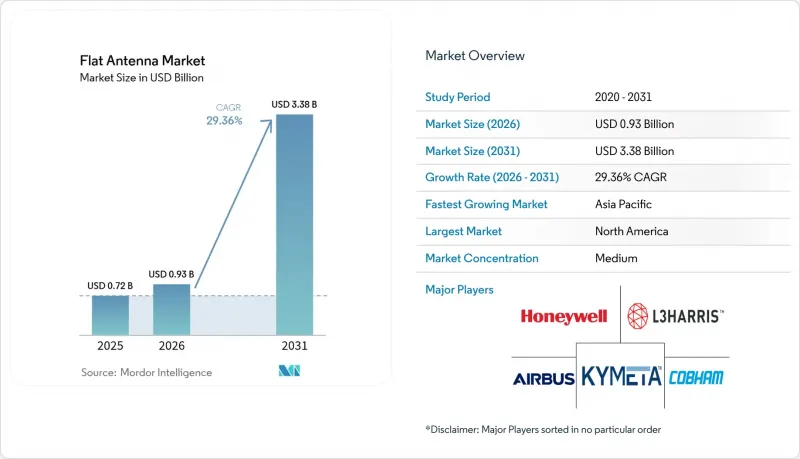
Mordor Intelligence에 의하면, 플랫 안테나 시장 규모는 2025년에 7억 2,000만 달러로 평가되었고 2026년 9억 3,000만 달러에서 2031년까지 33억 8,000만 달러에 이를 것으로 예측되며, 예측 기간(2026-2031년) CAGR은 29.36%를 나타낼 전망입니다.
본 보고서는 용도별(항공우주, 국방·정부, 해양, 기타), 주파수 대역별(Ku대역, Ka대역, 기타), 플랫폼별(지상 고정국, 항공기 탑재형, 기타), 안테나 기술별(전자식 지향성 위상 배열(ESA), 전자·기계식 하이브리드 지향형, 기타), 지역별로 분류되어 있습니다. 시장 예측은 금액(달러) 기준으로 제시되어 있습니다.
세계 플랫 안테나 시장 동향 및 인사이트
LEO 위성 군집의 전개가 소형 사용자 단말기 수요를 견인
주요 하이라이트
- 메가 콘스텔레이션 사업자들은 수백 기의 위성을 운용하기 시작했으며, 지상 단말기에는 신속한 핸드오버와 넓은 시야각에 대한 대응이 요구되고 있습니다. Telesat Lightspeed 네트워크용 Intellian 사의 Ka-밴드 패널은 이러한 변화를 상징하며, 밀리초 단위의 빔 전환을 가능하게 하여 기계 구동식 파라볼라 안테나를 구식으로 만들고 있습니다. 전자 제어 어레이로 인해 크기, 무게, 유지보수 부담이 줄어들어 플랫 안테나 시장이 혜택을 보고 있으며, 기업 옥상, 이동체 플랫폼, 정부 기관 차량에 설치할 수 있게 되었습니다. 새로운 공급 계약으로 연간 생산 대수는 이미 수만 대 규모로 확대되어, 단말기 1대당 비용 절감이 가속화되고 있습니다. 또한, 저지연화를 통해 알고리즘 트레이딩나 원격 산업 제어와 같은 프리미엄 이용 사례가 가능해지면서, 대상 수익이 더욱 확대되고 있습니다. OneWeb 네트워크용 퓨즈(Fuse) 사의 HL1100W 싱글 패널 ESA는 각 사업자가 2025년 서비스 개시를 목표로 턴키 단말기의 인증 획득을 급속도로 추진하고 있는 사례를 보여줍니다.
IFC 업그레이드를 위한 민간 항공기 개조
각 항공사는 경쟁상의 차별화 요인으로 기내 연결을 추진하고 있으며, 레이돔이 장착된 파라볼라 안테나에 비해 공기 저항과 연료 소비를 줄여주는 플러시 마운트형 플랫 패널을 도입하고 있습니다. 델타항공이 ThinKom사의 Ka2,517 유닛을 탑재한 휴즈(Hughes)사의 ‘Fusion’ 솔루션을 채택한 것은 LEO(저궤도) 및 GEO(정지궤도) 링크에 걸친 멀티 궤도 유연성에 대한 항공사 수요를 여실히 보여주고 있습니다. 항력 저감에 관한 연구에 따르면, 공기역학적 손실이 75-90% 감소하여, 이로 인해 초기 하드웨어 비용을 상쇄할 정도의 운영 기간 전반에 걸친 상당한 연료비 절감으로 이어집니다. 규제 당국은 보완형식인증 절차를 간소화하여 사후 설치에 따른 가동 중단 시간을 단축하고 있습니다. 하와이안 항공의 스타링크 도입은 초기 도입자들이 동종 업계 경쟁사들이 유사한 아키텍처를 채택하도록 영향을 미치고 있음을 보여줍니다. 비아샛의 ‘Amara IFC’ 플랫폼은 노선 혼잡 상황에 따라 용량을 동적으로 할당하는 듀얼 빔 ESA를 탑재하고 있으며, 이는 하드웨어 혁신과 더불어 지능형 단말 소프트웨어의 중요성을 부각시키고 있습니다.
액티브 페이즈드 어레이의 막대한 연구개발비 및 제조 비용
새로운 평면 패널 아키텍처 개발에는 일반적으로 5,000만 달러를 초과하는 비반복적 엔지니어링 비용이 소요됩니다. 이는 주로 실리콘 칩보다 3-5배 더 비싼 갈륨 질화물(GaN) 전력 증폭기 때문입니다. 전용 클린룸 생산 라인과 근거리장 시험실 역시 추가적인 자본 비용을 필요로 합니다. 이러한 경제적 요인들은 기존 기업들에게 유리하게 작용하여 신생 기업의 투자 회수 기간을 길게 만들며, 결과적으로 플랫 안테나 시장으로의 신규 시장 진출기업 다양화를 저해하고 있습니다. 각 부품 공급업체들은 인건비를 절감하기 위해 3D 프린팅을 활용한 수동층 제작 및 자동 픽 앤 플레이스(pick-and-place) 도입을 모색하고 있는 반면, 시스템 프라이머 기업들은 장기 테이크-오어-페이(take-or-pay) 방식의 웨이퍼 계약을 협상하고 있습니다. 메타물질 설계가 성숙해짐에 따라 소자 수를 줄이고 바이어스 회로를 단순화함으로써 기존 위상 배열보다 비용을 절감할 가능성이 있지만, 우선 광대역 효율이 동등한 수준에 도달해야 합니다.
부문 분석
2025년, 국방 및 정부 부문은 고가대의 멀티밴드 전술 단말기 및 무인 차량의 도입으로 플랫 안테나 시장 점유율의 37.52%를 차지했습니다. 민간 항공사는 기내 연결 설비 개조 수요가 증가함에 따라 2위를 차지하고 있습니다. 선박 운항사는 승무원 복리후생 및 화물 추적 기능을 개선하기 위해 GEO(정지 궤도)와 LEO(저궤도)를 결합한 하이브리드 패키지를 지속적으로 도입하고 있습니다. 금액 기준으로는 이 용도 부문이 플랫 안테나 시장 규모에서 가장 큰 비중을 차지하고 있으며, NATO 회원국들이 위성 통신 장비를 갱신함에 따라 2027년까지 선두 자리를 유지할 것으로 예측됩니다.
eVTOL/도심항공모빌리티(UAM)(UAM) 부문은 2026년 이후 규제상 비행 경로가 개방됨에 따라, 용도 분야 내에서 가장 높은 연평균 성장률(CAGR) 33.44%를 나타낼 것으로 예측됩니다. 도시 간 운항 사업자는 배터리 탑재량을 희생하지 않고도 항공 전자 장비와 통합할 수 있는 소형·경량이며 멀티 궤도 대응이 가능한 패널을 필요로할 것입니다. 동시에, 소비자용 광대역 단말기는 하드웨어 가격 하락을 활용하여 통신 서비스가 부족한 농촌 지역으로의 보급을 도모할 것입니다. 또한, 긴급 대응 기관들도 재해 발생 시 통신 복구를 위해 휴대용 키트를 도입하고 있어, 이로 인해 플랫 안테나 시장의 고객 기반이 확대되고 있습니다.
Ku/Ka 대역 솔루션은 견실한 위성 용량과 수년에 걸친 규제상 주파수 할당 덕분에 2025년 플랫 안테나 시장 규모의 45.62%를 차지했습니다. Ku 대역의 강우 페이드 내성은 해상 이용에 적합하며, 한편 Ka 대역의 높은 처리량은 비디오, 클라우드 및 VPN 백홀을 뒷받침하고 있습니다. X 대역은 보안 통신 링크 및 레이더 융합을 위한 방위 분야에서 독점적인 지위를 유지하고 있습니다.
V/EHF 대역 시장 부문은 군이 감청이 어려운 파형으로 전환을 추진하고, 상용 위성 군집이 서브테라헤르츠 대역의 용량을 목표로 함에 따라 연평균 성장률(CAGR) 30.58%로 성장할 전망입니다. 위상 허용 오차의 엄격화 및 경로 손실 증가와 같은 하드웨어상의 과제가 열 기판 및 메타렌즈 이득 구조의 혁신을 촉진하고 있습니다. 단일 개구부 내에서 K, Ku, Ka 각 대역을 전환할 수 있는 멀티밴드 안테나가 주목받고 있으며, 함대 운영자에게 하드웨어 교체가 필요 없는 유연성을 제공할 것으로 기대됩니다.
지역별 분석
북미는 SpaceX와 OneWeb에 의한 초기 LEO 위성 군집 배치, 방위 프로젝트의 집중, 그리고 항공사의 연결 환경에 대한 적극적인 업그레이드를 배경으로 2025년 플랫 안테나 시장 점유율의 40.55%를 차지했습니다. 미국 연방통신위원회(FCC)는 비정지 궤도용 라이선스 규정을 간소화하고, 단말기 인증에 관한 행정적 장벽을 낮추는 한편, 기존 서비스를 보호하는 주파수 공유권을 확대했습니다. 또한, 캐나다의 수출 규제 완화로 국경을 초월한 공급망 통합이 가능해지면서 공동 개발 프로그램이 가속화되고 있습니다.
일본, 한국, 호주 각국 정부가 국가 우주 자산 및 위성 광대역 프로그램에 예산을 배정하고 있어, 아시아태평양은 2031년까지 31.24%라는 지역 내 가장 높은 연평균 성장률(CAGR)을 보일 것으로 전망됩니다. 중국 업체들은 Ku 대역 패널에 대해 수출 기준 안전 인증을 획득하여 동남아시아 해양 시장에 진출했습니다. 서울의 전자통신연구원(ETRI)은 고속철도를 위한 초박형 Ku 안테나의 시범 운영을 진행 중이며, 이는 방위 분야 외의 다각화가 진행되고 있음을 보여줍니다. 외딴 섬에서의 전자상거래 및 원격의료의 급속한 확대로 인해 기업용 VSAT에 대한 수요가 점차 증가하고 있으며, 이는 플랫 안테나 시장의 성장 궤도를 뒷받침하고 있습니다.
유럽은 여전히 안정적인 성장 시장이며, ESA(유럽 우주국)의 기술이 민간 항공, 크루즈선, 정부 네트워크에 침투하고 있습니다. SES의 인텔샛(Intelsat)에 대한 31억 달러 규모의 인수 계획은 다중 궤도 용량을 통합하고, 합병 후의 위성 군과 자사 개발 단말기 로드맵을 결합함으로써 수익성 확보를 도모합니다. 네덜란드와 프랑스를 필두로 한 각국의 국방 기관은 차세대 전투기와 통합 가능한 저가시성 플랫 어레이의 조달을 추진하고 있습니다. 중동 및 아프리카에서는 특히 위기 상황에서 견고한 통신 링크가 필요한 해상 에너지 시추 시설 및 인도주의 지원 기관으로부터의 수주가 아직 초기 단계이긴 하지만 급속히 증가하고 있습니다.
기타 혜택:
- 엑셀 형식 시장 예측(ME) 시트
- 3개월간의 애널리스트 지원
자주 묻는 질문
목차
제1장 서론
제2장 조사 방법
제3장 주요 요약
제4장 시장 구도
제5장 시장 규모와 성장 예측
제6장 경쟁 구도
제7장 시장 기회와 향후 전망
JHS 26.09.11According to Mordor Intelligence, the flat antenna market size was valued at USD 0.72 billion in 2025 and estimated to grow from USD 0.93 billion in 2026 to reach USD 3.38 billion by 2031, at a CAGR of 29.36% during the forecast period (2026-2031).

This report is Segmented by Application (Aerospace, Defense and Government, Maritime, and More), Frequency Band (Ku-Band, Ka-Band, and More), Platform (Ground Fixed Stations, Airborne, and More), Antenna Technology (Electronically-Steered Phased Array (ESA), Hybrid Electronically/Mechanically Steered, and More), and Geography. The Market Forecasts are Provided in Terms of Value (USD).
Global Flat Antenna Market Trends and Insights
LEO-Constellation Rollout Drives Demand for Compact User Terminals
Key Highlights
- Mega-constellation operators are commissioning hundreds of satellites, forcing ground terminals to support rapid handovers and wide look-angles. Intellian's Ka-band panel for the Telesat Lightspeed network exemplifies the shift, enabling millisecond beam switching and obsoleting mechanically driven dishes. The flat antenna market benefits because electronically steered arrays shrink size, weight, and maintenance, thereby fitting enterprise rooftops, mobility platforms, and government vehicles. New supply contracts are already scaling annual production into tens of thousands of units, accelerating per-terminal cost declines. Low latency also opens premium use cases such as algorithmic trading and remote industrial control, which further increases addressable revenues. Hughes' HL1100W single-panel ESA for the OneWeb network demonstrates how operators are racing to certify turnkey terminals for service launch in 2025.
Commercial Aircraft Retrofits for IFC Upgrades
Airlines are pursuing cabin connectivity as a competitive differentiator and are installing flush-mounted flat panels that cut drag and fuel burn compared with radome-topped dishes. Delta Air Lines' selection of Hughes' Fusion solution with ThinKom's Ka2517 unit highlights carrier demand for multi-orbit flexibility across LEO and GEO links. Drag reduction studies show 75-90% lower aerodynamic penalty, translating to significant lifetime fuel savings that offset upfront hardware costs. Regulatory agencies have simplified supplemental type certification, compressing downtime for retrofit installations. Hawaiian Airlines' Starlink rollout indicates how early adopters are influencing peer carriers to adopt similar architectures. Viasat's Amara IFC platform adds a dual-beam ESA that dynamically allocates capacity based on route congestion, underscoring the importance of intelligent terminal software in tandem with hardware innovation.
High R&D and Production Cost of Active Phased Arrays
Developing a new flat-panel architecture routinely exceeds USD 50 million in non-recurring engineering spend, largely due to expensive gallium nitride power amplifiers that cost 3-5 times more than silicon chips. Specialized clean-room lines and near-field test chambers impose added capital. These economics favor incumbents and elongate payback for start-ups, decelerating new-entrant diversity in the flat antenna market. Component vendors are exploring 3D-printed passive layers and automated pick-and-place to trim labor, while system primes negotiate long-term take-or-pay wafer contracts. As metamaterial designs mature, they may undercut legacy phased arrays by collapsing element count and simplifying bias networks, but wide-band efficiency must first reach parity.
Other drivers and restraints analyzed in the detailed report include:
- Unmanned Systems Adoption in Defense and ISR
- eVTOL and Autonomous-Vehicle SatCom Requirements
- GaN/RF-IC Supply-Chain Choke-Points
For complete list of drivers and restraints, kindly check the Table Of Contents.
Segment Analysis
Defense and Government represented 37.52% of the flat antenna market share in 2025 due to multiband tactical terminals and unmanned vehicle roll-outs that command premium pricing. Commercial airlines rank second on the back of rising in-flight connectivity retrofits. Ship operators continue adopting hybrid GEO-LEO packages to improve crew welfare and cargo tracking. In value terms, the application segment contributed the largest portion of the flat antenna market size, and is expected to retain primacy until 2027 as NATO members refresh satcom inventories.
The eVTOL/Urban Air Mobility category is projected to register a 33.44% CAGR, the highest within applications, as regulatory corridors open after 2026. City-pair operators will require small, lightweight, multi-orbit panels that integrate with avionics without compromising battery payload. Concurrently, consumer broadband terminals will leverage falling hardware prices to penetrate underserved rural territories. Emergency-response agencies are also adding man-portable kits to restore connectivity during disasters, widening the customer base for the flat antenna market.
Ku/Ka solutions held 45.62% share of the flat antenna market size in 2025 because of robust satellite capacity and long-standing regulatory allocations. Rain-fade resilience at Ku-band suits maritime use, while Ka-band's higher throughput supports video, cloud, and VPN backhaul. X-band remains a defense preserve for secure links and radar fusion.
The V-/EHF-band slice is set to grow at a 30.58% CAGR as militaries move toward low-probability-of-intercept waveforms and commercial constellations target sub-TeraHertz capacity. Hardware challenges such as tighter phase tolerance and higher path loss are spurring innovations in thermal substrates and meta-lens gain structures. Multi-band antennas that switch between K, Ku, and Ka within a single aperture are gaining traction, promising fleet operators flexibility without hardware swap-outs.
Complete Report Scope:
- By Application
- Aerospace
- Defense and Government
- Commercial Aviation
- Maritime
- Land Mobile / 5G Backhaul
- Consumer Broadband and Others
- By Frequency Band
- Ku-Band
- Ka-Band
- K/u//Ka Multi-band
- X-Band
- V-/EHF-Band
- By Platform
- Ground Fixed Stations
- Land-Mobile (Vehicular)
- Airborne
- Maritime and Offshore
- Portable / Man-pack
- By Antenna Technology
- Electronically-Steered Phased Array (ESA)
- Hybrid Electronically/Mechanically Steered
- Mechanically Steered Flat Panel
- Metamaterial / RIS-based
- By Geography
- North America
- United States
- Canada
- Mexico
- South America
- Brazil
- Argentina
- Rest of South America
- Europe
- United Kingdom
- Germany
- France
- Rest of Europe
- Asia Pacific
- China
- Japan
- India
- South Korea
- Rest of Asia Pacific
- Middle East and Africa
- United Arab Emirates
- Saudi Arabia
- South Africa
- Rest of Middle East and Africa
- North America
Geography Analysis
North America captured 40.55% of flat antenna market share in 2025 following early LEO constellation deployments by SpaceX and OneWeb, a high concentration of defense projects, and aggressive airline connectivity upgrades. The U.S. Federal Communications Commission has issued streamlined non-geostationary licensing rules, lowering administrative barriers for terminal certification while extending spectrum sharing rights that protect incumbent services. Canada's export-control liberalization is also enabling cross-border supply-chain integration, accelerating joint development programs.
Asia Pacific is projected to generate the fastest regional CAGR of 31.24% to 2031 as governments in Japan, South Korea, and Australia allocate budget for sovereign space assets and satellite broadband programs. Chinese vendors have achieved export-class safety certifications on Ku-band panels, opening Southeast-Asian maritime markets. Seoul's Electronics and Telecommunications Research Institute is trialing low-profile Ku antennas for high-speed rail, signaling diversification beyond defense. Rapidly expanding e-commerce and telemedicine in remote islands create incremental demand for enterprise VSAT, reinforcing the growth trajectory of the flat antenna market.
Europe remains a stable growth arena where ESA technology permeates commercial aviation, cruise shipping, and governmental networks. SES's planned USD 3.1 billion takeover of Intelsat will consolidate multi-orbit capacity, pairing the merged fleet with in-house terminal roadmaps to protect margins. National defense agencies, led by the Netherlands and France, are channeling procurement toward low observable flat arrays that integrate with next-generation combat aircraft. Middle East and Africa show nascent but accelerating orders, especially from offshore energy rigs and humanitarian agencies that require resilient links during crises.
- Kymeta Corporation
- Cobham (Chelton)
- Intellian Technologies
- ThinKom Solutions
- L3Harris Technologies
- Honeywell International
- Airbus SE
- General Dynamics Mission Systems
- Phasor (Hanwha Systems)
- Ball Aerospace
- Viasat Inc.
- SES S.A. (SES Techcom)
- Anokiwave Inc.
- China Starwin
- All.Space (Isotropic Systems)
- Hughes Network Systems
- SatixFy Communications
- C-COM Satellite Systems
- Gilat Satellite Networks
- ArrayComm LLC
- Mars Antenna and RF Systems
- MacDonald, Dettwiler and Associates (MDA)
- Mitsubishi Electric
Additional Benefits:
- The market estimate (ME) sheet in Excel format
- 3 months of analyst support
TABLE OF CONTENTS
1 INTRODUCTION
- 1.1 Study Assumptions and Market Definition
- 1.2 Scope of the Study
2 RESEARCH METHODOLOGY
3 EXECUTIVE SUMMARY
4 MARKET LANDSCAPE
- 4.1 Market Overview
- 4.2 Market Drivers
- 4.2.1 LEO-constellation rollout drives demand for compact user terminals
- 4.2.2 Rising broadband connectivity needs for maritime and remote areas
- 4.2.3 Commercial aircraft retrofits for IFC upgrades
- 4.2.4 Unmanned systems adoption in defense and ISR
- 4.2.5 eVTOL and autonomous-vehicle SatCom requirements (under-the-radar)
- 4.2.6 Metamaterial manufacturing cuts cost and weight (under-the-radar)
- 4.3 Market Restraints
- 4.3.1 High RandD and production cost of active phased-arrays
- 4.3.2 Thermal management and RF power-handling limits
- 4.3.3 GaN/RF-IC supply-chain choke-points (under-the-radar)
- 4.3.4 Emerging orbital-debris rules restricting terminal density (under-the-radar)
- 4.4 Value Chain Analysis
- 4.5 Regulatory Landscape
- 4.6 Technological Outlook
- 4.7 Porter's Five Forces Analysis
- 4.7.1 Threat of New Entrants
- 4.7.2 Bargaining Power of Buyers
- 4.7.3 Bargaining Power of Suppliers
- 4.7.4 Threat of Substitutes
- 4.7.5 Intensity of Competitive Rivalry
5 MARKET SIZE AND GROWTH FORECASTS (VALUE)
- 5.1 By Application
- 5.1.1 Aerospace
- 5.1.2 Defense and Government
- 5.1.3 Commercial Aviation
- 5.1.4 Maritime
- 5.1.5 Land Mobile / 5G Backhaul
- 5.1.6 Consumer Broadband and Others
- 5.2 By Frequency Band
- 5.2.1 Ku-Band
- 5.2.2 Ka-Band
- 5.2.3 K/u//Ka Multi-band
- 5.2.4 X-Band
- 5.2.5 V-/EHF-Band
- 5.3 By Platform
- 5.3.1 Ground Fixed Stations
- 5.3.2 Land-Mobile (Vehicular)
- 5.3.3 Airborne
- 5.3.4 Maritime and Offshore
- 5.3.5 Portable / Man-pack
- 5.4 By Antenna Technology
- 5.4.1 Electronically-Steered Phased Array (ESA)
- 5.4.2 Hybrid Electronically/Mechanically Steered
- 5.4.3 Mechanically Steered Flat Panel
- 5.4.4 Metamaterial / RIS-based
- 5.5 By Geography
- 5.5.1 North America
- 5.5.1.1 United States
- 5.5.1.2 Canada
- 5.5.1.3 Mexico
- 5.5.2 South America
- 5.5.2.1 Brazil
- 5.5.2.2 Argentina
- 5.5.2.3 Rest of South America
- 5.5.3 Europe
- 5.5.3.1 United Kingdom
- 5.5.3.2 Germany
- 5.5.3.3 France
- 5.5.3.4 Rest of Europe
- 5.5.4 Asia Pacific
- 5.5.4.1 China
- 5.5.4.2 Japan
- 5.5.4.3 India
- 5.5.4.4 South Korea
- 5.5.4.5 Rest of Asia Pacific
- 5.5.5 Middle East and Africa
- 5.5.5.1 United Arab Emirates
- 5.5.5.2 Saudi Arabia
- 5.5.5.3 South Africa
- 5.5.5.4 Rest of Middle East and Africa
- 5.5.1 North America
6 COMPETITIVE LANDSCAPE
- 6.1 Market Concentration
- 6.2 Strategic Moves
- 6.3 Market Share Analysis
- 6.4 Company Profiles (includes Global level Overview, Market level overview, Core Segments, Financials as available, Strategic Information, Market Rank/Share for key companies, Products and Services, and Recent Developments)
- 6.4.1 Kymeta Corporation
- 6.4.2 Cobham (Chelton)
- 6.4.3 Intellian Technologies
- 6.4.4 ThinKom Solutions
- 6.4.5 L3Harris Technologies
- 6.4.6 Honeywell International
- 6.4.7 Airbus SE
- 6.4.8 General Dynamics Mission Systems
- 6.4.9 Phasor (Hanwha Systems)
- 6.4.10 Ball Aerospace
- 6.4.11 Viasat Inc.
- 6.4.12 SES S.A. (SES Techcom)
- 6.4.13 Anokiwave Inc.
- 6.4.14 China Starwin
- 6.4.15 All.Space (Isotropic Systems)
- 6.4.16 Hughes Network Systems
- 6.4.17 SatixFy Communications
- 6.4.18 C-COM Satellite Systems
- 6.4.19 Gilat Satellite Networks
- 6.4.20 ArrayComm LLC
- 6.4.21 Mars Antenna and RF Systems
- 6.4.22 MacDonald, Dettwiler and Associates (MDA)
- 6.4.23 Mitsubishi Electric
7 MARKET OPPORTUNITIES AND FUTURE OUTLOOK
- 7.1 White-space and Unmet-need Assessment