|
시장보고서
상품코드
2124170
칩 안테나 시장 : 시장 점유율 분석, 업계 동향 및 통계, 성장 예측(2026-2031년)Chip Antenna - Market Share Analysis, Industry Trends & Statistics, Growth Forecasts (2026 - 2031) |
||||||
 Mordor Intelligence
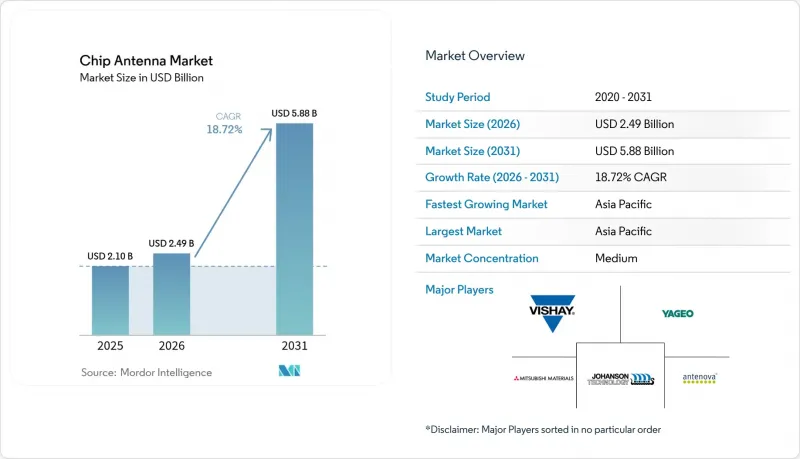
Mordor Intelligence에 의하면, 칩 안테나 시장 규모는 2025년에 21억 달러로 평가되었고, 2026년 24억 9,000만 달러에서 2031년까지 58억 8,000만 달러에 이를 것으로 예측되며, 예측 기간(2026-2031년) CAGR은 18.72%를 기록할 전망입니다.
본 보고서는 유형별(LTCC(저온 동시 소성 세라믹) 칩 안테나, 유전체 칩 안테나 및 인쇄 회로 기판 내장형 칩 안테나), 용도별(WLAN/Wi-Fi, 블루투스/BLE, 듀얼 밴드/멀티 밴드, GPS/GNSS, LPWAN(NB-IoT, LoRa, Sigfox)), 최종 사용자 산업별(자동차, 소비자용 전자기기, 헬스케어 및 의료기기, IT 및 통신 인프라, 기타), 그리고 지역별로 분류되어 있습니다.
세계의 칩 안테나 시장 동향 및 인사이트
OEM 클러스터 내 웨어러블 기기용 Bluetooth-LE 도입 사례
Bluetooth Low Energy(Bluetooth LE)는 스마트 워치, 피트니스 센서 및 신흥 의료용 웨어러블 기기에서 사실상 표준 프로토콜로 자리 잡았습니다. 1차 OEM 업체들은 여러 제품군에 걸쳐 안테나 레이아웃의 표준화를 시작하고 있으며, 이를 통해 규모의 경제에 기반한 조달과 플랫폼 갱신 주기의 단축이 가능해졌습니다. Nordic Semiconductor의 nRF54L 시리즈는 고효율 무선부와 칩 안테나에 최적화된 레퍼런스 레이아웃을 갖추고 있어 이러한 추세를 뒷받침하고 있습니다. 2024년 블루투스 LE 탑재 기기의 연간 출하 대수는 18억 대를 넘어섰으며, 이 수치에 힘입어 안테나 공급업체의 생산 능력은 증가 추세를 유지하고 있습니다. 설계 표준화는 신뢰성, 생체 적합성, FOTA(Firmware-over-Air) 업데이트와 같은 추가적인 성능 요건이 요구되는 산업용 및 의료용 분야로도 확대되고 있습니다. 그 결과, 각 벤더들은 크기와 효율의 균형을 맞추기 위해 조정 가능한 임피던스 네트워크와 고유전율 세라믹에 대한 투자를 진행하고 있습니다.
차량 실내 ADAS 레이더 모듈에 채택된 LTCC 안테나
자동차 제조업체들은 탑승자를 모니터링하기 위해 헤드라이너나 대시보드 뒤에 레이더 유닛을 내장하는 사례가 늘고 있습니다. 이러한 설치 위치에서는 열 사이클을 견디고 76-81GHz에서 안정적인 이득을 발휘하는 안테나가 요구됩니다. LTCC 기판은 낮은 손실 탄젠트와 치수 안정성 덕분에 이 두 가지 요구 사항을 모두 충족합니다. Johanson Technology사의 지향성 RHCP 안테나는 AEC-Q200 규격 준수는 물론, 플라스틱 트림으로 인한 조율 오차를 견딜 수 있는 슬림한 형상을 갖추고 있습니다. Indie Semiconductor와 GlobalFoundries와 같은 병행 연구 개발 제휴는 마찬가지로 고정밀 안테나 어레이가 필요한 77GHz 및 120GHz 레이더 SoC를 목표로 하고 있습니다. 이러한 움직임에 따라 칩 안테나는 단순한 옵션 부품에서 자동차 업계의 PPAP 및 ISO 26262 워크플로우를 준수하는 안전상 중요한 부품으로 격상되었습니다.
밀리파 AR 안경에서 맞춤형 PCB/FPC 안테나와의 효율 차이
증강현실(AR) 안경은 24GHz 이상의 대역에서 수 기가비트의 데이터를 전송합니다. 곡면 FPC에 에칭된 맞춤형 구리 배선은 총 방사 전력에서 여전히 개별 칩 안테나보다 최대 2 dB 더 높으며, 이 차이는 배터리 수명과 그래픽 지연 시간에 직접적인 영향을 미칩니다. 금속 메쉬 필름 위에 에칭된 투명 슬롯 루프 안테나에 대한 연구는 유망하지만, 부품 비용이 높고 기판이 취약하기 때문에 그 보급은 여전히 제한적입니다. 그 결과, 고급 AR/VR 브랜드들은 계속해서 맞춤형 전력 공급 구조를 지정하고 있으며, 이 틈새 시장에서는 기성 칩 안테나가 채택되기 어려운 상황이 지속되고 있습니다.
부문 분석
LTCC 안테나는 넓은 온도 변동 범위에서도 성능 변동을 최소화하면서 밀리파 주파수 대역에서 작동할 수 있다는 특징 덕분에 2025년에는 칩 안테나 시장 점유율의 57.35%를 차지했습니다. 이러한 우위는 차량 실내 천장에서 최대 +105°C의 온도 프로파일을 견뎌야 하는 자동차용 레이더 모듈에서의 채택 확대에 힘입어 더욱 공고해졌습니다. 인쇄 유전체 안테나는 생산량 면에서는 뒤처지고 있지만, 재료 과학의 혁신을 통해 더 얇은 기판에서 높은 Q값을 실현할 수 있게 됨에 따라 연평균 성장률(CAGR) 19.86%라는 가장 빠른 성장세를 기록하고 있습니다.
또한, LTCC의 동시 소성 다층 구조 특성을 중시하는 스마트폰 OEM 제조업체들 수요도 이를 뒷받침하고 있습니다. 이를 통해 동일한 세라믹 블록 내에 필터링 네트워크와 매칭 네트워크를 통합하는 것이 가능해집니다. 한편, PCB 이식형 안테나는 성능 허용 범위가 넓고, 생산 대수가 수백만 대 규모에 달하는 비용 중심의 IoT 게이트웨이에서 여전히 매력적인 선택지로 남아 있습니다. 지속적인 소형화로 인해 연구 개발비는 초단파장 모노폴 구조에 집중되고 있으며, 이는 2.4GHz 텔레메트리 기능이 필요하면서도 길이가 10 mm 미만인 의료용 캡슐로의 보급을 촉진하고 있습니다.
지역별 분석
아시아태평양은 칩 안테나 시장 매출의 45.60%를 차지하고 있으며, 2031년까지 연평균 성장률(CAGR) 19.48%로 확대될 것으로 예측됩니다. 중국에는 230만 개 이상의 5G 기지국이 구축되어 있어, CPE 라우터 및 UE 모듈에 사용되는 소형 안테나의 대량 조달 파이프라인이 유지되고 있습니다. 일본은 정밀 제조의 전통을 바탕으로 현지 공급업체들이 LTCC의 하이엔드 시장에서 확고한 입지를 다지고 있으며, 자동차 업계의 Tier 1 고객에 대한 공급 라인을 공고히 하고 있습니다. 한국의 재벌들은 자사 내 기술력을 활용하여 스마트폰 및 가전제품에 맞춤형 멀티밴드 안테나를 탑재함으로써 국내 수직 통합을 강화하고 있습니다.
북미는 2위를 차지했습니다. 이는 통신 사업자들이 중파 대역의 주파수 재할당을 추진하고, 전기차 제조업체들이 견고한 6GHz 미만 통신 링크를 필요로 하는 데이터 집약형 플랫폼을 추진하고 있기 때문입니다. ‘CHIPS and Science Act’는 국내 기판 및 패키징 생산 능력을 촉진하여 애리조나주와 텍사스주에서의 안테나 생산을 간접적으로 지원하고 있습니다. 방위 및 항공우주 분야의 주요 기업들에서의 수요도 점진적인 증가를 가져오고 있습니다. 이는 SATCOM 단말기 및 저궤도(LEO)용 사용자 장비가 세라믹 급전 네트워크를 갖춘 위상 배열에 의존하고 있기 때문입니다.
유럽은 독일의 자동차 산업과 고품질 유전체 솔루션을 뒷받침하는 EU의 엄격한 EMC 규제에 힘입어 아시아를 근소한 차이로 뒤쫓고 있습니다. ‘유럽 칩 법(European Chip Act)’은 아시아 공급망의 일부를 재현하는 것을 목표로 하고 있으며, 향후 5년 동안 지역 내 안테나 제조를 촉진하기 위한 자금을 지원하고 있습니다. L-밴드 GNSS와 6GHz Wi-Fi에 걸친 규제 조화 또한 유럽 시장용 제품의 안테나 튜닝 우선순위에 영향을 미치고 있습니다.
기타 혜택 :
- 엑셀 형식 시장 예측(ME) 시트
- 3개월간의 애널리스트 지원
자주 묻는 질문
목차
제1장 서론
제2장 조사 방법
제3장 주요 요약
제4장 시장 구도
제5장 시장 규모 및 성장 예측
제6장 경쟁 구도
제7장 시장 기회 및 향후 전망
AJY 26.09.09According to Mordor Intelligence, the chip antenna market size was valued at USD 2.10 billion in 2025 and estimated to grow from USD 2.49 billion in 2026 to reach USD 5.88 billion by 2031, at a CAGR of 18.72% during the forecast period (2026-2031).
This report is Segmented by Type ( LTCC [Low-Temperature Co-Fired Ceramic] Chip Antenna, Dielectric Chip Antenna, and Printed PCB-Embedded Chip Antenna), Application (WLAN/Wi-Fi, Bluetooth/BLE, Dual-Band/Multi-Band, GPS/GNSS, and LPWAN [NB-IoT, Lora, Sigfox]), End-User Industry (Automotive, Consumer Electronics, Healthcare and Medical Devices, IT and Telecommunications Infrastructure, and More), and Geography.
Global Chip Antenna Market Trends and Insights
Bluetooth-LE design wins for wearables in OEM clusters
Bluetooth Low Energy has become the de facto protocol for smart watches, fitness sensors, and emerging medical wearables. Tier-one OEMs have started standardizing antenna layouts across multiple product families, enabling economy-of-scale procurement and faster platform refresh cycles. Nordic Semiconductor's nRF54L series underscores the trend with a higher-efficiency radio and reference layout optimized for chip antennas. Annual Bluetooth LE device shipments exceeded 1.8 billion in 2024, a figure that keeps antenna suppliers on an upward capacity trajectory. The design convergence is spreading into industrial and medical categories where reliability, biocompatibility, and firmware-over-air updates add further performance requirements. Consequently, vendors are investing in tunable impedance networks and high-dielectric ceramics to balance size with efficiency.
LTCC antennas adopted in-cabin ADAS radar modules
Automakers increasingly embed radar units behind headliners and dashboards to monitor occupants. These locations demand antennas that withstand heat cycles and deliver stable gain at 76-81 GHz. LTCC substrates meet both needs through low loss tangent and dimensional stability. Johanson Technology's directional RHCP antenna combines AEC-Q200 qualification with a slim profile that resists detuning from plastic trim. Parallel R&D alliances, such as Indie Semiconductor with GlobalFoundries, target 77 GHz and 120 GHz radar SoCs that call for equally precise antenna arrays. These moves elevate chip antennas from discretionary items to safety-critical components governed by automotive PPAP and ISO 26262 workflows.
Efficiency gap vs. custom PCB/FPC antennas in mmWave AR glasses
Augmented-reality eyewear streams multi-gigabit data over 24 GHz and higher bands. Custom copper traces etched into curved FPCs still outperform discrete chip antennas by up to 2 dB in total radiated power, a gap that directly impacts battery life and graphics latency. Research into transparent slot-loop antennas etched on metal-mesh films shows promise, but mass adoption remains limited due to higher bill-of-materials costs and fragile substrates. Consequently, premium AR/VR brands continue to specify tailored feed structures, sidelining off-the-shelf chip antennas in this niche.
Other drivers and restraints analyzed in the detailed report include:
- Wi-Fi 6E reference designs mandate chip antennas in smart appliances
- Private 5G industrial networks driving sub-6 GHz sensor demand
- U.S. fractal-geometry IP litigation disrupting supply-chain diversification
For complete list of drivers and restraints, kindly check the Table Of Contents.
Segment Analysis
LTCC antennas held 57.35% of the chip antenna market share in 2025 due to their ability to operate at millimeter-wave frequencies with minimal performance drift under wide temperature swings. This dominance is reinforced by rising adoption in automotive radar modules that must endure up to +105 °C profiles on cabin roofs. Printed dielectric antennas trail in volume but post the fastest growth, riding a 19.86% CAGR as materials science innovations squeeze higher Q-factors into thinner substrates.
Demand is further bolstered by smartphone OEMs that value LTCC's co-fired multilayer capability, allowing integration of filtering and matching networks inside the same ceramic block. Conversely, PCB-embedded antennas remain an attractive choice for cost-sensitive IoT gateways where performance tolerances are broad and unit counts run into millions. Continuous miniaturization funnels R&D dollars into ultra-short monopole geometries, aiding penetration in medical capsules that require 2.4 GHz telemetry yet measure under 10 mm.
Complete Report Scope:
- By Type
- LTCC (Low-Temperature Co-fired Ceramic) Chip Antenna
- Dielectric Chip Antenna
- Printed PCB-Embedded Chip Antenna
- By Application
- WLAN/Wi-Fi
- Bluetooth/BLE
- Dual-Band/Multi-Band
- GPS/GNSS
- LPWAN (NB-IoT, LoRa, Sigfox)
- By End-User Industry
- Automotive
- Consumer Electronics
- Healthcare and Medical Devices
- IT and Telecommunications Infrastructure
- Industrial and Retail IoT
- Smart Grid and Smart Home
- By Geography
- North America
- United States
- Canada
- Mexico
- South America
- Brazil
- Argentina
- Rest of South America
- Europe
- Germany
- France
- United Kingdom
- Italy
- Spain
- Nordics
- Rest of Europe
- Middle East
- GCC
- Israel
- Turkey
- Rest of Middle East
- Africa
- South Africa
- Nigeria
- Rest of Africa
- Asia-Pacific
- China
- Japan
- South Korea
- India
- ASEAN
- Rest of Asia-Pacific
- North America
Geography Analysis
Asia Pacific controls 45.60% of the chip antenna market revenue and is expanding at a forecast 19.48% CAGR through 2031. China deploys more than 2.3 million 5G base stations, sustaining a high-volume procurement pipeline for small-form antennas used in CPE routers and UE modules. Japan's precision-manufacturing heritage positions local suppliers at the premium end of LTCC, cementing supply lines to tier-one automotive clients. South Korean conglomerates leverage in-house capabilities to embed custom multi-band antennas into smartphones and home appliances, reinforcing domestic vertical integration.
North America ranks second as telecom carriers refarm mid-band spectrum and EV makers push data-rich platforms that require robust sub-6 GHz links. The CHIPS and Science Act stimulates domestic substrate and packaging capacity, indirectly supporting antenna production in Arizona and Texas. Demand from defense and aerospace primes further incremental gains because SATCOM terminals and low-earth-orbit user equipment rely on phased arrays with ceramic feed networks.
Europe trails closely, anchored by Germany's automotive sector and the EU's strict EMC regulations that favor higher-quality dielectric solutions. The European Chips Act seeks to replicate parts of Asia's supply chain, providing funding that could catalyze regional antenna fabrication over the next five years. Regulatory harmonization across L-band GNSS and 6-GHz Wi-Fi also influences antenna tuning priorities for products intended for continental markets.
- Vishay Intertechnology Inc.
- Yageo Corporation
- Johanson Technology Inc.
- Fractus S.A.
- Antenova Ltd.
- Partron Co., Ltd.
- Inpaq Technology Co., Ltd.
- Mitsubishi Materials Corporation
- Taoglas Limited
- Fractus Antennas S.L.
- Murata Manufacturing Co., Ltd.
- KYOCERA AVX Components Corporation
- Molex LLC
- Linx Technologies Inc.
- Pulse Electronics Corp.
- TE Connectivity Ltd.
- Laird Connectivity
- Abracon LLC
- Amphenol Antcom
- Alps Alpine Co., Ltd.
Additional Benefits:
- The market estimate (ME) sheet in Excel format
- 3 months of analyst support
TABLE OF CONTENTS
1 INTRODUCTION
- 1.1 Study Assumptions and Market Definition
- 1.2 Scope of the Study
2 RESEARCH METHODOLOGY
3 EXECUTIVE SUMMARY
4 MARKET LANDSCAPE
- 4.1 Market Overview
- 4.2 Market Drivers
- 4.2.1 Bluetooth-LE design wins for wearables in OEM clusters
- 4.2.2 LTCC antennas adopted in-cabin ADAS radar modules
- 4.2.3 Wi-Fi 6E reference designs mandate chip antennas in smart appliances
- 4.2.4 Private-5G industrial networks driving sub-6 GHz sensor demand
- 4.3 Market Restraints
- 4.3.1 Efficiency gap vs. custom PCB/FPC antennas in mmWave AR glasses
- 4.3.2 U.S. fractal-geometry IP litigation disrupting supply-chain diversification
- 4.3.3 Multi-radio coexistence detuning in ultra-compact wearables
- 4.4 Value/Supply-Chain Analysis
- 4.5 Regulatory Outlook
- 4.6 Technological Outlook
- 4.7 Porter's Five Forces Analysis
- 4.7.1 Threat of New Entrants
- 4.7.2 Bargaining Power of Buyers
- 4.7.3 Bargaining Power of Suppliers
- 4.7.4 Threat of Substitute Products
- 4.7.5 Intensity of Competitive Rivalry
5 MARKET SIZE AND GROWTH FORECASTS (VALUE)
- 5.1 By Type
- 5.1.1 LTCC (Low-Temperature Co-fired Ceramic) Chip Antenna
- 5.1.2 Dielectric Chip Antenna
- 5.1.3 Printed PCB-Embedded Chip Antenna
- 5.2 By Application
- 5.2.1 WLAN/Wi-Fi
- 5.2.2 Bluetooth/BLE
- 5.2.3 Dual-Band/Multi-Band
- 5.2.4 GPS/GNSS
- 5.2.5 LPWAN (NB-IoT, LoRa, Sigfox)
- 5.3 By End-User Industry
- 5.3.1 Automotive
- 5.3.2 Consumer Electronics
- 5.3.3 Healthcare and Medical Devices
- 5.3.4 IT and Telecommunications Infrastructure
- 5.3.5 Industrial and Retail IoT
- 5.3.6 Smart Grid and Smart Home
- 5.4 By Geography
- 5.4.1 North America
- 5.4.1.1 United States
- 5.4.1.2 Canada
- 5.4.1.3 Mexico
- 5.4.2 South America
- 5.4.2.1 Brazil
- 5.4.2.2 Argentina
- 5.4.2.3 Rest of South America
- 5.4.3 Europe
- 5.4.3.1 Germany
- 5.4.3.2 France
- 5.4.3.3 United Kingdom
- 5.4.3.4 Italy
- 5.4.3.5 Spain
- 5.4.3.6 Nordics
- 5.4.3.7 Rest of Europe
- 5.4.4 Middle East
- 5.4.4.1 GCC
- 5.4.4.2 Israel
- 5.4.4.3 Turkey
- 5.4.4.4 Rest of Middle East
- 5.4.5 Africa
- 5.4.5.1 South Africa
- 5.4.5.2 Nigeria
- 5.4.5.3 Rest of Africa
- 5.4.6 Asia-Pacific
- 5.4.6.1 China
- 5.4.6.2 Japan
- 5.4.6.3 South Korea
- 5.4.6.4 India
- 5.4.6.5 ASEAN
- 5.4.6.6 Rest of Asia-Pacific
- 5.4.1 North America
6 COMPETITIVE LANDSCAPE
- 6.1 Market Concentration
- 6.2 Strategic Moves
- 6.3 Market Share Analysis
- 6.4 Company Profiles (includes Global level Overview, Market level overview, Core Segments, Financials as available, Strategic Information, Market Rank/Share for key companies, Products and Services, and Recent Developments)
- 6.4.1 Vishay Intertechnology Inc.
- 6.4.2 Yageo Corporation
- 6.4.3 Johanson Technology Inc.
- 6.4.4 Fractus S.A.
- 6.4.5 Antenova Ltd.
- 6.4.6 Partron Co., Ltd.
- 6.4.7 Inpaq Technology Co., Ltd.
- 6.4.8 Mitsubishi Materials Corporation
- 6.4.9 Taoglas Limited
- 6.4.10 Fractus Antennas S.L.
- 6.4.11 Murata Manufacturing Co., Ltd.
- 6.4.12 KYOCERA AVX Components Corporation
- 6.4.13 Molex LLC
- 6.4.14 Linx Technologies Inc.
- 6.4.15 Pulse Electronics Corp.
- 6.4.16 TE Connectivity Ltd.
- 6.4.17 Laird Connectivity
- 6.4.18 Abracon LLC
- 6.4.19 Amphenol Antcom
- 6.4.20 Alps Alpine Co., Ltd.
7 MARKET OPPORTUNITIES AND FUTURE OUTLOOK
- 7.1 White-space and Unmet-Need Assessment