|
시장보고서
상품코드
2124172
차세대 3D 디스플레이 시장 : 시장 점유율 분석, 업계 동향 및 통계, 성장 예측(2026-2031년)Next Generation 3D Display - Market Share Analysis, Industry Trends & Statistics, Growth Forecasts (2026 - 2031) |
||||||
 Mordor Intelligence
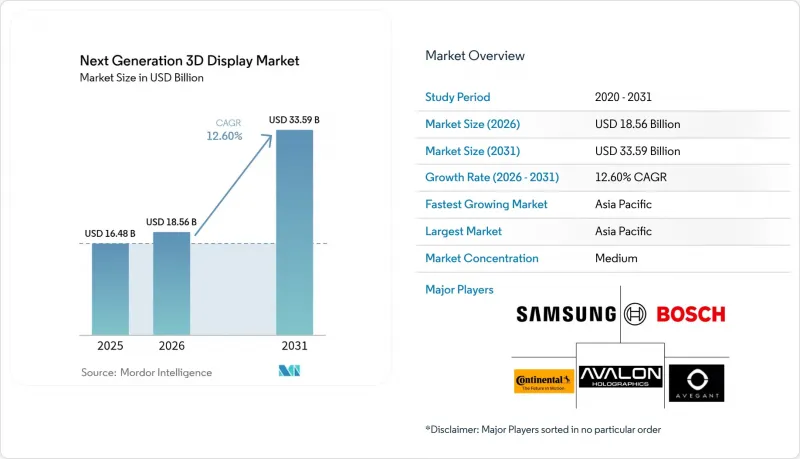
Mordor Intelligence에 의하면, 차세대 3D 디스플레이 시장 규모는 2025년에 164억 8,000만 달러로 평가되었고, 2026년 185억 6,000만 달러로 추정되고, 2031년까지 335억 9,000만 달러에 이를 것으로 예측되며, 예측 기간(2026-2031년) CAGR은 12.60%를 기록할 전망입니다.
본 보고서는 제품별(3D 홀로그래픽 디스플레이, 헤드마운트 디스플레이(HMD) 등), 기술별(디지털 라이트 프로세싱·리어 프로젝션 TV(DLP RPTV), LED 등), 표시 방식별(마이크로 디스플레이, 기존/스크린 기반 디스플레이), 최종 사용자 산업별(소비자 가전 등), 그리고 지역별로 분류되어 있습니다. 시장 예측은 금액(달러) 기준으로 제시되어 있습니다.
세계의 차세대 3D 디스플레이 시장 동향 및 인사이트
소비자 가전에서의 급속한 보급
현재 플래그십 모델의 스마트폰 및 태블릿에는 별도의 액세서리 없이도 게임, 전자상거래, 화상 채팅에서 입체감을 구현하는 오토스테레오스코픽 스크린이 탑재되어 있으며, 이를 통해 포화 상태에 이른 프리미엄 부문의 지각 가치(perceived value)가 높아지고 있습니다. 삼성은 2024년 상반기에 안경이 필요 없는 3D 태블릿을 200만 대 이상 판매하며, 차세대 3D 디스플레이 시장의 대중 시장으로서의 가능성을 입증했습니다. 중국 브랜드들은 폴더블 단말기에 라이트 필드 모듈을 탑재하고 있으며, 패널 비용을 상쇄하기 위해 1,000달러 이상의 단말기에 대해 15-20%의 가격 프리미엄을 예상하고 있습니다. 실리콘 상 OLED의 양산화가 진행됨에 따라 2D 디스플레이와 3D 디스플레이의 비용 격차는 줄어들고 있으며, 이에 따라 Tier 1 벤더들은 3D 기능을 하이엔드 하드웨어의 표준 사양으로 자리매김하고 있습니다. 소매업체에 따르면, 3D 제품 뷰의 전환율이 높아지고 있으며, 이는 컨텐츠 생태계의 활성화를 촉진하고, 결과적으로 하드웨어 수요 증가로 이어지고 있습니다.
자동차용 HUD 통합의 물결
헤드업 디스플레이(HUD)는 평면적인 오버레이에서 10미터 앞을 조준하는 내비게이션 화살표를 표시하는 입체 투영으로 진화하고 있으며, 이를 통해 운전자의 시선 재조정 지연이 해소되고 ADAS 경보의 오인식률이 감소합니다. 콘티넨탈이 2024년 3월에 실시한 홀로그래픽 HUD 시연은 ISO 26262 안전 요건을 충족하여, 독일의 한 고급 자동차 브랜드가 해당 프로그램을 채택하기로 결정했습니다. 보쉬와 파트너 OEM 각사는 2027년형 모델까지 마이크로 LED HUD를 출시할 계획이며, 디스플레이 로드맵을 레벨 2+ 자율주행의 전개와 연계하고 있습니다. 시선 추적 모듈은 10밀리초 이내에 홀로그램의 깊이를 동적으로 조정하지만, 이를 위해서는 신경망 가속을 지원하는 컨트롤러가 필요하며, 이는 실리콘 수준의 혁신을 촉진하고 있습니다. 이러한 발전 덕분에 차세대 3D 디스플레이 시장은 안전상 매우 중요한 콕핏 경험을 실현하는 핵심 요소로서 확고한 입지를 다지고 있습니다.
3D 컨텐츠 표준의 부재
ISO/IEC MPEG-I Part 12가 여전히 초안 단계에 있기 때문에 각 제조업체는 멀티뷰 동영상, 메쉬 스트리밍, 라이트 필드 인코딩에 걸친 독자적인 파이프라인을 유지하고 있습니다. 이러한 분산으로 인해 생산 비용이 40-60% 상승하고 출시 주기가 지연되면서, 견조한 하드웨어 혁신에도 불구하고 기기의 보급이 주춤하고 있습니다. SMPTE의 2024년 상호운용성 보고서는 여전히 권고적 표준에 그치고 있어, 주요 스튜디오들은 벤더 고유의 마스터링 기법에 얽매여 있습니다. 스트리밍 플랫폼은 심도 맵 메타데이터의 일관성이 부족하여 컨텐츠와 디스플레이의 성능을 자동으로 매칭하는 데 어려움을 겪고 있으며, 수동으로 선택해야 하는 상황에 처해 있습니다. 공통 코덱이 확립될 때까지 차세대 3D 디스플레이 시장은 공급 측면의 병목 현상에 직면해 있으며, 이는 단기적으로 일반 가정에의 보급을 저해하는 요인이 되고 있습니다.
부문 분석
볼륨 디스플레이는 2031년까지 연평균 14.25%의 성장률을 보일 것으로 예측되며, 차세대 3D 디스플레이 시장 중 가장 빠르게 성장하는 분야가 될 전망입니다. Light Field Lab사의 280억 픽셀 ‘SolidLight’ 파일럿 프로젝트와 같은 연구실에서의 획기적인 성과로 인해, 소매점 쇼케이스에서의 상업적 실현 가능성이 확인되었습니다. 안경이 필요 없고 여러 시청자가 동시에 시청할 수 있어 피로를 줄여주며, 공동 설계, 의료용 영상 진단, 엔터테인먼트와 같은 새로운 활용 분야를 개척합니다. 입체 시야 방식은 2025년 시점에서 매출의 41.72%를 계속 차지한 것으로 평가되었으며, 조절 피로에 관한 연구 결과로 인해 사용 시간에 제한이 생기고 있으므로, 조달 동향이 체적형 디스플레이로 기울어질 가능성이 있습니다. 정적 체적형 유닛은 방사선과 의사가 자유 공간에서 CT 데이터 세트를 회전시켜 확인할 수 있도록 지원하며, 2D 모니터에 비해 이상 징후 감지 정확도를 향상시킵니다. 한편, 헤드마운트형 입체 시야 디스플레이는 게임 및 훈련 분야에서 여전히 중요하며, 비용 상한선으로 인해 패널 가격은 50달러 미만으로 억제되고 있습니다.
홀로그래픽 태블릿은 여전히 높은 연산 부하를 필요로 하지만, 엣지 AI 가속기를 통해 2027년까지는 배터리 소모를 줄인 작동이 실현될 것으로 예측됩니다. 각 자동차 제조업체는 고속 주행 시 공간 인식 능력 향상을 목표로, 기존의 계기판을 대체할 자유 공간형 볼륨메트릭 대시보드의 실증 실험을 진행하고 있습니다. 소매업체들은 재고를 보유하지 않고 실물과 똑같은 상품을 전시하는 바닥 설치형 볼륨메트릭 키오스크를 도입하여 체험형 상거래를 추진하고 있습니다. 이러한 도입 사례가 더해지면서 볼륨메트릭 형식은 차세대 3D 디스플레이 시장의 주류 부문으로 부상하고 있습니다.
AR 헤드셋, 조종사용 헬멧, 수술용 스코프에 대한 니어 아이 수요가 가속화됨에 따라, 실리콘 기판 기반 OLED 출하량은 2031년까지 연평균 13.38% 성장할 것으로 예측됩니다. 픽셀 단위의 조광 기능을 통해 무한한 명암비가 실현되며, 이는 항공 및 건설 분야에서 밝은 실외 장면을 오버레이로 표시하는 데 필수적입니다. LED 패널은 경기장 규모의 벽면 디스플레이 시장을 장악하여 2025년 매출의 33.74%를 차지했으나, 픽셀 밀도에는 한계가 있어 이 점에서 실리콘 기판형 OLED가 우월합니다. 현재 MicroLED 프로토타입은 OLED와 동등한 화질을 구현하면서도 번인 저항성을 갖추고 있어, 수율이 향상된다면 이 기술은 장기적인 후속 기술로서의 입지를 확고히할 것입니다. 비용 효율을 중시하는 디지털 사이니지 분야에서는 여전히 액정 디스플레이가 사용되고 있지만, 시야각이 좁아 공동 3D 세션에 제약이 있으며, 차세대 3D 디스플레이 시장에 미치는 영향도 제한적입니다.
접이식 태블릿은 플렉서블 OLED 기판을 활용하여 대형 화면에서 3D의 입체감을 구현하고, 휴대성과 공간적인 몰입감을 매끄럽게 융합하고 있습니다. 10,000니트에 달하는 탠덤 OLED는 보조 반사판 없이도 햇빛 아래에서 시인 가능한 자동차용 HUD를 가능하게 하여, 광학 시스템 구성을 단순화하는 동시에 차량 내부의 열 부하를 저감합니다. 한때 저가형 대형 게임용 디스플레이의 대표 주자였던 디지털 라이트 프로세싱(DLP) 방식의 리어 프로젝션 TV는 평판 패널 기술의 발전으로 인해 크기 대비 비용 면에서의 우위를 잃고 시장에서 점차 철수하고 있습니다. 이러한 변화들이 맞물리면서 실리콘 기판 상의 OLED의 우위가 확고해지는 한편, MicroLED도 전략적 로드맵 상의 위치를 유지하고 있습니다.
지역별 분석
아시아태평양은 2025년 매출의 46.31%를 차지했으며, 연평균 성장률(CAGR) 12.74%로 성장을 이어가고 있습니다. 이는 마이크로 디스플레이에 대한 설비 투자 위험을 완화하고 공급망의 규모를 유지하기 위한 한국과 중국의 보조금에 힘입은 결과입니다. 한국이 5,000억 원의 보조금을 지원함에 따라 실리콘 기판 기반 OLED 및 MicroLED의 시범 라인이 가속화되고 있으며, 국내 기업들이 세계 조달 전략의 중심에 자리 잡고 있습니다. 중국의 제조업체인 BOE와 Tianma는 청두와 우한에서 생산 능력을 확대하고 있으며, 수입 의존도를 낮추는 동시에 적극적인 가격 책정을 통해 전 세계적인 디자인 인(design-in)을 확보하고 있습니다. 일본은 산업용 및 의료용 마이크로 디스플레이로 무게중심을 옮기고 있으며, 정밀 카메라와 반도체 분야의 전문 지식을 활용하여 차세대 3D 디스플레이 시장에서 수익성을 지키고 있습니다.
북미에서는 자동차용 HUD 도입 확대, 군용 AR 조달, 의료 기술 혁신이 시장을 견인하고 있으며, 미국의 국방 예산이 견고한 헤드셋에 대한 수요를 뒷받침하고 있습니다. 캐나다의 시각 효과 클러스터는 급성장하는 3D 컨텐츠 생태계를 주도하며 현지 하드웨어 판매를 촉진하고 있습니다. 유럽에서는 홀로그래픽 HUD를 통합하는 독일 및 이탈리아의 자동차 제조업체와, 작업장 전반에 걸쳐 피로도가 낮은 디스플레이를 우선시하는 엄격한 안전보건 규제가 계속해서 주요 지지 요인으로 작용하고 있습니다. ‘호라이즌 유럽’ 및 ‘유럽 칩법’에 기반한 정책 지원으로 파일럿 팹에 대한 투자가 진행되고 있으나, 그 속도는 아시아태평양에 비해 완만합니다.
남미에서는 소매업 및 호스피탈리티 업계에서 초기 도입이 진행되고 있으며, 특히 브라질의 고급 쇼핑몰에서는 홀로그램 키오스크가 브랜드 경험을 향상시키고 있습니다. 중동에서는 국부펀드의 자본을 바탕으로 인기 있는 쇼핑센터나 스마트시티 구상 속에서 3D 스크린이 적극적으로 도입되고 있습니다. 아프리카에서의 보급은 비용 및 인프라 제약으로 인해 제한적이지만, 남아프리카공화국과 나이지리아에서는 기업 대상 도입이 시작되었으며, 이 대륙은 차세대 3D 디스플레이 시장에 단계적으로 진입하기 위한 준비를 갖추고 있습니다.
기타 혜택 :
- 엑셀 형식 시장 예측(ME) 시트
- 3개월간 애널리스트 지원
자주 묻는 질문
목차
제1장 서론
제2장 조사 방법
제3장 주요 요약
제4장 시장 구도
제5장 시장 규모 및 성장 예측
제6장 경쟁 구도
제7장 시장 기회 및 향후 전망
AJY 26.09.09According to Mordor Intelligence, the next generation 3D display market size was valued at USD 16.48 billion in 2025 and estimated to grow from USD 18.56 billion in 2026 to reach USD 33.59 billion by 2031, at a CAGR of 12.60% during the forecast period (2026-2031).
This report is Segmented by Product (3D Holographic Display, Head Mounted Displays (HMD), and More), by Technology (Digital Light Processing Rear-Projection Television (DLP RPTV), LED, and More), by Access Method (Micro Display, Conventional/Screen Based Display), by End User Industry (Consumer Electronics, and More), and by Geography. The Market Forecasts are Provided in Terms of Value (USD).
Global Next Generation 3D Display Market Trends and Insights
Rapid Adoption in Consumer Electronics
Flagship smartphones and tablets now ship with autostereoscopic screens that deliver gaming, e-commerce, and video-chat depth cues without the need for accessories, thereby boosting perceived value in saturated premium segments. Samsung moved more than 2 million glasses-free 3D tablets during H1 2024, validating the mass-market potential of the next generation 3D display market. Chinese brands are integrating light-field modules into foldables, counting on 15-20% price premiums above USD 1,000 devices to offset panel costs. The cost gap between 2D and 3D displays is narrowing as OLED-on-silicon volume scales, enabling tier-1 vendors to treat 3D capability as a default spec for high-end hardware. Retailers report higher conversion rates for 3D product views, incentivizing content ecosystems that, in turn, expand hardware demand.
Automotive HUD Integration Wave
Head-up displays are graduating from planar overlays to volumetric projections that place navigation arrows 10 meters ahead, eliminating driver refocus lag and cutting false-dismiss rates for ADAS alerts. Continental's March 2024 holographic HUD demonstration met ISO 26262 safety requirements and secured program adoption by a German luxury marque. Bosch and its partner OEMs plan to launch micro-LED HUDs by model year 2027, aligning display roadmaps with the rollouts of Level-2+ autonomy. Eye-tracking modules dynamically adjust hologram depth within 10 ms, which demands neural-accelerated controllers and propels silicon-level innovation. These advances reinforce the next-generation 3D display market as a core enabler of safety-critical cockpit experiences.
Lack of 3D Content Standards
With ISO/IEC MPEG-I Part 12 still in draft, manufacturers maintain proprietary pipelines spanning multi-view video, mesh streaming, or light-field encoding. This fragmentation raises production costs 40-60% and slows release cadences, damping device uptake despite robust hardware innovation. SMPTE's 2024 interoperability report remains voluntary, leaving major studios tied to vendor-specific mastering approaches. Streaming platforms struggle to auto-match content with display capabilities because depth-map metadata remains inconsistent, forcing manual curation. Until a consensus codec emerges, the next generation 3D display market faces an availability bottleneck that tempers near-term household penetration.
Other drivers and restraints analyzed in the detailed report include:
- Advancements in OLED and MicroLED Technologies
- Emergence of AI-Generated Holographic Ecosystems
- High Capital Costs of Manufacturing Lines
For complete list of drivers and restraints, kindly check the Table Of Contents.
Segment Analysis
Volumetric displays are forecast to expand at 14.25% annually through 2031, making them the fastest-growing slice of the next-generation 3D display market. Laboratory breakthroughs, such as Light Field Lab's 28-billion-pixel SolidLight pilot, have confirmed commercial viability in retail showcases. Multiple-viewer visibility without glasses reduces fatigue and opens collaborative design, medical imaging, and entertainment scenarios. Stereoscopic formats, despite retaining 41.72% revenue in 2025, face usage-time limits due to accommodative stress studies, which may tilt procurement toward volumetric options. Static volumetric units support radiologists who rotate CT datasets in free space, enhancing anomaly detection compared to 2D monitors. Meanwhile, head-mounted stereoscopic displays stay relevant in gaming and training, where cost ceilings dictate sub-USD 50 panel premiums.
Although holographic tablets remain compute-intensive, edge AI accelerators promise battery-friendly operation by 2027. Automotive OEMs are experimenting with free-space volumetric dashboards to replace conventional clusters, seeking to enhance spatial awareness at highway speeds. Retailers deploy floor-standing volumetric kiosks to display lifelike products without inventory, advancing experiential commerce. Collectively, these deployments propel volumetric formats into mainstream segments of the next generation 3D display market.
OLED-on-silicon shipments are projected to grow at a 13.38% rate through 2031, as near-eye demand in AR headsets, pilot helmets, and surgical scopes accelerates. Pixel-level dimming delivers infinite contrast, crucial for overlaying bright outdoor scenes in aviation and construction. LED panels kept 33.74% of 2025 revenue by dominating stadium-scale walls, yet face pixel-density ceilings that OLED-on-silicon surpasses. MicroLED prototypes now match OLED fidelity while offering burn-in resistance, positioning the technology as a long-term successor once yield climbs. Liquid-crystal variants linger in cost-sensitive digital signage, though narrow viewing angles limit collaborative 3D sessions and cap their influence on the next generation 3D display market.
Foldable tablets utilize flexible OLED substrates to provide 3D depth on large canvases, seamlessly merging portability with spatial immersion. Tandem OLEDs that reach 10,000 nits enable sunlight-readable automotive HUDs without auxiliary reflectors, simplifying optics stacks and reducing cabin heat load. Digital Light Processing rear-projection televisions, once a staple of budget big-screen gaming, are exiting the market as flat-panel advances nullify their size-to-cost edge. Collectively, these shifts consolidate OLED-on-silicon's lead while keeping MicroLED on the strategic roadmap.
Complete Report Scope:
- By Product
- 3D Holographic Display
- Head Mounted Displays
- Static Volume Displays
- Light Field Displays
- Volumetric Displays
- Stereoscopic Displays
- By Technology
- Digital Light Processing Rear-Projection Television (DLP RPTV)
- Light Emitting Diode (LED)
- Organic Light Emitting Diode (OLED)
- Plasma Display Panel (PDP)
- Liquid Crystal Display (LCD)
- MicroLED
- OLED-on-Silicon (OLEDoS)
- By Access Method
- Micro Display
- Conventional/Screen Based Display
- By End User Industry
- Consumer Electronics
- Automotive and Transportation
- Medical
- Aerospace and Defense
- Industrial
- Education and Training
- Retail and Advertising
- By Geography
- North America
- United States
- Canada
- Mexico
- South America
- Brazil
- Argentina
- Rest of South America
- Europe
- Germany
- United Kingdom
- France
- Italy
- Russia
- Rest of Europe
- Asia Pacific
- China
- Japan
- South Korea
- India
- Australia AND New Zealand
- Rest of Asia Pacific
- Middle East
- Saudi Arabia
- United Arab Emirates
- Turkey
- Rest of Middle East
- Africa
- South Africa
- Nigeria
- Egypt
- Rest of Africa
- North America
Geography Analysis
Asia Pacific retained 46.31% of 2025 revenue and advances at a 12.74% CAGR, underpinned by South Korean and Chinese subsidies that derisk micro-display capex and sustain supply-chain scale. South Korea's KRW 500 billion grant pool accelerates OLED-on-silicon and MicroLED pilot lines, placing domestic players at the center of global sourcing strategies. Chinese manufacturers BOE and Tianma scale capacity in Chengdu and Wuhan, reducing import dependence and pricing aggressively to gain global design-ins. Japan pivots toward industrial and medical micro-displays, leveraging precision camera and semiconductor expertise to protect margins in the next generation 3D display market.
North America is driven by the growth of automotive HUD rollouts, military AR procurement, and med-tech innovation, with U.S. defense budgets underpinning the demand for ruggedized headsets. Canada's visual-effects cluster fuels a burgeoning 3D content ecosystem, driving local hardware sales. Europe remains anchored by German and Italian carmakers integrating holographic HUDs and by rigorous health-and-safety regulations that prioritize low-fatigue displays across workplaces. Policy support under Horizon Europe and the European Chips Act drives pilot fab investments, albeit at slower cadence than Asia Pacific.
South America sees early retail and hospitality deployments, notably in Brazil's luxury malls where holographic kiosks elevate brand experiences. The Middle East embraces 3D screens in destination shopping centers and smart-city initiatives, backed by sovereign wealth capital. African adoption stays limited by cost and infrastructure, though South Africa and Nigeria begin corporate rollouts, positioning the continent for gradual inclusion in the next generation 3D display market.
- Avalon Holographics Inc.
- Avegant Corporation
- Robert Bosch GmbH
- Continental Aktiengesellschaft
- Fovi3D Inc.
- Samsung Electronics Co., Ltd.
- NVIDIA Corporation
- Google LLC
- Coretronic Corporation
- Creal 3D SA
- Sharp Corporation
- LG Electronics Inc.
- AU Optronics Corp.
- Panasonic Holdings Corporation
- Sony Group Corporation
- Light Field Lab Inc.
- Looking Glass Factory Inc.
- Voxon Photonics Pty Ltd
- RealView Imaging Ltd.
- HYPERVSN Limited
- Holoxica Limited
- Leia Inc.
- Microsoft Corporation
Additional Benefits:
- The market estimate (ME) sheet in Excel format
- 3 months of analyst support
TABLE OF CONTENTS
1 INTRODUCTION
- 1.1 Study Assumptions and Market Definition
- 1.2 Scope of the Study
2 RESEARCH METHODOLOGY
3 EXECUTIVE SUMMARY
4 MARKET LANDSCAPE
- 4.1 Market Overview
- 4.2 Market Drivers
- 4.2.1 Rapid adoption in consumer electronics
- 4.2.2 Automotive HUD integration wave
- 4.2.3 Advancements in OLED and MicroLED technologies
- 4.2.4 Emergence of AI-generated holographic content ecosystems
- 4.2.5 Government incentives for domestic micro-display fabs
- 4.2.6 Growing use in tele-medicine surgical planning
- 4.3 Market Restraints
- 4.3.1 Lack of 3D content standards
- 4.3.2 High capital costs of manufacturing lines
- 4.3.3 Occupational-health concerns on VAC conflict
- 4.3.4 Supply-chain dependency on rare-earth phosphors
- 4.4 Industry Value Chain Analysis
- 4.5 Impact of Macroeconomic Factors
- 4.6 Regulatory Landscape
- 4.7 Technological Outlook
- 4.8 Porter's Five Forces Analysis
- 4.8.1 Bargaining Power of Suppliers
- 4.8.2 Bargaining Power of Consumers
- 4.8.3 Threat of New Entrants
- 4.8.4 Threat of Substitutes
- 4.8.5 Intensity of Competitive Rivalry
5 MARKET SIZE AND GROWTH FORECASTS (VALUE)
- 5.1 By Product
- 5.1.1 3D Holographic Display
- 5.1.2 Head Mounted Displays
- 5.1.3 Static Volume Displays
- 5.1.4 Light Field Displays
- 5.1.5 Volumetric Displays
- 5.1.6 Stereoscopic Displays
- 5.2 By Technology
- 5.2.1 Digital Light Processing Rear-Projection Television (DLP RPTV)
- 5.2.2 Light Emitting Diode (LED)
- 5.2.3 Organic Light Emitting Diode (OLED)
- 5.2.4 Plasma Display Panel (PDP)
- 5.2.5 Liquid Crystal Display (LCD)
- 5.2.6 MicroLED
- 5.2.7 OLED-on-Silicon (OLEDoS)
- 5.3 By Access Method
- 5.3.1 Micro Display
- 5.3.2 Conventional/Screen Based Display
- 5.4 By End User Industry
- 5.4.1 Consumer Electronics
- 5.4.2 Automotive and Transportation
- 5.4.3 Medical
- 5.4.4 Aerospace and Defense
- 5.4.5 Industrial
- 5.4.6 Education and Training
- 5.4.7 Retail and Advertising
- 5.5 By Geography
- 5.5.1 North America
- 5.5.1.1 United States
- 5.5.1.2 Canada
- 5.5.1.3 Mexico
- 5.5.2 South America
- 5.5.2.1 Brazil
- 5.5.2.2 Argentina
- 5.5.2.3 Rest of South America
- 5.5.3 Europe
- 5.5.3.1 Germany
- 5.5.3.2 United Kingdom
- 5.5.3.3 France
- 5.5.3.4 Italy
- 5.5.3.5 Russia
- 5.5.3.6 Rest of Europe
- 5.5.4 Asia Pacific
- 5.5.4.1 China
- 5.5.4.2 Japan
- 5.5.4.3 South Korea
- 5.5.4.4 India
- 5.5.4.5 Australia AND New Zealand
- 5.5.4.6 Rest of Asia Pacific
- 5.5.5 Middle East
- 5.5.5.1 Saudi Arabia
- 5.5.5.2 United Arab Emirates
- 5.5.5.3 Turkey
- 5.5.5.4 Rest of Middle East
- 5.5.6 Africa
- 5.5.6.1 South Africa
- 5.5.6.2 Nigeria
- 5.5.6.3 Egypt
- 5.5.6.4 Rest of Africa
- 5.5.1 North America
6 COMPETITIVE LANDSCAPE
- 6.1 Market Concentration
- 6.2 Strategic Moves
- 6.3 Market Share Analysis
- 6.4 Company Profiles (includes Global level Overview, Market level overview, Core Segments, Financials as available, Strategic Information, Market Rank/Share for key companies, Products AND Services, and Recent Developments)
- 6.4.1 Avalon Holographics Inc.
- 6.4.2 Avegant Corporation
- 6.4.3 Robert Bosch GmbH
- 6.4.4 Continental Aktiengesellschaft
- 6.4.5 Fovi3D Inc.
- 6.4.6 Samsung Electronics Co., Ltd.
- 6.4.7 NVIDIA Corporation
- 6.4.8 Google LLC
- 6.4.9 Coretronic Corporation
- 6.4.10 Creal 3D SA
- 6.4.11 Sharp Corporation
- 6.4.12 LG Electronics Inc.
- 6.4.13 AU Optronics Corp.
- 6.4.14 Panasonic Holdings Corporation
- 6.4.15 Sony Group Corporation
- 6.4.16 Light Field Lab Inc.
- 6.4.17 Looking Glass Factory Inc.
- 6.4.18 Voxon Photonics Pty Ltd
- 6.4.19 RealView Imaging Ltd.
- 6.4.20 HYPERVSN Limited
- 6.4.21 Holoxica Limited
- 6.4.22 Leia Inc.
- 6.4.23 Microsoft Corporation
7 MARKET OPPORTUNITIES AND FUTURE OUTLOOK
- 7.1 White-space and unmet-need assessment