

|
시장보고서
상품코드
2124177
자동차용 실내 백미러 시장 : 점유율 분석, 업계 동향과 통계, 성장 예측(2026-2031년)Automotive Inside Rearview Mirrors - Market Share Analysis, Industry Trends & Statistics, Growth Forecasts (2026 - 2031) |
||||||
 Mordor Intelligence
Mordor Intelligence에 의하면, 자동차용 실내 백미러 시장 규모는 2025년 32억 6,000만 달러에서 2026년에는 34억 5,000만 달러로 확대되어 2026년부터 2031년까지 CAGR 5.74%로 성장을 지속하여, 2031년에는 45억 6,000만 달러에 이를 것으로 예측됩니다.
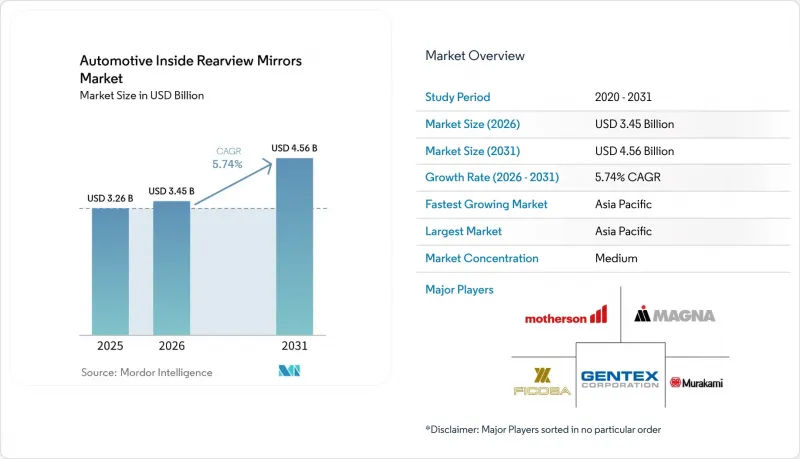
본 보고서는 차종(승용차 및 상용차), 파워트레인 유형(내연기관 및 전기), 기능 유형(프리즘형, 자동 조광, 사각지대 표시기, 기타 스마트 기능), 판매 채널(OEM 및 애프터마켓),지역(북미, 유럽, 아시아태평양, 기타 지역)별로 분류되어 있습니다. 시장 규모 및 전망은 금액(달러) 기준으로 제시되어 있습니다.
전 세계 자동차용 실내 백미러 시장 동향 및 인사이트
안전 기준 및 후방 시야 확보에 관한 규제 강화
세계 규제 당국은 후방 시야, 사각지대 및 충돌 회피에 관한 요건을 지속적으로 강화하고 있으며, 이는 고성능 백미러에 대한 수요를 직접적으로 끌어올리고 있습니다. 신차 평가 프로그램 및 교통 안전 기관은 별점 평가나 적합 라벨을 시인성, 눈부심 감소, 운전자 주의 환기 시스템과 연계하는 경향이 강해지고 있습니다. 이로 인해 각 OEM 업체들은 기본적인 프리즘형 디자인에서 더 넓은 시야각, 개선된 눈부심 방지 기능 및 경고 표시기를 통합한 유닛으로 백미러를 업그레이드해야 하는 상황에 직면해 있습니다.
이와 병행하여 버스, 장거리 버스, 트럭 등 상용차에 관한 규제에서는 미러의 커버 범위가 명확하게 정해져 있으며, 일부 지역에서는 보조 카메라 시스템의 탑재가 의무화되어 있습니다. 카메라가 추가된 경우에도 일반적으로 인증된 실내 미러 또는 디지털 미러 디스플레이가 여전히 필요하며, 미러 모듈이 필수적인 안전 부품이라는 사실이 재확인되고 있습니다. 이러한 규제는 완만하게 진화하면서도 단계적으로 강화되고 있어, 주요 자동차 시장 전반에 걸쳐 미러의 구성 요소 및 품질에 대한 장기적이고 구조적인 수요를 창출하고 있습니다.
ADAS 및 스마트 미러 모듈의 도입
ADAS(첨단 운전자 보조 시스템)는 점점 더 실내 백미러 모듈을 통해 제어되거나 그곳에 표시되고 있습니다. 자동 조광 기능, 사각지대 표시기, 차선 이탈 경고, 후방 및 서라운드 뷰 시스템의 카메라 영상은 현재 미러 하우징에 통합되는 경우가 많습니다. 이러한 설계를 통해 대시보드의 복잡성을 증가시키지 않으면서도 중요한 정보를 운전자의 자연스러운 시선 범위 내에 집중시킬 수 있습니다.
대중차에 ADAS 패키지가 탑재되는 사례가 늘어남에 따라, 미러는 센서, 카메라, 디스플레이를 통합하는 합리적인 거점이 되고 있습니다. 이에 대응하여 각 공급업체들은 일렉트로크로믹 유리, 내장형 LED, 음성 어시스턴트용 마이크, 나아가 운전자 모니터링 카메라와 같은 모듈식 추가 기능을 갖춘 스마트 미러 플랫폼을 제공합니다. 이러한 추세에 따라 미러는 낮은 수익률을 보이는 범용 제품에서 고부가가치의 전자기기 허브로 변모하여, 평균 판매 가격을 끌어올리는 동시에 공급업체와 OEM 제조업체 간의 파트너십을 더욱 공고히 하고 있습니다.
가격에 민감한 부문에서 첨단 미러의 높은 비용
자동 조광 기능, 내장 카메라 및 다수의 센서를 탑재한 미러는 기존의 프리즘형 유닛에 비해 부품 원가를 대폭 끌어올립니다. 성숙한 시장에서는 이 비용이 트림 가격 인상을 통해 상쇄되지만, 엔트리급 승용차와 기본적인 상용차가 주류를 이루는 신흥국 시장에서는 OEM 각사가 이러한 비용을 소비자에게 전가하는 데 큰 저항에 직면하고 있습니다. 그 결과, 인도, 동남아시아,아프리카, 라틴아메리카에서는 많은 모델이 여전히 기본적인 미러를 장착한 상태로 출고되고 있으며, 스마트 기능은 프리미엄 등급이나 채택률이 낮은 옵션 패키지로만 제한되어 있습니다.
이러한 비용 장벽은 전자 부품 가격 급등 및 환율 변동과 맞물려 특히 심각한 문제로 대두되고 있습니다. 중소규모의 OEM이나 지역 브랜드는 규제상 더 고도화된 솔루션이 허용되는 경우에도, 이익률 하락을 피하기 위해 미러 사양 업그레이드를 미룰 가능성이 있습니다. 그 결과, 저·중소득 시장에서의 스마트 미러 보급 곡선은 정체 상태를 보이고 있으며, 본래라면 안전성이나 기술 동향에 힘입어 성장했을 세계 시장이 둔화되고 있습니다.
부문 분석
승용차가 자동차용 실내 백미러 시장을 독점하고 있으며, 2025년에는 약 81.94%의 점유율을 차지할 것으로 전망됩니다. 해치백, 세단, SUV, 크로스오버의 전 세계 생산 대수가 많다는 점이 이러한 지배적인 지위를 뒷받침하고 있을 뿐만 아니라, 탑승자 안전 기준이 엄격해지고 있어 많은 트림에서 첨단 실내 미러가 기본 사양 또는 거의 기본 사양으로 장착되고 있습니다. 현재 중형차 및 고급 승용차에서는 자동 조광 기능, 통합형 디스플레이, 내장 센서가 빈번하게 채택되고 있어 차량당 미러의 사양이 향상되고 있습니다. 또한, 벨트라인이 높고 후방 헤드레스트를 갖춘 소형 SUV 및 크로스오버 차량의 부상으로 인해, 후방 시야를 확보하기 위한 최적화된 미러 설계와 디지털 미러에 대한 의존도도 높아지고 있습니다.
상용차는 규모는 작지만, 특히 안전성이 극히 중요한 용도에서 전략적으로 중요한 부문을 형성하고 있습니다. 트럭이나 버스에는 특수한 실내 미러가 필요하며, 많은 경우 광범위한 사각지대를 관리하기 위해 복잡한 외부 미러 세트나 카메라 시스템과 결합하여 사용됩니다. 차량 운영업체와 규제 당국은 스쿨버스, 장거리 버스, 장거리 트럭의 후방 시야 확보를 추진하고 있으며, OEM 각사에 차량 운영용 사양의 운전실에 디지털 백미러 모듈과 운전자 모니터링 기능을 통합할 것을 촉구하고 있습니다. 예측 기간 동안 각국 정부가 전문 운전자를 위한 안전 규제를 강화하고, 물류 및 여객 운송 차량이 더욱 정교한 미러 시스템으로 업그레이드됨에 따라 상용차 시장은 꾸준히 성장할 것으로 예측됩니다.
2025년에도 내연기관(ICE) 차량은 실내 백미러 수요의 약 84.92%를 계속 차지할 것으로 전망됩니다. 이는 전 세계적으로 많은 ICE 차량이 운행되고 있으며, 신흥 시장에서 ICE 차량 판매가 지속되고 있음을 반영합니다. 각 OEM 업체들이 새로운 안전 규제와 경쟁사 벤치마킹에 대응함에 따라, 내연기관 차량용 실내 백미러의 사양은 향상되고 있으며, 미러 하우징에 자동 조광 기능, 나침반/온도 표시 및 기본적인 ADAS 경보 기능이 추가되고 있습니다. 이로 인해 전기차(EV)의 성장이 가속화되는 상황에서도 내연기관 차량 부문은 미러 공급업체에게 구조적으로 중요한 위치를 계속 차지하고 있습니다.
전기차(EV) 부문은 현재 규모는 작지만, 실내 백미러 시장에서 2031년까지 연평균 성장률(CAGR) 20.95%라는 눈부신 성장이 예상됩니다. EV 아키텍처에는 카메라 기반 미러 시스템이나 통합형 운전자 모니터링 기능이 기본으로 장착되는 경우가 많아, 이에 따라 미러 1개당 탑재되는 전자 부품 및 소프트웨어의 양이 증가하고 있습니다. 각 OEM 업체들이 대형 센터 디스플레이와 디지털 콕핏을 중심으로 차량 내부를 재설계하는 가운데, 실내 백미러는 ADAS 센서, 운전자 모니터링 카메라, 스트리밍 동영상 디스플레이를 설치하기에 최적의 장소가 되고 있습니다. 이에 따라 전기차는 첨단 미러 기술 채택을 주도하는 주요 원동력이 되고 있으며, 프리미엄 전기차 모델에서는 새로운 디지털 미러 구성이 빈번하게 도입된 후, 판매 대수가 많은 내연기관(ICE) 플랫폼으로 확산되는 추세를 보이고 있습니다.
지역별 분석
아시아태평양은 자동차용 실내 백미러 수요의 중심지이며, 2025년에는 전 세계 시장 가치의 약 41.05%를 차지하며, 2026년부터 2031년까지 연평균 성장률(CAGR) 약 6.63%로 성장할 것으로 전망됩니다. 이는 해당 지역이 자동차 생산에서 지배적인 위치를 차지하고 있음을 반영하며, 중국, 일본, 인도, 한국이 합쳐서 전 세계 경차 생산 대수 및 신규 등록 대수에서 가장 큰 점유율을 차지하고 있습니다. 승용차 생산 대수 증가, SUV 및 크로스오버 차량 판매 증가, 그리고 전기차(EV) 보급 가속화는 모두 기존 및 스마트 IRVM의 OEM 탑재를 뒷받침하고 있습니다. 현지 브랜드들이 가치 사다리를 오름에 따라 중급 및 프리미엄 등급 모델에서 자동 조광 기능과 다기능 미러의 채택이 점점 더 확대되면서, 아시아태평양의 차량 1대당 장비 수량이 더욱 증가하고 있습니다.
북미와 유럽은 엄격한 안전 규제와 ADAS의 높은 보급률에 힘입어 여전히 규모는 크지만, 비교적 성장이 둔화된 시장입니다. 한편, 세계 기타 지역(라틴아메리카, 중동 및 아프리카)에서는 차량 보유 대수 증가와 단계적인 안전 성능 향상에 따라 규모는 작지만 꾸준히 확대되는 수요가 나타나고 있습니다. 그러나 어느 지역도 아시아태평양이 가진 규모와 성장성을 모두 갖춘 수준에는 미치지 못하는 상황입니다. 중국과 인도의 OEM 프로그램만 보더라도, 특정 기능을 옵션에서 기본 사양으로 전환하는 것만으로도 첨단 미러에 대한 전 세계 수요를 좌우할 정도의 영향력을 가지고 있습니다. 예측 기간 동안 이러한 동향에 힘입어 아시아태평양은 최대의 지역 시장일 뿐만 아니라 가장 빠르게 성장하는 지역으로 자리매김할 것이며, 미러 공급업체에게는 생산 능력 확대, 현지화, 그리고 세계 및 지역 자동차 제조업체와의 공동 개발 프로그램에서 전략적 초점이 될 것입니다.
기타 혜택:
- 엑셀 형식 시장 예측(ME) 시트
- 3개월간의 애널리스트 지원
자주 묻는 질문
목차
제1장 서론
제2장 조사 방법
제3장 주요 요약
제4장 시장 구도
제5장 시장 규모와 성장 예측
제6장 경쟁 구도
제7장 시장 기회와 향후 전망
JHS 26.09.11According to Mordor Intelligence, the automotive inside rearview mirrors market size is expected to grow from USD 3.26 billion in 2025 to USD 3.45 billion in 2026 and is forecast to reach USD 4.56 billion by 2031 at 5.74% CAGR over 2026-2031.
This report is Segmented by Vehicle Type (Passenger Car and Commercial Vehicle), Powertrain Type (ICE and Electric), Feature Type (Prismatic, Auto-Dimming, Blind Spot Indicator, and Other Smart Features), Sales Channel (OEM and Aftermarket), and Geography (North America, Europe, Asia-Pacific, and Rest of the World). Market Sizes and Forecasts are Provided in Terms of Value (USD).
Global Automotive Inside Rearview Mirrors Market Trends and Insights
Stricter Safety & Rear-Visibility Regulations
Regulators worldwide continue to tighten rear visibility, blind-spot, and crash-avoidance requirements, which directly lifts demand for better-performing rearview mirrors. New car assessment programs and road-safety agencies increasingly link star ratings or compliance labels to visibility performance, glare reduction, and driver awareness systems. This pushes OEMs to upgrade mirrors from basic prismatic designs to units with wider fields of view, improved anti-glare functionality, and integrated warning indicators.
In parallel, commercial-vehicle rules for buses, coaches, and trucks mandate defined mirror coverage zones and, in some regions, supplementary camera systems. Even when cameras are added, a certified interior mirror or digital mirror display is usually still required, reinforcing the mirror module as a non-negotiable safety component. Because these regulations evolve slowly but ratchet upward, they create a long-term structural pull on mirror content and quality across all major automotive regions.
Adoption of ADAS & Smart Mirror Modules
Advanced driver-assistance systems (ADAS) are increasingly being routed through or displayed in the inside rear-view mirror module. Auto-dimming, blind-spot indicators, lane-departure alerts, and camera streaming from rear or surround-view systems are now frequently anchored in the mirror housing. This design choice centralizes critical information in the driver's natural line of sight, without increasing dashboard clutter.
As more mass-market vehicles add ADAS bundles, the mirror becomes a logical integration node for sensors, cameras, and displays. Suppliers respond by offering smart mirror platforms with modular add-ons: electrochromic glass, embedded LEDs, microphones for voice assistants, and even driver-monitoring cameras. This trend turns the mirror from a low-margin commodity into a higher-value electronics hub, lifting average selling prices and deepening supplier-OEM partnerships.
High Cost of Advanced Mirrors in Price-Sensitive Segments
Auto-dimming, camera-integrated, and sensor-rich mirrors significantly increase bill-of-materials cost versus traditional prismatic units. In mature markets, this is absorbed into higher trim prices, but in emerging economies, where entry-level cars and basic commercial vehicles dominate, OEMs face strong resistance to passing these costs to consumers. As a result, many models in India, Southeast Asia, Africa, and Latin America still ship with basic mirrors, and smart features are limited to premium variants or optional packs with low take-rates.
This cost barrier is especially acute when combined with rising electronics prices and currency volatility. Smaller OEMs and regional brands may delay upgrading mirror specifications to avoid margin erosion, even when regulations permit more advanced solutions. Consequently, the adoption curve for smart mirrors flattens in low- and mid-income markets, muting global growth that would otherwise be supported by safety and technology trends.
Other drivers and restraints analyzed in the detailed report include:
- Premium Vehicle Mix & Feature Upgrades in Mass Segments
- Electrification & EV Interior Re-Architecture
- Semiconductor & Electronics Supply Volatility
For complete list of drivers and restraints, kindly check the Table Of Contents.
Segment Analysis
Passenger cars dominate the automotive inside rearview mirrors market, with around 81.94% share in 2025. High global production volumes of hatchbacks, sedans, SUVs, and crossovers underpin this dominance, alongside increasingly stringent occupant-safety norms that make advanced interior mirrors standard or near-standard on many trims. Auto-dimming, integrated displays, and embedded sensors are now frequently specified in mid-range and premium passenger vehicles, lifting mirror content per vehicle. The rise of compact SUVs and crossovers with higher beltlines and rear head restraints has also increased reliance on optimized mirror designs and digital mirrors for rearward visibility.
Commercial vehicles form a smaller but strategically important segment, particularly for safety-critical applications. Trucks and buses require specialized inside mirrors, often paired with complex exterior mirror sets and camera systems to manage extended blind spots. Fleet operators and regulators push for enhanced rear visibility in school buses, coaches, and long-haul trucks, incentivizing OEMs to integrate digital rearview modules and driver monitoring into fleet-spec cabs. Over the forecast period, commercial vehicles are expected to grow steadily as governments tighten safety rules for professional drivers and as logistics and passenger transport fleets upgrade to more advanced mirror systems.
Vehicles with internal combustion engines (ICE) continue to represent roughly 84.92% of inside rearview mirror demand in 2025, reflecting the large global in-use fleet and ongoing ICE vehicle sales in emerging markets. Inside rearview mirror specifications for ICE vehicles are being upgraded as OEMs respond to new safety regulations and competitive benchmarks, adding auto-dimming, compass/temperature displays, and basic ADAS alerts into the mirror housing. This keeps the ICE segment structurally important for mirror suppliers even as EV growth accelerates.
The electric vehicle (EV) segment, though smaller today, is forecast to grow at an impressive 20.95% CAGR through 2031 in the inside rearview mirrors market. EV architectures often incorporate camera-based mirror systems and integrated driver monitoring as standard features, increasing the electronics and software content per mirror. As OEMs redesign cabins around large central displays and digital cockpits, the inside rearview mirror becomes a logical location for ADAS sensors, driver monitoring cameras, and streaming-video displays. This makes EVs an outsized driver of advanced mirror technology adoption, with premium electric models frequently debuting new digital mirror configurations that later trickle down into higher-volume ICE platforms.
Complete Report Scope:
- By Vehicle Type
- Passenger Car
- Commercial Vehicle
- By Powertrain Type
- ICE
- Electric
- By Feature Type
- Auto-Dimming
- Prismatic
- Blind spot indicator
- Other Smart / Digital Mirrors
- By Sales Channel Type
- OEM
- Aftermarket
- By Geography
- North America
- United States
- Canada
- Rest of North America
- Europe
- Germany
- United Kingdom
- France
- Rest of Europe
- Asia Pacific
- India
- China
- Japan
- South Korea
- Rest of Asia-Pacific
- Rest of the World
- Brazil
- United Arab Emirates
- Other Countries
- North America
Geography Analysis
Asia-Pacific is the clear demand hub for automotive inside rearview mirrors, accounting for an estimated 41.05% of global market value in 2025 and growing at about 6.63% CAGR over 2026-2031. This reflects the region's dominance in vehicle production, with China, Japan, India, and South Korea together contributing the largest share of global light-vehicle output and new registrations. High volumes of passenger cars, rising SUV and crossover sales, and accelerating EV adoption all translate into strong OEM fitment of both conventional and smart IRVMs. As local brands move up the value ladder, mid-range and premium trims increasingly adopt auto-dimming and feature-rich mirrors, further lifting content per vehicle in Asia-Pacific.
North America and Europe remain substantial but comparatively slower-growing markets, driven by stringent safety regulations and high ADAS penetration, while the Rest of the World (Latin America, Middle East & Africa) offers smaller but steadily expanding pockets of demand tied to vehicle parc growth and gradual safety upgrades. However, neither region matches Asia-Pacific's combination of scale and growth: OEM programs in China and India alone can shift global demand for advanced mirrors when they migrate a feature from optional to standard. Over the forecast period, this dynamic keeps Asia-Pacific both the largest regional market and the fastest-growing geography, making it the strategic focal point for mirror suppliers' capacity expansion, localization, and co-development programs with global and regional automakers.
- Gentex Corporation
- Samvardhana Motherson Reflectec
- Magna International, Inc.
- Ficosa International SA
- Continental AG
- Murakami Corporation
- Tokai Rika Co., Ltd.
- Mitsuba Corporation
- SL Corporation
- Flabeg Automotive Holding GmbH
Additional Benefits:
- The market estimate (ME) sheet in Excel format
- 3 months of analyst support
TABLE OF CONTENTS
1 Introduction
- 1.1 Study Assumptions and Market Definition
- 1.2 Scope of the Study
2 Research Methodology
3 Executive Summary
4 Market Landscape
- 4.1 Market Overview
- 4.2 Market Drivers
- 4.2.1 Stricter Safety and Rear-Visibility Regulations
- 4.2.2 Adoption of ADAS and Smart Mirror Modules
- 4.2.3 Premium Vehicle Mix and Feature Upgrades in Mass Segments
- 4.2.4 Electrification and EV Interior Re-architecture
- 4.2.5 Fleet and Commercial-Vehicle Safety Programs
- 4.2.6 Vehicle Production Growth in Emerging Markets
- 4.3 Market Restraints
- 4.3.1 High Cost of Advanced Mirrors in Price-Sensitive Segments
- 4.3.2 Semiconductor and Electronics Supply Volatility
- 4.3.3 OEM Cost-Down Pressure and Mirror Commoditization
- 4.3.4 Regulatory and Design Uncertainty Around Pure Camera-Mirror Systems
- 4.4 Value / Supply-Chain Analysis
- 4.5 Regulatory Landscape
- 4.6 Technological Outlook
- 4.7 Porter's Five Forces
- 4.7.1 Threat of New Entrants
- 4.7.2 Bargaining Power of Buyers/Consumers
- 4.7.3 Bargaining Power of Suppliers
- 4.7.4 Threat of Substitute Products
- 4.7.5 Intensity of Competitive Rivalry
5 Market Size and Growth Forecasts (Value)
- 5.1 By Vehicle Type
- 5.1.1 Passenger Car
- 5.1.2 Commercial Vehicle
- 5.2 By Powertrain Type
- 5.2.1 ICE
- 5.2.2 Electric
- 5.3 By Feature Type
- 5.3.1 Auto-Dimming
- 5.3.2 Prismatic
- 5.3.3 Blind spot indicator
- 5.3.4 Other Smart / Digital Mirrors
- 5.4 By Sales Channel Type
- 5.4.1 OEM
- 5.4.2 Aftermarket
- 5.5 By Geography
- 5.5.1 North America
- 5.5.1.1 United States
- 5.5.1.2 Canada
- 5.5.1.3 Rest of North America
- 5.5.2 Europe
- 5.5.2.1 Germany
- 5.5.2.2 United Kingdom
- 5.5.2.3 France
- 5.5.2.4 Rest of Europe
- 5.5.3 Asia Pacific
- 5.5.3.1 India
- 5.5.3.2 China
- 5.5.3.3 Japan
- 5.5.3.4 South Korea
- 5.5.3.5 Rest of Asia-Pacific
- 5.5.4 Rest of the World
- 5.5.4.1 Brazil
- 5.5.4.2 United Arab Emirates
- 5.5.4.3 Other Countries
- 5.5.1 North America
6 Competitive Landscape
- 6.1 Vendor Market Share
- 6.2 Company Profiles
- 6.2.1 Gentex Corporation
- 6.2.2 Samvardhana Motherson Reflectec
- 6.2.3 Magna International, Inc.
- 6.2.4 Ficosa International SA
- 6.2.5 Continental AG
- 6.2.6 Murakami Corporation
- 6.2.7 Tokai Rika Co., Ltd.
- 6.2.8 Mitsuba Corporation
- 6.2.9 SL Corporation
- 6.2.10 Flabeg Automotive Holding GmbH


