|
시장보고서
상품코드
2124182
비행 시간(TOF) 센서 시장 : 점유율 분석, 업계 동향과 통계, 성장 예측(2026-2031년)Time-of-Flight (TOF) Sensor - Market Share Analysis, Industry Trends & Statistics, Growth Forecasts (2026 - 2031) |
||||||
 Mordor Intelligence
Mordor Intelligence에 의하면, 세계의 비행 시간(ToF) 센서 시장 규모는 2025년에 66억 8,000만 달러로 평가되었고 2026년 80억 6,000만 달러에서 2031년까지 205억 2,000만 달러에 이를 것으로 예측되며, 예측 기간(2026-2031년) CAGR은 20.56%를 나타낼 전망입니다.
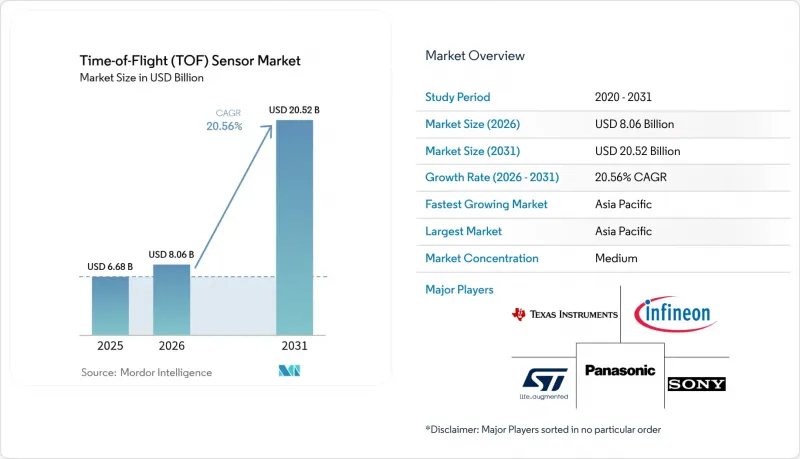
본 보고서는 센서 유형(간접형, 직접형, 레인지게이트형 이미저), 해상도(QVGA 이하, VGA, HD 이상), 측정 거리(단거리, 중거리, 장거리),용도(증강현실(AR) 및 가상현실(VR), LiDAR, 기타), 최종 사용자 산업(소비자 가전, 자동차, 기타), 그리고 지역별로 분류되어 있습니다. 시장 전망은 금액(달러) 기준으로 제시되어 있습니다.
전 세계 비행 시간(TOF) 센서 시장 동향 및 인사이트
유럽 및 일본에서의 머신 비전 시스템 도입 확대
독일, 이탈리아, 일본의 산업 클러스터에서는 빈 피킹 및 무작위 순서 팔레타이징 해제 효율화를 위해 로봇에 비행 시간식 이미저를 탑재하고 있습니다. 2024년 하반기부터 출하되고 있는 니콘의 로봇 비전 패키지는 250fps의 깊이 프레임을 스트리밍하여 자동차용 프레스 라인의 사이클 타임을 단축하고 있습니다. 일본의 시스템 통합사업자들은 현재 이러한 센서를 프라이빗 5G와 결합하여 침입이 감지될 경우 기계를 즉시 정지시키는 방안을 모색하고 있으며, 이러한 접근 방식은 2025년에 도쿄 무역 및 넷원 시스템즈에 의해 실증되었습니다. 노동력 부족이 심화되고 EU 공장이 인더스트리 4.0 표준으로 업그레이드되는 가운데, 비행 시간(ToF) 센서 시장에서는 중급 iToF 어레이에 대한 안정적인 주문이 예상됩니다.
중국 및 한국에서의 dToF 3D 스마트폰 카메라 수요 증가
삼성의 ‘갤럭시 S24 울트라’는 보케 정확도와 AR 앵커링을 개선한 정교한 dToF 모듈을 최초로 탑재하여, 플래그십 모델에서 구조화된 광 방식에서 직접 ToF로의 전환을 가속화하고 있습니다. 중국의 각 OEM 업체들도 이미징 기능의 차별화를 꾀하기 위해 이러한 추세를 따르고 있으며, 애널리스트들은 스마트폰 3D 카메라 매출이 2030년까지 440억 1,000만 달러에 달할 것으로 예측했습니다. 단말기의 모델 변경 주기가 짧기 때문에 설계 채택이 결정될 때마다 연간 출하 대수가 증가하여 모바일 단말기 출하량이 비행 시간 센서 시장에서 차지하는 비중이 더욱 확대될 것입니다.
30m를 초과하는 거리에서의 멀티패스 간섭 및 환경광 노이즈
MIT의 실험에 따르면, 여러 표면에서 반사된 광자가 원시 위상 데이터를 왜곡하여 깊이 맵상에서 물체의 위치를 잘못 인식하게 하는 것으로 나타났습니다. 마이크로소프트의 SPUMIC 알고리즘은 소프트웨어를 통해 이를 보정하지만, 계산 부하가 높아 예산이 제한된 환경에서는 도입하기에 적합하지 않습니다. 센서 공급업체들은 더 큰 픽셀이나 세계 셔터 어레이를 통해 이에 대응하고 있지만, 정오의 실외 환경에서는 여전히 성능이 저하되기 때문에 ToF 센서 시장에서 일부 스마트 시티 및 장거리 산업용 사례의 활용이 제한되고 있습니다.
부문 분석
2025년, 간접식 ToF 기술은 비행 시간(ToF) 센서 시장의 62.40%를 차지했습니다. 이는 스마트폰, 웹캠, 픽 앤 플레이스 로봇 분야에서 비용 면에서의 우위와 기술의 성숙도를 반영한 것입니다. 직접 ToF 유닛은 가격이 비싸고, 레인지게이트가 장착된 SPAD 어레이를 통해 200m가 넘는 거리에서도 센티미터 수준의 정확도가 보장되기 때문에 연평균 성장률(CAGR) 22.6%로 급성장하고 있습니다. 자동차 제조업체들이 LiDAR 중심의 ADAS 스택에 주력함에 따라, 직접 ToF 모듈의 ToF 센서 시장 규모는 급속히 확대될 것으로 예측됩니다. Tier 1 공급업체들은 dToF가 제공하는 지연 없는 깊이 출력을 높이 평가하고 있으며, 이를 통해 센서 퓨전 시 레이더 트랙과의 중복성이 확보됩니다. 간접 ToF 칩셋은 세계 셔터, HDR, 내장 DSP와 같은 새로운 기능을 지속적으로 추가하고 있으며, AR 스마트폰 및 공장용 코봇의 표준 사양으로 자리매김하고 있습니다.
첨단 파운드리 노드에서는 온칩 히스토그램 처리 기능이 탑재되면서 외부 DRAM 수요가 감소하고, VR 컨트롤러의 부품 원가가 절반으로 줄어들고 있습니다. 스마트폰 OEM 업체들이 전면 인물 촬영 카메라와 후면 자동 초점 보조 기능 모두에서 단일 iToF 다이를 재사용할 수 있다면, 비행 시간(ToF) 센서 시장은 그 혜택을 누릴 것입니다. 한편, 자동차용 LiDAR의 경우 로직 회로로부터 전기적으로 절연된 애벌랜치 다이오드가 필수적이기 때문에 2031년까지는 직접식 ToF의 비용이 높은 수준을 유지할 것으로 전망됩니다. 두 아키텍처가 공존함으로써 개별적인 성능 요구 사항을 충족시키고, 비행 시간 센서 시장의 수익 다각화를 안정화하고 있습니다.
스마트폰의 인물 사진 촬영과 AR 매핑이 2025년 수요의 48.10%를 견인하며, 3D 이미징이 최대 수익원으로서의 입지를 공고히 했습니다. LiDAR용 ToF 센서 시장 규모는 레벨 3 ADAS 도입에 따라 차량 1대당 여러 개의 루프라인 레이저가 필요하기 때문에 연평균 성장률(CAGR) 23.1%로 확대되고 있습니다. 전자기기 조립 라인의 머신 비전 사후 도입에서는 iToF 카메라를 채택해 실시간 택트 속도에서 솔더 편차를 감지하고 있으며, 전자상거래 물류 센터에서는 동적 장애물 회피를 위해 통로를 순찰하는 로봇에 깊이 어레이를 탑재하고 있습니다.
로보틱스 및 드론 분야는 현재 규모는 작지만, 높은 성장이 예상되는 미개척 시장입니다. 산소가 부족한 광산에서는 dToF 스캐너를 사용하여 동굴 지도를 작성하고, 농약 살포용 UAV에서는 경량 ToF 고도계를 활용하여 수관과의 거리를 유지하고 있습니다. 스마트 TV, 게임기, XR 헤드셋의 제스처 인식은 RGB 촬영에 따른 개인정보 보호 문제를 피하기 위해 멀티존 iToF로 전환되고 있습니다. 2026년부터 유럽에서 의무화되는 차량 내 운전자 모니터링은 가시광선을 방출하지 않고 시선이나 미세 수면 행동을 추적하는 초광각 근적외선 ToF 광학 기술의 발전을 촉진하여, 비행 시간(ToF) 센서 시장의 안전 관련 매출을 확대시키고 있습니다.
지역별 분석
아시아태평양은 여전히 ToF 센서 시장의 중심지이며, 전 세계 생산량의 절반 이상을 공급 및 소비하고 있습니다. 광둥성에 집중된 중국의 스마트폰 조립 거점에서는 분기마다 수백만 개의 iToF 다이가 소비되고 있는 반면, 장쑤성에 기반을 둔 백엔드 기업에서는 메타옵틱스 렌즈의 대규모 실장이 이루어지고 있습니다. 일본의 팹에서는 고수익률의 자동차용 계약을 위해 SPAD 웨이퍼를 정제하고 있으며, 국내 로봇 공학 생태계를 활용하여 새로운 공정 노드의 시범 운영을 진행하고 있습니다. 한국의 수직 통합형 대기업은 이미터와 이미지 센서 생산을 모두 주도하며, 팹 가동률을 안정시키는 내부 수요와 수출 수익을 창출하고 있습니다. 이 지역의 ToF 센서 시장 규모는 휴대폰의 평균 판매 가격(ASP) 상승과 멀티빔 LiDAR를 사양으로 하는 지역에서의 전기차(EV) 도입 확대에 발맞추어 성장하고 있습니다.
북미는 기술 사양의 주도적 역할을 하고 있습니다. 실리콘밸리의 라이다 스타트업들은 감지 거리와 눈의 안전성 한계를 넓혀가고 있으며, 시애틀 지역의 전자상거래 물류창고에서는 고밀도 로봇 간 협업 실증이 진행되고 있습니다. 핸즈프리 운전의 시범 도입을 검토 중인 연방 고속도로 규제 당국은 간접적으로 중복된 차량 내 카메라의 채택을 촉진하고 있으며, 이로 인해 ToF 센서 시장에 대한 지역 수요가 확대되고 있습니다. 캐나다의 애그리테크 분야에서는 NIR ToF 고도계를 활용한 드론 기반 바이오매스 추정 기술이 시범 도입되어, 농촌 지역에서 틈새 성장의 조짐이 보이고 있습니다.
유럽에서는 규제 추진력과 산업용 자동화가 융합되고 있습니다. EU의 ‘일반 안전 규정 2026’은 첨단 운전자 모니터링을 의무화하고 있어 최소 출하량을 보장하고 있습니다. 독일의 Tier 1 공급업체, 이탈리아의 포장 라인 전문 기업, 북유럽의 로봇 제조업체는 품질을 중시하는 워크플로우에 iToF를 통합하고 있습니다. 에너지 효율이 높은 공장 개조에 대한 세제 혜택은 센서 교체 주기에 필요한 자금 조달을 뒷받침하고 있습니다. 경제적 역풍으로 인해 소비자용 전자기기 수요는 둔화되고 있지만, 산업 분야의 설비 투자가 이 지역의 비행 시간(ToF) 센서 시장 안정화에 기여하고 있습니다.
기타 혜택:
- 엑셀 형식 시장 예측(ME) 시트
- 3개월간의 애널리스트 지원
자주 묻는 질문
목차
제1장 서론
제2장 조사 방법
제3장 주요 요약
제4장 시장 구도
제5장 시장 규모와 성장 예측
제6장 경쟁 구도
제7장 시장 기회와 향후 전망
JHSAccording to Mordor Intelligence, the global Time-of-Flight sensor market size was valued at USD 6.68 billion in 2025 and estimated to grow from USD 8.06 billion in 2026 to reach USD 20.52 billion by 2031, at a CAGR of 20.56% during the forecast period (2026-2031).
This report is Segmented by Sensor Type (Indirect, Direct, Range-Gated Imagers), Resolution (QVGA and Below, VGA, HD and Above), Range (Short, Medium, Long), Application (Augmented and Virtual Reality, Lidar, and More), End-User Vertical (Consumer Electronics, Automotive, and More), and Geography. The Market Forecasts are Provided in Terms of Value (USD).
Global Time-of-Flight (TOF) Sensor Market Trends and Insights
Growing adoption of machine-vision systems in Europe and Japan
Industrial clusters in Germany, Italy, and Japan are equipping robots with Time-of-Flight imagers to improve bin-picking and random-order depalletizing. Nikon's robot-vision package, shipping since late 2024, streams 250 fps depth frames, cutting cycle time for automotive stamping lines. Japanese integrators now couple these sensors with private 5 G to stop machines instantly when intrusion is detected, an approach validated by Tokyo Boeki and Net One Systems in 2025. As labor shortages worsen and EU factories upgrade to Industry 4.0 standards, the Time-of-Flight sensor market expects steady purchase orders for mid-range iToF arrays.
Rising demand for dToF 3-D smartphone cameras in China and South Korea
Samsung's Galaxy S24 Ultra debuted a refined dToF module that improves bokeh accuracy and AR anchoring, reinforcing the shift from structured-light to direct ToF in flagships. Chinese OEMs mirror this move to differentiate imaging, and analysts see smartphone 3-D camera revenues climbing to USD 44.01 billion by 2030. Because handset refresh cycles are short, every design win lifts annual unit volumes, magnifying the contribution of mobile shipments to the Time-of-Flight sensor market.
Multipath Interference and Ambient-Light Noise at Greater than30 m Range
Laboratory trials at MIT show that photons bouncing off multiple surfaces distort raw phase data, misplacing objects in depth maps. Microsoft's SPUMIC algorithm corrects this in software, yet its compute footprint discourages budget deployments. Sensor vendors respond with larger pixels and global-shutter arrays, but performance still drops outdoors at noon, restraining some smart-city and long-haul industrial use cases inside the Time-of-Flight sensor market.
Other drivers and restraints analyzed in the detailed report include:
- dToF LiDAR integration for Level-3+ ADAS roll-outs in EU and US
- Miniaturization of SPAD-based modules enabling sub-6 mm camera islands
- Volatile VCSEL supply concentration in the Taiwan-US corridor
For complete list of drivers and restraints, kindly check the Table Of Contents.
Segment Analysis
Indirect ToF technology accounted for 62.40% of the Time-of-Flight sensor market in 2025, reflecting its cost advantage and maturity in smartphones, webcams, and pick-and-place robots. Direct ToF units, though pricier, are surging at a 22.6% CAGR because range-gated SPAD arrays guarantee centimeter-grade accuracy beyond 200 m. The Time-of-Flight sensor market size for direct ToF modules is projected to swell rapidly as automakers fixate on LiDAR-centric ADAS stacks. Tier-1 suppliers value the latency-free depth output that dToF delivers, enabling redundancy with radar tracks during sensor-fusion. Indirect ToF chipsets continue to gain new features-global-shutter, HDR, and embedded DSP-positioning them as the default for AR handsets and factory cobots.
Advanced foundry nodes now pack on-chip histogramming that reduces external DRAM needs, cutting bill-of-materials in half for VR controllers. The Time-of-Flight sensor market benefits when handset OEMs can reuse a single iToF die across front-facing portrait cameras and rear-facing autofocus assist. Automobile LiDAR, however, mandates avalanche diodes, galvanically isolated from logic, which keeps the direct ToF bill higher through 2031. Both architectures coexist, filling discrete performance slots and stabilizing revenue diversity within the Time-of-Flight sensor market.
Smartphone portraiture and AR mapping drove 48.10% of 2025 demand, cementing 3-D imaging as the largest revenue bucket. The Time-of-Flight sensor market size for LiDAR is climbing at a 23.1% CAGR because Level-3 ADAS roll-outs require multiple roof-line lasers per vehicle. Machine-vision retrofits in electronics assembly lines adopt iToF cameras to identify solder misalignment at real-time takt speed, and e-commerce distribution centers fit depth arrays on aisle-roaming robots for dynamic obstacle avoidance.
Robotics and drones, while smaller today, represent high-growth greenfields: oxygen-starved mines use dToF scanners to map voids, and crop-spraying UAVs leverage low-weight ToF altimeters to maintain canopy distance. Gesture-recognition in smart TVs, gaming consoles, and XR headsets shifts toward multizone iToF, avoiding the privacy pitfalls of RGB capture. In-cabin driver monitoring-mandated in Europe from 2026-advances ultrawide near-infrared ToF optics that track gaze and microsleep behavior without emitting visible light, broadening safety-related revenues for the Time-of-Flight sensor market.
Complete Report Scope:
- By Sensor Type
- Indirect (iToF / RF-Modulated)
- Direct (dToF)
- Range-Gated Imagers
- By Component
- Illumination (VCSEL/LED)
- Sensor/Receiver Array
- Depth Processor
- By Resolution
- QVGA and Below
- VGA
- HD and Above
- By Range
- Short
- Medium
- Long
- By Application
- Augmented and Virtual Reality
- LiDAR
- Machine Vision
- 3-D Imaging and Scanning (incl. Smartphone Cameras)
- Robotics and Drones
- Gesture Recognition and Biometrics
- In-Cabin Driver-Monitoring Systems
- Security and Surveillance
- By End-User Vertical
- Consumer Electronics
- Automotive
- Entertainment and Gaming
- Industrial and Manufacturing
- Healthcare and Medical Imaging
- Logistics and Warehouse Automation
- Security and Smart Buildings
- By Geography
- North America
- United States
- Canada
- Mexico
- South America
- Brazil
- Argentina
- Rest of South America
- Europe
- Germany
- United Kingdom
- France
- Italy
- Rest of Europe
- Asia-Pacific
- China
- Japan
- South Korea
- India
- Rest of Asia-Pacific
- Middle East
- Israel
- Saudi Arabia
- Turkey
- Rest of Middle East
- Africa
- South Africa
- Rest of Africa
- Oceania
- Australia
- New Zealand
- North America
Geography Analysis
Asia-Pacific remains the epicenter of the Time-of-Flight sensor market, supplying and consuming over half of global output. China's smartphone assembly clusters in Guangdong absorb millions of iToF dies each quarter, while Jiangsu-based back-end houses attach meta-optics lenses at scale. Japanese fabs refine SPAD wafers for high-margin automotive contracts, leveraging domestic robotics ecosystems to pilot new process nodes. South Korea's vertically integrated conglomerates anchor both emitter and image-sensor production, providing internal demand and export revenue that stabilizes fab utilization. The Time-of-Flight sensor market size in this region grows in lockstep with handset ASP gains and regional EV roll-outs that specify multi-beam LiDAR.
North America drives technological specification. Silicon Valley lidar start-ups push range and eye-safety envelopes, and Seattle-area e-commerce warehouses prove out high-density robot-to-robot coordination. Federal highway regulators studying hands-free pilot deployments indirectly promote adoption of redundant cabin cameras, enlarging local demand for the Time-of-Flight sensor market. Canada's agritech scene pilots drone-based biomass estimation using NIR ToF altimeters, marking niche rural growth.
Europe blends regulatory pull and industrial automation. The EU General Safety Regulation 2026 mandates advanced driver-monitoring, guaranteeing baseline shipments. German Tier-1s, Italian packaging-line specialists, and Nordic robotics makers integrate iToF in quality-driven workflows. Tax incentives for energy-efficient factory retrofits help finance sensor refresh cycles. Although economic headwinds temper consumer electronics demand, industrial capital expenditure stabilizes the regional Time-of-Flight sensor market.
- Sony Corporation (Sony Semiconductor Solutions)
- STMicroelectronics N.V.
- Infineon Technologies AG
- Texas Instruments Incorporated
- onsemi (ON Semiconductor Corp.)
- Panasonic Holdings Corp.
- Sharp Corp.
- Keyence Corp.
- Teledyne Technologies Inc.
- Omron Corp.
- ams-OSRAM AG
- Melexis N.V.
- PMD Technologies AG
- Analog Devices Inc.
- Cognex Corp.
- LMI Technologies Inc.
- Samsung Electronics Co. Ltd.
- LG Innotek Co. Ltd.
- Hamamatsu Photonics K.K.
- Renesas Electronics Corp.
- Himax Technologies Inc.
- Tower Semiconductor Ltd.
Additional Benefits:
- The market estimate (ME) sheet in Excel format
- 3 months of analyst support
TABLE OF CONTENTS
1 INTRODUCTION
- 1.1 Study Assumptions and Market Definition
- 1.2 Scope of the Study
2 RESEARCH METHODOLOGY
3 EXECUTIVE SUMMARY
4 MARKET LANDSCAPE
- 4.1 Market Overview
- 4.2 Macroeconomic Impact Analysis
- 4.3 Market Drivers
- 4.3.1 Growing Adoption of Machine Vision Systems Across Manufacturing Hubs in Europe and Japan
- 4.3.2 Rising Demand for Smartphones Integrating dToF 3-D Cameras in China and South Korea
- 4.3.3 Integration of dToF LiDAR for Level-3+ ADAS Roll-outs in EU and U.S.
- 4.3.4 Miniaturization of SPAD-Based ToF Modules Enabling Sub-6 mm Camera Islands
- 4.3.5 Warehouse Automation Push Elevating iToF Depth Cameras in North-American Logistics
- 4.3.6 Government-Mandated Driver-Monitoring Systems under EU GSR-2026
- 4.4 Market Restraints
- 4.4.1 Multipath Interference and Ambient-Light Noise at >30 m Range
- 4.4.2 Volatile VCSEL Supply Concentration in Taiwan-U.S. Corridor
- 4.4.3 Strict EU GDPR Rules on In-Store People-Counting Cameras
- 4.4.4 Price Erosion from Competing Structured-Light Depth Solutions in Entry Smartphones
- 4.5 Value / Supply-Chain Analysis
- 4.6 Regulatory and Technological Outlook
- 4.7 Porter's Five Forces Analysis
- 4.7.1 Bargaining Power of Suppliers
- 4.7.2 Bargaining Power of Buyers
- 4.7.3 Threat of New Entrants
- 4.7.4 Threat of Substitute Products
- 4.7.5 Degree of Competition
5 MARKET SIZE AND GROWTH FORECASTS (VALUE)
- 5.1 By Sensor Type
- 5.1.1 Indirect (iToF / RF-Modulated)
- 5.1.2 Direct (dToF)
- 5.1.3 Range-Gated Imagers
- 5.2 By Component
- 5.2.1 Illumination (VCSEL/LED)
- 5.2.2 Sensor/Receiver Array
- 5.2.3 Depth Processor
- 5.3 By Resolution
- 5.3.1 QVGA and Below
- 5.3.2 VGA
- 5.3.3 HD and Above
- 5.4 By Range
- 5.4.1 Short
- 5.4.2 Medium
- 5.4.3 Long
- 5.5 By Application
- 5.5.1 Augmented and Virtual Reality
- 5.5.2 LiDAR
- 5.5.3 Machine Vision
- 5.5.4 3-D Imaging and Scanning (incl. Smartphone Cameras)
- 5.5.5 Robotics and Drones
- 5.5.6 Gesture Recognition and Biometrics
- 5.5.7 In-Cabin Driver-Monitoring Systems
- 5.5.8 Security and Surveillance
- 5.6 By End-User Vertical
- 5.6.1 Consumer Electronics
- 5.6.2 Automotive
- 5.6.3 Entertainment and Gaming
- 5.6.4 Industrial and Manufacturing
- 5.6.5 Healthcare and Medical Imaging
- 5.6.6 Logistics and Warehouse Automation
- 5.6.7 Security and Smart Buildings
- 5.7 By Geography
- 5.7.1 North America
- 5.7.1.1 United States
- 5.7.1.2 Canada
- 5.7.1.3 Mexico
- 5.7.2 South America
- 5.7.2.1 Brazil
- 5.7.2.2 Argentina
- 5.7.2.3 Rest of South America
- 5.7.3 Europe
- 5.7.3.1 Germany
- 5.7.3.2 United Kingdom
- 5.7.3.3 France
- 5.7.3.4 Italy
- 5.7.3.5 Rest of Europe
- 5.7.4 Asia-Pacific
- 5.7.4.1 China
- 5.7.4.2 Japan
- 5.7.4.3 South Korea
- 5.7.4.4 India
- 5.7.4.5 Rest of Asia-Pacific
- 5.7.5 Middle East
- 5.7.5.1 Israel
- 5.7.5.2 Saudi Arabia
- 5.7.5.3 Turkey
- 5.7.5.4 Rest of Middle East
- 5.7.6 Africa
- 5.7.6.1 South Africa
- 5.7.6.2 Rest of Africa
- 5.7.7 Oceania
- 5.7.7.1 Australia
- 5.7.7.2 New Zealand
- 5.7.1 North America
6 COMPETITIVE LANDSCAPE
- 6.1 Market Concentration
- 6.2 Strategic Moves
- 6.3 Market Share Analysis
- 6.4 Company Profiles (includes Global and Market Overview, Core Segments, Financials, Strategy, Market Rank/Share, Products and Services, Recent Developments)
- 6.4.1 Sony Corporation (Sony Semiconductor Solutions)
- 6.4.2 STMicroelectronics N.V.
- 6.4.3 Infineon Technologies AG
- 6.4.4 Texas Instruments Incorporated
- 6.4.5 onsemi (ON Semiconductor Corp.)
- 6.4.6 Panasonic Holdings Corp.
- 6.4.7 Sharp Corp.
- 6.4.8 Keyence Corp.
- 6.4.9 Teledyne Technologies Inc.
- 6.4.10 Omron Corp.
- 6.4.11 ams-OSRAM AG
- 6.4.12 Melexis N.V.
- 6.4.13 PMD Technologies AG
- 6.4.14 Analog Devices Inc.
- 6.4.15 Cognex Corp.
- 6.4.16 LMI Technologies Inc.
- 6.4.17 Samsung Electronics Co. Ltd.
- 6.4.18 LG Innotek Co. Ltd.
- 6.4.19 Hamamatsu Photonics K.K.
- 6.4.20 Renesas Electronics Corp.
- 6.4.21 Himax Technologies Inc.
- 6.4.22 Tower Semiconductor Ltd.
7 MARKET OPPORTUNITIES AND FUTURE OUTLOOK
- 7.1 White-Space and Unmet-Need Assessment