

|
시장보고서
상품코드
2124183
경보 모니터링 시장 : 점유율 분석, 업계 동향과 통계, 성장 예측(2026-2031년)Alarm Monitoring - Market Share Analysis, Industry Trends & Statistics, Growth Forecasts (2026 - 2031) |
||||||
 Mordor Intelligence
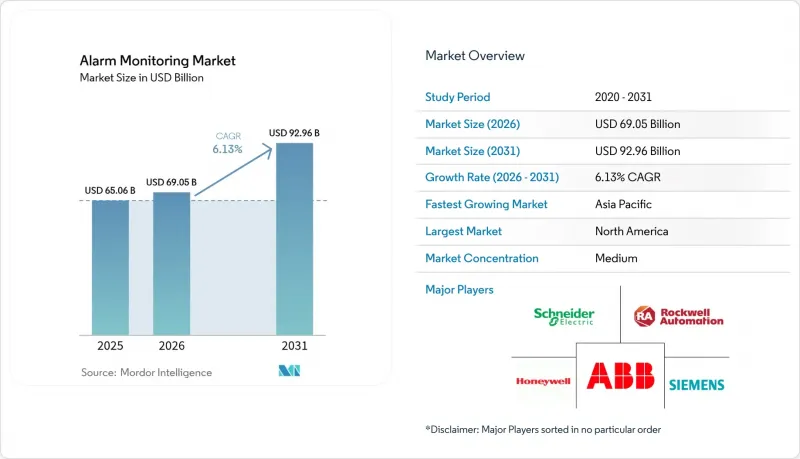
Mordor Intelligence에 의하면, 경보 모니터링 시장 규모는 2025년에 650억 6,000만 달러로 평가되었고 2026년 690억 5,000만 달러에서 2031년까지 929억 6,000만 달러에 이를 것으로 예측되며, 예측 기간(2026-2031년) CAGR은 6.13%를 나타낼 전망입니다.
본 보고서는 제공 형태(하드웨어, 소프트웨어, 서비스), 통신 기술(유선 통신 네트워크, 이동통신 네트워크 등), 용도(차량용 경보 모니터링, 건물용 경보 모니터링 등), 최종 사용자 산업(주택, 상업시설 등) 및 지역별로 분류되어 있습니다. 시장 예측은 금액(달러)으로 제시되어 있습니다.
세계 경보 모니터링 시장 동향 및 인사이트
클라우드 기반 VSaaS 경보 플랫폼 도입 확대
클라우드 기반 비디오 감시 서비스(VSaaS)는 비용을 자본 지출에서 예측 가능한 운영 비용으로 전환하여, 기업이 유지보수 부담을 줄이면서 스토리지 및 분석 기능을 즉시 확장할 수 있도록 합니다. 주요 공급업체들은 현재 연간 수억 건의 신호를 처리하고 있으며, 멀티테넌트 아키텍처가 On-Premise형 서버보다 트래픽 급증에 더 잘 대응할 수 있음이 입증되었습니다. 업데이트는 중앙 집중식으로 배포되므로, 고객은 현장 방문 없이도 새로운 AI 기능을 이용할 수 있어 출장 횟수를 줄이고 이산화탄소 배출량을 절감할 수 있습니다. 시설 관리 소프트웨어와의 통합을 통해 이 플랫폼은 보안, HVAC, 에너지 관리 대시보드를 중앙에서 관리할 수 있는 ‘싱글 페인 오브 글래스’가 됩니다. 클라우드에 대한 전문 역량이 부족한 벤더는 가입자들이 예측 분석 및 자동 대응 옵션을 갖춘 공급자로 이동함에 따라 이익률 하락 위험에 직면하게 될 것입니다.
선제적인 위협 감지를 위한 AI 기반 영상 분석 통합
다양한 카메라 영상을 통해 학습된 머신러닝 모델은 사람과 반려동물, 식물의 움직임을 구별할 수 있게 되어, 오경보로 인한 출동 횟수를 최대 40%까지 줄입니다. 그 결과, 모니터링 센터는 운영 비용을 절감하고 긴급 대응 요원들의 신뢰를 높일 수 있습니다. 얼굴 인식 등의 본인 식별형 분석을 통해 개인을 특정하는 경보가 가능해지며, 접근 제어를 통한 수익이 향상됩니다. 하네웰을 비롯한 각 제조업체는 엣지 측에 알고리즘을 내장함으로써 데이터 주권에 관한 규정을 준수하면서도 대역폭을 절약하고 있습니다. 하지만 유럽 및 미국의 특정 주에서 시행되는 개인정보 보호 규제는 통합업체에 규정 준수 부담을 안겨주고 있으며, 옵트인 방식의 동의나 감사 추적 기록 제출이 요구되고 있습니다. ‘프라이버시 바이 디자인(Privacy by Design)’ 프레임워크를 숙지한 제공업체는 규제가 엄격한 업계에서 지속적인 차별화를 꾀할 수 있습니다.
주거용 감시 서비스의 높은 해지율
연간 12% 이상의 해지율은 이익률을 압박하고 있으며, 제공업체는 고객 재유치를 위해 막대한 비용을 지출할 수밖에 없습니다. 가격에 민감한 밀레니얼 세대는 월정액 요금을 피하기 위해 스마트폰 알림 기능이 탑재된 DIY 카메라를 선호하는 경향이 있습니다. 규제 당국의 감독으로 인해 장기 계약이나 자동 갱신 조항이 제한되면서, 과거 해지율을 억제하던 락인 전략의 효과가 약화되고 있습니다. 고객 유지율을 높이기 위해 기존 사업자들은 조명이나 누수 감지 등의 홈 오토메이션 패키지를 추가하여 일상적인 이용을 촉진하고 있습니다. 초기 결과에서는 소폭의 개선이 나타나고 있지만, 경기 침체가 발생하면 해지 물결이 다시 불거질 가능성이 있습니다.
부문 분석
2025년에는 서비스 부문이 매출의 49.22%를 차지했습니다. 이는 고객들이 24시간 365일 모니터링, 전문 업체에 의한 설치 및 유지보수에 대해 예측 가능한 월정액 요금을 선호했기 때문입니다. 서비스 부문의 경보 모니터링 시장 규모는 사이트당 ARPU(평균 매출액)를 끌어올리는 첨단 클라우드 분석 기술의 보급에 따라 확대될 전망입니다. 센서의 상품화로 인한 가격 압박으로 하드웨어 매출은 둔화되고 있지만, 위험한 장소에서 사용하기 위해 추가 인증이 필요한 상황에서는 견고한 산업용 기기가 틈새 시장에서 프리미엄 가격을 유지하고 있습니다. 소프트웨어 구독은 예측 연평균 성장률(CAGR) 6.78%로 모든 카테고리를 능가하는 성장세를 보이고 있으며, 분석을 최우선으로 하는 비즈니스 모델로의 전환이 정당화되고 있습니다.
정기 계약은 현금 흐름을 유지하며, 공급자가 지역 딜러를 전국 규모의 사업 기반으로 통합하기 위한 인수 자금을 확보할 수 있게 해줍니다. UL 인증 취득 비용과 중앙 감시 스테이션의 이중화는 기존 사업자를 보호하는 진입 장벽이 되고 있습니다. 한편, DIY 설정이 가능한 SaaS 대시보드를 통해 사업자는 소규모 고객에게도 수익성 높은 서비스를 제공할 수 있게 되었습니다. 그 결과, 경보 모니터링 시장에서는 하드웨어 이익률과 장기적인 서비스 수익을 결합한 하이브리드형 사업자가 점점 더 우위를 점하고 있습니다.
2025년에는 셀룰러가 매출의 44.35%를 차지하며, 도시 및 지방 모두에서 오프사이트 신호 전송의 기반 역할을 계속하고 있습니다. 배터리 효율이 뛰어난 LTE-M 및 NB-IoT 모뎀 덕분에 외딴 지역의 파이프라인 및 태양광 발전 설비에 대한 도입이 확대되고 있으며, 이러한 부문이 경보 모니터링 시장의 성장을 주도하고 있습니다. 한편, 대역폭을 많이 소비하는 영상을 처리하기 위한 건물 전체의 이더넷 및 PoE 업그레이드로 인해 IP 기반 솔루션은 연평균 성장률(CAGR) 6.74%로 가장 빠르게 성장하고 있습니다. 고객은 보험 인수 요건 및 소방 법규의 이중화 요건을 충족하기 위해 유선 IP와 셀룰러를 통한 페일오버를 결합한 듀얼 패스 구성을 선택하는 경우가 많습니다.
정부 기관이나 역사적 건축물의 경우, 인프라 구축 보조금으로 비용이 상쇄되기 때문에 기존의 POTS 회선이 계속 사용되고 있지만, 통신 사업자들은 5년 이내에 이를 단계적으로 폐지할 예정입니다. 일시적인 건설 현장이나 행사장에서는 여전히 무선 네트워크가 이용되고 있어, 이용 가능한 통신 사업자 간에 자동으로 전환을 수행하는 멀티테크놀로지 허브의 중요성이 부각되고 있습니다. 전환 주기가 가속화되는 가운데, 유니버설 게이트웨이를 제공하는 공급업체들은 시장 점유율을 더욱 확대되고 있습니다.
지역별 분석
북미는 2025년 매출의 38.55%를 차지하며, 성숙한 경보 센터 인프라와 확립된 딜러 네트워크를 활용하여 AI 분석 및 홈 오토메이션 부가 기능을 번들로 제공합니다. 경보 모니터링 시장에서는 ADT의 최근 12.6%라는 지표가 보여주듯이, 보안과 라이프스타일의 편의성을 결합하는 참여 프로그램의 발전에 따라 고객 이탈률이 점차 완화되고 있습니다. UL 827 및 TMA 파이브 다이아몬드와 같은 규제 프레임워크로 인해 소규모 신규 진출기업들은 단독으로 스테이션을 운영하기보다는 도매 파트너십을 맺을 수밖에 없으며, 이로 인해 대규모 기존 기업들의 이익률이 유지되고 있습니다.
아시아태평양은 연평균 성장률(CAGR) 6.69%로 확대되고 있으며, 각국 정부가 교통 카메라, 대기질 센서, 긴급 신고함을 통합된 지휘 센터로 집약하는 스마트 시티 플랫폼에 자금을 지원하고 있습니다. 그린필드 건설이 주류를 이루고 있어, 휴대전화 및 IP 연결이 유선 전화를 앞지르고 있으며, 메가시티에서의 신속한 전개가 가능해졌습니다. 그러나 시장의 세분화는 여전히 지속되고 있으며, 세계 공급업체가 입찰에서 승리하기 위해서는 언어, 지불 조건, 사후 서비스의 현지화가 요구됩니다. 설치 인력 부족이 일정을 더욱 복잡하게 만들고 있어, 중소기업을 위한 자가 설치형 무선 키트에 대한 수요가 증가하고 있습니다.
유럽의 꾸준한 성장은 개인정보 보호를 중시하고 사이버 공격에 강인한 솔루션에 대한 수요를 반영하고 있습니다. Verisure사는 13개국에서 사업을 전개하며 570만 명의 고객을 보유하고 있으며, 평균 응답 시간이 60초 미만임을 자랑합니다. 이 지표는 프리미엄 가격 책정의 근거가 되고 있습니다. 데이터 부정 사용에 대한 GDPR(EU 개인정보보호규정)의 제재 조치로 인해 기업들은 종단 간암호화 및 SOC-2 준수가 문서화된 공급업체를 선택하도록 권장받고 있습니다. 한편, 친환경 건축 지침에 따라 리모델링 프로젝트에서 보안과 에너지 관리를 통합한 패키지가 장려되고 있어, 경보 시스템의 중요성은 침입 감지의 범위를 넘어 확장되고 있습니다.
기타 혜택:
- 엑셀 형식 시장 예측(ME) 시트
- 3개월간의 애널리스트 지원
자주 묻는 질문
목차
제1장 서론
제2장 조사 방법
제3장 주요 요약
제4장 시장 구도
제5장 시장 규모와 성장 예측
제6장 경쟁 구도
제7장 시장 기회와 향후 전망
JHS 26.09.11According to Mordor Intelligence, the alarm monitoring market size was valued at USD 65.06 billion in 2025 and estimated to grow from USD 69.05 billion in 2026 to reach USD 92.96 billion by 2031, at a CAGR of 6.13% during the forecast period (2026-2031).
This report is Segmented by Offering (Hardware, Software, and Services), Communication Technology (Wired Telecommunication Network, Cellular Wireless Network, and More), Application (Vehicle Alarm Monitoring, Building Alarm Monitoring, and More), End-User Industry (Residential, Commercial, and More), and Geography. The Market Forecasts are Provided in Terms of Value (USD).
Global Alarm Monitoring Market Trends and Insights
Rising Adoption of Cloud-Based VSaaS Alarm Platforms
Cloud video surveillance as a service shifts costs from capital outlay to predictable operating fees, letting enterprises scale storage and analytics instantly while off-loading maintenance. Large providers now process hundreds of millions of signals each year, proving that multitenant architectures handle burst traffic better than on-premise servers. Because updates deploy centrally, customers receive new AI features without site visits, reducing truck rolls and carbon emissions. Integration with facility-management software turns the platform into a single pane of glass for security, HVAC, and energy dashboards. Vendors that lack cloud competencies risk margin erosion as subscribers migrate to providers with predictive analytics and automated response options.
Integration of AI-Powered Video Analytics for Proactive Threat Detection
Machine-learning models trained on diverse camera feeds now differentiate humans from pets or foliage motion, reducing false dispatches by up to 40%. Monitoring centers consequently lower operating expense and improve emergency-responder trust. Identity-based analysis such as facial recognition enables person-specific alerts, enhancing access control revenue. Honeywell and other manufacturers embed algorithms at the edge, preserving bandwidth while meeting data-sovereignty rules. Nonetheless, privacy regulations in Europe and select U.S. states place compliance burdens on integrators, demanding opt-in consent and audit trails. Providers that master privacy-by-design frameworks create durable differentiation in regulated verticals.
High Churn Rates in Residential Monitoring Subscriptions
Annual attrition exceeding 12% erodes margins, forcing providers to spend heavily on re-acquisition. Price-sensitive millennials gravitate toward DIY cameras with smartphone alerts, bypassing monthly fees. Regulatory scrutiny curtails long-term contracts and auto-renewal clauses, limiting lock-in strategies that once dampened churn. To improve retention, incumbents add home-automation bundles such as lighting or leak-detection, deepening daily engagement. Early results show modest improvements, but any economic downturn could reignite cancellation waves.
Other drivers and restraints analyzed in the detailed report include:
- Insurance Premium Incentives for Professionally Monitored Systems
- Mandatory Lone-Worker Safety Regulations in High-Risk Industries
- Cyber-Security Vulnerabilities of IoT Alarm Endpoints
For complete list of drivers and restraints, kindly check the Table Of Contents.
Segment Analysis
Services generated 49.22% of revenue in 2025 as customers favored predictable monthly fees for 24/7 monitoring, professional installation, and maintenance. The alarm monitoring market size for services is positioned to climb alongside advanced cloud analytics that raise per-site ARPU. Hardware revenue softens as commoditized sensors face pricing pressure, yet ruggedized industrial gear keeps niche premiums where hazardous locations demand extra certifications. Software subscriptions outpace all categories at a projected 6.78% CAGR, validating the pivot toward analytics-first business models.
Recurring contracts sustain cash flow, letting providers fund acquisitions that consolidate regional dealers into national footprints. UL listing expenses and central-station redundancy create barriers to entry that protect incumbents. Meanwhile, SaaS dashboards enabling DIY configuration allow operators to serve smaller accounts profitably. As a result, the alarm monitoring market increasingly rewards hybrid players that couple hardware margins with long-life service annuities.
Cellular accounted for 44.35% of revenue in 2025 and remains the backbone for off-site signal transmission in both urban and rural locales. Battery-efficient LTE-M and NB-IoT modems broaden deployment to remote pipelines and solar arrays, segments fueling the alarm monitoring market. Conversely, IP-based solutions grow fastest at 6.74% CAGR thanks to building-wide Ethernet and PoE upgrades that support bandwidth-heavy video. Clients often select dual-path configurations, melding wired IP with cellular failover, to satisfy insurance underwriting and fire code redundancies.
Legacy POTS lines continue in government and heritage buildings where infrastructure grants offset costs, yet carriers phase them out within five years. Radio networks persist in temporary construction or event sites, underscoring the relevance of multi-technology hubs that switch automatically among available carriers. Suppliers that provide universal gateways capture more share as migration cycles accelerate.
Complete Report Scope:
- By Offering
- Hardware
- Remote Terminal Units (RTUs)
- Alarm Sensors
- Communication Networks and Gateways
- Other Hardware
- Software
- Services
- Hardware
- By Communication Technology
- Wired Telecommunication Network
- Cellular Wireless Network
- Wireless Radio Network
- IP Network
- By Application
- Vehicle Alarm Monitoring
- Building Alarm Monitoring
- Other Applications
- By End-User Industry
- Residential
- Commercial
- Industrial and Infrastructure
- Government and Public Safety
- By Geography
- North America
- United States
- Canada
- South America
- Brazil
- Mexico
- Rest of South America
- Europe
- Germany
- United Kingdom
- France
- Russia
- Rest of Europe
- Asia Pacific
- China
- Japan
- India
- Rest of Asia Pacific
- Middle East and Africa
- Middle East
- Saudi Arabia
- United Arab Emirates
- Rest of Middle East
- Africa
- South Africa
- Nigeria
- Rest of Africa
- Middle East
- North America
Geography Analysis
North America collected 38.55% of 2025 revenue, leveraging mature alarm center infrastructure and established dealer networks to bundle AI analytics and home-automation add-ons. The alarm monitoring market sees churn gradually easing as ADT's latest 12.6% metric shows progress in engagement programs that tie security to lifestyle convenience. Regulatory frameworks such as UL 827 and TMA Five Diamond push smaller entrants toward wholesale partnerships rather than standalone stations, preserving margin for scaled incumbents.
Asia Pacific expands at 6.69% CAGR, with governments funding smart-city platforms that integrate traffic cameras, air-quality sensors, and emergency call boxes into unified command centers. Because greenfield construction dominates, cellular and IP connectivity outpace landlines, enabling rapid rollouts in megacities. Yet fragmentation persists, requiring global vendors to localize language, payment terms, and after-sales support to win tenders. Install-labor shortages further complicate timelines, elevating the appeal of self-install wireless kits for small businesses.
Europe's steady growth reflects demand for privacy-centric, cyber-hardened solutions. Verisure operates across 13 countries with 5.7 million customers, boasting average response times under 60 seconds, a benchmark that underpins premium pricing. GDPR penalties for data misuse incentivize enterprises to select providers with documented end-to-end encryption and SOC-2 compliance. Meanwhile, green building directives push integrated security-plus-energy packages in retrofit projects, extending alarm relevance beyond intrusion.
- ADT Inc.
- Johnson Controls International plc
- Securitas AB
- Verisure Holding AB
- Honeywell International Inc.
- Schneider Electric SE
- ABB Ltd.
- Siemens AG
- Rockwell Automation, Inc.
- Diebold Nixdorf, Incorporated
- Assa Abloy AB
- Robert Bosch GmbH (Bosch Security Systems)
- Alarm.com Holdings, Inc.
- Vivint Smart Home, Inc.
- Brinks Home Security (Monitronics International, Inc.)
- Hangzhou Hikvision Digital Technology Co., Ltd.
- Zhejiang Dahua Technology Co., Ltd.
- Stanley Black and Decker, Inc.
- Allegion plc
- CPI Security Systems, Inc.
- SimpliSafe, Inc.
- Telular Corporation
- Nortek Security and Control LLC
- Resideo Technologies, Inc.
- Chubb Fire and Security Group (Carrier Global Corporation)
- Tyco Fire and Security Services
Additional Benefits:
- The market estimate (ME) sheet in Excel format
- 3 months of analyst support
TABLE OF CONTENTS
1 INTRODUCTION
- 1.1 Study Assumptions and Market Definition
- 1.2 Scope of the Study
2 RESEARCH METHODOLOGY
3 EXECUTIVE SUMMARY
4 MARKET LANDSCAPE
- 4.1 Market Overview
- 4.2 Market Drivers
- 4.2.1 Rising adoption of cloud-based VSaaS alarm platforms
- 4.2.2 Integration of AI-powered video analytics for proactive threat detection
- 4.2.3 Insurance premium incentives for professionally monitored systems
- 4.2.4 Mandatory lone-worker safety regulations in high-risk industries
- 4.2.5 Growing demand for remote asset monitoring in renewable-energy sites
- 4.2.6 Expansion of 5G and LTE-M boosting cellular alarm reliability
- 4.3 Market Restraints
- 4.3.1 High churn rates in residential monitoring subscriptions
- 4.3.2 Cyber-security vulnerabilities of IoT alarm endpoints
- 4.3.3 Shortage of certified installers in emerging markets
- 4.3.4 Sunset of 3G/2G networks increasing equipment obsolescence
- 4.4 Industry Value Chain Analysis
- 4.5 Regulatory Landscape
- 4.6 Technological Outlook
- 4.7 Porter's Five Forces Analysis
- 4.7.1 Bargaining Power of Suppliers
- 4.7.2 Bargaining Power of Buyers
- 4.7.3 Threat of New Entrants
- 4.7.4 Threat of Substitutes
- 4.7.5 Intensity of Competitive Rivalry
5 MARKET SIZE AND GROWTH FORECASTS (VALUE)
- 5.1 By Offering
- 5.1.1 Hardware
- 5.1.1.1 Remote Terminal Units (RTUs)
- 5.1.1.2 Alarm Sensors
- 5.1.1.3 Communication Networks and Gateways
- 5.1.1.4 Other Hardware
- 5.1.2 Software
- 5.1.3 Services
- 5.1.1 Hardware
- 5.2 By Communication Technology
- 5.2.1 Wired Telecommunication Network
- 5.2.2 Cellular Wireless Network
- 5.2.3 Wireless Radio Network
- 5.2.4 IP Network
- 5.3 By Application
- 5.3.1 Vehicle Alarm Monitoring
- 5.3.2 Building Alarm Monitoring
- 5.3.3 Other Applications
- 5.4 By End-User Industry
- 5.4.1 Residential
- 5.4.2 Commercial
- 5.4.3 Industrial and Infrastructure
- 5.4.4 Government and Public Safety
- 5.5 By Geography
- 5.5.1 North America
- 5.5.1.1 United States
- 5.5.1.2 Canada
- 5.5.2 South America
- 5.5.2.1 Brazil
- 5.5.2.2 Mexico
- 5.5.2.3 Rest of South America
- 5.5.3 Europe
- 5.5.3.1 Germany
- 5.5.3.2 United Kingdom
- 5.5.3.3 France
- 5.5.3.4 Russia
- 5.5.3.5 Rest of Europe
- 5.5.4 Asia Pacific
- 5.5.4.1 China
- 5.5.4.2 Japan
- 5.5.4.3 India
- 5.5.4.4 Rest of Asia Pacific
- 5.5.5 Middle East and Africa
- 5.5.5.1 Middle East
- 5.5.5.1.1 Saudi Arabia
- 5.5.5.1.2 United Arab Emirates
- 5.5.5.1.3 Rest of Middle East
- 5.5.5.2 Africa
- 5.5.5.2.1 South Africa
- 5.5.5.2.2 Nigeria
- 5.5.5.2.3 Rest of Africa
- 5.5.5.1 Middle East
- 5.5.1 North America
6 COMPETITIVE LANDSCAPE
- 6.1 Market Concentration
- 6.2 Strategic Moves
- 6.3 Market Share Analysis
- 6.4 Company Profiles (includes Global level Overview, Market level overview, Core Segments, Financials as available, Strategic Information, Market Rank/Share for key companies, Products and Services, and Recent Developments)
- 6.4.1 ADT Inc.
- 6.4.2 Johnson Controls International plc
- 6.4.3 Securitas AB
- 6.4.4 Verisure Holding AB
- 6.4.5 Honeywell International Inc.
- 6.4.6 Schneider Electric SE
- 6.4.7 ABB Ltd.
- 6.4.8 Siemens AG
- 6.4.9 Rockwell Automation, Inc.
- 6.4.10 Diebold Nixdorf, Incorporated
- 6.4.11 Assa Abloy AB
- 6.4.12 Robert Bosch GmbH (Bosch Security Systems)
- 6.4.13 Alarm.com Holdings, Inc.
- 6.4.14 Vivint Smart Home, Inc.
- 6.4.15 Brinks Home Security (Monitronics International, Inc.)
- 6.4.16 Hangzhou Hikvision Digital Technology Co., Ltd.
- 6.4.17 Zhejiang Dahua Technology Co., Ltd.
- 6.4.18 Stanley Black and Decker, Inc.
- 6.4.19 Allegion plc
- 6.4.20 CPI Security Systems, Inc.
- 6.4.21 SimpliSafe, Inc.
- 6.4.22 Telular Corporation
- 6.4.23 Nortek Security and Control LLC
- 6.4.24 Resideo Technologies, Inc.
- 6.4.25 Chubb Fire and Security Group (Carrier Global Corporation)
- 6.4.26 Tyco Fire and Security Services
7 MARKET OPPORTUNITIES AND FUTURE OUTLOOK
- 7.1 White-space and Unmet-Need Assessment


