|
시장보고서
상품코드
2124185
보어스코프 시장 : 시장 점유율 분석, 업계 동향 및 통계, 성장 예측(2026-2031년)Borescope - Market Share Analysis, Industry Trends & Statistics, Growth Forecasts (2026 - 2031) |
||||||
 Mordor Intelligence
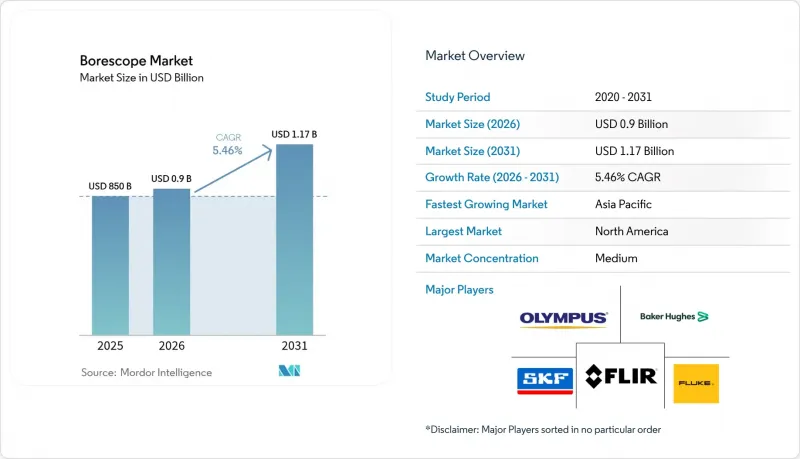
Mordor Intelligence에 의하면, 보어스코프 시장 규모는 2025년에 8억 5,000만 달러로 평가되었고, 2026년 9억 달러에서 2031년까지 11억 7,000만 달러에 이를 것으로 예측되며, 예측 기간(2026-2031년) CAGR은 5.46%를 기록할 전망입니다.
본 보고서는 유형별(비디오식, 플렉서블식, 리지드식 등), 직경별(0-3 mm, 3-6 mm 등), 각도별(0°-90°, 90°-180°, 180°-360°), 최종 사용자 산업별(자동차, 항공 등), 지역별(북미, 남미, 유럽 등)로 분류되어 있습니다. 시장 예측은 금액(달러) 기준으로 제시되어 있습니다.
세계의 보어스코프 시장 동향 및 인사이트
높은 업무 생산성에 대한 수요 증가
산업 관리자들은 가동 중단으로 인한 비용과 주주 환원 간의 연관성을 점점 더 중요하게 여기고 있습니다. 그 결과, 육안 검사 예산은 재량적 지출에서 필수 경비 항목으로 전환되고 있습니다. 현대 가스 터빈 운영 사업자에 따르면, 고해상도 보어스코프 검사를 통해 정기 분해 정비 1회 주기 전에 블레이드의 열화를 감지할 수 있으므로, 수요가 적은 시기에 수리를 계획할 수 있게 되었습니다. 자동차 엔진 생산 라인의 품질 관리 공정에서는 최종 조립 전에 주조 공극을 감지하기 위해 극소직경의 프로브가 도입되고 있습니다. AI를 활용한 인식 기술로 인해 각 검사 루프에 소요되는 시간이 단축되어, 과거에 육안 검사를 병목 현상으로 여겼던 공장에서도 처리량이 향상되고 있습니다. 이러한 다양한 상황에서 보어스코프 시장은 명확한 가치 제안을 통해 혜택을 보고 있습니다. 즉, 소액의 설비 투자로 수백만 달러 규모의 가동 중단을 미연에 방지할 수 있는 것입니다.
MRO 프로그램에서의 비디오 보어스코프 도입 가속화
현재 유지보수·수리·정비(MRO) 제공업체들은 4K 영상을 촬영하고, 감사 기록을 보관하며, 원격 실시간 협업을 가능하게 하는 비디오 시스템을 선호하여 채택하고 있습니다. 항공 MRO 팀은 기존 파이버스코프에 비해 사이클 타임이 30-40% 단축되었다고 밝혔으며, 고해상도화 덕분에 합격·불합격 판단을 더욱 확신 있게 내릴 수 있게 되었습니다. 군사 사양도 이러한 전환을 뒷받침하고 있으며, USSOCOM의 2025년 입찰 요건에서는 방수·저지연·4K 포렌식 카메라가 요구되고 있으며, 이 사양은 민간 공급업체로도 확산되고 있습니다. 그 결과, 보어스코프 시장을 디지털 워크플로우로 정착시키는 업그레이드의 물결이 일어나고 있습니다.
높은 초기 도입 비용과 교육 비용
AI 분석 기능을 탑재한 고급 비디오스코프의 가격은 대개 5만-10만 달러로, 소규모 수리 공장의 설비 투자 예산을 훨씬 초과합니다. 또한, 인증 프로그램에는 기술자 1인당 추가로 1만-1만 5,000달러의 비용이 발생할 수 있습니다. 이러한 경제적 요인으로 인해 개발도상국에서의 도입은 지연되고 있으며, 대규모 차량 운영 사업자는 첨단 광학 장비를 이용할 수 있는 반면, 소규모 공급업체는 저해상도 도구를 계속 사용하는 양극화 구조가 발생하고 있습니다.
부문 분석
2025년, 보어스코프 시장에서 비디오 시스템은 41.60%라는 최대 점유율을 차지했습니다. 이는 이미지 아카이빙 및 원격 감사 기록 보존을 요구하는 규제적 요건에 힘입은 결과입니다. 이 부문의 예측 연평균 성장률(CAGR)은 7.64%이며,매출액은 2025년 추정치인 3억 6,000만 달러에서 2031년까지 약 5억 6,015만 달러로 확대될 전망이며, 디지털 플랫폼이 보어스코프 시장 규모에서 주도적인 입지를 더욱 공고히 할 것입니다. 복잡한 형상의 검사에서 기동성이 요구되는 상황에서는 유연한 비디오 모델이 우위를 차지하지만, 도달 거리보다 절대적인 영상 선명도가 우선시되는 경우에는 여전히 리지드 광학 시스템이 선택되고 있습니다. 하이브리드형 반강성 프로브는 소형 엔진 검사 분야에서 조작성과 비용의 균형을 맞추며 틈새 시장을 개척하고 있습니다.
지속적인 기능 도입이 경쟁 우위를 형성하고 있습니다. 올림푸스는 피사계 심도를 확대한 ‘EZ1500’ 시리즈를 도입하여, 과거 심부 검사에서 골칫거리였던 초점 오차를 줄였습니다. 클라우드 API를 통해 촬영된 영상은 AI 물체 감지 서비스로 전송되어, 사람의 감시 없이도 피칭, 피로, 스케일을 태그할 수 있게 되었습니다. 이러한 동향이 맞물려 영상 카테고리는 보어스코프 시장의 디지털 분야를 선도하고 있으며, 하류 분석 수익으로 이어지는 주요 관문으로서의 입지를 공고히 하고 있습니다.
6-10mm 범위(주류 터빈 및 파이프라인 작업에 사용되는 크기)는 2025년 보어스코프 시장 점유율의 34.50%를 차지했습니다. 이 ‘스위트 스팟’은 높은 루멘 출력과 충분한 기동성을 겸비하여 수명 주기 비용을 절감하고 있습니다. 한편, 반도체 팹과 의료기기 공장이 마이크로미터 단위의 결함 감지를 추구하는 가운데, 0-3mm 프로브는 연평균 성장률(CAGR) 6.19%로 성장을 지속하고, 있습니다. Gradient Lens사는 마이크로 밀링 장비의 좁은 냉각수 통로를 통과할 수 있는 0.5mm 모델을 상용화했습니다. SCHOLLY사의 0.35mm 파이버스코프는 3,000개의 개별 파이버로 구성되어 있어, 서브mm급 검사를 향한 로드맵을 뒷받침하고 있습니다.
10mm를 초과하는 대구경 모델은 보일러 관이나 석유화학용 용기에서 여전히 필수적이며, 이러한 용도에서는 내경의 밝기나 통합형 측정 모듈의 성능이 크기보다 더 중요하게 여겨집니다. 모든 등급에서 CMOS의 감도 향상과 LED 조명 기술의 발전으로 인해 외경이 축소되어도 영상의 선명도가 유지되고 있으며, 보로스코프 시장은 끊임없이 소형화가 진행되는 산업의 요구에 지속적으로 부응하고 있습니다.
지역별 분석
북미는 2025년 보로스코프 시장 매출의 33.70%를 차지했습니다. 이는 미국의 광범위한 파이프라인망과 연방항공청(FAA)의 엄격한 엔진 검사 지침에 힘입은 결과입니다. PHMSA의 2024년 규정 제정으로 20개 이상의 기술 기준이 추가되었으며, 파이프라인 사업자는 규정 준수에 대한 상세한 시각적 증거를 수집해야 할 의무가 부과되었습니다. AI 기반 분석 기술의 조기 도입으로 고품질 보어스코프가 사업자의 예산에 더욱 자리 잡고 있으며, 성숙한 서비스 생태계가 애프터마켓 매출을 높은 수준으로 뒷받침하고 있습니다. 아시아태평양은 연평균 성장률(CAGR) 6.74%로 확대되고 있으며, 공장 확장 및 인프라 구축이 지속적인 장비 수요로 이어지고 있습니다. QBH Technology와 같은 중국의 OEM 제조업체들은 규모의 경제를 활용하여 60개 이상의 수출 대상국에 경쟁력 있는 가격의 보어스코프를 제공합니다. 일본과 한국에서는 조선 및 반도체 분야에 대한 투자를 배경으로, 클린룸 기준을 충족하는 고급 광학 기기가 구매되고 있습니다. 인도에서는 발전소 및 화학 플랜트의 산업 안전 감사 추진으로 인해 서비스 체계가 아직 정비되지 않은 분야에서 새로운 비즈니스 기회가 창출되고 있으며, 이 지역은 전 세계 보어스코프 시장에서 가장 빠르게 성장하고 있는 지역이 되었습니다.
유럽에서는 노후화된 산업 자산, 해상 풍력 발전소, 원자력 시설에 예측 유지보수 체계가 도입됨에 따라, 꾸준히 한 자릿수 중반대의 성장을 보이고 있습니다. 독일의 ‘인더스트리 4.0’ 전개에 따라 내시경은 자동화된 품질 관리 게이트웨이에 통합되고 있는 반면, 영국 북해에 위치한 노후화된 자산에서는 협소하고 고압인 환경에서 작동하는 고각도 프로브가 활용되고 있습니다. EU의 환경 지침에 따라 상태 모니터링에 대한 투자가 강화되고 있으며, 이로 인해 교체 주기가 안정화되어 내시경 시장 전체 규모에 대한 꾸준한 기여가 뒷받침되고 있습니다.
기타 혜택 :
- 엑셀 형식 시장 예측(ME) 시트
- 3개월간의 애널리스트 지원
자주 묻는 질문
목차
제1장 서론
제2장 조사 방법
제3장 주요 요약
제4장 시장 구도
제5장 시장 규모 및 성장 예측(금액, 2021-2030년)
제6장 경쟁 구도
제7장 시장 기회 및 향후 전망
AJY 26.09.09According to Mordor Intelligence, the borescope market size was valued at USD 850 million in 2025 and estimated to grow from USD 900 million in 2026 to reach USD 1.17 billion by 2031, at a CAGR of 5.46% during the forecast period (2026-2031).
This report is Segmented by Type (Video, Flexible, Rigid, and More), Diameter (0-3 Mm, 3-6 Mm, and More), Angle (0°-90°, 90°-180°, 180°-360°), End-User Industry (Automotive, Aviation, and More), and by Geography (North America, South America, Europe, and More). The Market Forecasts are Provided in Terms of Value (USD).
Global Borescope Market Trends and Insights
Rising Demand for High Operational Productivity
Industrial managers increasingly link downtime costs to shareholder returns; as a result, visual inspection budgets are shifting from discretionary to mandated line items. Modern gas-turbine operators report that high-definition borescope passes can detect blade deterioration a full maintenance season before routine strip-downs, allowing repairs to be scheduled during low-demand windows. Micro-diameter probes have entered quality-control cells on automotive engine lines to spot casting voids before final assembly. AI-assisted recognition shortens each inspection loop, boosting throughput in factories that once considered visual checks a bottleneck. Across these settings, the borescope market benefits from a clear value narrative: small capital outlays avert multimillion-dollar outages.
Accelerating Adoption of Video Borescopes in MRO Programs
Maintenance, repair, and overhaul providers now favor video systems that capture 4K imagery, store audit trails, and enable live remote collaboration. Aviation MRO teams cite 30-40% cycle-time savings versus legacy fiber scopes, while higher resolution delivers more confident go-no-go decisions. Military specifications reinforce the shift; USSOCOM's 2025 tender requires waterproof, low-latency, 4K forensic cameras, a specification that cascades to civilian suppliers. The net result is an upgrade wave that anchors the borescope market in digital workflows.
High Upfront Acquisition and Training Costs
Premium video scopes equipped with AI analytics often list between USD 50,000 and USD 100,000-well above the capital budgets of small repair shops. Certification programs can add another USD 10,000-15,000 per technician. These economics slow adoption in developing economies, creating a two-tier structure in which large fleet operators access advanced optics while smaller vendors continue with lower-resolution tools.
Other drivers and restraints analyzed in the detailed report include:
- Regulatory Inspection Mandates in Aviation and Energy Sectors
- Preventive-Maintenance Push in Oil & Gas & Power Generation
- Skilled-Operator Shortage in Emerging Markets
For complete list of drivers and restraints, kindly check the Table Of Contents.
Segment Analysis
Video systems held the largest 41.60% slice of the borescope market in 2025, a position underwritten by regulatory calls for image archiving and remote audit trails. The segment's 7.64% forecast CAGR will push its revenue from an estimated USD 360 million in 2025 to roughly USD 560.15 million by 2031, reinforcing the borescope market size leadership of digital platforms. Flexible video models win where complex geometries demand articulation, while rigid optics remain the choice when absolute image clarity outweighs reach. Hybrid semi-rigid probes carve out niches in small-engine inspection, balancing maneuverability against cost.
Continued feature infusion shapes competitive moats. Olympus introduced the EZ1500 line with extended depth-of-field imaging, mitigating the focus drift that once plagued deep bores. Cloud APIs now funnel footage into AI object-detection services that tag pitting, fatigue, and scale without human oversight. These dynamics collectively ensure that the video category remains the borescope market's digital vanguard and the primary gateway for downstream analytics revenues.
The 6-10 mm range-home to mainstream turbine and pipeline work-accounted for 34.50% of borescope market share in 2025. This sweet spot combines high lumen output with adequate articulation, keeping lifetime service costs in check. Meanwhile, 0-3 mm probes are registering a 6.19% CAGR as semiconductor fabs and medical-device plants pursue defect detection at micrometer scale. Gradient Lens has commercialized 0.5 mm models that thread through narrow coolant channels on micro-milling equipment. SCHOLLY's 0.35 mm fiberscope, comprising 3,000 individual fibers, underscores a roadmap toward sub-millimeter inspection.
Larger diameters above 10 mm remain indispensable for boiler tubes and petrochemical vessels, where lumen intensity and integrated measurement modules trump size. Across all classes, advances in CMOS sensitivity and LED lighting sustain image clarity even as external diameters shrink, ensuring the borescope market can service industries moving toward perpetual miniaturization.
Complete Report Scope:
- By Type
- Video
- Flexible
- Rigid
- Semi-rigid
- Endoscopes
- By Diameter
- 0-3 mm
- 3-6 mm
- 6-10 mm
- Above 10 mm
- By Angle
- 0°-90°
- 90°-180°
- 180°-360°
- By End-user Industry
- Automotive
- Aviation
- Power Generation
- Oil and Gas
- Manufacturing
- Chemicals
- Food and Beverages
- Pharmaceuticals
- Mining and Construction
- Defense and Security
- By Geography
- North America
- United States
- Canada
- Mexico
- South America
- Brazil
- Argentina
- Rest of South America
- Europe
- Germany
- United Kingdom
- France
- Italy
- Spain
- Russia
- Rest of Europe
- Asia-Pacific
- China
- Japan
- India
- South Korea
- Australia and New Zealand
- ASEAN
- Rest of APAC
- Middle East and Africa
- Middle East
- GCC
- Turkey
- Rest of Middle East
- Africa
- South Africa
- Nigeria
- Rest of Africa
- Middle East
- North America
Geography Analysis
North America maintained 33.70% of borescope market revenue in 2025, anchored by the United States' extensive pipeline grid and the Federal Aviation Administration's stringent engine-inspection directives. PHMSA's 2024 rulemaking added more than 20 technical standards, compelling pipeline operators to collect detailed visual evidence of compliance. Early uptake of AI-enabled analytics further embeds premium scopes in operator budgets, and a mature service ecosystem sustains high aftermarket revenues.Asia-Pacific is advancing at a 6.74% CAGR, converting factory expansions and infrastructure build-outs into sustained equipment demand. Chinese OEMs such as QBH Technology leverage scale economics to offer competitively priced scopes across more than 60 export destinations. Japan and South Korea, driven by shipbuilding and semiconductor investments, purchase high-end optics that stand up to clean-room protocols. India's push for industrial safety audits in power and chemical plants opens green-field opportunities where service capacity is still nascent, positioning the region as the fastest-moving component of the global borescope market.
Europe shows consistent mid-single-digit growth as aging industrial assets, offshore wind farms, and nuclear facilities adopt predictive inspection regimes. Germany's Industrie 4.0 rollout embeds scopes within automated quality gateways, while the United Kingdom's mature North Sea assets rely on high-angle probes that operate in confined, high-pressure environments. EU environmental directives reinforce condition-monitoring investments, keeping replacement cycles steady and supporting stable contribution to overall borescope market size.
- Olympus Corporation
- Baker Hughes (Waygate Technologies)
- Teledyne FLIR LLC
- Fluke Corporation
- AB SKF
- Karl Storz SE and Co. KG
- Yateks Corporation
- IT Concepts GmbH
- ViZaar Industrial Imaging AG
- Advanced Inspection Technologies Inc.
- Gradient Lens Corporation
- JME Technologies Inc.
- USA Borescopes LLC
- Schoelly Fiberoptic GmbH
- Ralcam Technology Co., Ltd.
- PCE Instruments
- MFE Inspection Solutions
- OME-TOP Systems Co., Ltd.
- Viper Imaging LLC
- General Tools and Instruments LLC
Additional Benefits:
- The market estimate (ME) sheet in Excel format
- 3 months of analyst support
TABLE OF CONTENTS
1 INTRODUCTION
- 1.1 Study Assumptions and Market Definition
- 1.2 Scope of the Study
2 RESEARCH METHODOLOGY
3 EXECUTIVE SUMMARY
4 MARKET LANDSCAPE
- 4.1 Market Overview
- 4.2 Market Drivers
- 4.2.1 Rising demand for high operational productivity
- 4.2.2 Accelerating adoption of video borescopes in MRO programs
- 4.2.3 Regulatory inspection mandates in aviation and energy sectors
- 4.2.4 Preventive-maintenance push in oil and gas and power generation
- 4.2.5 AI-enabled defect-detection capabilities
- 4.2.6 Mini-diameter borescopes for micro-electronics inspection
- 4.3 Market Restraints
- 4.3.1 Inadequate lighting and image quality in legacy devices
- 4.3.2 High upfront acquisition and training costs
- 4.3.3 Cyber-security concerns for connected video borescopes
- 4.3.4 Skilled-operator shortage in emerging markets
- 4.4 Value / Supply-Chain Analysis
- 4.5 Regulatory Landscape
- 4.6 Technological Outlook
- 4.7 Porter's Five Forces Analysis
- 4.7.1 Threat of New Entrants
- 4.7.2 Bargaining Power of Buyers
- 4.7.3 Bargaining Power of Suppliers
- 4.7.4 Threat of Substitute Products
- 4.7.5 Intensity of Competitive Rivalry
5 MARKET SIZE AND GROWTH FORECASTS (VALUE, 2021-2030)
- 5.1 By Type
- 5.1.1 Video
- 5.1.2 Flexible
- 5.1.3 Rigid
- 5.1.4 Semi-rigid
- 5.1.5 Endoscopes
- 5.2 By Diameter
- 5.2.1 0-3 mm
- 5.2.2 3-6 mm
- 5.2.3 6-10 mm
- 5.2.4 Above 10 mm
- 5.3 By Angle
- 5.3.1 0°-90°
- 5.3.2 90°-180°
- 5.3.3 180°-360°
- 5.4 By End-user Industry
- 5.4.1 Automotive
- 5.4.2 Aviation
- 5.4.3 Power Generation
- 5.4.4 Oil and Gas
- 5.4.5 Manufacturing
- 5.4.6 Chemicals
- 5.4.7 Food and Beverages
- 5.4.8 Pharmaceuticals
- 5.4.9 Mining and Construction
- 5.4.10 Defense and Security
- 5.5 By Geography
- 5.5.1 North America
- 5.5.1.1 United States
- 5.5.1.2 Canada
- 5.5.1.3 Mexico
- 5.5.2 South America
- 5.5.2.1 Brazil
- 5.5.2.2 Argentina
- 5.5.2.3 Rest of South America
- 5.5.3 Europe
- 5.5.3.1 Germany
- 5.5.3.2 United Kingdom
- 5.5.3.3 France
- 5.5.3.4 Italy
- 5.5.3.5 Spain
- 5.5.3.6 Russia
- 5.5.3.7 Rest of Europe
- 5.5.4 Asia-Pacific
- 5.5.4.1 China
- 5.5.4.2 Japan
- 5.5.4.3 India
- 5.5.4.4 South Korea
- 5.5.4.5 Australia and New Zealand
- 5.5.4.6 ASEAN
- 5.5.4.7 Rest of APAC
- 5.5.5 Middle East and Africa
- 5.5.5.1 Middle East
- 5.5.5.1.1 GCC
- 5.5.5.1.2 Turkey
- 5.5.5.1.3 Rest of Middle East
- 5.5.5.2 Africa
- 5.5.5.2.1 South Africa
- 5.5.5.2.2 Nigeria
- 5.5.5.2.3 Rest of Africa
- 5.5.5.1 Middle East
- 5.5.1 North America
6 COMPETITIVE LANDSCAPE
- 6.1 Market Concentration
- 6.2 Strategic Moves
- 6.3 Market Share Analysis
- 6.4 Company Profiles (includes Global level Overview, Market level overview, Core Segments, Financials as available, Strategic Information, Market Rank/Share for key companies, Products and Services, and Recent Developments)
- 6.4.1 Olympus Corporation
- 6.4.2 Baker Hughes (Waygate Technologies)
- 6.4.3 Teledyne FLIR LLC
- 6.4.4 Fluke Corporation
- 6.4.5 AB SKF
- 6.4.6 Karl Storz SE and Co. KG
- 6.4.7 Yateks Corporation
- 6.4.8 IT Concepts GmbH
- 6.4.9 ViZaar Industrial Imaging AG
- 6.4.10 Advanced Inspection Technologies Inc.
- 6.4.11 Gradient Lens Corporation
- 6.4.12 JME Technologies Inc.
- 6.4.13 USA Borescopes LLC
- 6.4.14 Schoelly Fiberoptic GmbH
- 6.4.15 Ralcam Technology Co., Ltd.
- 6.4.16 PCE Instruments
- 6.4.17 MFE Inspection Solutions
- 6.4.18 OME-TOP Systems Co., Ltd.
- 6.4.19 Viper Imaging LLC
- 6.4.20 General Tools and Instruments LLC
7 MARKET OPPORTUNITIES AND FUTURE OUTLOOK
- 7.1 White-space and Unmet-Need Assessment