
|
시장보고서
상품코드
2124187
컨테이너 취급 장비 시장 : 시장 점유율 분석, 산업 동향 및 통계, 성장 예측(2026-2031년)Container Handling Equipment - Market Share Analysis, Industry Trends & Statistics, Growth Forecasts (2026 - 2031) |
||||||
 Mordor Intelligence
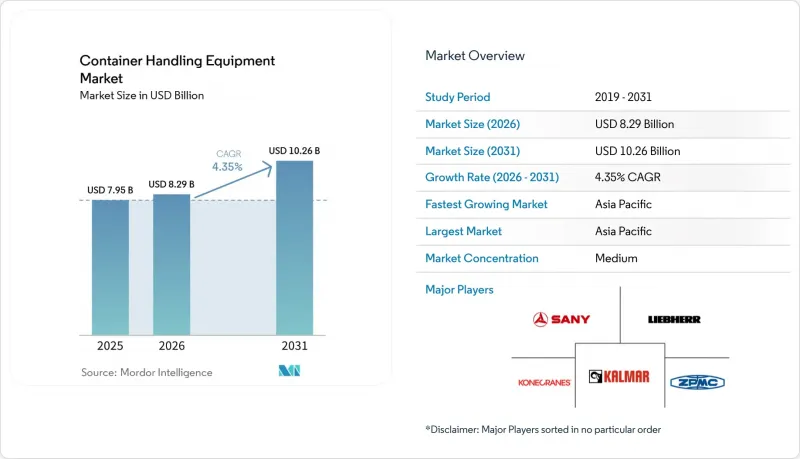
Mordor Intelligence에 의하면, 컨테이너 취급 장비 시장 규모는 2025년에 79억 5,000만 달러로 평가되었고, 2026년에는 82억 9,000만 달러에 이를 것으로 추정되고, 2026-2031년 CAGR 4.35%로 성장을 지속할 전망이며, 2031년까지 102억 6,000만 달러에 이를 것으로 예측됩니다.
본 보고서는 장비 유형별(지게차, 리치 스태커, 기타), 추진 방식별(디젤, 하이브리드, 기타), 자동화 수준별(수동, 반자동, 기타), 최종 사용자별(항만·하천 터미널, 내륙 컨테이너 창고, 기타), 지역별(북미, 남미, 기타)로 분류되어 있습니다. 시장 전망은 금액(달러)과 수량(대)으로 제시되어 있습니다.
세계의 컨테이너 취급 장비 시장 동향 및 인사이트
터미널 운영의 자동화 및 디지털화
싱가포르 PSA가 운영하는 투아스 시설에서는 첨단 자동화 기술이 도입되어 업무 효율이 대폭 향상되었으며, 필요한 인력 수가 감소했습니다. 함부르크에 위치한 코넥크레인즈(Conecranes)의 원격 조작 스테이션에서는 한 명의 운영자가 여러 대의 선박-부두 크레인을 동시에 관리할 수 있어, 한산한 시간대의 크레인 가동률이 향상되고 있습니다. 톈진항에서는 5G 연결을 통해 자율 주행형 운반차의 정밀한 연동이 가능해져, 안전하고 효율적인 혼합 교통 운영이 뒷받침되고 있습니다. 나비스(Navis)와 칼마(Kalmar)의 미들웨어 오버레이는 레거시 터미널 운영 시스템의 업그레이드에 기여하고 있지만, 그 도입에는 상당한 시간이 소요됩니다. 향후에는 표준화된 데이터 교환을 통해 통합에 따른 마찰을 줄일 수 있을 가능성이 있습니다. 컨테이너용 장비의 상태 및 이벤트에 관한 메시징에 대해서는 ISO 9897(CEDEX)가 일반적인 통신 코드를 정의하고 있습니다.
컨테이너 취급 차량의 전기화에 대한 관심 고조
규제 당국이 배기가스 기준을 강화하고 있는 만큼, 사업자들은 하나의 사업 주기 내에서 투자 회수가 보장될 만큼 가동률이 높은 경우 배터리식 전기 차량 도입을 추진하고 있습니다. DP 월드는 터미널 탈탄소화 로드맵의 일환으로 렘차반 항에 완전 전기식 터미널 내 운송 차량을 도입했습니다. 터미널 장비의 전동화는 모든 차량을 일괄적으로 전환하는 형태가 아니라 단계적으로 진행되고 있습니다. 미국 환경보호청(EPA)은 2027년까지 다수의 디젤 차량을 대체하기 위해 ‘클린 포트 프로그램’의 일환으로 2024년에 약 4억 1,200만 달러를 지출했습니다. 캘리포니아주와 뉴저지주의 가동률이 높은 터미널들이 전기 장비로의 전환을 주도하고 있습니다.
높은 자본 비용과 긴 투자 회수 기간
배터리식 장비는 디젤식에 비해 가격이 훨씬 비싸며, 충전 인프라 구축으로 인해 프로젝트 예산은 더욱 부풀어 오릅니다. 예를 들어, 배터리식 리치 스태커는 디젤 모델보다 가격이 상당히 높고, 급속 충전기 역시 막대한 비용이 듭니다. 신흥 시장의 사업자들은 현지 은행들이 잔존 가치에 대해 신중한 태도를 고수하고 있어 자금 조달에 어려움을 겪고 있습니다. 이러한 신중한 태도로 인해 디젤 방식에 비해 리스 비용이 높아지고 있습니다. 미국의 ‘인플레이션 억제법’에는 투자 세액 공제가 마련되어 있지만, 이에 수반되는 택스 에쿼티 구조는 프로젝트 일정을 장기화시키는 경향이 있습니다. 수년 사용 후 필요해지는 배터리 교체는 대부분의 경우 초기 예산에서 제외되기 쉬운 고액의 비용이 됩니다. 이러한 간과로 인해 예상되는 비용 절감 효과가 크게 줄어들 가능성이 있습니다. 취급 화물량이 적은 소규모 터미널에서는 고정 인프라 비용을 효과적으로 분산시키는 데 어려움을 겪고 있습니다. 그 결과, 규제에 의해 전환이 강제되지 않는 한 디젤 기계가 여전히 비용 대비 효과가 높은 선택지로 남아 있습니다.
부문 분석
2025년 현재, 지게차는 컨테이너 취급 장비 시장 점유율의 38.12%를 차지했으며, 이는 항만, 내륙 디포, 창고 등 다양한 현장에서의 범용성을 뒷받침합니다. 무인 운반차(AGV)는 도입 규모는 작지만, 인건비 급등과 연속 가동 수요에 힘입어 연평균 성장률(CAGR) 10.85%로 성장하고 있습니다. 2020년대 중반까지 터미널 트랙터가 전동화로의 전환을 주도하며, 배터리식 전기 모델이 큰 성장세를 보일 것으로 예측됩니다. 대조적으로, 리치 스태커는 고정 마스트식 지게차에 비해 텔레스코픽 붐을 이용한 작업 주기의 에너지 수요가 높기 때문에 전동화로의 전환이 더디게 진행되고 있습니다. 스트래들 캐리어의 경우, 하이브리드식 디젤·전기 구동 시스템의 활용이 확대되고 있으며, 이 시스템은 제동 에너지를 효율적으로 회수하여 충전 인프라 없이도 현저한 연료 절감을 실현하고 있습니다.
무인 운반차(AGV)의 도입은 전 세계적으로 확대될 것으로 예상되며, 주요 지역에서는 현저한 보급이 전망됩니다. AGV는 초기 비용이 높지만, 컨테이너 야드의 밀도를 최적화하고 트럭의 대기 시간을 단축함으로써 운영 효율을 향상시킵니다. 또한, 고무 타이어식 갠트리 크레인 및 선박-부두 크레인에는 원격 조작 기능이 탑재되고 있어, 피크 시간대 이외의 시간대에서의 가동률이 향상되고 있습니다. 완전 자율형 레일식 갠트리 크레인의 경우, 안전성이 대폭 향상되고 운영 효율이 개선된 것이 입증되었습니다. 그러나 AGV 프로젝트는 유도 시스템의 인프라 비용과 관련된 과제에 계속해서 직면하고 있어, 도입 전에는 장기적인 비용을 신중하게 평가할 필요가 있습니다.
2025년, 컨테이너 취급 장비 시장에서 디젤 구동 방식의 점유율은 58.04%를 유지했습니다. 이는 기존 도입 대수가 안정적으로 정착되어 있고, 연료 보급 인프라가 널리 구축되어 있음을 반영합니다. 배터리식 전기 장비는 배터리 가격 하락에 힘입어 2031년까지 연평균 성장률(CAGR) 17.31%로 확대될 것으로 예측됩니다. 하이브리드 장비는 완전한 충전 인프라가 갖춰지지 않았더라도 배기가스 감축이 가능하다는 점 때문에 신규 판매에서 소폭의 점유율을 확보했습니다. 수소는 여전히 틈새 시장으로 남아 있지만, 주요 허브 항만에서 그린 수소 생산이 확대됨에 따라 성장이 기대됩니다.
가까운 미래에 미국 환경보호청(EPA)은 캘리포니아주, 뉴저지주, 워싱턴주 등 주요 주를 중심으로 다수의 디젤 차량을 대체할 계획입니다. 한편, 유럽의 항만에서는 규정을 준수하지 않는 디젤 차량에 대한 벌칙이 조만간 도입될 전망이며, 이는 전동화로의 전환을 촉진할 것입니다. 충전으로 인한 가동 중단 시간과 비교했을 때 지속적인 연료 보급이 가능하다는 장점 덕분에, 연중 광범위하게 가동되는 가동률이 높은 자산에서는 여전히 디젤 차량이 주류를 이루고 있지만, 총 소유 비용(TCO) 상황은 변화하고 있습니다. 많은 지역에서 디젤 가격에 비해 전력 비용이 상승하고 있습니다.
지역별 분석
아시아태평양은 2025년에 컨테이너 취급 장비 시장 점유율의 44.22%를 차지한 것으로 평가되었으며, 2031년까지 연평균 성장률(CAGR) 6.88%로 성장할 것으로 전망됩니다. 중국은 2024년에 막대한 컨테이너 처리량을 기록했으며, 업무 효율과 처리 능력을 향상시키기 위해 칭다오와 톈진 등 주요 항만에 양산(Yangshan)의 자동화 모델을 확대되고 있습니다. 인도의 자와할랄 네루 항만청(JNPA)은 진행 중인 인프라 및 터미널 개발 프로젝트가 가동을 시작함에 따라, 해당 청의 컨테이너 취급 능력이 대폭 확대될 것으로 전망된다고 발표했습니다. 싱가포르와 포트클란 등 동남아시아의 허브 항구에서는 노동 시장 부족을 완화하고, 부두의 생산성을 높이며, 보다 신뢰할 수 있는 화물 운송을 지원하기 위해 자동화가 활용되고 있습니다. 한편, 일본과 한국은 항만 운영을 탄소 중립 공약에 부합시키고, 컨테이너 처리 업무 전반의 배출량을 감축하기 위해 기존 선단의 전기화를 우선시하고 있습니다.
유럽은 2025년에 상당한 수익 점유율을 차지한 것으로 평가되었지만, 처리량 정체와 노동 보호 조치로 인한 제약이 있는 반면, 제로 배출 목표 시한 설정에 힘입고 있습니다. 로테르담 항은 2024년에 1,380만 TEU를 처리했으며, 2030년까지 해운 관련 CO₂ 배출량을 감축하기 위해 육상 전원 공급 노력에 더해 업무의 전기화 및 대체 연료의 시범 도입을 지속하고 있습니다. 함부르크의 원격 조종 크레인 프로그램으로 가동률이 향상된 반면, 앤트워프·브뤼헤에서는 전기 트랙터와 자동 레일식 갠트리에 대한 투자가 진행되고 있습니다. 발렌시아나 피레우스와 같은 남유럽 항만에서는 지중해로의 니어쇼어링 제조 흐름을 유치하기 위해 처리 능력 확대가 진행되고 있습니다. 북미는 2025년 컨테이너 취급 장비 시장 규모에서 큰 점유율을 차지한 것으로 평가되었습니다.
중동 및 아프리카 역시 시장에서 주목할 만한 위치를 차지하고 있습니다. DP 월드의 제벨 알리 제4 터미널은 2025년에 처리 능력을 대폭 확대하고 최첨단 자동화 장비를 도입할 전망입니다. 사우디아라비아의 킹 압둘라 항은 운영을 확대하고 있으며, 이집트의 수에즈 운하 컨테이너 터미널은 새로운 전기 갠트리 크레인을 도입했습니다. 남아프리카공화국은 운영상의 과제가 있음에도 불구하고, 항만 현대화를 위해 막대한 투자를 약속하고 있습니다. 튀르키예의 암바르리 항은 유럽·중앙아시아 회랑을 따라 연결성을 강화하기 위해 자율주행 차량을 도입하여 인프라 업그레이드를 추진하고 있습니다. 남미도 시장에서 일정한 점유율을 차지하고 있습니다. 브라질의 주요 항만에서는 민영화의 일환으로 현대화가 진행되었습니다.
기타 혜택
- 엑셀 형식 시장 예측(ME) 시트
- 3개월간의 애널리스트 지원
자주 묻는 질문
목차
제1장 서론
제2장 조사 방법
제3장 주요 요약
제4장 시장 구도
제5장 시장 규모 및 성장 예측
제6장 경쟁 구도
제7장 시장 기회 및 향후 전망
AJYAccording to Mordor Intelligence, the container handling equipment market size was valued at USD 7.95 billion in 2025, is expected to reach USD 8.29 billion in 2026, and is forecast to reach USD 10.26 billion by 2031, at a 4.35% CAGR over 2026-2031.
This report is Segmented by Equipment Type (Forklift Truck, Reach Stacker, and More), Propulsion Type (Diesel, Hybrid, and More), Automation Level (Manual, Semi-Automated, and More), End-User (Seaport and River Terminals, Inland Container Depots, and More), and Geography (North America, South America, and More). The Market Forecasts are Provided in Terms of Value (USD) and Volume (Units).
Global Container Handling Equipment Market Trends and Insights
Automation and Digitalization of Terminal Operations
PSA's Tuas facility in Singapore has implemented advanced automation technologies, significantly improving operational efficiency and reducing workforce requirements. Konecranes' remote operating stations in Hamburg allow a single operator to manage multiple ship-to-shore cranes simultaneously, improving crane utilization during off-peak shifts. At Tianjin Port, 5G connectivity enables precise coordination of autonomous transporters, supporting safe and efficient mixed-traffic operations. Navis and Kalmar middleware overlays are helping upgrade legacy terminal operating systems; however, implementation requires considerable time. In the future, standardized data exchange could reduce integration friction. For container-equipment condition/event messaging, ISO 9897 (CEDEX) defines general communication codes.
Growing Emphasis on Electrification of Container-Handling Fleets
Regulators are tightening emissions standards, prompting operators to adopt battery-electric fleets where utilization is high enough to ensure payback within one business cycle. DP World has deployed all-electric internal transfer vehicles at Laem Chabang as part of its terminal decarbonization roadmap; broader terminal-equipment electrification is being phased rather than completed as a full-fleet conversion. The United States Environmental Protection Agency disbursed approximately USD 412 million in 2024 under the Clean Ports Program to replace several diesel units by 2027 . High-utilization terminals in California and New Jersey are leading the transition to electric equipment.
High Capital Cost and Long Pay-Back Periods
Battery-electric units are significantly more expensive than their diesel counterparts, with charging infrastructure further increasing project budgets. For example, battery-electric reach-stackers are priced considerably higher than diesel models, and fast chargers also add substantial costs. Operators in emerging markets encounter difficulties in obtaining financing, as local banks remain cautious about residual values. This caution leads to higher lease rates compared to diesel. Although the United States Inflation Reduction Act provides investment tax credits, the associated tax-equity structures tend to prolong project timelines . Battery replacements, required after several years of use, often represent a high cost that is frequently excluded from initial budgets. This omission can substantially reduce anticipated savings. Smaller terminals, handling lower volumes of cargo, struggle to distribute fixed infrastructure costs effectively. Consequently, diesel continues to be the more cost-effective option unless regulations enforce a transition.
Other drivers and restraints analyzed in the detailed report include:
- Port Capacity Expansion and Rising Global TEU Throughput
- Modular High-Capacity Charging Infrastructure Speeds Electric Roll-Outs
- Supply-Chain Lead-Time Volatility for Critical Components
For complete list of drivers and restraints, kindly check the Table Of Contents.
Segment Analysis
Forklift trucks accounted for 38.12% of the container handling equipment market share in 2025, a testament to their versatility across seaports, inland depots, and warehouses. Automated guided vehicles, although starting from a smaller base, are growing at a 10.85% CAGR, propelled by rising labor costs and a push for continuous operations. By the mid-2020s, terminal tractors are expected to lead the shift toward electrification, with battery-electric models gaining significant traction. In contrast, reach-stackers are slower to adopt electrification due to the higher energy demands of their telescopic-boom work cycles compared to fixed-mast forklifts. Straddle carriers are increasingly utilizing hybrid diesel-electric drivetrains, which efficiently capture braking energy and provide notable fuel savings without requiring charging infrastructure.
The deployment of automated guided vehicles (AGVs) is expected to expand globally, with notable adoption in key regions. Although AGVs involve higher initial costs, they deliver operational efficiencies by optimizing container-yard density and reducing truck waiting times. Additionally, rubber-tired gantry and ship-to-shore cranes are being equipped with remote-operation capabilities, enhancing their utilization during non-peak hours. Fully autonomous rail-mounted gantry cranes have demonstrated significant safety improvements and operational efficiency gains. However, AGV projects continue to face challenges related to infrastructure costs for guidance systems, necessitating careful evaluation of long-term costs before implementation.
Diesel propulsion retained 58.04% of the container handling equipment market share in 2025, reflecting the entrenched installed base and ubiquitous refueling infrastructure. Battery-electric equipment is projected to expand at a 17.31% CAGR through 2031, driven by declining battery prices. Hybrid units captured a nominal share of new sales, offering emissions gains without a full charging infrastructure. Hydrogen has remained niche but is poised to grow as green hydrogen production scales up at major hub ports.
In the near future, the United States EPA plans to replace a significant number of diesel units, focusing on key states such as California, New Jersey, and Washington. Meanwhile, European ports will soon face penalties for non-compliant diesel units, driving a shift towards electrification. Although diesel continues to dominate high-utilization assets-those operating extensively throughout the year-due to the advantage of continuous refueling over charging downtimes, the total cost of ownership is transforming. In many regions, electricity costs are increasing compared to diesel prices.
Complete Report Scope:
- By Equipment Type
- Forklift Truck
- Reach Stacker
- Straddle Carrier
- Rubber Tired Gantry Crane
- Ship-to-Shore Crane
- Automated Guided Vehicle (AGV)
- Terminal Tractor/Yard Truck
- By Propulsion Type
- Diesel
- Hybrid
- Battery Electric
- Hydrogen Fuel Cell
- Others (Gasoline, LPG, etc.)
- By Automation Level
- Manual
- Semi-Automated
- Fully Automated
- By End-User
- Seaport and River Terminals
- Inland Container Depots/Rail Yards
- Container Freight Stations and Warehouses
- By Geography
- North America
- United States
- Canada
- Rest of North America
- South America
- Brazil
- Argentina
- Rest of South America
- Europe
- Germany
- United Kingdom
- France
- Italy
- Spain
- Netherlands
- Russia
- Rest of Europe
- Asia-Pacific
- China
- India
- Japan
- South Korea
- Australia
- Rest of Asia-Pacific
- Middle East and Africa
- Turkey
- Saudi Arabia
- United Arab Emirates
- South Africa
- Egypt
- Rest of Middle East and Africa
- North America
Geography Analysis
The Asia-Pacific region accounted for 44.22% of the container handling equipment market share in 2025 and is projected to grow at a 6.88% CAGR through 2031. China handled substantial container volumes in 2024 and is extending the Yangshan automation model to key ports, including Qingdao and Tianjin, to improve operational efficiency and throughput. India's Jawaharlal Nehru Port Authority (JNPA) stated that its container handling capacity is expected to expand significantly as ongoing infrastructure and terminal development projects come online. Southeast Asian hubs, such as Singapore and Port Klang, are using automation to offset tightening labor markets, enhance berth productivity, and support more reliable cargo movement. Meanwhile, Japan and South Korea are prioritizing the electrification of existing fleets to align port operations with their carbon-neutral pledges and to reduce emissions across container-handling activities.
Europe is expected to hold a notable share of revenue in 2025, constrained by mature throughput and labor protections but supported by zero-emission deadlines. Rotterdam handled 13.8 million TEUs in 2024 and continues to electrify operations and pilot alternative fuels alongside shore power initiatives to reduce maritime-related CO2 emissions by 2030. Hamburg's remote crane program has improved utilization, while Antwerp-Bruges is investing in electric tractors and automated rail-mounted gantries. Southern European ports, such as Valencia and Piraeus, are expanding capacity to capture near-shored manufacturing flows into the Mediterranean. North America is expected to capture a significant share of the container handling equipment market size in 2025.
The Middle East and Africa held a notable position in the market. DP World's Jebel Ali Terminal 4 is expected to significantly increase its capacity and introduce advanced automated equipment in 2025. Saudi Arabia's King Abdullah Port expanded its operations, while Egypt's Suez Canal Container Terminal implemented new electric gantry cranes. South Africa, despite operational challenges, has committed substantial investments toward port modernization. Turkey's AmbarlI Port is upgrading its infrastructure with autonomous guided vehicles to enhance connectivity along the Europe-Central Asia corridors. South America also held a modest share of the market. Brazil's key ports underwent modernization as part of privatization efforts.
- Kalmar Corporation (Cargotec)
- Konecranes Oyj
- Liebherr Group
- Shanghai Zhenhua Heavy Industries Co., Ltd. (ZPMC)
- SANY Group
- Hyster-Yale Materials Handling, Inc.
- Toyota Industries Corporation
- KION Group AG
- Terex Corporation
- Anhui Forklift Group Corporation Ltd.
- Lonking Holdings Limited
- CVS ferrari S.P.A.
- Doosan Corporation
- Mitsubishi Logisnext Co., Ltd.
- Taylor Machine Works, Inc.
- GAUSSIN
Additional Benefits:
- The market estimate (ME) sheet in Excel format
- 3 months of analyst support
TABLE OF CONTENTS
1 Introduction
- 1.1 Study Assumptions & Market Definition
- 1.2 Scope of the Study
2 Research Methodology
3 Executive Summary
4 Market Landscape
- 4.1 Market Overview
- 4.2 Market Drivers
- 4.2.1 Automation and Digitalization of Terminal Operations
- 4.2.2 Growing Emphasis on Electrification of Container-Handling Fleets
- 4.2.3 Port Capacity Expansion and Rising Global TEU Throughput
- 4.2.4 Modular High-Capacity Charging Infrastructure Speeds Electric Roll-Outs
- 4.2.5 Secondary Market for Refurbished Electric Reach-Stackers
- 4.2.6 Hydrogen-Ready Handlers at Green-Hydrogen Hub Ports
- 4.3 Market Restraints
- 4.3.1 High Capital Cost and Long Pay-Back Periods
- 4.3.2 Supply-Chain Lead-Time Volatility for Critical Components
- 4.3.3 Grid-Capacity Bottlenecks at Legacy Ports
- 4.3.4 System-Integration Complexity with Brownfield Automation
- 4.4 Value/Supply-Chain Analysis
- 4.5 Regulatory Landscape
- 4.6 Technological Outlook
- 4.7 Porter's Five Forces
- 4.7.1 Bargaining Power of Suppliers
- 4.7.2 Bargaining Power of Buyers
- 4.7.3 Threat of New Entrants
- 4.7.4 Threat of Substitutes
- 4.7.5 Intensity of Competitive Rivalry
5 Market Size & Growth Forecasts (Value (USD) and Volume (Units))
- 5.1 By Equipment Type
- 5.1.1 Forklift Truck
- 5.1.2 Reach Stacker
- 5.1.3 Straddle Carrier
- 5.1.4 Rubber Tired Gantry Crane
- 5.1.5 Ship-to-Shore Crane
- 5.1.6 Automated Guided Vehicle (AGV)
- 5.1.7 Terminal Tractor/Yard Truck
- 5.2 By Propulsion Type
- 5.2.1 Diesel
- 5.2.2 Hybrid
- 5.2.3 Battery Electric
- 5.2.4 Hydrogen Fuel Cell
- 5.2.5 Others (Gasoline, LPG, etc.)
- 5.3 By Automation Level
- 5.3.1 Manual
- 5.3.2 Semi-Automated
- 5.3.3 Fully Automated
- 5.4 By End-User
- 5.4.1 Seaport and River Terminals
- 5.4.2 Inland Container Depots/Rail Yards
- 5.4.3 Container Freight Stations and Warehouses
- 5.5 By Geography
- 5.5.1 North America
- 5.5.1.1 United States
- 5.5.1.2 Canada
- 5.5.1.3 Rest of North America
- 5.5.2 South America
- 5.5.2.1 Brazil
- 5.5.2.2 Argentina
- 5.5.2.3 Rest of South America
- 5.5.3 Europe
- 5.5.3.1 Germany
- 5.5.3.2 United Kingdom
- 5.5.3.3 France
- 5.5.3.4 Italy
- 5.5.3.5 Spain
- 5.5.3.6 Netherlands
- 5.5.3.7 Russia
- 5.5.3.8 Rest of Europe
- 5.5.4 Asia-Pacific
- 5.5.4.1 China
- 5.5.4.2 India
- 5.5.4.3 Japan
- 5.5.4.4 South Korea
- 5.5.4.5 Australia
- 5.5.4.6 Rest of Asia-Pacific
- 5.5.5 Middle East and Africa
- 5.5.5.1 Turkey
- 5.5.5.2 Saudi Arabia
- 5.5.5.3 United Arab Emirates
- 5.5.5.4 South Africa
- 5.5.5.5 Egypt
- 5.5.5.6 Rest of Middle East and Africa
- 5.5.1 North America
6 Competitive Landscape
- 6.1 Market Concentration
- 6.2 Strategic Moves
- 6.3 Market Share Analysis
- 6.4 Company Profiles (includes Global Level Overview, Market Level Overview, Core Segments, Financials as Available, Strategic Information, Market Rank/Share for Key Companies, Products and Services, SWOT Analysis, and Recent Developments)
- 6.4.1 Kalmar Corporation (Cargotec)
- 6.4.2 Konecranes Oyj
- 6.4.3 Liebherr Group
- 6.4.4 Shanghai Zhenhua Heavy Industries Co., Ltd. (ZPMC)
- 6.4.5 SANY Group
- 6.4.6 Hyster-Yale Materials Handling, Inc.
- 6.4.7 Toyota Industries Corporation
- 6.4.8 KION Group AG
- 6.4.9 Terex Corporation
- 6.4.10 Anhui Forklift Group Corporation Ltd.
- 6.4.11 Lonking Holdings Limited
- 6.4.12 CVS ferrari S.P.A.
- 6.4.13 Doosan Corporation
- 6.4.14 Mitsubishi Logisnext Co., Ltd.
- 6.4.15 Taylor Machine Works, Inc.
- 6.4.16 GAUSSIN
7 Market Opportunities & Future Outlook
- 7.1 Retrofit Electrification Kits for Legacy Diesel Yard Trucks
- 7.2 Brownfield Automation-as-a-Service Business Models
- 7.3 AI-Driven Predictive Maintenance Platforms for Crane Fleets
- 7.4 Portable Hydrogen Refuelling Skids for Pilot Terminals
- 7.5 Integrated Shore-Power and Charging Micro-Grids at Ports
- 7.6 Circular Economy for Component Refurbishment and Resale