|
시장보고서
상품코드
2124193
정밀 주조 시장 : 시장 점유율 분석, 업계 동향 및 통계, 성장 예측(2026-2031년)Investment Casting - Market Share Analysis, Industry Trends & Statistics, Growth Forecasts (2026 - 2031) |
||||||
 Mordor Intelligence
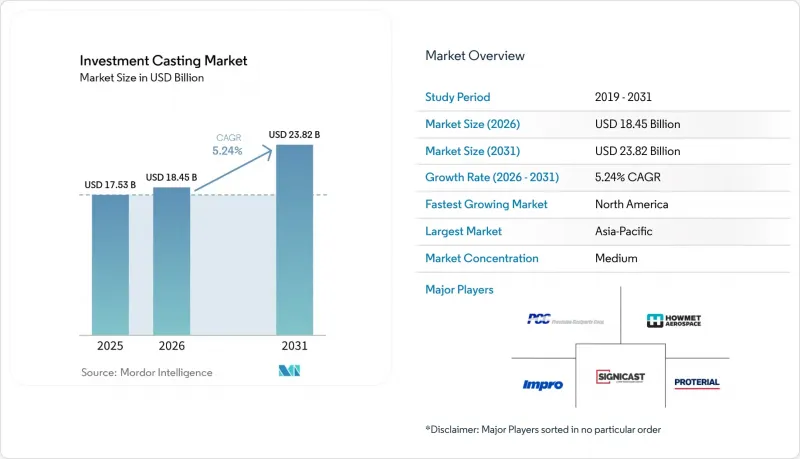
Mordor Intelligence에 의하면, 정밀 주조 시장 규모는 2025년에 175억 3,000만 달러로 평가되었고, 2026년에는 184억 5,000만 달러로 추정되고, 2031년까지 238억 2,000만 달러에 이를 것으로 예상되며, 2026-2031년 CAGR 5.24%를 기록할 전망입니다.
본 보고서는 공정 유형별(규산나트륨/워터글라스, 실리카졸/콜로이드 실리카 등), 소재별(탄소강 및 합금강, 스테인리스 스틸 등), 최종 사용자별(자동차, 항공우주 및 방위, 기타), 패턴 기술별(기존 왁스 패턴, 3D 프린팅/래피드 프로토타입 패턴), 부품 중량별 및 지역별로 분류되어 있습니다. 시장 예측은 금액(달러) 단위로 제시되어 있습니다.
세계의 정밀 주조 시장 동향 및 인사이트
민간 및 방위 항공 분야의 기체 현대화 프로그램
민간 및 군용 항공 분야는 여전히 정밀 주조 시장에 있어 가장 큰 구조적 수요 기반을 형성하고 있습니다. 기체 교체 프로그램은 고온 및 고응력 조건에서 성능이 요구되는 터빈 블레이드, 구조 노드 및 복잡한 날개 형상 부품에 대한 수요를 뒷받침하고 있습니다. 또한, OEM이 여러 날개형 부품을 단일 주조품으로 통합할 경우, 부품 수가 최대 60%까지 감소하고 동시에 조립의 복잡성도 줄어들기 때문에 정밀 주조 시장에도 이점이 있습니다. 이는 접합부 감소가 경량화로 이어지고, 검사를 간소화하며, 항공우주 분야 고객에게 공급망 내 이관 횟수를 줄여준다는 점에서 중요합니다. 방위 항공 분야는 추진 시스템 및 기타 중요한 플랫폼에서 고온 주조품이 여전히 필수적이기 때문에 추가적인 수요를 뒷받침하고 있습니다. 그 결과, 정밀 주조 시장에서 항공우주 분야는 기술적 진입 장벽, 인증 주기 및 프로그램의 장기화가 가장 견고한 수요 기반을 창출하는 부문으로 계속해서 자리매김하고 있습니다.
자동차 부품의 경량화 추진
자동차의 경량화는 정밀 주조 시장을 뒷받침하고 있지만, 수요가 모든 부품 범주에 고르게 분포되어 있는 것은 아닙니다. 동료 심사를 거친 연구에 따르면, 2019년 유럽 자동차에는 알루미늄이 대폭 채택되었으며, 2026년까지 그 비율이 증가할 것으로 예측됩니다. 주요 성형 기법으로서 주조가 주도적인 역할을 하고 있습니다. 그러나 정밀 주조 분야에서는 전기자동차 플랫폼이 기존 주조 부품의 사용을 일부 줄이고 있기 때문에 모든 구동계 부품에서 광범위한 성장이 예상되는 것은 아닙니다. 또 다른 동료 심사 연구에 따르면, 배터리 전기차(BEV)로 인해 구동계에서 알루미늄 주조의 비율은 감소하는 반면, 메가캐스팅이 차체 구조에서 점유율을 끌어올리고 있으며, 정밀 주조 수요를 구조상의 핵심 부위나 열 관리 부품으로 전환시키고 있다고 지적되고 있습니다. 본질적으로, 정밀 주조 시장이 활기를 띠는 것은 형상, 공차, 재료에 대한 요구 사항이 보다 단순한 성형 방법의 능력을 능가하는 경우입니다. 그 결과, 자동차 분야의 비즈니스 기회는 더욱 선별적으로 변하고 있으며, 범용 대량 생산품보다 EV용 모터 하우징, 서스펜션 부품, 터보차저 휠 및 열 관리 어셈블리가 중시되고 있습니다.
자본 집약적인 자동화 및 검사 설비
정밀 주조 시장은 자동화 및 첨단 검사 시스템의 비용 측면에서 명백한 장벽에 직면해 있습니다. 로봇을 이용한 쉘 이송, 열화상 진단, 산업용 감시 시스템, CT를 이용한 검사에는 막대한 초기 투자가 필요하며, 많은 중규모 주조소는 이를 쉽게 감당할 수 없습니다. 이는 중요한 문제입니다. 정밀 주조 시장이 더욱 엄격한 품질 관리로 전환되고 있는 반면, 항공우주 및 의료 분야의 고객들은 더 높은 추적성과 재현성을 요구하고 있기 때문입니다. 게다가 자격 인증 지연도 문제를 더욱 심각하게 만들고 있습니다. 항공우주 프로그램에서 자동화된 생산 라인이 고객의 승인을 받기까지 12-18개월이 소요되는 경우가 있어, 이로 인해 수익 창출이 지연되고 투자 회수 기간이 연장되기 때문입니다. 사모펀드의 지원을 받는 그룹이나 대규모 플랫폼은 이러한 비용을 여러 공장에 분산시킬 수 있지만, 소규모 독립 기업은 여전히 불리한 입장에 놓여 있습니다. 그 결과, 정밀 주조 시장은 고사양 분야에서 통합이 계속 진행될 가능성이 있습니다. 이는 현재 기술력뿐만 아니라 자본 집약도 역시 프로그램 진입을 좌우하는 요인이 되고 있기 때문입니다.
부문 분석
2025년, 실리카졸 공법은 정밀 주조 시장 점유율의 50.78%를 차지했으며, 고정밀 용도에서 다른 제조 공정보다 뚜렷한 우위를 유지했습니다. 이러한 우위는 표면 거칠기 Ra 1.6µm 미만 및 엄격한 치수 관리가 요구되는 항공우주, 의료, 에너지 분야의 부품과의 높은 적합성을 반영합니다. 실리카졸 쉘 시스템은 1,000°C를 초과하는 주형 소성 온도에서도 안정성을 유지하며, 워터글라스 시스템에서 볼 수 있는 슬러리 제한의 일부를 피할 수 있습니다. 정밀 주조 시장에서는 고객이 최저 단가보다 일관성, 우수한 표면 마감 및 추적 가능한 공정 관리를 우선시하는 경우, 이 제조 방식이 계속해서 지지를 받고 있습니다. 나트륨 실리케이트 공정은 마감 요건이 그리 엄격하지 않고, 극도의 정밀도보다는 처리량을 통한 경제성이 중시되는 산업기계, 농업 기계 및 기타 가격에 민감한 프로그램에서 여전히 수요가 있습니다.
또한, 정밀 주조 시장에서는 단순히 공정군 간의 전환에 그치지 않고, 실리카졸 화학 분야의 공정 개선도 나타나고 있습니다. 유기 강화 복합 실리카졸 계열 변형에 의해 슬러리의 보관 기간이 60일 이상으로 연장되고 표면 결함률도 대폭 감소함에 따라, 사용 가능한 생산량과 생산 일정 모두 개선되었습니다. 하이브리드 공정 및 기타 공정은 2031년까지 연평균 성장률(CAGR) 5.30%를 나타낼 것으로 예측되며, 이로 인해 이러한 공정은 정밀 주조 시장에서 가장 빠르게 성장하는 부문이 되었습니다. 이러한 변화의 중심에는 프린트 정밀 주조 쉘 공법이 있습니다. 이 방법을 통해 세라믹 주형을 직접 제작할 수 있게 되어, 왁스 모형 제작에 수반되는 제약 사항 중 일부가 해소되기 때문입니다. 이를 통해 기존에는 경쟁력 있는 비용으로 제조하기 어려웠던 형상의 생산이 가능해집니다. 향후 정밀 주조 시장에서 실리카졸은 규모 면에서 주도적인 위치를 유지할 것으로 예상되는 반면, 하이브리드 공법은 개발 업무, 난이도가 높은 형상, 그리고 고부가가치 틈새 생산 분야에서 확대될 것으로 전망됩니다.
스테인리스 스틸은 2025년에 32.98%의 점유율을 차지했으며, 정밀 주조 시장에서 가장 폭넓은 재료 기반을 유지하고 있습니다. 이는 확립된 단일 재료 계열로 펌프, 밸브, 의료기기, 식품 가공 장비, 산업용 하드웨어에 대응하고 있기 때문입니다. 316L 및 17-4PH와 같은 등급은 내식성, 적당한 내열성, 그리고 가공성의 균형이 요구되는 분야에서 계속해서 수요의 기반을 형성하고 있습니다. 탄소강 및 저합금강은 극도의 정밀도보다 부품의 경제성이 중시되는 중장비 및 광업 분야에서 여전히 실용적인 위치를 차지하고 있습니다. 알루미늄 및 마그네슘 합금은 특히 OEM이 경량화와 열전도성 향상을 요구하는 경량 자동차 부품 및 열 관리 부품 분야에서 그 중요성이 커지고 있습니다. 이러한 의미에서 정밀 주조 업계는 여전히 대량 생산에서 스테인리스 스틸에 의존하고 있지만, 부가가치 창출은 프리미엄 합금 시스템으로 빠르게 전환되고 있습니다.
초합금 시장 규모는 2031년까지 연평균 성장률(CAGR) 5.76%로 확대될 것으로 예측되며, 이는 정밀 주조 시장에서 가장 빠르게 성장하는 재료 범주가 될 것입니다. 니켈 기반 초합금은 현대 첨단 항공기 엔진의 총 재료 중량의 60% 이상을 차지하고 있으며, 이것이 터빈 용도가 장기적인 수요의 중심을 계속 유지하는 이유를 설명해 줍니다. 단결정 CMSX-4 터빈 블레이드 주조품은 ±0.02 mm 이내의 공차와 Ra < =1.2µm의 표면 거칠기를 달성할 수 있습니다. 이는 정밀 주조 시장이 경쟁 제조 공정으로는 요구 사항을 충족하기 어려운 용도로 얼마나 진출했는지를 입증합니다. 조사에 따르면, Rene 77 정밀 주조품은 오랜 크리프 수명을 거친 후에도 고온에서 높은 하중 지지 능력을 유지하고 있어, 차세대 항공 엔진에서 이 소재를 채택해야 할 근거를 더욱 확고히 하고 있습니다. 따라서 정밀 주조 시장의 가치 상한선은 단순히 주조량뿐만 아니라 합금의 성능에 점점 더 의존하게 되고 있습니다.
지역별 분석
2025년, 아시아태평양은 정밀 주조 시장 점유율의 43.97%를 차지했으며, 생산 및 수요 면에서 최대 지역 거점으로서의 위상을 유지했습니다. 이 지역은 중국의 거대한 주조 거점, 인도의 항공우주 등급 역량 향상, 그리고 자동차, 기계, 에너지 분야 수요를 뒷받침하는 광범위한 제조거점의 혜택을 받고 있습니다. 중국은 밀집된 공급업체 네트워크와 산업 및 운송 분야에서의 주조 부품에 대한 견고한 국내 소비를 모두 갖추고 있어, 계속해서 이 지역의 규모를 지탱하고 있습니다. 인도는 국제적인 품질 시스템과 완벽한 자재 추적성을 갖춘 공급 다각화를 추구하는 유럽 및 미국의 OEM 제조업체들에게 니어쇼어 거점으로 주목받고 있습니다. 일본과 한국도 고급공정제어(APC), 진공 주조 능력, 그리고 항공우주 및 고정밀 제조 프로그램과의 긴밀한 협력을 통해 이 지역의 위상을 뒷받침하고 있습니다.
북미는 2031년까지 연평균 성장률(CAGR) 5.36%를 나타낼 것으로 예측되며, 이에 따라 정밀 주조 시장에서 가장 빠르게 성장하는 지역 부문이 될 것입니다. 이 지역의 동향은 단순한 경기 회복이라기보다는 국내 정밀 제조, 자동화, 그리고 인증 획득 준비가 완료된 생산 능력에 대한 의도적인 재투자에 기인합니다. 미국 주조 협회(American Foundry Society)의 데이터는 2026년 초에 리쇼어링 활동의 활성화와 광범위한 설비 투자 계획이 이미 나타나고 있음을 보여 주며, 이러한 견해를 뒷받침하고 있습니다. FAA 인증 및 Nadcap 요건은 항공우주 용도에서 저비용 수입품이 신속하게 극복할 수 없는 장벽을 형성함으로써, 국내의 우량 공급업체를 더욱 강화하고 있습니다.
유럽은 2025년, 항공우주 산업의 기반, 정밀 공학 분야의 강점, 그리고 엄격한 공정 기준에 힘입어 중요한 위치를 차지했습니다. 또한, 항공우주, 방위, 산업용 가스터빈 분야의 고객들이 공급업체의 추적성, 바인더 규정 준수 및 환경 경영 시스템을 중시하고 있기 때문에 이 지역은 여전히 중요한 위치를 차지하고 있습니다. 2025년 11월 돈캐스터(Doncasters)사가 보훔에서 진행한 5,200만 달러 규모의 증설은 공급업체들이 여전히 유럽에서 항공우주 및 터빈용 주조 역량을 확대할 여지가 있다고 보고 있음을 보여줍니다. 또한, 이 지역의 각 제조업체들은 REACH 규정 요건과 ISO 14001 요건은 물론, 폐쇄형 왁스 회수 및 보다 깨끗한 쉘 시스템에 대한 광범위한 압력에도 대응하고 있습니다. 남미, 중동 및 아프리카는 여전히 규모가 작지만, 브라질의 항공우주 MRO 활동, 사우디아라비아의 에너지 투자, 튀르키예의 방위 프로그램으로 인해 정밀 주조 시장에서 국지적인 수요가 지속적으로 창출되고 있습니다.
기타 혜택 :
- 엑셀 형식 시장 예측(ME) 시트
- 3개월간의 애널리스트 지원
자주 묻는 질문
목차
제1장 서론
제2장 조사 방법
제3장 주요 요약
제4장 시장 구도
제5장 시장 규모 및 성장 예측
제6장 경쟁 구도
제7장 시장 기회 및 향후 전망
AJY 26.09.09According to Mordor Intelligence, the investment casting market size was valued at USD 17.53 billion in 2025 and is expected to reach USD 18.45 billion in 2026 and USD 23.82 billion by 2031, growing at a CAGR of 5.24% over 2026-2031.
This report is Segmented by Process Type (Sodium-Silicate/Water Glass, Silica-Sol / Colloidal Silica, and More), Material (Carbon and Alloy Steel, Stainless Steel, and More), End-User (Automotive, Aerospace and Defense, and More), Pattern Technology (Conventional Wax Patterns, 3D-Printed / Rapid Prototype Patterns), Component Weight, and Geography. Market Forecasts are Provided in Value (USD).
Global Investment Casting Market Trends and Insights
Fleet-Renewal Programs in Commercial and Defense Aviation
Commercial and military aviation continues to be the largest structural demand base for the investment casting market. Fleet renewal programs support demand for turbine blades, structural nodes, and complex airfoil parts that must perform under high heat and stress. The investment casting market also benefits when OEMs consolidate multiple aerofoil parts into a single casting, because part count can fall by up to 60% and assembly complexity declines at the same time. This matters because fewer joints improve weight, simplify inspection, and reduce supply chain handoffs for aerospace customers. Defense aviation adds another layer of support because high-temperature castings remain essential in propulsion systems and other critical platforms. As a result, the investment casting market continues to see aerospace as the segment where technical entry barriers, qualification cycles, and long program lives create the most durable demand base.
Lightweighting Push in Automotive Components
While automotive lightweighting bolsters the investment casting market, demand isn't uniformly spreading across all part categories. A peer-reviewed study highlighted that in 2019, European vehicles saw significant aluminum content, projected to increase by 2026, with casting leading as the dominant forming route. However, in the investment casting realm, this doesn't spell widespread growth for every drivetrain component, as electric platforms curtail some traditional cast content. Another peer-reviewed study pointed out that while battery electric vehicles reduce cast aluminum in drivetrains, mega-casting boosts the share in body structures and shifts precision casting demand towards structural nodes and thermal management components. Essentially, the investment casting market thrives where geometry, tolerance, and material demands outstrip simpler forming methods. Consequently, automotive opportunities have become more discerning, favoring EV motor housings, suspension parts, turbocharger wheels, and heat-management assemblies over generic commodity volumes.
Capital-Intensive Automation and Inspection Equipment
The investment casting market faces a clear barrier in the cost of automation and advanced inspection systems. Robotic shell handling, thermal imaging, industrial monitoring systems, and CT-based inspection demand large upfront spending that many mid-sized foundries cannot absorb easily. This matters because the investment casting market is moving toward tighter quality control at the same time that aerospace and medical customers expect more traceability and repeatability. Qualification lag adds to the challenge, since automated process lines can take 12 to 18 months to clear customer approval in aerospace programs, which delays revenue and extends payback periods. Private equity-backed groups and larger platforms can spread this cost over multiple plants, but smaller independents remain at a disadvantage. The result is that the investment casting market may keep consolidating at the high-specification end because capital intensity now affects access to programs as much as technical skill does.
Other drivers and restraints analyzed in the detailed report include:
- Shift to Hydrogen and E-Fuel Turbines Needing Complex Hot-Section Parts
- Supply-Chain Re-Localization Incentives in U.S./EU Foundry Sectors
- Volatility in Nickel and Refractory Ceramic Prices
For complete list of drivers and restraints, kindly check the Table Of Contents.
Segment Analysis
Silica-sol held 50.78% of the investment casting market share in 2025, which kept it clearly ahead of other process routes in high-precision applications. This lead reflects its strong fit with aerospace, medical, and energy parts that require surface roughness below Ra 1.6 µm and tight dimensional control. Silica-sol shell systems remain more stable at mold firing temperatures above 1,000°C, and they avoid some of the slurry limitations seen in water-glass systems . The investment casting market continues to favor this route where customers prioritize consistency, better surface finish, and traceable process control over minimum unit cost. Sodium-silicate processes still retain demand in industrial machinery, agricultural equipment, and other price-sensitive programs where finish requirements are less demanding and throughput economics matter more than extreme precision.
The investment casting market is also seeing process improvement in silica-sol chemistry, rather than only a shift between process families. Organically enhanced composite silica-sol variants now extend slurry shelf life beyond 60 days and reduce surface defect rates significantly, which improves both usable output and production scheduling. Hybrid and other processes are forecast to grow at 5.30% CAGR through 2031, which makes them the fastest-growing process category in the investment casting market. Printed Investment Casting Shell methods are central to that shift because they allow direct ceramic mold creation and remove some of the limits tied to wax pattern preparation. This opens room for geometries that were previously difficult to produce at a competitive cost. Over time, the investment casting market is likely to keep silica-sol as the scale leader while hybrid methods expand in development work, difficult geometries, and high-value niche production.
Stainless steel held 32.98% share in 2025 and remained the broadest material base in the investment casting market because it serves pumps, valves, medical tools, food-processing equipment, and industrial hardware with one established material family. Grades such as 316L and 17-4PH continue to anchor demand where corrosion resistance, moderate heat performance, and machinability must be balanced. Carbon steel and low-alloy steel still hold a practical position in heavy equipment and mining applications where part economics matter more than extreme precision. Aluminum and magnesium alloys are gaining relevance in lighter automotive and thermal management parts, especially where OEMs want lower weight and improved heat transfer. In that sense, the investment casting industry still depends on stainless steel for broad volume, but value creation is moving more quickly into premium alloy systems.
Superalloys are projected to grow at 5.76% CAGR through 2031, which makes them the fastest-growing material class in the investment casting market. Nickel-based superalloys already account for more than 60% of total material weight in modern advanced aircraft engines, which explains why turbine applications remain central to long-term demand. Single-crystal CMSX-4 turbine blade castings can achieve tolerances within +-0.02 mm and surface finish at Ra <= 1.2 µm, which confirms how far the investment casting market has moved into applications that competing processes struggle to qualify. Research showed that Rene 77 investment castings sustained significant load-bearing capacity at high temperatures even after years of creep life, reinforcing the material case for next-generation aero engines. This is why the value ceiling in the investment casting market increasingly depends on alloy capability, not just casting volume.
Complete Report Scope:
- By Process Type
- Sodium-Silicate / Water Glass
- Silica-Sol / Colloidal Silica
- Hybrid and Other Processes
- By Material
- Carbon and Alloy Steel
- Stainless Steel
- Aluminum and Magnesium Alloys
- Super-alloys (Ni, Co)
- Others
- By End-User
- Automotive
- Aerospace and Defense
- Industrial Machinery
- Energy and Power
- Medical and Dental
- Others
- By Pattern Technology
- Conventional Wax Patterns
- 3D-Printed / Rapid Prototype Patterns
- By Component Weight
- Up to 1 kg
- 1-10 kg
- Above 10 kg
- By Geography
- North America
- United States
- Canada
- Rest of North America
- South America
- Brazil
- Argentina
- Rest of South America
- Europe
- Germany
- United Kingdom
- France
- Spain
- Russia
- Rest of Europe
- Asia-Pacific
- China
- India
- Japan
- South Korea
- Rest of Asia-Pacific
- Middle East and Africa
- Saudi Arabia
- United Arab Emirates
- Egypt
- Turkey
- South Africa
- Rest of Middle East and Africa
- North America
Geography Analysis
Asia-Pacific accounted for 43.97% of the investment casting market share in 2025, which kept it as the largest regional base for production and demand. The region benefits from China's large foundry base, India's rising aerospace-grade capability, and the broad manufacturing depth that supports automotive, machinery, and energy demand. China continues to anchor the regional scale because it combines dense supplier networks with strong domestic consumption of cast components in industrial and transport applications. India is gaining attention as a nearshore option for Western OEMs that want supply diversification with international quality systems and full material traceability. Japan and South Korea also support the regional position through advanced process control, vacuum casting capability, and close links to aerospace and high-precision manufacturing programs.
North America is projected to grow at 5.36% CAGR through 2031, which makes it the fastest-growing regional segment in the investment casting market. The regional story is less about simple recovery and more about deliberate reinvestment in domestic precision manufacturing, automation, and qualification-ready capacity. American Foundry Society data already showed stronger reshoring activity and broad capital spending plans in early 2026, which supports this view. FAA certification and Nadcap requirements further strengthen premium domestic suppliers because they create barriers that low-cost imports cannot overcome quickly in aerospace applications.
Europe held a significant position in 2025, supported by its aerospace base, precision engineering strengths, and strict process standards. The region also remains important because customers in aerospace, defense, and industrial gas turbines value supplier traceability, binder compliance, and environmental management systems. Doncasters' USD 52 million expansion at Bochum in November 2025 showed that suppliers still see room for new aerospace and turbine casting capacity in Europe. Producers across the region are also adapting to REACH requirements, ISO 14001 expectations, and broader pressure for closed-loop wax recovery and cleaner shell systems. South America, the Middle East, and Africa remain smaller in scale, but Brazil's aerospace MRO activity, Saudi Arabia's energy investments, and Turkey's defense programs continue to create localized demand pockets for the investment casting market.
- Precision Castparts Corp.
- Howmet Aerospace Inc.
- Impro Precision Industries
- Signicast (Form Technologies)
- MetalTek International
- Milwaukee Precision Casting
- Zollern GmbH & Co. KG
- Georg Fischer Ltd
- CIREX Holding B.V.
- Dongying Giayoung Precision Metal Co. Ltd.
- Taizhou Xinyu Precision Manufacture Co., Ltd.
- Proterial, Ltd.
- Texmo Precision Castings
- RLM Industries Inc.
- Arconic Inc.
- Thompson Investment Casting
- Barron Industries
- Aero Metals Inc.
Additional Benefits:
- The market estimate (ME) sheet in Excel format
- 3 months of analyst support
TABLE OF CONTENTS
1 Introduction
- 1.1 Study Assumptions & Market Definition
- 1.2 Scope of the Study
2 Research Methodology
3 Executive Summary
4 Market Landscape
- 4.1 Market Overview
- 4.2 Market Drivers
- 4.2.1 Fleet-Renewal Programs in Commercial and Defense Aviation
- 4.2.2 Lightweighting Push in Automotive Components
- 4.2.3 Shift to Hydrogen and E-Fuel Turbines Needing Complex Hot-Section Parts
- 4.2.4 Supply-Chain Re-Localization Incentives in U.S./EU Foundry Sectors
- 4.2.5 Near-Net-Shape Casting Lowers Machining Scrap and Energy Costs
- 4.2.6 Rapid Prototyping Boosts Low-Volume Precision Casting Demand
- 4.3 Market Restraints
- 4.3.1 Capital-Intensive Automation and Inspection Equipment
- 4.3.2 Volatility in Nickel and Refractory Ceramic Prices
- 4.3.3 Shortage of Metallurgical Talent for Super-Alloy Casting
- 4.3.4 Strict Environmental Norms on Foundry Emissions and Waste Wax
- 4.4 Value / Supply-Chain Analysis
- 4.5 Regulatory Landscape
- 4.6 Technological Outlook
- 4.7 Porter's Five Forces
- 4.7.1 Threat of New Entrants
- 4.7.2 Bargaining Power of Buyers
- 4.7.3 Bargaining Power of Suppliers
- 4.7.4 Threat of Substitute Products
- 4.7.5 Intensity of Competitive Rivalry
5 Market Size & Growth Forecasts (Value (USD))
- 5.1 By Process Type
- 5.1.1 Sodium-Silicate / Water Glass
- 5.1.2 Silica-Sol / Colloidal Silica
- 5.1.3 Hybrid and Other Processes
- 5.2 By Material
- 5.2.1 Carbon and Alloy Steel
- 5.2.2 Stainless Steel
- 5.2.3 Aluminum and Magnesium Alloys
- 5.2.4 Super-alloys (Ni, Co)
- 5.2.5 Others
- 5.3 By End-User
- 5.3.1 Automotive
- 5.3.2 Aerospace and Defense
- 5.3.3 Industrial Machinery
- 5.3.4 Energy and Power
- 5.3.5 Medical and Dental
- 5.3.6 Others
- 5.4 By Pattern Technology
- 5.4.1 Conventional Wax Patterns
- 5.4.2 3D-Printed / Rapid Prototype Patterns
- 5.5 By Component Weight
- 5.5.1 Up to 1 kg
- 5.5.2 1-10 kg
- 5.5.3 Above 10 kg
- 5.6 By Geography
- 5.6.1 North America
- 5.6.1.1 United States
- 5.6.1.2 Canada
- 5.6.1.3 Rest of North America
- 5.6.2 South America
- 5.6.2.1 Brazil
- 5.6.2.2 Argentina
- 5.6.2.3 Rest of South America
- 5.6.3 Europe
- 5.6.3.1 Germany
- 5.6.3.2 United Kingdom
- 5.6.3.3 France
- 5.6.3.4 Spain
- 5.6.3.5 Russia
- 5.6.3.6 Rest of Europe
- 5.6.4 Asia-Pacific
- 5.6.4.1 China
- 5.6.4.2 India
- 5.6.4.3 Japan
- 5.6.4.4 South Korea
- 5.6.4.5 Rest of Asia-Pacific
- 5.6.5 Middle East and Africa
- 5.6.5.1 Saudi Arabia
- 5.6.5.2 United Arab Emirates
- 5.6.5.3 Egypt
- 5.6.5.4 Turkey
- 5.6.5.5 South Africa
- 5.6.5.6 Rest of Middle East and Africa
- 5.6.1 North America
6 Competitive Landscape
- 6.1 Market Concentration
- 6.2 Strategic Moves
- 6.3 Market Share Analysis
- 6.4 Company Profiles (includes Global Level Overview, Market Level Overview, Core Segments, Financials as Available, Strategic Information, Market Rank/Share for Key Companies, Products and Services, SWOT Analysis, and Recent Developments)
- 6.4.1 Precision Castparts Corp.
- 6.4.2 Howmet Aerospace Inc.
- 6.4.3 Impro Precision Industries
- 6.4.4 Signicast (Form Technologies)
- 6.4.5 MetalTek International
- 6.4.6 Milwaukee Precision Casting
- 6.4.7 Zollern GmbH & Co. KG
- 6.4.8 Georg Fischer Ltd
- 6.4.9 CIREX Holding B.V.
- 6.4.10 Dongying Giayoung Precision Metal Co. Ltd.
- 6.4.11 Taizhou Xinyu Precision Manufacture Co., Ltd.
- 6.4.12 Proterial, Ltd.
- 6.4.13 Texmo Precision Castings
- 6.4.14 RLM Industries Inc.
- 6.4.15 Arconic Inc.
- 6.4.16 Thompson Investment Casting
- 6.4.17 Barron Industries
- 6.4.18 Aero Metals Inc.