

|
시장보고서
상품코드
2124196
폴리머 코팅 패브릭 시장 : 시장 점유율 분석, 업계 동향 및 통계, 성장 예측(2026-2031년)Polymer Coated Fabric - Market Share Analysis, Industry Trends & Statistics, Growth Forecasts (2026 - 2031) |
||||||
 Mordor Intelligence
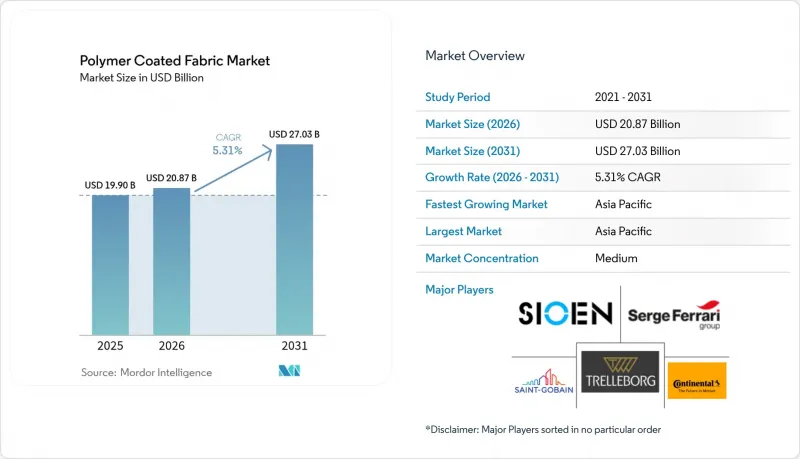
Mordor Intelligence에 의하면, 폴리머 코팅 패브릭 시장 규모는 2025년 199억 달러로 평가되었고, 2026년에는 208억 7,000만 달러로 추정되고, 2031년까지 270억 3,000만 달러에 달할 것으로 예측됩니다.
2026-2031년 연평균 성장률(CAGR) 5.31%를 기록할 전망입니다.
본 보고서는 제품 유형별(폴리염화비닐, 폴리우레탄, 폴리에틸렌, 실리콘, 기타), 용도별(운송, 산업용 장비 커버, 지붕·차양, 보호복, 가구, 스포츠 및 레저, 기타), 지역별(북미, 남미, 유럽, 아시아태평양, 중동 및 아프리카)로 분류되어 있습니다. 시장 전망은 금액(달러) 기준으로 제시되어 있습니다.
세계의 폴리머 코팅 패브릭 시장 동향 및 인사이트
경량 및 지속 가능한 내장재에 대한 수요
각 자동차 제조업체들은 기존의 비닐이나 가죽 대신, 도어 패널 및 시트 커버의 무게를 최대 15% 경감시키는 폴리우레탄 코팅 패브릭로 전환하고 있습니다. 이러한 움직임은 2026년까지 갤런당 49마일을 달성하겠다는 미국의 CAFE 목표에 부합하는 것입니다. 수성 폴리우레탄 시스템은 N-메틸-2-피롤리돈을 배제하고 휘발성 유기 화합물(VOC) 배출을 95% 감축함으로써 ISO 12219-1 차량 실내 공기 기준을 준수할 수 있게 합니다. 유럽의 자동차 제조업체들은 폐식용유나 피마자유에서 추출한 바이오 유래 폴리올의 채택을 확대하고 있으며, 인장 강도를 25 MPa 이상으로 유지하면서 재생 가능 탄소 함유율을 20-30%로 높이고 있습니다. 각 가구 제조업체들은 캘리포니아주 제안 65(Proposition 65)의 공개 규정 및 유럽연합(EU)의 가구 및 인테리어 제품에 관한 난연성 규제를 충족하기 위해 유사한 화학 기술을 도입하고 있습니다. 사용 후 시트 커버에서 폴리에스터 스크림을 회수하는 폐쇄형 재활용 라인이 등장했으며, 이를 통해 버진 섬유 사용량을 최대 40%까지 줄여 순환 경제 목표를 뒷받침하고 있습니다.
기후 변화에 강한 인장 구조가 유행
PTFE 코팅된 유리나 PVC 코팅된 폴리에스터 막은 시속 200km를 넘는 풍하중을 견디며 찢어지지 않기 때문에 사이클론이 빈번하게 발생하는 지역의 경기장 지붕, 공항 로비, 야외 캐노피 설계에서 주류를 이루고 있습니다. 유럽연합(EU) 공동연구센터(JRC)의 현장 조사에 따르면, 카타르 연안 지역에 설치된 PTFE 막이 15년이 지난 후에도 초기 인장 강도의 98%를 유지하고 있는 것으로 확인되어, 8년도 채 되지 않아 부식된 금속 클래딩을 능가하는 성능을 보여주었습니다. 자가 세정 기능을 갖춘 이산화티타늄계 탑코트는 광촉매 작용을 통해 유기 오염 물질을 분해함으로써 유지 관리 비용을 30% 절감합니다. 사우디아라비아는 2028년까지 리야드와 제다에 그늘이 있는 보도를 조성하기 위해 21억 달러를 예산으로 편성했으며, 국가 적응 계획에 패브릭 구조물을 포함시켰습니다. 이와 유사한 솔루션은 사하라 이남 아프리카의 인프라 프로젝트에서도 주목을 받고 있으며, 이동식 막 구조는 고정식 콘크리트 쉘터에 비해 50%의 비용 우위를 제공합니다.
원유 유래 폴리머의 가격 변동
2025년 한 해 동안 브렌트유 가격은 배럴당 평균 70-90달러를 기록하며, PVC 가격의 60-70%를 차지하는 에틸렌 및 프로파일렌의 원자재 비용을 상승시켰습니다. 분기별 공급 계약을 체결했던 유럽의 중견 컨버터 각사는 2025년 2분기 현물 가격이 12% 급등했을 때 이익률 압박을 겪었고, 시장이 정상화될 때까지 3주 동안 생산 중단을 감수해야 했습니다. MDI 등 폴리우레탄 원료도 유사한 추세를 보이고 있습니다. 이는 벤젠 가격이 원유 가격에 3개월의 시차를 두고 연동되기 때문입니다. 일부 아시아 가공업체들은 공급량과 가격을 확보하기 위해 폴리올 공장의 소수 지분을 취득하고 있지만, 소규모 기업들은 완제품 가치의 8-10%로 이익이 제한되는 위탁 코팅 모델에 의존할 수밖에 없습니다. 따라서 수직 통합은 원자재 가격 변동에 대한 중요한 헤지 수단이 되고 있습니다.
부문별 분석
2025년, 폴리염화비닐(PVC)은 폴리우레탄보다 30-40% 저렴한 수지 가격과 추가 첨가제 없이도 NFPA 701 규격을 충족하는 내재적 난연성 덕분에 폴리머 코팅 패브릭 시장 매출의 42.15%를 차지했습니다. 수성 폴리우레탄은 2031년까지 연평균 성장률(CAGR) 6.12%라는 가장 빠른 속도로 시장 점유율을 확대되고 있습니다. 이는 자동차 및 가구 OEM 제조업체들이 사우스 코스트 대기질 관리국(AQMD) 규정 1168에 명시된 휘발성 유기 화합물(VOC) 제한치를 충족하는 부드러운 촉감의 표면을 요구하고 있기 때문입니다. 또한, 이러한 화학 기술을 통해 컨버터는 플랜트 설비 투자액의 15%에 해당하는 증기 회수 설비에 대한 투자를 피할 수 있습니다.
폴리에틸렌계 코팅은 농업용 사일리지 커버 등 화학적 비활성이 요구되는 틈새 시장을 충족시킵니다. 한편, 실리콘계 시스템은 250°C 이상에서도 안정성을 유지하기 때문에 배기 단열 블랭킷 등 고온 용도에서 주류를 이루고 있습니다. 불소 수지 분산액과 바이오 폴리에스테르는 ‘기타’ 범주에 분류되며, 각각 매우 높은 내화학성이나 ‘요람에서 무덤까지’ 인증과 같은 특수한 수요를 충족시키고 있습니다. 과거 데이터에 따르면, 이 제품 유형 시장 규모는 2020-2025년 연평균 약 4.8% 성장했으나, 자동차 생산 회복 및 유틸리티 지출 재개에 따라 그 성장세는 가속화되고 있습니다. ISO 14001 인증에 30%의 가중치를 부여하는 유럽의 엄격한 공공 조달 규정에 따라, 재활용 경로가 문서화된 폴리우레탄 솔루션으로의 고객 전환이 지속적으로 촉진되고 있습니다.
지역별 분석
아시아태평양은 2025년에 46.42%의 점유율로 폴리머 코팅 패브릭 시장을 독점했으며, 2031년까지 연평균 성장률(CAGR) 5.98%를 유지할 것으로 예측됩니다. 중국만 해도 2025년에 2,700만 대의 자동차를 생산할 예정이며, 장쑤성과 절강성에 집중된 연간 80만 톤 이상의 코팅 패브릭 생산 능력을 보유하고 있습니다. 이 지역에서는 원자재의 근접성으로 인해 물류 비용이 최대 15% 절감되고 있습니다. 인도의 국가 인프라 계획에는 2030년까지 1조 4,000억 달러가 배정되어 있어, 국내 수요 촉진에 더해 중동 및 아프리카로의 수출 확대도 촉진하고 있습니다.
2025년에는 북미가 큰 시장 점유율을 차지했습니다. 자동차 시트에는 18만 톤의 폴리우레탄 코팅 패브릭이 사용되었으며, 2026년까지 연방 정부의 1,100억 달러 인프라 지출이 지오텍스타일 및 임시 대피소에서의 채택을 뒷받침하고 있습니다. 유럽 시장의 성장은 ‘유럽 그린딜’의 운송 부문 배출량 55% 감축 목표에 따른 경량화 요건에 힘입고 있으며, 각 OEM 업체들은 탄소 발자국이 인증된 폴리우레탄 솔루션의 도입을 서두르고 있습니다.
남미, 중동 및 아프리카에서는 폴리머 코팅 패브릭에 대한 수요가 현저히 증가하고 있습니다. 브라질 농업 분야의 사일리지 커버 수요와 걸프협력회의(GCC)의 건설 프로젝트(특히 경기장 지붕 및 교통 허브)가 주요 성장 요인으로 작용하고 있습니다. 팬데믹으로 인한 혼란 기간 동안 지리적 확장은 정체되었으나, 공급망 정상화와 인프라 프로젝트 재개에 힘입어 2031년까지의 세계 성장률은 5.31%로 전망됩니다.
기타 혜택 :
- 엑셀 형식 시장 예측(ME) 시트
- 3개월간의 애널리스트 지원
자주 묻는 질문
목차
제1장 서론
제2장 조사 방법
제3장 주요 요약
제4장 시장 구도
제5장 시장 규모 및 성장 예측
제6장 경쟁 구도
제7장 시장 기회 및 향후 전망
AJY 26.09.09According to Mordor Intelligence, the polymer coated fabric market size is projected to grow from USD 19.90 billion in 2025 to USD 20.87 billion in 2026, and reach USD 27.03 billion by 2031, growing at a CAGR of 5.31% from 2026 to 2031.
This report is Segmented by Product Type (Polyvinyl Chloride, Polyurethane, Polyethylene, Silicone, and Others), Application (Transportation, Industrial Equipment Covers, Roofing and Awning, Protective Clothing, Furniture, Sports and Leisure, and Others), and Geography (North America, South America, Europe, Asia-Pacific, and Middle East and Africa). Market Forecasts are Provided in Terms of Value (USD).
Global Polymer Coated Fabric Market Trends and Insights
Lightweight and Sustainable Interior Materials Demand
Automotive OEMs are replacing traditional vinyl and leather with polyurethane-coated textiles that lower door-panel and seat-cover weight by up to 15%, a shift aligned with U.S. CAFE targets of 49 miles per gallon by 2026. Water-based polyurethane systems remove N-methyl-2-pyrrolidone, cutting volatile-organic-compound emissions by 95% and enabling compliance with ISO 12219-1 cabin-air standards. European automakers increasingly specify bio-attributed polyols sourced from waste cooking oil or castor beans, achieving 20-30% renewable-carbon content while maintaining tensile strengths above 25 MPa. Furniture manufacturers are adopting analogous chemistries to satisfy California Proposition 65 disclosure rules and the European Union Furniture and Furnishings regulations on flame retardancy. Closed-loop recycling lines that reclaim polyester scrim from end-of-life seat covers are emerging, lowering virgin-fiber use by up to 40% and reinforcing circular-economy goals.
Climate-Resilient Tensile Structures Boom
PTFE-coated glass and PVC-coated polyester membranes now headline designs for stadium roofs, airport halls, and outdoor canopies in cyclone-prone regions because they resist wind loads above 200 km/h without tearing. A Joint Research Centre field study confirmed that PTFE membranes in coastal Qatar retained 98% of initial tensile strength after 15 years, outperforming metallic cladding that corroded in fewer than eight. Self-cleaning titanium-dioxide topcoats slash maintenance costs by 30% through photocatalytic degradation of organic dirt. Saudi Arabia has earmarked USD 2.1 billion for shaded walkways in Riyadh and Jeddah by 2028, embedding fabric structures in national adaptation plans. Similar solutions are gaining traction in sub-Saharan infrastructure projects where relocatable membranes deliver a 50% cost advantage over fixed concrete shelters.
Crude-Derived Polymer Price Volatility
Brent crude averaged USD 70-90 per barrel through 2025, lifting ethylene and propylene feedstock costs that make up 60-70% of PVC pricing. Mid-sized European converters locked into quarterly supply contracts saw margin squeeze when Q2 2025 spot prices jumped 12%, forcing three-week production stoppages until markets normalized. Polyurethane raw-material inputs such as MDI follow similar trends because benzene prices track oil with a three-month lag. Some Asian converters have acquired minority stakes in polyol plants to secure volumes and pricing, while smaller firms resort to toll-coating models that cap profit potential at 8-10% of finished-fabric value. Vertical integration is therefore becoming a critical hedge against raw-material swings.
Other drivers and restraints analyzed in the detailed report include:
- Antimicrobial Healthcare Furnishings Adoption
- Sensor-Embedded Smart Fabrics Integration
- Environmental Scrutiny of PVC and Phthalates
For complete list of drivers and restraints, kindly check the Table Of Contents.
Segment Analysis
PVC accounted for 42.15% of polymer polymer-coated fabrics market revenue in 2025, owing to resin prices that run 30-40% below polyurethane and built-in flame retardancy that satisfies NFPA 701 without extra additives. Water-based polyurethane is capturing share fastest at a 6.12% CAGR to 2031 because automotive and furniture OEMs demand soft-touch surfaces that meet South Coast AQMD Rule 1168 limits on volatile organic compounds. These chemistries also help converters sidestep vapor-recovery investments equal to 15% of plant capital.
Polyethylene coatings cater to chemical-inertness niches such as agricultural silage covers, while silicone systems dominate high-temperature uses like exhaust-insulation blankets because they remain stable above 250 °C. Fluoropolymer dispersions and bio-based polyesters populate the "Others" category, each serving specialty demand for extreme chemical resistance or cradle-to-grave certification. Historical data show the product-type hierarchy grew at roughly 4.8% per year from 2020-2025, but momentum is accelerating as auto production rebounds and public-works spending returns. Stricter European public-procurement rules that grant 30% weighting to ISO 14001 certification continue to nudge customers toward polyurethane solutions with documented recycling pathways.
Complete Report Scope:
- By Product Type
- Polyvinyl Chloride (PVC)
- Polyurethane (PU)
- Polyethylene
- Silicone
- Others
- By Application
- Transportation
- Industrial Equipment Covers
- Roofing and Awning
- Protective Clothing
- Furniture
- Sports and Leisure
- Others
- By Geography
- Asia-Pacific
- China
- India
- Japan
- South Korea
- Rest of Asia-Pacific
- North America
- United States
- Canada
- Mexico
- Europe
- Germany
- United Kingdom
- France
- Italy
- Rest of Europe
- South America
- Brazil
- Argentina
- Rest of South America
- Middle East and Africa
- Saudi Arabia
- South Africa
- Rest of Middle East and Africa
- Asia-Pacific
Geography Analysis
Asia-Pacific dominated the polymer coated fabrics market with a 46.42% share in 2025 and is projected to maintain a 5.98% CAGR through 2031. China alone produced 27 million motor vehicles in 2025 and hosts more than 800,000 tons/year of coated-fabric capacity concentrated in Jiangsu and Zhejiang, where feedstock proximity lowers logistics overhead by up to 15% . India's National Infrastructure Pipeline earmarks USD 1.4 trillion through 2030, stimulating domestic demand and export growth to the Middle East and Africa.
North America accounted for a significant market share in 2025. Automotive seating absorbed 180,000 tons of polyurethane coated fabric, and federal infrastructure spending of USD 110 billion through 2026 is spurring uptake in geotextiles and temporary shelters. Europe's market growth is driven by lightweight requirements under the 55% transport-emission-reduction goal in the European Green Deal, pushing OEMs toward polyurethane solutions with certified carbon footprints.
South America plus the Middle East and Africa are witnessing a considerable rise in demand for polymer coated fabrics. Brazil's farm-sector demand for silage covers and the Gulf Cooperation Council's construction pipeline-particularly stadium roofs and transit hubs-are the main growth drivers. Historically, geographic expansion lagged during pandemic disruptions, but normalization of supply chains and resumption of infrastructure projects underpin the 5.31% global forecast growth rate to 2031.
- Continental AG
- Freudenberg Performance Materials Holding GmbH
- Heytex Gruppe
- OMNOVA North America Inc.
- MICHELIN
- Saint-Gobain
- Seaman Corporation
- Serge Ferrari Group
- Sioen Industries NV
- SPRADLING INTERNATIONAL GmbH
- SRF Limited
- Trelleborg AB
Additional Benefits:
- The market estimate (ME) sheet in Excel format
- 3 months of analyst support
TABLE OF CONTENTS
1 Introduction
- 1.1 Study Assumptions and Market Definition
- 1.2 Scope of the Study
2 Research Methodology
3 Executive Summary
4 Market Landscape
- 4.1 Market Overview
- 4.2 Market Drivers
- 4.2.1 Lightweight and Sustainable Interior Materials Demand
- 4.2.2 Climate-Resilient Tensile Structures Boom
- 4.2.3 Antimicrobial Healthcare Furnishings Adoption
- 4.2.4 Sensor-Embedded Smart Fabrics Integration
- 4.2.5 Flexible PV Back-Sheet Fabrics Investments
- 4.3 Market Restraints
- 4.3.1 Crude-Derived Polymer Price Volatility
- 4.3.2 Environmental Scrutiny of PVC and Phthalates
- 4.3.3 Micro-plastic Release Regulations Tighten
- 4.4 Value Chain Analysis
- 4.5 Porter's Five Forces
- 4.5.1 Threat of New Entrants
- 4.5.2 Bargaining Power of Buyers
- 4.5.3 Bargaining Power of Suppliers
- 4.5.4 Threat of Substitutes
- 4.5.5 Degree of Competition
5 Market Size and Growth Forecasts (Value)
- 5.1 By Product Type
- 5.1.1 Polyvinyl Chloride (PVC)
- 5.1.2 Polyurethane (PU)
- 5.1.3 Polyethylene
- 5.1.4 Silicone
- 5.1.5 Others
- 5.2 By Application
- 5.2.1 Transportation
- 5.2.2 Industrial Equipment Covers
- 5.2.3 Roofing and Awning
- 5.2.4 Protective Clothing
- 5.2.5 Furniture
- 5.2.6 Sports and Leisure
- 5.2.7 Others
- 5.3 By Geography
- 5.3.1 Asia-Pacific
- 5.3.1.1 China
- 5.3.1.2 India
- 5.3.1.3 Japan
- 5.3.1.4 South Korea
- 5.3.1.5 Rest of Asia-Pacific
- 5.3.2 North America
- 5.3.2.1 United States
- 5.3.2.2 Canada
- 5.3.2.3 Mexico
- 5.3.3 Europe
- 5.3.3.1 Germany
- 5.3.3.2 United Kingdom
- 5.3.3.3 France
- 5.3.3.4 Italy
- 5.3.3.5 Rest of Europe
- 5.3.4 South America
- 5.3.4.1 Brazil
- 5.3.4.2 Argentina
- 5.3.4.3 Rest of South America
- 5.3.5 Middle East and Africa
- 5.3.5.1 Saudi Arabia
- 5.3.5.2 South Africa
- 5.3.5.3 Rest of Middle East and Africa
- 5.3.1 Asia-Pacific
6 Competitive Landscape
- 6.1 Market Concentration
- 6.2 Strategic Moves
- 6.3 Market Share (%)/Ranking Analysis
- 6.4 Company Profiles (includes Global level Overview, Market level overview, Core Segments, Financials as available, Strategic Information, Products and Services, Recent Developments)
- 6.4.1 Continental AG
- 6.4.2 Freudenberg Performance Materials Holding GmbH
- 6.4.3 Heytex Gruppe
- 6.4.4 OMNOVA North America Inc.
- 6.4.5 MICHELIN
- 6.4.6 Saint-Gobain
- 6.4.7 Seaman Corporation
- 6.4.8 Serge Ferrari Group
- 6.4.9 Sioen Industries NV
- 6.4.10 SPRADLING INTERNATIONAL GmbH
- 6.4.11 SRF Limited
- 6.4.12 Trelleborg AB
7 Market Opportunities and Future Outlook
- 7.1 White-Space and Unmet-Need Assessment


