|
시장보고서
상품코드
2124200
럭셔리 요트 시장 : 시장 점유율 분석, 업계 동향 및 통계, 성장 예측(2026-2031년)Luxury Yacht - Market Share Analysis, Industry Trends & Statistics, Growth Forecasts (2026 - 2031) |
||||||
 Mordor Intelligence
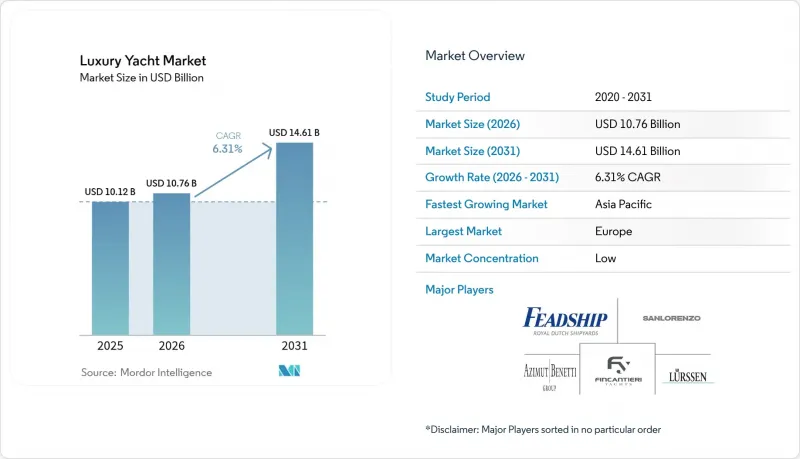
Mordor Intelligence에 의하면, 2026년 럭셔리 요트 시장 규모는 107억 6,000만 달러로 추정되고, 2025년 101억 2,000만 달러에서 확대해, 2031년에는 146억 1,000만 달러에 이를 것으로 예측됩니다.
2026-2031년 연평균 성장률(CAGR)은 6.31%를 나타낼 전망입니다.
본 보고서는 유형별(모터 요트, 세일링 요트, 기타), 크기별(20m 이하, 20-40m, 기타), 선체 재질별(유리섬유/복합재료, 알루미늄, 기타), 추진 시스템별(디젤, 디젤-전기/하이브리드, 기타), 최종 사용자별(개인, 전세 업체, 기타), 지역별로 분류되어 있습니다. 시장 전망은 금액(달러)과 수량(대)으로 제시되어 있습니다.
세계의 럭셔리 요트 시장 동향 및 인사이트
요트 관광 붐의 급속한 확대
요트 관광은 견조한 성장세를 보이며, 2030년까지 해양 경제의 26%를 차지할 전망입니다. 요트 관광객의 1일당 지출액은 약 287달러로, 기존 관광객의 거의 2배에 달하며 지역 경제에 큰 영향을 미치고 있습니다. 이 부문은 혼잡한 관광지를 피하고 사적이고 통제된 환경을 선호하는 팬데믹 이후의 여행 트렌드 덕분에 혜택을 보고 있습니다. 전세 업체들은 이러한 프리미엄 소비를 흡수하기 위해 더 크고 호화로운 선박에 대한 투자를 확대하고 있으며, 요트 세일링 프로그램은 관광객에게 가장 가치 있는 요소로 부상하고 있습니다. 안전 교육과 대중교통을 이용해 1시간 이내에 접근 가능한 입지는 관광객이 선호하는 최적의 조합이며, 신흥 크루즈 목적지의 인프라 개발을 주도하고 있습니다.
신흥 시장의 초고액 자산가(UHNWIs) 증가
초고액 자산가 인구는 2028년까지 크게 증가하여, 순자산이 3,000만 달러를 초과하는 개인이 58만 7,000명을 넘어설 것으로 예측됩니다. 신흥 시장이 타 지역을 압도하는 성장을 주도하고 있으며, 베트남에서는 1억 미달러 이상의 자산을 보유한 개인의 수가 95% 증가하고, 인도에서는 80%, 모리셔스에서는 75% 증가할 것으로 전망됩니다. 이러한 새로운 부유층은 기존 자산보다 체험형 럭셔리를 우선시하며, 요트는 지위, 사생활 보호, 라이프스타일상의 이점을 모두 갖춘 ‘열정의 투자’로 자리매김하고 있습니다. 초고액 자산가 투자자의 20%가 지속가능한 투자로 전환함에 따라 하이브리드 및 전기 추진 시스템에 대한 수요가 발생하고 있습니다. 젊은 세대는 자산 유동화와 투자 결정을 점점 더 주도하고 있으며, 환경 성능이 뛰어난 기술적으로 진보된 선박을 선호하는 경향이 있습니다.
높은 소유 및 유지 비용
운영비 급등이 요트 소유의 경제성을 압박하고 있으며, 프린세스 요트(Princess Yachts)는 어려운 시장 환경 속에서 2022년 매출 3억 1,500만 파운드에 비해 6,100만 파운드의 손실을 기록했습니다. 이 회사는 운영 비용 상승과 어려운 세계 시장 환경을 이유로 250명의 인력 감축을 발표했습니다. 고급 시설의 요금이 급등함에 따라 마리나 비용도 상승하고 있으며, 세이프 하버 마리나즈의 56억 5,000만 달러 기업 가치는 2024년 예상 영업 현금 흐름의 21배에 해당합니다. 금리 상승은 요트 구매 자금 조달 비용을 더욱 끌어올리고 있는 반면, 보험 청구 증가와 재취득 가격 인상으로 인해 보험료도 상승하고 있습니다. 이러한 요인으로 인해 소유주들은 비용을 여러 이용자에게 분산시키기 위해 분할 소유 모델이나 전세 계약으로 눈을 돌리고 있습니다.
부문 분석
2025년, 모터 요트는 럭셔리 요트 시장을 휩쓸며 66.68%라는 압도적인 점유율을 확보했습니다. 이는 널찍한 레이아웃, 항속 거리 연장, 다양한 항해 조건에서 입증된 신뢰성에 대한 소비자의 확고한 선호도를 반영한 것입니다. 하이브리드/전기 요트는 환경 규제와 기술 발전에 힘입어 2031년 연평균 성장률(CAGR) 10.09%를 기록하며 가장 빠르게 성장하는 부문으로 부상하고 있습니다. 세일링 요트는 전통적인 경험을 추구하는 순수주의 소유자들 사이에서 안정적인 수요를 유지하고 있는 반면, 쌍동선 요트는 그 안정성과 높은 공간 효율성 덕분에 전세 사업에서 인기를 끌고 있습니다. 익스플로러 요트는 전문적이면서도 급속히 확대되고 있는 틈새 시장으로, 2025년에는 모험을 즐기는 소유주를 대상으로 58척의 신조선이 취항했습니다.
각 제조업체들이 저소음화, 연비 효율 향상, 업그레이드가 용이한 모듈식 파워트레인을 실현하는 하이브리드 시스템을 채택함에 따라 전동화 추세는 가속화되고 있습니다. 페레티 그룹은 기존 디자인과 최신 전기 기술을 융합한 E-럭셔리 부문의 자사 최초의 완전 전기 모델 ‘리바 엘 이세오’를 발표했습니다. 태양광 발전 통합 및 AI를 활용한 에너지 관리 시스템을 통해 전력 소비가 최적화되어, 환경을 배려하면서도 럭셔리한 경험을 향상시키고 있습니다. 모터 요트 제조업체들은 성능에 대한 기대를 저버리지 않으면서도 환경 의식이 높은 구매자를 확보하기 위해, 전체 모델 라인업에서 하이브리드 사양을 점점 더 많이 제공합니다.
20-40미터 부문이 주도적인 위치를 확립하여, 2025년에는 시장 점유율의 43.62%를 차지했습니다. 이 부문은 공간, 운항의 복잡성, 마리나 접근성 간의 균형이 잘 잡혀 있어 개인 소유에 있어 최적의 선택지가 되고 있습니다. 80미터를 초과하는 선박은 2031년 연평균 성장률(CAGR)이 11.74%로 가장 높은 성장률을 기록하고 있으며, 이는 초고액 자산가 구매자들이 알찬 설비를 갖춘 ‘수상 저택’을 선호하는 경향을 반영하고 있습니다. 20미터 이하 부문은 입문 수준의 럭셔리 구매자나 전세 사업을 대상으로 하며, 40-60미터 요트는 더 높은 성능을 추구하는 정평이 난 소유주층을 대상으로 합니다. 60-80미터 범위는 승무원 및 게스트를 위한 숙박 시설을 확충한 대형 선박으로의 전환을 검토하고 있는 경험 많은 소유주를 대상으로 합니다.
슈퍼요트 건조에는 첨단 소재와 기술이 점점 더 많이 도입되고 있으며, 탄소 복합재는 경주 용도에 그치지 않고 경량화와 성능 최적화를 위해 호화 선박에도 채택되고 있습니다. ‘셰헤라자드’호는 돛대,리깅, 갑판 구조에 카본 복합재를 채택하여 이러한 추세를 상징하는 존재입니다. 대형 선박에서는 하이브리드 추진 시스템 통합에 있어 규모의 경제 효과가 발휘되고 있으며, 롤스로이스사의 1,000-4,000kW급 시스템은 다양한 크기의 요트에 적합합니다. 선박 크기의 확대는 장기 크루징 중 자급자족을 원하는 선주의 요구를 반영하고 있으며, 항속 거리, 수납 용량, 선내 설비가 충실한 선박에 대한 수요를 뒷받침하고 있습니다.
지역별 분석
2025년, 유럽은 이탈리아, 네덜란드, 독일의 오랜 조선 클러스터 강점을 바탕으로 럭셔리 요트 시장의 42.62%를 차지했습니다. 이탈리아 조선소는 전 세계에서 건조된 24미터 이상의 선박 중 절반을 납품하고 있으며, 아지무트 베네티(Azimut Benetti)는 고급 제품 시장 전반의 침체에도 불구하고 2025년까지 15억 유로의 매출을 목표로 하고 있습니다. EU의 기후 변화 관련 법규는 하이브리드 추진 시스템의 연구 개발을 촉진하고 있으며, 조선사는 탄소 배출량을 중시하는 구매자에게 규제 준수를 경쟁 우위로 어필할 수 있게 되었습니다. 그러나 EU산 요트에 부과되는 미국의 20% 수입 관세로 인해, 일부 미국 발 주문이 국내 브랜드로 유입될 가능성이 있으며, 그 결과 예측 기간 동안 유럽 시장 점유율이 축소될 우려가 있습니다.
아시아태평양은 연평균 성장률(CAGR) 11.24%로 가장 빠르게 성장하고 있는 지역입니다. 2025년 ‘홍콩 슈퍼요트 서밋’에는 250명의 경영진이 참가하여 하이난섬, 세부, 랑카위에서의 마리나 확장 계획이 제시되었습니다. 연안 크루즈 허가 완화로 항로가 합리화됨에 따라 중국의 등록 건수는 증가하고 있습니다. 인도의 해안선 현대화 계획에는 11곳의 신규 마리나 건설이 예정되어 있으며, 고아는 몰디브행 전세 요트의 거점으로서의 입지가 강화되고 있습니다. 그러나 관료적인 인가 절차와 심수 부두의 부족은 여전히 럭셔리 요트 시장의 지역 수요를 완전히 활용하는 데 걸림돌이 되고 있습니다.
북미는 성숙 단계에 접어들었음에도 불구하고 계속해서 성장하는 시장입니다. 미국의 마리나 산업은 2023년에 67억 달러의 매출을 기록했으며, 많은 주요 거점에서 가동률이 90%를 넘어섰습니다. 블랙스톤이 세이프 하버 마리나스를 사상 최고가로 인수함에 따라, 이 펀드는 138개의 시설을 확보하게 되었으며, 계류 시설 인프라의 전략적 가치가 부각되었습니다. 일률적으로 10%인 수입 관세(원산지에 따라 20-54%까지 인상될 수 있음)는 웨스트포트나 크리스텐슨과 같은 국내 조선업체들을 뒷받침하고 있습니다. 그러나 숙련된 노동력 부족으로 인해 선원 임금이 두 자릿수 비율로 상승하고 있어, 일부 소유주들은 노동 집약도가 낮은 배수량형 요트로 전환하고 있습니다. 이러한 추세는 럭셔리 요트 시장 전체로 파급되고 있습니다.
기타 혜택
- 엑셀 형식 시장 예측(ME) 시트
- 3개월간의 애널리스트 지원
자주 묻는 질문
목차
제1장 서론
제2장 조사 방법
제3장 주요 요약
제4장 시장 구도
제5장 시장 규모 및 성장 예측
제6장 경쟁 구도
제7장 시장 기회 및 향후 전망
AJY 26.09.11According to Mordor Intelligence, luxury yacht market size in 2026 is estimated at USD 10.76 billion, growing from 2025 value of USD 10.12 billion with 2031 projections showing USD 14.61 billion, growing at 6.31% CAGR over 2026-2031.

This report is Segmented by Type (Motor Yacht, Sailing Yacht, and More), Size (Up To 20 Meter, 20 To 40 Meter, and More), Hull Material (Fiberglass/Composite, Aluminum, and More), Propulsion System (Diesel, Diesel-Electric/Hybrid, and More), End-User (Private Individuals, Charter Companies, and More), and Geography. The Market Forecasts are Provided in Terms of Value (USD) and Volume (Units).
Global Luxury Yacht Market Trends and Insights
Surge in Yacht-Tourism Boom
Yacht tourism will demonstrate healthy growth, accounting for 26% of the marine economy by 2030. Yacht tourists spend approximately USD 287 daily, nearly double conventional tourists, significantly impacting local economies. The sector benefits from post-pandemic travel preferences favoring private, controlled environments, with overcrowded destinations. Charter companies increasingly invest in larger, more luxurious vessels to capture this premium spending, with yacht sailing programs emerging as the most valued attribute among tourists. Safety training and accessible locations within one hour of transport represent optimal combinations that tourists prefer, driving infrastructure development in emerging cruising destinations.
Rising UHNWIs in Emerging Markets
The ultra-wealthy population is projected to grow considerably by 2028, reaching over 587,000 individuals with a net worth exceeding USD 30 million. Emerging markets drive disproportionate growth, with Vietnam forecasting 95% centi-millionaire growth, India 80%, and Mauritius 75%. These new wealth centers prioritize experiential luxury over traditional assets, with yachts representing passion investments that combine status, privacy, and lifestyle benefits. The shift toward sustainable investments among 20% of UHNW investors creates demand for hybrid and electric propulsion systems. Younger generations increasingly drive wealth mobility and investment decisions, favoring technologically advanced vessels with environmental credentials.
High Ownership and Maintenance Costs
Rising operational expenses strain yacht ownership economics, with Princess Yachts reporting a GBP 61 million loss in 2022 on revenues of GBP 315 million amid challenging market conditions. The company announced 250 workforce reductions due to rising operational costs and challenging global market conditions. Marina costs escalate as premium facilities command higher rates, with Safe Harbor Marinas' USD 5.65 billion valuation reflecting 21 times the estimated 2024 Funds from Operations. Interest rate increases compound financing costs for yacht purchases, while insurance premiums rise due to increased claims and replacement values. These factors drive owners toward fractional ownership models and charter arrangements to distribute costs across multiple users.
Other drivers and restraints analyzed in the detailed report include:
- Growing Demand for Expedition/Explorer Yachts
- Shift Toward Hybrid and Electric Propulsion
- Supply-Chain Bottlenecks for Specialized Components
For complete list of drivers and restraints, kindly check the Table Of Contents.
Segment Analysis
In 2025, motor yachts dominated the luxury yacht market, securing a commanding 66.68% share, reflecting established consumer preferences for spacious layouts, extended range capabilities, and proven reliability across diverse cruising conditions. Hybrid/electric yachts emerge as the fastest-growing segment at 10.09% CAGR through 2031, driven by environmental regulations and technological advancements. Sailing yachts maintain steady demand among purist owners seeking traditional experiences, while catamaran yachts gain traction for charter operations due to stability and space efficiency. Explorer yachts represent a specialized but rapidly expanding niche, with 58 new vessels launching in 2025 targeting adventure-oriented owners.
The electrification trend accelerates as manufacturers integrate hybrid systems offering reduced noise, improved fuel efficiency, and modular powertrains allowing easy upgrades. Ferretti Group unveiled the Riva El-Iseo, their first full-electric model in the E-Luxury segment, combining traditional design with modern electric technology. Solar energy integration and AI-powered energy management systems optimize power consumption, enhancing the luxury experience while addressing environmental concerns. Motor yacht manufacturers increasingly offer hybrid variants across their model ranges to capture environmentally conscious buyers without sacrificing performance expectations.
The 20 to 40-meter segment emerged as the frontrunner, holding 43.62% of the market share in 2025, striking a balance between space, operational complexity, and marina accessibility, making it the prime choice for private ownership. Vessels above 80 meters achieve the highest growth rate at 11.74% CAGR through 2031, reflecting ultra-wealthy buyers' preference for floating estates with comprehensive amenities. The up to 20-meter segment serves entry-level luxury buyers and charter operations, while 40 to 60-meter yachts cater to established owners seeking enhanced capabilities. The 60-to-80-meter range targets experienced owners transitioning to larger vessels with expanded crew and guest accommodations.
Superyacht construction increasingly incorporates advanced materials and technologies, with carbon composites moving beyond racing applications into luxury vessels for weight reduction and performance optimization. The Scheherazade exemplifies this trend, incorporating carbon composites in masts, rigging, and deck structures. Larger vessels benefit from economies of scale in hybrid propulsion integration, with Rolls-Royce's systems ranging from 1,000 to 4,000 kilowatts suitable for various yacht sizes. The size escalation reflects owners' desire for self-sufficiency during extended cruising, driving demand for vessels with enhanced range, storage, and onboard facilities.
Complete Report Scope:
- By Type
- Motor Yacht
- Sailing Yacht
- Hybrid / Electric Yacht
- Catamaran Yacht
- Explorer / Others
- By Size
- Up to 20 m
- 20 to 40 m
- 40 to 60 m
- 60 to 80 m
- Above 80 m
- By Hull Material
- Fiberglass / Composite
- Aluminum
- Steel
- Carbon Fiber
- Others
- By Propulsion System
- Diesel
- Diesel-Electric / Hybrid
- Full Electric
- Hydrogen Fuel Cell (Emerging)
- By End-User
- Private Individuals
- Charter Companies
- Corporate and Events
- Fractional-Ownership Clubs
- Government and Naval (VIP)
- By Geography
- North America
- United States
- Canada
- Rest of North America
- South America
- Brazil
- Argentina
- Chile
- Rest of South America
- Europe
- Italy
- Germany
- United Kingdom
- France
- Netherlands
- Spain
- Rest of Europe
- Asia-Pacific
- China
- Japan
- South Korea
- Australia
- India
- Rest of Asia-Pacific
- Middle East and Africa
- Saudi Arabia
- United Arab Emirates
- Egypt
- South Africa
- Rest of Middle East and Africa
- North America
Geography Analysis
Europe commanded 42.62% of the luxury yacht market in 2025 on the strength of enduring shipbuilding clusters in Italy, the Netherlands, and Germany. Italian yards delivered half of all 24 m-plus vessels globally, with Azimut-Benetti aiming for EUR 1.5 billion turnover by 2025 despite soft luxury-goods sentiment. EU climate legislation spurs R&D in hybrid propulsion, allowing builders to market compliance as a competitive edge to carbon-conscious buyers. However, 20% U.S. import tariffs on EU yachts may divert some American orders to domestic brands, potentially trimming Europe's share over the forecast horizon.
Asia-Pacific is the fastest-growing region at an 11.24% CAGR. The 2025 Hong Kong Superyacht Summit drew 250 executives who outlined marina expansions in Hainan, Cebu, and Langkawi. Chinese registrations increase as the easing of coastal cruising permits streamlines itineraries. India's coastline modernization plan earmarks eleven new marinas, positioning Goa as a charter springboard for the Maldives. Nevertheless, bureaucratic clearance protocols and limited deep-water berths still inhibit full exploitation of regional demand in the luxury yacht market.
North America remains a mature yet expanding arena. The U.S. marina sector booked USD 6.7 billion in 2023 revenue with occupancy above 90% in many hubs. Blackstone's record purchase of Safe Harbor Marinas grants the fund 138 properties and underscores the strategic value of berth infrastructure. Universal 10% import tariffs, escalating to 20-54% by source country, buttress domestic builders such as Westport and Christensen. Skill shortages, however, increase crew wages by double-digit percentages, nudging some owners toward less labor-intensive displacement yachts, a trend reverberating across the luxury yacht market.
- Azimut-Benetti Group
- Lurssen Werft
- Feadship
- Ferretti Group
- Sanlorenzo
- Heesen Yachts
- Oceanco
- Fincantieri Yachts
- Nobiskrug
- Sunseeker International
- Royal Huisman
- Damen Yachting
- Palumbo Superyachts
- Gulf Craft
- Princess Yachts
- Sunreef Yachts
- Westport Yachts
- Trinity Yachts
- Baglietto
- Baltic Yachts
Additional Benefits:
- The market estimate (ME) sheet in Excel format
- 3 months of analyst support
TABLE OF CONTENTS
1 Introduction
- 1.1 Study Assumptions and Market Definition
- 1.2 Scope of the Study
2 Research Methodology
3 Executive Summary
4 Market Landscape
- 4.1 Market Overview
- 4.2 Market Drivers
- 4.2.1 Surge in yacht-tourism boom
- 4.2.2 Rising UHNWIs in emerging markets
- 4.2.3 Growing demand for expedition / explorer yachts
- 4.2.4 Shift toward hybrid and electric propulsion
- 4.2.5 Private-island and remote-marina build-out
- 4.2.6 Rise of fractional-ownership platforms
- 4.3 Market Restraints
- 4.3.1 High ownership and maintenance costs
- 4.3.2 Supply-chain bottlenecks for specialised components
- 4.3.3 Stringent environmental emission regulations
- 4.3.4 Shortage of skilled crew inflating operating costs
- 4.4 Value / Supply-Chain Analysis
- 4.5 Technological Outlook
- 4.6 Regulatory Landscape
- 4.7 Porter's Five Forces
- 4.7.1 Threat of New Entrants
- 4.7.2 Bargaining Power of Buyers
- 4.7.3 Bargaining Power of Suppliers
- 4.7.4 Threat of Substitutes
- 4.7.5 Intensity of Competitive Rivalry
5 Market Size and Growth Forecasts (Value (USD) and Volume (Units))
- 5.1 By Type
- 5.1.1 Motor Yacht
- 5.1.2 Sailing Yacht
- 5.1.3 Hybrid / Electric Yacht
- 5.1.4 Catamaran Yacht
- 5.1.5 Explorer / Others
- 5.2 By Size
- 5.2.1 Up to 20 m
- 5.2.2 20 to 40 m
- 5.2.3 40 to 60 m
- 5.2.4 60 to 80 m
- 5.2.5 Above 80 m
- 5.3 By Hull Material
- 5.3.1 Fiberglass / Composite
- 5.3.2 Aluminum
- 5.3.3 Steel
- 5.3.4 Carbon Fiber
- 5.3.5 Others
- 5.4 By Propulsion System
- 5.4.1 Diesel
- 5.4.2 Diesel-Electric / Hybrid
- 5.4.3 Full Electric
- 5.4.4 Hydrogen Fuel Cell (Emerging)
- 5.5 By End-User
- 5.5.1 Private Individuals
- 5.5.2 Charter Companies
- 5.5.3 Corporate and Events
- 5.5.4 Fractional-Ownership Clubs
- 5.5.5 Government and Naval (VIP)
- 5.6 By Geography
- 5.6.1 North America
- 5.6.1.1 United States
- 5.6.1.2 Canada
- 5.6.1.3 Rest of North America
- 5.6.2 South America
- 5.6.2.1 Brazil
- 5.6.2.2 Argentina
- 5.6.2.3 Chile
- 5.6.2.4 Rest of South America
- 5.6.3 Europe
- 5.6.3.1 Italy
- 5.6.3.2 Germany
- 5.6.3.3 United Kingdom
- 5.6.3.4 France
- 5.6.3.5 Netherlands
- 5.6.3.6 Spain
- 5.6.3.7 Rest of Europe
- 5.6.4 Asia-Pacific
- 5.6.4.1 China
- 5.6.4.2 Japan
- 5.6.4.3 South Korea
- 5.6.4.4 Australia
- 5.6.4.5 India
- 5.6.4.6 Rest of Asia-Pacific
- 5.6.5 Middle East and Africa
- 5.6.5.1 Saudi Arabia
- 5.6.5.2 United Arab Emirates
- 5.6.5.3 Egypt
- 5.6.5.4 South Africa
- 5.6.5.5 Rest of Middle East and Africa
- 5.6.1 North America
6 Competitive Landscape
- 6.1 Market Concentration
- 6.2 Strategic Moves
- 6.3 Market Share Analysis
- 6.4 Company Profiles (includes Global Level Overview, Market Level Overview, Core Segments, Financials as Available, Strategic Information, Market Rank/Share for Key Companies, Products and Services, SWOT Analysis, and Recent Developments)
- 6.4.1 Azimut-Benetti Group
- 6.4.2 Lurssen Werft
- 6.4.3 Feadship
- 6.4.4 Ferretti Group
- 6.4.5 Sanlorenzo
- 6.4.6 Heesen Yachts
- 6.4.7 Oceanco
- 6.4.8 Fincantieri Yachts
- 6.4.9 Nobiskrug
- 6.4.10 Sunseeker International
- 6.4.11 Royal Huisman
- 6.4.12 Damen Yachting
- 6.4.13 Palumbo Superyachts
- 6.4.14 Gulf Craft
- 6.4.15 Princess Yachts
- 6.4.16 Sunreef Yachts
- 6.4.17 Westport Yachts
- 6.4.18 Trinity Yachts
- 6.4.19 Baglietto
- 6.4.20 Baltic Yachts
7 Market Opportunities and Future Outlook
- 7.1 White-space and Unmet-Need Assessment