|
시장보고서
상품코드
2124208
염소화 폴리에틸렌 시장 : 시장 점유율 분석, 업계 동향 및 통계, 성장 예측(2026-2031년)Chlorinated Polyethylene - Market Share Analysis, Industry Trends & Statistics, Growth Forecasts (2026 - 2031) |
||||||
 Mordor Intelligence
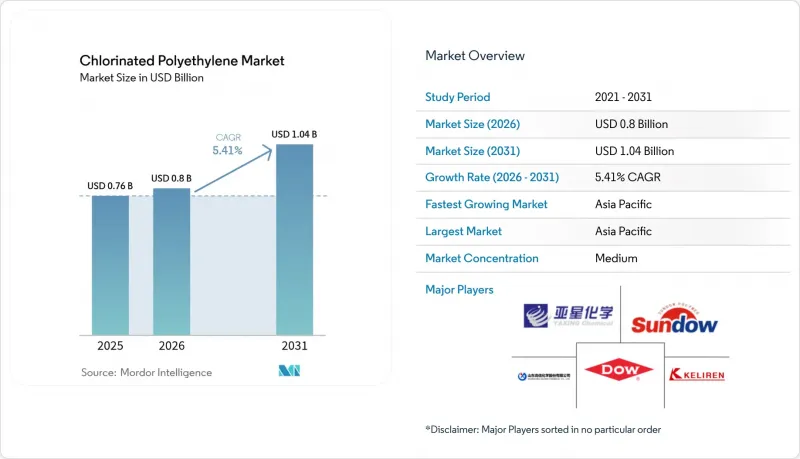
Mordor Intelligence에 의하면, 염소화 폴리에틸렌 시장 규모는 2025년 7억 6,000만 달러로 평가되었고, 2026년에는 8억 달러로 추정되고, 2031년까지 10억 4,000만 달러에 이를 것으로 예상되며, 2026-2031년 CAGR 5.41%로 성장할 전망입니다.
본 보고서는 제품별(CPE 135A, CPE 135B, 기타), 용도별(충격 개질제, 전선 및 케이블 피복재, 호스·튜브, 접착제, 기타), 지역별(아시아태평양, 북미, 유럽, 남미, 중동 및 아프리카)로 분류되어 있습니다. 시장 예측은 금액(달러) 기준으로 제시되어 있습니다.
세계의 염소화 폴리에틸렌 시장 동향 및 인사이트
무할로겐 난연성 CPE 하이브리드로의 전환
각 배합 제조업체들은 CPE에 인·질소계 팽창성 난연제를 혼합하여 총 할로겐 함량을 저감함으로써, IEC 60754-2 기준을 충족하는 동시에 UL-94 V-0 규격 인증을 획득하고 있습니다. 2025년 연구에 따르면, 마이크로캡슐화된 적린과 시아누르산 멜라민을 첨가함으로써 한계 산소 지수가 34%를 초과하고 발연 밀도가 80Ds 미만으로 떨어지는 결과가 얻어졌으며, 이를 통해 수산화물계 광물 충전재의 사용량을 40% 절감할 수 있게 되었습니다. 데이터센터 및 철도 운송용 제품을 공급하는 북미와 EU의 케이블 공장은 현지 규제가 할로겐의 전면 금지가 아닌 저발연 성능을 의무화하고 있기 때문에 이 기술의 조기 도입자가 되었습니다. 이러한 ‘할로겐 저감’ 화합물은 염화 폴리에틸렌 시장의 제품 수명 주기를 연장하지만, 정밀한 분산 처리와 내습성 포장이 필요하기 때문에 배합의 복잡성과 비용이 증가합니다.
중국공급 확대에 따른 가격 경쟁력 향상
산둥성의 에틸렌 및 염소-알칼리 통합 자산 덕분에 2025년에는 CPE의 평균 현금 원가가 톤당 1,200달러 미만으로 떨어졌으며, 이는 유럽 및 미국 생산자보다 20-30% 낮은 수준입니다. 웨이팡 야싱(Weifang Yaxing)만 해도 생산 능력을 연간 8만 톤으로 확대했으나, 수출 수요 부진으로 이익률이 축소됨에 따라 온실용 필름 및 특수 호스용 등급으로의 전환을 추진하고 있습니다. 가격 약세는 비용에 민감한 PVC 및 케이블 부문에 원료를 공급하는 인도, 베트남, 인도네시아의 컴파운더들에게 혜택을 주고 있지만, 산동성의 소규모 시설 간 품질 편차가 반덤핑 조사를 초래하여 브랜드 신뢰도를 훼손하고 있습니다.
EU의 염소계 플라스틱 공공 조달 금지 조치
독일, 프랑스, 네덜란드에서는 현재 공공 자금 지원 프로젝트에서 LSZH 소재를 우선적으로 채택하고 있습니다. REACH와 CPR에서는 전면적인 금지는 이루어지지 않았지만, 조달 지침에서는 IEC 60754-1에 따라 할로겐산 가스 함유율을 0.5% 이하로 제한하고 있습니다. 케이블 및 지붕재 공급업체들은 두 유형의 재고를 보유해야 하며, 도심 지역의 방화 규제가 강화됨에 따라 CPE를 산업 시장으로 전환하고 있습니다. 그 결과, 염소화 폴리에틸렌 시장은 단기적으로 유럽 내 물량 감소와 이익률 압박에 직면해 있습니다.
부문 분석
2025년, CPE 135A의 염화 폴리에틸렌 시장 규모는 매출 점유율의 52.94%를 차지했습니다. 이 반결정성 등급은 염소 함유율 35±2%와 무니 점도 약 50의 균형을 유지하며, 쇼어 A 경도 60과 600% 이상의 성장률을 실현하고 있으며, 이러한 특성은 경질 PVC의 내충격성 개선 및 전선 피복 분야에서 높이 평가받고 있습니다. 더 높은 점도를 가진 CPE 135B는 용융 강도가 높아 블로우 필름 및 난연성 충전재의 배합을 가능하게 하며, 이것이 2031년까지 연평균 성장률(CAGR) 5.51%라는 예측을 뒷받침하고 있습니다. 특수 등급으로는 UL-94 V-0 규격의 케이블 컴파운드용 고염소 함유량(Cl > 40%) 등급, 고무 자석용 분자량 조정 등급, 엔진룸용 호스용 내열성 등급이 있으며, 이들이 결합되어 범용 수지의 범위를 넘어선 가치 확대를 가져오고 있습니다.
생산자들이 업스트림 공정으로 진출함에 따라 경쟁은 치열해지고 있습니다. 다우, 레조낙, 산동성의 주요 기업들이 공동 처리된 CPE-인 마스터배치를 공급하고 있으며, 이를 통해 컴파운더는 턴키 방식의 저발연 솔루션을 제공할 수 있게 되었습니다. 이러한 수직 통합 움직임은 범용 수지 가격이 정체된 상황에서도 이익률을 유지하고, 통합된 공급 계약을 통해 장기 고객을 확보함으로써 염소화 폴리에틸렌 시장 전체의 고객 충성도 강화에 기여하고 있습니다.
지역별 분석
아시아태평양은 2025년 염소화 폴리에틸렌 시장의 전 세계 수요의 72.15%를 차지했으며, 2031년까지 연평균 성장률(CAGR) 5.78%를 나타낼 것으로 예측됩니다. 중국에는 에틸렌(연간 6,200만 톤)과 폴리에틸렌(연간 4,500만 톤)의 통합 생산 거점이 있어 CPE 반응기에 염소 원료를 저렴하게 공급하고 있습니다. 산둥성의 생산 클러스터에서는 공장 인도 가격이 톤당 1,200달러 미만으로 형성되어 있어, 이에 따라 인도와 베트남의 컴파운더들은 XLPE 및 TPO 대비 시장 점유율을 확대되고 있습니다. 그러나 공급 과잉으로 인해 생산자의 이익률은 압박을 받고 있으며, 튀르키예와 브라질로부터 정기적으로 반덤핑 조사가 이루어지고 있습니다.
북미 시장의 성장은 전기차 충전 케이블, 데이터센터용 전원 코드, 석유 시추용 호스에 의해 뒷받침되고 있습니다. 연방 규격에서는 산업용 배선에 CPE 사용이 허용되고 있으며, 캘리포니아주 정부 조달에서는 고승차율 운송을 위한 LSZH 채택이 점점 더 요구되고 있습니다. 사우스와이어(Southwire)사의 2025년판 전기차 충전소 사양(SPEC 45005)에서는 90℃의 연속 정격 및 FT4 난연 규격 준수를 보장하기 위해 열경화성 CPE 재킷의 사용이 요구되고 있습니다. 이러한 문서는 할로겐 함유에 대한 엄격한 모니터링에도 불구하고 CPE의 지속적인 존재 가치를 입증하고 있습니다.
유럽 시장은 이중의 역풍에 직면해 있습니다. 각국의 조달 금지 조치로 인해 건축용 전선의 취급량이 감소하고 있는 데 더해, CBAM(탄소 국경 조정 메커니즘)으로 인해 탄소 배출량이 많은 수입품의 입고 비용이 상승할 가능성이 있습니다. 네덜란드의 Nobian을 필두로 한 현지 제조업체들은 재생에너지와 결합된 막형 전해조를 개조하여 내재된 탄소를 줄이는 동시에 국내 CPE의 경쟁력을 유지하고 있습니다.
남미, 중동 및 아프리카에서는 염소화 폴리에틸렌에 대한 수요가 증가하고 있습니다. 브라질과 멕시코에서는 열대 지역의 산업 단지에서 CPE를 기재로 한 3층 구조의 지붕재가 채택되고 있으며, 사우디아라비아와 아랍에미리트에서는 90℃의 오일 침지가 일상적으로 이루어지는 해양 시추용 케이블에 CPE 재킷의 사용이 지정되어 있습니다. 할로겐에 대한 규제 압력의 완화와 강한 일조량이 CPE의 채택 확대를 뒷받침하고 있으며, 이는 염소화 폴리에틸렌 시장 전체의 다각적인 성장을 지탱하고 있습니다.
기타 혜택
- 엑셀 형식 시장 예측(ME) 시트
- 3개월간의 애널리스트 지원
자주 묻는 질문
목차
제1장 서론
제2장 조사 방법
제3장 주요 요약
제4장 시장 구도
제5장 시장 규모 및 성장 예측
제6장 경쟁 구도
제7장 시장 기회 및 향후 전망
AJY 26.09.11According to Mordor Intelligence, the chlorinated polyethylene market size is expected to increase from USD 0.76 billion in 2025 to USD 0.8 billion in 2026 and reach USD 1.04 billion by 2031, growing at a CAGR of 5.41% over 2026-2031.
This report is Segmented by Product (CPE 135A, CPE 135B, and Other Products), Application (Impact Modifiers, Wire and Cable Jacketing, Hose and Tubing, Adhesives, and Other Applications), and Geography (Asia-Pacific, North America, Europe, South America, and Middle East and Africa). The Market Forecasts are Provided in Terms of Value (USD).
Global Chlorinated Polyethylene Market Trends and Insights
Shift Toward Halogen-Free Flame-Retardant CPE Hybrids
Formulators are lowering total halogen content by blending CPE with phosphorus-nitrogen intumescent systems, reaching UL-94 V-0 ratings while meeting IEC 60754-2 thresholds. A 2025 study showed that adding micro-encapsulated red phosphorus and melamine cyanurate delivers limiting oxygen index values above 34% and smoke density below 80 Ds, allowing 40% less mineral hydroxide filler. North American and EU cable plants serving data centers and rail transit are early adopters because local codes mandate low-smoke performance without banning all halogens. Such "reduced-halogen" compounds lengthen the product life cycle for the chlorinated polyethylene market, though precise dispersion and moisture-resistant packaging raise formulation complexity and cost.
Chinese Supply-Side Expansion Enhancing Price Competitiveness
Integrated ethylene and chlor-alkali assets in Shandong province drove average CPE cash costs below USD 1,200 per tonne in 2025, undercutting Western producers by 20-30%. Weifang Yaxing alone lifted capacity to 80,000 tpa yet saw margins narrow when export demand cooled, prompting a pivot toward greenhouse-film and specialty hose grades. Price softness benefits compounders across India, Vietnam, and Indonesia that feed cost-sensitive PVC and cable segments, although quality variability among smaller Shandong facilities stokes anti-dumping inquiries and undermines brand confidence.
EU Public-Procurement Bans on Chlorinated Plastics
Germany, France, and the Netherlands now prioritize LSZH materials in publicly funded projects. Although REACH and CPR stop short of an outright ban, procurement guidelines cap halogen acid gas at <= 0.5% under IEC 60754-1. Cable and roofing suppliers must keep dual inventories, diverting CPE toward industrial markets while downtown fire codes tighten. The chlorinated polyethylene market therefore faces near-term European volume erosion and margin compression.
Other drivers and restraints analyzed in the detailed report include:
- Oil-Resistant Hoses for Hydrogen Refueling Infrastructure
- Growth of 3-Layer Smart Roofing Membranes
- TPV and SEBS Elastomer Performance Advances
For complete list of drivers and restraints, kindly check the Table Of Contents.
Segment Analysis
The chlorinated polyethylene market size for CPE 135A accounted for 52.94% of revenue share in 2025. This semi-crystalline grade balances 35+-2% chlorine with Mooney viscosity around 50, generating Shore A 60 hardness and elongation above 600%, metrics prized for rigid PVC impact modification and wire jackets. Higher-viscosity CPE 135B offers extra melt strength, unlocking blown-film and flame-retardant filler loading that underpins a forecast 5.51% CAGR through 2031. Specialty variants. high-chlorine (>40% Cl) for UL-94 V-0 cable compounds, modified molecular-weight grades for rubber magnets, and heat-stable versions for under-hood hoses, collectively broaden value pools beyond commodity resin.
Competition intensifies as producers migrate upstream: Dow, Resonac, and leading Shandong firms supply co-processed CPE-phosphorus masterbatches, enabling compounders to offer turnkey low-smoke solutions. This vertical move shields margin amid flat commodity pricing and embeds long-term customers within integrated supply contracts, reinforcing stickiness across the chlorinated polyethylene market.
Complete Report Scope:
- By Product
- CPE 135A
- CPE 135B
- Other Products
- By Application
- Impact Modifiers
- Wire and Cable Jacketing
- Hose and Tubing
- Adhesives
- Other Applications
- By Geography
- Asia-Pacific
- China
- India
- Japan
- South Korea
- ASEAN
- Rest of Asia-Pacific
- North America
- United States
- Canada
- Mexico
- Europe
- Germany
- United Kingdom
- France
- Italy
- Russia
- Rest of Europe
- South America
- Brazil
- Argentina
- Rest of South America
- Middle-East and Africa
- Saudi Arabia
- South Africa
- Rest of Middle-East and Africa
- Asia-Pacific
Geography Analysis
Asia-Pacific anchored 72.15% of 2025 global demand for the chlorinated polyethylene market and is projected to grow at a 5.78% CAGR through 2031. China harbors integrated ethylene (62 Mt y) and polyethylene (45 Mt y) assets that flow chlorine feedstock cheaply into CPE reactors. Shandong clusters deliver ex-works prices under USD 1,200 t, spurring compounders in India and Vietnam to capture share versus XLPE and TPO. Overcapacity, however, trims producer margins and invites periodic anti-dumping probes from Turkey and Brazil.
North American market growth is buoyed by EV charging cables, data-center power cords, and oil-patch hoses. Federal codes allow CPE in industrial wiring; state procurements in California increasingly request LSZH for high-occupancy transit. Southwire's 2025 EV charge-station spec (SPEC 45005) calls for thermoset CPE jackets to assure 90 °C continuous rating and FT4 flame compliance. Such documents validate CPE's staying power despite halogen scrutiny.
European market faces dual headwinds: national procurement bans shrink building-wire tonnage, and CBAM may raise landed costs for high-carbon imports. Local producers, led by Nobian in the Netherlands, retrofit membrane electrolysers paired with renewable electricity to cut embedded carbon and sustain domestic CPE competitiveness.
South America, the Middle East, and Africa are witnessing rising demand for chlorinated polyethylene. Brazil and Mexico deploy CPE-based three-layer roofing in tropical industrial zones; Saudi Arabia and the UAE specify CPE jackets in offshore drilling cables where 90°C oil immersion is routine. Lower regulatory pressure on halogens and heavy sunlight drive incremental uptake, supporting diversified growth across the chlorinated polyethylene market.
- Aurora Material Solutions
- Bontecn Group China Co. Ltd
- Dow
- Dycon Chemicals
- Epigral Limited
- Hangzhou Keli Chemical Co. Ltd
- Jiangsu Tianteng Chemical Industry Co. Ltd
- Resonac Holdings Corporation
- Shandong Gaoxin Chemical Co. Ltd
- Shandong Ketian Chemical Co. Ltd
- Shandong Novista Chemical Ltd (Novista Group)
- Shandong Rike Chemical Co.,Ltd
- Shandong Xiangsheng New Materials Technology Co. Ltd
- Shandong Xuye New Materials Co. Ltd
- Sundow Polymers Co. Ltd
- Weifang Yaxing Chemical Co. Ltd
Additional Benefits:
- The market estimate (ME) sheet in Excel format
- 3 months of analyst support
TABLE OF CONTENTS
1 Introduction
- 1.1 Study Assumptions and Market Definition
- 1.2 Scope of the Study
2 Research Methodology
3 Executive Summary
4 Market Landscape
- 4.1 Market Overview
- 4.2 Market Drivers
- 4.2.1 Shift Toward Halogen-Free Flame-Retardant CPE Hybrids
- 4.2.2 Chinese Supply-Side Expansion Enhancing Price Competitiveness
- 4.2.3 Oil-Resistant Hoses for Hydrogen Refuelling Infrastructure
- 4.2.4 Growth of 3-Layer Smart Roofing Membranes in Tropical Regions
- 4.2.5 On-site Chlorination Tech Cutting Scope-3 Emissions in Europe
- 4.3 Market Restraints
- 4.3.1 EU Public-Procurement Bans on Chlorinated Plastics
- 4.3.2 TPV and SEBS Elastomer Performance Advances
- 4.3.3 Emerging Carbon-Border Tariffs on Halogenated Polymers
- 4.4 Value Chain Analysis
- 4.5 Porter's Five Forces
- 4.5.1 Bargaining Power of Suppliers
- 4.5.2 Bargaining Power of Buyers
- 4.5.3 Threat of New Entrants
- 4.5.4 Threat of Substitutes
- 4.5.5 Competitive Rivalry
5 Market Size and Growth Forecasts (Value)
- 5.1 By Product
- 5.1.1 CPE 135A
- 5.1.2 CPE 135B
- 5.1.3 Other Products
- 5.2 By Application
- 5.2.1 Impact Modifiers
- 5.2.2 Wire and Cable Jacketing
- 5.2.3 Hose and Tubing
- 5.2.4 Adhesives
- 5.2.5 Other Applications
- 5.3 By Geography
- 5.3.1 Asia-Pacific
- 5.3.1.1 China
- 5.3.1.2 India
- 5.3.1.3 Japan
- 5.3.1.4 South Korea
- 5.3.1.5 ASEAN
- 5.3.1.6 Rest of Asia-Pacific
- 5.3.2 North America
- 5.3.2.1 United States
- 5.3.2.2 Canada
- 5.3.2.3 Mexico
- 5.3.3 Europe
- 5.3.3.1 Germany
- 5.3.3.2 United Kingdom
- 5.3.3.3 France
- 5.3.3.4 Italy
- 5.3.3.5 Russia
- 5.3.3.6 Rest of Europe
- 5.3.4 South America
- 5.3.4.1 Brazil
- 5.3.4.2 Argentina
- 5.3.4.3 Rest of South America
- 5.3.5 Middle-East and Africa
- 5.3.5.1 Saudi Arabia
- 5.3.5.2 South Africa
- 5.3.5.3 Rest of Middle-East and Africa
- 5.3.1 Asia-Pacific
6 Competitive Landscape
- 6.1 Market Concentration
- 6.2 Strategic Moves
- 6.3 Market Share(%)/Ranking Analysis
- 6.4 Company Profiles (includes Global Overview, Market Overview, Core Segments, Financials, Strategic Information, Products and Services, Recent Developments)
- 6.4.1 Aurora Material Solutions
- 6.4.2 Bontecn Group China Co. Ltd
- 6.4.3 Dow
- 6.4.4 Dycon Chemicals
- 6.4.5 Epigral Limited
- 6.4.6 Hangzhou Keli Chemical Co. Ltd
- 6.4.7 Jiangsu Tianteng Chemical Industry Co. Ltd
- 6.4.8 Resonac Holdings Corporation
- 6.4.9 Shandong Gaoxin Chemical Co. Ltd
- 6.4.10 Shandong Ketian Chemical Co. Ltd
- 6.4.11 Shandong Novista Chemical Ltd (Novista Group)
- 6.4.12 Shandong Rike Chemical Co.,Ltd
- 6.4.13 Shandong Xiangsheng New Materials Technology Co. Ltd
- 6.4.14 Shandong Xuye New Materials Co. Ltd
- 6.4.15 Sundow Polymers Co. Ltd
- 6.4.16 Weifang Yaxing Chemical Co. Ltd
7 Market Opportunities and Future Outlook
- 7.1 White-space and Unmet-Need Assessment