

|
시장보고서
상품코드
2124216
소프트웨어 정의 경계 시장 : 시장 점유율 분석, 업계 동향 및 통계, 성장 예측(2026-2031년)Software-Defined Perimeter - Market Share Analysis, Industry Trends & Statistics, Growth Forecasts (2026 - 2031) |
||||||
 Mordor Intelligence
Mordor Intelligence에 의하면, 2026년 소프트웨어 정의 경계(Software-Defined Perimeter) 시장 규모는 146억 2,000만 달러로 추정되며, 2025년 115억 4,000만 달러에서 2031년에는 476억 4,000만 달러에 달할 것으로 예측됩니다.
2026-2031년 연평균 성장률(CAGR)은 26.64%를 기록할 것으로 전망됩니다.
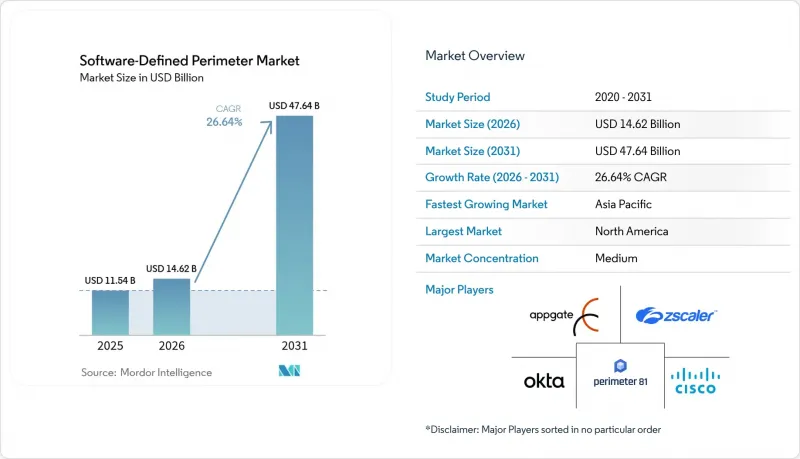
본 보고서는 제공 내용별(솔루션, 서비스), 연결 모델별(클라우드 엣지, 데이터센터 게이트웨이 등), 도입 형태별, 조직 규모별, 최종 사용자 산업별(은행, 금융서비스 및 보험(BFSI), IT 및 통신 등) 및 지역별로 세분화되어 있습니다. 시장 예측은 금액(달러) 기준으로 제시되어 있습니다.
세계의 소프트웨어 정의 경계(SDP) 시장 동향 및 인사이트
급속한 멀티클라우드 도입과 공격 표면의 확대
현재 조직들은 평균 2.6개의 퍼블릭 클라우드를 운영하고 있으며, 이로 인해 제어 플레인이 세분화되고 기존의 경계 방어가 약화되고 있습니다. 소프트웨어 정의 경계(SDP) 솔루션은 워크로드의 위치와 관계없이 이를 추적하는 용도 전용 마이크로 터널을 구축함으로써 이러한 무질서한 확장을 억제합니다. 금융 서비스 업계의 지출 현황은 그 중요성을 여실히 보여줍니다. 2024년 6,230억 달러 규모의 IT 지출을 배경으로, 제로 트러스트 오버레이에 대한 병행 투자가 진행되었습니다. 영국의 ‘레벨업부(Level Up Ministry)’ 등 기관들은 8,100만 건의 정책 위반을 차단하는 SDP 패브릭으로 전환한 결과, 연결 시간을 80% 단축했습니다.
2024년 이후 원격 및 하이브리드 근무 인력의 급증
원격 트래픽이 급증했을 때, VPN의 취약점이 드러났습니다. 기업의 56%가 권한 설정이 너무 느슨한 터널로 인해 발생한 사고를 보고했습니다. Flex와 같은 제조업체는 Prisma Access를 활용하여 2만 명의 직원을 보호하고, 세션을 격리함으로써 멀웨어의 횡방향 확산을 차단했습니다. 위기 상황에서 인공호흡기 생산을 확대하는 과정에서 가동 시간을 유지하기 위해 ID 인식형 세분화이 결정적인 역할을 했습니다.
레거시 NAC/VPN 환경과의 통합 복잡성
기업에서는 NAC, VPN, SD-WAN 도구가 중복되어 운영되는 경우가 많습니다. 그로 인해 정책 마이그레이션에 막대한 노력이 소요됩니다. 포춘 500에 선정된 한 은행의 사례에서도 서로 다른 규칙 세트를 통합한 결과, 대역폭이 25배 향상되고 운영 비용이 50% 절감되는 데 그쳤습니다. OECD에 따르면, 중소기업은 더욱 심각한 영향을 받고 있으며, 코로나19 기간 동안 최대 70%가 디지털 도구를 도입했으나 보안 예산이 부족한 상황입니다.
부문 분석
솔루션은 2025년 매출의 77.10%를 차지했으며, 정책 엔진 및 제어 플레인을 통해 소프트웨어 정의 경계(Software-Defined Perimeter) 시장을 뒷받침하고 있습니다. 한편, 기업들이 설계, 전환 및 관리형 감지에 대한 전문 지식에 의존하는 경향이 강해짐에 따라 서비스 부문은 2031년까지 연평균 성장률(CAGR) 30.05%로 성장할 전망입니다. BT가 ‘Zero Trust Exchange’를 기반으로 제공하는 세계 매니지드 서비스는 ‘as-a-service’형 이용 모델로의 전환을 여실히 보여주고 있습니다. 이러한 구성을 고려할 때, 소프트웨어 정의 경계(SDP) 시장은 앞으로도 솔루션 주도로 운영되겠지만, 실행 측면에서는 서비스에 대한 의존도가 높은 상태가 지속될 것으로 보입니다.
관리형 서비스에는 아키텍처 청사진, 파일럿 단계의 배포, 그리고 인력 부족으로 인해 사내 팀만으로는 감당할 수 없는 연중무휴 24시간 사고 대응 업무가 포함됩니다. 조직이 신원, 기기, 용도의 상태를 통합함에 따라 전문 파트너가 조건부 액세스 로직과 지속적인 검증 루프를 미세 조정합니다.
클라우드-엣지 간 연결은 2025년 지출의 51.90%를 차지했지만, 엔드포인트 중심 모델은 연평균 성장률(CAGR) 33.62%로 이를 상회할 것으로 예측됩니다. 엣지 워크로드 증가와 IoT의 보급으로 인해 보안 조치는 디바이스에 더 가까운 곳에서 수행되게 되었으며, 이는 검사를 단일 경로 교환으로 통합하는 제로 트러스트 SASE 노드와 일치합니다. Supermicro의 클라우드 관리형 게이트웨이는 경량 에이전트와 무선 정책 배포를 통해 네트워크의 최말단에서 상황에 맞는 방어를 구현하는 방식을 보여줍니다.
제조업이나 의료 등 지연 시간에 민감한 업계에서는 특히 디바이스의 운영 체제가 모든 기능을 갖춘 에이전트를 호스팅할 수 없는 경우, 이러한 근접성을 높이 평가했습니다. 멀티 액세스 엣지 컴퓨팅이 성숙해짐에 따라, 엔드포인트 중심 프레임워크는 모든 센서 및 액추에이터 주변에 새로운 마이크로 페리미터를 구축하여 소프트웨어 정의 페리미터(SDP) 시장의 회복력을 강화하게 될 것입니다.
지역별 분석
북미는 연방 정부의 제로 트러스트 지침과 성숙한 클라우드 인프라를 배경으로 2025년 매출의 39.05%를 차지했습니다. 대통령령 제14144호는 정부 기관에 ‘보안 설계(Secure by Design)’ 소프트웨어를 의무화하고 있으며, 이로 인해 계약업체 간의 수주 기회가 지속적으로 확대되고 있습니다. 중요 인프라 관련 기업들은 감사 체크포인트를 통과하고 공공 부문 입찰에서 수주하기 위해 소프트웨어 정의 경계(SDP) 시장의 제어 기능을 채택하고 있습니다.
아시아태평양은 연평균 성장률(CAGR) 27.90%로 가장 빠르게 성장하는 지역입니다. 디지털화의 가속화, 건당 3,000만 달러에 달하는 침해 비용의 급등, 그리고 정부 주도의 사이버 보안 프로그램이 지출을 뒷받침하고 있습니다. 통신 사업자들은 ID가 통합된 네트워크 슬라이스 API를 제공함으로써, 기술 인력이 부족한 환경에서도 SDP 도입이 가능하도록 하고 있습니다. 심각한 인력 부족에도 불구하고, 클라우드 호스팅형 정책 브로커가 운영상의 과제를 해소하며 일본, 호주, 인도, 싱가포르의 소프트웨어 정의 경계(SDP) 시장 확대를 뒷받침하고 있습니다.
유럽에서는 GDPR(EU 개인정보보호규정)을 배경으로 한 세밀한 접근 제어 및 데이터 주권에 대한 수요가 증가하고 있습니다. EU 내에 호스팅된 ID 제공업체(IdP)를 통해 사용자 인증을 수행하면서 워크로드에 지오펜싱을 적용하는 클라우드 브로커는 기업이 국경을 넘는 데이터 전송에 관한 규정을 준수할 수 있도록 지원하고 있습니다. 중동 및 아프리카은 여전히 발전 단계에 있지만, 스마트 시티 구축과 석유 및 가스 산업의 디지털화를 통해 성장세가 가속화되고 있습니다. 정부의 보조금과 지역별 SOC 허브가 초기 단계의 시범 프로젝트를 뒷받침하고 있으며, 이는 소프트웨어 정의 경계(SDP) 시장의 추가적인 확산을 위한 길을 열어주고 있습니다.
기타 혜택 :
- 엑셀 형식 시장 전망(ME) 시트
- 3개월간의 애널리스트 지원
자주 묻는 질문
목차
제1장 서론
제2장 조사 방법
제3장 주요 요약
제4장 시장 구도
제5장 시장 규모 및 성장 예측
제6장 경쟁 구도
제7장 시장 기회 및 향후 전망
AJY 26.09.09According to Mordor Intelligence, software-Defined perimeter market size in 2026 is estimated at USD 14.62 billion, growing from 2025 value of USD 11.54 billion with 2031 projections showing USD 47.64 billion, growing at 26.64% CAGR over 2026-2031.
This report is Segmented by Offering (Solutions, Services), Connectivity Model (Cloud Edge, Data-Centre Gateway, and More), Deployment Mode, Organization Size, End-User Industry (BFSI, IT and Telecom, and More), and Geography. The Market Forecasts are Provided in Terms of Value (USD).
Global Software-Defined Perimeter Market Trends and Insights
Rapid multi-cloud adoption & expanding attack-surface
Organizations now run an average of 2.6 public clouds, fragmenting control planes and eroding legacy perimeter defenses. Software-Defined Perimeter solutions mitigate this sprawl by establishing application-specific micro-tunnels that follow workloads wherever they reside. Financial-services spending illustrates the stakes: USD 623 billion in IT outlays during 2024 drove parallel investments in zero-trust overlays. Agencies such as the UK Ministry for Levelling Up trimmed connection times by 80% after moving to an SDP fabric that blocked 81 million policy violations.
Surge in remote and hybrid workforce post-2024
VPN weaknesses surfaced when remote traffic ballooned; 56% of firms reported incidents tied to over-permissive tunnels. Manufacturers like Flex secured 20,000 staff with Prisma Access, isolating sessions and halting lateral malware spread. Identity-aware segmentation proved decisive for maintaining uptime during crisis-level ventilator output.
Integration Complexity with Legacy NAC/VPN Estates
Enterprises often run overlapping NAC, VPN, and SD-WAN tools. Policy migration thus becomes labor-intensive, as shown by a Fortune 500 bank that only realized a 25X bandwidth boost and 50% opex cut after aligning disparate rule sets. SMEs are hit harder, with up to 70% adopting digital tools during COVID-19 yet lacking security budgets, according to the OECD.
Other drivers and restraints analyzed in the detailed report include:
- Escalating zero-trust mandates from regulators
- Convergence of SDP with SASE edge nodes
- Telco rollout of 5G network-slice security APIs
- Shortage of zero-trust skills inflates deployment cost
For complete list of drivers and restraints, kindly check the Table Of Contents.
Segment Analysis
Solutions accounted for 77.10% of 2025 revenue, anchoring the Software-Defined Perimeter market with policy engines and control planes. Services, however, are on pace for a 30.05% CAGR through 2031 as firms lean on design, migration, and managed detection expertise. BT's global managed service based on the Zero Trust Exchange underscores the pivot to as-a-service consumption models. This mix suggests the Software-Defined Perimeter market will remain solution-led but service-dependent for execution.
Managed engagements cover architecture blueprints, pilot staging, and 24X7 incident response-tasks that internal teams cannot absorb amid talent shortfalls. As organizations unify identity, device, and application postures, specialist partners fine-tune conditional-access logic and continuous verification loops.
Cloud-edge connectivity secured 51.90% of 2025 spend, but endpoint-centric models are set to outpace at a 33.62% CAGR. Rising edge workloads and IoT adoption pull enforcement closer to the device, aligning with Zero Trust SASE nodes that collapse inspection into single-pass exchanges. Supermicro's cloud-managed gateways showcase how lightweight agents and over-the-air policy pushes deliver context-aware shields at the network's extreme.
Latency-sensitive industries such as manufacturing and healthcare value this proximity, especially when device operating systems cannot host full agents. As multi-access edge computing matures, endpoint-centric frameworks will anchor new micro-perimeters around every sensor and actuator, reinforcing Software-Defined Perimeter market resilience.
Complete Report Scope:
- By Offering
- Solutions
- Services
- By Connectivity Model
- Cloud Edge
- Data-centre Gateway
- Endpoint-centric (Client/Agent)
- By Deployment Mode
- Cloud
- On-Premise
- Hybrid
- By Organisation Size
- Large Enterprises
- Small and Medium Enterprises (SMEs)
- By End-User Industry
- BFSI
- IT and Telecom
- Healthcare and Life-Sciences
- Retail and E-commerce
- Government and Defence
- Manufacturing, Energy and Others
- By Geography
- North America
- United States
- Canada
- Mexico
- South America
- Brazil
- Argentina
- Rest of South America
- Europe
- United Kingdom
- Germany
- France
- Spain
- Italy
- Rest of Europe
- Asia-Pacific
- China
- Japan
- India
- South Korea
- ASEAN
- Rest of Asia-Pacific
- Middle East and Africa
- Middle East
- GCC
- Turkey
- Rest of Middle East
- Africa
- South Africa
- Nigeria
- Rest of Africa
- Middle East
- North America
Geography Analysis
North America generated 39.05% of 2025 revenue, underpinned by federal zero-trust edicts and mature cloud infrastructure. Executive Order 14144 mandates secure-by-design software for agencies, sustaining funnel growth among contractors. Enterprises across critical infrastructure adopt Software-Defined Perimeter market controls to pass audit checkpoints and win public-sector bids.
Asia-Pacific is the fastest-growing territory at a 27.90% CAGR. Accelerated digitization, elevated breach costs of USD 30 million per incident, and government-led cyber programs spur spending. Telcos supply network-slice APIs that embed identity, making SDP adoption viable even where skills are scarce. Despite acute talent gaps, cloud-hosted policy brokers offset operational hurdles, broadening the Software-Defined Perimeter market footprint in Japan, Australia, India, and Singapore.
Europe follows with GDPR-driven demand for granular access and data sovereignty. Cloud brokers that geofence workloads-while authenticating users via EU-hosted IdPs-help firms satisfy cross-border transfer rules. Middle East and Africa remain nascent but gain traction through smart-city builds and oil-and-gas digitization. Government grants and regional SOC hubs foster early pilots, paving the way for wider Software-Defined Perimeter market penetration.
- Akamai Technologies Inc.
- AON PLC (Perimeter 81)
- Broadcom Inc. (Symantec Enterprise Cloud)
- Cato Networks Ltd.
- Check Point Software Technologies Ltd.
- Cisco Systems Inc.
- Fortinet Inc.
- Google LLC (BeyondCorp Enterprise)
- IBM Corporation (Security Verify Trust)
- Ivanti Inc.
- Microsoft Corporation (Azure AD ZTNA)
- Netskope Inc.
- Okta Inc.
- OpenVPN Inc.
- Palo Alto Networks Inc.
- Proofpoint Inc.
- Safe-T Group Ltd.
- Unisys Corporation
- Verizon Communications Inc. (Vidder SDP)
- Zscaler Inc.
Additional Benefits:
- The market estimate (ME) sheet in Excel format
- 3 months of analyst support
TABLE OF CONTENTS
1 INTRODUCTION
- 1.1 Study Assumptions and Market Definition
- 1.2 Scope of the Study
2 RESEARCH METHODOLOGY
3 EXECUTIVE SUMMARY
4 MARKET LANDSCAPE
- 4.1 Market Overview
- 4.2 Market Drivers
- 4.2.1 Rapid multi-cloud adoption and expanding attack-surface
- 4.2.2 Surge in remote and hybrid workforce post-2024
- 4.2.3 Escalating zero-trust mandates from regulators (e.g., U.S. EO 14028)
- 4.2.4 Convergence of SDP with SASE edge nodes
- 4.2.5 Telco rollout of 5G network-slice security APIs
- 4.3 Market Restraints
- 4.3.1 Integration complexity with legacy NAC/VPN estates
- 4.3.2 Shortage of zero-trust skills inflates deployment cost
- 4.3.3 Vendor lock-in fears due to proprietary overlay protocols
- 4.4 Value / Supply-Chain Analysis
- 4.5 Regulatory Landscape
- 4.6 Technological Outlook
- 4.7 Porter's Five Forces Analysis
- 4.7.1 Threat of New Entrants
- 4.7.2 Bargaining Power of Buyers
- 4.7.3 Bargaining Power of Suppliers
- 4.7.4 Threat of Substitutes
- 4.7.5 Intensity of Competitive Rivalry
5 MARKET SIZE AND GROWTH FORECASTS (VALUE)
- 5.1 By Offering
- 5.1.1 Solutions
- 5.1.2 Services
- 5.2 By Connectivity Model
- 5.2.1 Cloud Edge
- 5.2.2 Data-centre Gateway
- 5.2.3 Endpoint-centric (Client/Agent)
- 5.3 By Deployment Mode
- 5.3.1 Cloud
- 5.3.2 On-Premise
- 5.3.3 Hybrid
- 5.4 By Organisation Size
- 5.4.1 Large Enterprises
- 5.4.2 Small and Medium Enterprises (SMEs)
- 5.5 By End-User Industry
- 5.5.1 BFSI
- 5.5.2 IT and Telecom
- 5.5.3 Healthcare and Life-Sciences
- 5.5.4 Retail and E-commerce
- 5.5.5 Government and Defence
- 5.5.6 Manufacturing, Energy and Others
- 5.6 By Geography
- 5.6.1 North America
- 5.6.1.1 United States
- 5.6.1.2 Canada
- 5.6.1.3 Mexico
- 5.6.2 South America
- 5.6.2.1 Brazil
- 5.6.2.2 Argentina
- 5.6.2.3 Rest of South America
- 5.6.3 Europe
- 5.6.3.1 United Kingdom
- 5.6.3.2 Germany
- 5.6.3.3 France
- 5.6.3.4 Spain
- 5.6.3.5 Italy
- 5.6.3.6 Rest of Europe
- 5.6.4 Asia-Pacific
- 5.6.4.1 China
- 5.6.4.2 Japan
- 5.6.4.3 India
- 5.6.4.4 South Korea
- 5.6.4.5 ASEAN
- 5.6.4.6 Rest of Asia-Pacific
- 5.6.5 Middle East and Africa
- 5.6.5.1 Middle East
- 5.6.5.1.1 GCC
- 5.6.5.1.2 Turkey
- 5.6.5.1.3 Rest of Middle East
- 5.6.5.2 Africa
- 5.6.5.2.1 South Africa
- 5.6.5.2.2 Nigeria
- 5.6.5.2.3 Rest of Africa
- 5.6.5.1 Middle East
- 5.6.1 North America
6 COMPETITIVE LANDSCAPE
- 6.1 Market Concentration
- 6.2 Strategic Moves
- 6.3 Market Share Analysis
- 6.4 Company Profiles (includes Global level Overview, Market level overview, Core Segments, Financials as available, Strategic Information, Market Rank/Share, Products and Services, Recent Developments)
- 6.4.1 Akamai Technologies Inc.
- 6.4.2 AON PLC (Perimeter 81)
- 6.4.3 Broadcom Inc. (Symantec Enterprise Cloud)
- 6.4.4 Cato Networks Ltd.
- 6.4.5 Check Point Software Technologies Ltd.
- 6.4.6 Cisco Systems Inc.
- 6.4.7 Fortinet Inc.
- 6.4.8 Google LLC (BeyondCorp Enterprise)
- 6.4.9 IBM Corporation (Security Verify Trust)
- 6.4.10 Ivanti Inc.
- 6.4.11 Microsoft Corporation (Azure AD ZTNA)
- 6.4.12 Netskope Inc.
- 6.4.13 Okta Inc.
- 6.4.14 OpenVPN Inc.
- 6.4.15 Palo Alto Networks Inc.
- 6.4.16 Proofpoint Inc.
- 6.4.17 Safe-T Group Ltd.
- 6.4.18 Unisys Corporation
- 6.4.19 Verizon Communications Inc. (Vidder SDP)
- 6.4.20 Zscaler Inc.
7 MARKET OPPORTUNITIES AND FUTURE OUTLOOK
- 7.1 White-space and Unmet-Need Assessment


