
|
시장보고서
상품코드
2124218
보트 및 선박 MRO 시장 : 시장 점유율 분석, 업계 동향 및 통계, 성장 예측(2026-2031년)Boat And Ship MRO - Market Share Analysis, Industry Trends & Statistics, Growth Forecasts (2026 - 2031) |
||||||
 Mordor Intelligence
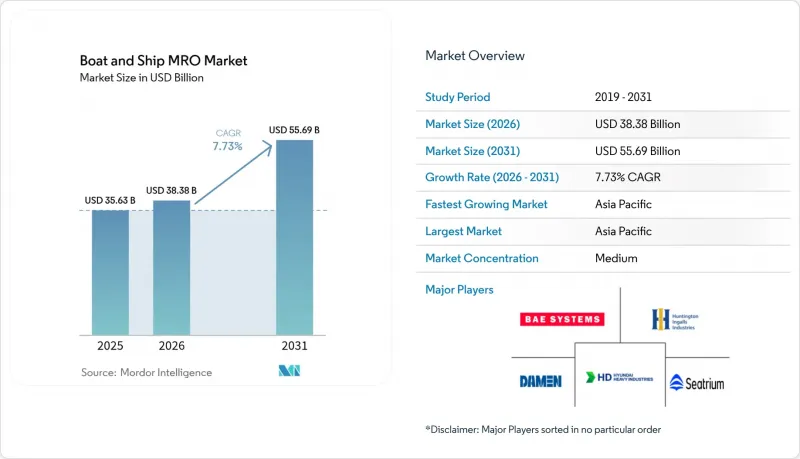
Mordor Intelligence에 의하면, 보트 및 선박 MRO 시장 규모는 2025년에 356억 3,000만 달러로 평가되었고, 2026년에 383억 8,000만 달러로 추정되고, 2031년까지 556억 9,000만 달러에 이를 것으로 예측되며, 2026-2031년 CAGR 7.73%로 성장할 전망입니다.
본 보고서는 선박 유형별(보트, 요트, 기타), 선박 용도별(민간, 기타), MRO 유형별(엔진 MRO, 기타), 서비스 제공업체 유형별(독립 조선소, 기타), 지역별로 분류되어 있습니다. 시장 예측은 금액(달러)으로 표시되어 있습니다.
세계의 보트 및 선박 MRO 시장 동향과 인사이트
IMO의 환경 규제 강화
2026년에 EEXI 및 CII 규정이 전면 시행됨에 따라, 성능 평가가 낮은 등급에 속하는 선박에 대해 벌칙이 부과되게 되었습니다. 이에 따라 선주들은 저마찰 선체 도장, 프로펠러 피치 변경, 엔진 출력 저감 등의 조치를 포함한 에너지 효율 향상을 위한 개조를 도입해야 하는 상황에 놓였습니다. 2027년부터는 ‘FuelEU Maritime’에 따라 EU로 항해하는 선박에 대해 금전적 벌금이 부과될 예정입니다. 이에 따라 특히 잔여 수명이 긴 선박의 경우, 스크러버 설치나 LNG로의 전환을 검토하는 것이 경제적으로 타당해집니다. 2024년, 머스크는 보유 중인 컨테이너선의 대부분에 대해 개조 공사를 실시하여 전체 선단의 연료 소비량을 대폭 줄이는 한편, 신조선 발주를 연기했습니다. 현재 싱가포르와 한국의 조선소에서 발주된 밸러스트수 처리 장치 설치 잔여 물량은 2026년 중반까지 이어지고 있으며, 이는 선급 협회의 승인과 OEM과의 제휴를 보유한 시설의 경쟁 우위를 더욱 강화하고 있습니다.
전 세계 선단의 노후화
팬데믹 기간 동안 선주들이 신조선 건조를 연기함에 따라 상선 선단의 평균 선령이 크게 상승했습니다. 노후화된 선박의 경우, 드라이독 정비 예산의 상당 부분을 강재 교체 비용이 차지하고 있습니다. 한편, 엔진 관련 수리비는 주로 크랭크샤프트 연마 및 터보차저 개조에 의해 차지되고 있습니다. 이러한 추세는 유조선의 평균 선령이 지속적으로 상승하고 있는 미국의 존스법 적용 선대에서 두드러지게 나타납니다. 교체 비용이 터무니없이 높아짐에 따라, 운항사는 선령 중반기의 지속적인 오버홀에 점점 더 주력하고 있습니다. 게다가 OEM의 기술 데이터에 접근할 수 없는 독립 조선소는 복잡한 디젤 엔진 업그레이드를 수행하는 데 어려움을 겪고 있으며, 이러한 작업은 브랜드 계열 서비스 센터로 이전되고 있습니다.
높은 자본 집약도와 도크 용량 부족
대형 선박용 새로운 도크를 건설하려면 막대한 투자가 필요하며, 수년이 소요되기도 합니다. 이러한 장기간의 공사 기간이 규제 구역 내 확장을 저해하는 요인이 되고 있습니다. 미국 동부 해안의 조선소는 가동률이 높으며, 수요가 가장 높은 도크 슬롯은 해군 프로젝트가 차지하고 있습니다. 예를 들어, 노퍽에 위치한 주요 시설의 경우, 그 용량의 상당 부분을 해군의 수상 전투함에 할당하고 있습니다. 캘리포니아 해안 위원회가 최근 샌디에이고에서의 도크 확장을 저지한 사례가 보여주듯이, 환경 인가를 획득하는 과정에서 이러한 공사 기간이 더욱 길어질 가능성이 있습니다.
부문 분석
2025년 현재, 상선은 보트 및 선박 MRO 시장 점유율의 63.17%를 차지했으며, 2031년까지 연평균 성장률(CAGR) 7.75%를 나타낼 것으로 예측됩니다. 전 세계에 광범위한 선단을 보유한 컨테이너선은 파나마 운하의 최근 흘수 제한에 따라 통행 권한을 확보하기 위해 선체 코팅 갱신을 해야만 했습니다. 한편, 요트는 톤수 등급으로는 소규모이지만, 1미터당 수익률 측면에서는 높은 수익을 창출하고 있습니다. 주요 유럽 조선소들은 최근 고부가가치 개조 공사의 대부분을 확보했습니다. 그러나 복합재료 수리 분야의 인력 부족으로 인해 대기 시간이 크게 늘어났습니다. 레저용 보트에 대한 수요는 여전히 분산되어 있으며, 마리나나 출장 기술자를 통해 제공되고 있습니다. 대조적으로, 조사선과 준설선은 DP 시스템 교정에 능숙한 전문 조선소에 의존하고 있습니다. 그 결과, 보트·선박 MRO 시장에서는 다양한 서비스 모델이 나타나고 있으며, 하위 부문 전체의 규모의 경제가 제한되고 있습니다.
상업용 선단의 개조 주기는 향후 몇 년간 스크러버 설치만으로도 시장에 크게 기여할 것으로 예상되며, 이는 보트 및 선박 MRO 시장의 초석이 되고 있습니다. 요트 개조는 부유층의 재량 지출에 영향을 받지만(최근 몇 년간 축소 추세를 보였으나 가까운 시일 내에 회복될 것으로 전망됩니다), 보트 관련 작업은 여전히 계절적 변동의 영향을 받기 쉬운 상황입니다. 이러한 계절적 수요 변동으로 인해 북미에서는 매년 봄에 인력 확보 문제가 발생하고 있습니다. 이러한 격차로 인해 조선소는 전문 분야를 확립할 수밖에 없는 상황입니다. 요트와 상선 양쪽 모두에 걸쳐 사업을 전개하려는 조선소는 설비나 인력의 불일치로 인해 이익률 침체를 자주 겪고 있습니다.
2025년에는 보트 및 선박 MRO 시장 중 상선이 58.73%를 차지했으나, 현대화 예산 증가에 따라 해군 관련 프로젝트는 2031년까지 연평균 성장률(CAGR) 7.87%로 가장 높은 성장률을 기록할 전망입니다. 미국 해군은 콜롬비아급 잠수함의 수명 주기 운영을 지원하기 위해 그로턴 기지의 시설 확장에 막대한 투자를 하고 있습니다. 한편, 일본은 차년도 해상 방위 예산의 대폭 증액을 승인했습니다. 민간 부문의 매출은 방위 부문을 상회하고 있지만, 경쟁으로 인해 이익률이 줄어들고 있어 조선소들은 장기 해군 계약에 주력하고 있습니다.
방위 부문의 정비·수리·오버홀(MRO) 업무는 엄격한 사이버 보안 요건과 ‘국방 연방 조달 규칙 보충 규정(DFARS)’ 준수로 인해 제약을 받고 있습니다. 이러한 요건들은 조선소에 막대한 인프라 비용을 부과하게 되며, 그 결과 진입 장벽이 높아지고 있습니다. 민간 기업들은 가동 시간을 보장받는 대가로 고정된 연간 요금을 지불하는 해군용 정비 계약을 점점 더 많이 채택하고 있으며, 이 모델은 주로 OEM(Original Equipment Manufacturer) 네트워크에 이익을 가져다주고 있습니다. 민간 선박 MRO 부문에서는 시장이 여전히 매우 세분화되어 있으며, 선정 과정에서는 가격보다 조선소의 평판이 더 중요하게 여겨집니다.
지역별 분석
아시아태평양은 보트 및 선박 MRO 시장을 독점하고 있으며, 2025년에는 매출의 36.73%를 차지했으며, 2031년까지 연평균 성장률(CAGR) 7.83%를 나타낼 것으로 예측됩니다. CSSC가 주도하는 중국의 산업 재편, 한화오션의 필리 조선소와의 최근 거래(이로 인해 한국이 존스법에 재가입하게 됨), 인도의 사갈마라 계획 확대가 주요 촉진요인으로 작용하고 있습니다. 싱가포르에 본사를 둔 Seatrium은 Keppel과 Sembcorp의 시너지 효과를 활용하여 가까운 시일 내에 해상 풍력 발전용 선박 개조에 관한 대규모 계약을 수주했습니다. 한편, 일본의 잠수함 수명 연장 프로그램은 미쓰비시 조선소와 가와사키 중공업 조선소 수요를 뒷받침하고 있지만, 지정학적 긴장으로 인해 유럽과 미국의 선주들이 중국 시설에 보이는 관심은 주춤하고 있습니다.
북미에서는 해군의 발주가 이용 가능한 조선 능력의 대부분을 차지하고 있어 도크 부족에 직면해 있습니다. ‘존스법’은 보호주의적 측면을 가지고 있는 반면, 세계 기준에 비해 국내 MRO(정비·수리·오버홀) 비용을 크게 끌어올리고 있습니다. 최근 캐나다의 시스팬(Seaspan)사가 쇄빙선 MRO와 관련된 대규모 계약을 수주했으며, NASSCO 등 미국의 조선소들은 앞으로도 해군과 민간 부문의 수주 균형을 잘 유지하고 있어, 이로 인해 운항사들은 멕시코의 도크를 고려하도록 유도되고 있습니다.
유럽에서는 고부가가치의 해군 및 요트 관련 사업과 튀르키예 및 루마니아의 경쟁적인 민간 프로젝트가 조화를 이루고 있습니다. 핀칸티에리(Fincantieri)사가 이탈리아 해군용 LHD(강습상륙함)와 체결한 계약에는 수십 년에 걸친 수명 주기 지원이 포함되어 있으며, 나반티아(Navantia)사의 S-80 Plus형 잠수함 수출로 인해 스페인의 조선 시설은 장기적으로 가동량이 확보되고 있습니다. EU 혁신 기금이 지원하는 친환경 개조 보조금은 지역 조선소를 우대하고 있지만, 예산을 중시하는 선주들은 여전히 유조선을 튀르키예의 드라이독으로 보내는 것을 선택함으로써 상당한 비용 절감을 실현하고 있습니다.
기타 혜택
- 엑셀 형식 시장 예측(ME) 시트
- 3개월간의 애널리스트 지원
자주 묻는 질문
목차
제1장 서론
제2장 조사 방법
제3장 주요 요약
제4장 시장 구도
제5장 시장 규모 및 성장 예측
제6장 경쟁 구도
제7장 시장 기회 및 향후 전망
AJY 26.09.11According to Mordor Intelligence, the boat and Ship MRO Market size is projected to be USD 35.63 billion in 2025, USD 38.38 billion in 2026, and reach USD 55.69 billion by 2031, growing at a CAGR of 7.73% from 2026 to 2031.
This report is Segmented by Vessel Type (Boat, Yacht, and More), Vessel Application (Private and More), MRO Type (Engine MRO and More), Service Provider Type (Independent Yards and More), and Geography. The Market Forecasts are Provided in Value (USD).
Global Boat And Ship MRO Market Trends and Insights
Stricter IMO Environmental Mandates
In 2026, the EEXI and CII rules came into full effect, imposing penalties on vessels rated in lower performance bands. This has driven ship owners to adopt energy-efficiency retrofits, including measures such as low-friction hull coatings, propeller re-pitching, and engine derating. Starting in 2027, FuelEU Maritime will impose monetary penalties for voyages heading to the EU. This makes it economically viable for ships, especially those with significant remaining service life, to consider converting to scrubbers or LNG. In 2024, Maersk undertook retrofitting on a substantial portion of its container ships, achieving a notable reduction in fleet fuel consumption and postponing newbuild orders . Ballast-water installation backlogs now stretch into mid-2026 at Singapore and South Korean yards, reinforcing the competitive edge of facilities holding class approvals and OEM alliances.
Aging Global Vessel Fleet
The median age of merchant fleets has significantly increased, as owners delayed new builds during the pandemic. For older ships, steel renewals now account for a substantial portion of dry-dock budgets. Meanwhile, engine invoices are primarily driven by crankshaft grinding and turbocharger refurbishments. This trend is evident in the U.S. Jones Act fleet, where the average tanker age continues to rise. With replacement costs becoming prohibitively high, operators are increasingly committed to ongoing mid-life overhauls. Furthermore, independent yards, lacking access to OEM technical data, face difficulties executing complex diesel upgrades, leading to a shift of such work to branded service centers.
High Capital Intensity & Dock-Capacity Scarcity
Constructing a new dock for large ships can require significant investment and take several years, a timeline that deters expansion in regulated areas. U.S. East Coast shipyards operate at high capacity, with naval projects dominating the most sought-after slots; for instance, a major facility in Norfolk dedicated a substantial portion of its capacity to Navy surface combatants. Environmental clearances can lengthen these timelines, as highlighted by the California Coastal Commission's recent blockage of a dock extension in San Diego.
Other drivers and restraints analyzed in the detailed report include:
- Growth in Commercial Marine Trade
- Naval Fleet Modernization Budget
- Marine-Fuel Price Volatility Limiting Budgets
For complete list of drivers and restraints, kindly check the Table Of Contents.
Segment Analysis
Commercial vessels held 63.17% of the boat and ship MRO market share in 2025 and are projected to post a 7.75% CAGR till 2031. With an extensive global fleet, the Panama Canal's recent draft restrictions prompted container ships to renew hull coatings, ensuring they retained their transit slots. While yachts represent a smaller tonnage class, they command premium returns on a dollar-per-meter basis. European yards in key countries secured a majority of high-value refits recently. However, labor shortages in composite repairs significantly extended queue times. Demand for recreational boats remains fragmented, channeled through marinas and mobile technicians. In contrast, research ships and dredgers depend on specialized yards adept at DP system calibration. Consequently, the boat and ship MRO market showcases varied service models, limiting economies of scale across its sub-segments.
The commercial fleet's retrofit cycle, with scrubber installations alone projected to contribute significantly to the market over the coming years, serves as a cornerstone for the boat and ship MRO market. While yacht refits are influenced by the discretionary spending of high-net-worth individuals-contracting in recent years but witnessing a rebound in the near future-boat work remains subject to seasonal fluctuations. These seasonal demands create staffing challenges each spring in North America. Such disparities compel yards to carve out specializations; those attempting to straddle both yachts and commercial hulls frequently find themselves grappling with margin underperformance, a consequence of mismatches in tooling and talent.
Commercial traffic accounted for 58.73% of the boat and ship MRO market in 2025, yet naval projects are set to record the fastest 7.87% CAGR through 2031 as modernization budgets rise. The U.S. Navy is making a significant investment to expand Groton facilities to support Columbia-class lifecycle operations. Meanwhile, Japan has approved a notable increase in its maritime defense budget for the upcoming fiscal year. While commercial revenues surpass those of the defense sector, the former face narrowing margins due to competitive tenders, prompting shipyards to focus on extended naval contracts.
Defense Maintenance, Repair, and Overhaul (MRO) operations are constrained by rigorous cybersecurity mandates and compliance with the Defense Federal Acquisition Regulation Supplement (DFARS). These requirements impose substantial infrastructure costs on shipyards, thereby raising entry barriers. Commercial entities are increasingly adopting naval availability contracts, agreeing to fixed annual fees in exchange for uptime assurances, a model that primarily benefits Original Equipment Manufacturer (OEM) networks. In the private-vessel MRO segment, the market remains highly fragmented, with a yard's reputation outweighing pricing considerations in the selection process.
Complete Report Scope:
- By Vessel Type
- Boat
- Yacht
- Commercial Vessels
- Other Types
- By Vessel Application
- Private
- Commercial
- Defense
- By MRO Type
- Engine MRO
- Component MRO
- Dry-dock / Hull
- Modifications and Retrofits
- Other Types
- By Service Provider Type
- Independent Yards
- OEM-Affiliated MROs
- In-house Operator Facilities
- By Geography
- North America
- United States
- Canada
- Rest of North America
- South America
- Brazil
- Argentina
- Rest of South America
- Europe
- Germany
- United Kingdom
- France
- Italy
- Spain
- Russia
- Rest of Europe
- Asia Pacific
- China
- Japan
- India
- South Korea
- Rest of Asia Pacific
- Middle East and Africa
- Saudi Arabia
- United Arab Emirates
- Turkey
- South Africa
- Rest of Middle East and Africa
- North America
Geography Analysis
Asia Pacific dominated the boat and ship MRO market, accounting for 36.73% of revenue in 2025 and forecast to grow at a 7.83% CAGR through 2031. Chinese consolidation led by CSSC, Hanwha Ocean's recent deal with Philly Shipyard, marking South Korea's return to the Jones Act, and India's Sagarmala expansions are pivotal drivers. Seatrium, based in Singapore, secured a significant contract for offshore wind vessel refits in the near term, capitalizing on the combined strengths of Keppel and Sembcorp . While Japan's submarine life-extension program bolsters demand at Mitsubishi and Kawasaki yards, geopolitical tensions dampen Western owners' interest in Chinese facilities.
North America grapples with a dock shortage, as naval orders consume a substantial portion of available capacity. The Jones Act, while protective, inflates domestic MRO costs significantly compared to global norms. Recently, Canada's Seaspan clinched a significant contract for icebreaker MRO, and U.S. yards like NASSCO are balancing Navy and commercial bookings well into the future, nudging operators to consider Mexican docks.
Europe harmonizes high-value naval and yacht endeavors with competitive commercial propositions from Turkey and Romania. Fincantieri's contract for the Italian Navy's LHD includes decades of lifecycle commitments, and Navantia's export of S-80 Plus submarines ensures Spanish facilities remain busy for an extended period . While EU Innovation Fund subsidies for green retrofits favor local yards, budget-conscious owners are still opting to send tankers to Turkish graving docks, enjoying significant cost savings.
- Huntington Ingalls Industries Inc.
- Zamakona Yards
- Abu Dhabi Shipbuilding Co.
- Bender CCP, Inc.
- Mitsubishi Heavy Industries Ltd.
- Bath Iron Works (General Dynamics)
- Rhoads Industries Inc.
- BAE Systems PLC
- Damen Shipyards Group
- Hyundai Heavy Industries Co.
- General Dynamics NASSCO
- Seatrium Limited
- ST Engineering
- Fincantieri S.p.A.
- Rolls-Royce Power Systems
- Caterpillar Inc. (Cat Marine)
- Wartsila Corporation
- ABB Group (ABB Marine & Ports)
Additional Benefits:
- The market estimate (ME) sheet in Excel format
- 3 months of analyst support
TABLE OF CONTENTS
1 Introduction
- 1.1 Study Assumptions & Market Definition
- 1.2 Scope of the Study
2 Research Methodology
3 Executive Summary
4 Market Landscape
- 4.1 Market Overview
- 4.2 Market Drivers
- 4.2.1 Stricter IMO Environmental Mandates
- 4.2.2 Aging Global Vessel Fleet
- 4.2.3 Growth in Commercial Marine Trade
- 4.2.4 Naval Fleet Modernization Budget
- 4.2.5 Predictive-Maintenance Adoption by Mid-Sized Yards
- 4.2.6 Green-Retrofit Subsidies for Coastal Tourism Craft
- 4.3 Market Restraints
- 4.3.1 High Capital Intensity and Dock-Capacity Scarcity
- 4.3.2 Marine-Fuel Price Volatility Limiting Budgets
- 4.3.3 Skilled Labor Gap in Composite-Hull Repair
- 4.3.4 Cyber-Security Compliance Cost for Connected Vessels
- 4.4 Value / Supply-Chain Analysis
- 4.5 Regulatory Landscape
- 4.6 Technological Outlook
- 4.7 Porter's Five Forces
- 4.7.1 Threat of New Entrants
- 4.7.2 Bargaining Power of Suppliers
- 4.7.3 Bargaining Power of Buyers
- 4.7.4 Threat of Substitutes
- 4.7.5 Competitive Rivalry
5 Market Size & Growth Forecasts (Value (USD))
- 5.1 By Vessel Type
- 5.1.1 Boat
- 5.1.2 Yacht
- 5.1.3 Commercial Vessels
- 5.1.4 Other Types
- 5.2 By Vessel Application
- 5.2.1 Private
- 5.2.2 Commercial
- 5.2.3 Defense
- 5.3 By MRO Type
- 5.3.1 Engine MRO
- 5.3.2 Component MRO
- 5.3.3 Dry-dock / Hull
- 5.3.4 Modifications and Retrofits
- 5.3.5 Other Types
- 5.4 By Service Provider Type
- 5.4.1 Independent Yards
- 5.4.2 OEM-Affiliated MROs
- 5.4.3 In-house Operator Facilities
- 5.5 By Geography
- 5.5.1 North America
- 5.5.1.1 United States
- 5.5.1.2 Canada
- 5.5.1.3 Rest of North America
- 5.5.2 South America
- 5.5.2.1 Brazil
- 5.5.2.2 Argentina
- 5.5.2.3 Rest of South America
- 5.5.3 Europe
- 5.5.3.1 Germany
- 5.5.3.2 United Kingdom
- 5.5.3.3 France
- 5.5.3.4 Italy
- 5.5.3.5 Spain
- 5.5.3.6 Russia
- 5.5.3.7 Rest of Europe
- 5.5.4 Asia Pacific
- 5.5.4.1 China
- 5.5.4.2 Japan
- 5.5.4.3 India
- 5.5.4.4 South Korea
- 5.5.4.5 Rest of Asia Pacific
- 5.5.5 Middle East and Africa
- 5.5.5.1 Saudi Arabia
- 5.5.5.2 United Arab Emirates
- 5.5.5.3 Turkey
- 5.5.5.4 South Africa
- 5.5.5.5 Rest of Middle East and Africa
- 5.5.1 North America
6 Competitive Landscape
- 6.1 Market Concentration
- 6.2 Strategic Moves
- 6.3 Market Share Analysis
- 6.4 Company Profiles (Includes Global Level Overview, Market Level Overview, Core Segments, Financials as Available, Strategic Information, Market Rank/Share for Key Companies, Products and Services, SWOT Analysis, and Recent Developments)
- 6.4.1 Huntington Ingalls Industries Inc.
- 6.4.2 Zamakona Yards
- 6.4.3 Abu Dhabi Shipbuilding Co.
- 6.4.4 Bender CCP, Inc.
- 6.4.5 Mitsubishi Heavy Industries Ltd.
- 6.4.6 Bath Iron Works (General Dynamics)
- 6.4.7 Rhoads Industries Inc.
- 6.4.8 BAE Systems PLC
- 6.4.9 Damen Shipyards Group
- 6.4.10 Hyundai Heavy Industries Co.
- 6.4.11 General Dynamics NASSCO
- 6.4.12 Seatrium Limited
- 6.4.13 ST Engineering
- 6.4.14 Fincantieri S.p.A.
- 6.4.15 Rolls-Royce Power Systems
- 6.4.16 Caterpillar Inc. (Cat Marine)
- 6.4.17 Wartsila Corporation
- 6.4.18 ABB Group (ABB Marine & Ports)
7 Market Opportunities & Future Outlook
- 7.1 White-space & unmet-need assessment