

|
시장보고서
상품코드
2124219
상지 의지 시장 : 시장 점유율 분석, 업계 동향 및 통계, 성장 예측(2026-2031년)Upper Limb Prosthetics - Market Share Analysis, Industry Trends & Statistics, Growth Forecasts (2026 - 2031) |
||||||
 Mordor Intelligence
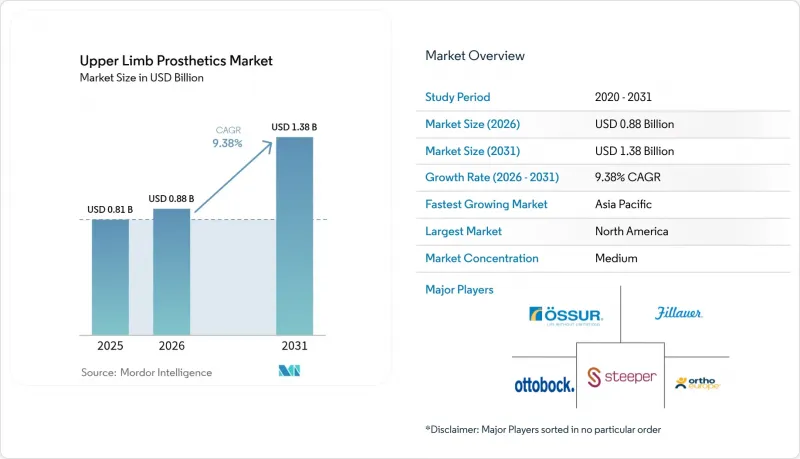
Mordor Intelligence에 의하면, 상지 의지 시장 규모는 2025년에 8억 1,000만 달러로 평가되었고, 2026년 8억 8,000만 달러에서 2031년까지 13억 8,000만 달러에 이를 것으로 예측되며, 예측 기간(2026-2031년) CAGR은 9.38%를 나타낼 전망입니다.
본 보고서는 제품 유형별(수동형·장식용 기기, 신체 동력식·기계식 기기, 근전도식·전동식 기기, 하이브리드·TMR 대응 기기), 구성 요소별(의지·말단 기기, 손목 의지, 팔꿈치 의지, 어깨·상완 의지), 최종 사용자별(전문 클리닉, 기타), 지역별(북미, 유럽, 아시아태평양, 중동 및 아프리카, 남미)로 분류되어 있습니다. 시장 예측은 금액(달러) 기준으로 제시되어 있습니다.
세계의 상지 의지 시장 동향 및 인사이트
고령화를 배경으로 한 혈관 질환 및 당뇨병에 의한 절단 사례의 급증
2024년, 전 세계 65세 이상 인구는 7억 6,100만 명에 달했으며, 연간 3.1%의 속도로 계속 증가하고 있어, 만성 질환과 고도의 외과 수술 능력이 교차하는 지역에서 상지 의지 수요를 끌어올리고 있습니다. OECD 회원국에서 관리가 미흡한 당뇨병으로 인한 혈관 합병증은 비외상성 상지 절단의 약 54%를 차지하며, 당뇨병 환자는 비당뇨병 환자에 비해 절단 위험이 15배 더 높습니다. 일본에서는 2025년 4월에 시행된 정책 전환을 반영하여, 현재 70세 이상의 개인을 대상으로 근전도식 의지에 대한 보험 적용이 이루어지고 있습니다. 절단 후 평균 수명이 연장됨에 따라, 환자는 15-20년에 걸친 의지 사용 기간 동안 정기적으로 소켓 교체, 배터리 업그레이드, 소프트웨어 업데이트가 필요합니다. 그 결과, 이러한 요인은 자립성을 유지하고 장기 요양 비용을 절감하는 내구성이 뛰어난 의료기기로의, 순환적인 것이 아닌 구조적인 의료 예산 재분배를 나타냅니다.
사용자 수용성을 높이는 AI 기반 감각 피드백 시스템의 등장
고밀도 근전도와 머신러닝 알고리즘을 결합함으로써, 의지는 단 2곳의 전극으로 8가지 이상의 잡기 패턴을 인식할 수 있게 되었으며, 인지적 부하가 경감되고 훈련 기간이 18주에서 4주로 단축되었습니다. 진동 촉각 액추에이터를 통해 제공되는 감각 피드백 덕분에 일상생활 동작 중 물건을 떨어뜨리는 비율이 41% 감소했습니다. TASKA Hand와 같은 시판 제품에는 손가락 끝의 힘 센서가 내장되어 있어, 이를 통해 모터의 토크를 동적으로 조정할 수 있으므로 수동으로 모드를 전환하지 않고도 식사 준비와 같은 섬세한 조작이 가능해집니다. 기존의 개방 루프형 장치를 양방향 인간-기계 인터페이스로 전환함으로써, AI 탑재 시스템은 사용자의 도입을 가속화하고 사용 중단률을 낮추고 있습니다.
전동 의지의 고액 도입 비용 및 평생 유지비
엔트리 레벨의 근전도식 손은 2만 달러부터 시작하지만, 폐루프 피드백을 갖춘 다관절 시스템은 12만 달러를 초과하여, 1인당 연간 의료비가 500달러 이하인 중저소득 국가에 거주하는 전 세계 절단 장애인의 68%에게는 가격적으로 감당하기 어려운 수준입니다. 소유 비용은 3-5년마다 소켓을 교체하고, 2년마다 배터리를 교체하며, 연간 500-1,000달러가 드는 소프트웨어 업데이트로 인해 더욱 치솟습니다. 미국에서조차 메디케어의 평균 수급자는 보험 적용이 있음에도 불구하고, 첨단 의지에 대해 6,200달러의 본인 부담금을 지불해야 합니다. 모듈식 3D 프린팅 설계로 소아 사용자의 도입 비용은 절감되고 있지만, 그 진전은 점진적인 수준에 그치고 있어 가격에 민감한 시장에서의 보급을 제약하고 있습니다.
부문 분석
상지 의지 시장에서는 외관을 중시하는 사용자의 요구를 충족시키는 3,000-8,000달러 가격대가 주를 이루며, 수동형 및 장식용 의지가 시장을 독점하여 2025년에는 43.82%를 차지했습니다. 바디 파워 방식 솔루션은 판매 대수의 약 28%를 차지하며, 가혹한 환경에서의 기계적 내구성을 중시하는 산업 근로자들에게 지지를 받고 있습니다. 전동식 근전도 제어 장치는 보험 적용 범위 확대와 훈련 장벽을 낮추는 AI 탑재 제어 기능에 힘입어, 2026년부터 2031년까지 연평균 성장률(CAGR) 10.06%를 나타낼 것으로 예측됩니다. 하이브리드 TMR 대응 시스템은 여전히 틈새 시장으로 남아 있지만, 여러 관절을 동시에 제어할 수 있어 학술 기관의 표준 치료 프로토콜을 재정의하고 있습니다.
이처럼 양극화된 시장 상황으로 인해 신흥국에서는 대량이지만 낮은 이익률을 보이는 수요가 패시브형 기기로 향하는 반면, 보험이 적용되는 시장에서는 고부가가치 성장이 전동식 시스템에 집중되고 있습니다. 소아용 프로그램에서는 골격이 성숙할 때까지 저비용의 프린트 바이오닉스가 채택되는 경향이 강해지고 있으며, 그 후 사용자는 다관절 손으로 업그레이드합니다. 한편, 신체 동력식 기어의 내구성은 농업 및 건설 근로자들 사이에서 충성도 높은 지지 기반을 확보하고 있지만, 센서가 탑재된 손이 해당 시장에 진입하기 시작하고 있습니다.
지역별 분석
북미는 상지 의지 시장을 주도하며, 2025년에는 전 세계 매출의 43.18%를 차지했습니다. 캐나다의 단일 지불자 제도를 채택한 주에서는 외상성 절단 환자에 대한 근전도식 의지 비용이 보상되지만, 혈관성 절단 사례에 대해서는 더 엄격한 기능 기준이 설정되어 있어 지역 간 격차가 발생하고 있습니다. 멕시코는 500-1,200달러 상당의 수동형 의지를 제조하는 소규모 공방에 의존하고 있으나, 2024년에 시작된 연방 프로그램을 통해 2028년까지 12곳의 근전도식 의지 센터를 개설할 계획이 추진되고 있습니다.
독일, 영국, 프랑스는 1대당 최대 8만 유로(8만 7,000달러)를 환급하는 법정 보험 제도의 지원을 받아 이 수치의 68%를 차지했습니다. 이 지역의 ‘의료기기 규정(MDR)’ 전환은 당초 신제품 출시를 지연시켰으나, 현재는 국경 간 승인 절차가 원활해지면서 다국적 기업의 규정 준수 비용이 절감되고 있습니다.
아시아태평양은 가장 빠른 성장이 예상되며, 2031년까지 연평균 성장률(CAGR) 12.71%로 확대될 것으로 전망됩니다. 일본의 초고령화 사회를 배경으로, 70세 이상 고령자용 전동 의족이 보험 적용 대상이 되었습니다. 중국의 현지 제조업체들은 연간 8,000대를 생산할 수 있는 시설을 구축하여 생산 규모를 확대하고 있으며, 유럽 및 미국의 동종 제품보다 40% 저렴한 가격대를 목표로 하고 있습니다. 인도에서는 가격 면에서 제약이 있지만, 2025년에는 국가 장애인 지원 프로그램의 일환으로 3D 프린팅 의족 1,200개가 배포되었습니다. 호주의 NDIS(국가 장애 보험 제도)는 의족 1개당 최대 15만 호주 달러(9만 8,000 달러)를 지원하며, 호주는 1인당 전동 의족 보급률에서 최상위권을 기록하고 있습니다.
중동 및 아프리카 시장에서는 여전히 보급률이 낮은 상황이 지속되고 있습니다. GCC는 국민을 위해 고가형 의족을 수입하고 있지만, 이주 노동자들은 자선 단체가 자금을 지원하는 의족에 의존하고 있습니다. 남미에서는 브라질과 아르헨티나에 시장이 집중되어 있으며, 부분적인 보험 적용으로 인해 전동 의지 시스템의 경우 본인 부담금이 8,000-1만 5,000 달러에 달하기 때문에 도입은 고소득층으로 한정되어 있습니다.
기타 혜택
- 엑셀 형식 시장 예측(ME) 시트
- 3개월간의 애널리스트 지원
자주 묻는 질문
목차
제1장 서론
제2장 조사 방법
제3장 주요 요약
제4장 시장 구도
제5장 시장 규모 및 성장 예측
제6장 경쟁 구도
제7장 시장 기회 및 향후 전망
AJY 26.09.11According to Mordor Intelligence, the upper limb prosthetics market size was valued at USD 0.81 billion in 2025 and is estimated to grow from USD 0.88 billion in 2026 to reach USD 1.38 billion by 2031, at a CAGR of 9.38% during the forecast period (2026-2031).

This report is Segmented by Product Type (Passive/Cosmetic, Body-Powered/Mechanical, Myoelectric/Powered, Hybrid & TMR-Enabled), Component (Hand/Terminal Device, Wrist, Elbow, Shoulder & Upper Arm), End User (Specialty Clinics, and More), and Geography (North America, Europe, Asia-Pacific, Middle East & Africa, South America). Market Forecasts are Provided in Terms of Value (USD).
Global Upper Limb Prosthetics Market Trends and Insights
Ageing-Population-Driven Vascular & Diabetic Amputations Surge
The global population aged 65 and older reached 761 million in 2024 and continues to expand at 3.1% annually, pushing demand for upper-limb devices in regions where chronic disease intersects with advanced surgical capacity. Vascular complications from uncontrolled diabetes account for roughly 54% of non-traumatic upper-limb amputations across OECD economies, and diabetic patients face a 15-fold higher amputation risk than non-diabetic cohorts. Japan now reimburses myoelectric prostheses for individuals aged 70 or older, reflecting a policy shift that took effect in April 2025. A longer post-amputation life expectancy means patients routinely require multiple socket replacements, battery upgrades, and software updates over 15-20 years of device use. Consequently, the driver represents a structural, not cyclical, reallocation of healthcare budgets toward durable medical equipment that safeguards independence and lowers long-term care spending.
Emergence of AI-Based Sensory Feedback Systems Enhancing User Acceptance
High-density electromyography paired with machine-learning algorithms now enables prosthetic hands to recognize eight or more grip patterns from only two electrode sites, cutting cognitive load and shortening training periods from 18 weeks to four.Sensory feedback delivered via vibrotactile actuators reduces object-drop rates by 41% during daily living tasks. Commercial roll-outs such as the TASKA Hand integrate fingertip force sensors that dynamically modulate motor torque, allowing delicate operations like food preparation without manual mode changes. By converting a traditionally open-loop device into a bidirectional human-machine interface, AI-enabled systems are accelerating user adoption and decreasing abandonment rates.
High Acquisition & Lifetime Maintenance Cost of Powered Prostheses
Entry-level myoelectric hands start at USD 20,000, while multi-articulated systems with closed-loop feedback exceed USD 120,000, pricing out 68% of global amputees who live in low- or middle-income countries where annual per-capita health spending falls below USD 500. Ownership costs escalate with socket replacements every 3-5 years, battery swaps every two years, and software updates that command USD 500-1,000 annually. Even in the United States, average Medicare beneficiaries face USD 6,200 in out-of-pocket expenses for an advanced device despite coverage. Although modular 3D-printed designs reduce acquisition costs for paediatric users, progress remains incremental, constraining penetration in price-sensitive markets.
Other drivers and restraints analyzed in the detailed report include:
- Rapid Advances in Myoelectric Control Algorithms & Multi-Articulated Hands
- Wider Reimbursement Expansion in Veteran & Worker-Comp Programs
- Shortage of Skilled Prosthetists for Complex Upper-Limb Fittings
For complete list of drivers and restraints, kindly check the Table Of Contents.
Segment Analysis
Passive and cosmetic limbs dominated the upper-limb prosthetics market, accounting for 43.82% in 2025, supported by price points of USD 3,000-8,000 that meet the needs of appearance-focused users. Body-powered solutions held roughly 28% of unit volume, appealing to industrial laborers who value mechanical endurance in harsh settings. Powered myoelectric devices are projected to post a 10.06% CAGR over 2026-2031, fueled by reimbursement gains and AI-enabled control that lowers training barriers. Hybrid TMR-enabled systems remain niche but deliver simultaneous multi-joint control, redefining standard-of-care protocols in academic centers.
The bifurcated landscape sends high-volume, low-margin demand toward passive devices in emerging economies, while high-value growth concentrates in powered systems across insured markets. Paediatric programs increasingly adopt low-cost printed bionics until skeletal maturity, after which users upgrade to multi-articulated hands. Meanwhile, the durability of body-powered gear is securing a loyal base among agriculture and construction workers, even as sensor-equipped hands begin to encroach on that space.
Complete Report Scope:
- By Product Type
- Passive / Cosmetic Devices
- Body-Powered / Mechanical Devices
- Myoelectric / Powered Devices
- Hybrid & TMR-Enabled Devices
- By Component
- Prosthetic Hand / Terminal Device
- Prosthetic Wrist
- Prosthetic Elbow
- Prosthetic Shoulder & Upper Arm
- By End User
- Specialty Clinics
- Hospitals & Surgical Centers
- Rehabilitation Centers
- By Geography
- North America
- United States
- Canada
- Mexico
- Europe
- Germany
- United Kingdom
- France
- Italy
- Spain
- Rest of Europe
- Asia-Pacific
- China
- Japan
- India
- Australia
- South Korea
- Rest of Asia-Pacific
- Middle East & Africa
- GCC
- South Africa
- Rest of Middle East & Africa
- South America
- Brazil
- Argentina
- Rest of South America
- North America
Geography Analysis
North America led the upper-limb prosthetics market, accounting for 43.18% of global revenue in 2025. Canada's single-payer provinces reimburse myoelectric solutions for traumatic amputees but maintain stricter functional criteria for vascular cases, creating regional disparities. Mexico relies on small workshops producing passive limbs at USD 500-1,200, though a federal program launched in 2024 aims to open 12 myoelectric centers by 2028.
Germany, the United Kingdom, and France accounted for 68% of that figure, aided by statutory insurance that reimburses up to EUR 80,000 (USD 87,000) per device. The region's transition to the Medical Device Regulation initially slowed launches but is now smoothing cross-border approvals, lowering compliance costs for multinationals.
Asia-Pacific is expected to deliver the fastest growth, expanding at a 12.71% CAGR through 2031. Japan's super-aged society has prompted insurance to cover powered devices for seniors over 70. China's local manufacturers are scaling up output with facilities capable of producing 8,000 units per year, targeting price points 40% below those of Western analogues. India faces affordability constraints, yet it distributed 1,200 printed limbs in 2025 under a national disabilities program. Australia's NDIS funds up to AUD 150,000 (USD 98,000) per prosthesis, making the country a per-capita leader in powered adoption.
Markets in the Middle East and Africa remain underpenetrated; GCC nations import high-end devices for their citizens, while migrant laborers rely on charity-funded prosthetics. South America is concentrated in Brazil and Argentina, where partial reimbursement leaves out-of-pocket gaps of USD 8,000-15,000 for powered systems, limiting uptake to higher-income groups.
- Arm Dynamics
- Blatchford
- BrainRobotics
- College Park Industries
- Coapt
- COVVI Ltd
- DEKA Integrated Solutions
- Fillauer
- Hanger Clinic
- Mobius Bionics LLC
- Motorica LLC
- Naked Prosthetics
- Ortho Europe
- Ottobock
- Ossur
- Protunix
- Proteor SAS
- RSLSteeper
- Steeper
- TASKA Prosthetics
Additional Benefits:
- The market estimate (ME) sheet in Excel format
- 3 months of analyst support
TABLE OF CONTENTS
1 Introduction
- 1.1 Study Assumptions & Market Definition
- 1.2 Scope of the Study
2 Research Methodology
3 Executive Summary
4 Market Landscape
- 4.1 Market Overview
- 4.2 Market Drivers
- 4.2.1 Ageing-Population-Driven Vascular & Diabetic Amputations Surge
- 4.2.2 Emergence of AI-Based Sensory Feedback Systems Enhancing User Acceptance
- 4.2.3 Rapid Advances in Myoelectric Control Algorithms & Multi-Articulated Hands
- 4.2.4 Wider Reimbursement Expansion in Veteran & Worker-Comp Programs
- 4.2.5 3D-Printed, Low-Cost Paediatric Bionic Arms Addressing Unmet Needs
- 4.2.6 Defence-Funded Osseointegration R&D Crossing Over to Civilian Clinics
- 4.3 Market Restraints
- 4.3.1 High Acquisition & Lifetime Maintenance Cost of Powered Prostheses
- 4.3.2 Shortage Of Skilled Prosthetists for Complex Upper-Limb Fittings
- 4.3.3 Battery-Life & Durability Gaps in Multi-DOF Devices
- 4.3.4 Fragmented National Regulatory Pathways Slowing Cross-Border Launches
- 4.4 Regulatory Landscape
- 4.5 Technological Outlook
- 4.6 Porter's Five Forces Analysis
- 4.6.1 Threat of New Entrants
- 4.6.2 Bargaining Power of Buyers
- 4.6.3 Bargaining Power of Suppliers
- 4.6.4 Threat of Substitute Products
- 4.6.5 Intensity of Competitive Rivalry
5 Market Size & Growth Forecasts
- 5.1 By Product Type
- 5.1.1 Passive / Cosmetic Devices
- 5.1.2 Body-Powered / Mechanical Devices
- 5.1.3 Myoelectric / Powered Devices
- 5.1.4 Hybrid & TMR-Enabled Devices
- 5.2 By Component
- 5.2.1 Prosthetic Hand / Terminal Device
- 5.2.2 Prosthetic Wrist
- 5.2.3 Prosthetic Elbow
- 5.2.4 Prosthetic Shoulder & Upper Arm
- 5.3 By End User
- 5.3.1 Specialty Clinics
- 5.3.2 Hospitals & Surgical Centers
- 5.3.3 Rehabilitation Centers
- 5.4 By Geography
- 5.4.1 North America
- 5.4.1.1 United States
- 5.4.1.2 Canada
- 5.4.1.3 Mexico
- 5.4.2 Europe
- 5.4.2.1 Germany
- 5.4.2.2 United Kingdom
- 5.4.2.3 France
- 5.4.2.4 Italy
- 5.4.2.5 Spain
- 5.4.2.6 Rest of Europe
- 5.4.3 Asia-Pacific
- 5.4.3.1 China
- 5.4.3.2 Japan
- 5.4.3.3 India
- 5.4.3.4 Australia
- 5.4.3.5 South Korea
- 5.4.3.6 Rest of Asia-Pacific
- 5.4.4 Middle East & Africa
- 5.4.4.1 GCC
- 5.4.4.2 South Africa
- 5.4.4.3 Rest of Middle East & Africa
- 5.4.5 South America
- 5.4.5.1 Brazil
- 5.4.5.2 Argentina
- 5.4.5.3 Rest of South America
- 5.4.1 North America
6 Competitive Landscape
- 6.1 Market Concentration
- 6.2 Market Share Analysis
- 6.3 Company Profiles (includes Global Level Overview, Market Level Overview, Core Segments, Financials as Available, Strategic Information, Market Rank/Share for Key Companies, Products & Services, and Recent Developments)
- 6.3.1 Arm Dynamics
- 6.3.2 Blatchford Limited
- 6.3.3 BrainRobotics
- 6.3.4 College Park Industries
- 6.3.5 Coapt LLC
- 6.3.6 COVVI Ltd
- 6.3.7 DEKA Integrated Solutions
- 6.3.8 Fillauer LLC
- 6.3.9 Hanger Clinic
- 6.3.10 Mobius Bionics LLC
- 6.3.11 Motorica LLC
- 6.3.12 Naked Prosthetics
- 6.3.13 Ortho Europe
- 6.3.14 Ottobock SE & Co. KGaA
- 6.3.15 Ossur
- 6.3.16 Protunix
- 6.3.17 Proteor SAS
- 6.3.18 RSLSteeper
- 6.3.19 Steeper Inc.
- 6.3.20 TASKA Prosthetics
7 Market Opportunities & Future Outlook
- 7.1 White-space & Unmet-Need Assessment


