

|
시장보고서
상품코드
2124224
불소화합물 시장 : 시장 점유율 분석, 업계 동향 및 통계, 성장 예측(2026-2031년)Fluorochemical - Market Share Analysis, Industry Trends & Statistics, Growth Forecasts (2026 - 2031) |
||||||
 Mordor Intelligence
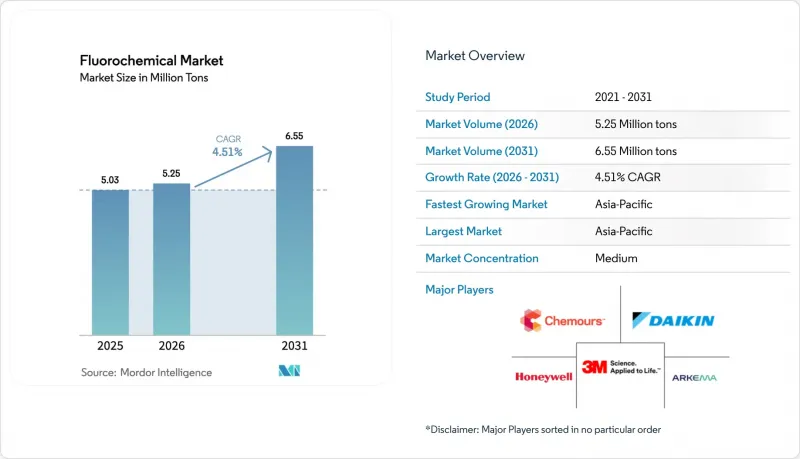
Mordor Intelligence에 의하면, 불소화합물 시장 규모는 2025년 503만 톤으로 평가되었고, 2026년에는 525만 톤으로 추정되고, 2026-2031년 CAGR 4.51%로 성장을 지속할 전망이며, 2031년에는 655만 톤에 이를 것으로 예측됩니다.

본 보고서는 제품 유형별(플루오로카본, 불소 수지, 특수 불소화합물 및 무기 불소화합물, 기타), 최종 사용자 산업별(냉동·공조, 자동차, 전기 및 전자, 기타), 지역별(아시아태평양, 북미, 유럽, 남미, 중동 및 아프리카)로 분류되어 있습니다. 시장 예측은 수량(톤) 기준으로 제시되어 있습니다.
세계의 불소화합물 시장 동향 및 인사이트
신흥 경제국에서의 HVAC·콜드체인 확충
인도의 냉장 인프라 투자액은 수확 후 식품 손실을 줄이기 위한 정부 프로그램의 지원에 힘입어 2032년까지 474억 달러에 달할 전망입니다. 태국, 베트남, 인도네시아 전역의 새로운 창고와 슈퍼마켓도 유사한 추세를 보이고 있지만, 효율성에 관한 규제가 비교적 완만하기 때문에 중간 수준의 GWP(지구 온난화 지수)를 가진 혼합물이 앞으로 2-3년 동안 계속 사용될 전망입니다. 걸프 연안 국가들은 키갈리 의정서의 할당량 초과에 따른 벌금을 피하기 위해, 공장에서 충전된 HFO 시스템을 우선적으로 도입하는 냉장 창고를 구축하여 식량 안보 목표 달성을 뒷받침하고 있습니다. 이로 인해 장비 교체 주기가 단축되고 있습니다. 이러한 설비는 불소화합물 시장에 꾸준한 수요를 창출하고 있습니다. 이는 스플릿형 에어컨 1대당 보통 1-2Kg의 냉매가 포함되어 있고, 상업용 워크인 냉장고에는 5-10Kg의 냉매가 충전되어 있기 때문입니다. 엄격한 도시 화재 예방 조례로 인해 인구 밀도가 높은 도시 지역에서의 프로판 가스 도입이 지연되고 있어, 불소계 냉매에 대한 수요가 더욱 장기화되고 있습니다.
저 GWP HFO 냉매로의 전환 확대
EU 규정 2024/573과 미국 AIM법에 따라 2036년까지 HFC를 85% 감축해야 할 의무가 부과됨에 따라, 자동차 및 칠러 분야에서 R-1234yf와 R-1234ze의 채택이 가속화되고 있습니다. EU, 미국, 일본, 한국의 소형 차량은 2025년까지 거의 완전히 R-1234yf로 전환되었으나, 생산이 2개 특허 보유사에 집중되어 있어 이 제품의 가격은 단종된 R-134a의 약 3배 수준을 유지하고 있습니다. 상업용 공조 설비의 개조에서는 R-513A가 선호되지만, 윤활유나 개스킷의 업그레이드가 필요한 경우가 많아 투자 회수 기간이 길어지고 있습니다. 중국의 각 OEM 업체들은 국내 판매용으로 여전히 R-32를 추진하고 있으며, 수출 규제 요건이 2020년대 후반에 본격화될 때까지 HFO로의 광범위한 전환을 미루고 있습니다. 천연 냉매 도입, 특히 CO2 초임계 시스템을 채택한 슈퍼마켓의 경우 유럽에서 점유율을 지속적으로 확대하고 있지만, 북미에서는 에너지 비용 급등과 규제 지연으로 인해 유사한 대체 추세가 주춤하고 있습니다.
전 세계 PFAS 규제 강화
2024년 4월, 미국 환경보호청(EPA)은 음용수 내 PFOA 및 PFOS에 대해 4ppt의 기준치를 설정했습니다. 이로 인해 CERCLA(종합적 환경 대응·배상·책임법)에 따른 책임이 발생하며, 제조업체는 100억 달러를 초과할 가능성이 있는 정화 조치에 관한 합의금 지급에 직면하게 됩니다. EU의 광범위한 PFAS 규제안은 2025년에 최종 의견 단계로 접어들었지만, 반도체 칩 및 의료기기에 대한 적용 제외 조치는 여전히 불투명하여 투자 결정을 지연시키고 있습니다. 독일에서는 현재 불소화합물의 제조 및 취급 시설에서 격리 조치의 증명이 의무화되어 있어, 운영 비용 증가로 이어지고 있습니다. 한편, 일본에서는 더 엄격한 규제를 예고하는 모니터링 지침이 발표되었습니다. 반도체 및 의료 분야의 이해관계자들은 PTFE 및 기타 불소 수지에 대한 대체재가 없습니다고 주장하고 있지만, 여론의 압력으로 인해 승인 절차가 복잡해지고 있어 불소화합물 시장에 큰 부담이 되고 있습니다.
부문별 분석
불소 수지는 2031년까지 연평균 성장률(CAGR) 8.65%로 확대될 것으로 예측되며, 이는 전체 불소화합물 시장의 성장률보다 거의 2배에 달하는 수준입니다. 2025년에는 반도체용 가스 및 의약품 중간체가 고급 틈새 시장에서 계속해서 지배적인 위치를 차지함에 따라, 특수 제품과 무기 제품이 불소화합물 시장 점유율의 56.81%를 차지했습니다. PTFE는 씰 및 개스킷 분야에서 타의 추종을 불허하는 화학적 비활성 특성을 발휘하여 여전히 판매량 1위를 유지하고 있습니다. 한편, 전기차(EV) 배터리에서 PVDF가 바인더로 사용되는 역할은 두 자릿수 성장률을 기록하며 확대되고 있으며, 이로 인해 배터리 재료용 불소화합물 시장 규모가 확대되고 있습니다. 불소 엘라스토머는 대체가 허용되지 않는 항공우주 부문 및 엔진룸 내 사양으로 인해 Kg당 가격이 가장 높습니다.
PTFE와 PVDF의 성장세는 키갈리 할당 제도 하에서 축소되는 HFC의 물량과 대조적입니다. HFO의 도입은 이러한 축소를 부분적으로만 상쇄하고 있어, 플루오로카본의 전반적인 수요는 보합세에서 소폭 감소할 전망입니다. 중국 내 PVDF와 PTFE의 급속한 생산 확대는 유럽이나 미국에서 PFAS 수입 규제가 강화될 경우 공급 과잉의 위험을 초래할 가능성이 있습니다. 그러나 저렴한 비용과 자체 보유한 형석 덕분에 중국의 생산량은 경쟁력을 유지하고 있습니다. ‘기타 제품’, 특히 불소계 계면활성제는 가장 엄격한 규제 모니터링 대상이며, PFAS에 대한 광범위한 금지 조치가 구체화될 경우 시장 규모가 대폭 축소될 가능성이 있습니다.
지역별 분석
아시아태평양은 2025년에 불소화합물 시장의 61.52%를 차지한 것으로 평가되었으며, 2031년까지 연평균 성장률(CAGR) 4.88%를 나타낼 것으로 전망됩니다. 중국의 수직 통합형 대기업들은 자사가 보유한 형석과 HF를 활용하여 비용 우위를 유지하고 있는 반면, 인도에서는 474억 달러 규모의 콜드체인 구축으로 인해 HFC와 R-32에 대한 수요가 증가하고 있습니다. 일본과 한국은 생산 능력이 중국으로 이전됨에 따라 고순도 가스 수입을 늘리고 있으며, 이는 리쇼어링을 촉진하여 2027년 이후 해당 지역의 불소화합물 시장 거래량을 끌어올릴 가능성이 있습니다.
북미는 2025년에 2위를 차지했으며, 애리조나주, 텍사스주, 오하이오주의 반도체 메가 프로젝트와 자동차에 대한 R-1234yf 채택 의무화가 이를 뒷받침했습니다. 허가 지연 및 인력 부족으로 인해 신규 팹의 가동 개시가 다소 늦어지면서 단기적인 시장 규모 확대는 억제되고 있으나, 일단 가동에 들어가면 추가적인 NF3 및 CF4 수요가 해당 지역의 불소화합물 시장을 대폭 확대시킬 것으로 예측됩니다. 캐나다에서는 오일샌드 처리 및 항공우주 산업의 생산이 PTFE와 불소 엘라스토머 수요를 뒷받침하고 있는 반면, 멕시코는 미국의 HF 플랜트용 불화칼슘(fluorspar) 공급국으로서의 역할을 강화하고 있습니다.
유럽 시장 점유율은 하락했습니다. 이는 F-가스 할당 제한으로 인해 신규 HFC 판매가 억제되고, PFAS 규제에 대응하는 데 드는 비용이 생산 능력 확장을 방해했기 때문입니다. 각 생산 업체들은 현재 항공우주 및 의료기기 분야의 규제 면제를 활용하여, 높은 수익률을 보이는 특수 틈새 시장과 불소 수지 재활용에 주력하고 있습니다. 남미와 중동 및 아프리카는 여전히 시장 규모가 작지만, 냉동 인프라, 지역 냉방 프로젝트, 생활 수준 향상으로 인한 가전제품의 첫 구매 촉진에 힘입어 평균 이상의 성장을 기록하고 있습니다.
기타 혜택
- 엑셀 형식 시장 예측(ME) 시트
- 3개월간의 애널리스트 지원
자주 묻는 질문
목차
제1장 서론
제2장 조사 방법
제3장 주요 요약
제4장 시장 구도
제5장 시장 규모 및 성장 예측
제6장 경쟁 구도
제7장 시장 기회 및 향후 전망
AJY 26.09.11According to Mordor Intelligence, the fluorochemical market size is expected to grow from 5.03 million tons in 2025 to 5.25 million tons in 2026 and is forecast to reach 6.55 million tons by 2031 at a 4.51% CAGR over 2026-2031.
This report is Segmented by Product Type (Fluorocarbon, Fluoropolymer, Specialty and Inorganic Fluorochemicals, and Other Products), End-User Industry (Refrigeration and Air Conditioning, Automotive, Electrical and Electronics, and More), and Geography (Asia-Pacific, North America, Europe, South America, Middle East and Africa). The Market Forecasts are Provided in Terms of Volume (Tons).
Global Fluorochemical Market Trends and Insights
HVAC and Cold-Chain Build-Out in Emerging Economies
Cold-storage infrastructure spending in India is rising toward USD 47.4 billion by 2032, spurred by government programs to cut post-harvest food loss. New warehouses and supermarkets across Thailand, Vietnam, and Indonesia follow similar trajectories, albeit under looser efficiency rules, allowing medium-GWP blends to remain relevant for two to three more years. Gulf states back food-security targets with chilled warehouses that prefer factory-charged HFO systems to avoid Kigali quota penalties, compressing equipment-replacement cycles. These installations add steady volume to the Fluorochemicals market as each split air-conditioner typically contains one to two kilograms of refrigerant, while commercial walk-ins carry five to 10 kilograms. Strict urban-fire codes delay propane uptake in densely populated cities, further extending demand for fluorocarbon options.
Growing Transition to Low-GWP HFO Refrigerants
EU Regulation 2024/573 and the U.S. AIM Act together force an 85% HFC reduction before 2036, accelerating adoption of R-1234yf and R-1234ze in vehicles and chillers. Light-duty vehicles in the EU, U.S., Japan, and South Korea switched almost entirely to R-1234yf by 2025, yet the product remains priced at roughly triple that of phased-out R-134a because production is concentrated at two patent-holders. Commercial HVAC retrofits favor R-513A but often require lubricant and gasket upgrades that prolong payback periods. China's OEMs still push R-32 for domestic sales, deferring a broad HFO transition until export compliance demands take hold late in the decade. Natural refrigerant installations, particularly CO2 transcritical supermarkets, keep gaining share in Europe, but higher energy costs and regulatory lag in North America slow similar substitution trends.
Global PFAS Regulatory Clamp-Down
In April 2024, the U.S. EPA set 4 ppt limits for PFOA and PFOS in drinking water, triggering CERCLA liability and exposing producers to remediation settlements that can exceed USD 10 billion. The EU's broad PFAS restriction proposal advanced to final opinion in 2025; exemptions for chips and medical devices remain uncertain and delay investment commitments. Germany now requires proof of containment at fluorochemical sites, raising operating costs, while Japan issued monitoring guidelines that foreshadow stricter rules. Semiconductor and medical stakeholders argue that PTFE and other fluoropolymers lack substitutes, but public pressure complicates approval processes, weighing on the Fluorochemicals market.
Other drivers and restraints analyzed in the detailed report include:
- Semiconductor Boom in East Asia Drives High-Purity Demand
- EV Battery Chemistries Adopting Fluorinated Binders and Salts
- Fluorspar Feedstock Supply Volatility
For complete list of drivers and restraints, kindly check the Table Of Contents.
Segment Analysis
Fluoropolymers are forecast to expand at an 8.65% CAGR through 2031, nearly doubling overall Fluorochemicals market growth. Specialty and inorganic products held 56.81% of the Fluorochemicals market share in 2025 as semiconductor gases and pharma intermediates continued to dominate premium niches. PTFE remains the volume leader because of unmatched chemical inertness in seals and gaskets, while PVDF's binder role in EV batteries advances at double-digit rates that elevate the Fluorochemicals market size for battery materials. Fluoroelastomers command the highest per-kilogram pricing due to aerospace and under-hood specifications that tolerate no substitution.
Growth momentum in PTFE and PVDF contrasts with shrinking HFC volumes under Kigali quotas. HFO uptake only partially offsets this contraction, leaving overall fluorocarbon demand flat to slightly down. China's fast-tracked PVDF and PTFE expansions introduce oversupply risk if PFAS import rules tighten in Europe or the United States, yet low cost and captive fluorspar keep Chinese volumes competitive. "Other products," notably fluorinated surfactants, face the harshest regulatory scrutiny and could shrink outright once broad PFAS bans crystallize.
Complete Report Scope:
- By Product Type
- Fluorocarbon
- HFCs
- HFOs
- HCFCs
- Fluoropolymer
- PTFE
- PVDF
- PCTFE
- Fluoroelastomers
- Others
- Specialty and Inorganic Fluorochemicals
- Other Products
- Fluorocarbon
- End-user Industry
- Refrigeration and Air Conditioning
- Automotive
- Electrical and Electronics (incl. Semiconductors)
- Medical
- Textile and Chemicals
- Other End-user Industries (Military, Aerospace, etc.)
- By Geography
- Asia-Pacifc
- China
- India
- Japan
- South Korea
- ASEAN Countries
- Rest of Asia-Pacific
- North America
- United States
- Canada
- Mexico
- Europe
- Germany
- United Kingdom
- France
- Italy
- Russia
- Rest of Europe
- South America
- Brazil
- Argentina
- Rest of South America
- Middle East and Africa
- Saudi Arabia
- South Africa
- Rest of Middle East and Africa
- Asia-Pacifc
Geography Analysis
Asia-Pacific held 61.52% of the Fluorochemicals market in 2025 and is forecast to post a 4.88% CAGR through 2031. China's vertically integrated majors leverage captive fluorspar and HF to defend cost leadership, while India's USD 47.4 billion cold-chain build elevates HFC and R-32 demand. Japan and South Korea import more high-purity gases after capacity relocations to China, spurring re-shoring incentives that could boost regional Fluorochemicals market volumes from 2027 onward.
North America ranked second in 2025, lifted by semiconductor megaprojects in Arizona, Texas, and Ohio and by mandatory R-1234yf adoption in cars. Permitting delays and labor shortages slightly postpone new fab startups, tempering near-term volume, but once operational the additional NF3 and CF4 pull-through will materially enlarge the regional Fluorochemicals market. Canada's oil-sands processing and aerospace production sustain PTFE and fluoroelastomer demand, while Mexico strengthens its role as a fluorspar supplier to U.S. HF plants.
Europe's share slipped as F-gas quotas constrained new HFC sales and PFAS compliance costs deterred capacity additions. Producers now focus on high-margin specialty niches and fluoropolymer recycling, leveraging regulatory exemptions for aerospace and medical devices. South America and Middle East & Africa remain smaller bases yet post above-average growth, aided by refrigeration infrastructure, district-cooling projects, and rising living standards that spur first-time appliance ownership.
- 3M
- AGC Inc.
- Anupam Rasayan India Ltd (Tanfac)
- Arkema
- Daikin Industries, Ltd.
- Derivados del Fluor (MINERSA)
- DIC Corporation
- Dongyue Group
- Dynax Corporation
- Gujarat Fluorochemicals Limited
- Halopolymer
- Honeywell International Inc.
- Juhua Group Corporation
- Koura (Orbia)
- Maflon S.p.A
- Navin Fluorine International Limited
- Pelchem SOC Ltd.
- Sinochem Lantian Co. Ltd.
- Solvay
- SRF Limited
- The Chemours Company
Additional Benefits:
- The market estimate (ME) sheet in Excel format
- 3 months of analyst support
TABLE OF CONTENTS
1 Introduction
- 1.1 Study Assumptions and Market Definition
- 1.2 Scope of the Study
2 Research Methodology
3 Executive Summary
4 Market Landscape
- 4.1 Market Overview
- 4.2 Market Drivers
- 4.2.1 HVAC and cold-chain build-out in emerging economies
- 4.2.2 Growing transition to low-GWP HFO refrigerants
- 4.2.3 Semiconductor boom in East Asia drives high-purity demand
- 4.2.4 EV battery chemistries adopting fluorinated binders and salts
- 4.2.5 Increasing demand for hydrogen turbines needing ultra-high-temp fluoropolymer seals
- 4.3 Market Restraints
- 4.3.1 Global PFAS regulatory clamp-down
- 4.3.2 Fluorspar feedstock supply volatility
- 4.3.3 Uptake of natural refrigerants and fluorine-free solvents
- 4.4 Value Chain Analysis
- 4.5 Porter's Five Forces
- 4.5.1 Bargaining Power of Suppliers
- 4.5.2 Bargaining Power of Buyers
- 4.5.3 Threat of New Entrants
- 4.5.4 Threat of Substitute Products or Services
- 4.5.5 Degree of Competition
5 Market Size and Growth Forecasts (Volume)
- 5.1 By Product Type
- 5.1.1 Fluorocarbon
- 5.1.1.1 HFCs
- 5.1.1.2 HFOs
- 5.1.1.3 HCFCs
- 5.1.2 Fluoropolymer
- 5.1.2.1 PTFE
- 5.1.2.2 PVDF
- 5.1.2.3 PCTFE
- 5.1.2.4 Fluoroelastomers
- 5.1.2.5 Others
- 5.1.3 Specialty and Inorganic Fluorochemicals
- 5.1.4 Other Products
- 5.1.1 Fluorocarbon
- 5.2 End-user Industry
- 5.2.1 Refrigeration and Air Conditioning
- 5.2.2 Automotive
- 5.2.3 Electrical and Electronics (incl. Semiconductors)
- 5.2.4 Medical
- 5.2.5 Textile and Chemicals
- 5.2.6 Other End-user Industries (Military, Aerospace, etc.)
- 5.3 By Geography
- 5.3.1 Asia-Pacifc
- 5.3.1.1 China
- 5.3.1.2 India
- 5.3.1.3 Japan
- 5.3.1.4 South Korea
- 5.3.1.5 ASEAN Countries
- 5.3.1.6 Rest of Asia-Pacific
- 5.3.2 North America
- 5.3.2.1 United States
- 5.3.2.2 Canada
- 5.3.2.3 Mexico
- 5.3.3 Europe
- 5.3.3.1 Germany
- 5.3.3.2 United Kingdom
- 5.3.3.3 France
- 5.3.3.4 Italy
- 5.3.3.5 Russia
- 5.3.3.6 Rest of Europe
- 5.3.4 South America
- 5.3.4.1 Brazil
- 5.3.4.2 Argentina
- 5.3.4.3 Rest of South America
- 5.3.5 Middle East and Africa
- 5.3.5.1 Saudi Arabia
- 5.3.5.2 South Africa
- 5.3.5.3 Rest of Middle East and Africa
- 5.3.1 Asia-Pacifc
6 Competitive Landscape
- 6.1 Market Concentration
- 6.2 Strategic Moves
- 6.3 Market Share(%)/Ranking Analysis
- 6.4 Company Profiles (includes Global level Overview, Market level overview, Core Segments, Financials as available, Strategic Information, Market Rank/Share for key companies, Products and Services, and Recent Developments)
- 6.4.1 3M
- 6.4.2 AGC Inc.
- 6.4.3 Anupam Rasayan India Ltd (Tanfac)
- 6.4.4 Arkema
- 6.4.5 Daikin Industries, Ltd.
- 6.4.6 Derivados del Fluor (MINERSA)
- 6.4.7 DIC Corporation
- 6.4.8 Dongyue Group
- 6.4.9 Dynax Corporation
- 6.4.10 Gujarat Fluorochemicals Limited
- 6.4.11 Halopolymer
- 6.4.12 Honeywell International Inc.
- 6.4.13 Juhua Group Corporation
- 6.4.14 Koura (Orbia)
- 6.4.15 Maflon S.p.A
- 6.4.16 Navin Fluorine International Limited
- 6.4.17 Pelchem SOC Ltd.
- 6.4.18 Sinochem Lantian Co. Ltd.
- 6.4.19 Solvay
- 6.4.20 SRF Limited
- 6.4.21 The Chemours Company
7 Market Opportunities and Future Outlook
- 7.1 White-space and Unmet-need Assessment
- 7.2 Increase in requirements from the data center for fluorinated fluids for cooling


