|
시장보고서
상품코드
2124226
의약품 중간체 시장 : 시장 점유율 분석, 업계 동향 및 통계, 성장 예측(2026-2031년)Pharmaceutical Intermediates - Market Share Analysis, Industry Trends & Statistics, Growth Forecasts (2026 - 2031) |
||||||
 Mordor Intelligence
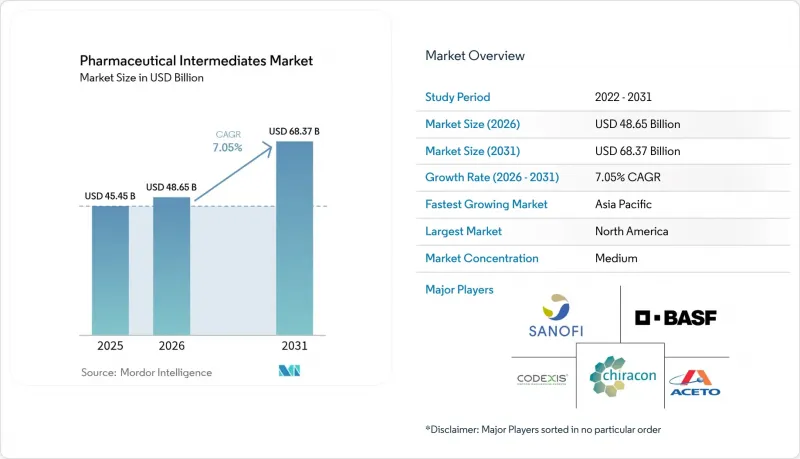
Mordor Intelligence에 의하면, 의약품 중간체 시장 규모는 2025년에 454억 5,000만 달러로 평가되었고, 2026년 486억 5,000만 달러에서 2031년까지 683억 7,000만 달러에 이를 것으로 예측되며, 예측 기간(2026-2031년) CAGR은 7.05%를 기록할 전망입니다.
본 보고서는 제품 유형별(원료의약품 중간체, 맞춤형·위탁 중간체 등), 치료 분야별(종양학 등), 합성 공정별(기존 배치 화학 등), 최종 사용자별(제네릭 의약품 제조업체 등) 및 지역별(북미, 유럽 등)로 분류되어 있습니다. 시장 예측은 입수 가능한 정보를 바탕으로 금액(달러) 단위로 제시되어 있습니다.
세계의 의약품 중간체 시장 동향 및 인사이트
제조 외주화 가속화
의약품 원개발 기업이 공급망 리스크를 줄여주는 자본 효율이 높은 모델을 우선시하는 가운데, 수탁 서비스는 신규 화학물질 생산의 핵심이 되고 있습니다. 풀서비스 CDMO 기업들은 현재 자체 개발에 비해 25%의 비용 절감과 50%의 리드타임 단축을 내세우고 있습니다. 팬데믹 이후 경영진은 주요 중간체의 현지화도 추진하고 있습니다. 2025년에 조사 대상이었던 경영진의 81%가 적어도 하나의 제조 공정을 동일한 경제권 내의 CDMO로 이전할 계획을 세우고 있었습니다. 규제 당국의 승인, 특히 FDA의 ‘첨단 제조 기술 지정 프로그램(Advanced Manufacturing Technologies Designation Program)’은 인증 시설이 승인 전 현장 조사 일정을 더 빨리 확보할 수 있고 심사 주기 또한 단축되므로, 아웃소싱을 더욱 유리하게 만드는 요인이 되고 있습니다.
저분자 항암제 원료의약품(API)에 대한 수요 증가
2024년에는 전 세계적으로 25종의 신규 항암제 유효 성분이 출시되었으며, 지난 5년간의 신규 출시 건수는 132건에 달하고, 전문적인 중간체에 대한 수주가 급증했습니다. 항암제 파이프라인의 생산성은 2019년 이후 51% 향상되었지만, 그 기반이 되는 화학 구조는 더욱 복잡해지고 있으며, 많은 경우 다단계에 걸친 고활성 물질의 취급과 맞춤형 키랄 촉매가 필요합니다. 북미의 혁신적인 기업들이 정밀 의학 임상시험을 주도하고 있지만, 중국의 CDMO는 2세대 티로신 키나제 억제제 분야에서 점유율을 확대하고 있어, 이로 인해 전 세계 조달 패턴이 복잡해지고 두 지역을 아우르는 공급 전략의 필요성이 더욱 커지고 있습니다.
제조 외주화 가속화
의약품사가 공급망 위험을 줄이는 자본 효율이 높은 모델을 우선시함에 따라, 수탁 서비스는 신규 화학 물질(NCE) 생산의 핵심이 되고 있습니다. 풀서비스 CDMO 기업들은 현재 자체 개발에 비해 25%의 비용 절감과 50%의 기간 단축을 내세우고 있습니다. 팬데믹 이후 경영진은 핵심 중간체의 현지화도 추진하고 있습니다. 2025년 조사 대상 경영진의 81%가 적어도 하나의 제조 공정을 동일한 경제권 내의 CDMO로 이전할 계획을 세우고 있었습니다. 규제 당국의 승인, 특히 FDA의 ‘첨단 제조 기술 지정 프로그램(Advanced Manufacturing Technologies Designation Program)’은 인증을 받은 제조 거점이 승인 전 현장 조사 일정을 더 빨리 확보할 수 있고 심사 주기 또한 단축되기 때문에 아웃소싱을 더욱 유리하게 만드는 요인이 되고 있습니다.
부문 분석
원료의약품 중간체는 대량 생산되는 저분자 제네릭 의약품과 성숙한 치료제를 견인력으로 삼아, 2025년에는 의약품 중간체 시장 점유율의 48.10%를 차지하며 계속해서 주도적인 위치를 유지했습니다. 펩타이드 및 올리고뉴클레오티드 중간체는 절대값은 작지만, 바이오의약품과 유사한 화학 물질이 임상 개발에서 탄력을 받고 있어 연평균 성장률(CAGR) 7.85%로 시장을 주도할 것으로 예측됩니다. 맞춤형 및 위탁 중간체 시장은 혁신적인 기업들이 신속한 승인 일정에 대응할 수 있는 턴키 합성을 선호함에 따라 계속해서 호황을 누리고 있습니다.
키랄 및 고효능 중간체의 의약품 중간체 시장 규모는 정밀한 입체 화학 및 특수한 봉쇄 기술이 필요한 종양학 분야의 파이프라인을 배경으로 꾸준히 확대되고 있습니다. 플로우 케미스트리와 첨단 유해 물질 관리를 결합할 수 있는 CDMO(개발·제조·위탁 서비스) 기업들은 수년에 걸친 마스터 서비스 계약을 수주하고 있으며, 이는 고품질·소량·고수익률 하위 부문으로의 구조적 전환을 나타냅니다.
2025년에는 종양학 분야가 매출의 37.20%를 차지했으며, 연평균 성장률(CAGR) 7.35%를 유지할 것으로 예측되어, 의약품 중간체 시장에서 주요 가치 창출원으로서의 입지를 공고히 하고 있습니다. 면역종양학의 병용 요법이나 항체-약물 복합체(ADC)에는 복잡한 링커 화학이 필수적이며, 이로 인해 초고순도 중간체에 대한 수요가 증가하고 있습니다. 심혈관계 약물은 일부 특허가 만료되면서 성장세가 둔화되고 있지만, 만성 질환 치료가 일반적이기 때문에 여전히 상당한 양의 중간체가 필요합니다.
AI를 통해 발견된 분자들이 임상시험 단계에 접어들면서 중추신경계(CNS) 후보 약물이 다시 주목받고 있으며, 이러한 추세로 인해 특수 아미드계 및 복합환계 중간체의 소비가 가속화될 전망입니다. 감염병 관련 프로그램은 각국 정부가 항바이러스제 및 백신을 비축하고 있어 전략적으로 중요한 위치를 계속 차지하고 있으며, 중규모 수요가 유지되고 있습니다. 대사성 질환, 특히 비만은 GLP-1 작용제와 관련된 펩타이드 중간체의 수주를 촉진하고 있습니다.
지역별 분석
북미는 이미 발표된 1,600억 달러 규모의 제조 투자와 국내 조달을 장려하는 정책 환경의 뒷받침을 받아 2025년 매출의 41.80%를 차지했습니다. FDA의 PreCheck 프로그램과 의약품 부족 완화 계획안으로 인해 이미 검사 대기 시간이 단축되었으며, 기존 기업과 신규 진출기업 모두 미국 거점 인증 취득을 촉진하고 있습니다. 캐나다는 원료 부족을 방지하기 위한 규제 현대화를 통해 이 지역의 생태계를 보완하고, 국경을 초월한 공급망의 회복력을 강화하고 있습니다.
아시아태평양은 2026-2031년 8.02%라는 가장 높은 연평균 성장률(CAGR)을 나타낼 전망입니다. 인도의 CRDMO 업계는 고효능 의약품 및 항체-약물 복합체(ADC) 서비스 확대를 추진하는 한편, 중국은 환경 관련 법규 개정에 따른 규정 준수 비용 증가가 예상에도 불구하고 범용 API 분야에서 주도적인 위치를 유지하고 있습니다. 인도-미국 간의 ‘TRUST 이니셔티브’와 같은 양자 간 협력 체제는 단일 국가로의 집중을 피하고 조달처를 다각화하는 것의 전략적 중요성을 부각시키고 있습니다. 동남아시아 국가들 또한 자유무역지대 및 그린필드 시설에 대한 신속한 인가를 통해 투자 유치에 주력하고 있습니다.
유럽은 여전히 중요한 축이며, 지속가능성과 첨단 의료 대응 능력을 중시하고 있습니다. 이 지역의 생산량 중 77%를 합성 API가 차지하고 있지만, 정책 입안자들은 공급 안정화 조치의 일환으로 특정 중간체의 이전에 대해 보조금을 지급하고 있습니다. 아일랜드, 벨기에, 독일에서 진행 중인 연속 생산 방식로의 설비 현대화는 저비용 지역과의 비용 격차를 좁힐 수 있는 기술적 도약을 보여주고 있습니다. 또한, 개정된 EU GMP 부속서 및 유럽의약품청(EMA)의 3개년 업무 계획은 일관된 품질 기준을 강화하고 있어 신규 공급업체에 대한 진입 장벽을 높이고 있습니다.
기타 혜택 :
- 엑셀 형식 시장 예측(ME) 시트
- 3개월간 애널리스트의 지원
자주 묻는 질문
목차
제1장 서론
제2장 조사 방법
제3장 주요 요약
제4장 시장 구도
제5장 시장 규모 및 성장 예측
제6장 경쟁 구도
제7장 시장 기회 및 향후 전망
AJY 26.09.09According to Mordor Intelligence, the pharmaceutical intermediates market size was valued at USD 45.45 billion in 2025 and estimated to grow from USD 48.65 billion in 2026 to reach USD 68.37 billion by 2031, at a CAGR of 7.05% during the forecast period (2026-2031).
This report is Segmented by Product Type (Bulk Drug Intermediates, Custom & Contract Intermediates, and More), Therapeutic Application (Oncology, and More), Synthesis Process (Traditional Batch Chemistry, and More), End User (Generic Drug Manufacturers, and More), and Geography (North America, Europe and More ). The Market Forecasts are Provided in Terms of Value (USD), Based On Availability.
Global Pharmaceutical Intermediates Market Trends and Insights
Accelerating Shift Toward Outsourced Manufacturing
Contract services have become the production backbone for new chemical entities as drug originators prioritize capital-light models that de-risk supply chains. Full-service CDMOs now advertise 25% cost reductions and 50% timeline compression compared with in-house development. Post-pandemic boardrooms are also localizing critical intermediates; 81% of executives surveyed in 2025 planned to relocate at least one manufacturing step to a CDMO in the same economic bloc. Regulatory endorsements, notably the FDA Advanced Manufacturing Technologies Designation Program, further tilt the calculus in favor of outsourcing because certified sites gain quicker pre-approval inspection slots and shorter review cycles.
Rising Demand for Small-Molecule Oncology APIs
Twenty-five novel oncology active substances launched globally in 2024, lifting the five-year debut count to 132 and triggering a surge in specialized intermediate orders. The productivity of oncology pipelines has improved 51% since 2019, yet the underlying chemistry has grown more complex, often requiring multi-step high-potency handling and customized chiral catalysts. North American innovator companies dominate precision medicine trials, but Chinese CDMOs have gained share in second-generation tyrosine kinase inhibitors, complicating global sourcing patterns and magnifying the need for dual geography supply strategies.
Accelerating Shift Toward Outsourced Manufacturing
Contract services have become the production backbone for new chemical entities as drug originators prioritize capital-light models that de-risk supply chains. Full-service CDMOs now advertise 25% cost reductions and 50% timeline compression compared with in-house development. Post-pandemic boardrooms are also localizing critical intermediates; 81% of executives surveyed in 2025 planned to relocate at least one manufacturing step to a CDMO in the same economic bloc. Regulatory endorsements, notably the FDA Advanced Manufacturing Technologies Designation Program, further tilt the calculus in favor of outsourcing because certified sites gain quicker pre-approval inspection slots and shorter review cycles.
Other drivers and restraints analyzed in the detailed report include:
- Re-shoring Incentives in the United States & Europe
- Growing Investments in Continuous-Flow Chemistry
- Rising Demand for Small-Molecule Oncology APIs
For complete list of drivers and restraints, kindly check the Table Of Contents.
Segment Analysis
Bulk drug intermediates retained leadership with 48.10% of pharmaceutical intermediates market share in 2025, anchored by high-volume small-molecule generics and mature therapies. Peptide & oligonucleotide intermediates, though smaller in absolute value, are forecast to outpace at an 7.85% CAGR as biologic-like chemical entities gain clinical momentum. Custom & contract intermediates continue to flourish because innovators prefer turnkey synthesis that meets accelerated filing timelines.
The pharmaceutical intermediates market size for chiral & high-potency intermediates is expanding steadily on the back of oncology pipelines that demand precise stereochemistry and specialized containment. CDMOs able to combine flow chemistry with advanced hazardous-material management are winning multi-year master service agreements, indicating a structural shift toward premium, low-volume, high-margin subsegments.
Oncology generated 37.20% of revenue in 2025 and is projected to maintain a 7.35% CAGR, reinforcing its status as the chief value driver within the pharmaceutical intermediates market. Immuno-oncology combinations and antibody-drug conjugates necessitate intricate linker chemistry, elevating demand for ultrapure intermediates. Cardiovascular agents, though moderating after several patent expiries, continue to require sizable base intermediates given the chronic-care prevalence.
Central nervous system candidates are re-emerging as AI-discovered molecules enter trials, a trend likely to accelerate specialized amide and heterocycle intermediate consumption. Infectious disease programs remain strategically important as governments stockpile antivirals and vaccines, sustaining medium-volume demand. Metabolic disorders, especially obesity, stimulate peptide intermediate orders tied to GLP-1 agonists.
Complete Report Scope:
- By Product Type
- Bulk Drug Intermediates
- Custom & Contract Intermediates
- Peptide & Oligonucleotide Intermediates
- Chiral & High-Potency Intermediates
- By Therapeutic Application
- Oncology
- Cardiovascular
- Infectious Diseases
- Central Nervous System
- Metabolic & Others
- By Synthesis Process
- Traditional Batch Chemistry
- Continuous-Flow Chemistry
- Biocatalytic & Enzymatic Routes
- By End User
- Generic Drug Manufacturers
- Innovative Pharma Companies
- Contract Research & Manufacturing Organizations (CROs/CDMOs)
- By Geography
- North America
- United States
- Canada
- Mexico
- Europe
- Germany
- United Kingdom
- France
- Italy
- Spain
- Rest of Europe
- Asia-Pacific
- China
- India
- Japan
- South Korea
- Australia
- Rest of Asia-Pacific
- South America
- Brazil
- Argentina
- Rest of South America
- Middle East and Africa
- GCC
- South Africa
- Rest of Middle East and Africa
- North America
Geography Analysis
North America generated 41.80% of 2025 revenue, buoyed by USD 160 billion in announced manufacturing investments and a policy environment that rewards domestic sourcing. The FDA PreCheck program and draft shortage-mitigation plans are already shortening inspection queues, encouraging both incumbents and new entrants to qualify U.S. sites. Canada complements the regional ecosystem with regulatory modernization aimed at averting ingredient shortages, thereby cementing cross-border supply resilience.
Asia-Pacific is forecast to post the fastest 8.02% CAGR between 2026 and 2031. India's CRDMO community is scaling high-potency and antibody-drug conjugate services, while China sustains leadership in commodity APIs despite emerging compliance costs linked to revised environmental statutes. Bilateral frameworks such as the India-U.S. TRUST Initiative underscore the strategic imperative of diversified sourcing away from single-country concentration. Southeast Asian nations are also courting investment with free-trade zones and expedited clearance for greenfield facilities.
Europe remains a critical pillar, emphasizing sustainability and advanced therapy readiness. Synthetic APIs account for 77% of the region's output, yet policy makers are subsidizing relocation of select intermediates as part of supply-security drives. Continuous-manufacturing retrofits across Ireland, Belgium, and Germany signal a technological leap that could close cost gaps with low-cost jurisdictions. Moreover, updated EU GMP Annexes and the European Medicines Agency's three-year work plan reinforce consistent quality expectations, raising the entry bar for new suppliers.
- Lonza Group
- WuXi AppTec Co., Ltd.
- Thermo Fisher Scientific
- Cambrex
- Siegfried Holding AG
- Divi's Laboratories Ltd.
- Aarti Industries Limited
- Curia Global, Inc.
- Dishman Carbogen Amcis Ltd.
- Jubilant Pharmova Limited
- Sanofi
- Merck
- BASF
- Hetero Labs Limited
- Pfizer
- Asymchem Laboratories
- Porton Pharma Solutions Ltd.
- Almac Group Ltd.
- Laxmi Organic Industries Ltd.
- Esteve Quimica
Additional Benefits:
- The market estimate (ME) sheet in Excel format
- 3 months of analyst support
TABLE OF CONTENTS
1 Introduction
- 1.1 Study Assumptions & Market Definition
- 1.2 Scope of the Study
2 Research Methodology
3 Executive Summary
4 Market Landscape
- 4.1 Market Overview
- 4.2 Market Drivers
- 4.2.1 Accelerating shift toward outsourced manufacturing
- 4.2.2 Rising demand for small-molecule oncology APIs
- 4.2.3 Re-shoring incentives in the United States & Europe
- 4.2.4 Growing investments in continuous-flow chemistry
- 4.2.5 Expansion of nucleotide & oligonucleotide drug pipelines
- 4.2.6 AI-enabled route scouting and synthesis optimization
- 4.3 Market Restraints
- 4.3.1 Volatile prices of key raw materials (solvents, reagents)
- 4.3.2 Stringent environmental-impact compliance costs
- 4.3.3 Geopolitical export controls on dual-use precursors
- 4.3.4 CDMO capacity bottlenecks for highly-potent intermediates
- 4.4 Value / Supply-Chain Analysis
- 4.5 Regulatory Landscape
- 4.6 Technological Outlook
- 4.7 Porter's Five Forces
- 4.7.1 Threat of New Entrants
- 4.7.2 Bargaining Power of Suppliers
- 4.7.3 Bargaining Power of Buyers
- 4.7.4 Threat of Substitutes
- 4.7.5 Competitive Rivalry
5 Market Size & Growth Forecasts (Value, USD billion)
- 5.1 By Product Type
- 5.1.1 Bulk Drug Intermediates
- 5.1.2 Custom & Contract Intermediates
- 5.1.3 Peptide & Oligonucleotide Intermediates
- 5.1.4 Chiral & High-Potency Intermediates
- 5.2 By Therapeutic Application
- 5.2.1 Oncology
- 5.2.2 Cardiovascular
- 5.2.3 Infectious Diseases
- 5.2.4 Central Nervous System
- 5.2.5 Metabolic & Others
- 5.3 By Synthesis Process
- 5.3.1 Traditional Batch Chemistry
- 5.3.2 Continuous-Flow Chemistry
- 5.3.3 Biocatalytic & Enzymatic Routes
- 5.4 By End User
- 5.4.1 Generic Drug Manufacturers
- 5.4.2 Innovative Pharma Companies
- 5.4.3 Contract Research & Manufacturing Organizations (CROs/CDMOs)
- 5.5 By Geography
- 5.5.1 North America
- 5.5.1.1 United States
- 5.5.1.2 Canada
- 5.5.1.3 Mexico
- 5.5.2 Europe
- 5.5.2.1 Germany
- 5.5.2.2 United Kingdom
- 5.5.2.3 France
- 5.5.2.4 Italy
- 5.5.2.5 Spain
- 5.5.2.6 Rest of Europe
- 5.5.3 Asia-Pacific
- 5.5.3.1 China
- 5.5.3.2 India
- 5.5.3.3 Japan
- 5.5.3.4 South Korea
- 5.5.3.5 Australia
- 5.5.3.6 Rest of Asia-Pacific
- 5.5.4 South America
- 5.5.4.1 Brazil
- 5.5.4.2 Argentina
- 5.5.4.3 Rest of South America
- 5.5.5 Middle East and Africa
- 5.5.5.1 GCC
- 5.5.5.2 South Africa
- 5.5.5.3 Rest of Middle East and Africa
- 5.5.1 North America
6 Competitive Landscape
- 6.1 Market Concentration
- 6.2 Market Share Analysis
- 6.3 Company Profiles (includes Global-level Overview, Market-level Overview, Core Segments, Financials as available, Strategic Information, Market Rank/Share, Products & Services, Recent Developments)
- 6.3.1 Lonza Group AG
- 6.3.2 WuXi AppTec Co., Ltd.
- 6.3.3 Thermo Fisher Scientific Inc.
- 6.3.4 Cambrex Corporation
- 6.3.5 Siegfried Holding AG
- 6.3.6 Divi's Laboratories Ltd.
- 6.3.7 Aarti Industries Limited
- 6.3.8 Curia Global, Inc.
- 6.3.9 Dishman Carbogen Amcis Ltd.
- 6.3.10 Jubilant Pharmova Limited
- 6.3.11 Sanofi S.A.
- 6.3.12 Merck KGaA
- 6.3.13 BASF SE
- 6.3.14 Hetero Labs Limited
- 6.3.15 Pfizer Inc.
- 6.3.16 Asymchem Laboratories
- 6.3.17 Porton Pharma Solutions Ltd.
- 6.3.18 Almac Group Ltd.
- 6.3.19 Laxmi Organic Industries Ltd.
- 6.3.20 Esteve Quimica
7 Market Opportunities & Future Outlook
- 7.1 White-space & Unmet-Need Assessment