
|
시장보고서
상품코드
2124239
금속 프린트 포장 시장 : 시장 점유율 분석, 업계 동향 및 통계, 성장 예측(2026-2031년)Metal Print Packaging - Market Share Analysis, Industry Trends & Statistics, Growth Forecasts (2026 - 2031) |
||||||
 Mordor Intelligence
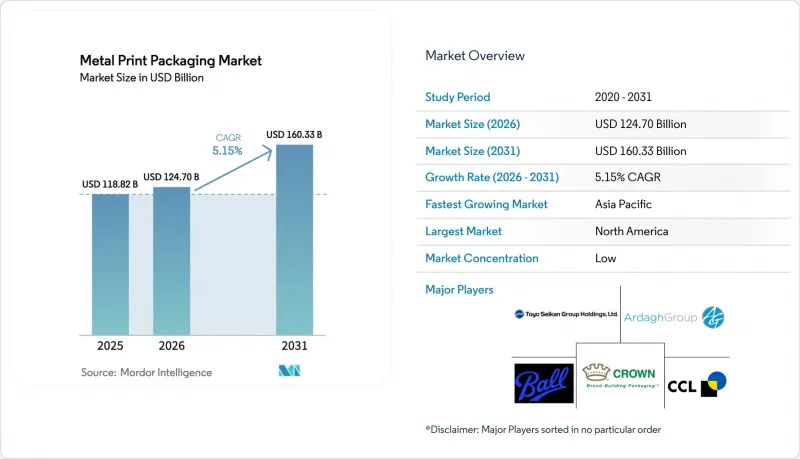
Mordor Intelligence에 의하면, 금속 프린트 포장 시장 규모는 2025년에 1,188억 2,000만 달러로 평가되었고, 2026년 1,247억 달러에서 2031년까지 1,603억 3,000만 달러에 이를 것으로 예측되며, 예측 기간(2026-2031년) CAGR은 5.15%를 나타낼 전망입니다.
본 보고서는 인쇄 기술별(오프셋 리소그래피, 플렉소그래피, 기타), 기판별(알루미늄, 기타), 제품 유형별(음료 캔, 에어로졸 용기, 병 및 그라우러, 기타), 최종 용도별(식음료, 퍼스널케어 및 화장품, 의약품 및 의료, 기타), 지역별로 분류되어 있습니다. 시장 예측은 달러 기준 금액으로 제시되어 있습니다.
세계의 금속 프린트 포장 시장 동향 및 인사이트
디지털 인쇄 기술의 급속한 진화
디지털 인쇄기는 오랫동안 소량 주문에서 오프셋 인쇄를 경제적으로 비효율적으로 만들었던 8,000-12,000달러의 제판 비용을 제거하여, 컨버터가 2,500개 단위의 로트에서도 이익을 낼 수 있도록 하고 있습니다. Konig & Bauer사의 600dpi ‘MetJET ONE’은 인라인 분광 측색 기능을 통해 생산 라인에서 색상 정확도를 실현함으로써, 민첩성과 고품질 그래픽을 모두 달성하고 있습니다. 크래프트 맥주 양조업체는 연간 4종에 불과했던 계절 한정 SKU를 12종으로 늘리고, 디자인부터 매장에 진열되기까지의 주기를 48시간으로 단축함으로써 제품 라인업의 신선도를 높이고 있습니다. 유럽의 서비스 ‘NOMOQ’는 204캔 단위를 캔당 0.267달러에 제공하고 있으며, 수축 슬리브보다 가격이 저렴하기 때문에 실험 예산 확대에 기여하고 있습니다. 크라운 홀딩스는 6곳의 거점에서 Velox 잉크젯 라인을 활용하고 있으며, 금속 프린트 포장 시장에서 퍼스널케어 및 RTD 커피 채널로의 디지털 경제 확산을 촉진하고 있습니다.
캔 음료(맥주, 에너지 드링크) 소비량 증가
2024년, 미국의 에너지 드링크 판매량은 8.2% 증가했습니다. 이는 표준 규격보다 소매 마진이 0.15달러 높은 슬림형 16온스 캔이 기여한 결과입니다. 인도의 1인당 알루미늄 캔 사용량은 2025년에 6개에 달할 것으로 예상되며, 2선 도시에서도 콜드체인 접근성이 확대됨에 따라 2031년까지 2배로 증가할 것으로 전망됩니다. 중국에서는 2024년에 420억 개의 음료 캔이 생산되었으며, 바이주 칵테일 RTD와 수입 맥주의 프리미엄화가 생산량 9% 증가를 주도했습니다. 브라질의 앰베브(Ambev)사는 2027년까지 알루미늄 캔 조달을 100% 국내산으로 전환할 예정이며, 이로 인해 20억 개의 국내 수요가 창출되고 남미의 생산 능력에 대한 투자가 촉진될 전망입니다. 이러한 동향에 따라 금속 프린트 포장 시장은 포화 상태에 있는 북미의 생산량을 넘어 다양화되며, 중기적인 확장이 뒷받침될 것입니다.
금속 및 잉크 투입 가격의 변동
2025년 알루미늄 3개월 선물 가격은 톤당 2,340-2,760달러 범위에서 변동하며, 고정 가격 공급 계약에 묶인 가공업체에 부담을 주었습니다. 이산화티타늄은 중국의 공장 가동 중단으로 톤당 3,850달러에 달하여, 배합 업체들은 도막이 두껍고 불투명도가 낮은 등급의 제품을 사용할 수밖에 없었습니다. 콩고의 코발트 수출 관세(10%)로 인해 유럽에서는 UV 잉크용 드라이어 비용이 캔당 0.008달러 상승했습니다. 헤지 조치를 취하지 않은 지역의 컨버터에서는 이익률이 150베이시스포인트 이상 축소되어 설비 투자가 위축되었습니다. 일괄 생산 제조업체는 위탁 가공 계약을 통해 위험을 완화하고 있지만, 남미 및 동남아시아의 중소기업은 여전히 취약한 상황에 놓여 있어 금속 프린트 포장 시장에 대한 투자를 자제하고 있습니다.
부문별 분석
2025년, 오프셋 리소그래피는 시장 점유율의 43.14%를 차지했으며, 생산량이 50만 개를 초과할 경우 캔당 비용을 0.05달러 미만으로 억제할 수 있는 성숙한 인쇄기를 활용하고 있습니다. 연평균 성장률(CAGR) 6.12%로 성장하는 디지털 시스템은 짧은 납기 대응력이 강점으로, 금속 프린트 포장 시장이 수제 맥주 양조업체, 부티크 스킨케어 브랜드, 계절 한정 에너지 드링크 제조업체에 서비스를 제공하는 데 기여하고 있습니다. 그라비아 인쇄와 플렉소 인쇄는 고급 증류주 및 에어로졸 제품 부문에서 계속 채택되고 있지만, VOC 규제와 실린더 조각 비용으로 인해 그 경쟁력은 떨어지고 있습니다. 패드 인쇄와 핫 스탬핑은 초고급 틈새 시장을 차지하고 있으며, 시장 수익의 3% 미만에 그치지만, 엠보싱 처리된 메탈릭 효과를 통해 높은 이익률을 확보하고 있습니다. 새로운 오프셋 라인에서 AI를 활용한 등록 제어 덕분에 폐기물을 줄이고, 디지털 인쇄기 대수가 증가하는 상황에서도 기존 설비의 유용성을 유지하고 있습니다.
Velox를 탑재한 Crown의 시설은 2024년에 출시된 1만 8,000개의 신규 미국 크래프트 맥주 SKU에 대한 수요를 충족시켰으며, 이는 디지털 인쇄가 성장의 원동력으로서 역할을 하고 있음을 보여줍니다. Koenig and Bauer의 MetalStar 3는 인라인 결함 감지 기능을 갖추고 있어 오프셋 인쇄의 폐기율을 0.5% 미만으로 억제함으로써, 디지털 인쇄가 지속가능성 측면에서 가지는 우위를 좁히고 있습니다. 디지털 밑면 인쇄와 오프셋 윗면 인쇄를 결합한 하이브리드 워크플로는 유연성과 고급스러운 광택의 균형을 맞추며 기술 융합을 가속화하고 있습니다. 장비 공급업체들은 하드웨어에 소프트웨어 구독을 묶어 제공함으로써 수익 모델을 서비스 기반의 가동 시간 보증으로 전환하고 있습니다. 전반적으로, 인쇄 기술의 조합 변화는 고속 레거시 자산을 포기하지 않으면서도 금속 프린트 포장 시장이 대량 맞춤화(mass customization)로 진화하도록 뒷받침하고 있습니다.
알루미늄은 2025년에 45.32%의 시장 점유율을 확보한 것으로 평가되었으며, 재활용 가능성, 운송 시 경량화, CBAM과 관련된 저탄소 포장에 대한 수요에 힘입어 연평균 성장률(CAGR) 6.38%로 확대되고 있습니다. 양철은 수프, 토마토 제품, 반려동물사료 부문에서 여전히 확고한 입지를 유지하고 있으며, 내부 내압성이 15%의 중량 증가를 상회하지만, 탄소 발자국이 알루미늄보다 40% 높기 때문에 유럽의 식품 브랜드들은 대체 소재를 모색해야 하는 상황에 처해 있습니다. 우시강은 톤당 80-100달러의 비용 절감 효과가 있지만, 성형성이 떨어지기 때문에 목 부분이 가늘어진 음료 캔에의 채택은 제한적입니다. 하이브리드 바이메탈 구조의 점유율은 2% 미만에 그치고 있습니다. 이는 서로 다른 금속 간의 이음매 강도가 확보되지 않아 고속 충진이 어려워지기 때문입니다. 생명주기 평가에서는 재활용 알루미늄을 사용함으로써 온실가스 배출량이 95% 감소한다는 사실이 일관되게 나타나고 있어, 금속 프린트 포장 시장의 성장에서 그 입지가 확고해지고 있습니다.
바오강포장이 2025년에 양철 생산 라인을 알루미늄 음료 캔용 소재로 전환하기로 결정한 것은 기판의 경량화 추세를 여실히 보여줍니다. 노벨리스, 볼, 트리비움 등 3사는 2024-2026년 총 150만 톤을 초과하는 새로운 알루미늄 압연 및 캔용 시트 생산 능력을 공동으로 가동하여, 즉석 음료 시장의 확대를 위한 공급 기반을 확립했습니다. 경량화는 계속되고 있으며, 합금 조성의 최적화를 통해 좌굴 강도를 유지하면서도 캔의 평균 두께는 2020년 0.097mm에서 2025년 0.088mm로 얇아지고 있습니다. 이러한 진전 덕분에 각 컨버터 기업들은 1차 금속 수요를 비례적으로 늘리지 않고도 금속 프린트 포장 시장 규모 목표를 달성할 수 있게 되었습니다. 전 세계 브랜드들의 순환형 경제 추진 노력 덕분에, 상품 가격 상승이라는 역풍에도 불구하고 알루미늄에 대한 투자 계획은 견조한 추세를 보이고 있습니다.
지역별 분석
북미에서는 2025년에 1,000억 개의 음료 캔이 생산되어 시장 점유율 39.31%를 유지했습니다. 이는 미국 10개 주와 캐나다 전역에서 보증금 환불 제도가 성숙해졌기 때문입니다. 크래프트 맥주 양조장은 디지털 장식 업체가 활용하는 고수익 소량 생산에 기여하고 있으며, 미국의 12개 생산 라인에 AI 기반 검사 시스템이 도입됨에 따라 연간 420만 달러의 스크랩 비용이 절감되었습니다. 재활용 인프라 덕분에 알루미늄 캔 회수율은 75%에 달하며, 이는 국내 재용해로에 공급되는 원료가 되어 수입 1차 금속에 대한 의존도를 낮추고 있습니다. 그러나 인력 부족으로 운영 비용이 상승함에 따라 가공업체들은 팔레타이징 및 물류 자동화를 추진하고 있습니다. 뉴욕주와 조지아주에서 CANPACK과 Ball이 단계적으로 생산 능력을 확대함에 따라 지역 수급 균형이 유지되고, 금속 프린트 포장 시장에서 북미의 기여도가 강화되고 있습니다.
아시아태평양은 인도의 1인당 소비량이 12캔으로 증가할 것으로 예상되고, 중국의 2024년 생산 규모가 420억 개에 달한 것으로 평가되었으며, 여러 요인을 바탕으로 2031년까지 연평균 성장률(CAGR) 7.08%를 나타낼 것으로 보입니다. 광둥성과 장쑤성 정부의 장려책은 RTD 칵테일, 에너지 드링크, 수입 수제 맥주를 대상으로 한 국가 지원 캔 생산 라인 확장을 뒷받침하고 있습니다. 도요제칸의 광둥성 내 연간 5억 개 생산 규모의 합작 사업은 일본의 수출 감소를 상쇄하는 동시에, 국내 양조장에 오프셋 인쇄가 적용된 고급 캔을 공급하고 있습니다. 베트남이나 인도네시아 등 동남아시아 국가에서는 캔 커피 판매가 두 자릿수 성장률을 기록하고 있는 반면, 호주의 수제 맥주 붐은 온팩(On-Pack) 록리(Rockley) 생산 라인이 현재 대응하고 있는 소량 생산에 대한 수요를 뒷받침하고 있습니다. 중산층의 구매력 향상과 콜드체인의 급속한 보급으로 인해, 아시아태평양은 금속 프린트 포장 시장의 장기적인 성장에 있어 계속해서 매우 중요한 위치를 차지할 것으로 보입니다.
유럽은 성숙해 가고 있지만 여전히 변화의 과정에 있는 시장이며, CBAM에 따른 단계적 관세 부과가 캔용 강판 조달의 국내 회귀를 촉진하고 있습니다. 2024년, 독일, 프랑스, 영국에서는 350억 개의 음료 캔이 소비되었지만, 새로운 투자는 풍력 및 태양광을 동력원으로 하는 탄소 배출량을 최적화한 용광로에 집중되고 있습니다. 아르다그(Ardag)와 크라운(Crown)은 모두 2030년까지 스코프 1 및 2 배출량을 50% 감축하겠다고 약속했으며, 이는 기업 구매자의 배출량 감축 목표와 부합합니다. 동유럽에서는 가공업체들이 EU 탄소 배출권 거래 제도 내에 머물면서 저비용 노동력을 추구하고 있어, 폴란드와 루마니아에서 생산 능력 확대가 나타나고 있습니다. 중동 및 아프리카는 현재 지역별 기여도가 가장 낮은 편이지만,사우디아라비아의 ‘비전 2030’에 따른 인센티브와 남아프리카공화국의 첫해 62% 캔 회수율을 배경으로 성장을 가속화하고 있으며, 알루미늄을 중심으로 한 신규 공장 발표가 잇따르면서 금속 프린트 포장 시장의 지리적 범위가 확대될 토대가 마련되고 있습니다.
기타 혜택
- 엑셀 형식 시장 예측(ME) 시트
- 3개월간의 애널리스트 지원
자주 묻는 질문
목차
제1장 서론
제2장 조사 방법
제3장 주요 요약
제4장 시장 구도
제5장 시장 규모 및 성장 예측
제6장 경쟁 구도
제7장 시장 기회 및 향후 전망
AJY 26.09.11According to Mordor Intelligence, the metal print packaging market size was valued at USD 118.82 billion in 2025 and is estimated to grow from USD 124.70 billion in 2026 to reach USD 160.33 billion by 2031, at a CAGR of 5.15% during the forecast period (2026-2031).
This report is Segmented by Printing Technology (Offset Lithography, Flexography, and More), Substrate Material (Aluminium, and More ), Product Type (Beverage Cans, Aerosol Containers, Bottles and Growlers, and More), End-Use Application (Food and Beverage, Personal Care and Cosmetics, Pharmaceuticals and Healthcare, and More), and Geography. The Market Forecasts are Provided in Terms of Value USD.
Global Metal Print Packaging Market Trends and Insights
Rapid Evolution of Digital Print Technology
Digital presses eliminate the USD 8,000-12,000 plate cost that long made offset uneconomic for small jobs, enabling converters to profit on 2,500-unit lots. Koenig and Bauer's 600-dpi MetJET ONE delivers production-line color accuracy with inline spectrophotometry, pairing agility with premium graphics. Craft brewers now launch twelve seasonal SKUs per year instead of four, compressing design-to-shelf cycles to 48 hours and boosting portfolio freshness. European service NOMOQ prices runs of 204 cans at USD 0.267 each, undercutting shrink sleeves and extending experimentation budgets. Crown Holdings leverages Velox inkjet lines across six sites, positioning the metal print packaging market for deeper penetration of digital economics in personal-care and RTD coffee channels.
Growth in Canned Beverage Consumption
Energy drinks in the United States expanded 8.2% by volume in 2024, aided by slim 16-oz cans commanding USD 0.15 higher retail margins than standard formats. India's per-capita aluminium-can use reached six units in 2025 and is projected to double by 2031 as tier-2 cities gain cold-chain access. China produced 42 billion beverage cans in 2024, with baijiu-cocktail RTDs and imported-beer premiumization driving 9% output growth. Brazil's Ambev will source 100% domestic aluminium cans by 2027, adding 2 billion units of local demand and spurring South America capacity investments . These dynamics diversify the metal print packaging market beyond saturated North American volumes and reinforce medium-term expansion.
Volatility in Metal and Ink Input Prices
Aluminium three-month futures ranged from USD 2,340-2,760 /t in 2025, stressing converters locked into fixed-price supply contracts. Titanium dioxide hit USD 3,850 /t after Chinese plant shutdowns, forcing formulators to use heavier-coat, lower-opacity grades. A 10% Congolese cobalt export levy lifted UV-ink drier costs by USD 0.008 per can in Europe. Regional converters without hedging saw margin erosion exceeding 150 basis points, curbing capital spending. Integrated producers mitigate exposure via tolling deals, yet smaller firms in South America and Southeast Asia remain vulnerable, tempering metal print packaging market investment.
Other drivers and restraints analyzed in the detailed report include:
- Sustainability-Driven Demand for Infinitely Recyclable Metal
- Direct-to-Can High-Resolution Inkjet Unlocking SKU Proliferation
- Emerging PFAS Bans Disrupting Fluoropolymer Can Coatings
For complete list of drivers and restraints, kindly check the Table Of Contents.
Segment Analysis
Offset lithography contributed 43.14% of market share in 2025, capitalizing on mature presses that drop per-can costs under USD 0.05 once runs exceed 500,000 units. Digital systems, advancing at 6.12% CAGR, thrive on short-run agility, helping the metal print packaging market serve craft brewers, boutique skincare lines, and seasonal energy drinks. Gravure and flexography continue in luxury spirits and aerosols, yet VOC regulations and cylinder-engraving fees erode their competitiveness. Pad printing and hot stamping occupy ultra-premium niches, representing less than 3% of market revenue but commanding high margins through embossed metallic effects. AI-enabled registration control on new offset lines keeps waste low, stretching the installed base's relevance while digital press count rises.
Velox-equipped Crown facilities now satisfy 18,000 new U.S. craft-beer SKUs launched during 2024, showing digital's role as a growth lever. Koenig and Bauer's MetalStar 3 with inline defect detection brings offset waste below 0.5%, narrowing digital's sustainability edge. Hybrid workflows that print digital undercoats and offset top layers balance flexibility with premium gloss, accelerating technology convergence. Equipment suppliers bundle software subscriptions with hardware, moving the revenue model toward service-based uptime guarantees. Overall, printing-technology mix shifts reinforce the evolution of the metal print packaging market toward mass customisation without abandoning high-speed legacy assets.
Aluminium secured 45.32% of market share in 2025 and is expanding at a 6.38% CAGR, driven by recyclability, lighter transport weight, and CBAM-linked demand for low-carbon packaging. Tinplate remains entrenched in soups, tomatoes, and pet food, where internal pressure resistance outweighs the 15% weight penalty, but its carbon footprint is 40% higher than aluminium, pressuring European food brands to seek alternatives. Tin-free steel offers USD 80-100/t savings but suffers reduced formability, limiting its adoption in necked beverage cans. Hybrid bi-metal designs have a share of less than 2% because seam integrity between dissimilar metals complicates high-speed filling. Lifecycle studies consistently show recycled-content aluminium cutting greenhouse-gas emissions by 95%, solidifying its place in the metal print packaging market's growth story.
Baosteel Packaging's 2025 decision to pivot tinplate lines toward aluminium beverage-can stock underscores the trend toward lighter substrates. Novelis, Ball, and Trivium collectively commissioned over 1.5 million t of new aluminium rolling and can-sheet capacity between 2024-2026, anchoring supply for ready-to-drink expansions. Lightweighting continues, with average can walls thinning from 0.097 mm in 2020 to 0.088 mm in 2025 while maintaining buckle strength through alloy optimisation. These advances allow converters to achieve the metal print packaging market size targets without proportionally increasing primary metal demand. Circularity commitments from global brands keep aluminium investment pipelines strong despite commodity-price headwinds.
Complete Report Scope:
- By Printing Technology
- Offset Lithography
- Gravure
- Flexography
- Digital
- Other Printing Technologies
- By Substrate Material
- Aluminium
- Steel (Tinplate)
- Tin-free Steel
- Other Substrate Materials
- By Product Type
- Beverage Cans
- Aerosol Containers
- Bottles and Growlers
- Tubes and Cartridges
- Other Product Types
- By End-Use Application
- Food and Beverage
- Personal Care and Cosmetics
- Pharmaceuticals and Healthcare
- Industrial and Household Chemicals
- Other End-use Applications
- By Geography
- North America
- United States
- Canada
- Mexico
- South America
- Brazil
- Argentina
- Chile
- Rest of South America
- Europe
- Germany
- United Kingdom
- France
- Italy
- Spain
- Rest of Europe
- Asia-Pacific
- China
- Japan
- India
- South Korea
- Australia
- Rest of Asia-Pacific
- Middle East and Africa
- Middle East
- Saudi Arabia
- United Arab Emirates
- Turkey
- Rest of Middle East
- Africa
- South Africa
- Nigeria
- Kenya
- Rest of Africa
- Middle East
- North America
Geography Analysis
North America produced 100 billion beverage cans in 2025 and retained 39.31% of market share in 2025, thanks to mature deposit-return laws in ten U.S. states and every Canadian province. Craft breweries contribute high-margin short runs that digital decorators capitalize on, and AI-enabled inspection rollouts across 12 U.S. lines lowered scrap costs by USD 4.2 million annually. Recycling infrastructure delivers 75% recovery of aluminium cans, feeding domestic remelt furnaces and reducing reliance on imported primary metal. Nevertheless, labour shortages elevate operating costs, prompting converters to automate palletisation and logistics. Incremental capacity expansions by CANPACK and Ball in New York and Georgia maintain regional supply-demand balance and reinforce North America's contribution to the metal print packaging market.
Asia-Pacific will post a 7.08% CAGR through 2031, driven by India's projected rise to 12 cans per capita and China's 2024 production footprint of 42 billion units. Government incentives in Guangdong and Jiangsu support state-backed can-line expansions that target RTD cocktails, energy drinks, and imported craft beers. Toyo Seikan's 500 million-unit Guangdong joint venture offsets Japanese export declines and supplies premium offset-decorated cans to domestic breweries. Southeast Asian nations such as Vietnam and Indonesia register double-digit canned coffee growth, while Australia's craft beer boom fuels demand for digital runs that Onpack's Rocklea line now fulfills. Rising middle-class purchasing power and rapid cold-chain rollout ensure that Asia-Pacific remains pivotal to the long-term growth of the metal print packaging market.
Europe represents a mature yet transforming landscape where CBAM's phased tariffs spur re-shoring of can-sheet sourcing. Germany, France, and the United Kingdom consumed 35 billion beverage cans in 2024, but new investments focus on carbon-optimized furnaces powered by wind and solar. Ardagh and Crown both committed to 50% Scope 1 and 2 cuts by 2030, aligning with corporate buyer emissions targets. Eastern Europe sees capacity growth in Poland and Romania as converters seek lower-cost labour while remaining inside the EU carbon-trade perimeter. Middle East and Africa, though currently the smallest regional contributor, accelerates with Saudi Arabia's Vision 2030 incentives and South Africa's 62% first-year can recovery rate, setting the stage for future aluminium-centric plant announcements that will broaden the geographic reach of the metal print packaging market.
- Ball Corporation
- Crown Holdings Inc.
- Ardagh Metal Packaging S.A.
- CANPACK S.A.
- Silgan Holdings Inc.
- Toyo Seikan Group Holdings Ltd.
- CCL Industries Inc.
- Envases Universales de Mexico S.A. de C.V.
- Trivium Packaging B.V.
- Showa Aluminum Can Corporation
- Orora Packaging Australia Pty Ltd
- CPMC Holdings Limited
- Massilly Holding SAS
- Nampak Limited
- Can-Pack India Private Limited
- Independent Can Company
- Envases CMF S.A.
- Jiangsu Baosteel Metal Products Co., Ltd.
- Guangzhou Pacific Tinplate Co., Ltd.
- Shanghai Baosteel Packaging Co., Ltd.
Additional Benefits:
- The market estimate (ME) sheet in Excel format
- 3 months of analyst support
TABLE OF CONTENTS
1 Introduction
- 1.1 Study Assumptions and Market Definition
- 1.2 Scope of the Study
2 Research Methodology
3 Executive Summary
4 Market Landscape
- 4.1 Market Overview
- 4.2 Market Drivers
- 4.2.1 Rapid Evolution of Digital Print Technology
- 4.2.2 Growth in Canned Beverage Consumption (Beer, Energy Drinks)
- 4.2.3 Sustainability-Driven Demand for Infinitely Recyclable Metal
- 4.2.4 Direct-to-can High-Resolution Inkjet Unlocking SKU Proliferation
- 4.2.5 AI-Driven Inline Vision Systems Cutting Defect Waste
- 4.2.6 EU CBAM Favouring Low-Carbon Domestic Can Production
- 4.3 Market Restraints
- 4.3.1 Volatility in Metal and Ink Input Prices
- 4.3.2 Competition from Alternative Packaging Substrates
- 4.3.3 Emerging PFAS Bans Disrupting Fluoropolymer Can Coatings
- 4.3.4 Scarcity of High-Purity Recycled Aluminium Feedstock
- 4.4 Industry Value Chain Analysis
- 4.5 Regulatory Landscape
- 4.6 Technological Outlook
- 4.7 Porter's Five Forces Analysis
- 4.7.1 Bargaining Power of Suppliers
- 4.7.2 Bargaining Power of Consumers
- 4.7.3 Threat of New Entrants
- 4.7.4 Threat of Substitutes
- 4.7.5 Intensity of Competitive Rivalry
- 4.8 Impact of Macroeconomic Factors
5 Market Size and Growth Forecasts (Value)
- 5.1 By Printing Technology
- 5.1.1 Offset Lithography
- 5.1.2 Gravure
- 5.1.3 Flexography
- 5.1.4 Digital
- 5.1.5 Other Printing Technologies
- 5.2 By Substrate Material
- 5.2.1 Aluminium
- 5.2.2 Steel (Tinplate)
- 5.2.3 Tin-free Steel
- 5.2.4 Other Substrate Materials
- 5.3 By Product Type
- 5.3.1 Beverage Cans
- 5.3.2 Aerosol Containers
- 5.3.3 Bottles and Growlers
- 5.3.4 Tubes and Cartridges
- 5.3.5 Other Product Types
- 5.4 By End-Use Application
- 5.4.1 Food and Beverage
- 5.4.2 Personal Care and Cosmetics
- 5.4.3 Pharmaceuticals and Healthcare
- 5.4.4 Industrial and Household Chemicals
- 5.4.5 Other End-use Applications
- 5.5 By Geography
- 5.5.1 North America
- 5.5.1.1 United States
- 5.5.1.2 Canada
- 5.5.1.3 Mexico
- 5.5.2 South America
- 5.5.2.1 Brazil
- 5.5.2.2 Argentina
- 5.5.2.3 Chile
- 5.5.2.4 Rest of South America
- 5.5.3 Europe
- 5.5.3.1 Germany
- 5.5.3.2 United Kingdom
- 5.5.3.3 France
- 5.5.3.4 Italy
- 5.5.3.5 Spain
- 5.5.3.6 Rest of Europe
- 5.5.4 Asia-Pacific
- 5.5.4.1 China
- 5.5.4.2 Japan
- 5.5.4.3 India
- 5.5.4.4 South Korea
- 5.5.4.5 Australia
- 5.5.4.6 Rest of Asia-Pacific
- 5.5.5 Middle East and Africa
- 5.5.5.1 Middle East
- 5.5.5.1.1 Saudi Arabia
- 5.5.5.1.2 United Arab Emirates
- 5.5.5.1.3 Turkey
- 5.5.5.1.4 Rest of Middle East
- 5.5.5.2 Africa
- 5.5.5.2.1 South Africa
- 5.5.5.2.2 Nigeria
- 5.5.5.2.3 Kenya
- 5.5.5.2.4 Rest of Africa
- 5.5.5.1 Middle East
- 5.5.1 North America
6 Competitive Landscape
- 6.1 Market Concentration
- 6.2 Strategic Moves
- 6.3 Market Share Analysis
- 6.4 Company Profiles (Includes Global Level Overview, Market Level Overview, Core Segments, Financials as Available, Strategic Information, Market Rank/Share, Products and Services, and Recent Developments)
- 6.4.1 Ball Corporation
- 6.4.2 Crown Holdings Inc.
- 6.4.3 Ardagh Metal Packaging S.A.
- 6.4.4 CANPACK S.A.
- 6.4.5 Silgan Holdings Inc.
- 6.4.6 Toyo Seikan Group Holdings Ltd.
- 6.4.7 CCL Industries Inc.
- 6.4.8 Envases Universales de Mexico S.A. de C.V.
- 6.4.9 Trivium Packaging B.V.
- 6.4.10 Showa Aluminum Can Corporation
- 6.4.11 Orora Packaging Australia Pty Ltd
- 6.4.12 CPMC Holdings Limited
- 6.4.13 Massilly Holding SAS
- 6.4.14 Nampak Limited
- 6.4.15 Can-Pack India Private Limited
- 6.4.16 Independent Can Company
- 6.4.17 Envases CMF S.A.
- 6.4.18 Jiangsu Baosteel Metal Products Co., Ltd.
- 6.4.19 Guangzhou Pacific Tinplate Co., Ltd.
- 6.4.20 Shanghai Baosteel Packaging Co., Ltd.
7 Market Opportunities and Future Outlook
- 7.1 White-space and Unmet-Need Assessment