

|
시장보고서
상품코드
2124240
습도 센서 시장 : 시장 점유율 분석, 업계 동향 및 통계, 성장 예측(2026-2031년)Humidity Sensors - Market Share Analysis, Industry Trends & Statistics, Growth Forecasts (2026 - 2031) |
||||||
 Mordor Intelligence
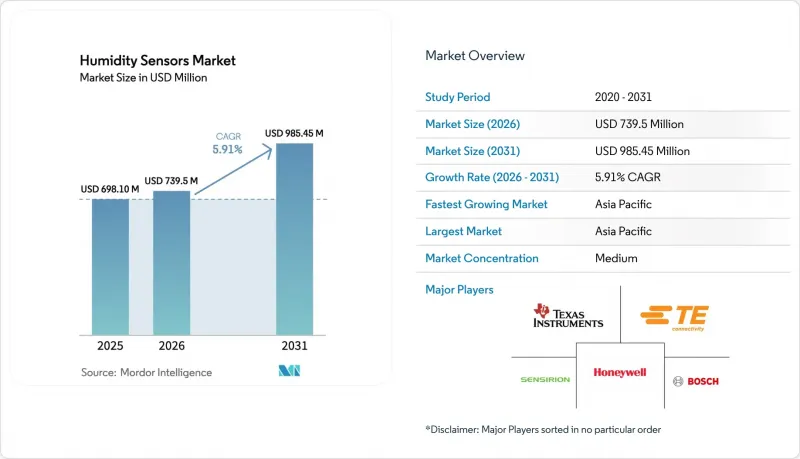
Mordor Intelligence에 의하면, 습도 센서 시장 규모는 2025년에 6억 9,810만 달러로 평가되었고, 2026년 7억 3,950만 달러에서 2031년까지 9억 8,545만 달러에 이를 것으로 예측되며, 예측 기간(2026-2031년) CAGR은 5.91%를 기록할 전망입니다.
본 보고서는 센서 기술별(적외선, 바이메탈, 냉각 미러, 고분자 저항식 등), 측정 매개변수별(상대 습도, 절대 습도 등), 최종 사용자 산업별(화학제품 및 석유화학제품, 빌딩 자동화, 자동차 등), 유통 채널별(OEM 통합, 전자상거래 등) 및 지역별로 분류되어 있습니다. 시장 전망은 금액(달러) 기준으로 제시되어 있습니다.
세계의 습도 센서 시장 동향 및 인사이트
웨어러블 기기의 소형화 가속화
현재 웨어러블 기기의 각 브랜드는 걸음 수에 그치지 않고, 발한율, 피부 수분량 및 주변 환경 데이터를 통해 차별화를 꾀하기 위해 습도 감지 기능을 통합하고 있습니다. 2024년에 출시된 Bosch Sensortec사의 BME690은 MEMS 습도 소자와 AI 알고리즘을 3mm×3mm 랜드 그리드 패키지 내에 통합하고 있으며, 저전력 모드에서는 단 0.1mA의 전류만 소비합니다. 이에 이어 아날로그 디바이스(Analog Devices)는 센서 인터페이스를 다이(die)에 내장하여 디스크리트 기판이 필요 없는 마이크로컨트롤러 ‘MAX32672’를 발표했습니다. 웨이퍼 레벨 칩 스케일 및 팬아웃 패키징을 통해 기판 면적을 최대 70% 줄이고, 2mm² 미만의 실적를 실현했습니다. 부품 수가 감소함에 따라, 디바이스 제조업체들은 6개월마다 이루어지는 모델 업데이트에 대응하기 위해 설계 주기를 단축하고 있습니다. 수직 통합형 반도체 제조업체는 동일한 제조 라인에서 MEMS와 로직을 공동으로 최적화할 수 있어 비용 면에서 우위를 점하고 있으며, 이는 디스크리트 센서 전문 제조업체에게는 장벽이 되고 있습니다.
신흥 경제국에서의 HVAC 개보수 프로젝트 증가
동남아시아, 중동, 남미에서는 도시 인구 증가와 평균 기온 상승에 따라 냉방 수요가 증가하고 있습니다. 국제에너지기구(IEA)의 예측에 따르면, 아세안(ASEAN) 국가들의 공간 냉방 에너지 소비량은 2020년 대비 2040년까지 3배로 증가할 것으로 전망됩니다. 가변 냉매 유량 시스템과 습도 반응형 제어를 결합하면 에너지 소비량을 20-30% 절감할 수 있으므로, 건물 소유주들은 독립형 습도 조절기를 네트워크화된 시스템으로 교체하도록 권장받고 있습니다. 사우디아라비아의 2024년판 그린빌딩 기준에서는 신규 상업용 HVAC에 습도 센서 장착이 의무화되어 있으며, 리모델링 공사에는 보조금도 지급되고 있습니다. 전기 요금은 설비 비용보다 빠른 속도로 상승하고 있으며, 특히 인도에서는 2020-2025년 상업용 요금이 연평균 8% 상승함에 따라 개보수 공사의 경제성이 더욱 높아지고 있습니다. 공급업체들은 장기간의 플랜트 가동을 중단하지 않아도 되는 플러그 앤 플레이형 센서에 대한 안정적인 수요로 인해 혜택을 보고 있습니다.
고분자 센서의 교정 드리프트
저비용 폴리머 저항형 및 정전용량형 장치는 노화, 오염, 히스테리시스의 영향으로 인해 연간 2-5%RH의 정확도 저하가 발생합니다. 2025년 『IEEE Sensors Journal』지의 기사에 따르면, 휘발성 유기 화합물에 노출될 경우 12개월 이내에 10%RH를 초과하는 비가역적인 감도 변화가 발생한다고 보고되었습니다. NIST의 2024년 교정 지침에서는 포화 염 표준 용액을 이용한 연 1회 검증을 권장하고 있으며, 이를 통해 5년간의 소유 비용을 최대 40% 절감할 수 있습니다. 습도가 높은 열대 지역에서는 폴리머의 팽윤이 가속화되어 재교정 주기가 단축됩니다. 대부분의 폴리머製 유닛은 현장이 아닌 공장에서 재교정이 필요하기 때문에 공조 설비나 창고 운영자는 교체를 미루는 경향이 있으며, 그 결과 고사양 장치 시장 침투가 지연되고 있습니다.
부문 분석
2025년, 폴리머 저항식 장치를 사용한 습도 센서 시장 규모는 컸으며, 이 부문은 전체 습도 센서 시장 가치의 32.40%를 차지했습니다. 그러나 MEMS 기반 디지털 센서는 아날로그-디지털 변환, 온도 보정, 직렬 통신을 단일 칩에 집적할 수 있는 특징을 반영하여 2031년까지 연평균 성장률(CAGR) 6.40%로 성장을 주도하고 있습니다.
적외선식 및 냉각 미러식 습도계는 기준급의 고정밀도를 실현하는 한편, 대당 5,000달러가 넘는 가격으로 인해 실험실이라는 틈새 시장에서 입지를 유지하고 있습니다. 알루미늄 산화물로 제작된 정전용량식 소자는 영하 이슬점이 우려되는 압축 공기 및 오븐 용도에서 여전히 중요하지만, 오염 위험으로 인해 더 광범위한 채택에는 한계가 있습니다. 전자기 간섭의 영향을 받지 않는 광섬유 센서는 MRI실이나 고압 변전소에서 주문을 확보하고 있습니다. 바이살라(Vaisala)와 같은 공급업체는 ‘Indigo 200’ 시리즈에서 모듈식 설계로 전환하여 프로브 헤드를 교체할 수 있게 함으로써 재고 관리의 복잡성을 줄이고 있습니다.
상대 습도는 2025년 매출의 46.00%를 차지했으며, 거의 모든 HVAC(냉난방 공조) 및 소비자용 전자 기기의 제어 루프에 통합되어 있어 계측 분야의 핵심을 이루고 있습니다. 연평균 성장률(CAGR) 7.70%라는 수치에서도 이 지표가 여전히 가장 빠르게 성장하고 있음을 알 수 있으며, 건축 기준 및 산업 규격에 따른 정착도가 두드러지게 나타나고 있습니다.
이슬점 측정은 규모는 작지만, 온도 변동과 무관하게 수분량을 정량화해야 하는 압축 공기, 천연가스, 그리고 제약 업계의 분무 건조 라인에서 주목을 받고 있습니다. 미셸 기기(Michel Instruments)사의 DMT152는 -60°C까지의 이슬점을 측정할 수 있으며, 석유화학용 건조기 및 산업용 가스 처리 장치에 대응합니다. 절대 습도는 수증기압 결손 계산을 통해 작물 수확량을 향상시킬 수 있기 때문에 제어 환경 하의 농업 분야에서 선호되고 있습니다.
지역별 분석
아시아태평양은 2025년에 전 세계 습도 센서 시장 매출의 36.90%를 차지한 것으로 평가되었으며, 2026-2031년 연평균 성장률(CAGR) 6.90%를 나타낼 것으로 전망됩니다. 수요는 대만과 한국의 반도체 제조 공장, 중국의 전기차 생산, 그리고 인도와 동남아시아의 정부 장려 정책에 따른 HVAC(공조·환기·난방) 설비 개조에 집중되어 있습니다. 일본도 이러한 추세를 따르고 있으며, 그 예로 2025년 야마나시현에 개설된 히타치 하이테크의 공장을 들 수 있습니다. 이 공장에서는 바이살라(Vaisala)사의 프로브를 탑재한 클린룸 감시 시스템을 제조하고 있습니다. 또한, 인도의 에너지 효율국(BEE)은 현재 대용량 에어컨에 습도 감지 제어 장치의 탑재를 의무화하고 있어, 이로 인해 1대당 센서 탑재량이 증가하고 있습니다.
북미는 2위를 차지하고 있으며, 제약 업계의 보관 시설 업그레이드, 데이터센터 건설, 그리고 전기차 조립 라인이 주요 성장 동력으로 작용하고 있습니다. 미국 환경보호청(EPA)이 2024년에 정한 반도체 제조 공장의 대기 오염 물질 기준에 따라 공장 내 허용 습도 범위가 엄격해지면서 센서 네트워크 개조가 진행되고 있습니다. 캐나다 연방 정부의 히트 펌프에 대한 보조금도 마찬가지로 주택 분야 수요를 촉진하고 있습니다.
유럽에서는 히트펌프 설치가 원동력이 되어 견조한 확대세가 나타나고 있으며, 독일에서는 2024년까지 설치 대수가 50만 대를 돌파했습니다. 중동에서는 NEOM이나 마스다르 시티와 같이 통합적인 환경 모니터링 기능을 갖춘 메가 프로젝트가 추진되고 있습니다. 남미에서는 브라질의 식품 가공 공장 및 펄프·제지 공장을 중심으로 성장이 나타나고 있지만, 아프리카는 여전히 초기 단계에 머물러 있어 도입이 의약품 콜드체인 및 Tier III 데이터센터로 한정되어 있습니다.
기타 혜택 :
- 엑셀 형식 시장 예측(ME) 시트
- 3개월간의 애널리스트 지원
자주 묻는 질문
목차
제1장 서론
제2장 조사 방법
제3장 주요 요약
제4장 시장 구도
제5장 시장 규모 및 성장 예측
제6장 경쟁 구도
제7장 시장 기회 및 향후 전망
AJY 26.09.09According to Mordor Intelligence, the humidity sensors market size was valued at USD 698.10 million in 2025 and is estimated to grow from USD 739.5 million in 2026 to reach USD 985.45 million by 2031, at a CAGR of 5.91% during the forecast period (2026-2031).
This report is Segmented by Sensor Technology (Infrared, Bimetallic, Cooled Mirror, Polymer Resistive, and More), Measurement Parameter (Relative Humidity, Absolute Humidity, and More), End-User Industry (Chemical and Petrochemical, Building Automation, Automotive, and More), Distribution Channel (OEM Integration, E-Commerce, and More), and Geography. The Market Forecasts are Provided in Terms of Value (USD).
Global Humidity Sensors Market Trends and Insights
Accelerating Miniaturization for Wearables
Wearable brands are now integrating humidity sensing to differentiate themselves through sweat rate, skin hydration, and ambient condition data, rather than relying solely on step counts. Bosch Sensortec's BME690, released in 2024, merges a MEMS humidity element and AI algorithm inside a 3 mm X 3 mm land-grid package that draws just 0.1 mA in low-power mode. Analog Devices followed with the MAX32672 microcontroller, which embeds sensor interfaces on-die to eliminate the need for discrete boards. Wafer-level chip-scale and fan-out packaging now reduces board real estate by up to 70%, enabling sub-2 mm2 footprints. As component counts fall, device makers compress design cycles to match six-month model refreshes. Vertically integrated semiconductor houses gain a cost edge because they can co-optimize MEMS and logic on the same line, a hurdle for discrete-sensor specialists.
Rising HVAC Retrofit Projects in Emerging Economies
Cooling demand in Southeast Asia, the Middle East, and South America is increasing as urban populations expand and average temperatures rise. The International Energy Agency projects that ASEAN's space-cooling energy use will triple by 2040 compared to 2020. Variable-refrigerant-flow systems, coupled with humidity-responsive controls, cut energy consumption by 20-30%, encouraging building owners to replace stand-alone humidistats with networked arrays. Saudi Arabia's 2024 green-building code mandates humidity sensing in new commercial HVAC and subsidizes retrofits. Electricity tariffs are rising faster than equipment costs, particularly in India, where commercial rates climbed 8% annually between 2020 and 2025, further strengthening retrofit economics. Suppliers benefit from steady demand for plug-and-play sensors that avoid lengthy plant shutdowns.
Calibration Drift in Polymer-Based Sensors
Low-cost polymer resistive and capacitive devices experience an annual accuracy loss of 2-5% RH due to aging, contamination, and hysteresis. An IEEE Sensors Journal article from 2025 reported irreversible sensitivity shifts of over 10% RH within 12 months when exposed to volatile organic compounds. NIST's 2024 calibration guide recommends yearly verification against saturated-salt standards, which can reduce five-year ownership costs by up to 40%. High-humidity tropical zones accelerate polymer swelling, shortening recalibration intervals. Because most polymer units require factory, not field, recalibration, HVAC and warehouse operators often delay replacements, which slows market penetration for higher-spec devices.
Other drivers and restraints analyzed in the detailed report include:
- Stringent Pharmaceutical GMP Humidity Controls
- Electric-Vehicle Battery Thermal Safety Needs
- Limited Adoption in Extreme-Temperature Oilfields
For complete list of drivers and restraints, kindly check the Table Of Contents.
Segment Analysis
The humidity sensors market size attributed to polymer resistive devices was significant in 2025, when the segment secured a 32.40% share of the overall humidity sensors market value. MEMS-based digital sensors, however, are pacing the gains with a 6.40% CAGR to 2031, reflecting their ability to integrate analog-to-digital conversion, temperature compensation, and serial communication onto a single die.
Infrared and cooled-mirror hygrometers retain their niche in the laboratory because they deliver reference-grade accuracy but command prices above USD 5,000 per unit. Aluminum-oxide capacitive elements remain relevant for compressed-air and oven applications where sub-zero dew points are a concern, although the risk of contamination limits their broader adoption. Optical-fiber sensors, immune to electromagnetic interference, win orders in MRI suites and high-voltage substations. Vendors such as Vaisala transitioned to modular designs with the Indigo 200 series, enabling probe head swaps to reduce inventory complexity.
Relative humidity secured 46.00% of 2025 revenues and anchors the measurement landscape due to its inclusion in nearly every HVAC and consumer electronics control loop. With a 7.70% CAGR, the metric remains the fastest climber, underscoring its lock-in due to building codes and industrial standards.
Dew-point sensing, while smaller, is gaining traction in compressed-air, natural-gas, and pharmaceutical spray-drying lines where moisture must be quantified independently of temperature swings. Michell Instruments' DMT152, which measures to -60 °C dew point, supports petrochemical dryers and industrial gas processors. Absolute humidity is favored in controlled-environment agriculture because vapor-pressure deficit calculations improve crop yields.
Complete Report Scope:
- By Sensor Technology
- Infrared
- Bimetallic
- Cooled Mirror
- Aluminum Oxide Capacitive
- Polymer Resistive
- MEMS-Based Digital
- Optical Fiber
- By Measurement Parameter
- Relative Humidity
- Absolute Humidity
- Dew Point
- By End-User Industry
- Chemical and Petrochemical
- Building Automation (HVAC)
- Automotive
- Oil and Gas and Natural Gas
- Pharmaceutical
- Semiconductor
- Power Generation
- Food and Beverage
- Paper and Pulp
- Water, Wastewater, and Incineration
- Consumer Electronics
- Rest of End-User Industries
- By Distribution Channel
- OEM Integration
- Aftermarket / Retrofit
- E-Commerce
- By Geography
- North America
- United States
- Canada
- South America
- Brazil
- Rest of South America
- Europe
- Germany
- United Kingdom
- France
- Italy
- Spain
- Russia
- Rest of Europe
- Asia-Pacific
- China
- Japan
- India
- South Korea
- Australia and New Zealand
- Rest of Asia-Pacific
- Middle East
- Saudi Arabia
- United Arab Emirates
- Turkey
- Rest of Middle East
- Africa
- South Africa
- Nigeria
- Egypt
- Rest of Africa
- North America
Geography Analysis
The Asia-Pacific region generated 36.90% of the global humidity sensors market revenue in 2025 and is projected to record a 6.90% CAGR from 2026 to 2031. Demand concentrates in semiconductor fabs across Taiwan and South Korea, electric-vehicle production in China, and government-incentivized HVAC retrofits in India and Southeast Asia. Japan is following the trend, exemplified by Hitachi High-Tech's 2025 factory in Yamanashi, which manufactures cleanroom monitor systems featuring Vaisala probes. India's Bureau of Energy Efficiency now requires humidity-sensing controls in higher-capacity air conditioners, lifting sensor content per unit.
North America ranks second, driven by pharmaceutical storage upgrades, data center construction, and electric vehicle assembly lines. The U.S. EPA's 2024 semiconductor air-pollutant standards tightened humidity windows inside fabs, prompting sensor network retrofits. Canada's federal heat-pump subsidies likewise seed residential demand.
Europe is experiencing solid expansion, driven by the installation of heat pumps, which surpassed 500,000 units in Germany by 2024. The Middle East pursues megaprojects such as NEOM and Masdar City, which incorporate integrated environmental monitoring. South America's growth clusters in Brazil's food processing and pulp-and-paper mills, while Africa remains nascent, with uptake limited to pharmaceutical cold-chain and Tier-III data centers.
- General Electric Company
- Honeywell International Inc.
- Bosch Sensortec GmbH
- Sensirion AG
- Texas Instruments Incorporated
- TE Connectivity Ltd
- Amphenol Advanced Sensors
- STMicroelectronics International NV
- Laird Connectivity
- E+E Elektronik GmbH
- Michell Instruments Ltd
- Renesas Electronics Corporation
- Infineon Technologies AG
- Omron Corporation
- ProGlove GmbH
- NXP Semiconductors NV
- Analog Devices Inc.
- Murata Manufacturing Co. Ltd
- Seiko Epson Corporation
- Vaisala Oyj
Additional Benefits:
- The market estimate (ME) sheet in Excel format
- 3 months of analyst support
TABLE OF CONTENTS
1 INTRODUCTION
- 1.1 Study Assumptions and Market Definition
- 1.2 Scope of the Study
2 RESEARCH METHODOLOGY
3 EXECUTIVE SUMMARY
4 MARKET LANDSCAPE
- 4.1 Market Overview
- 4.2 Industry Supply-Chain Analysis
- 4.3 Regulatory Landscape
- 4.4 Technological Outlook
- 4.5 Impact of Macroeconomic Factors on the Market
- 4.6 Porter's Five Forces Analysis
- 4.6.1 Threat of New Entrants
- 4.6.2 Bargaining Power of Suppliers
- 4.6.3 Bargaining Power of Buyers
- 4.6.4 Threat of Substitutes
- 4.6.5 Intensity of Competitive Rivalry
- 4.7 Market Drivers
- 4.7.1 Accelerating Miniaturisation for Wearables
- 4.7.2 Rising HVAC Retrofit Projects in Emerging Economies
- 4.7.3 Stringent Pharmaceutical GMP Humidity Controls
- 4.7.4 Electric-Vehicle Battery Thermal Safety Needs
- 4.7.5 Demand for Edge-Ready IIoT Environmental Nodes
- 4.7.6 Carbon-Credit Linked Greenhouse Monitoring
- 4.8 Market Restraints
- 4.8.1 Calibration Drift in Polymer-Based Sensors
- 4.8.2 Limited Adoption in Extreme-Temperature Oilfields
- 4.8.3 High IP Barriers for MEMS-level Packaging
- 4.8.4 Supply Chain Concentration of Specialty Dielectrics
5 MARKET SIZE AND GROWTH FORECASTS (VALUE)
- 5.1 By Sensor Technology
- 5.1.1 Infrared
- 5.1.2 Bimetallic
- 5.1.3 Cooled Mirror
- 5.1.4 Aluminum Oxide Capacitive
- 5.1.5 Polymer Resistive
- 5.1.6 MEMS-Based Digital
- 5.1.7 Optical Fiber
- 5.2 By Measurement Parameter
- 5.2.1 Relative Humidity
- 5.2.2 Absolute Humidity
- 5.2.3 Dew Point
- 5.3 By End-User Industry
- 5.3.1 Chemical and Petrochemical
- 5.3.2 Building Automation (HVAC)
- 5.3.3 Automotive
- 5.3.4 Oil and Gas and Natural Gas
- 5.3.5 Pharmaceutical
- 5.3.6 Semiconductor
- 5.3.7 Power Generation
- 5.3.8 Food and Beverage
- 5.3.9 Paper and Pulp
- 5.3.10 Water, Wastewater, and Incineration
- 5.3.11 Consumer Electronics
- 5.3.12 Rest of End-User Industries
- 5.4 By Distribution Channel
- 5.4.1 OEM Integration
- 5.4.2 Aftermarket / Retrofit
- 5.4.3 E-Commerce
- 5.5 By Geography
- 5.5.1 North America
- 5.5.1.1 United States
- 5.5.1.2 Canada
- 5.5.2 South America
- 5.5.2.1 Brazil
- 5.5.2.2 Rest of South America
- 5.5.3 Europe
- 5.5.3.1 Germany
- 5.5.3.2 United Kingdom
- 5.5.3.3 France
- 5.5.3.4 Italy
- 5.5.3.5 Spain
- 5.5.3.6 Russia
- 5.5.3.7 Rest of Europe
- 5.5.4 Asia-Pacific
- 5.5.4.1 China
- 5.5.4.2 Japan
- 5.5.4.3 India
- 5.5.4.4 South Korea
- 5.5.4.5 Australia and New Zealand
- 5.5.4.6 Rest of Asia-Pacific
- 5.5.5 Middle East
- 5.5.5.1 Saudi Arabia
- 5.5.5.2 United Arab Emirates
- 5.5.5.3 Turkey
- 5.5.5.4 Rest of Middle East
- 5.5.6 Africa
- 5.5.6.1 South Africa
- 5.5.6.2 Nigeria
- 5.5.6.3 Egypt
- 5.5.6.4 Rest of Africa
- 5.5.1 North America
6 COMPETITIVE LANDSCAPE
- 6.1 Market Concentration
- 6.2 Strategic Moves
- 6.3 Market Share Analysis
- 6.4 Company Profiles (includes Global Level Overview, Market Level Overview, Core Segments, Financials as Available, Strategic Information, Market Rank/Share for Key Companies, Products and Services, and Recent Developments)
- 6.4.1 General Electric Company
- 6.4.2 Honeywell International Inc.
- 6.4.3 Bosch Sensortec GmbH
- 6.4.4 Sensirion AG
- 6.4.5 Texas Instruments Incorporated
- 6.4.6 TE Connectivity Ltd
- 6.4.7 Amphenol Advanced Sensors
- 6.4.8 STMicroelectronics International NV
- 6.4.9 Laird Connectivity
- 6.4.10 E+E Elektronik GmbH
- 6.4.11 Michell Instruments Ltd
- 6.4.12 Renesas Electronics Corporation
- 6.4.13 Infineon Technologies AG
- 6.4.14 Omron Corporation
- 6.4.15 ProGlove GmbH
- 6.4.16 NXP Semiconductors NV
- 6.4.17 Analog Devices Inc.
- 6.4.18 Murata Manufacturing Co. Ltd
- 6.4.19 Seiko Epson Corporation
- 6.4.20 Vaisala Oyj
7 MARKET OPPORTUNITIES AND FUTURE OUTLOOK
- 7.1 White-Space and Unmet-Need Assessment


