

|
시장보고서
상품코드
2124259
협업 화이트 보드 소프트웨어 시장 : 시장 점유율 분석, 업계 동향 및 통계, 성장 예측(2026-2031년)Collaborative Whiteboard Software - Market Share Analysis, Industry Trends & Statistics, Growth Forecasts (2026 - 2031) |
||||||
 Mordor Intelligence
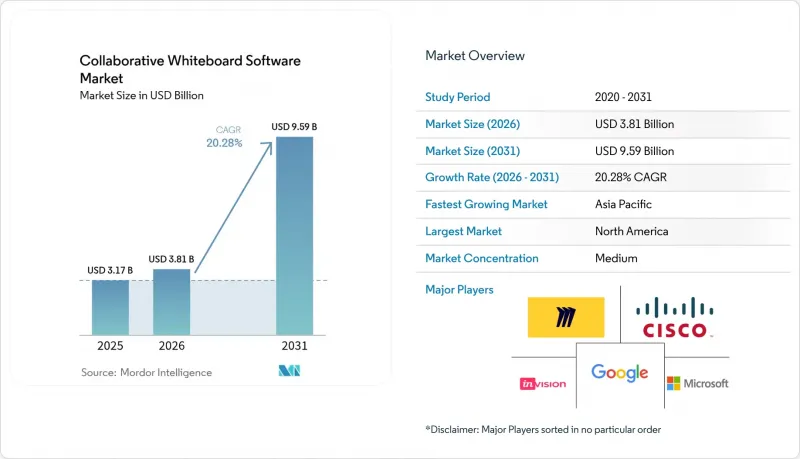
에 의하면, 협업 화이트 보드 소프트웨어 시장 규모는 2025년에 31억 7,000만 달러로 평가되었고, 2026년 38억 1,000만 달러에서 2031년까지 95억 9,000만 달러에 이를 것으로 예측되며, 예측 기간(2026-2031년) CAGR은 20.28%를 나타낼 전망입니다.
본 보고서는 운영 체제별(Windows, 웹, iOS, Android), 배포 방식별(클라우드 및 온프레미스), 조직 규모별(대기업 및 중소기업), 최종 사용자 산업별(은행, 금융서비스 및 보험(BFSI), 헬스케어, 교육, IT 및 통신, 기타), 지역별로 분류되어 있습니다. 시장 예측은 금액(달러) 기준으로 제시되어 있습니다.
세계의 협업 화이트보드 소프트웨어 시장 동향 및 인사이트
원격 근무 및 하이브리드 근무의 정착
기업 조사에 따르면, 2025년에는 교육 종사자의 80%가 기술을 통해 자신의 역할이 간소화될 것이라고 생각하고 있는 것으로 나타났으며, 이는 2023년의 63%에서 증가한 수치입니다. 따라서 하이브리드 근무 방식이 정착됨에 따라 조달 정책은 단기적인 대응책에서 동기식 아이디어 창출과 비동기식 후속 조치를 융합하는 전략적 플랫폼으로 전환되고 있습니다. 시간대를 초월하여 시각적 맥락이 유지됨으로써 프로젝트상의 마찰이 완화되고, 보다 장기적인 조직 전체의 라이선싱 계약이 촉진되고 있습니다. 그 결과, 협업형 화이트보드 소프트웨어 시장은 핵심 생산성 스택을 뒷받침하며, 정부 계약업체 및 규제 산업이 요구하는 제로 트러스트(Zero Trust)에 부합하는 보안 체계를 지원하고 있습니다.
클라우드 네이티브 SaaS 생태계의 확대
마이크로소프트의 클라우드 매출은 2025 회계연도 4분기에 전년 동기 대비 27% 증가한 467억 달러를 기록하며, 내장형 협업 서비스를 뒷받침하는 인프라의 역량을 여실히 보여주었습니다. 각 벤더는 오픈 API와 마이크로서비스를 활용하여 화이트보드를 프로젝트, CRM, ERP 워크플로우에 직접 통합함으로써, 브레인스토밍의 결과를 실행 가능한 산출물로 전환하고 있습니다. 도입 장벽이 낮아지면서 중소기업에서의 보급이 촉진되는 한편, 지속적 배포 파이프라인을 통해 제공업체는 클라이언트 측 업그레이드 없이도 AI 템플릿이나 반복적인 분석과 같은 기능을 배포할 수 있게 되었습니다. 그 결과, 클라우드 연동은 경쟁상의 필수 요건일 뿐만 아니라 협업용 화이트보드 소프트웨어 시장의 주요 성장 가속 요인으로 자리 잡았습니다.
데이터 개인정보 보호 및 규정 준수 관련 우려
GDPR(EU 개인정보보호규정), FedRAMP, HIPAA 규정에 따라 보호 대상 데이터를 다루는 산업에서는 판매 주기가 12-18개월 연장되고 있습니다. 지역 내 데이터 저장, 암호화, 침투 테스트 증명에 관한 요건은 벤더의 운영 비용을 상승시키고 있습니다. Bluescape의 FedRAMP ‘Moderate’ 인증 등 완전한 인증을 획득한 공급업체는 국방 분야 및 공공 부문 고객을 대상으로 즉시 차별화 요소로서 우위를 점하고 있지만, 벤더들이 보안 체계를 정비하는 동안 협업형 화이트보드 소프트웨어 시장 전체는 일시적으로 둔화되고 있습니다.
부문 분석
Windows/웹 운영 환경에 기반한 협업용 화이트보드 소프트웨어 시장 규모는 2025년에 19억 7,000만 달러에 달하여 시장 점유율의 62.05%를 차지했습니다. 그러나 안드로이드 플랫폼은 기기에 구애받지 않는 협업으로의 인력 이동을 반영하여 2031년까지 연평균 성장률(CAGR) 21.55%를 나타낼 것으로 예측됩니다. 안드로이드의 성장은 Google Workspace와의 긴밀한 연동과 현장 팀 및 신흥 시장 사용자에게 적합한 가성비 높은 하드웨어에 힘입고 있습니다. 또한, 태블릿이 이동 중 아이디어 창출에 유용함이 입증된 경영진층에서도 iOS 채택이 증가하고 있습니다.
기존 데스크톱 환경의 레거시 기업 소프트웨어와의 통합으로 인해 Windows/웹의 우위는 유지되고 있지만, 터치스크린의 진화와 AI 기반 차트 작성 기능의 등장으로 생산성 격차는 점차 줄어들고 있습니다. EMM(Enterprise Mobility Management)과 같은 모바일 보안 프레임워크는 현재 데스크톱과 동등한 제어 기능을 갖추게 되어, 스마트폰 및 태블릿 사용을 더욱 촉진하고 있습니다. 그 결과, 화면 크기에 관계없이 동등한 기능을 제공하는 공급업체가 협업용 화이트보드 소프트웨어 시장에서 타사를 압도하는 성장을 이룰 것으로 예측됩니다.
2025년에는 클라우드 도입이 협업용 화이트보드 소프트웨어 시장 점유율의 71.05%를 차지했으며, 22억 5,000만 달러의 매출 규모에 도달했습니다. 연평균 성장률(CAGR) 29.45%라는 전망에 힘입어 SaaS 모델은 자동 확장, 지속적인 기능 제공, 총 소유 비용(TCO) 절감 측면에서 매력적입니다. 은행 및 국방 분야에서는 여전히 온프레미스 도입이 이어지고 있지만, 이러한 산업조차도 퍼블릭 클라우드의 협업상 이점을 유지하면서 기밀 데이터를 프라이빗 클라우드로 분리하는 하이브리드 아키텍처로 전환하고 있습니다.
2025년에 마이크로소프트(Microsoft) 등 하이퍼스케일 제공업체들이 242억 달러를 투자할 예정이라는 점은 클라우드 애플리케이션를 뒷받침하는 인프라 경쟁이 치열함을 여실히 보여줍니다. 고가용성을 갖춘 전 세계 PoP(Point of Presence) 및 통합된 가시성 도구와 같은 기능은 성능과 거버넌스를 향상시킵니다. 그 결과, 클라우드 네이티브 지향은 협업형 화이트보드 소프트웨어 시장에서 경쟁력과 회복탄력성의 기반으로 계속 자리 잡고 있습니다.
지역별 분석
2025년, 북미는 협업용 화이트보드 소프트웨어 시장에서 37.40%의 점유율을 차지하며 가장 높은 매출을 기록했습니다. 이는 성숙한 SaaS 지출 패턴과 정착된 하이브리드 근무 문화를 반영한 결과입니다. 제로 트러스트 의무화로 인해, 특히 항공우주 및 방위 관련 계약업체를 중심으로 FedRAMP 또는 DoD 임팩트 레벨 4 인증을 획득한 플랫폼에 대한 수요가 증가하고 있습니다. 기존 기업 시장의 포화 상태로 인해, 벤더들은 계약 갱신을 통한 성장을 유지하기 위해 틈새 산업용 모듈 및 고도화된 AI 기능 개발에 주력하고 있습니다.
아시아태평양은 모바일 우선 업무 방식, 급증하는 교육 기술(EdTech) 투자, 인도, 인도네시아, 베트남의 정부 주도 디지털 프로그램의 뒷받침을 받아 2031년까지 연평균 성장률(CAGR) 21.05%를 기록할 전망입니다. 스마트폰의 보급과 5G의 확산으로 접근 장벽은 낮아지고 있지만, 통신 사업자는 통신 불안정성 및 다국어 UI 지원에 대응하기 위한 최적화가 요구됩니다. 따라서 협업형 화이트보드 소프트웨어 시장에서는 모바일용으로 최적화된 아키텍처와 지역에 따른 가격 책정이 높이 평가받고 있습니다.
유럽에서는 GDPR(EU 개인정보보호규정)(일반 데이터 보호 규정)에 따른 데이터 주권 의무가 시장 확산을 저해하고 있으며, 벤더가 투명한 데이터 처리를 보장하지 못하는 한 도입 주기가 장기화되고 AI 기능이 제한될 것입니다. 프랑스와 독일의 국가 차원 클라우드 이니셔티브는 현지 호스팅 제휴 기회를 창출하고 있습니다. 한편, 중동 및 아프리카와 남미에서는 인프라 업그레이드와 하이브리드 근무 방식의 확산 여부에 따라 장기적인 성장 여지가 예상됩니다.
기타 혜택
- 엑셀 형식 시장 예측(ME) 시트
- 3개월간 애널리스트 지원
자주 묻는 질문
목차
제1장 서론
제2장 조사 방법
제3장 주요 요약
제4장 시장 구도
제5장 시장 규모 및 성장 예측
제6장 경쟁 구도
제7장 시장 기회 및 향후 전망
AJY 26.09.11According to Mordor Intelligence, the collaborative whiteboard software market size was valued at USD 3.17 billion in 2025 and estimated to grow from USD 3.81 billion in 2026 to reach USD 9.59 billion by 2031, at a CAGR of 20.28% during the forecast period (2026-2031).
This report is Segmented by Operating System (Windows and Web, IOS, and Android), Deployment Mode (Cloud and On-Premises), Organization Size (Large Enterprises and Small and Medium Enterprises), End-User Vertical (BFSI, Healthcare, Education, IT and Telecommunications, and More), and Geography. The Market Forecasts are Provided in Terms of Value (USD).
Global Collaborative Whiteboard Software Market Trends and Insights
Remote and Hybrid Work Becoming Permanent
Enterprise surveys show that 80% of educators in 2025 believe technology simplifies their roles, up from 63% in 2023. Persistent hybrid arrangements therefore shift procurement from short-term fixes to strategic platforms that merge synchronous ideation with asynchronous follow-ups. Visual context maintained across time zones reduces project friction, prompting longer-term, organization-wide licensing. As a result, the collaborative whiteboard software market underpins core productivity stacks and supports zero-trust-aligned security postures demanded by government contractors and regulated industries.
Expansion of Cloud-Native SaaS Ecosystems
Microsoft's cloud revenue climbed 27% year-over-year to USD 46.7 billion in Q4 FY25, underscoring the infrastructural capacity that powers embedded collaboration services. Vendors leverage open APIs and microservices to slot whiteboards directly into project, CRM, and ERP workflows, turning brainstorming sessions into actionable objects. Reduced implementation friction democratizes adoption among SMEs, while continuous delivery pipelines let providers roll out features such as AI templates and iterative analytics without client-side upgrades. Consequently, cloud alignment is both a competitive necessity and a primary accelerator of the collaborative whiteboard software market.
Data-Privacy and Compliance Concerns
GDPR, FedRAMP, and HIPAA stipulations extend sales cycles by 12-18 months in sectors handling protected data. Requirements for in-region storage, encryption, and penetration-test attestation raise vendor operating costs. Providers achieving full certifications, such as Bluescape's FedRAMP Moderate authorization, enjoy an immediate differentiator among defense and public-sector clients, but the broader collaborative whiteboard software market temporarily slows while vendors retrofit security postures.
Other drivers and restraints analyzed in the detailed report include:
- Growing Integration with UCaaS and Project-Management Suites
- AI-Assisted Facilitation and Automated Summarization
- Low Digital Infrastructure in Africa and South Asia
For complete list of drivers and restraints, kindly check the Table Of Contents.
Segment Analysis
The collaborative whiteboard software market size attributed to Windows/Web operating environments stood at USD 1.97 billion in 2025, translating to 62.05% dominance. Android platforms, however, are expected to post a 21.55% CAGR through 2031, reflecting the workforce shift toward device-agnostic collaboration. Android gains are reinforced by deep Google Workspace hooks and cost-effective hardware that suits field teams and emerging-market users. iOS adoption also rises in executive settings where tablets prove convenient for on-the-go ideation.
Traditional desktop integrations with legacy enterprise software safeguard the leadership of windows/web, yet touchscreen advancements and AI-generated diagramming are shrinking productivity gaps. Mobile security frameworks such as enterprise mobility management now match desktop controls, further propelling smartphone and tablet usage. Consequently, providers that deliver parity across screen sizes will seize disproportionate growth within the collaborative whiteboard software market.
Cloud deployments captured 71.05% of collaborative whiteboard software market share in 2025, equal to a USD 2.25 billion revenue pool. Fueled by 29.45% CAGR expectations, SaaS models appeal through automatic scaling, continuous feature rollout, and lower total cost of ownership. On-premises adoption persists in banking and defense, yet even these verticals gravitate toward hybrid architectures that partition sensitive data into private clouds while retaining public-cloud collaboration advantages.
Capital investments of USD 24.2 billion by hyperscale providers such as Microsoft in 2025 underscore the infrastructure race supporting cloud applications. Features like high-availability global points of presence and integrated observability tools enhance performance and governance. As a result, cloud-native orientation remains the bedrock for competitive resilience within the collaborative whiteboard software market.
Complete Report Scope:
- By Operating System
- Windows and Web
- iOS
- Android
- By Deployment Mode
- Cloud
- On-premise
- By Organization Size
- Large Enterprises
- Small and Medium Enterprises
- By End-user Vertical
- BFSI
- Healthcare
- Education
- IT and Telecommunications
- Other End-user Verticals
- By Geography
- North America
- South America
- Europe
- Asia-Pacific
- Middle East and Africa
Geography Analysis
North America generated the highest revenue at 37.40% collaborative whiteboard software market share in 2025, reflecting mature SaaS spending patterns and entrenched hybrid work cultures. Zero-trust mandates spur demand for platforms boasting FedRAMP or DoD Impact Level 4 credentials, particularly among aerospace and defense contractors. Saturation in traditional enterprise pockets propels vendors toward niche-vertical modules and advanced AI features to sustain renewal growth.
Asia-Pacific is on pace for a 21.05% CAGR through 2031, propelled by mobile-first workstyles, surging ed-tech investments, and government-backed digital programs across India, Indonesia, and Vietnam. Smartphone penetration and 5G rollouts lower access barriers, though providers must optimize for intermittent connectivity and multilanguage UI support. The collaborative whiteboard software market therefore rewards mobile-optimized architectures and region-specific pricing.
Europe's steady adoption is moderated by GDPR data-sovereignty obligations that lengthen deployment cycles and limit AI functionality unless vendors can guarantee transparent data-handling. National cloud initiatives in France and Germany create opportunities for local hosting partnerships. Meanwhile, Middle East and Africa and South America represent long-term upside contingent on infrastructure upgrades and increased hybrid work prevalence.
- Miro, Inc.
- Microsoft Corporation
- Zoom Video Communications, Inc.
- Lucid Software Inc.
- Mural, Inc.
- Cisco Systems, Inc.
- Google LLC
- InVisionApp Inc.
- Bluescape Software, Inc.
- Stormboard Inc.
- Limnu Corporation
- Conceptboard GmbH
- Collaboard AG
- FigJam - Figma, Inc.
- Beecanvas Inc.
- Explain Everything Inc.
- Klaxoon SAS
- Padlet Pte Ltd.
- ClickUp Global Inc. (Whiteboards)
- TeamViewer SE (Frontline Spatial)
- Autodesk, Inc. (Flox)
Additional Benefits:
- The market estimate (ME) sheet in Excel format
- 3 months of analyst support
TABLE OF CONTENTS
1 INTRODUCTION
- 1.1 Study Assumptions and Market Definition
- 1.2 Scope of the Study
2 RESEARCH METHODOLOGY
3 EXECUTIVE SUMMARY
4 MARKET LANDSCAPE
- 4.1 Market Overview
- 4.2 Market Drivers
- 4.2.1 Remote and hybrid work becoming permanent
- 4.2.2 Expansion of cloud-native SaaS ecosystems
- 4.2.3 Growing integration with UCaaS and project-management suites
- 4.2.4 AI-assisted facilitation and automated board summarization
- 4.2.5 Zero-trust whiteboarding demand in classified / defense sectors
- 4.2.6 Vendor monetisation of template marketplaces and plug-in economies
- 4.3 Market Restraints
- 4.3.1 Data-privacy and compliance concerns (GDPR, FedRAMP, HIPAA)
- 4.3.2 Low digital infrastructure in parts of Africa and South Asia
- 4.3.3 "Good-enough" free whiteboards bundled with UC platforms
- 4.3.4 Canvas-sprawl creating governance and knowledge-management headaches
- 4.4 Industry Value Chain Analysis
- 4.5 Regulatory Landscape
- 4.6 Technological Outlook
- 4.7 Porter's Five Forces Analysis
- 4.7.1 Bargaining Power of Suppliers
- 4.7.2 Bargaining Power of Buyers
- 4.7.3 Threat of New Entrants
- 4.7.4 Threat of Substitutes
- 4.7.5 Intensity of Competitive Rivalry
5 MARKET SIZE AND GROWTH FORECASTS (VALUE)
- 5.1 By Operating System
- 5.1.1 Windows and Web
- 5.1.2 iOS
- 5.1.3 Android
- 5.2 By Deployment Mode
- 5.2.1 Cloud
- 5.2.2 On-premise
- 5.3 By Organization Size
- 5.3.1 Large Enterprises
- 5.3.2 Small and Medium Enterprises
- 5.4 By End-user Vertical
- 5.4.1 BFSI
- 5.4.2 Healthcare
- 5.4.3 Education
- 5.4.4 IT and Telecommunications
- 5.4.5 Other End-user Verticals
- 5.5 By Geography
- 5.5.1 North America
- 5.5.2 South America
- 5.5.3 Europe
- 5.5.4 Asia-Pacific
- 5.5.5 Middle East and Africa
6 COMPETITIVE LANDSCAPE
- 6.1 Market Concentration
- 6.2 Strategic Moves
- 6.3 Market Share Analysis
- 6.4 Company Profiles (includes Global level Overview, Market level overview, Core Segments, Financials as available, Strategic Information, Market Rank/Share for key companies, Products and Services, and Recent Developments)
- 6.4.1 Miro, Inc.
- 6.4.2 Microsoft Corporation
- 6.4.3 Zoom Video Communications, Inc.
- 6.4.4 Lucid Software Inc.
- 6.4.5 Mural, Inc.
- 6.4.6 Cisco Systems, Inc.
- 6.4.7 Google LLC
- 6.4.8 InVisionApp Inc.
- 6.4.9 Bluescape Software, Inc.
- 6.4.10 Stormboard Inc.
- 6.4.11 Limnu Corporation
- 6.4.12 Conceptboard GmbH
- 6.4.13 Collaboard AG
- 6.4.14 FigJam - Figma, Inc.
- 6.4.15 Beecanvas Inc.
- 6.4.16 Explain Everything Inc.
- 6.4.17 Klaxoon SAS
- 6.4.18 Padlet Pte Ltd.
- 6.4.19 ClickUp Global Inc. (Whiteboards)
- 6.4.20 TeamViewer SE (Frontline Spatial)
- 6.4.21 Autodesk, Inc. (Flox)
7 MARKET OPPORTUNITIES AND FUTURE OUTLOOK
- 7.1 White-space and Unmet-need Assessment


